
Introduction
If you’re looking for a smarter way to automate prospecting, qualify leads faster, and turn go-to-market data into action, this Alta AI review will help you understand where the platform fits in a modern sales stack.
Alta AI, also known as Alta HQ, is an AI-powered GTM platform built around specialized revenue agents. Instead of giving you one generic AI assistant, Alta gives you purpose-built agents that support different parts of the revenue workflow, including outbound prospecting, inbound qualification, meeting booking, campaign analysis, and growth insights.
The platform is especially relevant for B2B sales teams that want to reduce manual prospect research, personalize outreach at scale, and respond to high-intent leads faster. Alta’s main value is not just automation. It is the ability to connect research, signals, outreach, and revenue intelligence into one coordinated workflow.
That makes it different from traditional sales engagement platforms, which often focus mainly on sequencing, email sending, or CRM activity tracking. Alta is closer to an AI revenue workforce that helps your team move from strategy to execution with less manual work.
In this updated review for 2026, you’ll see how Alta works, what Katie, Luna, and Alex actually do, where the platform stands out, where it may be limited, and whether it is the right fit for your sales team.
AI GTM Platform
What Is Alta AI?
Alta AI is an AI GTM system built to help revenue teams automate the repetitive but critical work that usually slows down sales execution. This includes prospect research, lead qualification, personalized outreach, follow-up management, meeting booking, and campaign performance analysis.
According to Alta, its AI agents are designed to handle outbound, inbound, and revenue intelligence workflows. The company launched from stealth after raising a $7 million seed round, positioning itself as an AI revenue workforce platform for sales, marketing, and RevOps teams.
For buyers, the important point is simple: Alta is not only a cold email tool. It is not only a lead database. It is a platform built around role-specific AI agents that work across the sales funnel.
That makes Alta most useful when your team wants to:
- Build targeted lead lists faster
- Research accounts without manual digging
- Personalize outreach at scale
- Qualify inbound leads more consistently
- Book meetings without slow response times
- Analyze what is working across campaigns
Software Specification
Alta AI Key Features
Alta AI brings prospecting, enrichment, outreach, inbound qualification, and revenue intelligence into one connected workflow. Instead of forcing your team to jump between sales intelligence tools, sequencing platforms, spreadsheets, and CRM reports, Alta uses Katie, Luna, and Alex to automate different parts of the GTM motion.
AI-Powered List Building
Alta’s list-building capabilities help you move from a broad market idea to a focused prospect list faster. Rather than manually searching databases and exporting contacts into spreadsheets, you can define your ICP and let Katie identify relevant accounts and contacts.
You can segment prospects using criteria such as:
- Company size
- Industry
- Location
- Role or seniority
- Technographic signals
- Funding and growth indicators
This is valuable because better outbound starts with better targeting. If your list is too broad, your messaging becomes generic. If your list is tightly aligned with your ICP, your personalization and conversion rates are likely to improve.
Buyer Intent and Signal-Based Targeting
Alta AI helps you prioritize leads based on signals, not only static firmographic data. This matters because a company can match your ICP perfectly but still have no active buying need.
With signal-based targeting, your team can focus on accounts that show stronger signs of readiness, such as growth activity, hiring patterns, technology changes, or other relevant business triggers.
For outbound sales, this creates a more practical workflow. Instead of asking, “Who could buy from us?” your team can ask, “Who looks like they may need us now?”
Smart Outreach Automation
Alta includes outreach automation that helps sales teams run personalized sequences without relying on separate tools for every step. Katie can support messaging, follow-ups, and engagement workflows, while Alex can support qualification and booking when calling or inbound engagement is part of the motion.
Core outreach capabilities may include:
- Personalized email generation
- Multi-step follow-up workflows
- Lead prioritization
- Meeting booking workflows
- CRM activity syncing
The main benefit is that outreach becomes more connected to research and qualification. Your messaging can be informed by the same signals used to build the list.
Campaign Analytics and Reporting
Alta HQ also includes performance insights that help you evaluate campaigns, lead sources, and conversion impact. This is where Luna becomes particularly important.
Instead of waiting for a RevOps team to manually prepare reports, Luna can help surface useful performance signals such as:
- Cost per lead and cost per acquisition trends
- Channel and lead source performance
- Pipeline movement
- Campaign conversion impact
- Areas where outreach or qualification can improve
This gives sales and growth teams a better feedback loop. You can test campaigns, measure performance, and adjust the next workflow faster.
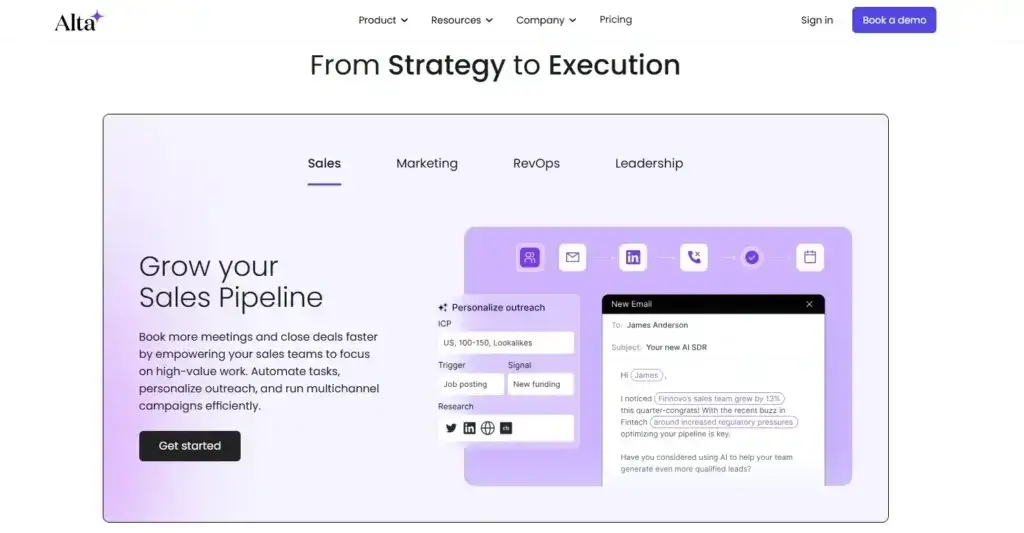
Katie, Luna and Alex
How Alta AI’s Agents Work Together
Alta’s strongest advantage is the way Katie, Luna, and Alex support different parts of the revenue workflow. Many AI sales tools automate one narrow task, such as writing emails or enriching records. Alta is designed to connect multiple GTM motions through specialized agents.
| Alta Agent | Main Role | Best Use Case |
| Katie | AI SDR Agent | Outbound prospecting, account research, lead list building, and personalized outreach. |
| Luna | AI Growth Agent | Revenue insights, campaign analysis, pipeline visibility, and GTM optimization. |
| Alex | AI Calling Agent | Inbound qualification, follow-up conversations, meeting booking, and lead routing. |
This agent-based structure is important because each workflow feeds the next. Katie can help create and engage the pipeline. Alex can help qualify and schedule conversations. Luna can help analyze the results and suggest where to improve.
In practical terms, Alta works best when you want AI to support the full revenue motion, not just one isolated task.
Katie – AI SDR Agent for Prospecting and Outreach
Katie is Alta’s AI SDR Agent. She is built to support top-of-funnel sales development by finding prospects, researching accounts, detecting buying signals, and running personalized outreach.
Katie is especially useful when your SDR team needs to build pipeline but does not have enough time to manually research every account. She can help identify prospects based on your ICP, enrich records with relevant context, and generate messaging that feels more relevant than basic mail merge personalization.
She helps you:
- Build lead lists using ICP filters and live enrichment
- Research companies, contacts, and buying signals
- Personalize outbound emails using account-level context
- Run follow-ups without relying on manual reminders
- Prioritize accounts based on fit and timing
Katie is a strong fit for SDR teams, founders, and agencies that want to increase outbound activity without adding more manual research work.
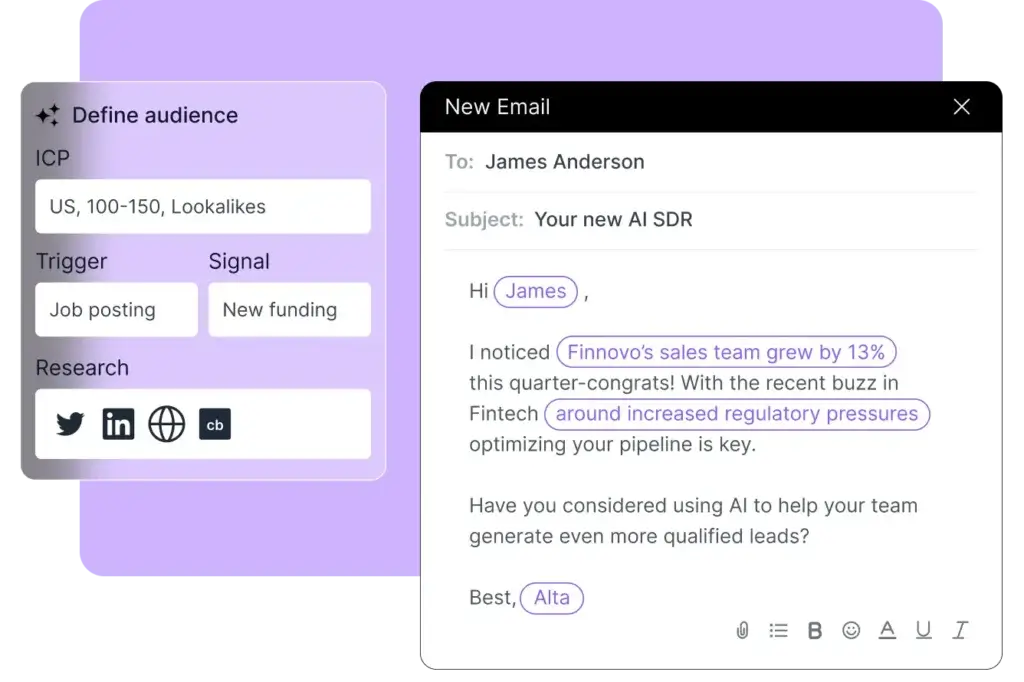
Luna – AI Growth Agent for Revenue Intelligence
Luna is Alta’s AI Growth Agent. She focuses on the analysis, orchestration, and optimization side of the go-to-market workflow.
Where Katie helps generate pipeline, Luna helps you understand what is happening across that pipeline. She is designed to connect GTM data, surface performance trends, and help revenue teams make better decisions without relying only on manual reporting.
Luna can support:
- Campaign performance reporting
- Pipeline and funnel analysis
- Revenue insights across outreach channels
- Recommendations for improving conversion rates
- Visibility into what is working and what needs adjustment
For sales leaders and RevOps teams, Luna is one of Alta’s most important differentiators because she connects execution with performance insights.
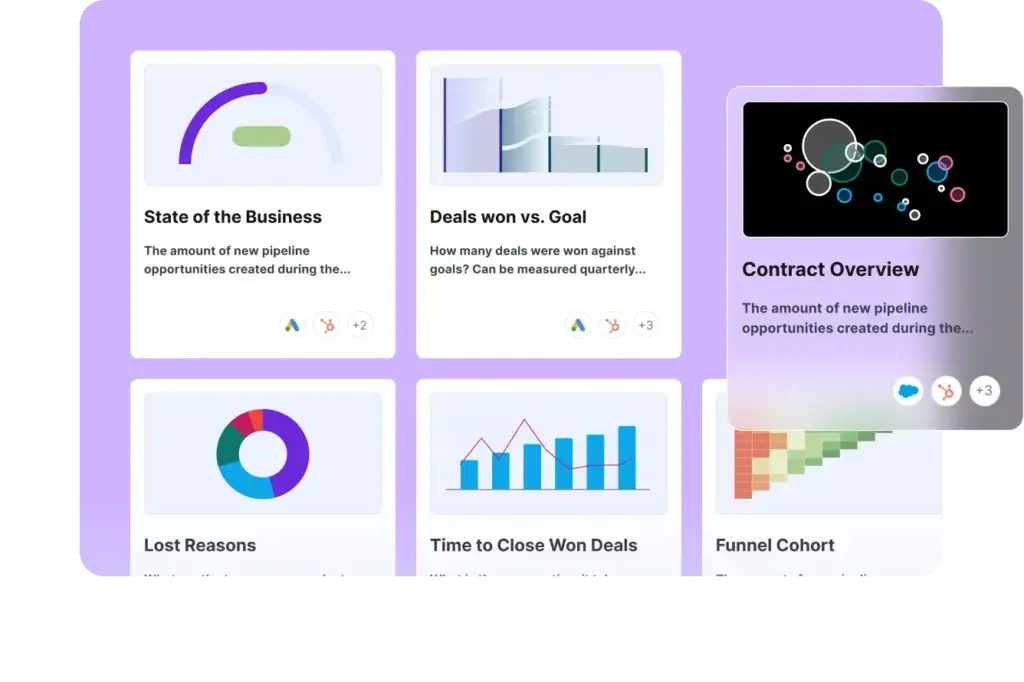
Alex – AI Calling Agent for Lead Qualification
Alex is Alta’s AI Calling Agent, built to support inbound qualification, follow-up conversations, and meeting booking. This is particularly useful when your team receives inbound interest but struggles to respond quickly, qualify every lead, or keep the calendar full.
Speed matters in inbound sales. If a lead submits a form and waits hours for a reply, conversion rates can drop quickly. Alex helps reduce that gap by handling early-stage qualification and scheduling workflows automatically.
Alex can help you:
- Engage inbound leads faster
- Ask qualification questions before routing leads
- Schedule meetings directly on calendars
- Sync activity with connected sales tools
- Reduce manual follow-up work for reps
Alex is best suited for teams that already generate inbound demand and want to improve speed-to-lead, qualification consistency, and meeting conversion.

Benefits
Top Benefits and Features of Alta AI
Alta AI is built for teams that want to increase sales output without increasing manual workload. Its key benefit is that it reduces the repetitive tasks that typically slow down SDRs, account executives, RevOps teams, and growth teams.
Faster Prospecting and Research
Katie helps reduce the time spent building lists and researching accounts. This is valuable for teams that need consistent pipeline generation but do not want reps spending most of the day inside LinkedIn, spreadsheets, and enrichment tools.
Better Lead Prioritization
Alta helps your team prioritize based on fit and signals. Instead of treating every lead the same, your sales workflow can focus more attention on accounts that look relevant, timely, and more likely to convert.
More Personalized Outreach
Personalized outreach is usually difficult to scale because it requires research. Alta helps close that gap by using account context and signals to support more relevant messaging.
Faster Inbound Response
Alex can help teams respond to inbound leads faster, qualify them, and book meetings. This is especially useful for teams that generate demo requests, contact form submissions, or campaign-driven inbound traffic.
Stronger Revenue Visibility
Luna helps transform performance data into clearer insights. Instead of looking only at open rates or lead counts, teams can get a better understanding of which campaigns, channels, and messages contribute to pipeline.
Lean Team Scalability
Alta is particularly useful for lean sales teams that want to scale GTM execution without hiring a large SDR or RevOps team immediately. It can help smaller teams operate with more consistency and speed.
In-Depth Platform Analysis
What Makes Alta AI Effective?
Alta AI is designed around speed, automation, and GTM coordination. The platform is strongest when you use it as part of a clear revenue workflow, not just as a standalone outreach tool.
User Interface and Experience
Alta’s interface is modern and focused on execution. The platform is built to help teams move between strategy, lead generation, outreach, and reporting without feeling buried in unnecessary settings.
For sales teams, this matters because adoption is often the biggest obstacle with new GTM software. If a tool is too complex, reps avoid it. Alta’s agent-based model can make the experience easier because users interact with Katie, Luna, and Alex based on the job they want done.
Setup and Onboarding
Alta can deliver the most value when the initial setup is done properly. Your team should define the ICP, connect relevant systems, clarify outreach rules, and align the agents with your GTM goals.
Before using Alta, it is worth preparing:
- Your ideal customer profile
- Target markets and exclusions
- CRM fields and pipeline stages
- Messaging guidelines
- Qualification criteria
- Meeting routing rules
The stronger your setup, the better Katie, Luna, and Alex can support your revenue motion.
Integrations and Workflow Fit
Alta is designed to connect with the broader sales stack. The current article already includes integrations such as HubSpot, Salesforce, Pipedrive, Zapier, Slack, Google Calendar, and Gmail.
The practical benefit is that leads, meetings, and insights can flow into the systems your team already uses. This reduces duplicate entry and helps keep CRM data more accurate.
That said, buyers should still confirm the exact integrations they need during the demo. Some advanced workflows may require custom setup, API support, or additional configuration.
Top Traits That Make Alta AI Stand Out
- Agent-based GTM automation: Katie, Luna, and Alex each support a specific sales or growth function.
- Signal-driven prospecting: Alta helps prioritize accounts based on relevant business triggers.
- Inbound and outbound coverage: The platform supports both prospecting and lead qualification workflows.
- Revenue intelligence layer: Luna adds performance visibility beyond basic email metrics.
- Useful for lean teams: Alta can help smaller teams execute more without adding headcount immediately.
Pros and Cons
Advantages and Disadvantages
Positive
✅ Specialized AI agents for GTM teams
✅ Strong fit for outbound and inbound workflows
✅ Signal-based prospecting and personalization
✅ Useful revenue analytics through Luna
Negative
❌ Pricing is not fully transparent
❌ Setup quality affects performance
❌ May be too advanced for very small teams
❌ Less flexible than open-ended workflow tools
Alta AI offers a strong mix of AI automation, sales execution, and GTM intelligence. Still, it is not the right tool for every team. Here is a balanced look at its main strengths and limitations.
Pros
- Specialized AI agents for different revenue roles: Katie, Luna, and Alex each support a clear GTM function instead of acting like a generic AI assistant.
- Strong outbound prospecting capabilities: Katie can help sales teams research accounts, build lists, identify signals, and personalize outreach.
- Inbound qualification support: Alex helps teams respond faster to inbound interest, qualify leads, and book meetings.
- Better performance visibility: Luna gives teams a clearer view of pipeline, campaign performance, and revenue trends.
- Useful for lean sales teams: Alta can help smaller teams scale activity without immediately hiring more SDRs or RevOps support.
- Good fit for B2B sales workflows: The platform is built around GTM execution, not general-purpose automation.
Cons
- Pricing is not fully transparent: Alta does not clearly present simple self-serve pricing in the way some SMB sales tools do.
- Requires proper setup: The platform performs best when your ICP, qualification rules, messaging, and CRM structure are clearly defined.
- May be too much for very small teams: If you only send a small number of emails each month, Alta may be more advanced than you need.
- Less open-ended than Clay: Teams that want highly custom no-code data workflows may still prefer Clay or a more flexible workflow builder.
- Newer category: AI GTM agents are evolving quickly, so buyers should evaluate agent quality, control, and reporting before committing.
Pricing
Alta AI Pricing and Plans
Alta AI appears to use a more consultative pricing model rather than a simple public pricing table with fixed monthly tiers. This is common for AI GTM platforms because pricing often depends on the agents you use, your team size, your data volume, your workflow complexity, and the level of support required.
Because of that, the safest approach is to treat Alta as a quote-based platform and request a demo or pricing conversation before making a buying decision.
| Pricing Factor | What It May Affect | What to Ask Alta |
| Selected agents | Whether you use Katie, Luna, Alex, or a combination of agents | Are agents priced separately or bundled together? |
| Team size | Number of users, seats, managers, and workflows | Is pricing based on seats, usage, or company plan? |
| Outreach volume | Email, call, lead, and meeting booking activity | Are there limits on leads, messages, calls, or booked meetings? |
| Data and integrations | CRM sync, enrichment, routing, and reporting workflows | Which integrations are included, and which require custom setup? |
| Support needs | Implementation, onboarding, optimization, and reporting | Is onboarding included, or is it priced separately? |
Which Teams Get the Best Value?
Alta will usually make the most sense when your team has enough outbound or inbound volume to justify AI automation. If your reps spend hours researching accounts, manually qualifying leads, or preparing reports, Alta can create meaningful time savings.
It may be less cost-effective for very small teams that only run occasional outreach or do not yet have a repeatable sales process.
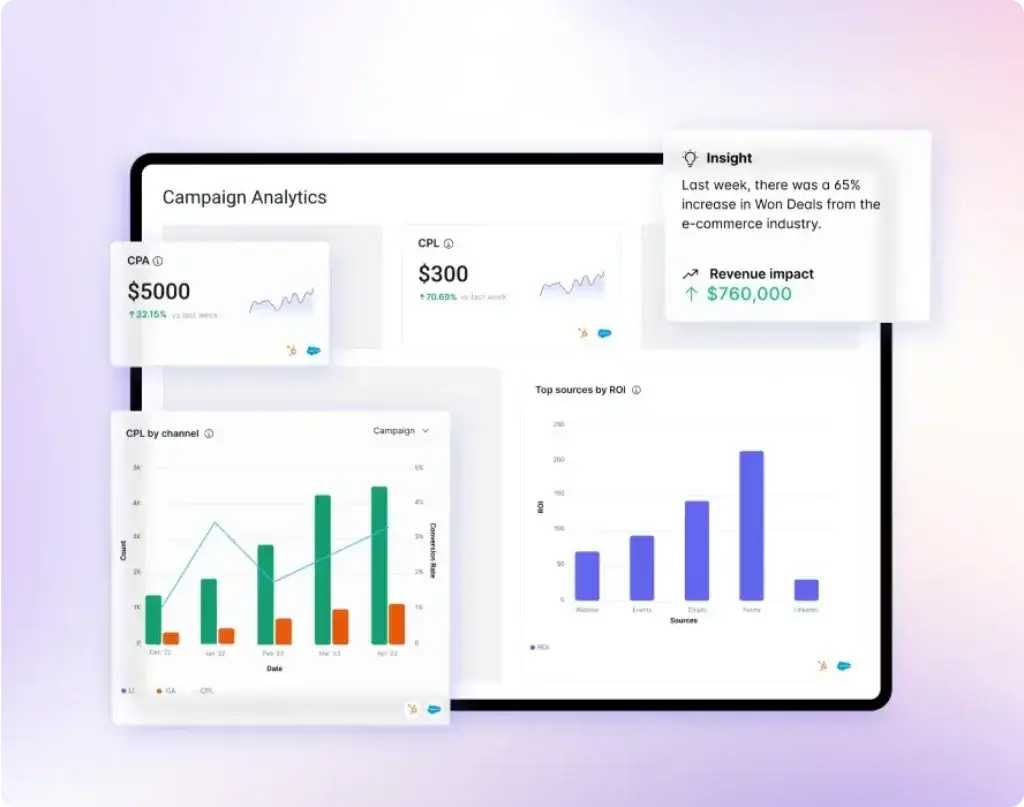
Comparison
Alta AI vs Alternatives
Alta AI competes with several types of sales tools. Some focus on lead databases, others on email sending, CRM workflows, or flexible data enrichment. Alta’s differentiator is its agent-based GTM automation model.
| Tool | Best For | Where Alta AI Is Stronger | Where the Alternative May Be Stronger |
| Alta AI | AI GTM automation across prospecting, inbound qualification, and growth insights | Specialized agents for different revenue workflows | Less transparent public pricing |
| Clay | Flexible enrichment workflows and custom data automation | Easier agent-led sales execution for teams that want less manual workflow building | More flexible no-code data workflows |
| Instantly | Cold email sending, inbox scaling, and campaign volume | Broader GTM support beyond cold email | Stronger focus on email infrastructure and sending at scale |
| Apollo | Sales database, prospecting, and engagement in one platform | More agent-driven workflow automation | Larger traditional sales database and familiar sales engagement workflows |
| Smartlead | Email deliverability and cold outreach infrastructure | More complete agent-based GTM workflow | Deeper cold email infrastructure for high-volume senders |
If your main need is high-volume cold email infrastructure, a tool like Instantly or Smartlead may be more focused. If your main need is flexible data workflows, Clay may be a better fit.
However, if you want a more guided AI system that helps with prospecting, qualification, meeting booking, and revenue insights, Alta AI is one of the more interesting options to evaluate.
Use Cases
Who Is Alta AI Best For?
Alta AI is best suited for B2B teams that already understand their target market and want to scale execution. It is not just for teams that want more leads. It is for teams that want more structured, automated, and measurable GTM workflows.
Alta AI Is a Strong Fit For:
- B2B SaaS sales teams that need more consistent outbound pipeline
- SDR and BDR teams that spend too much time on manual research
- RevOps teams that want better visibility into performance and conversion
- Founders who need to scale early outbound without hiring too quickly
- Agencies that manage prospecting or lead generation for multiple clients
- Inbound sales teams that need faster qualification and meeting booking
Alta AI May Not Be the Best Fit For:
- Teams without a clear ICP
- Businesses with very low sales volume
- Companies looking only for a simple email sender
- Teams that prefer fully manual control over every workflow
- Users who need public self-serve pricing before booking a demo
Security and Compliance
Protecting Your Data
Security and compliance matter when using any AI sales platform, especially one that connects to CRM data, customer interactions, lead records, calendars, and outreach systems.
Alta has a dedicated trust and security presence on its website, but buyers should still ask detailed questions during the demo process. This is especially important if your company operates in regulated markets or handles sensitive customer data.
Questions worth asking include:
- What data does Alta access inside your CRM?
- How are permissions and user roles managed?
- How does Alta handle data retention and deletion?
- Which integrations use token-based authentication?
- How are AI-generated messages reviewed or controlled?
- What compliance documentation is available for customers?
From a practical standpoint, Alta’s security story should be evaluated like any other connected revenue platform. Make sure your team reviews permissions, data flows, and governance before rolling it out across sales workflows.
Conclusion
Is Alta AI Worth It for Sales Teams?
⭐ Overall Rating: 9.4/10
Alta AI is worth evaluating if your sales team wants to automate more of the GTM workflow without stitching together too many disconnected tools.
Its biggest strength is the agent-based model. Katie helps with outbound prospecting and outreach. Alex helps with qualification and meeting booking. Luna helps with growth insights and revenue visibility. Together, they create a more connected system for teams that want to move faster from strategy to execution.
Alta is especially compelling for B2B teams with clear ICPs, meaningful lead volume, and a need to reduce manual research, follow-up, and reporting. It can also be valuable for agencies or lean sales teams that want to scale activity without immediately expanding headcount.
However, it is not the best fit for every buyer. If you only need basic cold email sending, there are simpler tools. If you need maximum workflow flexibility, Clay-style systems may offer more control. And if public pricing is a must, Alta may require an extra step because you will likely need to speak with the team directly.
Overall, Alta AI stands out as a strong AI GTM platform for teams that want a more intelligent way to build pipeline, qualify leads, and understand what is driving revenue.
Have more questions?
Frequently Asked Questions
What is Alta AI?
Alta AI is an AI-powered GTM platform that helps sales and revenue teams automate prospecting, inbound qualification, meeting booking, outreach, and revenue insights through specialized AI agents.
What does Katie do in Alta AI?
Katie is Alta’s AI SDR Agent. She helps with outbound prospecting, account research, lead list building, personalized outreach, and follow-up workflows.
What does Luna do in Alta AI?
Luna is Alta’s AI Growth Agent. She helps revenue teams analyze GTM performance, understand pipeline activity, surface campaign insights, and identify optimization opportunities.
What does Alex do in Alta AI?
Alex is Alta’s AI Calling Agent. He supports inbound qualification, follow-up conversations, meeting booking, and lead routing so teams can respond to prospects faster.
Is Alta AI an AI SDR tool?
Yes, Alta AI includes AI SDR functionality through Katie. However, Alta is broader than a standard AI SDR tool because it also includes Alex for qualification and Luna for growth insights.
Does Alta AI replace human sales reps?
No. Alta is best viewed as a way to augment sales reps, not replace them. It handles repetitive research, outreach, qualification, and reporting tasks so humans can focus on conversations, relationships, and closing deals.
Does Alta AI publish pricing?
Alta does not appear to provide a simple fixed public pricing table for all plans. Pricing may depend on selected agents, team size, usage volume, integrations, and onboarding needs, so buyers should request a quote directly.
Who is Alta AI best for?
Alta AI is best for B2B SaaS teams, SDR teams, RevOps teams, founders, and agencies that want to automate prospecting, qualification, meeting booking, and GTM reporting.
Is Alta AI better than Clay?
Alta AI is better if you want agent-led GTM execution across outbound, inbound, and growth insights. Clay may be better if you need highly flexible no-code data enrichment workflows and more control over custom automation logic.
Does Alta AI integrate with CRM tools?
Alta is designed to work with GTM systems such as CRMs, calendars, email tools, and workflow platforms. Buyers should confirm the exact integrations they need during the demo process.