
Introduction
HubSpot CRM is one of the most popular CRM platforms for businesses that want to manage contacts, track deals, automate follow-ups, and connect sales, marketing, and service teams in one place.
What makes it especially attractive is its balance between simplicity and depth. You can start with free CRM tools, then expand into more advanced features through Sales Hub, Marketing Hub, Service Hub, Operations Hub, Content Hub, Commerce Hub, and HubSpot’s broader customer platform.
In this HubSpot CRM review, we’ll look at where the platform performs best, where it may become expensive, and which types of businesses will get the most value from it.
- HubSpot CRM features and automation tools
- Pricing, free plan limits, and possible hidden costs
- HubSpot Breeze AI and how it supports teams
- Pros, cons, user experience, and support
- Best use cases for small businesses, mid-sized teams, and enterprises
If you are still comparing CRM options, you can also review our full guide to the best CRM software before making a final decision.
Quick Summary
HubSpot CRM is worth it if you want a CRM that is easy to adopt, strong in marketing and sales alignment, and flexible enough to grow with your team.
It is especially strong for small and mid-sized businesses that want CRM, email marketing, forms, pipelines, reporting, and automation in one connected system. The main drawback is cost. The free tools are useful, but advanced automation, reporting, permissions, and enterprise controls require paid plans.
| Category | HubSpot CRM Review Summary |
| Best For | Small businesses, growing sales teams, inbound marketing teams, and companies that want a connected customer platform |
| Not Ideal For | Teams that need very deep enterprise customization at the lowest possible cost |
| Top Strength | Ease of use combined with strong sales, marketing, service, and automation tools |
| Main Limitation | Pricing can rise quickly as you add paid seats, Hubs, contacts, automation, and advanced reporting |
| Best Alternative to Compare | Salesforce for enterprise customization, Zoho CRM for budget flexibility, and Pipedrive for simple sales pipeline management |
Key Features
HubSpot’s Software Specification
When you evaluate a CRM, features matter. But what matters more is how those features help you manage your pipeline, reduce manual work, and give your team a reliable view of every customer relationship.
HubSpot CRM does this well because it combines contact management, sales tools, marketing automation, reporting, AI, and integrations inside one connected platform.
Contact and Deal Management
HubSpot gives you a central database for contacts, companies, deals, tickets, and activities. You can see emails, calls, notes, meetings, form submissions, and website activity in one timeline.
This is helpful when your team needs context before a sales call or support conversation. Instead of searching through inboxes and spreadsheets, you can see the full relationship history in one record.
- Manage contacts, companies, deals, and tasks
- Track conversations and activity history
- Organize records by lifecycle stage, owner, source, or behavior
Sales Pipeline Management
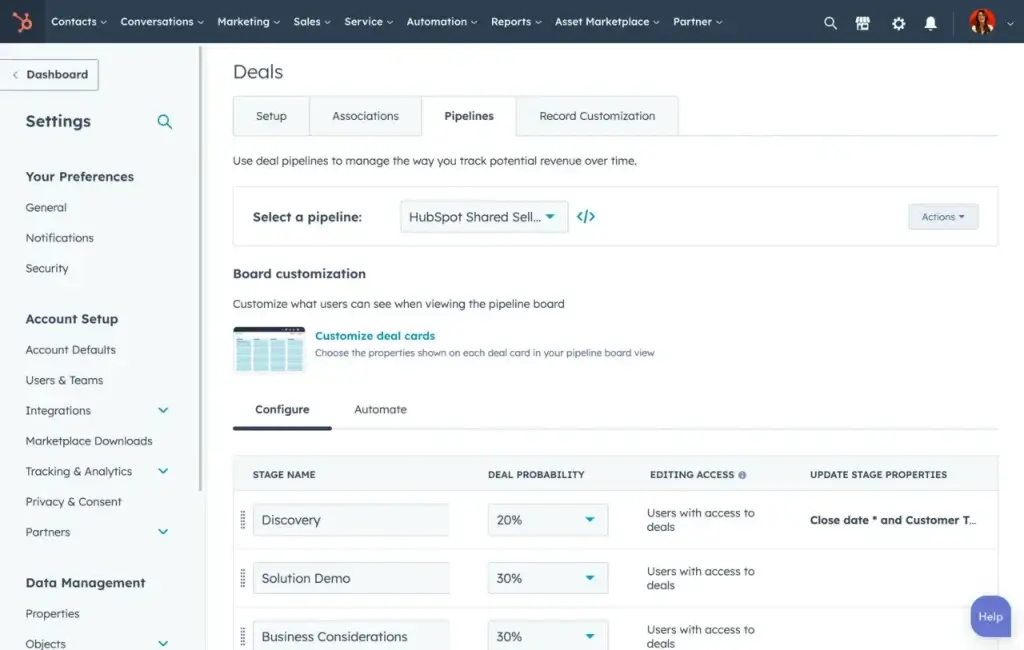
HubSpot’s pipeline tools are simple enough for smaller teams, but flexible enough for growing sales organizations. You can create deal stages, move opportunities visually, assign owners, and track progress from first contact to closed deal.
For managers, the pipeline view helps identify stalled deals, forecast revenue more clearly, and coach reps based on real activity instead of assumptions.
- Create custom deal stages
- Track deal value, probability, and expected close dates
- Use dashboards to monitor rep activity and pipeline health
Marketing and Sales Automation
Automation is one of HubSpot’s biggest advantages, especially when sales and marketing teams need to work together. You can automate lead assignment, email follow-ups, internal notifications, lifecycle updates, and nurture campaigns.
The visual workflow builder is easier to understand than many enterprise CRM automation tools. That makes it more accessible for marketing managers, sales operations teams, and business owners who do not want to depend on developers for every change.
- Automate follow-up emails and lead nurturing
- Route leads based on source, form, territory, or score
- Create internal reminders and task assignments
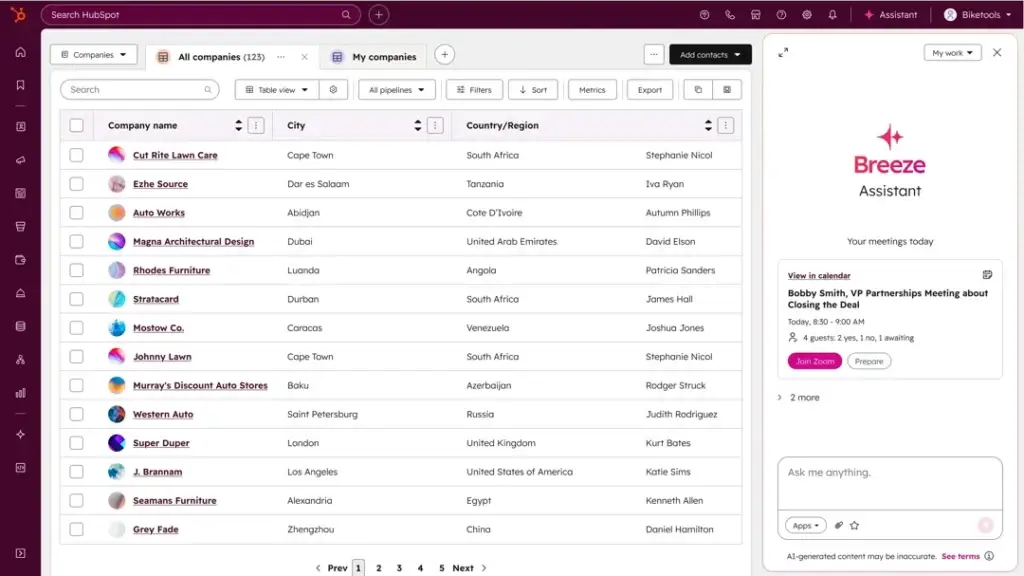
HubSpot Breeze AI
HubSpot has expanded its CRM with Breeze AI, a set of AI tools and agents designed to support marketing, sales, and service workflows. This is one of the most important updates to include in a modern HubSpot CRM review.
Breeze can help teams summarize CRM data, prepare for meetings, create content, qualify leads, research accounts, and automate customer service interactions. The value is not just faster writing. The bigger advantage is that AI works inside the CRM context, where your customer data already lives.
- Breeze Assistant helps with CRM insights, content, and productivity
- Breeze Agents can support prospecting, customer service, and data research
- HubSpot Credits may apply to certain AI-powered tools and usage
Inbound Marketing Tools
HubSpot started as an inbound marketing platform, and that strength still shows. If your business relies on content, landing pages, forms, email campaigns, lead magnets, and lifecycle nurturing, HubSpot gives you a more complete system than many sales-only CRMs.
You can capture leads from forms, segment them based on behavior, nurture them with email, and hand qualified contacts to sales with better context.
- Create landing pages, forms, and email campaigns
- Segment leads by lifecycle stage and activity
- Connect campaign performance with CRM records
Integrations and App Marketplace
HubSpot’s App Marketplace is one of its strongest ecosystem advantages. The platform supports thousands of app connections across email, ecommerce, analytics, advertising, communication, accounting, and workflow automation.
Popular integrations include Gmail, Outlook, Slack, Zoom, Microsoft Teams, Shopify, Stripe, Salesforce, Zapier, and many more. This matters because your CRM should connect to the tools your team already uses, not force every workflow into one system.
- Connect email, calendar, ads, ecommerce, and support tools
- Use native app marketplace integrations where available
- Build custom connections through APIs or automation platforms
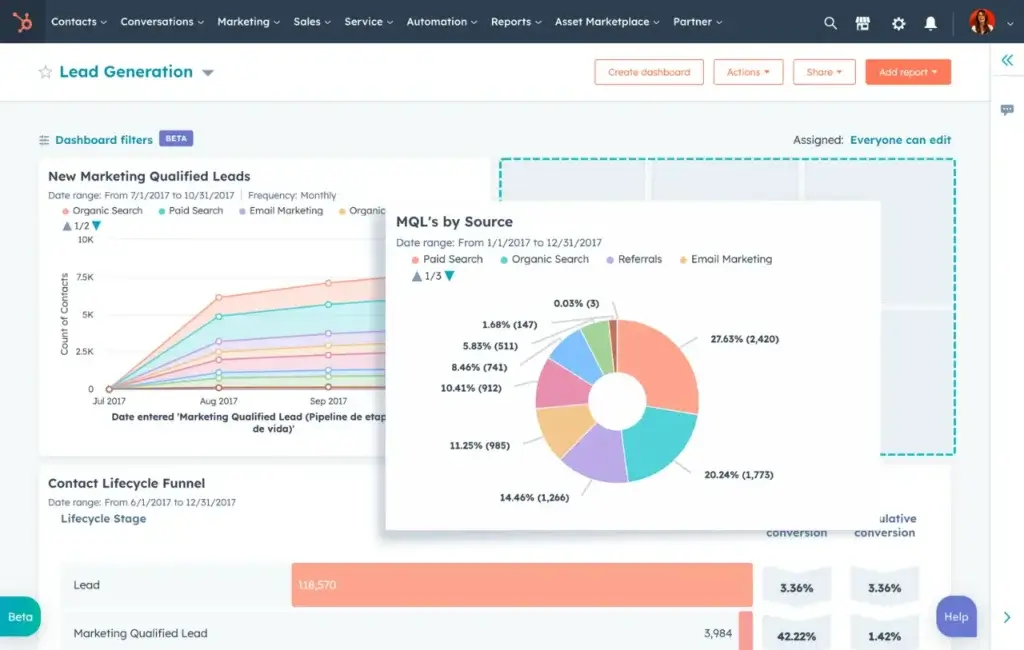
Reporting and Dashboards
HubSpot’s dashboards make it easier to see what is happening across your funnel. You can track leads, deals, campaigns, rep activity, revenue, tickets, and conversion rates from customizable reports.
Basic reporting is useful for smaller teams. More advanced attribution, custom reporting, and revenue analytics become more valuable as your sales and marketing operations mature.
- Track sales activity and deal performance
- Monitor campaign and lead generation results
- Create dashboards by team, manager, or business unit
HubSpot CRM vs HubSpot Hubs
One common point of confusion is the difference between HubSpot CRM and the paid Hubs. HubSpot CRM is the central customer database. The Hubs add specialized tools on top of that database.
For example, Sales Hub adds sales engagement, forecasting, sequences, and advanced pipeline tools. Marketing Hub adds campaigns, forms, landing pages, email marketing, automation, and attribution. Service Hub adds ticketing and customer support features. Operations Hub helps with data sync and automation.
This modular structure is a strength because you can expand gradually. It can also make pricing harder to predict, especially when you add more seats, marketing contacts, AI credits, or multiple Hubs.
Key Benefits
Benefits of Using HubSpot CRM
🧩 One Unified Customer Platform
HubSpot brings marketing, sales, service, content, operations, and commerce tools into one connected environment. This reduces the need for disconnected tools and gives teams one shared source of customer truth.
📊 Better Funnel Visibility
You can track where leads come from, how they engage, when they become sales qualified, and how deals move through the pipeline. This helps you make smarter decisions about campaigns, sales activity, and revenue growth.
💬 Stronger Team Collaboration
Marketing can see lead behavior. Sales can see campaign history. Service can see prior deal and communication activity. That shared context creates smoother handoffs and better customer experiences.
📈 Room to Scale
You can start with simple CRM tools and add more advanced capabilities over time. This makes HubSpot a practical choice for companies that want to avoid switching CRMs every time their process becomes more mature.
🔒 Trust, Security, and Compliance Support
HubSpot includes security controls such as permissions, two-factor authentication, encryption, and audit features on higher tiers. For growing teams, these controls become increasingly important as customer data expands.
Pros and Cons
Advantages and Limitations of Using HubSpot
Positive
✅ Easy to use and fast to adopt
✅ Strong free tools for small teams
✅ Excellent sales and marketing alignment
✅ Powerful automation and reporting as you scale
Negative
❌ Advanced plans can become expensive
❌ Pricing can be difficult to predict
❌ Some customization is limited in lower tiers
❌ Complex automation still requires careful setup
Every CRM has strengths and trade-offs. HubSpot is no exception. Its biggest advantage is usability, but its biggest challenge is cost as you grow into advanced features.
✅ Pros
- Very easy to use
HubSpot has one of the cleanest CRM interfaces available. Most teams can understand the basics quickly, which improves adoption and reduces training time. - Useful free CRM tools
The free CRM is a strong starting point for very small teams that need contact management, deal tracking, and basic customer data organization. - Strong marketing and sales connection
HubSpot is excellent when you want marketing activity and sales conversations to live in the same system. - Scalable automation
As your team grows, workflows, lead scoring, reporting, and AI features can help remove manual work and improve consistency.
❌ Cons
- Premium features can get expensive
The free and Starter tools are helpful, but the strongest automation, reporting, attribution, and enterprise controls sit in higher plans. - Pricing can be complex
Costs can depend on seats, Hubs, marketing contacts, AI credits, add-ons, and onboarding needs. - Lower tiers have customization limits
Small teams may eventually outgrow the simpler plans if they need custom objects, advanced permissions, or more complex reporting. - Advanced setup requires strategy
HubSpot is user-friendly, but building clean workflows, lead scoring, lifecycle stages, and reporting still requires planning.
User Experience
User Interface and Experience
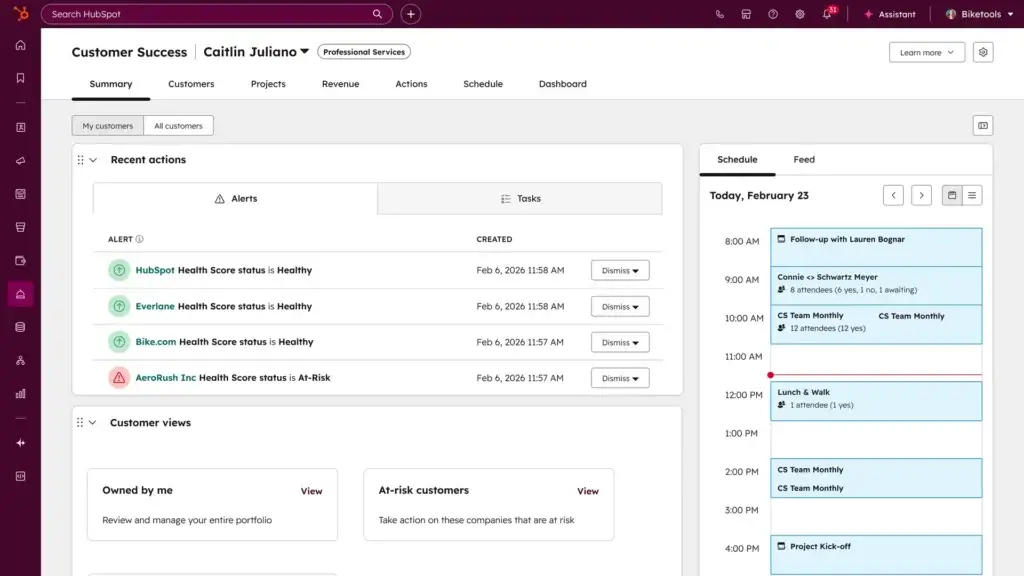
A CRM only works if your team actually uses it. This is where HubSpot performs especially well.
The interface feels modern, clean, and approachable. Sales reps can manage pipelines without feeling buried in menus. Marketing teams can build campaigns and workflows without relying on developers for every change. Managers can create dashboards that show activity, pipeline health, and performance trends.
Dashboard and Navigation
HubSpot’s navigation is organized around the main areas your team uses daily, including contacts, companies, deals, tickets, marketing, automation, and reports.
- Simple top navigation for core CRM areas
- Custom dashboards for sales, marketing, and service teams
- Search and record timelines that make customer data easier to find
Mobile App Experience
The HubSpot mobile app is useful for sales reps, founders, and managers who need to access CRM data away from their desk. You can view contacts, update deals, log calls, create tasks, and receive activity notifications from your phone.
It is not a full replacement for the desktop experience, but it is strong enough for field sales, meeting prep, and quick updates.
Support and Training Resources
HubSpot offers one of the strongest training ecosystems in the CRM market. HubSpot Academy is especially useful for teams that want structured learning around CRM, sales, marketing, automation, and inbound strategy.
| Support Resource | Availability | Best For |
| Knowledge Base | All users | Self-service troubleshooting and setup help |
| HubSpot Academy | All users | Training, certifications, and onboarding |
| Community Forum | All users | Peer advice and common CRM questions |
| Email and Chat Support | Paid plans vary | Product questions and account support |
| Phone Support | Higher-tier plans | More urgent or complex support needs |
What Real Users Typically Like
Users often praise HubSpot for ease of use, clean design, marketing and sales alignment, automation, and the ability to centralize customer activity.
The most common complaints usually relate to cost, feature limits in lower tiers, and the time needed to configure advanced workflows properly.
Challenges You May Encounter
- Data migration requires careful cleanup before importing records
- Advanced workflows need clear lifecycle and ownership rules
- Reporting becomes more useful when your CRM data is well structured
- Costs can rise when teams add Hubs, contacts, seats, and AI usage
Bottom line: HubSpot CRM is one of the easiest CRM platforms to adopt, but getting the best long-term value requires clean data, clear processes, and careful plan selection.
Business size fit
HubSpot for Different Business Sizes
HubSpot CRM is flexible enough for startups and powerful enough for larger teams, but the right fit depends on your business size, process complexity, and budget.
👩💻 HubSpot CRM for Small Businesses
For small businesses, HubSpot is one of the most accessible CRM platforms because it is easy to set up and does not require a dedicated CRM admin from day one.
- Manage contacts, companies, and deals
- Track emails, tasks, meetings, and notes
- Use forms, landing pages, and basic email tools
- Start with free tools before upgrading
The main thing to watch is scalability. The free plan is helpful, but small businesses should review limits around users, contacts, email sends, and automation before building too much of their process around free tools.
🏢 HubSpot CRM for Mid-Sized Companies
Mid-sized businesses often get the most value from HubSpot because they usually need more than basic contact tracking, but they may not want the complexity of an enterprise CRM.
This is where HubSpot’s automation, lead scoring, dashboards, team inboxes, and sales-marketing alignment become very valuable.
- Automate lead handoff between marketing and sales
- Create dashboards for departments and managers
- Build workflows for nurturing, routing, and lifecycle updates
- Track revenue impact across campaigns and pipeline activity
🏦 HubSpot CRM for Enterprises
HubSpot can support enterprise teams with advanced permissions, custom objects, team partitioning, revenue reporting, and scalable automation. Its biggest advantage at the enterprise level is that it remains easier to use than many legacy CRM systems.
However, Salesforce often enters the conversation for larger organizations. Salesforce is typically stronger for deep customization, complex industry-specific workflows, and large-scale enterprise architecture. HubSpot is usually easier to adopt and manage, while Salesforce can offer more depth for highly complex operations.
If you are comparing both platforms, read our full Salesforce Review and our dedicated HubSpot vs Salesforce comparison.
Best fit by business type
HubSpot CRM can work for many business sizes, but it is not the same fit for every team. The platform is strongest when you want to connect customer data, marketing activity, sales conversations, and service history without building a complex tech stack from scratch.
| Business Type | Fit | Why It Works |
| Startups | Excellent | Free tools, simple setup, and easy contact and deal tracking |
| Small businesses | Very strong | Good balance of CRM, email, forms, live chat, and pipeline tools |
| Mid-sized teams | Strong | Advanced workflows, reporting, lead scoring, and team collaboration |
| Enterprise teams | Good, with caveats | Scalable and user-friendly, but Salesforce may offer deeper enterprise customization |
| Budget-sensitive teams | Mixed | Free tools are useful, but paid tiers can become expensive as needs expand |
⚖️ Final Take
HubSpot’s biggest advantage is that you can start simple and grow into more advanced tools. That makes it a strong CRM for companies that want scalability without overwhelming their team too early.
Pricing and Plans
How much does HubSpot cost?
HubSpot pricing can be difficult to compare because costs depend on the Hub you choose, the number of paid seats, your contact volume, AI usage, add-ons, and whether you bundle multiple products.
The table below should be treated as a practical starting point, not a final quote. Always review HubSpot’s live pricing before purchase because plan packaging and seat rules can change.
🔍 HubSpot CRM Pricing Breakdown
| Plan | Typical Starting Point | Best For | What to Know |
| Free Tools | $0/month | Very small teams and startups | Useful for basic CRM needs, but free CRM limits should be reviewed before scaling |
| Starter | Entry-level paid plan | Small teams that need fewer limits and basic automation | Good upgrade path when you need branding removal, permissions, and more practical sales or marketing tools |
| Professional | Higher monthly investment | Growing teams with automation and reporting needs | Unlocks more advanced workflows, reporting, campaign tools, and scaling features |
| Enterprise | Custom or higher-tier pricing | Larger teams and complex operations | Adds advanced permissions, custom objects, governance, team controls, and enterprise-level reporting |
💡 Potential Hidden Costs to Consider
- Paid user seats for sales, marketing, and service teams
- Marketing contact volume and email send limits
- Professional or Enterprise upgrades for advanced automation
- AI credits for certain Breeze-powered tools
- Onboarding, migration, integrations, or consulting support
Pricing recommendation: HubSpot is cost-effective when your team uses its connected platform deeply. It may feel expensive if you only need simple sales pipeline tracking.
How it compares
HubSpot CRM Alternatives
HubSpot is a strong CRM, but it is not always the best choice for every team. If you are comparing options, these alternatives are worth reviewing.
| Alternative | Best For | Compared With HubSpot |
| Salesforce | Large enterprises | More customizable, but harder and more expensive to implement |
| Zoho CRM | Budget-conscious teams | More affordable, but less polished in user experience |
| Pipedrive | Sales-focused teams | Simpler pipeline management, but fewer native marketing tools |
| monday CRM | Visual workflow teams | More flexible for work management, but less mature for inbound marketing |
| Freshsales | Small sales teams | Strong value, but smaller ecosystem than HubSpot |
Security and Compliance
Protection for Your Data
Customer data is one of the most valuable assets in your business, so CRM security should be part of the buying decision.
HubSpot provides security features for access control, authentication, encryption, monitoring, and compliance support. Larger teams should pay special attention to permissions, audit logs, user roles, and data governance features.
🔐 HubSpot Security Features Overview
| Security Feature | What You Get |
| Data Encryption | Encryption protections for data transmission and storage environments |
| User Permissions and Roles | Control what users can access, edit, view, and manage |
| Two-Factor Authentication | Extra login protection to reduce unauthorized access risk |
| GDPR and Privacy Tools | Tools for consent tracking, privacy requests, and data management |
| Audit Logs | Available on higher tiers for monitoring user and account activity |
| Security Certifications | HubSpot references infrastructure protections connected to standards such as SOC 2 Type II and ISO 27001 |
For most small and mid-sized teams, HubSpot provides more than enough security functionality. Enterprises should review HubSpot’s Trust Center and security documentation before implementation, especially if they operate in regulated industries.
Conclusion
Final thoughts
⭐ Overall Rating: 9.0/10
If you’ve made it this far, you’re clearly serious about choosing the right CRM for your business, and that’s a smart move.
Choosing a CRM like HubSpot is not just about managing contacts or tracking emails. It is about building a customer platform that supports your team’s growth, improves collaboration, automates repetitive work, and gives you better visibility across the customer journey.
🔍 What You’re Really Getting
Here’s a quick recap of what HubSpot CRM brings to the table:
- A shared customer database for marketing, sales, and service teams
- Simple contact, company, deal, and activity management
- Automation tools that reduce repetitive manual work
- Breeze AI tools that support productivity, prospecting, and customer service
- Visual dashboards and reporting for better decision-making
- A scalable platform that can grow from small teams to enterprise operations
If you take the time to set it up correctly, HubSpot becomes more than just a CRM. It becomes the operating system for your customer relationships.
👥 Is It the Right Fit?
If you are a small business or startup, HubSpot gives you a practical way to organize customer data without overcomplicating your process.
If you are a growing sales or marketing team, the platform becomes more valuable when you use automation, workflows, reporting, and campaign tools together.
If you are an enterprise, HubSpot can scale well, but you should compare it carefully with Salesforce if your organization needs deep customization, complex governance, or highly specialized workflows.
Still comparing options? Read our HubSpot vs Salesforce guide to see how both platforms compare side by side.
🧠 Final Word from a CRM Expert
After working with many CRM platforms, here’s the clearest lesson: the best CRM is not the one with the longest feature list. It is the one your team actually uses consistently.
HubSpot succeeds because it makes CRM adoption easier while still offering serious depth as your business grows. If you want a CRM that combines usability, automation, marketing strength, and scalability, HubSpot is one of the strongest choices on the market.
Frequently Asked Questions
Have more questions?
Is HubSpot CRM really free?
Yes. HubSpot offers free CRM tools, but the free version has limits. It is best for very small teams that need basic contact management, deal tracking, and customer organization before upgrading to paid plans.
What is HubSpot CRM best for?
HubSpot CRM is best for small and mid-sized businesses that want an easy-to-use CRM with strong sales, marketing, automation, and reporting tools in one connected platform.
What are the main disadvantages of HubSpot CRM?
The main disadvantages are pricing complexity, higher costs for advanced features, customization limits in lower tiers, and the need for careful setup when building advanced workflows or reports.
Does HubSpot CRM include AI tools?
Yes. HubSpot includes Breeze AI tools that can help with content, prospecting, customer support, CRM insights, and productivity. Some AI-powered features may depend on plan level or available credits.
How does HubSpot CRM compare with Salesforce?
HubSpot CRM is usually easier to use and faster to adopt. Salesforce is often stronger for complex enterprise customization, advanced governance, and highly specialized workflows.
Can HubSpot CRM be used by enterprise companies?
Yes. HubSpot can support enterprise teams with custom objects, permissions, team controls, reporting, automation, and governance features. However, larger organizations should compare it with Salesforce before choosing.
What integrations does HubSpot CRM support?
HubSpot supports a large app marketplace with integrations for email, ecommerce, communication, analytics, advertising, payments, support, and workflow automation tools.
Is HubSpot CRM good for small businesses?
Yes. HubSpot CRM is one of the strongest CRM options for small businesses because it is easy to use, quick to set up, and includes useful free tools for organizing contacts and deals.
Does HubSpot CRM work on mobile?
Yes. HubSpot offers mobile apps for iOS and Android. Users can manage contacts, deals, tasks, calls, and notifications from their mobile devices.
What are the best HubSpot CRM alternatives?
Top HubSpot CRM alternatives include Salesforce for enterprise customization, Zoho CRM for affordability, Pipedrive for sales pipeline management, monday CRM for visual workflows, and Freshsales for small sales teams.