
Introduction
If your team works mainly inside Google Workspace, Copper CRM is one of the most relevant CRM platforms to consider.
Unlike many CRM systems that force you to work in a separate platform, Copper is built around the way Google-first teams already operate. It connects closely with Gmail, Google Calendar, Google Drive, and other Workspace tools, so your CRM activity feels less disconnected from your daily work.
That is the real strength of Copper CRM. It is not trying to be the most complex CRM on the market. Instead, it helps you manage contacts, deals, emails, tasks, and follow-ups without adding unnecessary friction.
Copper is very good for small and mid-sized businesses that want a clean, Google-friendly CRM. It is especially useful for agencies, consultants, real estate teams, service businesses, and B2B sales teams that need better relationship tracking without a heavy implementation process.
However, it is not the right CRM for every company. If you need advanced enterprise reporting, deep customization, complex territory management, or a large app marketplace, tools like Pipedrive, monday CRM, HubSpot, or Salesforce may be better options.
Quick Summary
| Category | Copper CRM Details |
| Best For | Google Workspace users, agencies, consultants, small sales teams, and service businesses |
| Starting Price | $9/user/month annually or $12/user/month monthly |
| Free Trial | Yes, Copper offers a free trial with no credit card required |
| Core Strength | Native Gmail, Calendar, Drive, and Google Workspace workflow integration |
| Main Limitation | Less flexible for teams that work outside the Google ecosystem |
| Best Alternatives | Pipedrive for visual pipelines, monday CRM for customization, and HubSpot for sales and marketing |
Overview
What Is Copper CRM?
Copper CRM is a customer relationship management platform designed for teams that use Google Workspace. It helps you manage contacts, track deals, automate follow-ups, and organize customer interactions from one connected system.
The main difference between Copper and many traditional CRMs is where the work happens. With Copper, your CRM can sit close to your inbox, calendar, and files, instead of forcing your team to update a completely separate system after every interaction.
This makes Copper useful for teams that care about adoption. A CRM only works if your team actually uses it, and Copper reduces the common friction that causes sales reps, account managers, and consultants to avoid updating their records.
Copper is especially strong for relationship-based selling. If your sales process depends on consistent follow-ups, email history, stakeholder mapping, and account context, Copper gives you a practical way to keep those details organized.
How Copper CRM Works
Copper connects with your Google Workspace account and helps bring your communication, contacts, tasks, and pipeline activity into one CRM environment.
You can use it to:
- Track leads, contacts, companies, and opportunities
- See email and calendar activity linked to CRM records
- Build pipelines for sales, onboarding, renewals, or delivery
- Create tasks, reminders, workflows, and email follow-ups
- Manage light project work after a deal closes
For a team that already works in Gmail, this can make CRM adoption much easier. Instead of changing your workflow completely, Copper adds structure to the tools your team already uses every day.
🎯 Key Benefits of Using Copper CRM
The biggest benefit of Copper CRM is that it helps you keep sales activity organized without turning CRM management into another full-time job.
For Google-first teams, Copper can help you:
- Save time: Reduce manual data entry and repeated CRM updates
- Stay organized: Keep contacts, emails, files, tasks, and deals connected
- Improve follow-up: Track next steps and prevent deals from going cold
- Improve account visibility: Give your team a shared view of customer history
If your current sales process depends on spreadsheets, scattered inboxes, and memory-based follow-up, Copper can bring more structure without overwhelming your team.
Key Features
Copper CRM’s Software Specification
Copper CRM is not the most feature-heavy CRM on the market, but that is part of its appeal.
It focuses on the areas that matter most for Google-first sales teams: contact management, pipeline visibility, follow-up tracking, workflow automation, and easy access to customer history.
Gmail and Google Workspace Integration
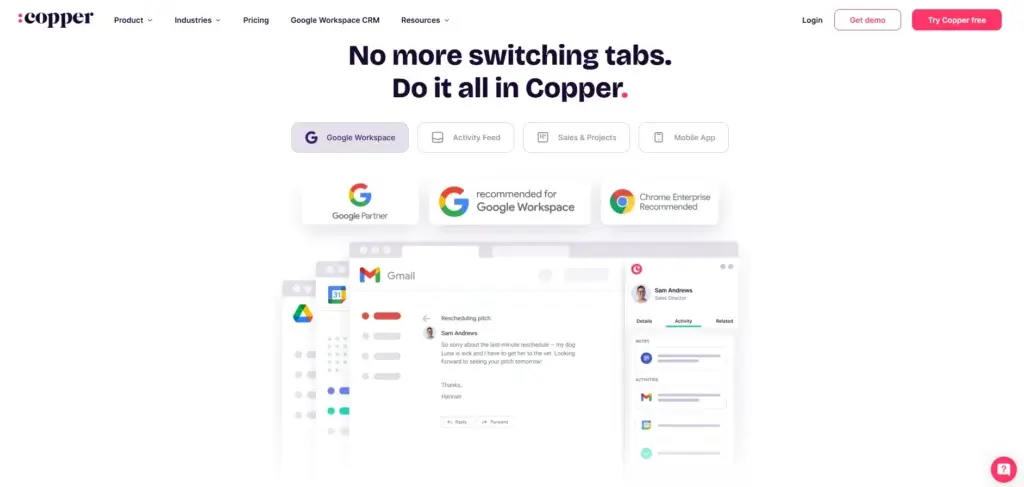
Copper’s strongest feature is its deep connection with Google Workspace. It works with Gmail, Google Calendar, Google Drive, and Google Workspace workflows, which makes it a strong option if your team already lives inside Google tools.
From Gmail, you can view customer details, log communication, create tasks, update opportunities, and keep track of follow-ups. This reduces the need to jump between your inbox and your CRM all day.
This is especially useful for teams where relationship history matters. When you open a contact or company record, you can quickly understand recent conversations, meetings, files, and next steps.
Contact and Relationship Management
Copper helps you organize contacts, companies, leads, and opportunities in a way that feels simple and visual.
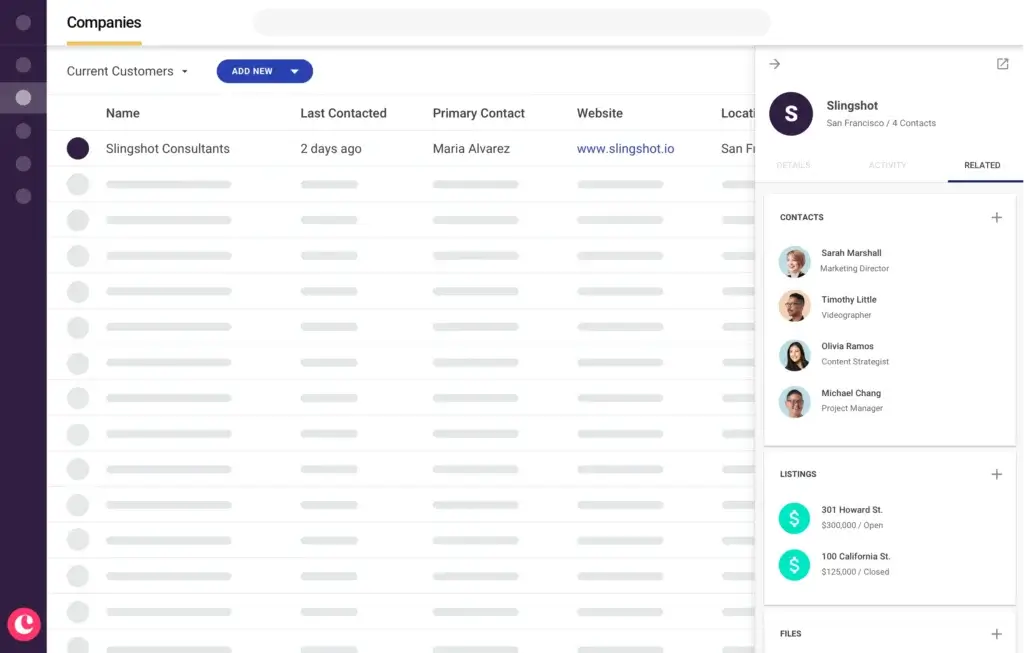
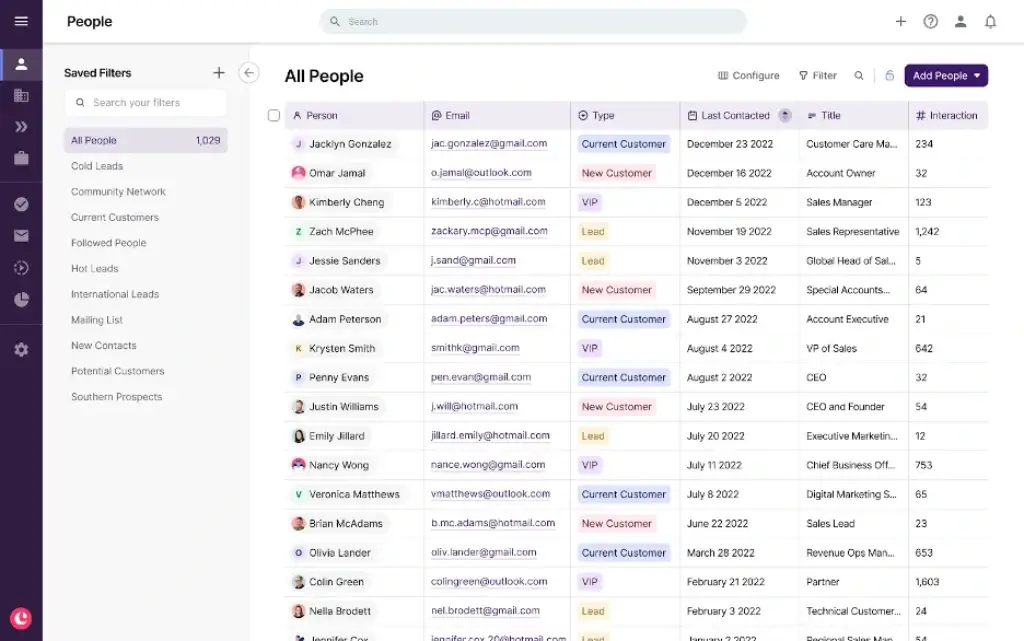
You can track details such as contact owner, company, deal stage, email history, last activity, and relationship status. For agencies, consultants, and service businesses, this gives you a clearer view of each account without relying on spreadsheets or memory.
You can also use tags, custom fields, and filtered views to segment your database. This helps you separate cold leads, current customers, hot opportunities, referral partners, and long-term accounts.
Sales Pipelines and Deal Tracking
Copper gives you visual pipelines that help you track opportunities from first contact to closed deal.
You can create pipelines for different workflows, including sales, partnerships, onboarding, renewals, and post-sale delivery. This flexibility is useful for companies that need more than one simple sales board.
For each opportunity, you can track deal value, expected close date, pipeline stage, owner, related contacts, and activity history. This helps you see which deals are moving, which deals are stuck, and where follow-up is needed.
Workflow Automation
Copper includes automation features that help reduce repetitive admin work. Depending on your plan, you can automate tasks, field updates, reminders, and workflows based on changes in your CRM.
For example, you can create a task when a deal moves to a new stage, notify a team member when a lead is assigned, or trigger follow-up steps after a prospect responds.
This matters because CRM data often becomes outdated when teams rely only on manual updates. Copper’s automation tools help keep records cleaner and make it easier to maintain a consistent sales process.
Email Templates, Bulk Email, and Email Series
Copper includes email productivity features that help sales teams communicate faster and more consistently.
Depending on the plan, you can use email templates, send bulk emails, and create email series. These features are useful for follow-up campaigns, client check-ins, renewal reminders, and lead nurturing.
Copper is not a full marketing automation platform like HubSpot, but it gives sales teams enough email functionality to manage common outreach workflows without leaving the CRM.
Reporting and Dashboards
Copper provides reporting tools that help you understand pipeline health, sales activity, team performance, and deal progress.
You can use reporting to answer practical questions such as:
- How many opportunities are currently active?
- Which deals are most likely to close?
- Where are deals slowing down?
- Which team members are completing the most activity?
The reporting experience is clean and useful for small and mid-sized teams. However, it may feel limited if you need advanced forecasting, complex revenue analytics, or enterprise-level business intelligence.
Mobile App and Chrome Extension
Copper offers a mobile app and Chrome extension, which makes it easier to manage CRM activity while you are away from your desk.
The Chrome extension is especially helpful for Gmail-based work. You can access CRM records, add contacts, update opportunities, and manage tasks from your browser.
The mobile app is useful for sales reps, consultants, founders, and account managers who need to check customer details before or after meetings.
Project Management and Client Delivery
One useful part of Copper is its ability to support post-sale work. You can use projects to manage delivery steps after a deal is closed.
This is valuable for service-based businesses where the customer journey does not end when the sale is won. Agencies, consultants, real estate professionals, and implementation teams can use Copper to connect sales activity with delivery work.
This does not replace a dedicated project management platform for complex operations. Still, it is helpful if you want a lightweight way to manage handoffs, tasks, milestones, and client-facing work inside the same CRM.
Pros and Cons
Advantages and Limitations of Using Copper CRM
Positive
✅ Excellent Google Workspace integration
✅ Clean and familiar user experience
✅ Helpful automation for small sales teams
✅ Strong fit for relationship-based selling
Negative
❌ Less ideal outside Google Workspace
❌ Key features require higher plans
❌ Reporting is not enterprise-level
❌ App ecosystem is smaller than some rivals
Copper CRM has a clear point of view. It is built for teams that want a practical CRM that works closely with Google Workspace.
That focus creates real advantages, but it also means Copper is not the best choice for every business.
👍 Pros
✅ Excellent Google Workspace integration
Copper works especially well for teams that rely on Gmail, Calendar, Drive, and Google Workspace. This makes the CRM feel more natural and reduces the need to constantly switch between tools.
✅ Clean and familiar user experience
The interface is easy to understand, especially if your team already knows Google products. This can reduce onboarding time and improve CRM adoption.
✅ Helpful automation for small sales teams
Copper can automate tasks, reminders, workflows, and email activity. This helps you keep deals moving without relying on manual follow-up every time.
✅ Strong fit for relationship-based selling
Copper is useful when your sales process depends on conversation history, customer context, account relationships, and consistent follow-up.
👎 Cons
❌ Less ideal outside Google Workspace
If your team uses Microsoft Outlook, Microsoft 365, or a mix of disconnected tools, Copper loses much of its main advantage.
❌ Key features require higher plans
Features like workflow automation, reporting, integrations, email series, and advanced admin controls are tied to higher-tier plans.
❌ Reporting is not enterprise-level
Copper gives you useful sales reports, but it is not as deep as Salesforce or other enterprise CRM platforms for complex forecasting and revenue operations.
❌ App ecosystem is smaller than some competitors
Copper integrates with many important tools, but its ecosystem is not as broad as HubSpot, Salesforce, or Zoho CRM.
User Experience
User Interface and Experience
Copper CRM has one of the more approachable user experiences in the CRM market, especially for teams that already understand Gmail and Google Workspace.
The platform does not feel as heavy as Salesforce or as broad as HubSpot. Instead, it is designed to help you manage relationship data in a cleaner, more familiar workspace.
A CRM That Feels Close to Gmail
Copper’s Gmail experience is one of its biggest advantages. When you work from your inbox, Copper can show relevant CRM details near the conversation, including contact history, related opportunities, notes, and activity.
This is valuable because many sales conversations happen in email. When your CRM is connected to the place where conversations happen, your team is more likely to keep data updated.
Clean and Simple Interface
Copper’s interface is clean, visual, and relatively easy to navigate. You can move between contacts, companies, opportunities, tasks, projects, and reports without feeling buried in menus.
The visual pipeline view is especially useful for sales teams. You can quickly see where deals stand and move opportunities from one stage to another.
Mobile-Friendly Experience
Copper’s mobile app gives you access to contacts, deals, tasks, and activity when you are away from your desk.
This is helpful for sales reps and business owners who need to check account history before meetings, add notes after calls, or review open opportunities while traveling.
Setup and Onboarding
Copper is easier to set up than many larger CRM platforms. Most small teams can import contacts, connect Google Workspace, create pipelines, and start tracking deals without a long implementation project.
That said, you should still spend time designing your pipeline stages, required fields, team permissions, and reporting structure. Even a simple CRM works better when your sales process is clearly defined.
Business size fit
Copper CRM for Different Business Sizes
Copper CRM works best for businesses that want a CRM built around communication, relationships, and Google Workspace productivity.
It is not the most advanced CRM for large enterprises, but it can be a strong option for small and mid-sized teams that need better structure without unnecessary complexity.
Best Fit: Google-First Businesses
If your team spends most of the day in Gmail, Google Calendar, and Google Drive, Copper can feel like a natural extension of your workflow.
It is especially relevant for:
- Freelancers and consultants managing client relationships
- Small sales teams that need pipeline visibility
- Agencies that need sales and client delivery tracking
- Real estate and service teams that manage many contacts
- Startups that want fast CRM adoption
Not Ideal For
Copper may feel limited if your organization depends on complex sales processes, multi-region sales structures, advanced approval flows, or a large number of non-Google integrations.
Teams that need deep customization may prefer monday CRM. Teams that want a more sales-focused pipeline tool may prefer Pipedrive. Teams that need marketing, sales, and service in one ecosystem may prefer HubSpot.
Business Size Fit Table
| Business Size | Is Copper CRM a Good Fit? | Why It Fits or Does Not Fit |
| Freelancers | ✅ Yes | Simple contact management, quick setup, and low operational overhead |
| Small Teams | ✅ Yes | Strong fit for Gmail-based sales and relationship tracking |
| Mid-Sized Teams | ⚠️ Maybe | Works well if the team uses Google Workspace and does not need heavy customization |
| Enterprises | ❌ Usually not | May lack the advanced controls, reporting depth, and flexibility large organizations need |
Bottom Line
Copper is a strong fit if you want a CRM that feels familiar, supports Google Workspace, and keeps your team focused on relationships rather than CRM administration.
It is less compelling if your team needs a broad app ecosystem, complex customization, or enterprise-level revenue operations.
Best Use Cases
Copper CRM Use Cases
Copper is most useful when your CRM needs to support relationship management, email-heavy sales activity, and client-facing workflows.
Agencies and Service Businesses
Agencies can use Copper to track leads, proposals, client communication, and post-sale delivery. The ability to connect opportunities with projects makes it useful for teams that sell services and then need to deliver work.
Consultants and Professional Services
Consultants can use Copper to manage prospects, referral partners, follow-ups, proposals, and ongoing client relationships.
Because many consulting relationships develop through email and meetings, Copper’s Google Workspace integration is especially practical.
Real Estate and Relationship-Based Sales
Real estate professionals and relationship-driven sales teams can benefit from Copper’s contact history, pipeline views, task reminders, and company records.
It can help you track stakeholders, listings, opportunities, and recurring follow-up activity in one place.
Small B2B Sales Teams
Small B2B sales teams can use Copper to replace spreadsheets and disconnected inbox tracking.
You can centralize deal activity, assign tasks, monitor pipeline progress, and make follow-up more consistent.
Pricing and Plans
How Much Does Copper CRM Cost?
Copper CRM has four paid plans: Starter, Basic, Professional, and Business.
The pricing is based on seats, and you can choose annual or monthly billing. Annual billing is cheaper, while monthly billing gives you more flexibility if you are still testing the platform.
One important thing to understand is that Copper’s lower plans have contact limits. This can matter if your team already has a large database or expects fast contact growth.
Copper CRM Plans at a Glance
| Plan | Annual Price | Monthly Price | Best For | Key Features and Limits |
| Starter | $9/user/month | $12/user/month | Very small teams starting with CRM | 1,000 contact limit, Google Workspace integration, tasks, activity feed, forms, and Zapier |
| Basic | $23/user/month | $29/user/month | Small teams that need pipelines | 2,500 contact limit, task automation, pipelines, project management, and contact enrichment |
| Professional | $59/user/month | $69/user/month | Sales teams that need automation | 15,000 contact limit, workflow automation, bulk email, reporting, and integrations |
| Business | $99/user/month | $134/user/month | Growing teams with advanced needs | Unlimited contacts, email series, custom reports, multi-currency, and premium support |
Which Copper CRM Plan Should You Choose?
🔹 Starter Plan
The Starter plan is best if you are a very small team and mainly need basic contact management, tasks, forms, and Google Workspace integration.
It is a good entry point if you want to test Copper without committing to a more expensive sales system.
🔸 Basic Plan
The Basic plan is a better fit if you need pipelines, task automation, project management, and contact enrichment.
This plan is more practical for small teams that want to manage active sales opportunities, not just contacts.
🔶 Professional Plan
The Professional plan is likely the strongest fit for many active sales teams because it includes workflow automation, bulk email, reporting, integrations, and a larger contact limit.
If your team wants Copper to support a real sales process, this is where the platform becomes much more useful.
🔷 Business Plan
The Business plan is best for teams that need unlimited contacts, email series, custom reports, multi-currency support, and premium support.
This plan makes sense if Copper is becoming a central system for your sales and customer relationship operations.
Pricing Notes
- Annual billing is cheaper than monthly billing
- Starter and Basic are useful, but may feel limited for active sales teams
- Professional is the most practical starting point for teams that need automation and reporting
- Business is best if you need unlimited contacts and more advanced reporting
CRM Comparisons
Copper CRM Alternatives
Copper CRM is not the only strong CRM for small and mid-sized businesses. The right choice depends on your workflow, tech stack, budget, and customization needs.
Copper CRM vs Pipedrive
Pipedrive is usually the better choice if your main priority is visual pipeline management, sales activity tracking, and deal-focused workflows.
Copper is better if your team is heavily invested in Google Workspace and wants CRM activity close to Gmail and Calendar.
Choose Copper if: you want a Google-native CRM experience.
Choose Pipedrive if: you want a highly focused sales pipeline CRM.
Copper CRM vs HubSpot
HubSpot is a broader CRM platform with strong sales, marketing, service, and content tools. It is a better fit if you want one platform for lead generation, email marketing, sales automation, support, and reporting.
Copper is simpler and more focused. It is a better fit if your main need is relationship management inside a Google-first workflow.
Choose Copper if: you want simplicity and Google Workspace alignment.
Choose HubSpot if: you want a broader growth platform.
Copper CRM vs monday CRM
monday CRM is more flexible for teams that need customizable workflows across sales, onboarding, account management, operations, and internal collaboration.
Copper is easier for Google-first teams that want CRM functionality close to their inbox.
Choose Copper if: your team wants a Gmail-friendly CRM.
Choose monday CRM if: you want more flexible workflow customization.
Copper CRM vs Streak
Streak is also Gmail-focused, but it is lighter and more inbox-based. It can be a good choice for individuals or very small teams that want simple pipeline tracking inside Gmail.
Copper is a stronger fit for teams that need a more complete CRM structure, including accounts, reports, automation, projects, and broader relationship management.
Choose Copper if: you need a fuller CRM for a team.
Choose Streak if: you want a very lightweight Gmail CRM.
Security and Compliance
Protection for Your Data
CRM security matters because your CRM stores customer data, sales activity, email history, business relationships, and sometimes sensitive account information.
Copper benefits from its connection to Google Workspace and its focus on secure access, permissions, and compliance practices.
Google Cloud and Google Workspace Foundation
Copper is designed around Google Workspace, which gives it a strong foundation for secure user access, data syncing, and Google account-based workflows.
For companies already using Google Workspace, this can simplify user adoption and security management because employees are working within tools they already know.
Authentication and Access Control
Copper supports secure authentication through Google-based access. Higher-tier plans also include more advanced controls, such as team permissions and single sign-on options.
This matters because CRM access should be controlled by role, team, and business need. Sales reps, managers, admins, and executives should not always have the same level of access.
Team Permissions
Team permissions help you control who can view, edit, and manage CRM data.
This is especially important as your team grows. A small team may be fine with simple access rules, but larger teams need clearer permission structures to protect data quality and customer privacy.
Compliance Considerations
Copper has publicly discussed GDPR and security practices, including encryption and third-party certifications. Still, compliance needs can vary by country, industry, and customer type.
If your business works in a regulated industry, you should review Copper’s current security documentation and confirm whether it meets your internal compliance requirements before purchasing.
Security Summary
- ✅ Strong fit for Google Workspace security workflows
- ✅ Google-based authentication support
- ✅ Team permissions on higher-tier plans
- ✅ SSO options on advanced plans
- ✅ GDPR and data protection resources available
Conclusion
Final Thoughts
Copper CRM is a strong choice if your business runs on Google Workspace and you want a CRM that feels simple, familiar, and connected to your daily communication.
Its biggest advantage is usability. Many CRMs fail because teams do not use them consistently. Copper solves part of that problem by bringing CRM activity closer to Gmail, Calendar, Drive, contacts, and everyday relationship management.
For small and mid-sized teams, Copper can help you move away from spreadsheets, scattered inboxes, and inconsistent follow-up. It gives you a structured way to manage leads, customers, opportunities, tasks, and post-sale work.
✅ Choose Copper CRM if you:
- Use Google Workspace as your main business environment
- Want a CRM that is easy for your team to adopt
- Need clean contact, company, and pipeline management
- Want lightweight automation without a complex setup
- Manage client relationships through email and meetings
⚠️ Consider another CRM if you:
- Use Microsoft 365 or Outlook as your main workflow
- Need advanced enterprise reporting and forecasting
- Need a larger native app marketplace
- Want full marketing automation and service tools
- Have complex sales operations across many teams or regions
Overall, Copper CRM is best viewed as a practical, Google-friendly CRM for teams that value simplicity and adoption. It may not be the deepest CRM in the market, but for the right business, it can be one of the easiest CRMs to actually use every day.
Frequently Asked Questions
Have more questions?
What is Copper CRM?
Copper CRM is a customer relationship management platform built for teams that use Google Workspace. It helps you manage contacts, companies, opportunities, tasks, email history, and follow-ups from a Google-friendly CRM environment.
Is Copper CRM good for small businesses?
Yes. Copper CRM is a strong option for small businesses that rely on Gmail, Google Calendar, and Google Drive. It is easy to adopt, simple to navigate, and useful for teams that want better contact and pipeline management without a complex setup.
Can I use Copper CRM without Google Workspace?
Copper CRM is designed mainly for Google Workspace users. You may be able to use it outside a Google-first workflow, but you would lose much of what makes the platform valuable, including its close Gmail and Calendar experience.
How much does Copper CRM cost?
Copper CRM pricing starts at $9 per user per month when billed annually for the Starter plan. Higher plans include Basic, Professional, and Business, with more advanced features such as pipelines, automation, reporting, integrations, email series, and custom reports.
Does Copper CRM offer a free trial?
Yes. Copper CRM offers a free trial, and users can start without entering credit card details. This lets you test the platform before choosing a paid plan.
What makes Copper CRM different from other CRMs?
Copper CRM stands out because it is built around Google Workspace. It works closely with Gmail, Google Calendar, and Google Drive, making it easier for Google-first teams to manage CRM activity without constantly switching platforms.
Is Copper CRM good for sales teams?
Yes, Copper CRM can work well for small and mid-sized sales teams that need visual pipelines, contact tracking, follow-up reminders, activity history, workflow automation, and sales reporting. Larger teams with complex sales operations may need a more customizable CRM.
Does Copper CRM include automation?
Yes. Copper CRM includes automation features, but the depth depends on the plan. Higher-tier plans include stronger workflow automation, bulk email, reporting, email series, and other productivity features.
Is Copper CRM secure?
Copper CRM supports secure Google-based access and offers additional controls on higher-tier plans, including team permissions and single sign-on options. Businesses with strict compliance requirements should review Copper’s current security documentation before purchasing.
What are the best Copper CRM alternatives?
The best Copper CRM alternatives include Pipedrive for visual sales pipeline management, monday CRM for customizable workflows, HubSpot for sales and marketing automation, and Streak for lightweight Gmail-based CRM use.