Introduction
If you are evaluating cloud contact center platforms for a support team, sales operation, or larger customer service environment, Five9 is one of the more established names worth considering. Unlike a basic business phone system, Five9 is built for organizations that need more than inbound calling and simple routing. It is designed as a full contact center platform that supports voice, chat, email, SMS, social messaging, AI-powered automation, analytics, and workforce engagement tools from one cloud-based environment.
In this Five9 review, you will explore how the platform works, which features matter most, how pricing is structured, and where Five9 stands out against alternatives. You will also see where it can feel more complex or expensive than lighter tools, what types of teams it fits best, and whether its enterprise-grade capabilities justify choosing it over more SMB-focused communication platforms. If you are trying to balance scalability, AI, omnichannel support, and operational control, Five9 deserves serious attention.
Platform Overview
How Five9 Works
Cloud contact center platform rather than a basic phone system
Five9 is best understood as a cloud contact center platform, not just a VoIP phone service. The product is built for customer-facing teams that manage higher interaction volumes, more complex routing, and more operational oversight than a standard business calling tool usually provides. That matters because buyers often compare Five9 to tools like Aircall, RingCentral, or Nextiva without realizing that Five9 is playing more directly in the CCaaS category than in the traditional business-phone category.
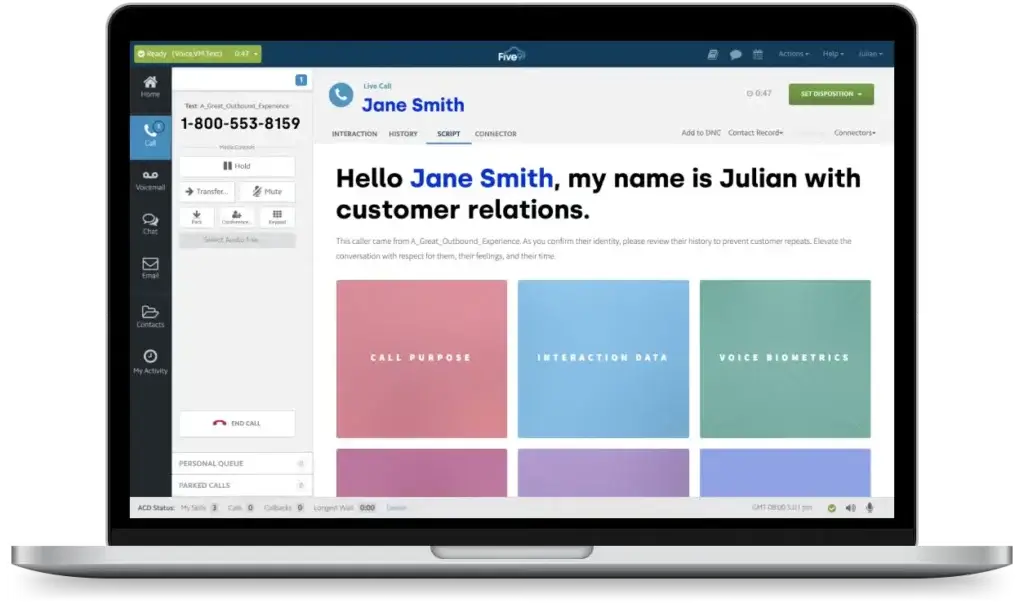
The platform supports voice, chat, email, SMS, and social messaging, which means it can serve as a central environment for omnichannel customer conversations. Five9 also combines these channels with agent desktop tools, reporting, AI features, recording, dialer functionality, and workflow automation. In practice, that gives contact centers a broader operating layer than they would get from a lightweight call management platform.
Built for inbound, outbound, and blended operations
One of Five9’s core strengths is that it supports inbound and outbound contact center workflows in the same environment. That makes it relevant not only for customer support teams, but also for sales teams, appointment centers, collections, and service operations that need agents to move between queues and campaigns without juggling disconnected systems.
This blended model is one of the reasons Five9 feels more serious than many small-business phone tools. If your team handles both service and proactive outreach, Five9 offers a more complete operating model than platforms that are mostly designed around inbound business calls.
AI is now part of the main platform story
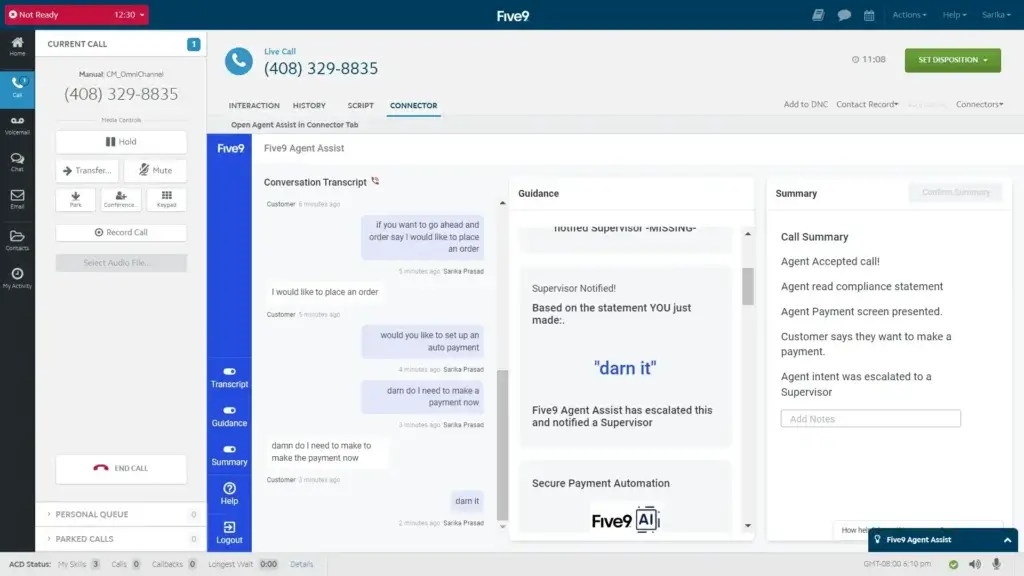
Five9 has placed AI at the center of its current product strategy. The company promotes AI summaries, live transcription, AI insights, AI knowledge, agent assist, intelligent virtual agents, and newer AI agent capabilities as part of its broader Intelligent CX positioning. This is not just a branding layer on top of basic telephony. Five9 is clearly trying to make AI useful across self-service, live-agent support, after-call work, and analytics.
That said, Five9 still feels strongest when you think of AI as an enhancement to a mature contact center platform, not as a reason by itself to buy the tool. The real value comes from how AI connects to routing, reporting, quality management, workforce planning, and agent workflows.
Key Features
What Stands Out
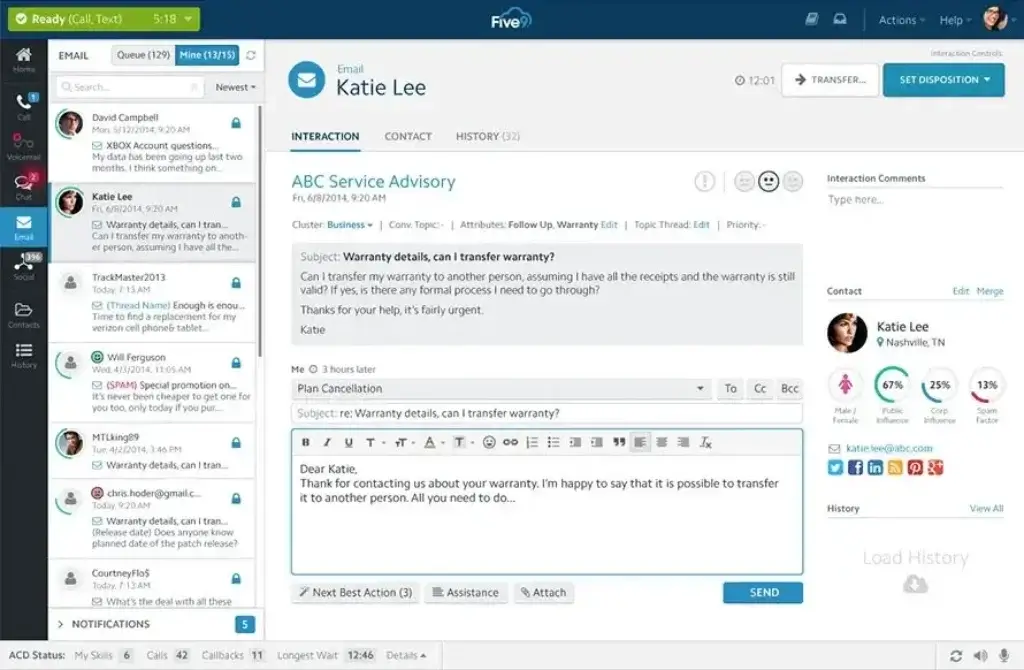
Omnichannel engagement
Five9 supports voice, chat, email, SMS, and social messaging, which gives teams the ability to manage customer communication across multiple channels in one platform. For contact centers that want to move beyond phone-only operations, this is a real advantage. It helps maintain context across channels and reduces the need to assemble separate tools for digital engagement.
Compared with simpler phone systems, this is one of Five9’s biggest category differences. You are not just buying a calling layer, you are buying a broader customer interaction environment.
AI summaries, transcription, and agent assistance
Five9’s current bundles highlight AI summaries, live transcription, AI insights, AI knowledge, and AI agent assist. These features are useful because they target real operational pain points, including after-call wrap-up, agent coaching, faster resolution, and better knowledge access. For teams handling high call volume, even modest improvements in summarization and guidance can translate into real labor savings.
My view is that this is one of Five9’s most compelling strengths today. Many platforms talk about AI, but Five9 is packaging it into the main contact center workflow in a way that feels more mature than most SMB-oriented alternatives.
Blended inbound and outbound capabilities
Five9 has long been strong in blended contact center operations. The platform supports ACD, IVR, dialer functionality, queue management, and outbound workflows within the same broader environment. That makes it suitable for organizations that do not fit neatly into “support only” or “sales only” categories.
If your operation includes service calls, follow-ups, campaigns, reminders, or proactive outreach, this flexibility matters a lot. It is one reason Five9 can work well for industries like healthcare, financial services, retail, travel, and business services.
Workforce engagement and quality management
Five9 goes beyond routing and calling by supporting workforce engagement management, quality management, analytics, and supervisor tools. It also gives buyers flexibility through native WEM options and partner relationships with vendors such as Verint and Calabrio. That means the platform is not limited to front-line communication. It also addresses scheduling, performance oversight, coaching, and operational planning.
This is where Five9 starts to separate itself from tools like Aircall or CallHippo. Those products can be easier to launch, but they are not usually as strong when you need more formal contact center management.
Reporting, analytics, and workflow automation
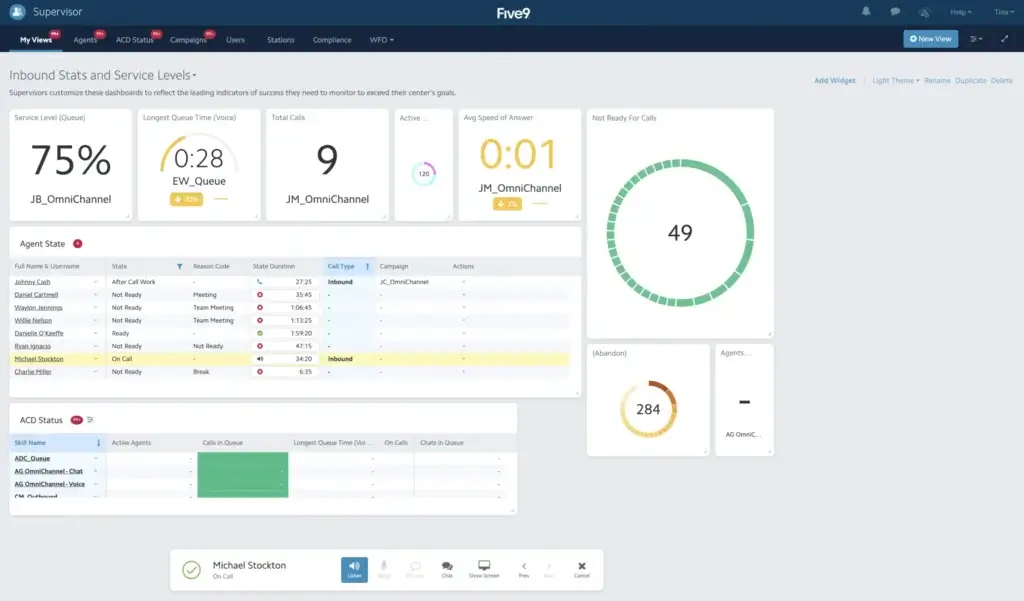
Five9 includes both real-time and historical reporting, plus pre-built and customizable dashboards. It also promotes workflow automation as part of the platform, which is useful for organizations that want to reduce manual handoffs and build more consistent customer journeys. For leaders managing contact center KPIs, these capabilities matter as much as the voice stack itself.
In my opinion, this is one of the platform’s most practical selling points. Five9 is not just trying to help agents answer calls. It is built to help managers run the operation.
Pre-built CRM and UC integrations
Five9 supports pre-built integrations with major CRM and UC platforms, including Salesforce, ServiceNow, Microsoft, Oracle, Zendesk, Microsoft Teams, RingCentral, and Zoom. It also offers APIs and SDKs for more tailored use cases. This matters because contact center software becomes much more valuable when it connects natively with the systems agents already use.
For many enterprise and upper-mid-market buyers, integrations are not optional. Five9’s integration story is one of the reasons it belongs in serious CCaaS conversations.
Pros and Cons
Advantages and Disadvantages
Pros
✅ True contact center depth
✅ Good omnichannel maturity
✅ Practical AI capabilities
✅ Strong enterprise and upper-mid-market fit
✅ Serious CRM and UC integration options
Cons
❌ Less suitable for micro-businesses
❌ Pricing can become layered
❌ Implementation is not lightweight
❌ Some buyers may overbuy
❌ Complexity rises with advanced use cases
Five9 is a strong platform, but it is not the right fit for every buyer. Its biggest strengths show up when you need scale, omnichannel engagement, AI assistance, and operational control. Its weaknesses become clearer when you want quick setup, low seat counts, or a lighter and more affordable SMB-focused tool.
✅ Strengths
- True contact center depth: Five9 offers more than basic telephony. It covers routing, digital channels, analytics, recording, dialers, AI, and workforce engagement.
- Good omnichannel maturity: Voice, chat, email, messaging, and social support make it relevant for modern customer service teams.
- Practical AI capabilities: AI summaries, transcription, agent assistance, and AI-driven workflows support real operational improvements.
- Strong enterprise and upper-mid-market fit: Five9 is designed for organizations that need scale, governance, and structured CX operations.
- Serious CRM and UC integration options: Pre-built CRM and UC connectors help Five9 fit into broader service and sales ecosystems.
❌ Weaknesses
- Less suitable for micro-businesses: Five9 is usually too much platform and too much commitment for very small teams.
- Pricing can become layered: Even with transparent bundle pages, real cost depends on seats, usage, add-ons, and configuration.
- Implementation is not lightweight: This is not the sort of tool most teams activate in one afternoon without planning.
- Some buyers may overbuy: If you mainly need a business phone system, Five9 may be more platform than you actually need.
- Complexity rises with advanced use cases: The more you lean into integrations, WEM, AI, and automation, the more deliberate your setup needs to be.
Pricing
How Much Does Five9 Cost?
Five9 is more transparent about pricing than many enterprise contact center vendors, but it is still not a simple flat-price product. The official pricing page lists bundle-based options and also notes that usage-based pricing may apply, with a minimum of 50 seats. That alone tells you Five9 is not primarily chasing the smallest business-phone buyer.
Digital bundle
The Digital bundle starts at $119 per concurrent user per month. It is positioned around digital channels, but the bundle page still shows broad platform functionality, including AI summaries, live transcription, recording, dialer access, analytics, workflow automation, and support. This tier makes the most sense for organizations emphasizing digital-first engagement rather than traditional voice-heavy operations.
Core bundle
The Core bundle starts at $159 per concurrent user per month. For many teams, this is the more realistic entry point because it is positioned as “all channels with AI essential.” If you want Five9 for a true omnichannel contact center with meaningful AI capabilities, Core is where the platform begins to feel complete.
Plus, Pro, and Enterprise bundles
Five9 also offers Plus, Pro, and Enterprise bundles, but these are quote-based rather than shown with public fixed pricing. The positioning suggests a move into more advanced AI, deeper workforce engagement coverage, and broader enterprise customization. In other words, the public pricing page gives you an idea of the entry point, but serious buyers will still need a sales conversation.
Important pricing caveats
Five9 notes that listed prices are based on concurrent users, that a minimum of 50 seats applies, and that additional usage-based pricing may be relevant. The company also differentiates between AI allocations, CRM and UC adapter options, and workforce engagement choices. That means your actual cost can vary significantly depending on the deployment model and modules you select.
Five9’s pricing is reasonable for what it is, but it is not “cheap.” It is competitively positioned for serious contact center buyers, not for businesses shopping for the simplest low-cost phone system.
Pricing overview table
| Bundle | Published Price | Best For |
| Digital | $119 per concurrent user/month | Digital-first teams that want Five9 platform depth without starting from a voice-heavy configuration |
| Core | $159 per concurrent user/month | Teams that need all channels plus essential AI capabilities |
| Plus | Contact sales | Organizations needing more advanced AI and expanded flexibility |
| Pro | Contact sales | Teams that want AI essentials combined with workforce engagement depth |
| Enterprise | Contact sales | Large organizations needing advanced AI, WEM, and tailored deployment |
How to evaluate Five9 pricing realistically
- Model seat structure carefully: Concurrent pricing can look attractive, but you need to understand actual agent usage patterns.
- Clarify add-ons early: Ask which AI, WEM, storage, and adapter options are included versus extra.
- Confirm minimum commitments: The minimum seat threshold matters if you are not a larger operation.
- Compare against true peers: Five9 should be evaluated against Talkdesk, Genesys, NICE CXone, and enterprise contact center alternatives, not only against SMB VoIP tools.
User Experience
Ease of Use and Setup
What the day-to-day experience looks like
Five9 is generally viewed as user-friendly for a platform in this category, and current review summaries on G2 consistently highlight ease of use and responsive support as positives. That is important because enterprise contact center tools often become difficult to manage once reporting, quality workflows, and multiple channels are involved. Five9 does not feel simple in the SMB sense, but it does seem to do a good job keeping a complex platform reasonably usable.
Implementation is still a real project
Even though Five9 is cloud-based, rollout should not be treated casually. Routing design, CRM integration, agent workflows, QA processes, reporting logic, and AI policies all require planning. If your team expects something plug-and-play like a lightweight business phone app, Five9 will feel heavier.
That is not a weakness by itself. It is simply the reality of buying contact center software rather than a small-business voice tool.
Where usability depends on team maturity
My view is that Five9 becomes easier to appreciate as your operation becomes more sophisticated. Teams with supervisors, analysts, QA workflows, and structured service operations are more likely to benefit from the platform’s depth. Smaller teams without those processes may find that a lighter platform is easier to adopt and easier to justify.
Connected Ecosystem
Integrations and Compatibility
CRM integrations
Five9 highlights pre-built integrations with Salesforce, ServiceNow, Microsoft, Oracle, and Zendesk. These connectors matter because they help agents work with customer records directly inside familiar service and sales environments. For organizations already invested in a CRM or service platform, integration quality is often one of the most important buying factors.
UC and collaboration integrations
Five9 also supports UC integrations including Microsoft Teams, RingCentral, and Zoom. That is useful for organizations that want tighter collaboration between the contact center and the rest of the business. In practice, this can make it easier for agents to consult internal experts and move faster on customer issues.
APIs and customization options
Beyond pre-built integrations, Five9 provides APIs and SDKs for custom workflows, dashboards, and application connections. That helps larger teams extend the platform rather than treat it as a closed system. This is another reason Five9 feels more enterprise-ready than many simpler customer communication tools.
Trust and Compliance
Security and Reliability
High-availability positioning
Five9 prominently promotes a 99.999% uptime SLA and geo redundancy, which is exactly the kind of reliability claim serious contact center buyers expect. When customer conversations are revenue-critical or service-critical, resilience matters just as much as features.
Security and compliance posture
Five9 publishes trust and security resources that speak to data protection and compliance commitments. It also highlights certifications and trust-related infrastructure on its trust pages, including TexasRAMP Level 2 certification. Buyers in regulated or sensitive environments should still do their own diligence, but Five9 clearly understands that trust is part of the enterprise buying process.
What this means in practice
Five9 should not be positioned as a niche security-first platform like a dedicated compliance product, but it can be described as a serious enterprise-grade vendor from a trust, uptime, and resilience standpoint. This gives it an edge over smaller communication providers when reliability and governance are central requirements.
Who Five9 Is Best For
Best Use Cases
Best fit organizations
Five9 is best for organizations that need a real contact center platform rather than a standard phone system. The strongest use cases include:
- Mid-market and enterprise contact centers that need omnichannel communication and deeper operational control
- Blended inbound and outbound teams that want one system for service and outreach workflows
- Customer support operations that need reporting, QA, AI summaries, and agent assistance
- Sales or collections environments that depend on dialers, monitoring, and performance analytics
- Organizations with established CRM or service ecosystems that need serious integration support
Who should probably look elsewhere
If you are a very small business, a startup with a handful of agents, or a team that only needs a straightforward cloud phone system, Five9 is probably more platform than you need. In those cases, tools like Aircall, CallHippo, or even business communications suites like RingCentral or Nextiva may make more sense.
Alternatives and Competitors
How Five9 Compares to Alternatives
Five9 overlaps with several communication platforms, but not all comparisons are equally fair. In my opinion, Five9 is much closer to Talkdesk, Genesys, and NICE CXone than it is to Aircall or CallHippo. Still, many buyers do compare it with broader communication tools, so here is the practical breakdown.
RingCentral
RingCentral is broader as a business communications suite, especially if you need internal messaging, meetings, and UCaaS functionality for the whole company. Five9 is stronger when the priority is the contact center itself. If your main challenge is customer service operations, routing, AI, reporting, and workforce engagement, Five9 is the more purpose-built choice.
Nextiva
Nextiva is often easier to understand for smaller organizations and can be more approachable if you want business communication and some customer communication under one roof. Five9 is the better fit once you move into more formal contact center requirements. I would choose Five9 over Nextiva for operational depth, but not necessarily for SMB simplicity.
Aircall
Aircall is easier to launch and often a better fit for small sales and support teams that want quick CRM-connected calling without enterprise contact center complexity. Five9 is much stronger on omnichannel coverage, workforce tools, and large-scale operational management. Aircall wins on simplicity, Five9 wins on platform depth.
Talkdesk
Talkdesk is one of the more direct Five9 comparisons because both compete in modern CCaaS. In many evaluations, this comes down to implementation preferences, integration fit, AI priorities, and commercial terms. Five9’s edge is its mature contact center depth and broad ecosystem fit. Talkdesk can be compelling if you prefer its product direction or deployment model, but this is the comparison class where Five9 belongs.
Alternatives comparison table
| Provider | Best For | Main Strength | Where Five9 Has the Edge |
| Five9 | Mid-market and enterprise contact centers | Omnichannel CX, AI, reporting, WEM, and integration depth | Best if you need a full contact center operating platform |
| RingCentral | Businesses wanting broad communications coverage | UCaaS and company-wide communication suite | Five9 is more purpose-built for contact center operations |
| Nextiva | SMBs wanting approachable business communications | Ease of adoption for smaller organizations | Five9 is stronger for structured contact center scale |
| Aircall | Small sales and support teams | Fast setup and simple CRM-connected calling | Five9 is stronger on omnichannel and operational depth |
| Talkdesk | Organizations evaluating modern CCaaS platforms | Direct CCaaS competition with strong enterprise appeal | Five9 remains highly competitive on maturity and ecosystem breadth |
Conclusion
Final Thoughts
Five9 is a serious contact center platform for organizations that need more than a phone system. Its strongest qualities are omnichannel support, mature operational tooling, meaningful AI integration, deep reporting, and strong compatibility with broader CRM and UC ecosystems. It is not the cheapest option, and it is definitely not the simplest, but that is because it is solving a more complex problem.
Five9 is a very strong choice for mid-market and enterprise teams that care about customer experience operations as a discipline, not just a communications channel. If you need routing, digital engagement, AI assistance, workforce planning, analytics, and resilience in one platform, Five9 belongs on your shortlist.
On the other hand, if you mainly need an easy cloud phone system for a smaller team, Five9 is likely too much platform and too much commitment. In that case, lighter alternatives may offer a better fit. But for serious contact center buyers, Five9 remains one of the more credible and capable options in the category.
Frequently Asked Questions
Have more questions?
What is Five9?
Five9 is a cloud contact center platform that helps organizations manage customer communication across voice, chat, email, SMS, and social messaging while also supporting AI, analytics, and workforce engagement capabilities.
Is Five9 a VoIP phone system?
Five9 includes voice capabilities, but it is broader than a standard VoIP phone system. It is better described as CCaaS software built for contact center operations.
How much does Five9 cost?
Five9 publicly lists Digital at $119 and Core at $159 per concurrent user per month, while Plus, Pro, and Enterprise are quote-based. Actual pricing can vary depending on seat model, usage, and add-ons.
Does Five9 have a minimum seat requirement?
Yes. The official pricing page notes a minimum of 50 seats, which reinforces that Five9 is aimed more at serious contact center deployments than very small teams.
What channels does Five9 support?
Five9 supports voice, chat, email, SMS, and social messaging, which makes it suitable for omnichannel customer service and sales environments.
What AI features does Five9 include?
Five9 highlights AI summaries, live transcription, AI insights, AI knowledge, agent assist, intelligent virtual agents, and newer AI agent capabilities as part of its current platform strategy.
Does Five9 integrate with Salesforce and ServiceNow?
Yes. Five9 promotes pre-built CRM integrations including Salesforce, ServiceNow, Microsoft, Oracle, and Zendesk, as well as UC integrations with Microsoft Teams, RingCentral, and Zoom.
Is Five9 good for small businesses?
Only sometimes. It can work for smaller contact center operations, but in most cases Five9 is better suited to mid-market and enterprise teams than very small businesses looking for a basic phone solution.
What are the biggest drawbacks of Five9?
The biggest drawbacks are complexity, enterprise-oriented deployment expectations, and the fact that it is usually more platform than smaller teams need.
Is Five9 worth it?
Yes, for the right buyer. If you need a true cloud contact center platform with omnichannel support, AI, analytics, and operational control, Five9 is worth serious consideration. If you only need simple calling, it may be more platform than you need.