Introduction
Choosing between Agile and Waterfall is not just a process decision. It affects how you plan work, involve stakeholders, manage risk, handle change, and select software.
If you are comparing Agile vs. Waterfall, you are usually trying to answer one practical question: which approach gives your project the best chance of success? That answer depends less on trends and more on the kind of work you are managing.
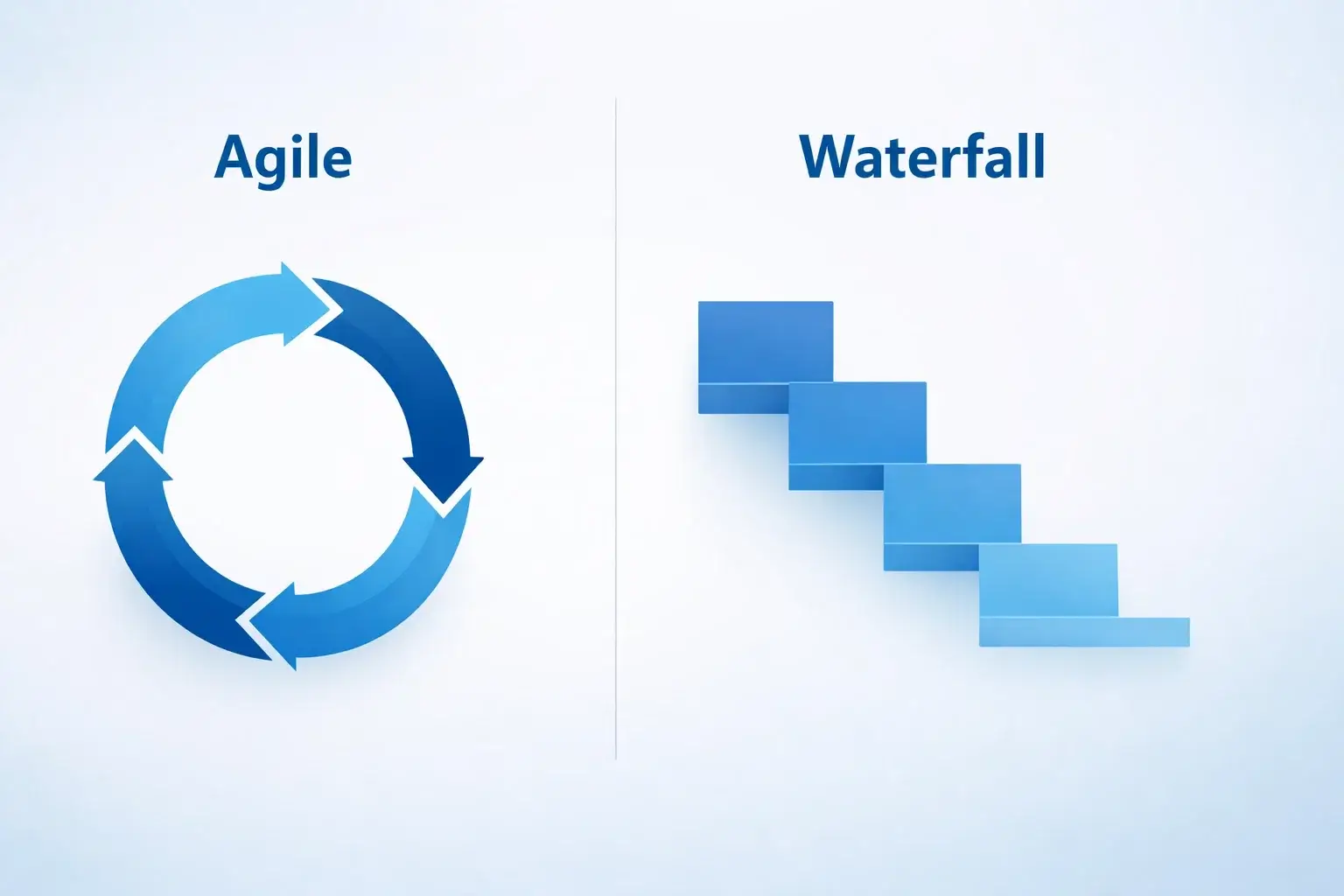
Agile is built for iteration, collaboration, and learning as you go. Waterfall is built for structure, predictability, and clear handoffs. Neither is universally better. The stronger choice is the one that matches your scope, timeline, risk level, stakeholder expectations, and delivery model.
In this guide, you will get a clear comparison, practical use cases, major pros and cons, and a realistic framework for choosing the right method for your next project.
Key Takeaways
- Agile works best when requirements may change, and feedback needs to shape the work as it progresses.
- Waterfall works best when the scope is stable, approvals matter, and each phase needs to be completed before the next begins.
- Hybrid delivery is common, especially when planning and governance are fixed, but execution still needs iteration.
- Your software should support the methodology, not force your team into the wrong way of working.
Agile vs. Waterfall at a Glance
| Category | Agile | Waterfall |
| Planning style | Adaptive and iterative | Sequential and upfront |
| Scope | Can evolve over time | Defined early and controlled tightly |
| Delivery | Incremental releases | Single major release or phased handoff |
| Stakeholder involvement | Frequent and ongoing | Heavier at the beginning and approval points |
| Documentation | Lean, useful, and continuous | Detailed and formal |
| Testing | Continuous throughout delivery | Often later in the lifecycle |
| Best fit | Complex, changing, feedback-driven work | Predictable, regulated, fixed-scope work |
| Main risk | Can feel chaotic without discipline | Can become rigid when change is needed |
What Is Agile?
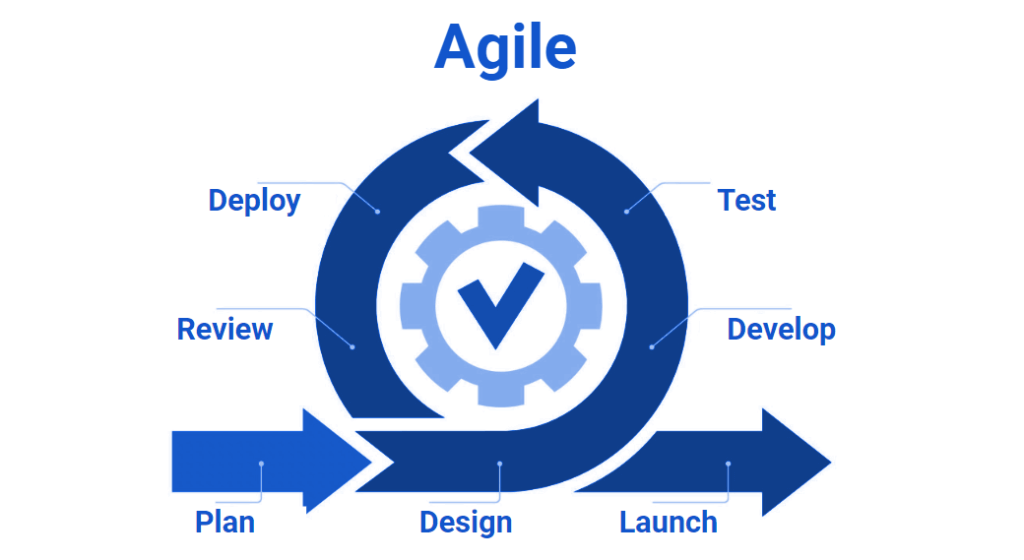
Agile is an adaptive project management approach built around short cycles, frequent feedback, and continuous improvement. Instead of trying to define everything at the start, you plan in smaller increments and adjust as you learn more.
That is why Agile is especially effective when the final product is not fully clear on day one, or when customer input is likely to reshape priorities during delivery.
What Agile looks like in practice
Agile is not one single framework. It is a way of managing work that often shows up through methods like Scrum, Kanban, or a custom workflow built around iterative delivery.
- You break work into smaller pieces instead of managing one large release.
- You review progress frequently and adjust priorities based on feedback.
- You test and improve continuously instead of waiting until the end.
- You involve cross-functional teams early, not only at handoff points.
Why teams choose Agile
You usually choose Agile when speed, learning, and responsiveness matter more than perfect predictability. It works well when your project environment is moving, your users are vocal, or the cost of waiting too long to validate decisions is high.
Agile tends to be a strong fit for software development, product teams, digital services, UX work, and marketing programs that need regular optimization.
Where Agile can go wrong
Agile is often described as flexible, but flexibility without discipline turns into drift. If your backlog is weak, priorities are unclear, or stakeholders want constant change without trade-offs, Agile can become messy fast.
Experienced project managers know Agile still requires structure. You need clear ownership, review cadence, working definitions of done, and a team that can make decisions quickly.
What Is Waterfall?
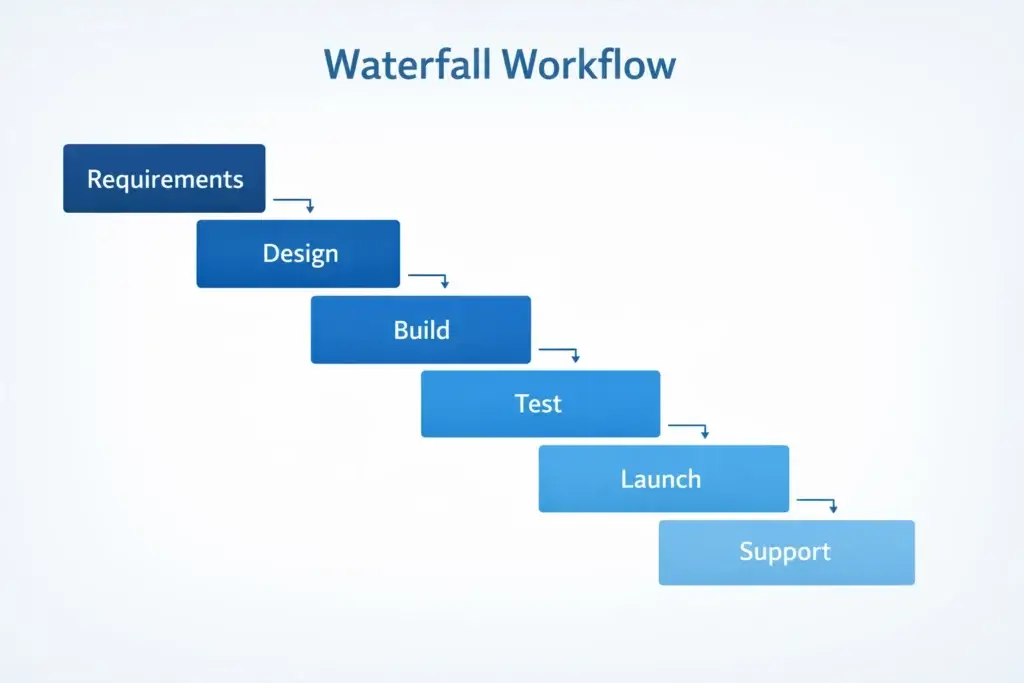
Waterfall is a linear project management approach in which work moves through defined phases in sequence. You complete one stage before moving to the next, with heavier planning and documentation at the start.
This makes Waterfall easier to control when scope is stable, dependencies are strict, and stakeholders expect formal approvals throughout the project lifecycle.
What Waterfall looks like in practice
Waterfall usually follows a staged flow such as requirements, planning, design, execution, testing, deployment, and support. The exact labels vary by industry, but the core idea stays the same: each stage depends on the previous one being completed.
- Requirements: You define what needs to be delivered.
- Planning and design: You map timelines, resources, risks, and specifications.
- Execution: The team builds according to the approved plan.
- Testing and validation: Deliverables are reviewed against requirements.
- Deployment and maintenance: The output is released and supported.
Why teams choose Waterfall
You usually choose Waterfall when change is expensive, approvals are formal, and documentation is not optional. That is why it remains relevant in construction, engineering, manufacturing, government projects, procurement-heavy work, and many compliance-driven environments.
It also works well when your project has a clear end state from the beginning and stakeholders care deeply about timeline, scope control, and traceability.
Where Waterfall can go wrong
Waterfall struggles when real discovery happens late. If stakeholders do not truly know what they want up front, or if market conditions change mid-project, the method can feel rigid and costly.
That is the trade-off. Waterfall gives you order and predictability, but it is less forgiving when the original assumptions turn out to be wrong.
What Is the Real Difference
The simplest difference is this: Agile expects change, while Waterfall tries to control it.
That sounds simple, but in practice, the distinction affects almost every part of how you manage work.
1. Planning
Agile plans continuously. Waterfall plans heavily at the start. If your project needs discovery along the way, Agile is usually the better fit. If your project needs a firm roadmap before execution begins, Waterfall is often safer.
2. Scope management
Agile allows scope to evolve as the team learns. Waterfall treats scope as something to define early and protect carefully. If your stakeholders expect changing priorities, Agile is more realistic. If they need locked deliverables, Waterfall is easier to govern.
3. Delivery model
Agile delivers value in smaller increments. Waterfall often delivers a larger completed package at the end or at phase gates. If early visibility matters, Agile has an advantage.
4. Stakeholder involvement
Agile works best when stakeholders stay involved throughout delivery. Waterfall usually concentrates stakeholder input around requirements, review, and approval milestones. If your sponsor wants regular demos and course correction, Agile fits better.
5. Testing
Agile blends testing into the delivery process. Waterfall often leaves more formal testing closer to the end. This is one reason Agile tends to surface issues earlier, while Waterfall can carry risk further downstream if assumptions are off.
6. Documentation
Agile uses documentation, but it tries to keep it practical and current. Waterfall relies more heavily on formal documentation, sign-offs, and controlled records. If auditability matters, Waterfall often has the edge.
7. Team structure
Agile favors close collaboration and shared ownership. Waterfall more often works through specialized roles and stage-based handoffs. That difference shapes how your team communicates and how quickly decisions get made.
8. Risk profile
Agile reduces risk by validating often. Waterfall reduces risk by planning thoroughly and controlling variance. Both manage risk, but they do it in different ways.
Pros and Cons of each
Agile
Advantages
- Better for changing requirements: You can adapt without redesigning the whole project plan.
- Earlier visibility: Stakeholders see progress sooner and more often.
- Stronger feedback loops: Teams can improve quality continuously.
- Faster learning: You catch weak assumptions earlier.
- Better fit for digital work: It aligns well with software, apps, product development, and iterative campaigns.
Drawbacks
- Less predictability: Budget, timeline, and final scope can be harder to lock early.
- Needs mature collaboration: Weak communication hurts Agile quickly.
- Can create scope drift: Without discipline, teams can keep expanding work.
- Harder in rigid governance models: Some organizations want fixed plans and formal stage control.
Waterfall
Waterfall advantages
- Clear structure: Everyone understands the sequence and deliverables.
- Strong predictability: Timelines, budget expectations, and handoffs are easier to define.
- Better for compliance: Formal documentation and approvals are easier to maintain.
- Useful for dependency-heavy work: It fits projects where one task truly must finish before another begins.
Waterfall drawbacks
- Less adaptable: Late changes can be expensive and disruptive.
- Slower feedback: Stakeholders may not see meaningful output until much later.
- Higher risk if requirements are wrong: A strong plan does not help if the initial assumptions were weak.
- Can create silos: Teams may communicate more at handoffs than during active collaboration.
When Agile Is the Better Choice
Agile tends to be the better choice when uncertainty is part of the job, not a planning mistake.
- You are building a product that will improve through user feedback.
- Your stakeholders want regular visibility and influence during delivery.
- Your requirements are likely to evolve.
- Your team can work in short cycles and make decisions quickly.
- You need to release value incrementally rather than wait for one final launch.
Typical Agile examples: SaaS product development, app releases, UX redesigns, experimentation-led marketing, internal digital transformation pilots, and feature roadmaps with frequent iteration.
When Waterfall Is the Better Choice
Waterfall is usually the better choice when the work depends on predictability, formal sequencing, and tight control over changes.
- Your scope is well defined from the start.
- Approvals and documentation are mandatory.
- Downstream work depends on upstream completion.
- Budget and timeline need to be forecasted early with confidence.
- Late changes are expensive or risky.
Typical Waterfall examples: construction projects, infrastructure rollouts, regulated implementations, government contracts, manufacturing programs, and large vendor-led deployments with formal sign-off stages.
| Project Type | Best Fit | Why |
| SaaS product development | Agile | Requirements evolve quickly, and user feedback shapes delivery. |
| Mobile app feature releases | Agile | Teams can launch in increments and improve continuously. |
| Website redesign | Hybrid | Core timelines may be fixed, but design and content often evolve during execution. |
| ERP implementation | Waterfall or Hybrid | Projects often require formal planning, vendor coordination, and structured approvals. |
| Construction project | Waterfall | Work depends on sequential phases, fixed plans, and strict dependencies. |
| Government rollout | Waterfall | Documentation, traceability, and formal sign-offs are critical. |
| Marketing campaign optimization | Agile | Performance data and ongoing testing make iteration valuable. |
| Internal digital transformation | Hybrid | Leadership may want fixed planning, while delivery teams need flexibility. |
Why Many Teams Actually Use a Hybrid Approach
In real organizations, the decision is often not Agile or Waterfall. It is a blend of both.
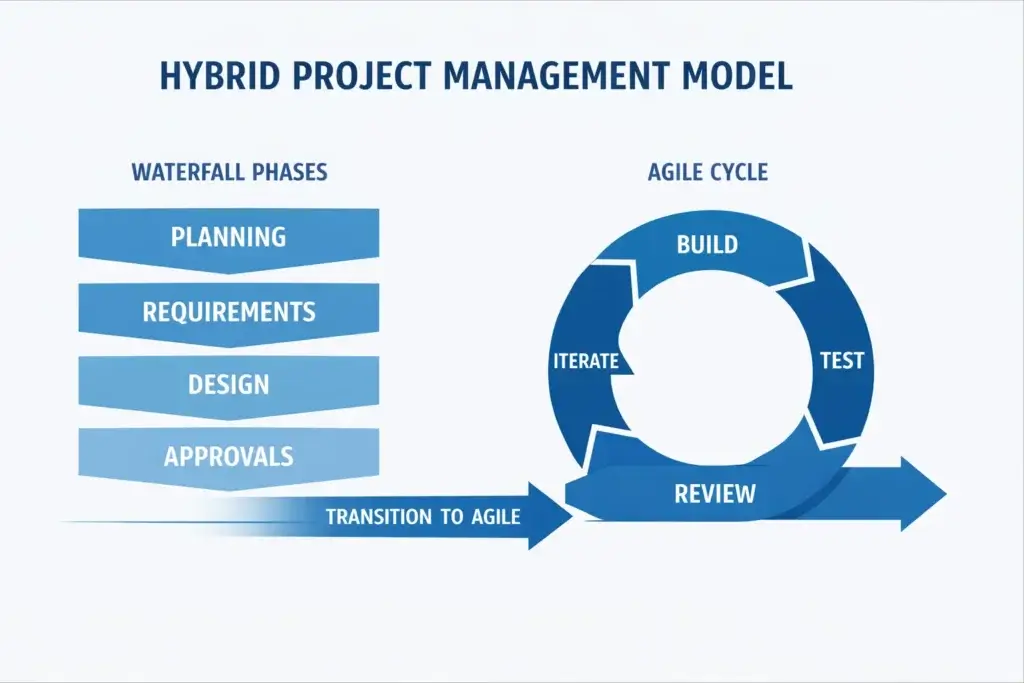
You might use Waterfall for budgeting, procurement, governance, or stakeholder approval, then use Agile for design, build, testing, or rollout refinement. That is especially common in larger companies where planning must be fixed early, but execution still benefits from iteration.
When hybrid makes sense
- You need an approved budget and roadmap before execution starts.
- You want iterative delivery inside a broader fixed timeline.
- Governance is formal, but the work itself is exploratory.
- Different teams in the same project operate in different ways.
Hybrid works best when you are intentional. If you mix methods without clear rules, you do not get the strengths of both. You get confusion from both.
How to Choose
If you want a practical decision framework, start here.
Choose Agile if:
- requirements are likely to change
- customer feedback needs to shape delivery
- you can release in increments
- your team is cross-functional and collaborative
- speed of learning matters more than early certainty
Choose Waterfall if:
- requirements are stable and well documented
- approvals and traceability matter
- tasks must happen in a strict sequence
- scope, budget, and timeline need firm control
- change late in the process would be costly
Choose Hybrid if:
- planning is fixed, but execution needs flexibility
- multiple teams work in different delivery modes
- governance is formal, but product development is iterative
- you need both predictability and feedback loops
How Software Selection Changes by Methodology
Your project management software should reinforce the way your team actually works. If the platform fights your delivery model, you will feel it in planning friction, reporting gaps, weak visibility, and poor adoption.
What Agile teams should look for
- backlog and sprint management
- Kanban or flexible board views
- real-time collaboration and updates
- custom workflows and automation
- dashboards for iteration progress and blockers
What Waterfall teams should look for
- timeline and Gantt views
- dependency tracking
- milestone reporting
- documentation and approval workflows
- strong status visibility for stakeholders
What hybrid teams should look for
- a platform that supports both boards and timelines
- easy switching between high-level plans and iterative execution
- workflow flexibility across departments
- clear reporting for both delivery teams and leadership
If you need a platform that can support Agile, Waterfall, and hybrid workflows in one place, monday.com is one of the strongest options. Its combination of boards, timelines, dashboards, automations, and cross-team visibility makes it especially useful when your organization does not fit neatly into one method.
| Software Capability | Agile Teams | Waterfall Teams | Hybrid Teams |
| Board views | Essential for sprint and backlog management | Useful, but usually secondary | Important for iterative execution |
| Timeline or Gantt view | Helpful for roadmaps | Essential for phase planning | Essential for high-level planning |
| Task dependencies | Useful for coordination | Critical for structured sequencing | Important across planning and execution |
| Sprint planning | Essential | Usually not needed | Useful for delivery teams |
| Documentation | Lean and practical | Detailed and formal | Must support both styles |
| Milestone tracking | Helpful for releases | Essential for phase control | Important for stakeholder visibility |
| Dashboards and reporting | Important for real-time visibility | Important for structured status reporting | Critical for aligning teams and leadership |
| Automations | Very useful for recurring workflows | Useful for approvals and status updates | Highly valuable across mixed delivery models |
Agile vs. Waterfall in different tools
If your readers also want a practical tooling angle, this is where the comparison becomes useful.
monday.com
monday.com is the most balanced option of the three if you need to support both Agile and Waterfall without forcing separate systems. It is especially strong for hybrid environments, cross-functional work, and organizations that want one platform for planning, execution, and reporting.
- Agile fit: Strong boards, sprint planning, automations, dashboards, and team collaboration.
- Waterfall fit: Strong timeline views, milestone tracking, documentation support, and executive reporting.
- Best for: Teams that want flexibility without losing control.
ClickUp
ClickUp offers a wide feature set and high flexibility, which can be powerful for advanced teams. The trade-off is that it can feel heavier to configure and manage well, especially if your team wants simplicity.
- Agile fit: Very capable for customized Agile workflows.
- Waterfall fit: Solid for structured planning when configured carefully.
- Best for: Teams that want broad functionality and are comfortable with a more involved setup.
If your goal is to recommend a single platform for readers comparing methodologies rather than just comparing tools, monday.com is the easiest platform to justify. It handles iterative work, structured planning, and hybrid delivery better than most teams expect from one system.
Asana
Asana is polished and easy to adopt. It works well for teams that want clarity, collaboration, and straightforward project planning, though it can feel lighter for very process-heavy delivery compared with more configurable systems.
- Agile fit: Good for lightweight Agile workflows and team coordination.
- Waterfall fit: Good for structured project plans and milestone-based work.
- Best for: Teams that value usability and clean execution over deep operational complexity.
Common Mistakes
- Choosing Agile because it sounds modern: Agile is not automatically better if your project needs formal approvals and stable scope.
- Choosing Waterfall because leadership wants certainty: Predictability only works if the requirements are truly known up front.
- Confusing Agile with lack of planning: Good Agile teams plan constantly, just in shorter cycles.
- Ignoring team maturity: The same method works differently with a strong team than with a misaligned one.
- Selecting software before selecting the operating model: Tools should support the method, not define it by accident.
Final Thoughts
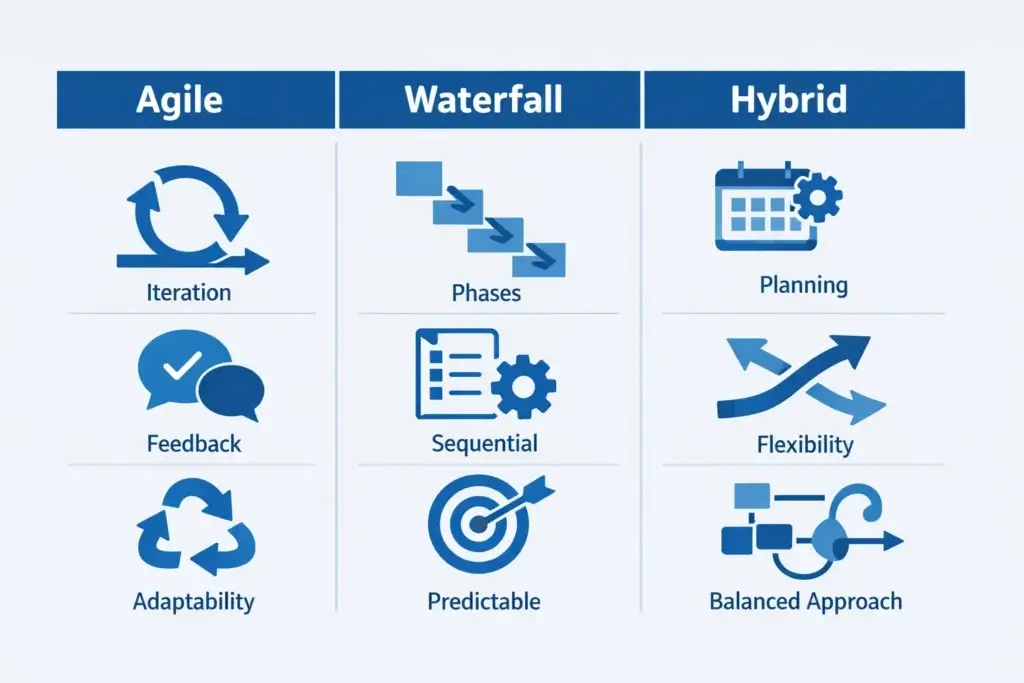
Agile and Waterfall are not competitors in the abstract. They are different responses to different project realities.
If your work is uncertain, feedback-driven, and likely to evolve, Agile is usually the smarter path. If your work is fixed, approval-heavy, and dependent on structure, Waterfall is often the safer one. And if your environment demands both control and iteration, a hybrid model may reflect how your organization already works.
The strongest project managers do not treat methodology as ideology. They choose the level of structure, adaptability, and stakeholder involvement that the work actually requires.
Once you make that choice, your software becomes much easier to evaluate. And if you need one platform that can support all three approaches without making your team switch systems, monday.com is one of the best all-around options to consider.
FAQs
What is the main difference between Agile and Waterfall?
The main difference is how each method handles planning and change. Agile is iterative and adapts as the project progresses, while Waterfall follows a sequential structure with more planning and control at the start.
Is Agile always better than Waterfall?
No. Agile is better for projects that need flexibility, frequent feedback, and incremental delivery. Waterfall is often better for projects with fixed requirements, strict approvals, and predictable execution.
When should you use Waterfall instead of Agile?
You should use Waterfall when your project has clearly defined requirements, a fixed scope, formal documentation needs, and tasks that must happen in a strict sequence.
Why do many companies use a hybrid model?
Many companies need the structure of Waterfall for budgeting, approvals, or governance, but still need Agile-style iteration during development, testing, or rollout. A hybrid model allows both.
Is Agile only for software development?
No. Agile is common in software, but it is also used in product teams, marketing, design, operations, and other environments where fast feedback and changing priorities are part of the work.
Can you switch from Waterfall to Agile in the middle of a project?
You can, but it is not always easy. Mid-project shifts often require changes to planning, governance, stakeholder communication, team roles, and software workflows.
What kind of software is best for Agile teams?
Agile teams usually need backlog management, board views, sprint planning, collaboration tools, automation, and dashboards that show progress and blockers clearly.
What kind of software is best for Waterfall teams?
Waterfall teams usually need timeline views, dependency tracking, milestone reporting, documentation support, and structured approval workflows.
Can the same project management tool support Agile and Waterfall?
Yes. Some platforms can support both. monday.com is a strong example because it combines flexible boards, timelines, automations, dashboards, and reporting in one system.
How do you choose between Agile, Waterfall, and hybrid?
Start with the nature of the work. Choose Agile when change is expected, Waterfall when stability matters most, and hybrid when you need formal planning but flexible execution.