Introduction
If you are looking for a modern cloud contact center platform that goes beyond basic business calling, Talkdesk is one of the most established names to consider. It is designed for customer service, support, and experience teams that need to manage voice and digital conversations at scale, while also improving routing, self-service, agent productivity, analytics, and workforce performance. Rather than functioning like a lightweight VoIP phone system for small teams, Talkdesk is built as a CCaaS platform, Contact Center as a Service, with strong emphasis on AI, automation, and enterprise-grade customer experience operations.
In this Talkdesk review, you will explore how the platform works, which features matter most, how pricing is positioned, where Talkdesk stands out against major competitors, and which types of organizations get the most value from it. You will also see where Talkdesk may feel too complex or too expensive for smaller teams, and whether its AI-focused direction is enough to justify shortlisting it against other leading contact center platforms. If your business needs an omnichannel customer service solution with serious automation and scalability, this guide will help you decide whether Talkdesk is the right fit.
Key Features
How Talkdesk Works
Cloud contact center platform for voice and digital channels
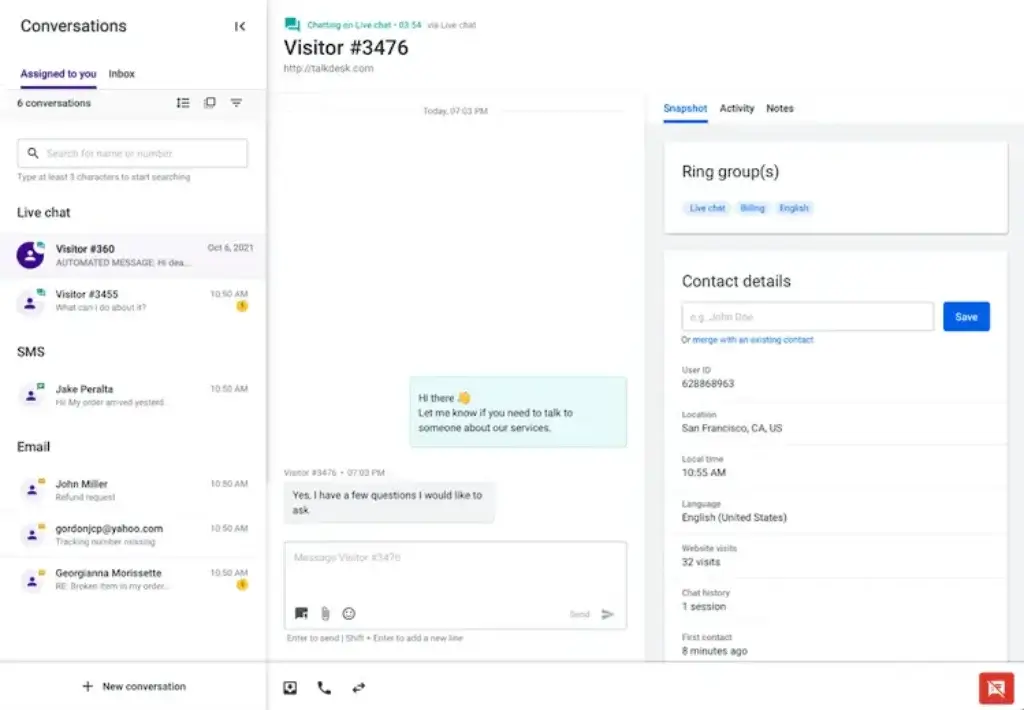
Talkdesk is not just a cloud phone system. It is a full contact center platform built for businesses that need to manage high volumes of customer conversations across voice and digital channels from one environment. The platform supports customer interactions across voice, SMS, email, chat, social messaging, and more, which makes it much better suited to service operations than traditional business telephony tools.
This difference matters. If your company simply needs business calling and extensions, Talkdesk will probably feel heavier than necessary. But if you need omnichannel support, routing, self-service, QA, workforce tools, analytics, and AI-powered assistance, Talkdesk fits much more naturally into that environment.
AI-first customer experience automation
One of Talkdesk’s clearest strategic shifts is its emphasis on Customer Experience Automation, or CXA. The platform now centers much of its positioning around AI agents, AI-powered routing, agent assistance, post-call summaries, knowledge delivery, and operational oversight. In practice, that means Talkdesk is trying to do more than help agents answer calls. It aims to automate repetitive service work, guide agents in real time, and turn conversations into actionable insight.
For buyers, this makes Talkdesk more relevant in enterprises that want to scale support without scaling headcount at the same rate. It also means the product should be evaluated against other serious CCaaS vendors, not against lightweight business phone systems.
Self-service, routing, and agent productivity tools
Talkdesk combines self-service and live support in a way that will appeal to mature support teams. The platform promotes AI agents for voice and digital channels, AI-powered routing through Talkdesk Navigator, agent assist through Talkdesk Copilot, and interaction summaries that reduce after-call work. That combination can improve service speed and make the system easier for supervisors and agents to manage at scale.
From a practical standpoint, this is where Talkdesk makes the strongest case for itself. It is built to reduce manual effort, improve consistency, and keep agents focused on more complex customer needs instead of repetitive workflows.
Talkdesk Key Features
Talkdesk is strongest when you evaluate it as an enterprise-ready CCaaS platform rather than a simple calling product. Below are the features that matter most when deciding whether it deserves a place on your shortlist.
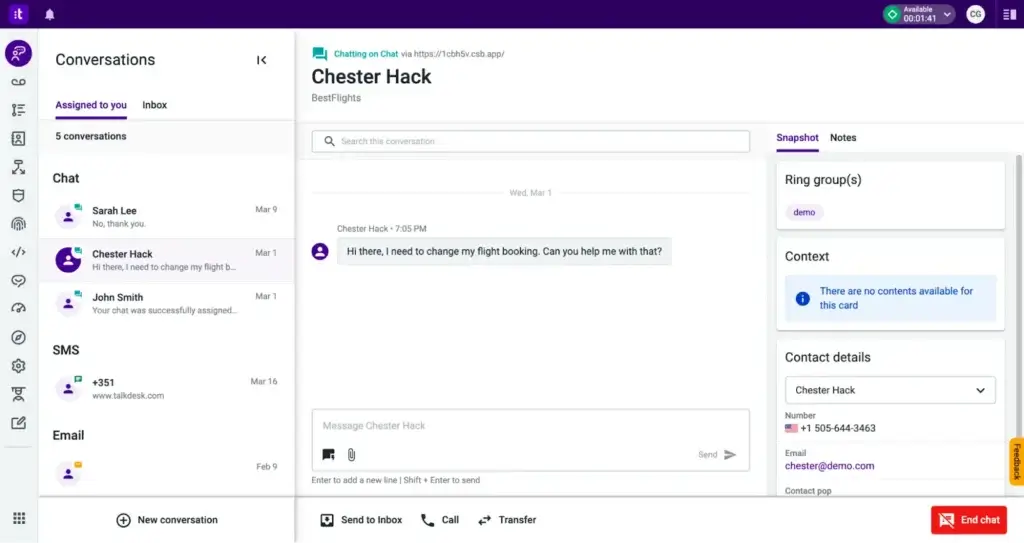
Omnichannel engagement
Talkdesk supports customer communication across voice and multiple digital channels, including SMS, email, chat, and social messaging. That omnichannel foundation is important for companies that want to give customers continuity across channels instead of forcing them into disconnected support experiences. It also makes the platform more flexible for businesses trying to balance phone-heavy service with digital-first support.
AI agents and virtual self-service
Talkdesk is investing heavily in AI agents for voice and digital interactions. These tools are designed to automate common customer requests, reduce the need for live-agent intervention on routine issues, and move customers faster toward resolution. For organizations with repetitive inbound volume, this can be one of the most valuable parts of the platform.
Talkdesk Copilot and agent assistance
Talkdesk Copilot is aimed at improving live agent performance through real-time support. It can surface contextual answers, reduce handle time, and support agents during conversations instead of only providing insight after the fact. For teams that want AI to improve agent effectiveness without fully replacing the human interaction, this is one of Talkdesk’s strongest capability areas.
Interaction analytics and quality management
Talkdesk also leans into analytics and quality management, with AI-powered insights designed to identify trends, support coaching, and improve service performance. This is especially useful for contact centers that care about more than answer speed and want to understand quality, sentiment, productivity, and customer outcomes over time.
Workforce engagement management
Beyond handling conversations, Talkdesk includes workforce engagement tools for scheduling, performance, quality, and agent development. That gives the platform more operational depth than products focused only on routing and telephony. It also makes Talkdesk more competitive with other full-scale contact center vendors that want to own both interaction handling and workforce performance.
Integrations and extensibility
Talkdesk offers 60+ integrations and extends this through Talkdesk AppConnect. For most mid-market and enterprise buyers, this matters because a contact center platform is only as useful as its connection to CRMs, helpdesk tools, workflow systems, and the applications agents already use. The integration story looks strong enough for serious deployments and is clearly more mature than what you usually get from SMB-focused calling platforms.
Pros and Cons
Advantages and Disadvantages
Pros
✅ AI-forward product strategy
✅ Omnichannel depth
✅ Mature WEM and analytics
✅ Enterprise-grade compliance
Cons
❌ Not ideal for simple phone needs
❌ Less transparent pricing than SMB tools
❌ Likely more involved implementation
❌ Enterprise orientation
Talkdesk has a strong feature story, but it is not the right platform for every company. Its value becomes clearer when you compare it with other serious CCaaS vendors, while its drawbacks become more obvious when you compare it with lighter business phone systems or lower-cost support tools.
✅ Strengths
- AI-forward product strategy: Talkdesk is one of the vendors most aggressively positioning around AI agents, AI assistance, AI summaries, and automation across the customer journey.
- Omnichannel depth: The platform supports voice plus digital service channels, which is essential for modern support teams.
- Mature WEM and analytics: Workforce engagement, analytics, quality management, and routing help make Talkdesk more than a communications layer.
- Enterprise-grade compliance: Security, compliance, and broad certification coverage will matter to regulated and large-scale organizations.
❌ Weaknesses
- Not ideal for simple phone needs: Businesses that only need basic calling or a lightweight support line may end up paying for more platform than they actually use.
- Less transparent pricing than SMB tools: Talkdesk publicly promotes starting pricing, but real plan selection is still sales-led and quote-oriented.
- Likely more involved implementation: The platform’s depth is a strength, but it also means setup and optimization can be more demanding than entry-level tools.
- Enterprise orientation: Smaller businesses may find Talkdesk harder to justify compared with simpler and cheaper products like Aircall or Nextiva.
Overall, Talkdesk looks strongest for mid-market and enterprise organizations that need an AI-driven contact center platform, not for teams simply shopping for cheaper business telephony.
Pricing
How Much Does Talkdesk Cost?
Talkdesk pricing is geared more toward serious contact center buyers than casual SMB shopping. The official pricing page currently promotes AI-powered contact center solutions starting at $85 per seat per month, but like many enterprise-oriented vendors, Talkdesk still uses a sales-led model for final plan selection and quotes. That means it is not as transparent as small-business phone systems where you can usually compare fixed plans instantly.
Starting price and buying model
The headline entry point of $85 per seat per month helps position Talkdesk in the premium contact center market, but it is only the beginning of the pricing conversation. Buyers should expect plan differences, add-on options, and implementation needs to affect the real total cost. In other words, Talkdesk is not cheap, but it is also not trying to compete on cheapness.
Who the pricing is built for
Talkdesk pricing makes more sense for companies that view customer service as an operational function worth optimizing with automation, analytics, and workforce tools. For smaller teams that only need call routing and a basic shared inbox, the platform may feel expensive. For larger service organizations, the additional functionality can make the price easier to justify.
What can raise total cost
As with most CCaaS platforms, the real cost is not only the base seat price. Buyers should also consider AI modules, workforce tools, implementation complexity, channel needs, integrations, and support requirements. That does not make Talkdesk unusually expensive for the category, but it does mean you should budget based on your actual workflow rather than on the advertised entry point alone.
Pricing overview table
| Pricing Area | What to Expect | Why It Matters |
| Starting Price | Starts at $85 per seat per month | Shows Talkdesk is positioned above entry-level business phone systems |
| Plan Selection | Sales-led and quote-based | Final pricing depends on edition, channels, and required capabilities |
| AI and Workforce Features | May affect total cost | Advanced automation and WEM can materially change the value equation |
| Implementation Scope | Varies by deployment | Larger organizations should model setup and integration needs before buying |
How to evaluate pricing realistically
If you are comparing Talkdesk to SMB-focused tools, it will likely look expensive. If you are comparing it to enterprise-grade CCaaS platforms like Genesys Cloud CX, Five9, or NICE CXone, the pricing position is more understandable. The right question is not whether Talkdesk is the cheapest option. It is whether the platform’s AI, omnichannel support, and operational depth can improve customer experience enough to justify the spend.
Implementation tips
- Model full use case costs: Price Talkdesk against your routing, AI, digital channel, and workforce requirements, not just the starting seat rate.
- Separate must-haves from nice-to-haves: This helps avoid overbuying enterprise capabilities you may not use immediately.
- Verify integration scope early: For CRM-heavy teams, integration requirements can materially affect rollout plans.
- Benchmark against real competitors: Compare Talkdesk against CCaaS vendors, not only against business phone systems.
User Experience
Ease of Use & Setup
Dashboard and day-to-day usability
Talkdesk has a more modern reputation than older legacy contact center systems, but ease of use should still be understood in context. For a product in this category, it appears relatively approachable, especially considering how many capabilities it brings together. That said, no enterprise-grade contact center platform feels truly simple in the same way that a lightweight SMB phone tool does.
For supervisors, managers, and structured support teams, that tradeoff can be worth it. The platform’s value comes from combining channels, AI, workflows, and workforce tools inside one system. For small teams with limited process complexity, the same depth may feel like unnecessary overhead.
Onboarding and implementation reality
Talkdesk is cloud-based and avoids the traditional burden of on-premises contact center infrastructure, which is a major benefit. Even so, implementation quality will depend heavily on the scope of your environment. A smaller rollout can be relatively fast, while a large enterprise deployment with routing design, integrations, digital channels, and AI workflows will naturally take more planning.
Who will find it easiest to adopt
Organizations already familiar with helpdesk, CRM, or contact center operations will likely get up to speed faster than teams new to the category. In other words, Talkdesk may feel intuitive for support leaders and CX teams, but not necessarily for businesses upgrading from a very basic phone setup.
Integrations & Compatibility
How Talkdesk Integrates with Other Tools
CRM and platform integrations
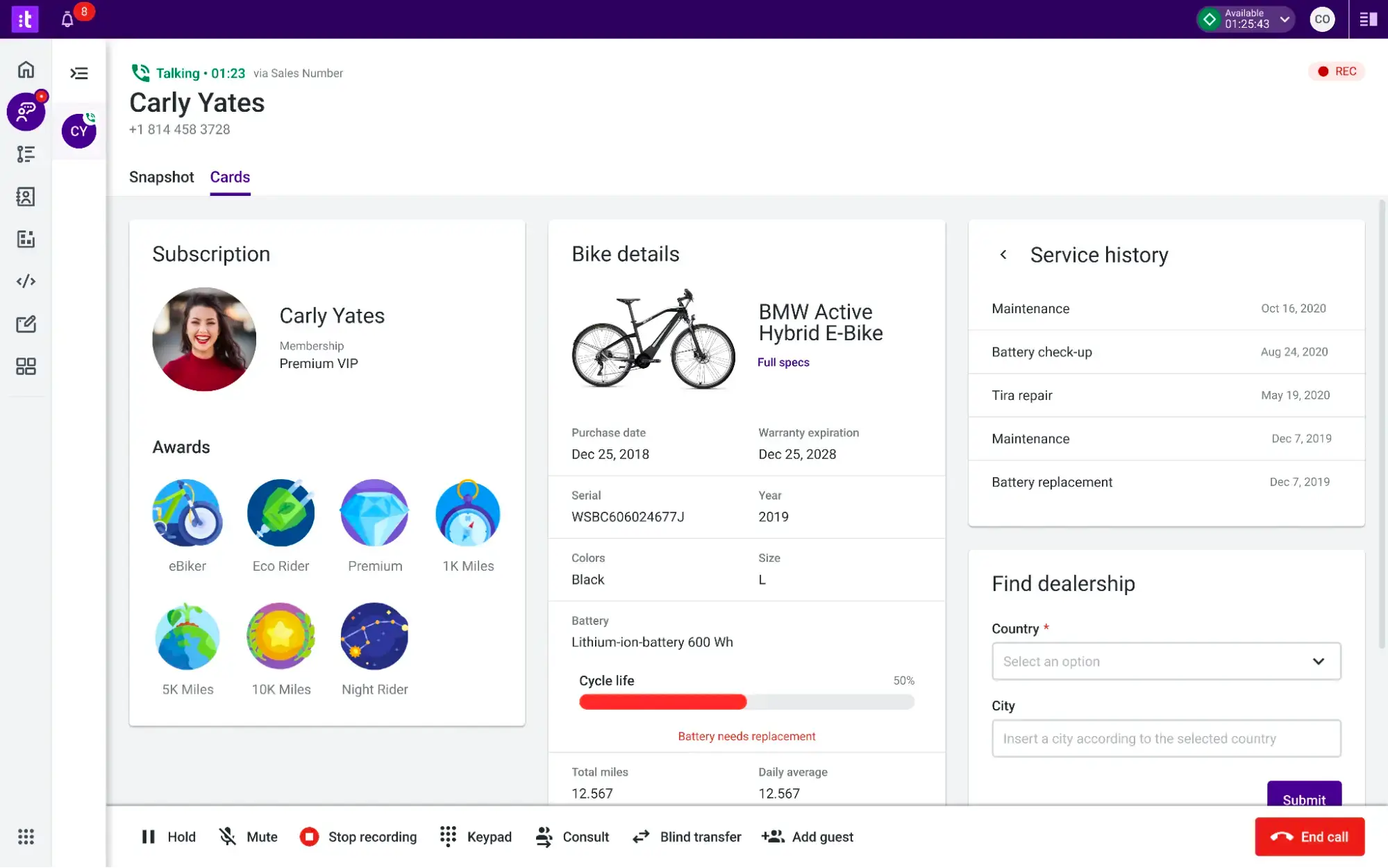
Talkdesk offers 60+ integrations, which already puts it in a credible position for mid-market and enterprise buyers. That matters because customer communication does not happen in isolation. Agents often need CRM records, case data, order context, and workflow triggers available alongside live conversations.
AppConnect marketplace and extensibility
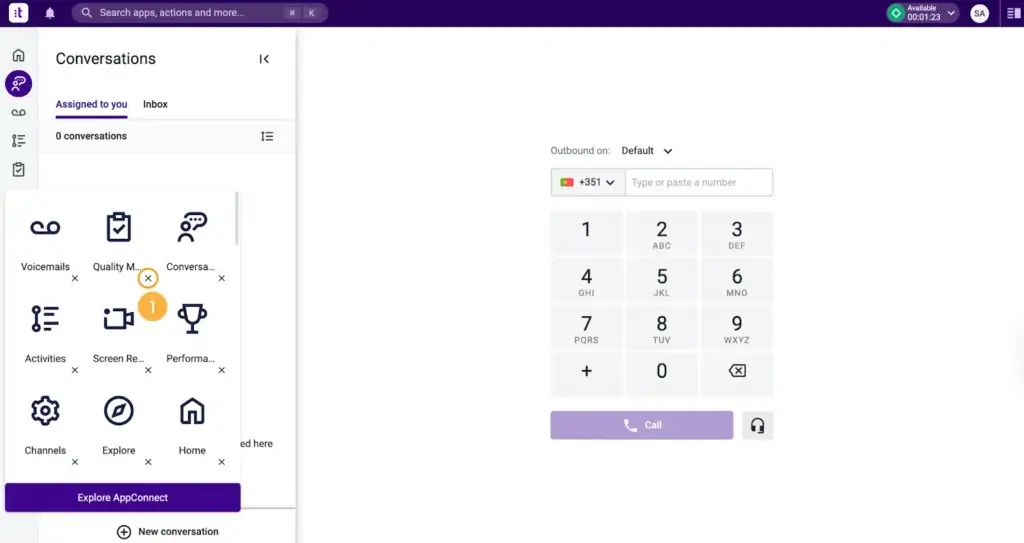
Beyond direct integrations, Talkdesk also supports AppConnect, which functions as its broader marketplace for extending contact center capabilities. That gives the product a stronger ecosystem story than newer or smaller vendors that rely on a much narrower set of native integrations. It also helps Talkdesk stay relevant in organizations where the contact center needs to plug into broader business systems.
Embedded and workflow-oriented deployment
Talkdesk also supports embedded use cases, allowing the platform to sit more naturally within the applications agents already use. This is particularly useful for larger service teams that want to reduce context switching and make the contact center feel like part of the existing workflow rather than a disconnected application.
Customer Support
How Good is Talkdesk Support
Vendor maturity and market credibility
Talkdesk benefits from being one of the better-known vendors in the CCaaS market. It also appears regularly in category-level market conversations and competitor sets, which gives buyers more confidence than they might have with a smaller or less established provider. That does not automatically mean support will be perfect, but it does suggest a higher level of operational maturity.
Where support expectations should be highest
Because Talkdesk serves serious service environments, buyers should expect responsive onboarding, documentation, and ongoing support. The product’s depth means support matters more here than it does in simpler SaaS categories. A business paying for Talkdesk is not only buying software. It is also buying a platform that needs to support critical customer-facing workflows.
Practical buyer takeaway
For most companies, the right way to evaluate Talkdesk support is not only by asking whether the vendor answers tickets quickly. It is by looking at implementation resources, documentation, integration guidance, and the quality of the sales-to-success handoff. In a product this strategic, those areas matter just as much as traditional support responsiveness.
Trust & Governance
Security, Compliance & Reliability
Security and compliance coverage
Talkdesk is one of the vendors that clearly takes trust and compliance positioning seriously. The company highlights more than 30 security certifications and standards, including SOC 2 and SOC 3, ISO 27001, PCI DSS Level 1, HIPAA, GDPR, ISO 22301, and ISO/IEC 42001 for AI governance. That breadth is particularly relevant for larger organizations and regulated industries where compliance is not optional.
Why this matters in practice
For healthcare, financial services, retail, and other regulated environments, security posture can narrow the shortlist quickly. Talkdesk’s certification depth is one of the reasons it is more credible in enterprise and industry-specific deployments than many lighter communication tools.
Reliability as part of the buying case
Strong compliance coverage does not guarantee a perfect implementation, but it does strengthen Talkdesk’s case for organizations that need secure, scalable, and governable CX infrastructure. This is one of the clearest areas where Talkdesk looks more like an enterprise platform than a standard phone vendor.
Best Use Cases
Ideal Use Cases & Industries
Best use cases
Talkdesk makes the most sense for businesses that treat customer service and support as a strategic function rather than as a simple inbound phone line. The strongest use cases include:
- Mid-market and enterprise support teams: Especially those handling high interaction volume across multiple channels.
- Organizations pursuing AI-led service efficiency: Teams that want to automate self-service and reduce repetitive agent work.
- Regulated industries: Companies in healthcare, financial services, and other compliance-heavy sectors.
- Complex customer operations: Businesses that need routing, analytics, quality management, and workforce tools in one platform.
- Globally distributed service environments: Teams that need scalable cloud infrastructure and mature contact center workflows.
Industries where Talkdesk stands out
Talkdesk actively supports industries such as financial services, healthcare, retail, government, travel and hospitality, utilities, and more. The company’s newer positioning also leans into industry-specific AI and pre-built use cases, which helps the platform feel more specialized than vendors offering only horizontal contact center tooling.
Alternatives & Competitors
How Talkdesk Compares to Alternatives
Talkdesk competes in one of the toughest categories in customer experience software, so the best choice depends on whether you prioritize AI direction, platform breadth, ecosystem maturity, or deployment style.
Five9
Five9 is one of the most direct Talkdesk competitors and is also heavily focused on AI-powered cloud contact center operations. In many evaluations, this is the closest comparison because both products are aimed at organizations that need serious CCaaS functionality instead of just communications basics. If you want a direct Talkdesk alternative with strong contact center depth, Five9 is an obvious benchmark.
Genesys Cloud CX
Genesys Cloud CX is often viewed as one of the strongest all-around enterprise competitors in the category. It brings AI, omnichannel engagement, routing, workforce engagement, and journey management into one platform. Compared with Talkdesk, Genesys may appeal more to organizations looking for very broad enterprise orchestration, while Talkdesk can feel slightly more concentrated around modern CX automation and contact center execution.
NICE CXone
NICE CXone is another heavyweight and remains a strong fit for organizations that want a highly mature AI-first customer experience platform. NICE tends to appeal to enterprises that care deeply about scale, governance, analytics, and workforce management. Compared with Talkdesk, it often feels like a choice between two premium vendors rather than between a premium and a budget option.
RingCentral RingCX
RingCX is relevant for businesses that like RingCentral’s broader communications footprint and want a contact center layer that connects well with that environment. Compared with Talkdesk, RingCX can look attractive for businesses already in the RingCentral ecosystem. Talkdesk, however, feels more clearly centered on the contact center as the main product story rather than as an adjacent communications capability.
Talkdesk Alternatives Comparison Table
| Provider | Best For | Main Strength | Positioning vs Talkdesk |
| Talkdesk | Organizations that want AI-driven CCaaS, omnichannel support, and enterprise-grade CX operations | Strong CX automation focus with AI, analytics, and workforce tools | Best fit for teams that want a modern AI-forward contact center platform |
| Five9 | Businesses wanting a direct enterprise CCaaS alternative | Strong cloud contact center and AI focus | One of the closest feature-category competitors |
| Genesys Cloud CX | Large organizations needing broad experience orchestration | Deep omnichannel, AI, journey, and WEM breadth | Often stronger on very broad enterprise platform scope |
| NICE CXone | Enterprises prioritizing AI-first scale, governance, and workforce depth | Mature AI platform and strong workforce engagement | Very strong premium-market competitor |
| RingCX | Businesses that want contact center tied to a larger communications ecosystem | AI contact center plus strong RingCentral alignment | Best when RingCentral ecosystem fit matters |
Conclusion
Final Thoughts
Talkdesk is a serious cloud contact center platform, not a lightweight business phone tool dressed up with AI. Its biggest strengths are its omnichannel support, AI-led customer experience automation, strong operational breadth, and enterprise-grade trust posture. For organizations that want to modernize customer service and reduce manual support effort, it is easy to understand why Talkdesk stays in the conversation with top-tier CCaaS vendors.
At the same time, Talkdesk is not the obvious choice for everyone. Smaller teams may find it too expensive, too complex, or simply more platform than they need. The sales-led pricing model also means you need to evaluate it more carefully than tools that publish straightforward plans for SMB buyers.
If your company needs a modern contact center with AI agents, digital engagement, agent assist, analytics, and workforce tools in one platform, Talkdesk deserves real consideration. If your needs are simpler, or if you want a lower-cost starting point, you may be better served by lighter alternatives. But for serious service teams, Talkdesk is one of the more credible platforms in the category.
Frequently Asked Questions
Have more questions?
What is Talkdesk?
Talkdesk is a cloud contact center platform, often classified as CCaaS, that helps businesses manage customer service across voice and digital channels with AI, automation, analytics, and workforce tools.
Is Talkdesk a VoIP phone system?
Talkdesk includes cloud voice capabilities, but it is more accurate to describe it as a contact center platform rather than as a basic VoIP phone system. It is built for customer-facing operations, not just business calling.
How much does Talkdesk cost?
Talkdesk officially promotes pricing that starts at $85 per seat per month, but final pricing depends on the solution, feature scope, and quote process.
What channels does Talkdesk support?
Talkdesk supports voice and digital engagement channels including SMS, email, chat, social messaging, and more.
What AI features does Talkdesk offer?
Talkdesk offers AI agents, AI-powered routing, agent assist through Copilot, automatic summaries, knowledge delivery, analytics, and AI-focused operational controls.
Is Talkdesk good for small businesses?
It can be, but it is usually a better fit for growing or larger service teams than for very small businesses with simple phone requirements.
Does Talkdesk integrate with other tools?
Yes. Talkdesk offers 60+ integrations and extends its ecosystem further through AppConnect and embedded deployment options.
Is Talkdesk secure enough for regulated industries?
Talkdesk highlights broad security and compliance coverage, including SOC 2, SOC 3, ISO 27001, PCI DSS Level 1, HIPAA, GDPR, and other certifications that support enterprise and regulated use cases.
What are the main alternatives to Talkdesk?
The most relevant alternatives include Five9, Genesys Cloud CX, NICE CXone, and RingCentral RingCX, depending on your priorities.
Is Talkdesk worth it?
If your company needs a modern contact center with AI agents, digital engagement, agent assist, analytics, and workforce tools in one platform, Talkdesk deserves real consideration. If your needs are simpler, or if you want a lower-cost starting point, you may be better served by lighter alternatives.