Introduction
Sanctions screening is one of the first controls businesses use to avoid working with restricted individuals, companies, vessels, investors, vendors, or counterparties.
In simple terms, sanctions screening means checking a person or organization against official sanctions lists and related watchlists before you onboard them, pay them, accept investment from them, sign a contract, or continue an existing relationship.
For banks, fintechs, crypto companies, marketplaces, exporters, law firms, accounting firms, procurement teams, and investors, this process is not just administrative. It is a key part of sanctions compliance, anti-money laundering controls, third-party risk management, and reputational protection.
The challenge is that sanctions screening is often misunderstood.
Some teams think it is only an OFAC screening check. Others treat it as a one-time onboarding step. Many assume that a name match automatically means the person is sanctioned, when in reality many alerts are false positives that require review.
This guide explains how sanctions screening works in plain language. You will learn who gets screened, which lists are commonly checked, why false positives happen, how PEP screening and watchlist screening fit into the process, and why ongoing monitoring is essential.
You will also learn where sanctions screening stops being enough, especially when you need deeper insight into ownership, litigation, adverse media, investor risk, and third-party relationships.
What Is Sanctions Screening?
Sanctions screening is the process of comparing names and identifying details against official sanctions lists and other restricted-party databases.
The goal is to identify whether a customer, vendor, investor, beneficial owner, counterparty, vessel, or related party may be subject to legal restrictions.
If the screening system finds a possible match, it creates an alert. A compliance analyst or risk reviewer then investigates whether the alert is a true match or a false positive.
At a basic level, sanctions screening helps you answer one question:
Are we allowed to do business with this person, company, or related party?
That answer is not always simple. A business may not appear directly on a sanctions list, but it may be owned or controlled by someone who is sanctioned. A payment may involve a sanctioned bank. A vendor may operate in a restricted region. An investor may have beneficial ownership links that require deeper review.
This is why effective sanctions screening is not just about searching one name in one database. It is about building a reliable process that checks the right parties, uses current lists, investigates potential matches, and documents decisions.
Sanctions screening in one sentence
Sanctions screening checks people, companies, transactions, and related parties against official sanctions and watchlist data so your business can identify prohibited or high-risk relationships before moving forward.
Why Sanctions Screening Matters for Businesses
Sanctions are used by governments and international bodies to restrict dealings with certain people, entities, countries, sectors, vessels, banks, and networks.
These restrictions may relate to terrorism, money laundering, corruption, human rights abuses, cybercrime, weapons proliferation, organized crime, conflict financing, or foreign policy objectives.
For your business, the risk is practical. If you onboard a sanctioned customer, pay a sanctioned vendor, accept money from a restricted investor, or work with a company controlled by a sanctioned party, you may face legal, financial, operational, and reputational consequences.
Sanctions screening helps reduce that risk by creating a repeatable control before a relationship or transaction is approved.
It is especially important if you operate across borders, process payments, manage suppliers, onboard investors, work with intermediaries, handle regulated goods, or serve customers in higher-risk sectors.
The business risks sanctions screening helps reduce
- Doing business with prohibited parties
- Processing restricted transactions
- Onboarding high-risk customers too quickly
- Missing sanctioned beneficial owners
- Delaying investigations because of poor records
- Creating reputational exposure with partners or regulators
Even when sanctions screening is not explicitly required for every company in every sector, it is increasingly expected as part of responsible counterparty due diligence.
That is why screening now appears in customer onboarding, vendor onboarding, investor vetting, M&A diligence, export control workflows, partner checks, and procurement risk reviews.
Who Gets Screened?
Sanctions screening should match the risk profile of your business. A bank will usually screen more parties and transactions than a small B2B SaaS company. An exporter may need stronger product, country, and counterparty checks than a local services company.
Still, the main screening targets are similar across many compliance programs.
Customers and clients
Customer screening is common in KYC and AML workflows. Before opening an account, approving access, or enabling transactions, you check whether the customer appears on sanctions lists or other restricted-party lists.
This can apply to individuals and companies.
For a company customer, you may also need to screen directors, officers, beneficial owners, parent entities, subsidiaries, and signatories.
Vendors and suppliers
Vendor screening helps procurement and compliance teams check whether a supplier can be safely onboarded.
This is important because vendor risk is not limited to payment fraud or service quality. A supplier may be sanctioned, linked to a sanctioned owner, operating in a restricted jurisdiction, involved in litigation, or exposed to negative media.
For more advanced workflows, vendor screening should connect with compliance software, procurement systems, and third-party risk processes.
Investors and shareholders
Investor screening is essential for funds, startups, private companies, real estate transactions, M&A teams, and regulated financial firms.
The goal is to check whether an investor is sanctioned, politically exposed, associated with adverse media, connected to restricted jurisdictions, or linked through ownership structures to higher-risk entities.
This matters because investment risk is not always visible from the name on the wire transfer. You may need to understand who ultimately controls the funds and whether there are hidden ownership or reputation concerns.
Beneficial owners and controllers
Beneficial ownership screening is one of the most important parts of a serious sanctions process.
A company may not be listed directly, but a sanctioned person may own or control it. If you only screen the legal entity name, you may miss the risk behind the company.
For higher-risk relationships, you should screen the ultimate beneficial owners, controlling shareholders, directors, officers, and related entities.
Partners, brokers, agents, and intermediaries
Third parties can create risk even when they are not direct customers or vendors.
This includes resellers, brokers, distributors, agents, introducers, local representatives, consultants, and joint venture partners.
These parties may act on your behalf, touch customers, move money, influence government relationships, or help you enter new markets. That makes them important screening targets, especially in anti-bribery, FCPA, sanctions, and export-control workflows.
What Lists Are Checked in Sanctions Screening?
A strong sanctions screening process does not rely on one list only. It checks the lists relevant to your jurisdiction, customer base, transaction routes, industry, products, and risk appetite.
For many global businesses, the baseline includes OFAC, EU, UN, and UK sanctions lists. Depending on your activity, you may also need local jurisdiction lists, export-control lists, law enforcement lists, vessel lists, and internal restricted-party lists.
| List Type | What It Covers | Why It Matters |
| OFAC screening | U.S. sanctions lists, including SDN and Non-SDN lists | Important for U.S. persons, U.S. dollar activity, and companies exposed to U.S. sanctions risk |
| EU sanctions lists | Individuals, entities, groups, and organizations subject to EU financial sanctions | Relevant for EU businesses and companies with European operations or counterparties |
| UN sanctions lists | Individuals and entities subject to UN Security Council sanctions measures | Used globally because UN measures are implemented by member states |
| UK Sanctions List | Designated people, entities, and ships under UK sanctions regulations | Relevant for UK businesses and cross-border companies with UK exposure |
| PEP databases | Politically exposed persons, family members, and close associates | Helps identify elevated corruption, bribery, and influence risk |
| Adverse media | Negative news, enforcement actions, litigation, and public-risk signals | Adds context beyond list-based screening |
OFAC screening
OFAC screening checks names against sanctions lists maintained by the U.S. Office of Foreign Assets Control.
Many businesses treat OFAC screening as the starting point because U.S. sanctions can have broad impact, especially where U.S. persons, U.S. goods, U.S. technology, U.S. banks, or U.S. dollar payments are involved.
You can review OFAC’s official Sanctions List Service and Sanctions List Search tools for official list access.
EU sanctions screening
EU sanctions screening checks whether a person, company, group, or organization is subject to EU restrictive measures.
The European Commission provides resources on EU sanctions, including the consolidated list of financial sanctions and the EU Sanctions Map.
If you operate in Europe, sell into Europe, process European transactions, or work with EU-based counterparties, EU sanctions screening should be part of your program.
UN sanctions screening
The UN Security Council maintains a consolidated sanctions list covering individuals and entities subject to Security Council measures.
You can review the official UN Security Council Consolidated List as part of a global sanctions screening approach.
UN sanctions are especially important because member states implement them through local laws and regulations.
UK sanctions screening
The UK Sanctions List includes designated people, entities, and ships subject to UK sanctions.
You can review the official UK Sanctions List and search tool when screening for UK sanctions exposure.
This is particularly relevant if you operate in the UK, use UK service providers, process UK payments, or work with UK customers, vendors, or investors.

How the Sanctions Screening Process Works
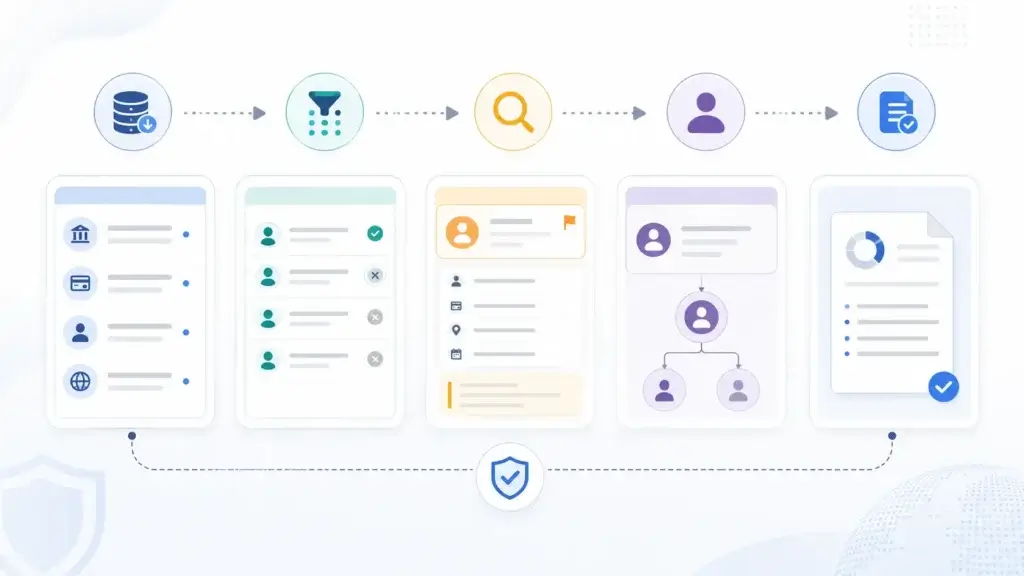
The sanctions screening process is easier to understand when you break it into practical steps.
The exact workflow depends on your business, but most programs follow the same basic pattern: collect data, screen it, review alerts, document decisions, and monitor over time.
Step 1: Collect identifying information
Screening quality starts with data quality.
For individuals, this may include full name, date of birth, nationality, address, passport number, government ID, place of birth, and known aliases.
For companies, this may include legal name, trade names, registration number, jurisdiction, address, directors, officers, subsidiaries, parent companies, beneficial owners, and website domain.
If your input data is incomplete or inconsistent, your screening results will be weaker. You may miss a true match or generate unnecessary false positives.
Step 2: Match names against sanctions and watchlists
The system compares your input data against sanctions lists, PEP data, watchlists, and other risk sources.
Modern sanctions compliance software usually uses fuzzy matching, name normalization, transliteration, alias detection, and configurable thresholds.
This matters because names can appear differently across languages, scripts, documents, and databases.
For example, a name translated from Arabic, Cyrillic, Hebrew, or Chinese may appear in several spellings. A company may use abbreviations, trade names, subsidiaries, or old legal names.
Step 3: Generate alerts for possible matches
If the system finds a potential match, it creates an alert.
An alert does not automatically mean the person or company is sanctioned. It means the system found enough similarity to require review.
Good screening tools should show why the alert was created, which list generated the match, what fields matched, what confidence score was assigned, and what information is missing.
Step 4: Investigate and resolve alerts
A compliance reviewer investigates the alert using available identifiers.
For an individual, the reviewer may compare name, date of birth, nationality, address, passport details, and aliases.
For a company, the reviewer may compare registration number, jurisdiction, address, directors, ownership, subsidiaries, and business activities.
The reviewer then decides whether the alert is a false positive, possible match, true match, or escalation case.
Step 5: Escalate true matches and high-risk cases
If the review suggests a true match, the case should be escalated according to your internal sanctions policy.
Depending on your jurisdiction and business type, this may involve blocking a transaction, freezing assets, rejecting onboarding, notifying legal counsel, filing a report, or contacting the relevant authority.
Do not rely on a blog article for case-specific legal decisions. When a true match is possible, involve qualified compliance and legal professionals.
Step 6: Document the decision
Documentation is a major part of sanctions compliance.
You should keep a clear record of the screened party, lists checked, date of screening, alert details, reviewer notes, evidence reviewed, final decision, and escalation outcome.
This helps you demonstrate that the decision was not arbitrary. It also helps future reviewers understand why a case was cleared or escalated.
OFAC Screening vs PEP Screening vs Watchlist Screening
Sanctions screening often appears alongside OFAC screening, PEP screening, watchlist screening, and adverse media screening.
These terms are related, but they are not identical.
OFAC screening
OFAC screening focuses on U.S. sanctions lists.
This includes checking whether a person, company, vessel, aircraft, group, or other party appears on OFAC-administered sanctions lists.
OFAC screening is critical for U.S. businesses and non-U.S. businesses with U.S. touchpoints, but it should not be your only screening layer if you operate globally.
PEP screening
PEP screening checks whether a person is a politically exposed person, a close family member of a PEP, or a close associate of a PEP.
A PEP is not automatically suspicious. The point is that public position, influence, or proximity to power can increase exposure to bribery, corruption, money laundering, and conflicts of interest.
FATF guidance explains that PEP requirements are preventive, not criminal, in nature. That distinction is important for fair and risk-based decision-making.
You can learn more from FATF’s official guidance on politically exposed persons.
Watchlist screening
Watchlist screening is broader than sanctions screening.
It may include sanctions lists, law enforcement lists, wanted-person lists, regulatory enforcement lists, export-control lists, internal blocklists, and jurisdiction-specific risk lists.
For many compliance teams, watchlist screening gives a wider view of risk than sanctions screening alone.
Adverse media screening
Adverse media screening checks public sources for negative news or risk signals.
This may include allegations, investigations, lawsuits, regulatory actions, fraud claims, corruption reports, organized crime links, financial crime concerns, environmental violations, or human rights issues.
Adverse media is not the same as an official sanctions hit, but it can help you decide whether a customer, vendor, or investor requires enhanced due diligence.
For a deeper comparison of due diligence levels, you can connect this topic with your guide on CDD vs EDD.
Why False Positives Happen in Sanctions Screening
A false positive happens when a screening system flags a possible match, but the person or company is not actually the sanctioned or restricted party.
False positives are common because screening systems are designed to be cautious. If the system is too strict, it may miss real risk. If it is too broad, it may create too many alerts.
The goal is not to eliminate every false positive. The goal is to reduce unnecessary noise while still catching meaningful risk.
Common reasons for false positives
- Common names shared by many people
- Partial name matches
- Different spelling variations
- Transliteration between alphabets
- Missing dates of birth or ID numbers
- Old company names or aliases
- Weak customer data quality
- Overly broad matching thresholds
For example, a customer named “Mohammed Hassan” may trigger several possible matches because the name is common and appears in multiple variations across different lists.
That does not mean the customer is sanctioned. It means your reviewer needs more context, such as date of birth, nationality, passport number, address, or company registration data.
Why false positives are more than an inconvenience
False positives slow down onboarding, delay payments, increase manual review work, and frustrate sales, finance, procurement, and operations teams.
They also create compliance risk when teams become overwhelmed by low-quality alerts.
If analysts are forced to review too many weak matches, they may miss the alert that actually matters. That is why sanctions compliance software should help prioritize alerts, explain confidence levels, and provide enough context for fast review.
Why Ongoing Monitoring Matters
Sanctions screening should not end after onboarding.
Sanctions lists change. Customers change. Companies change owners. Vendors expand into new regions. Investors transfer shares. Directors resign. New adverse media appears. A counterparty that was low risk six months ago may become higher risk after a new designation, acquisition, enforcement action, or ownership change.
Ongoing monitoring helps you detect these changes after the initial approval.
When ongoing screening should happen
For lower-risk relationships, periodic re-screening may be enough. For higher-risk relationships, ongoing or event-triggered monitoring is stronger.
Common triggers include:
- Sanctions list updates
- New transactions or payments
- Ownership changes
- New directors or signatories
- Country or address changes
- Negative news events
- Annual customer reviews
- Renewal of vendor contracts
Ongoing monitoring is especially important for high-risk third parties, investors, intermediaries, international suppliers, politically exposed persons, and counterparties in complex ownership structures.
This is also where sanctions screening connects naturally with enhanced due diligence. Screening tells you whether a clear list-based risk exists. EDD helps you understand the broader risk context.
What Sanctions Compliance Software Should Include
Manual screening may work for a small number of checks, but it becomes difficult to scale as your customer, vendor, and investor volume grows.
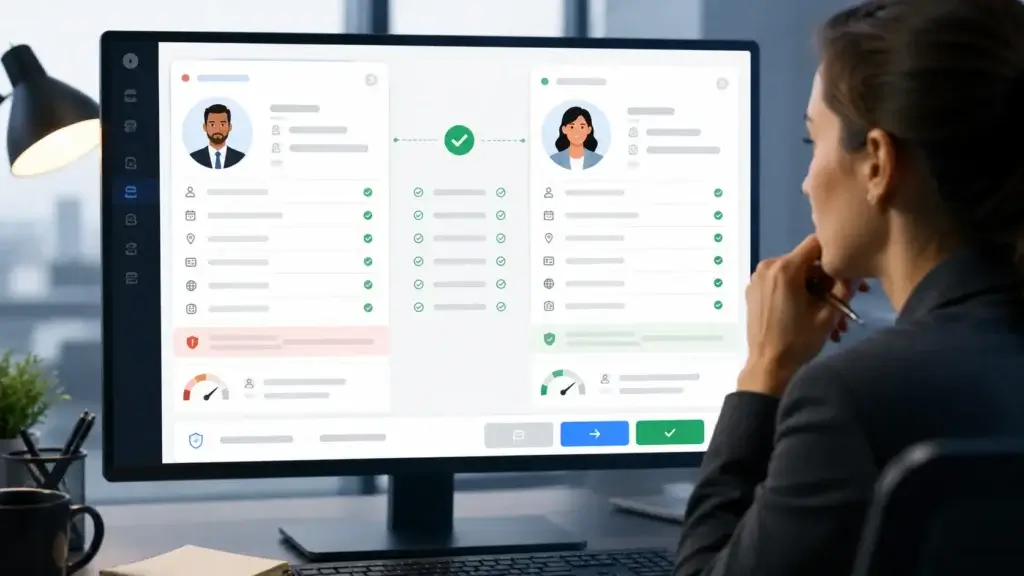
Sanctions compliance software helps automate screening, centralize alerts, reduce false positives, and create an audit trail.
The best tool for your business depends on your workflow. A fintech may need real-time API screening. A procurement team may need vendor batch screening. A fund may need investor due diligence reports. A law firm may need matter-level documentation.
Core features to look for
- OFAC, EU, UN, UK, and local list coverage
- PEP screening and close associate checks
- Adverse media screening
- Fuzzy matching and alias detection
- Beneficial ownership screening
- Batch screening for vendors or portfolios
- API access for onboarding workflows
- Case management and reviewer notes
- Confidence scoring and match explanations
- Audit-ready reports and exportable evidence
A good system should not only tell you that a match exists. It should help you understand why the match was created, how strong the match is, what evidence supports it, and what action should happen next.
Real-time API screening vs batch screening
Real-time API screening is useful when you need to check a party instantly inside onboarding, payments, signup, investment intake, or vendor approval workflows.
Batch screening is useful when you need to check many records at once, such as a vendor database, customer list, shareholder register, or portfolio of acquisition targets.
Many mature compliance programs use both. Real-time checks protect new activity. Batch and ongoing monitoring protect existing relationships.
When Sanctions Screening Is Not Enough
Sanctions screening is essential, but it is not a complete due diligence process.
A clean sanctions result does not prove that a customer, vendor, investor, or acquisition target is low risk. It only means the party did not produce a confirmed sanctions match based on the lists and data checked.
That distinction matters.
A company may clear sanctions screening but still have hidden beneficial ownership risk, litigation exposure, regulatory enforcement history, adverse media, corruption concerns, political exposure, bankruptcy issues, shell-company structures, or high-risk third-party connections.
This is where you need a deeper due diligence layer.
Where DueVestor fits
DueVestor is a strong fit when sanctions screening is only the starting point and your team needs a fuller, evidence-cited risk view.
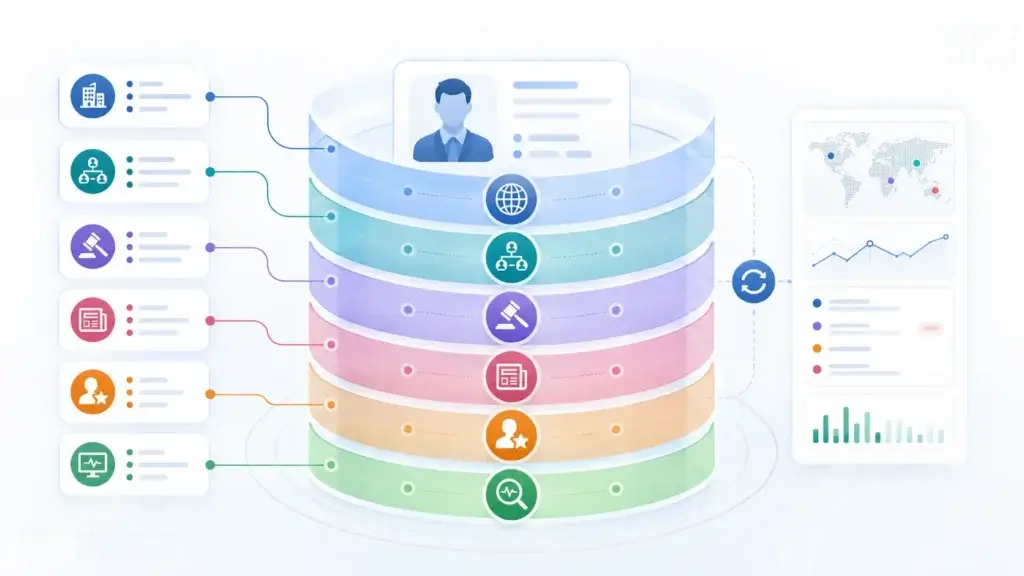
Its API is positioned for compliance teams that need more than raw list feeds. It layers sanctions screening with registry data, PEP screening, litigation checks, adverse media, confidence grading, and structured report output.
That makes it especially useful for investor vetting, M&A diligence, vendor onboarding, partner onboarding, and third-party risk review.
For example, a simple sanctions tool may tell you that a company does not appear on OFAC, EU, UN, or UK lists. DueVestor can help you go further by looking at ownership, litigation, adverse media, and broader risk indicators in a structured dossier.
This is useful when you need to show your decision to counsel, a board, an investment committee, a compliance officer, or a regulator.
Practical DueVestor use cases
- Screening investors before accepting funds
- Checking acquisition targets before term sheets
- Reviewing vendors before onboarding
- Vetting brokers, agents, and distributors
- Creating evidence-backed compliance reports
- Escalating high-risk names for deeper review
In my view, DueVestor is best positioned for teams that want screening plus explainable due diligence. If you only need a basic name check, a lighter sanctions screening tool may be enough. If you need a board-ready or compliance-ready risk file, DueVestor is more relevant because it connects screening with evidence, ownership context, and report output.
Best Practices for Sanctions Screening
A sanctions screening program should be practical, risk-based, and documented.
You do not need to make every workflow unnecessarily complex. You do need to make sure the process is clear enough to apply consistently and strong enough to handle higher-risk relationships.
1. Start with a risk-based approach
Not every customer, vendor, or investor presents the same level of risk.
A local low-value vendor may not need the same review as a cross-border intermediary in a high-risk jurisdiction. A small customer using a free account may not need the same depth as an investor wiring significant funds into a private company.
Use risk factors such as geography, transaction size, industry, ownership complexity, payment route, product type, and relationship role to decide the right screening depth.
2. Screen more than the legal entity name
Screening only the company name is often not enough.
For higher-risk relationships, screen beneficial owners, directors, officers, signatories, parent companies, subsidiaries, and key related parties.
This helps reduce the risk of missing indirect sanctions exposure.
3. Keep data clean and complete
Poor data creates poor screening results.
Collect enough identifiers to separate real matches from false positives. For individuals, dates of birth and nationality can be especially helpful. For companies, registration numbers and jurisdiction can make investigations faster.
If your onboarding forms collect weak data, your sanctions process will produce weak results.
4. Use clear alert escalation rules
Your team should know what happens when an alert appears.
Define who reviews the alert, what evidence they must check, when legal or compliance leadership must be involved, and what actions are required for a possible true match.
This prevents inconsistent decisions and reduces the chance that risky cases are handled casually.
5. Maintain an audit trail
Every screening decision should be documented.
A strong audit trail includes the screened party, list sources, match details, reviewer notes, supporting evidence, final decision, and date of resolution.
This is especially important when a false positive is cleared. If the same name appears again later, reviewers should understand why it was previously cleared.
6. Review and test your screening setup
Sanctions compliance software should not be treated as a set-and-forget tool.
Review matching thresholds, list coverage, false positive rates, escalation times, and reviewer decisions. Test whether your system catches known examples and whether list updates are flowing into your workflow properly.
If you see too many weak alerts or too few alerts in high-risk areas, your settings may need adjustment.
Sanctions Screening Checklist
You can use this simple checklist to review whether your current process covers the basics.
- Define which sanctions regimes apply to your business
- Collect reliable identifying data before screening
- Screen customers, vendors, investors, and beneficial owners
- Check OFAC, EU, UN, UK, and relevant local lists
- Add PEP screening for higher-risk relationships
- Use adverse media screening where context matters
- Investigate alerts before making final decisions
- Document false positives and true matches
- Re-screen parties when lists or profiles change
- Escalate complex cases to compliance or legal teams
This checklist should be adapted to your business model. A regulated financial institution will need more formal controls than a non-regulated company doing basic vendor checks. Still, the principles are similar: know who you are dealing with, screen them against relevant lists, document decisions, and monitor for change.
Final Thoughts
Sanctions Screening Is a Starting Point, Not the Whole Due Diligence File
Sanctions screening is one of the most important compliance controls for businesses that onboard customers, approve vendors, review investors, process payments, or work with third parties.
It helps you identify whether a person, company, vessel, or related party may be restricted under OFAC, EU, UN, UK, or other sanctions regimes.
However, sanctions screening should not be treated as a complete risk review.
A clean sanctions result does not automatically mean the party is safe. It may simply mean there is no confirmed list-based match. You may still need to review beneficial ownership, PEP exposure, litigation history, adverse media, regulatory actions, and hidden third-party links.
For basic onboarding, sanctions compliance software can help automate screening and reduce manual work. For higher-risk customers, vendors, investors, and acquisition targets, deeper due diligence is often the better approach.
That is where tools like DueVestor can add value. By combining sanctions screening with ownership checks, litigation, adverse media, confidence grading, and structured report output, it helps teams move from simple list matching to evidence-backed risk decisions.
In 2026, the strongest compliance teams will not rely on screening alone. They will use sanctions screening as the first layer, then apply deeper due diligence when the relationship, transaction, or counterparty deserves more scrutiny.
FAQs
What is sanctions screening?
Sanctions screening is the process of checking individuals, companies, transactions, vessels, and related parties against official sanctions lists and watchlists to identify restricted or high-risk relationships.
What is OFAC screening?
OFAC screening checks names against sanctions lists maintained by the U.S. Office of Foreign Assets Control, including the SDN List and Non-SDN sanctions lists.
Who should be screened for sanctions?
Businesses commonly screen customers, vendors, suppliers, investors, beneficial owners, directors, officers, agents, brokers, distributors, and other third parties involved in a relationship or transaction.
Which sanctions lists are commonly checked?
Common sanctions screening sources include OFAC lists, EU financial sanctions lists, the UN Security Council Consolidated List, the UK Sanctions List, and relevant local or sector-specific lists.
What is PEP screening?
PEP screening checks whether a person is a politically exposed person, a close family member, or a close associate. It helps identify elevated corruption, bribery, and influence risk.
What is watchlist screening?
Watchlist screening is broader than sanctions screening. It may include sanctions lists, law enforcement lists, regulatory lists, export-control lists, internal blocklists, and other restricted-party sources.
Why do false positives happen in sanctions screening?
False positives happen when a name partially matches a listed party but is not the same person or company. Common causes include shared names, spelling variations, aliases, missing data, and transliteration differences.
Is sanctions screening required only during onboarding?
No. Sanctions screening should also happen during ongoing monitoring, periodic reviews, list updates, transactions, ownership changes, and other risk-triggering events.
Does a clean sanctions result mean a party is low risk?
Not necessarily. A clean sanctions result only means there is no confirmed sanctions match based on the lists and data checked. You may still need to review ownership, litigation, PEP exposure, and adverse media.
When should a business use deeper due diligence software?
A business should use deeper due diligence software when screening investors, acquisition targets, high-risk vendors, intermediaries, or complex companies where ownership, litigation, adverse media, and evidence-backed reporting matter.