Introduction
Choosing the best due diligence software can directly affect how quickly your team evaluates customers, investors, acquisition targets, vendors, agents, distributors, and other high-risk business relationships.
The challenge is that due diligence software is not one narrow category. Some platforms help you generate compliance reports. Others manage M&A request lists, secure deal documents, screen third parties, map ownership structures, or report risk to executives and the board.
This difference matters because a compliance team does not always need the same tool as a private equity firm, corporate development team, procurement department, or board governance team.
In this guide, you’ll compare 7 of the best due diligence software platforms for compliance and M&A in 2026: DueVestor, DealRoom, Datasite, Ethixbase360, Exiger, Sayari, and Diligent.
DueVestor ranks first because it fits a clear buyer need: autonomous due diligence reports. It offers multiple report types, including Compliance Summary reports, Enhanced Due Diligence reports, self-attested compliance dossiers, and FCPA Third-Party Vetting. That makes it especially useful when you need a structured, evidence-backed report rather than only a data room or screening alert.
The goal is simple: help you choose the right due diligence software based on your workflow, risk level, team structure, compliance requirements, M&A process, and reporting needs.
Related reading: You may also want to read our guides on enhanced due diligence, CDD vs EDD, sanctions screening, and adverse media screening.
What Is Due Diligence Software?
Due diligence software helps you investigate, verify, document, and monitor business risk before entering a relationship or transaction.
You might use it to check a company, individual, investor, supplier, customer, broker, distributor, acquisition target, or strategic partner. The software helps centralize information that would otherwise be scattered across registries, search engines, spreadsheets, emails, screening tools, legal databases, and data rooms.
Due diligence software vs virtual data rooms
A virtual data room is mainly used to store, organize, and securely share sensitive documents during a transaction. It is especially common in M&A, fundraising, legal review, audits, and complex business deals.
Due diligence software is broader. It may include screening, ownership checks, sanctions and PEP review, adverse media screening, litigation checks, third-party questionnaires, report generation, risk scoring, and ongoing monitoring.
The two categories can overlap, but they are not the same. DealRoom and Datasite are stronger when the workflow is document-heavy M&A diligence. DueVestor is stronger when the output you need is a structured due diligence report.
Due diligence software vs third-party risk management
Third-party risk management software focuses on managing vendors, suppliers, agents, distributors, and other external relationships over time.
That usually includes onboarding, questionnaires, risk scoring, screening, approvals, monitoring, remediation, and periodic review. Ethixbase360, Exiger, and Diligent are especially relevant for this type of ongoing third-party risk workflow.
Due diligence software can be used before onboarding, during onboarding, or as part of ongoing monitoring. The right tool depends on whether you need a report, a workflow system, a data room, or a broader GRC platform.
What to Look for in the Best Due Diligence Software
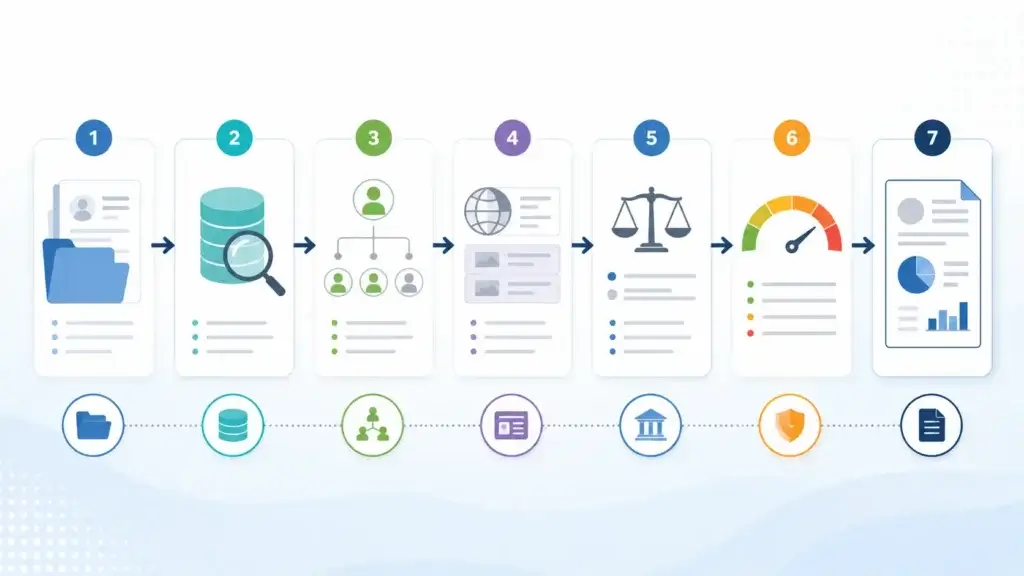
Before comparing platforms, focus on the criteria that determine whether the software will actually improve your workflow.
- Workflow fit – Does the tool support compliance reports, M&A diligence, third-party risk, or governance?
- Screening coverage – Does it support sanctions, PEP, adverse media, watchlists, litigation, or registry checks?
- Ownership visibility – Can it identify beneficial owners, related entities, subsidiaries, and network risk?
- Evidence quality – Can your team review sources, findings, risk flags, and rationale?
- Report output – Can you generate a shareable file for internal review, audit, investors, or board reporting?
- M&A support – Does it include secure document sharing, request tracking, Q&A, and permissions?
- Ongoing monitoring – Can it detect new risks after the initial review?
- Ease of use – Can business users operate it, or does it require specialist analysts?
- Pricing model – Does it charge per report, seat, data room, module, third party, or enterprise plan?
With those criteria in mind, here are the top due diligence software platforms for compliance and M&A in 2026.
Best Due Diligence Software Compared
The table below gives you a quick overview before you dive into the detailed reviews.
| Tool | Best For | Due Diligence Type | Ease of Use | Best Team Fit | Main Limitation |
| DueVestor | Autonomous due diligence reports | Report-based compliance and risk review | Easy to medium | Compliance, legal, investors, M&A teams | Not a full virtual data room |
| DealRoom | M&A due diligence project management | Deal workflow and request tracking | Medium | Corporate development, PE, M&A advisors | Not built primarily for compliance investigations |
| Datasite | Enterprise virtual data room diligence | Secure document disclosure and Q&A | Medium | Investment banks, law firms, enterprise M&A | Less focused on risk report generation |
| Ethixbase360 | Third-party anti-bribery compliance | Third-party risk management | Medium | Compliance and procurement teams | May be too broad for one-off reports |
| Exiger | AI-driven third-party and supply chain risk | Risk intelligence and monitoring | Medium to advanced | Large enterprises and regulated industries | Can be complex for smaller teams |
| Sayari | Corporate ownership and counterparty intelligence | Ownership graph and entity intelligence | Medium | Investigations, AML, procurement, compliance | Requires analyst review for deeper investigations |
| Diligent | Governance, risk, and board workflows | GRC and third-party oversight | Medium | Boards, risk, audit, compliance teams | Not a focused M&A data room |
DueVestor

DueVestor is my top recommendation for the best due diligence software because it is built around autonomous due diligence reports rather than only dashboards, alerts, or document storage.
This is important because many compliance and deal teams do not only need raw data. They need a clear report they can review, share, compare, and keep as evidence for a decision. DueVestor fits that workflow well because it offers different report types for different risk levels.
The platform is especially relevant for investor vetting, M&A screening, high-risk third-party review, partner onboarding, broker checks, distributor reviews, and compliance summaries.
Core features and capabilities
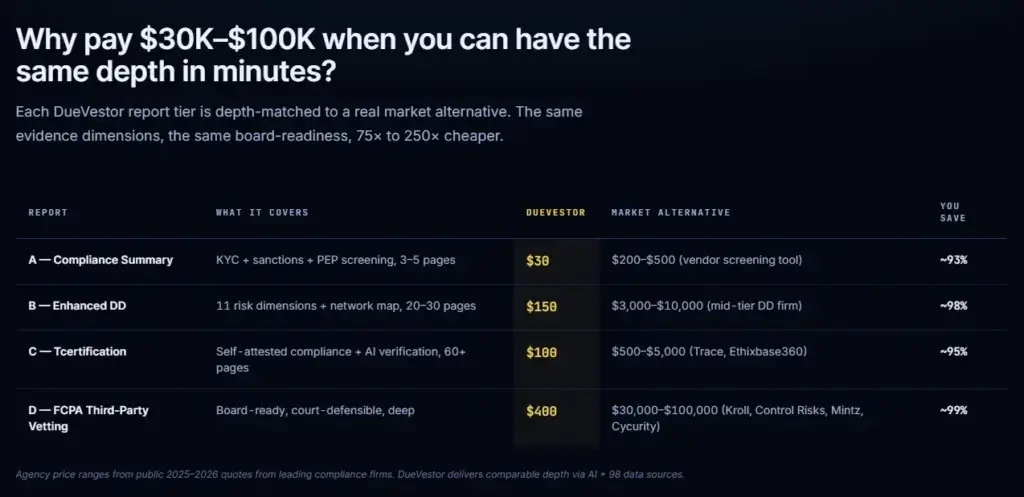
- Compliance Summary reports – KYC, sanctions, and PEP screening for quick checks.
- Enhanced Due Diligence reports – Deeper risk analysis across multiple dimensions.
- Self-attested compliance dossiers – Structured compliance files with verification layers.
- FCPA Third-Party Vetting – Deeper review for agents, brokers, distributors, and intermediaries.
- Risk matrix output – Helps teams compare findings and escalation levels.
- API-focused automation – Supports automated screening and risk data workflows.
Ideal use cases
DueVestor is strongest when you need a structured due diligence file. It is a strong fit for compliance teams that need to check companies or individuals quickly, but still want more context than a simple sanctions alert.
For example, you can use DueVestor to run a quick compliance summary on a potential investor, generate an Enhanced Due Diligence report for a higher-risk acquisition target, or perform FCPA-style vetting on a third-party intermediary.
Strengths and limitations
Strengths:
- Excellent fit for autonomous due diligence reports.
- Useful for compliance, legal, investor, and M&A screening workflows.
- Multiple report depths make it easier to match review effort to risk.
- Strong fit for sanctions, PEP, adverse media, litigation, and ownership review.
- Practical alternative to fully manual diligence research.
Limitations:
- Not a full virtual data room for hosting thousands of deal documents.
- Less focused on M&A task management than DealRoom.
- Not a complete board governance and GRC suite like Diligent.
Pricing and plans
DueVestor uses report-based pricing. Its public page lists Compliance Summary reports at $30, Enhanced Due Diligence reports at $150, self-attested compliance reports at $100, and FCPA Third-Party Vetting at $400.
This pricing model is one of the reasons DueVestor fits teams that want cost-controlled due diligence output without committing to a large enterprise platform upfront.
DealRoom

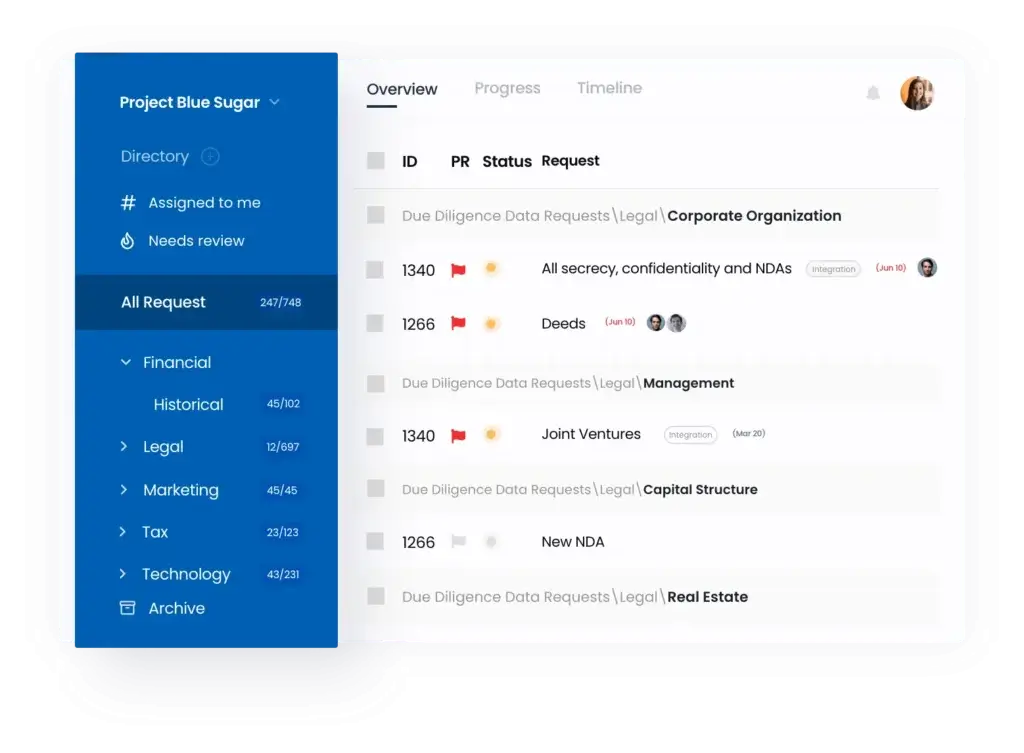
DealRoom is one of the best due diligence software platforms for M&A teams that need to manage the diligence process, not just store files.
The platform combines virtual data room functionality with diligence request tracking, document collaboration, and deal workflow management. This makes it especially useful for corporate development teams, private equity firms, investment bankers, and M&A advisors.
Core features and capabilities
- Virtual data room – Store, share, and collaborate on sensitive deal documents.
- Diligence request tracking – Link documents to requests and reduce spreadsheet-based tracking.
- Granular permissions – Control who can view, download, or edit deal files.
- AI document analysis – Help teams search and review information faster.
- Version control – Track updates and changes during the diligence process.
- M&A workflow support – Keep documents, requests, and deal activity connected.
Ideal use cases
DealRoom is ideal for buy-side and sell-side diligence where many stakeholders need to review documents, answer questions, track requests, and manage deadlines.
It is particularly helpful when your current process depends on a mix of spreadsheets, emails, file folders, and separate project management tools.
Strengths and limitations
Strengths:
- Strong fit for M&A due diligence coordination.
- Combines data room functionality with request tracking.
- Useful for deal teams that need accountability and structure.
- Granular permissions support sensitive document sharing.
- Better for M&A workflows than general compliance tools.
Limitations:
- Not built primarily for sanctions, PEP, or adverse media investigations.
- Less useful if you only need a one-off compliance report.
- Best value depends on running a structured M&A process.
Pricing and plans
DealRoom pricing is typically demo-based and depends on the product package, data room needs, deal volume, and organization size. Teams should request pricing based on whether they need the VDR, diligence management, pipeline management, or broader M&A lifecycle features.
Datasite

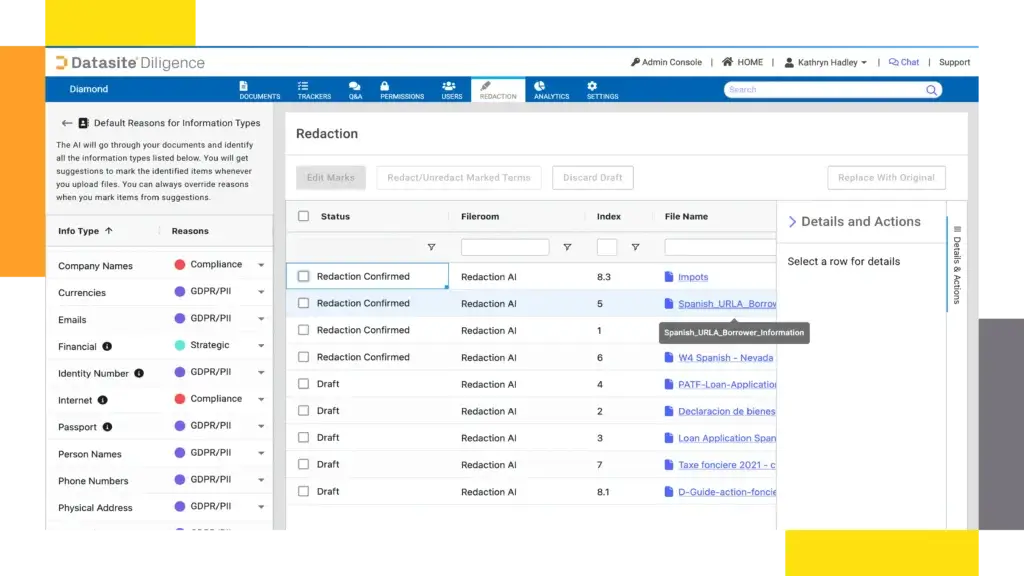
Datasite is one of the strongest options for enterprise M&A teams that need a mature virtual data room for due diligence.
It is built for secure document sharing, Q&A, deal preparation, buyer review, activity tracking, and large transaction workflows. That makes it a natural fit for investment banks, law firms, private equity firms, and enterprise corporate development teams.
Core features and capabilities
- Enterprise VDR – Securely manage sensitive documents for high-stakes transactions.
- M&A due diligence support – Facilitate information exchange and review during deals.
- Q&A workflow – Manage buyer questions and responses during diligence.
- Permissioned access – Control who can see and interact with deal materials.
- Deal preparation tools – Help sellers prepare documents and manage disclosure.
- AI-enabled deal workflows – Support faster review and document handling.
Ideal use cases
Datasite is ideal when your main due diligence challenge is secure document disclosure at enterprise scale.
If your deal involves sensitive financial records, legal documents, contracts, HR files, intellectual property, tax documents, and bidder review, Datasite is a strong platform to consider.
Strengths and limitations
Strengths:
- Excellent fit for enterprise M&A data rooms.
- Strong for secure document review and buyer access control.
- Useful for investment banks, law firms, and large deal teams.
- Supports formal transaction workflows.
- Good option for complex sell-side diligence.
Limitations:
- Not primarily designed for autonomous compliance reports.
- May be more than smaller teams need.
- Requires a separate risk intelligence tool for deeper screening workflows.
Pricing and plans
Datasite pricing is typically quote-based. Cost usually depends on project scope, deal size, data room requirements, users, storage, and transaction complexity.
Ethixbase360
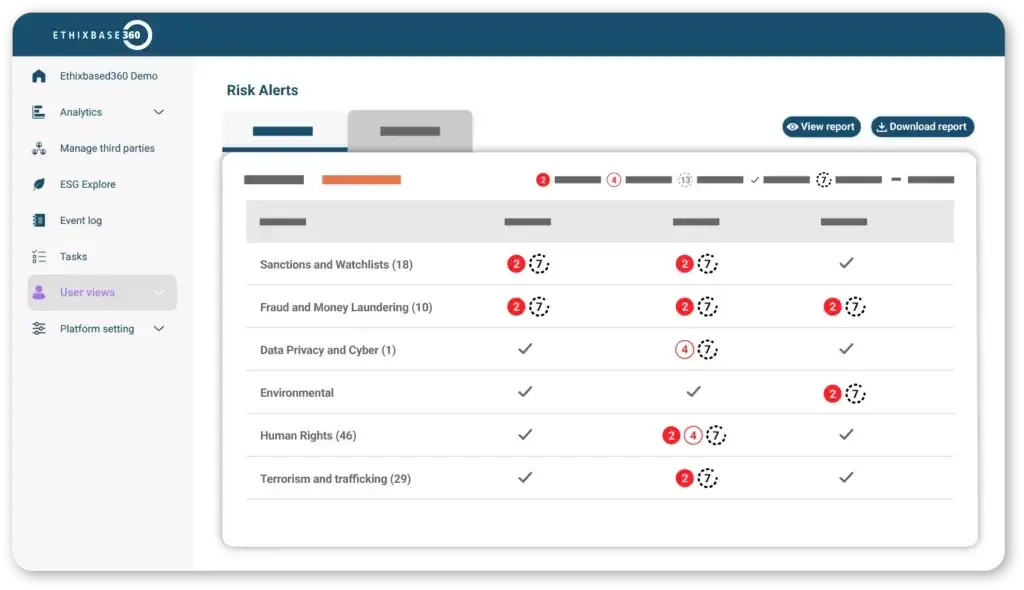
Ethixbase360 is one of the best due diligence software platforms for third-party anti-bribery, corruption, supplier, ESG, modern slavery, and human rights risk workflows.
It is not a traditional M&A data room. It is better understood as an integrated third-party risk management platform for companies that need to onboard, assess, monitor, and offboard third parties in a structured way.
Core features and capabilities
- Third-party onboarding – Centralize third-party intake and risk review.
- Risk assessment workflows – Assess vendors, suppliers, agents, and partners.
- Anti-bribery and corruption coverage – Support ABAC-focused due diligence programs.
- Monitoring and mitigation – Track third-party risk after onboarding.
- Multi-domain risk coverage – Support compliance, cyber, modern slavery, human rights, sustainability, and operational risk.
- Defensible decision-making – Keep third-party risk records organized for review.
Ideal use cases
Ethixbase360 is ideal for companies that manage large third-party networks across different countries, risk profiles, and compliance obligations.
It is especially relevant for compliance teams that need repeatable third-party due diligence rather than occasional one-off checks.
Strengths and limitations
Strengths:
- Strong fit for third-party anti-bribery and corruption programs.
- Useful for supplier, vendor, agent, and distributor reviews.
- Supports onboarding, assessment, monitoring, and offboarding.
- Good for multi-domain third-party risk management.
- Better for ongoing programs than manual spreadsheets.
Limitations:
- Not primarily an M&A virtual data room.
- May be too broad for one-off due diligence reports.
- Implementation may require workflow planning and internal process design.
Pricing and plans
Ethixbase360 pricing is typically quote-based. Pricing depends on modules, number of third parties, risk domains, monitoring needs, and implementation scope.
Exiger

Exiger is a strong option for large organizations that need AI-driven third-party risk management, supply chain visibility, risk intelligence, and due diligence workflows.
It is especially relevant for global enterprises, government contractors, regulated industries, procurement teams, and compliance teams managing complex supplier networks.
Core features and capabilities
- Third-party risk management – Support onboarding, risk ranking, monitoring, and remediation.
- Supply chain risk visibility – Identify risks across multi-tier supplier ecosystems.
- Enhanced due diligence – Escalate high-risk entities for deeper review.
- Continuous monitoring – Track third-party and supplier risk over time.
- Executive reporting – Use dashboards and reporting for risk oversight.
- AI-native risk platform – Apply automation and intelligence to risk-heavy workflows.
Ideal use cases
Exiger is ideal when risk is spread across a large vendor, supplier, customer, agent, or partner ecosystem.
Use it when your team needs to manage sanctions exposure, geopolitical risk, ESG risk, forced labor risk, cyber risk, supplier disruption, and third-party compliance in a connected way.
Strengths and limitations
Strengths:
- Strong fit for enterprise third-party risk and supply chain programs.
- Useful for continuous monitoring and deeper risk intelligence.
- Good for regulated industries and global organizations.
- Supports risk-based escalation and enhanced due diligence.
- Broader risk coverage than basic screening tools.
Limitations:
- May be too complex for small teams.
- Not designed as a traditional M&A data room.
- Can require more implementation resources than report-first platforms.
Pricing and plans
Exiger pricing is typically quote-based and depends on the products, risk coverage, third-party volume, data needs, monitoring requirements, and implementation scope.
Sayari

Sayari is one of the best due diligence software options for teams that need corporate ownership intelligence, counterparty research, and entity relationship mapping.
It is especially useful when the main question is not simply “Is this company on a list?” but “Who owns this company, what is it connected to, and where is the hidden risk?”
Core features and capabilities
- Ownership intelligence – Analyze corporate ownership and control relationships.
- Entity graph – Explore connections between companies, people, trade records, and related entities.
- Counterparty risk – Evaluate customers, vendors, suppliers, and business partners.
- Beneficial ownership support – Help teams understand indirect ownership links.
- Economic security intelligence – Support sanctions, export controls, forced labor, and trade risk workflows.
- Evidence-backed research – Give analysts more traceability than basic search.
Ideal use cases
Sayari is ideal for financial crime teams, compliance analysts, procurement teams, supply chain risk teams, and organizations that need to investigate complex corporate structures.
It is especially useful for enhanced due diligence, sanctions exposure analysis, supplier risk, foreign ownership checks, and counterparty investigations.
Strengths and limitations
Strengths:
- Excellent fit for corporate ownership and entity intelligence.
- Useful for hidden relationship and counterparty risk analysis.
- Strong for complex ownership structures across jurisdictions.
- Good fit for AML, sanctions, supply chain, and procurement use cases.
- Supports analyst-led investigations with traceable data.
Limitations:
- Not a virtual data room.
- Not designed as a simple report-ordering platform.
- Best results may require analysts who understand entity research.
Pricing and plans
Sayari pricing is typically quote-based and depends on the data access, team size, modules, use case, and enterprise requirements.
Diligent

Diligent is best for organizations that want due diligence connected to broader governance, risk, compliance, audit, board reporting, and third-party oversight.
It is not the most focused option for a one-off report or M&A data room. Its strength is helping companies centralize risk and governance activity across the organization.
Core features and capabilities
- GRC platform – Centralize governance, risk, and compliance activities.
- Board management – Connect risk insights to board-level decision-making.
- Third-party risk management – Assess, monitor, and mitigate vendor risk.
- Audit and controls – Support internal audit, controls, evidence, and compliance tracking.
- Executive dashboards – Give leadership a consolidated view of risk.
- Enterprise oversight – Connect risk workflows across teams and departments.
Ideal use cases
Diligent is ideal for enterprises that need due diligence findings to flow into governance, board materials, audit reporting, compliance programs, and executive risk oversight.
It is especially relevant for boards, general counsel, risk leaders, audit teams, compliance officers, and companies with mature governance requirements.
Strengths and limitations
Strengths:
- Strong fit for governance, risk, compliance, and board workflows.
- Useful for connecting risk findings to executive visibility.
- Good for audit, controls, and enterprise risk management.
- Supports third-party and vendor risk workflows.
- Better for enterprise oversight than point solutions.
Limitations:
- Not a specialist M&A virtual data room.
- Not the fastest option for simple one-off checks.
- May be broader than smaller teams need.
Pricing and plans
Diligent pricing is typically quote-based. Pricing depends on the modules, organization size, board and GRC needs, third-party risk requirements, and implementation scope.
How to Choose the Right Due Diligence Software
The best due diligence software depends on the workflow you need to improve first. A tool that is excellent for M&A document review may not be the best tool for sanctions screening, and a third-party risk platform may be too broad if you only need a quick report.
Choose based on your primary workflow
- Autonomous reports – Choose DueVestor if you need structured due diligence reports.
- M&A project management – Choose DealRoom if you need request tracking and deal coordination.
- Enterprise data rooms – Choose Datasite if secure document disclosure is the main workflow.
- Third-party anti-bribery compliance – Choose Ethixbase360 if you manage supplier and partner risk programs.
- Supply chain risk intelligence – Choose Exiger if you need AI-driven supplier and third-party monitoring.
- Ownership investigations – Choose Sayari if hidden relationships and beneficial ownership matter most.
- Governance and board oversight – Choose Diligent if risk needs to connect with audit, GRC, and board reporting.
Decision matrix
Use this simplified matrix to narrow your choice quickly.
| Use Case | Best Tool | Why |
| Best overall for autonomous due diligence reports | DueVestor | It offers report-based outputs for quick checks, EDD, self-attested compliance, and FCPA third-party vetting. |
| Best for M&A diligence coordination | DealRoom | It connects deal documents, request lists, permissions, and M&A workflow management. |
| Best for enterprise VDR diligence | Datasite | It is built for secure enterprise deal rooms, Q&A, and sensitive document review. |
| Best for anti-bribery third-party programs | Ethixbase360 | It supports third-party onboarding, assessment, monitoring, and risk-based compliance workflows. |
| Best for supply chain and third-party intelligence | Exiger | It supports AI-driven risk monitoring, supplier visibility, due diligence, and executive reporting. |
| Best for ownership and counterparty intelligence | Sayari | It helps analysts trace entity relationships, ownership structures, and hidden counterparty risk. |
| Best for governance and board workflows | Diligent | It centralizes GRC, board management, third-party risk, audit, and executive oversight. |

DueVestor vs DealRoom vs Datasite
DueVestor, DealRoom, and Datasite are often relevant to buyers searching for due diligence software, but they solve different problems.
DueVestor is best when you need a finished due diligence report. DealRoom is best when you need to manage an M&A diligence process. Datasite is best when you need an enterprise-grade virtual data room for sensitive transaction documents.
| Category | DueVestor | DealRoom | Datasite |
| Best for | Autonomous due diligence reports | M&A request tracking and deal workflows | Enterprise virtual data room diligence |
| Main output | Structured compliance and risk report | Organized diligence workspace | Secure data room and Q&A workflow |
| Compliance screening | Strong fit | Limited fit | Limited fit |
| M&A task management | Limited fit | Strong fit | Medium fit |
| Secure document sharing | Limited fit | Strong fit | Strong fit |
| Best buyer | Compliance, legal, investors, M&A screening teams | Corporate development, PE, advisors | Investment banks, law firms, enterprise deal teams |
Conclusion
The best due diligence software for your team depends on what you need to produce and manage.
If you need autonomous due diligence reports, DueVestor is the strongest overall recommendation. It is especially useful for compliance summaries, enhanced due diligence, self-attested compliance files, and FCPA-grade third-party vetting.
If your priority is M&A project management, DealRoom is a better fit because it connects documents, requests, permissions, and deal workflow coordination. If your priority is secure enterprise data room diligence, Datasite is the stronger option.
For third-party anti-bribery and supplier compliance programs, Ethixbase360 is a strong choice. For AI-driven third-party and supply chain risk intelligence, Exiger is better suited to large and complex organizations. For corporate ownership and counterparty intelligence, Sayari is one of the most specialized options. For governance, board oversight, audit, and GRC workflows, Diligent is the better fit.
The right choice depends on your main workflow. Start with one clear need, define the risk level, decide what output your team needs, and choose the platform that supports that workflow with the least friction.
FAQs
What is the best due diligence software?
The best due diligence software depends on your use case. DueVestor is best for autonomous due diligence reports, DealRoom is best for M&A due diligence project management, Datasite is best for enterprise virtual data rooms, and Ethixbase360 is best for third-party anti-bribery compliance.
What is due diligence software used for?
Due diligence software is used to investigate, verify, document, and monitor risk before entering a business relationship or transaction. It can support sanctions screening, PEP checks, ownership analysis, adverse media review, litigation checks, M&A workflows, third-party risk, and compliance reporting.
Is DueVestor a virtual data room?
No. DueVestor is not primarily a virtual data room. It is better understood as an autonomous due diligence reporting platform. If you need secure M&A document sharing, DealRoom or Datasite may be a better fit.
What is the difference between due diligence software and a VDR?
Due diligence software helps teams investigate and document risk. A virtual data room helps teams securely store, share, and manage sensitive documents during a transaction. Some M&A platforms include both workflow and VDR features, but not every due diligence tool is a data room.
Which due diligence software is best for M&A?
DealRoom is a strong choice for M&A due diligence project management because it supports request tracking, document workflows, permissions, and deal collaboration. Datasite is stronger for enterprise virtual data room diligence. DueVestor is better when you need a risk report on an acquisition target.
Which due diligence software is best for compliance teams?
DueVestor is a strong option for compliance teams that need structured due diligence reports. Ethixbase360 is better for third-party anti-bribery compliance programs, Exiger is better for enterprise third-party and supply chain risk, and Diligent is better for GRC and board-level oversight.
Which due diligence software is best for third-party risk?
Ethixbase360, Exiger, and Diligent are strong options for third-party risk management. Ethixbase360 is best for structured anti-bribery and supplier compliance programs, Exiger is best for AI-driven third-party and supply chain risk, and Diligent is best when third-party risk needs to connect with GRC and board reporting.
Which due diligence software is best for ownership checks?
Sayari is one of the strongest options for corporate ownership and counterparty intelligence. It helps teams trace entity relationships, identify hidden ownership structures, and evaluate risk across complex corporate networks.
Do small teams need due diligence software?
Small teams may need due diligence software when manual research becomes too slow, inconsistent, or difficult to document. A report-based platform can be especially useful when you need a repeatable way to screen investors, vendors, partners, or acquisition targets without building a large compliance team.
How should I choose due diligence software?
Start by identifying your main workflow. Choose DueVestor for autonomous reports, DealRoom for M&A process management, Datasite for secure data room diligence, Ethixbase360 for anti-bribery third-party programs, Exiger for supply chain risk intelligence, Sayari for ownership investigations, and Diligent for governance and GRC workflows.