
Introduction
If you are looking for a modern business phone system that combines VoIP calling, messaging, AI call insights, and international phone numbers, Calilio is a platform worth considering. It is designed for startups, small businesses, remote teams, and growing customer-facing organizations that want more than a basic virtual number, but do not necessarily need the complexity or cost of a large enterprise phone provider. Instead of relying on traditional phone hardware, Calilio gives you a cloud-based system for managing calls, SMS, routing, reporting, and team workflows from one interface.
In this Calilio review, you will explore how the platform works, what features stand out, how much it costs, and where it still has room to improve. You will also see how Calilio compares with well-known alternatives, what types of businesses benefit most from it, and whether its AI-powered call reporting and international number coverage are enough to justify choosing it over more established VoIP competitors. If you need a practical and affordable business phone system with room to scale, this guide will help you decide whether Calilio is the right fit.
Key Features
How Calilio Works
Cloud phone system and virtual number setup
Calilio is a cloud-based business phone system that lets you make and receive calls over the internet instead of relying on traditional PBX hardware. You can sign up, buy a new virtual number, or port an existing one, then manage calls, messages, team members, and reporting from a browser-based dashboard. This makes it appealing for businesses that want to move fast, support remote teams, and avoid the cost and maintenance of on-premise phone systems.
One of Calilio’s biggest selling points is its global number coverage. The platform promotes virtual local, mobile, and toll-free numbers from more than 100 countries, which makes it especially useful for small businesses expanding internationally or building a local presence in multiple markets. That international reach is one of the areas where Calilio stands out against many basic VoIP tools aimed only at domestic calling.
Calling, messaging, and day-to-day communication tools
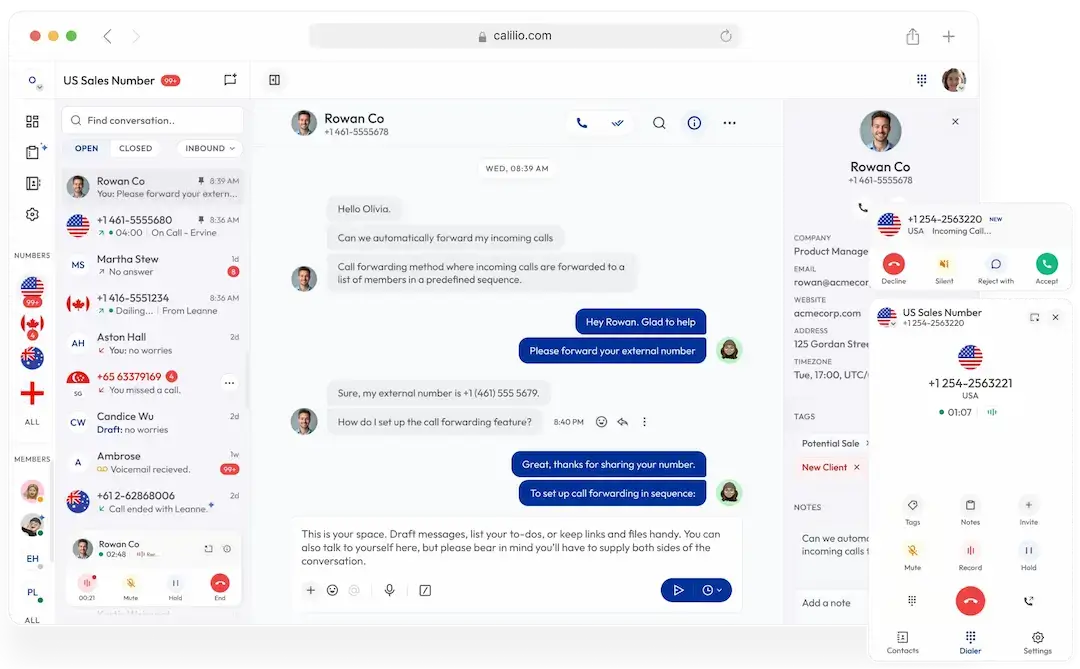
Calilio combines voice calling and SMS into a unified callbox, which helps teams manage customer communication from one place. Core telephony features include call forwarding, voicemail, number sharing, click-to-call, call history, greeting messages, business hours, IVR phone trees, call queues, and call transfer. The platform is clearly built for businesses that need more than just a business number, but still want a straightforward communication system that does not feel overloaded with enterprise complexity.
For outbound activity, Calilio also includes a power dialer on higher plans, which is important for sales teams, lead-generation teams, and other businesses that make frequent outbound calls. While it does not yet have the largest calling feature catalog in the category, it offers enough routing and call-handling tools to support many small and midsize customer-facing teams.
AI call reports and conversation intelligence
Calilio’s most interesting differentiator is its AI feature set. The platform promotes AI-powered call reports that automatically generate transcription, summary, reason for call, conclusion, and sentiment analysis after conversations. In practical terms, this can save your team time on note-taking, improve follow-up accuracy, and make it easier for managers to review customer interactions without listening back to every full recording.
The AI dashboard also gives teams a way to review call patterns and performance trends in a more structured format. For businesses that want lightweight conversation intelligence without paying for a full enterprise contact center platform, this is one of Calilio’s most compelling strengths. It is not just a generic AI label on the homepage, the product pages clearly describe several real post-call analysis features that can add value for support and sales workflows.

Calilio Key Features
Calilio’s feature set is strongest when you look at it through the lens of affordability, international availability, and practical business-phone functionality. Below are the capabilities that matter most when evaluating the platform.
Virtual phone numbers and global calling
Calilio is built around virtual phone numbers, with support for local, mobile, and toll-free numbers across more than 100 countries. That makes it a strong fit for global teams, service businesses, recruiting firms, agencies, and any company that wants to appear local in different regions. If international calling and regional presence are priorities, Calilio deserves more attention than many small-business VoIP tools that focus mostly on the U.S. and Canada.
Inbound routing and call management
For inbound operations, Calilio includes phone trees, business hours, call queues, queue callback, number sharing, voicemail, and call forwarding on higher plans. These features help businesses direct calls efficiently, reduce missed opportunities, and create a more professional phone experience for customers. It is a practical setup for small support teams, service desks, clinics, agencies, and growing customer success teams.
Reporting, dashboards, and monitoring
Calilio includes real-time dashboards and call analytics, with the Premium plan offering more comprehensive reporting than the Standard plan. It also promotes live call monitoring, although some official pages still label parts of that functionality as coming soon. That means the reporting story is solid for SMB needs, but buyers should still verify which monitoring capabilities are fully live before making a final decision.
CRM and workflow integration
Calilio highlights integrations with tools such as HubSpot, Salesforce, Zapier, Zendesk, Pipedrive, Pabbly Connect, Mailchimp, and others. However, the integration pages also show that some of these connectors are marked as coming soon. That is an important detail to mention in the review because the platform’s ecosystem looks promising, but it does not yet feel as mature or as proven as the deeper native integration catalogs offered by more established competitors.
Web access and remote team support
Because Calilio is cloud-based, it fits well with remote and distributed teams. You do not need dedicated desk phones to get started, and the product is designed around browser-based access and digital workflows. That alone makes it more appealing for modern businesses than older phone systems that still depend on hardware-heavy setups and more rigid office-based deployment.
Pros and Cons
Advantages and Disadvantages
Pros
✅ Affordable entry pricing
✅ International number coverage
✅ Useful AI call reports
✅ Simple SMB-friendly setup
Cons
❌ Standard plan is limited
❌ Developing integrations
❌ Usage-based extra costs
❌ Some number availability limitations
Calilio has a clear value proposition, but it is not the perfect fit for every type of business. Its strengths are most obvious when you compare it with more expensive VoIP tools, while its limitations become clearer when you compare it with mature enterprise communication platforms.
✅ Strengths
- Affordable entry pricing: Calilio’s Standard plan starts at a lower published price than many recognizable VoIP competitors, which makes it attractive for startups and smaller teams.
- International number coverage: Support for virtual numbers in more than 100 countries is a meaningful advantage for global or expansion-minded businesses.
- Useful AI call reports: AI summaries, transcriptions, reason-for-call tracking, conclusions, and sentiment analysis make the platform feel more modern than a typical entry-level phone system.
- Simple SMB-friendly setup: The platform is easier to understand than many enterprise-heavy phone systems, which lowers the adoption barrier for smaller teams.
❌ Weaknesses
- Standard plan is limited: The lower-tier plan caps users at 10 and removes several features that many teams may quickly outgrow.
- Developing integrations: Calilio names popular integrations, but multiple official pages still mark some of them as coming soon.
- Usage-based extra costs: Call recording storage, messaging, and some registration fees can raise total costs beyond the headline plan price.
- Some number availability limitations: Public review summaries indicate that virtual number availability in certain countries can be a pain point for some users.
Overall, Calilio looks strongest for small businesses and growing teams that want modern telephony features and AI-assisted call analysis without paying enterprise-level pricing from the start.

Pricing
How Much Does Calilio Cost?
Calilio keeps its pricing more transparent than many business phone providers, which is a real advantage for buyers trying to compare options quickly. The platform currently offers Standard, Premium, and Enterprise plans. Monthly billing is available, but annual billing gives the lower per-user rate.
Standard plan
The Standard plan starts at $12 per user per month when billed annually, or $15 per user per month when billed monthly. It is aimed at solopreneurs, startups, and small businesses. This plan includes one free local number in the U.S. or Canada, basic dashboarding, limited bundled calling and SMS, and a user limit of 10. It is affordable, but it is also clearly limited once your team needs more advanced routing, integrations, or collaboration features.
Premium plan
The Premium plan starts at $28 per user per month when billed annually, or $35 per user per month monthly. It is positioned for growing businesses, franchises, and call centers. Premium adds unlimited users, CRM integration, more bundled usage, more detailed dashboards, and access to more advanced calling features. For many businesses, this is the real plan to evaluate, because it is where Calilio begins to feel like a complete business communication platform instead of just a low-cost phone service.
Enterprise plan
Calilio also offers a custom Enterprise tier for organizations that need quote-based pricing, tailored workflows, dedicated support, and more advanced security or integration requirements. If you have larger operational needs or want a more customized setup, this is the tier to explore. However, most SMB readers comparing Calilio with other business phone tools will likely focus on Standard vs Premium.
Extra costs you should not ignore
Calilio’s published per-user pricing is attractive, but the real total cost can be higher once you factor in usage-based items. Official pricing also lists pay-per-minute calling, pay-per-segment SMS, pay-per-MMS charges, call recording and storage costs, and A2P 10DLC registration-related fees for U.S. and Canada messaging use cases. That does not make Calilio overpriced, but it does mean you should look beyond the entry plan price if your team records a lot of calls or sends large volumes of messages.
Pricing overview table
| Plan | Price (per user/month) | Best For |
| Standard | $12 annually / $15 monthly | Solopreneurs, startups, and teams up to 10 users |
| Premium | $28 annually / $35 monthly | Growing businesses needing CRM integration and more advanced features |
| Enterprise | Custom quote | Larger organizations needing customized deployment and support |
How to choose the right plan
If you only need a simple business number, light calling, and basic messaging, the Standard plan is the cheaper starting point. But if your team needs CRM integration, more robust workflows, or room to scale beyond 10 users, Premium is the more realistic long-term option. Enterprise only makes sense if you already know you need a tailored setup or more formal support.
Implementation tips
- Start small: Test the platform with a limited group before rolling it out across the whole team.
- Verify feature access: Confirm which routing, monitoring, and integration features are available on your plan before purchase.
- Model total costs: Include recording, storage, messaging, and registration fees in your final budget.
- Prioritize actual use cases: If international numbers and AI reporting matter most, make sure those are the core reasons you are choosing Calilio.
User Experience
Ease of Use & Setup
Dashboard and overall usability
Calilio’s interface is one of the reasons it is appealing to smaller teams. The product positioning and public review feedback both point toward ease of use as a core strength. Instead of trying to be a full unified communications suite with a bloated interface, Calilio feels more focused on calling, messaging, routing, and post-call analysis. That will likely appeal to buyers who want quick adoption rather than a long implementation process.
Public user feedback also supports this angle. Review summaries on G2 repeatedly highlight ease of use, affordability, and responsive support as positives. That does not guarantee the platform will feel perfect for every team, but it does suggest Calilio is doing a good job on the basic user-experience side, which matters a lot for smaller businesses without dedicated telecom administrators.
Onboarding and setup process
The basic implementation flow is simple: sign up, choose or port a number, assign users, and begin handling calls from the dashboard. That is a straightforward onboarding model compared with older business phone setups that require hardware planning and more technical deployment. It is another reason Calilio is likely to perform best for lean teams that want to launch quickly.
What may limit the experience
The biggest usability caveat is not the interface itself, it is plan limitations. The Standard plan removes several features that growing teams may expect, including advanced call features and integrations. So while onboarding may be simple, your actual experience can change a lot depending on the plan you choose. If you are serious about routing, CRM sync, or scaling beyond a very small team, Premium is probably the better measure of what Calilio really feels like in practice.
Integrations & Compatibility
How Calilio Integrates with Other Tools
CRM integrations
Calilio actively promotes CRM integrations as part of its value proposition, including HubSpot, Salesforce, Pipedrive, and LeadHeed. These integrations are designed to help teams log calls, track contact activity, and keep communication records connected to the rest of their sales pipeline. For small businesses, that can reduce manual work and make the phone system more useful beyond simple calling.
Support and automation tools
The platform also names Zendesk, Zapier, Pabbly Connect, Make, Mailchimp, and other tools in its integration ecosystem. That gives Calilio a good-looking surface-level compatibility story for support teams and workflow automation. In theory, this makes it easier to connect Calilio with helpdesk, CRM, and no-code automation workflows.
Important integration caveat
The main catch is that several official integration listings are still marked as coming soon. That means Calilio is directionally strong on integrations, but buyers should not assume every advertised connection is equally mature today. Compared with established competitors that already have larger, battle-tested integration marketplaces, Calilio still looks like a platform that is building out this part of its ecosystem.
Customer Support
How Good is Calilio Support
Support quality and customer sentiment
Based on current public review summaries, Calilio users often mention responsive support and a generally positive experience. G2 review summaries call out 24/7 support and ease of use as consistent positives, and recent Capterra feedback also reflects a favorable view of the product’s usability and responsiveness. That is a good sign for a business phone provider because support quality matters more here than in many other SaaS categories.
Where support still needs context
Positive review sentiment is helpful, but Calilio still has a smaller public review footprint than category leaders. That means the support reputation looks promising, but it is not as deeply validated across the market as older vendors with much larger customer bases. For an SMB buyer, that may be perfectly acceptable. For a larger enterprise, it may be a reason to ask more questions before committing.
Reliability considerations
Review feedback is mostly positive, but some public criticism points to fit issues around virtual number availability and product expectations in certain cases. That does not mean Calilio is unreliable overall, but it does reinforce the idea that you should test the product carefully if number coverage in specific countries is critical to your operations.
Best Use Cases
Ideal Use Cases & Industries
Best use cases
Calilio makes the most sense for businesses that want a modern phone system without paying enterprise VoIP pricing on day one. The strongest use cases include:
- Startups and SMBs: Especially teams that want affordable entry pricing and simple deployment.
- Remote or distributed teams: Businesses that want a cloud-first phone system without hardware overhead.
- Internationally focused companies: Teams that care about getting local numbers across different countries.
- Sales and service teams: Organizations that can benefit from call routing, power dialing, and AI-generated call notes.
- Agencies, recruiters, and service firms: Teams that need practical communication tools and want to keep follow-ups organized.
Industries that fit especially well
Calilio’s own AI and feature pages suggest it can serve a wide range of industries, including real estate, healthcare, finance, education, insurance, hospitality, retail, recruiting, construction, nonprofits, and SaaS. In practice, the best fit is probably any service-oriented business where phone conversations still matter, but the team is not looking for a huge enterprise contact center deployment.
Alternatives & Competitors
How Calilio Compares to Alternatives
Calilio is entering a crowded category, so the right decision depends on whether you value lower pricing and AI call insights more than ecosystem maturity and enterprise depth.
Aircall
Aircall is more established and generally stronger on ecosystem maturity, especially for sales and support teams that need a richer integration story. Calilio has an advantage on lower published entry pricing, but Aircall may be the better choice if you want a more proven platform with broader market validation and a larger native app ecosystem.
RingCentral
RingCentral is a better fit for larger organizations that want a broader communications suite. It typically offers more depth, more enterprise credibility, and more surrounding functionality, but it is also heavier and often more expensive. Calilio is the more approachable option for SMBs that want modern telephony rather than an all-in-one enterprise communications stack.
Nextiva
Nextiva is another more mature choice for companies that want a broader business communications platform. Compared with Calilio, Nextiva generally feels more established, but Calilio may appeal more to buyers who care specifically about affordable entry pricing, virtual numbers, and AI-powered call reporting.
CloudTalk
CloudTalk is probably one of the more relevant direct comparisons. CloudTalk is more mature and more feature-rich in several areas, particularly for advanced calling operations, but it also tends to come with higher complexity and pricing. Calilio has a simpler, more SMB-friendly pitch. If budget and ease of entry matter most, Calilio may win. If operational depth matters more, CloudTalk likely has the edge.
Calilio Alternatives Comparison Table
| Provider | Best For | Starting Price Positioning | Main Advantage |
| Calilio | SMBs wanting affordable VoIP, international numbers, and AI call insights | Lower-cost entry point | Affordable plans with useful AI reporting |
| Aircall | Sales and support teams needing a mature integration ecosystem | Higher than Calilio | More established app ecosystem |
| RingCentral | Larger organizations needing broader communications functionality | Typically higher and broader suite pricing | Enterprise-grade depth |
| CloudTalk | Teams needing stronger outbound and call-center functionality | Usually higher than Calilio | More advanced operational features |
Conclusion
Final Thoughts
Calilio is a promising business phone system for small and growing teams that want affordable cloud telephony, international virtual numbers, and genuinely useful AI-powered call insights. Its published pricing is attractive, the interface appears approachable, and the AI reporting features give it more substance than many basic VoIP tools aimed at the same audience.
At the same time, this is not the most mature platform in the category. The Standard plan is quite limited, some integrations still look like work in progress, and the broader market footprint is smaller than what you get from better-known VoIP competitors. That does not make Calilio a weak product, but it does mean buyers should evaluate it with realistic expectations.
If your business wants a cost-effective modern phone system and values AI summaries, sentiment analysis, and international number coverage, Calilio is worth shortlisting. If you need a deeper enterprise ecosystem, broader proven integrations, or a more established platform with fewer caveats, alternatives like Aircall, CloudTalk, RingCentral, or Nextiva may be stronger long-term choices.
Frequently Asked Questions
Have more questions?
What is Calilio?
Calilio is a cloud-based business phone system that offers VoIP calling, virtual phone numbers, SMS, call routing, analytics, and AI-powered call reporting features for businesses.
How much does Calilio cost?
Calilio starts at $12 per user per month on annual billing for the Standard plan, while Premium starts at $28 per user per month annually. Monthly billing is also available at higher rates, and Enterprise pricing is custom.
Is Calilio good for small businesses?
Yes, Calilio looks well suited to startups and small businesses that want affordable business telephony, especially if they value AI summaries and international number access.
Does Calilio support international numbers?
Yes. Calilio promotes virtual local, mobile, and toll-free phone numbers in more than 100 countries, which is one of its strongest selling points.
What AI features does Calilio include?
Calilio promotes AI-powered call reports that include transcription, summary, reason for call, conclusion, and sentiment analysis. These features are designed to make post-call follow-up and call review easier.
Does Calilio integrate with HubSpot and Salesforce?
Calilio names HubSpot, Salesforce, Zapier, Zendesk, and other tools in its integration catalog. However, some integrations are still shown as coming soon, so buyers should verify current live availability.
What are the biggest drawbacks of Calilio?
The biggest drawbacks are Standard plan limitations, extra usage costs beyond the headline monthly rate, a still-developing integration ecosystem, and a smaller market footprint than leading competitors.
Is Calilio better than Aircall?
Calilio is more attractive on entry pricing, while Aircall is usually the stronger option for teams that want a more mature ecosystem and deeper broader-market credibility.
Who should choose Premium instead of Standard?
Businesses that need CRM integration, more advanced routing, more users, and a more complete business-phone setup should look at Premium rather than Standard.
Is Calilio worth it?
Calilio is worth considering if you want a lower-cost business phone system with modern AI call insights and international number coverage. It is a particularly strong option for SMBs that do not need a full enterprise communication suite.