Introduction
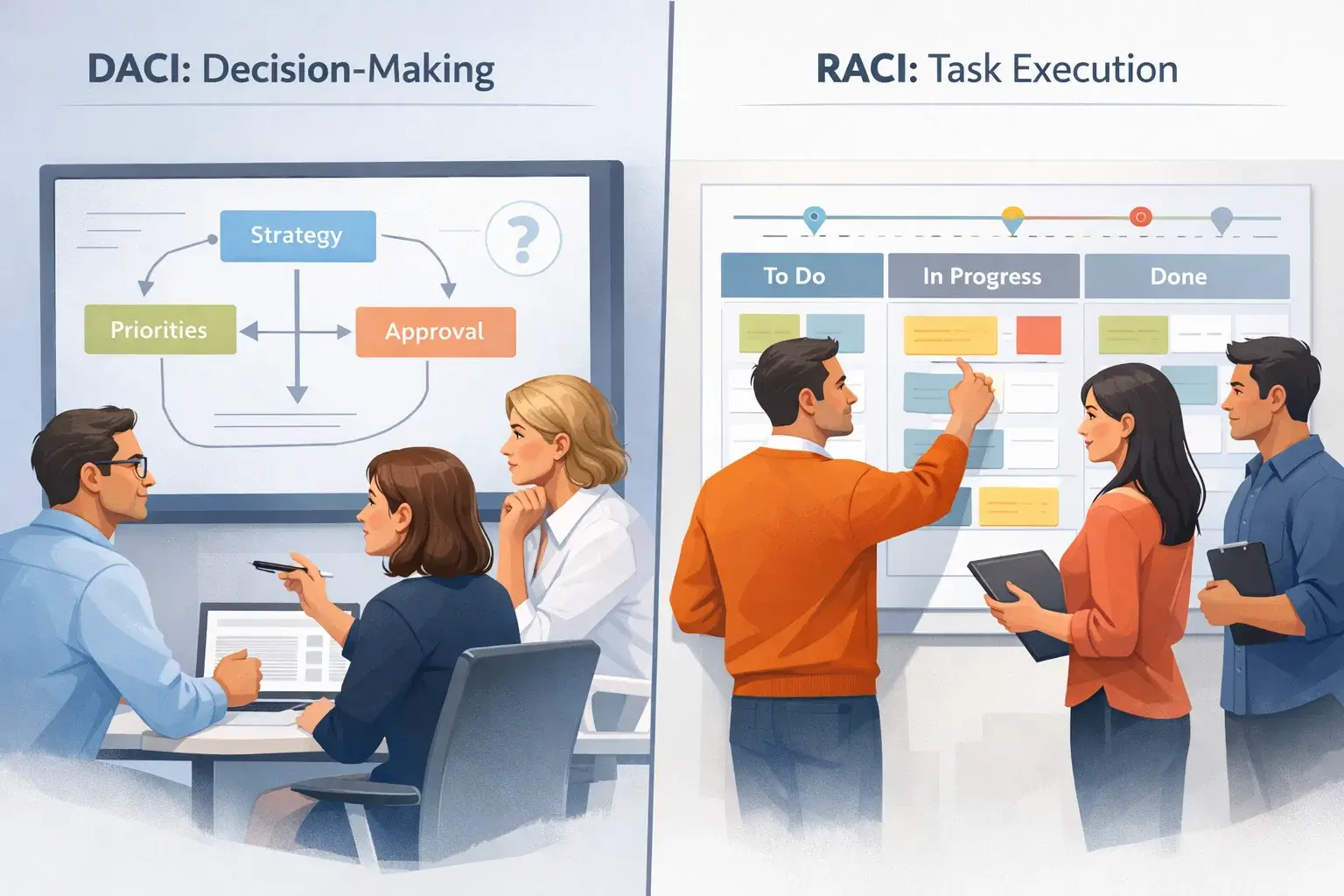
DACI vs RACI is not just a terminology question. It is a practical project management question about whether your team needs clearer decision ownership, clearer task ownership, or both.
That distinction matters more than many teams realize. When a project slows down, the problem is often not effort. It is that people are unclear on who makes the call, who does the work, who needs input, and who only needs visibility.
If you use the wrong framework for the wrong problem, you create friction. Meetings get longer, approvals get stuck, and responsibility becomes blurry.
In this guide, you will learn what DACI and RACI actually do, how they differ, when to use each one, and how to apply them together in a practical way. If you are also evaluating tools to manage these workflows, see our best project management software comparison.
Why Teams Often Confuse DACI and RACI
Teams mix up DACI and RACI because both frameworks assign roles. On the surface, they look similar. Both are used in projects, both improve clarity, and both help reduce confusion.
But they solve different types of confusion.
- DACI helps you answer: Who is driving this decision, and who approves it?
- RACI helps you answer: Who is doing the work, who owns the outcome, and who needs input or updates?
If your project is stuck because nobody can make a decision, DACI is often the better fit. If your project is stuck because work is falling between people, RACI is usually the better fit.
That is why the strongest teams do not always choose one over the other. In many cases, they use DACI for major decisions and RACI for execution.
What Is the DACI Model?
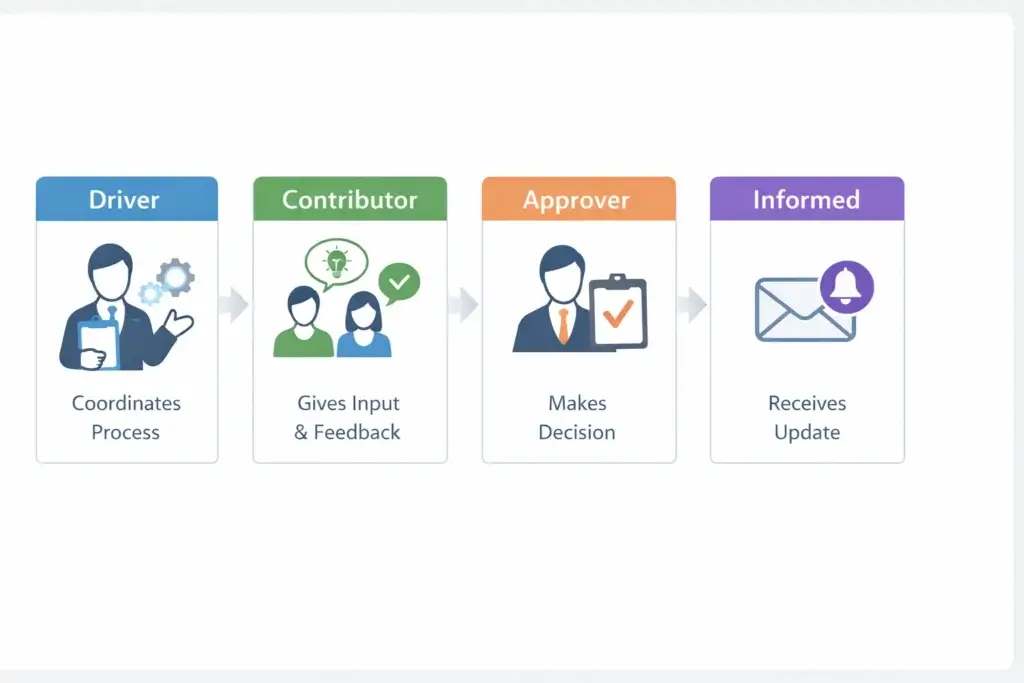
The DACI model is a decision-making framework. It helps your team make important calls faster by clarifying who drives the process, who gives input, and who makes the final decision.
DACI is especially useful when a decision affects multiple stakeholders, departments, or priorities. It prevents the common problem where everyone has opinions but no one clearly owns the decision.
DACI roles explained
- Driver – The person who moves the decision forward. They gather input, organize the process, and make sure the decision gets made.
- Approver – The person with final decision authority. There should usually be only one.
- Contributor – People with expertise, context, or recommendations that should inform the decision.
- Informed – People who are affected by the outcome and need to know what was decided.
When DACI works best
DACI is most useful when you are dealing with a high-impact decision, not just routine task coordination.
- Choosing a new software platform
- Approving a major process change
- Making a go-or-no-go launch decision
- Resolving a cross-functional priority conflict
- Deciding ownership of a strategic initiative
Where DACI can go wrong
DACI is not a full project delivery framework. It is a decision framework. If you use it for every small choice, you can create too much structure.
It also breaks down when the Approver role is unclear or when too many Contributors expect voting power. DACI works best when input is broad, but decision authority is sharp.
What Is the RACI Model?
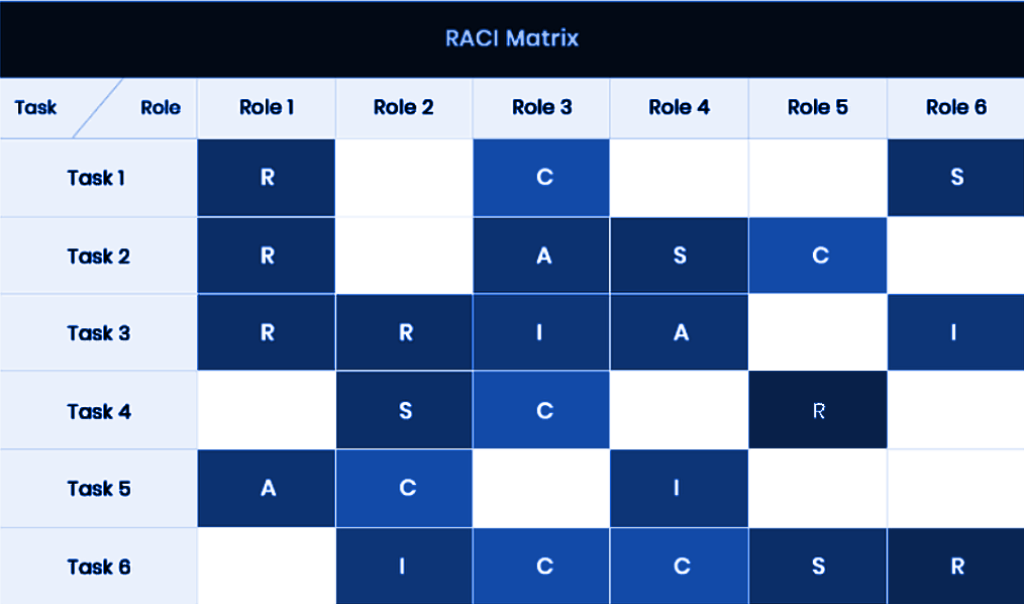
The RACI model is a responsibility assignment framework. It helps you define who does the work, who owns the result, who should be consulted, and who should stay informed.
RACI is most useful when execution involves multiple people, handoffs, or dependencies. It gives your team a shared view of responsibility so work does not drift or duplicate.
RACI roles explained
- Responsible – The person or people doing the work.
- Accountable – The single person ultimately answerable for the outcome.
- Consulted – Stakeholders or experts whose input is needed before or during the work.
- Informed – People who need updates, but are not actively involved in execution.
When RACI works best
RACI is ideal when your team needs clarity across tasks, deliverables, and handoffs.
- Cross-functional projects with shared ownership
- Implementations with multiple workstreams
- Projects with dependencies and approvals
- Operational workflows that repeat over time
- Large initiatives where communication can easily get messy
Where RACI can go wrong
RACI becomes less useful when teams overload it. Too many Consulted roles can slow down progress. Too many Informed roles can create noise. And if Accountable and Responsible are treated as the same thing, you lose one of the biggest benefits of the model.
The Core Differences
The simplest way to think about DACI vs RACI is this:
- DACI clarifies decisions
- RACI clarifies execution
One framework tells your team how to make an important call. The other tells your team how to deliver the work after that call is made.
| Comparison Area | DACI | RACI |
| Main purpose | Clarify decision-making authority | Clarify execution roles and ownership |
| Primary question answered | Who drives and approves this decision? | Who does the work and owns the outcome? |
| Best used for | High-impact or cross-functional decisions | Projects, deliverables, and ongoing workflows |
| Key strength | Faster, cleaner decisions | Clearer accountability and handoffs |
| Typical risk | Approval bottlenecks or too many contributors | Role confusion or too many consulted stakeholders |
| Best project phase | Before or during a major decision point | During planning and execution |
| Ideal output | A documented decision with clear authority | A clear map of responsibilities by task or deliverable |
| Good example | Selecting a new CRM or project platform | Rolling out that platform across teams |
What this means in practice
If the project question is “Who decides?”, start with DACI.
If the project question is “Who does what?”, start with RACI.
If your team is facing both problems at once, use both, in that order.
Can You Use DACI and RACI Together?
Yes, and in many real-world projects, that is the smartest approach.
In practice, teams often use DACI to make the decision and RACI to execute the decision. This is especially useful in software selection, process redesign, change management, and large cross-functional initiatives.
A simple way to combine them
- Step 1 – Use DACI to decide what you are doing
- Step 2 – Use RACI to assign who will deliver it
- Step 3 – Review both if scope or stakeholders change
For example, if your company is choosing a new work management platform, DACI can define who drives the evaluation and who approves the choice. Once the tool is selected, RACI can define who handles setup, migration, training, integrations, and reporting.
DACI Example
Choosing a New Project Management Tool
Imagine your company wants to replace several disconnected tools with a single project management platform. This is a decision problem first, not an execution problem.
That makes DACI a strong fit.
Example DACI setup
- Driver – Operations manager leading the evaluation
- Approver – VP of Operations
- Contributors – PMO lead, IT manager, finance manager, department heads
- Informed – Team leads and end users across departments
The Driver gathers requirements, compares vendors, collects Contributor input, and prepares a recommendation. The Approver makes the final call. Everyone else knows whether they have decision authority, input responsibility, or visibility only.
This structure prevents a very common problem: endless stakeholder feedback with no clear final owner.
RACI Example
Rolling Out the Tool After the Decision
Once the tool is selected, your challenge changes. You are no longer deciding. You are implementing.
This is where RACI works better.
Example rollout tasks
- Configure workspaces and boards
- Migrate tasks and documentation
- Set permissions and governance rules
- Train managers and end users
- Launch reporting dashboards
- Track adoption and fix workflow gaps
Example RACI logic
The project manager may be Accountable for the rollout. The systems admin may be Responsible for setup. Department leads may be Consulted for workflow design. Executives may be Informed through milestone updates.
That is the key advantage of RACI. It turns a vague implementation into a visible responsibility map.

When to Use Each
DACI
Choose DACI when the main challenge is not task execution, but decision clarity.
- You are making a strategic or high-stakes decision
- The decision affects multiple teams or functions
- You need one clear approver
- Your team keeps circling the same issue without closure
- Input is needed from experts, but decision ownership is unclear
Good DACI use cases
- Choosing between software vendors
- Approving a reorganization plan
- Defining a product launch approach
- Resolving a major resource conflict
- Setting priorities across departments
RACI
Choose RACI when the main challenge is execution clarity.
- The project has many tasks or deliverables
- Multiple people are involved in the same workflow
- You need to reduce duplicate work or missed handoffs
- The team is unclear on ownership
- You want a repeatable model for project governance
Good RACI use cases
- System implementation projects
- Cross-functional campaign launches
- Operations workflows with approvals
- Website redesigns
- Internal process standardization
Common Mistakes With DACI and RACI
Most teams do not fail because the frameworks are weak. They fail because they apply them too loosely or too mechanically.
Common DACI mistakes
- Too many approvers – A decision framework loses power when final authority is split.
- Contributors acting like voters – Input matters, but it is not the same as approval.
- No deadline for the decision – DACI works best when the decision has a clear timeline.
- Using DACI for low-value decisions – Not every decision needs a formal framework.
Common RACI mistakes
- Confusing Responsible with Accountable – One person can do the work, but another may still own the outcome.
- Too many Consulted roles – This is one of the fastest ways to slow a project down.
- No real owner – If everyone is loosely involved, no one is truly accountable.
- Creating the chart once and never revisiting it – Roles often need adjustment as scope changes.
How to Create a DACI Matrix
You do not need a complicated template to start. What you need is a clear decision and role discipline.
Step 1: Define the decision
Be specific. “Improve operations” is too broad. “Choose a new work management platform by the end of the month” is much better.
Step 2: Assign one Driver
This person owns momentum. They are not necessarily the most senior person. They are the person responsible for moving the process forward.
Step 3: Assign one Approver
This is the final decision-maker. In most cases, it should be one person, not a committee.
Step 4: Add Contributors carefully
Include people with real expertise or impact on the decision. Avoid adding every stakeholder by default.
Step 5: Identify who needs to be Informed
These are the people affected by the outcome who should be updated once the decision is made.
Step 6: Set a decision date
Without a deadline, DACI can become another discussion structure instead of a decision structure.
How to Create a RACI Matrix
RACI works best when it is built around real deliverables, not vague activity categories.
Step 1: List the tasks or deliverables
Break the project into meaningful units of work. Keep them specific enough to assign clearly.
Step 2: List the relevant roles
Use roles or functions if that is easier than individual names. This helps when teams change over time.
Step 3: Assign Responsible and Accountable roles
For each task, define who will do the work and who owns the outcome. These are the two most important assignments.
Step 4: Add Consulted and Informed roles only where needed
Do not add people to be safe. Add them only when their input or visibility is genuinely required.
Step 5: Review the matrix with stakeholders
This step matters. A RACI chart is only useful if the team agrees the assignments reflect how work should actually happen.
Step 6: Update it when the project changes
RACI is not a one-time document. It should evolve if scope, stakeholders, or approval paths change.
Which One Should You Choose?
If you need a fast answer, use this logic:
- Choose DACI when your biggest problem is slow or messy decision-making
- Choose RACI when your biggest problem is unclear ownership during execution
- Use both when your project includes a major decision followed by multi-step delivery
A simple rule of thumb
If your team keeps asking “Who gets to decide this?”, you probably need DACI.
If your team keeps asking “Who owns this task?”, you probably need RACI.
If your team keeps asking both questions, your project probably needs both frameworks.
Tools That Make DACI and RACI Easier to Manage
You can build both frameworks in a spreadsheet, and for simple cases, that is perfectly fine. But as projects become more cross-functional, software makes these frameworks easier to maintain.
For teams that want visual workflows, dashboards, automations, and strong cross-functional planning, monday.com is one of the strongest options. It is especially good when you want to turn structured decisions into visible execution plans.
If your team wants deeper customization, more views, and a highly flexible workspace, ClickUp is another strong fit. It gives you enough flexibility to model both decision processes and delivery workflows in one system.
To compare those tools with other leading options, visit our full project management software comparison.
Conclusion
DACI vs RACI is not really about choosing the smarter acronym. It is about choosing the right framework for the problem in front of you.
DACI helps you make better decisions with clearer authority. RACI helps you execute better with clearer ownership. Both are useful. Neither is universal.
If you apply DACI to decision-heavy moments and RACI to execution-heavy work, you give your team something every project needs: less confusion, better accountability, and faster progress.
For many teams, the most effective answer is not DACI or RACI. It is knowing when to use each one.
Frequently Asked Questions
What is the main difference between DACI and RACI?
DACI is a decision-making framework, while RACI is a responsibility assignment framework. DACI clarifies who drives and approves a decision. RACI clarifies who does the work, who owns the outcome, and who needs input or updates.
When should you use DACI instead of RACI?
You should use DACI when your biggest challenge is decision clarity. It is especially useful for strategic, cross-functional, or high-stakes decisions where one clear approver is needed.
When is RACI better than DACI?
RACI is better when the main challenge is execution clarity. It works well for projects with multiple tasks, handoffs, contributors, and accountability needs.
Can DACI and RACI be used together?
Yes. Many teams use DACI to make a key decision first, then use RACI to assign responsibilities for implementation. This is often the most practical approach in real projects.
What does the Driver do in DACI?
The Driver moves the decision-making process forward. This person gathers input, aligns stakeholders, defines scope, and makes sure the decision is reached on time.
Should DACI have more than one Approver?
In most cases, no. DACI works best when there is one clear Approver with final decision authority. Multiple approvers often slow the process and create ambiguity.
What is the difference between Responsible and Accountable in RACI?
Responsible refers to the person doing the work. Accountable refers to the person ultimately answerable for the result. In a strong RACI matrix, accountability is clear and not diluted across several people.
What is a common mistake when using RACI?
One of the most common mistakes is assigning too many Consulted roles. That often creates unnecessary feedback loops and slows down delivery.
Do agile teams use DACI or RACI?
Agile teams can use either one, depending on the problem they need to solve. DACI is helpful for clarifying decisions. RACI is helpful for clarifying ownership and handoffs. Agile teams may also use both together.
What tools can help manage DACI and RACI frameworks?
Many teams use spreadsheets for simple cases, but project management software can make both frameworks easier to maintain. Tools like monday.com and ClickUp can help teams map decisions, assign responsibilities, and track execution in one place.