Introduction
If your team ever asks “Who owns this?”, “Who approves this?”, or “Why was I not told?”, a RACI matrix can solve the problem quickly. It is one of the simplest project management tools for clarifying ownership, approval authority, stakeholder input, and communication across a project.
This guide explains what a RACI matrix is, how to build one, when to use it, and where teams often get it wrong. You will also find a practical example, a comparison of related frameworks, and a look at how teams can manage a RACI matrix in tools like monday.com, ClickUp, and Asana.
What is a RACI Matrix
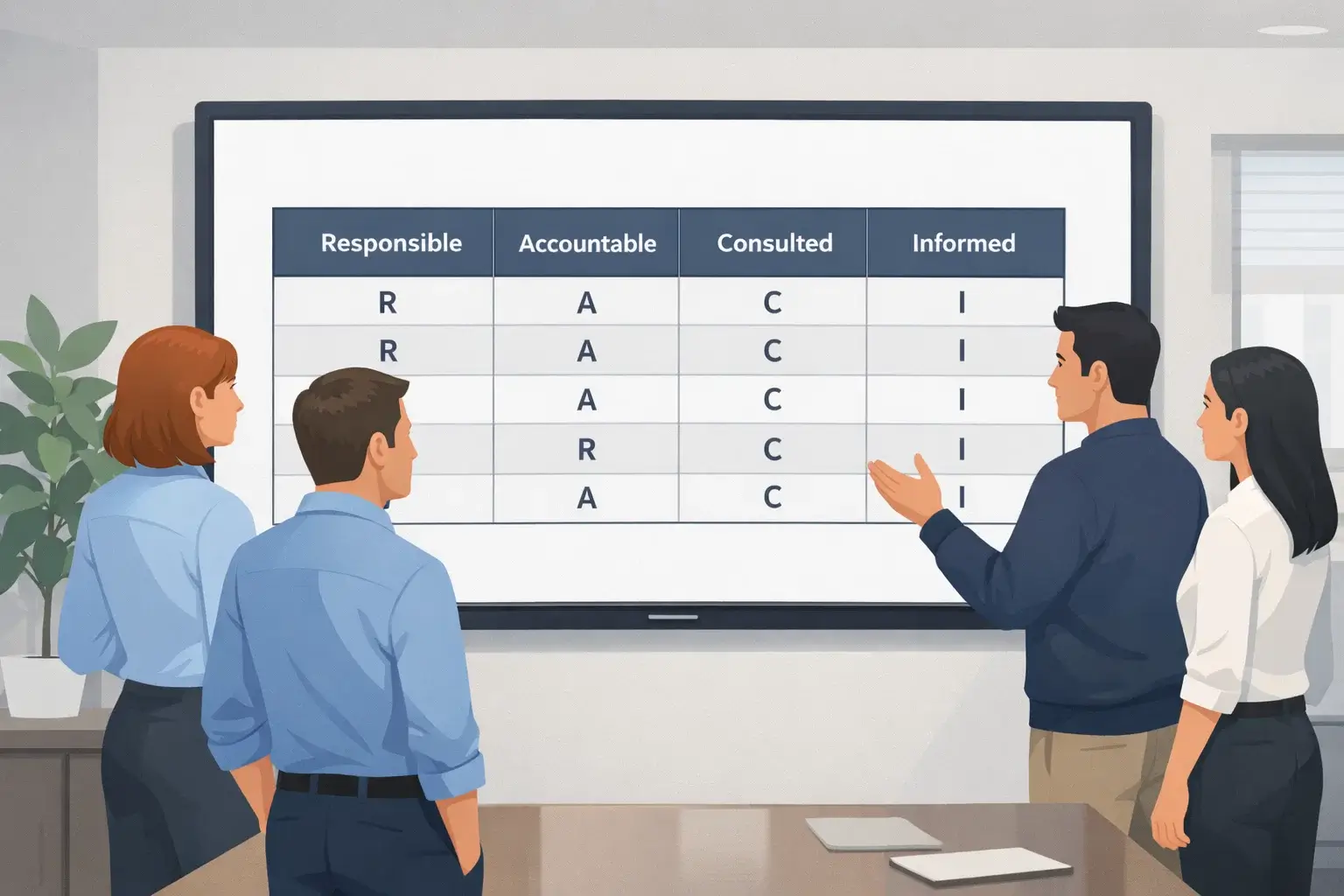
A RACI matrix, sometimes called a RACI chart, is a responsibility assignment matrix that maps tasks or deliverables against the people involved in them. RACI stands for Responsible, Accountable, Consulted, and Informed. In practice, it gives every important task a clear ownership structure so teams can move faster and avoid unnecessary confusion.
At a basic level, the matrix works like a grid. Tasks or decisions appear on one side, people or roles appear on the other, and each intersecting cell shows how that person is involved. That simple structure makes the RACI model especially useful for cross-functional projects, approval-heavy workflows, and complex handoffs.
RACI Chart Rules and Roles
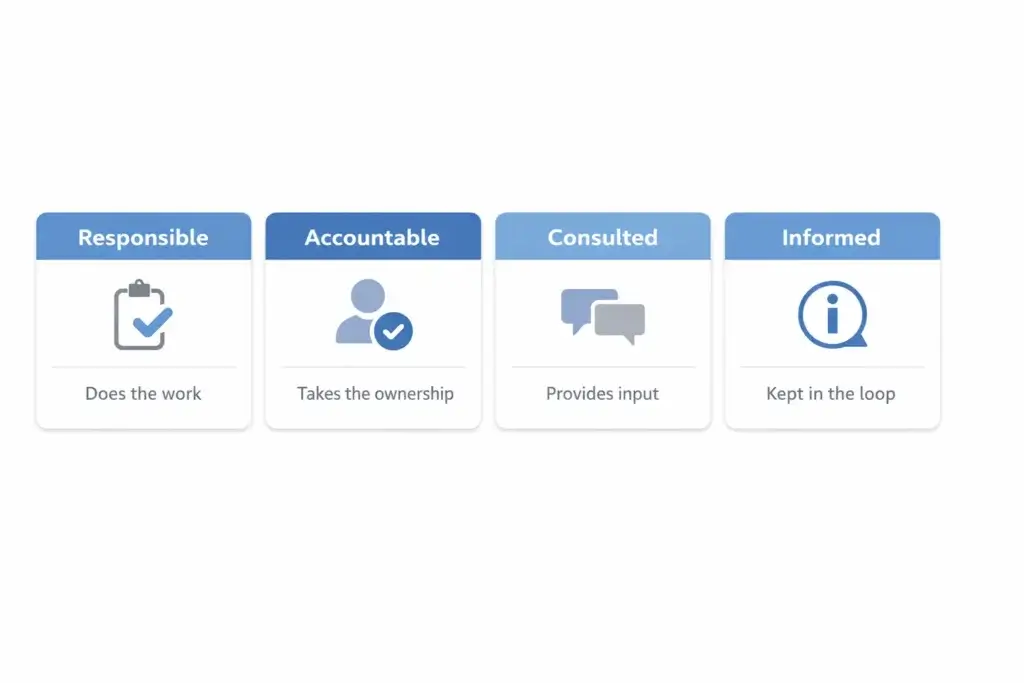
The RACI chart is only effective when each role is clearly understood and assigned consistently. The four roles look simple, but most project confusion happens when teams blur the line between execution, authority, consultation, and communication.
- Responsible (R): The person who completes the work. This is the role actively doing the task, moving it forward, and delivering the output.
- Accountable (A): The person who owns the final outcome. This is the decision-maker or final approver who is answerable for whether the task is completed properly.
- Consulted (C): The person or group whose input is needed before or during the work. They contribute expertise, feedback, or recommendations.
- Informed (I): The person or group that needs visibility into progress or final outcomes but does not directly shape the work.
Two rules matter more than the others. First, each task should have one clearly accountable owner. Second, every important task should have at least one responsible party. Without those two assignments, the matrix becomes a documentation exercise instead of a decision-making tool.
It also helps to avoid overloading the consulted category. If too many people must be consulted before every decision, progress slows down and accountability becomes diluted. A useful RACI matrix creates clarity, not bureaucracy.
Why Are RACI Roles Important?
RACI roles matter because projects rarely fail from lack of effort alone. More often, they slow down because ownership is vague, approvals are unclear, and stakeholders are involved at the wrong time. A well-built RACI matrix reduces that ambiguity by defining who executes, who approves, who advises, and who simply needs updates.
That clarity improves more than task assignment. It also supports better stakeholder management, cleaner handoffs, and faster decisions. When the team knows who has authority, who contributes expertise, and who needs visibility, meetings become shorter and work moves with fewer bottlenecks.
RACI is also valuable from a governance perspective. It helps project managers document decision rights, reduce duplicated work, and create a shared reference point when responsibilities are questioned later in the project.
Who Creates the RACI Matrix?
The project manager usually leads the creation of the RACI matrix, but the best version is built collaboratively. Functional leads, subject matter experts, and key stakeholders should be involved so the chart reflects how work actually happens, not just how it is expected to happen.
That collaboration matters because role clarity cannot be imposed effectively in a vacuum. If you create a RACI matrix without input from the people doing the work, you often end up with a neat chart that does not match reality.
How to Create a RACI Matrix
Creating a RACI matrix does not need to be complicated. The goal is not to document every minor activity. The goal is to define ownership and involvement for the tasks, deliverables, approvals, and decisions that actually matter.
- List the project tasks or deliverables: Start with the major outputs, milestones, decisions, and workflows in the project. Avoid overloading the matrix with tiny sub-tasks that are better managed in a task list.
- Identify the relevant roles: Add the people, teams, or functions that are meaningfully involved in the work. In many cases, it is better to use job roles than personal names if the project will last a long time.
- Assign RACI roles to each task: Mark who is Responsible, who is Accountable, who is Consulted, and who is Informed for every key activity.
- Check for structural issues: Make sure each task has one Accountable owner, at least one Responsible party, and only as many Consulted people as the work truly requires.
- Review with stakeholders: Walk through the matrix with the team and validate that it reflects the real workflow, decision path, and approval process.
- Publish and maintain it: Share the final matrix, connect it to the project plan, and update it when roles, scope, or governance change.
When Should You Use a RACI Matrix?
A RACI matrix is most useful when work crosses departments, includes multiple decision-makers, or depends on clear approvals. It is especially effective when there is a real risk that tasks will stall because nobody knows who owns them.
- Cross-functional projects: Marketing, product, operations, IT, finance, or leadership all contribute, but not at the same level.
- Projects with frequent approvals: Launches, procurement, implementation projects, audits, and compliance work often benefit from clearer sign-off paths.
- Process redesign or handovers: RACI helps teams clarify where responsibility shifts from one function to another.
- Stakeholder-heavy initiatives: When many people need input or visibility, the chart helps define who is consulted and who is merely informed.
- Projects that already feel stuck: If decisions keep circling or tasks sit idle, a RACI matrix can expose ownership gaps quickly.
It is less useful for very small teams working on fast-moving, low-complexity tasks where responsibilities are already obvious. In those cases, a full matrix can add unnecessary overhead.
RACI Model Best Practices
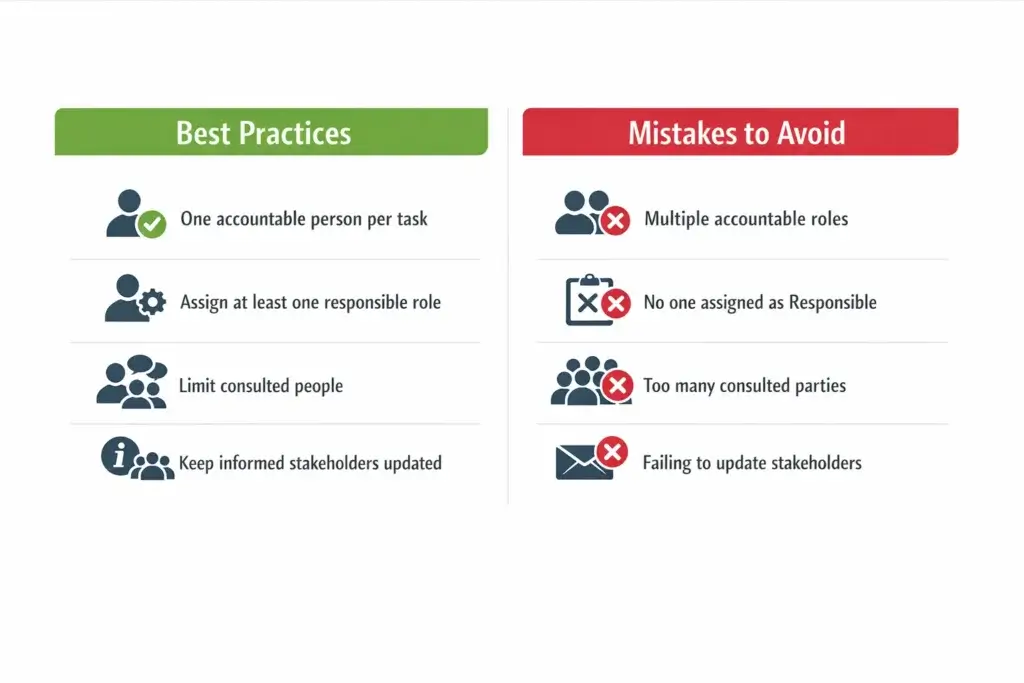
The best RACI matrices are usually simple, selective, and actively used. The weakest ones try to map everything, include too many stakeholders, and then disappear into documentation nobody revisits.
- Use RACI for important work only: Focus on decisions, deliverables, milestones, approvals, and major workflows, not every micro-task.
- Assign one Accountable role per task: Shared accountability usually means unclear accountability.
- Make Responsible and Accountable distinct when needed: In some tasks, the same person can hold both roles. In others, separating execution and approval improves control.
- Keep Consulted roles limited: Consultation is useful, but too many consulted stakeholders can slow delivery.
- Use roles instead of names when practical: This makes the matrix easier to maintain across longer projects or team changes.
- Review the matrix at phase changes: Ownership often shifts between planning, execution, testing, launch, and post-launch support.
- Treat the matrix as a working document: It should support planning and execution, not just sit inside project documentation.
Common RACI Mistakes to Avoid
Most RACI problems come from misuse rather than from the framework itself. A matrix can become confusing if the team treats it as a formal exercise instead of a practical decision tool.
- No accountable owner: If nobody has final ownership, approvals slow down and decisions drift.
- Too many accountable owners: If several people can say yes or no, the task often stalls.
- No responsible role: Some teams assign approvers and stakeholders but forget to define who actually does the work.
- Overusing consulted: This creates unnecessary dependencies and longer turnaround times.
- Trying to model everything: The more detailed the matrix becomes, the harder it is to maintain and use.
- Never updating it: A RACI matrix becomes outdated quickly if scope, teams, or approval paths change.
RACI Matrix Example
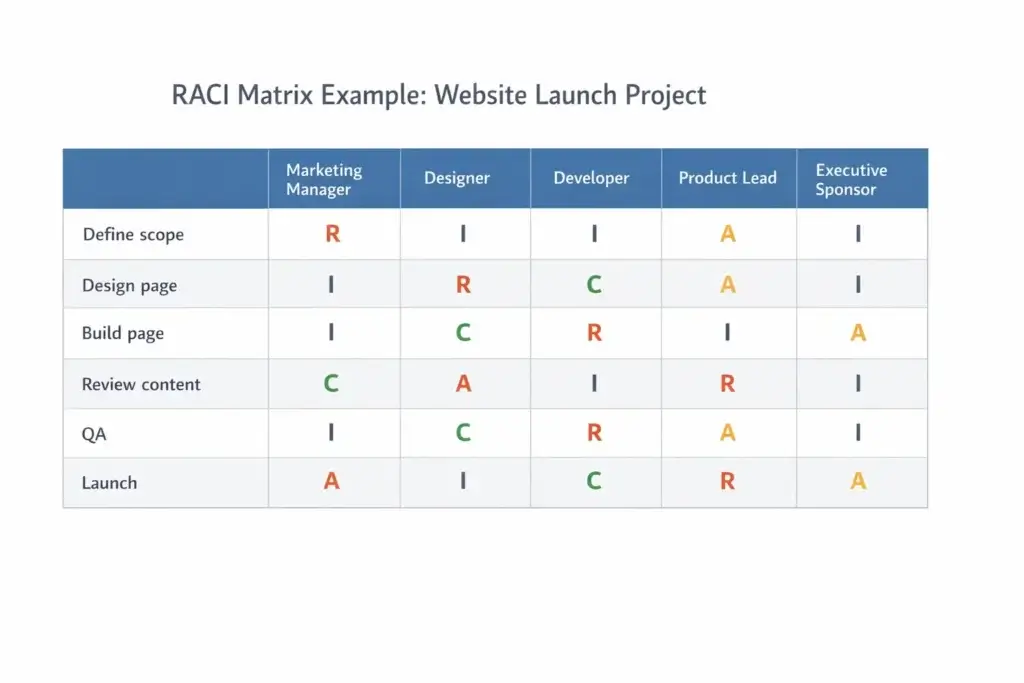
A practical example makes the framework easier to understand. Imagine a company is launching a new landing page for a product campaign. The project includes planning, design, development, approval, QA, and go-live communication.
In this example, you can see that accountability stays clear even though several people contribute. The product lead owns the overall outcome for multiple tasks, while execution shifts across marketing, design, and development. That is exactly where RACI works best: it clarifies both ownership and collaboration without flattening everything into one role.
RACI Matrix in Project Management
In project management, the RACI matrix is most valuable when ownership needs to be visible across functions. It helps teams move from vague collaboration to defined execution. Instead of assuming who approves, who contributes, or who needs updates, the project manager documents it early and uses that structure to support delivery.
This becomes especially important in projects with multiple workstreams, external stakeholders, or formal checkpoints. A RACI matrix can support project planning, stakeholder communication, risk reduction, and escalation management because it makes responsibility visible before delays happen.
It is also useful as a governance tool during project reviews. If a task is blocked, the team can return to the chart and quickly identify whether the problem is ownership, consultation overload, or an unclear approval path.
RACI vs RASCI vs DACI vs RAPID
RACI is not the only framework for clarifying involvement, but it serves a different purpose from decision-focused models. That distinction matters because teams often compare them as if they solve the same problem.
- RACI: Best for mapping roles and responsibilities across tasks, deliverables, and approvals.
- RASCI: Adds Support to the model, which can be useful when contributors help the responsible role without owning the task.
- DACI: Better for decision-making. It defines who drives the decision, who approves it, who contributes, and who is informed.
- RAPID: Also focused on decision-making, especially in organizations with more complex governance or executive involvement.
It is also important to frame Responsibility Assignment Matrix (RAM) correctly. RAM is the broader category, while a RACI matrix is one specific type of responsibility assignment matrix. In other words, RACI is not really an alternative to RAM. It is a version of it.
| Framework | What it stands for | Best used for | Main strength | Main limitation |
| RACI | Responsible, Accountable, Consulted, Informed | Clarifying roles and responsibilities across project tasks and deliverables | Simple and effective for defining ownership and communication | Can feel too rigid if overused in fast-moving teams |
| RASCI | Responsible, Accountable, Support, Consulted, Informed | Projects where supporting contributors need to be clearly identified | Adds more clarity when tasks require hands-on support beyond the main owner | Can become more complex than needed for smaller teams |
| DACI | Driver, Approver, Contributor, Informed | Decision-making processes where authority and input need to be clearly defined | Works especially well for strategic or cross-functional decisions | Less useful than RACI for mapping ongoing task ownership |
Top 3 Project Management Software Helps Teams Manage Their RACI Charts
monday.com


monday.com is the strongest fit here for teams that want to turn a static RACI chart into a living workflow. Instead of keeping responsibility mapping inside a spreadsheet that becomes outdated, teams can manage ownership inside a board, combine it with status tracking, and update it as the project evolves.
Its biggest advantage is usability. You can map roles visually, connect them to task status, deadlines, dependencies, and automations, and then share the board across functions without creating extra complexity. For cross-functional teams that want both role clarity and ongoing execution visibility, monday.com is the most practical option in this group.
Further Exploration: There is much more to learn about monday.com. For an in-depth review, visit monday.com Review.
ClickUp


ClickUp is a strong choice for teams that want more control over how the RACI model is documented and maintained. It works especially well when responsibility mapping needs to connect with docs, tasks, custom fields, dashboards, and more detailed project workflows.
Its flexibility is a clear advantage, but it also means the setup can feel heavier than a more visual-first platform. For teams that want deeper customization, reusable templates, and a more structured operational layer around their RACI chart, ClickUp is a compelling option.
Further Exploration: To delve deeper into ClickUp, read the full review at ClickUp Review.
Asana

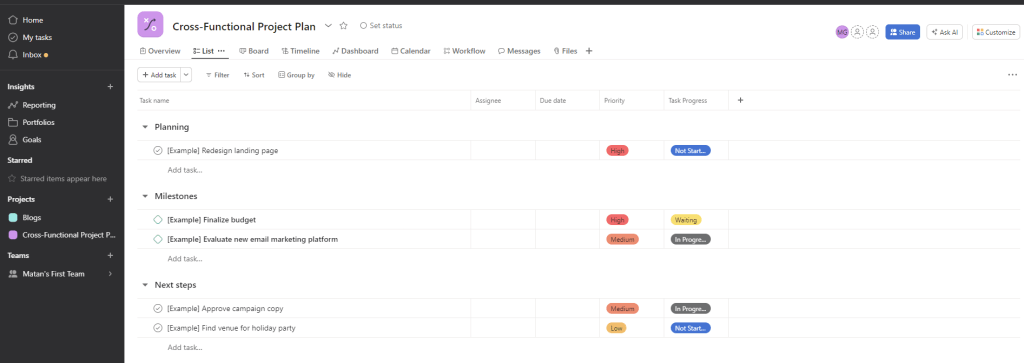
Asana is a good fit for teams that want a clean, approachable way to apply RACI principles without overengineering the setup. It is particularly useful when the main need is to connect role clarity with task progress, approvals, and stakeholder updates inside a structured project view.
Compared with monday.com and ClickUp, Asana is less focused on building a highly customized RACI environment, but it is excellent for teams that value simplicity, strong collaboration, and easy-to-follow project ownership. If your goal is to keep RACI practical and lightweight, Asana is a sensible choice.
Further Exploration: To discover more about Asana, check out the full review at Asana Review.
Conclusion
A RACI matrix remains one of the most effective ways to bring role clarity into project management. It is simple enough to use quickly, but powerful enough to improve ownership, approvals, stakeholder input, and communication across complex work.
The most important thing is not just creating the chart, but building it correctly. That means defining one accountable owner per task, ensuring the responsible role is clear, limiting unnecessary consultation, and revisiting the matrix when the project changes.
For teams that want to move beyond a static spreadsheet, project management software can make the RACI model much easier to maintain. If you want to compare stronger workflow tools for this kind of work, see our guide to Best Project Management Software.
FAQs
What does RACI stand for?
RACI stands for Responsible, Accountable, Consulted, and Informed. These four roles define who does the work, who owns the outcome, who gives input, and who needs updates.
What is the difference between Responsible and Accountable in a RACI matrix?
Responsible is the person doing the work. Accountable is the person who owns the final outcome and has approval authority. A task can involve several contributors, but it should usually have only one accountable owner.
Who should create a RACI matrix?
The project manager usually leads the process, but the matrix should be created with input from functional leads, subject matter experts, and key stakeholders so it reflects how work really happens.
When should you use a RACI chart?
Use a RACI chart at the start of projects that involve multiple contributors, approvals, handoffs, or stakeholders. It is especially useful for cross-functional work and projects where ownership is unclear.
Can one person be both Responsible and Accountable?
Yes. In smaller teams or simpler tasks, the same person can both complete the work and own the final outcome. In more complex environments, separating the two roles can improve control and governance.
What is the golden rule of RACI?
The most widely accepted rule is that each task should have one accountable owner. That keeps authority clear and reduces confusion during approvals and escalation.
Is RACI the same as RAM?
No. RAM stands for Responsibility Assignment Matrix, which is the broader category. A RACI matrix is one type of responsibility assignment matrix.
What is the difference between RACI and DACI?
RACI is mainly used to clarify responsibilities across project tasks and deliverables. DACI is more focused on decision-making by defining who drives, approves, contributes to, and is informed about a decision.
What are the main benefits of a RACI matrix?
The main benefits are clearer ownership, better approvals, improved stakeholder communication, fewer duplicated efforts, and faster identification of bottlenecks or responsibility gaps.
What are common mistakes when using a RACI matrix?
Common mistakes include assigning multiple accountable owners, leaving tasks without a responsible person, consulting too many people, making the matrix too detailed, and failing to update it when the project changes.