Introduction
Choosing between Unwrap and Enterpret comes down to how quickly you want to turn customer feedback into usable insight and how much control you want over the underlying taxonomy.
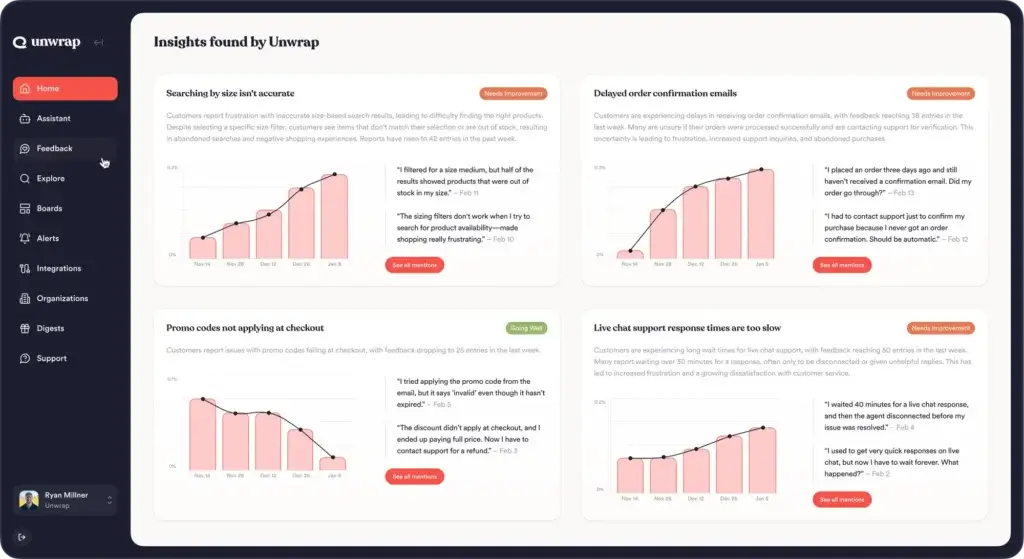
Unwrap is an enterprise-grade customer feedback intelligence platform for teams of different sizes. It automatically detects themes and trends without requiring you to build a taxonomy first, then delivers alerts and insights as customer issues emerge.
Enterpret is a customer feedback analytics platform built around an adaptive taxonomy. It is a stronger fit for organizations that want feedback categories calibrated to their product, terminology, and existing business structure, and that can support a more involved onboarding process.
The practical difference is straightforward. Unwrap prioritizes speed, automatic discovery, and low maintenance. Enterpret prioritizes a tailored taxonomy and gives teams more control over how feedback is structured.
This Unwrap vs. Enterpret comparison examines feedback analysis, setup, integrations, account and revenue context, proactive alerts, pricing, and the use cases each platform handles best.
What Is Unwrap?
Unwrap is an AI customer feedback and customer intelligence platform used to run voice of customer programs. It brings unstructured feedback together from support tickets, reviews, surveys, sales calls, and other customer channels.
The platform automatically groups feedback into themes and surfaces trends as they emerge. You do not have to define every category or tag each piece of feedback by hand before you can begin finding useful patterns.
Unwrap also connects customer feedback with CRM context, including annual recurring revenue, customer segment, and churn status. This helps product, customer experience, and customer success teams distinguish a widespread complaint from an issue affecting strategically important accounts.
Its main capabilities include:
- Automatic feedback tagging and theme detection
- Trend and sentiment analysis
- Real-time Slack and email alerts
- Executive and stakeholder digests
- Account, segment, ARR, and churn analysis
- More than 50 native feedback connectors
- Thousands of additional connections through Zapier
- Support for customer feedback from tickets, reviews, surveys, and calls
- Feedback search, reporting, and voice of customer workflows
Unwrap reports more than 90% tagging accuracy and is used by organizations including DoorDash, lululemon, Perplexity, GitHub, and Oura. It can suit lean teams that want to avoid maintaining a feedback model as well as enterprises that need to analyze large volumes of customer input.
| Pricing Factor | Unwrap | Enterpret |
| Pricing model | Custom quote | Custom quote |
| Published starting point | Approximately $24,000 per year | Not publicly listed |
| Third-party estimate | Not required for the stated starting point | Approximately $23,000 to $98,000 per year |
| Main cost drivers | Feedback volume and integrations | Feedback volume and integrations |
| Per-seat pricing | No | No |
What Is Enterpret?
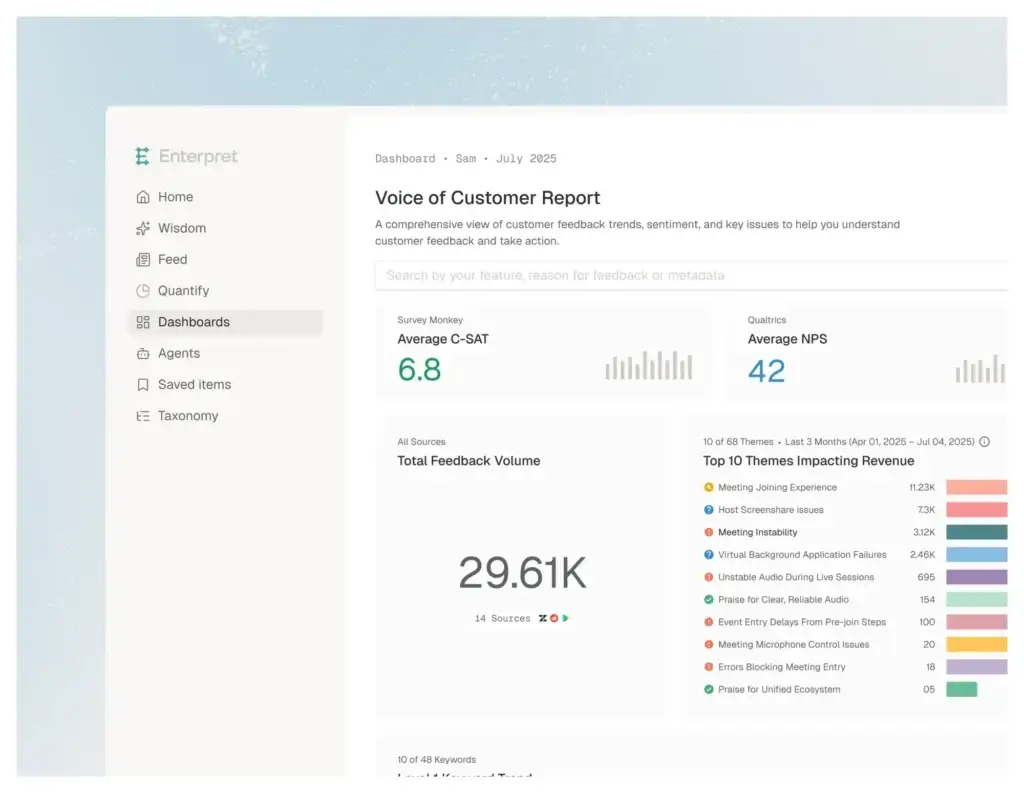
Enterpret is a customer feedback analytics platform designed around an adaptive taxonomy. It learns your product, business terminology, and historical feedback categories, then uses that structure to organize incoming customer feedback.
Both Enterpret and Unwrap use AI to classify feedback. Enterpret’s distinguishing characteristic is the emphasis it places on training and calibrating a taxonomy around the organization. This can produce categories closely aligned with your internal language, but it also means the platform generally requires more guided setup before it is fully tuned.
Enterpret connects feedback with customers, accounts, and revenue through its Customer Context Graph. Product and customer experience teams can use this context to understand which themes affect particular segments or valuable accounts.
Its main capabilities include:
- Adaptive feedback taxonomy
- AI-assisted feedback classification
- Customer Context Graph
- Account and revenue-aware analysis
- Feedback search and reporting
- More than 50 native feedback connectors
- API-based data connections
- Alerts and agent-based monitoring
- Voice of customer analysis for product and CX teams
Enterpret is best suited to organizations that consider a business-specific taxonomy a core requirement and have the resources to support initial calibration and ongoing review.
Unwrap vs. Enterpret: Quick Comparison
| Feature Type | Unwrap | Enterpret |
| Best for | Enterprise-grade, automatic feedback intelligence with less setup | Organizations that want a calibrated, business-specific taxonomy |
| Feedback categorization | Automatic grouping without an upfront taxonomy requirement | Adaptive taxonomy trained and calibrated to the business |
| Time to first insight | Generally shorter because no taxonomy must be built first | Generally longer due to taxonomy calibration |
| Account and revenue tracking | CRM metadata such as ARR, segment, and churn status | Customer Context Graph linking feedback to accounts and revenue |
| Proactive alerts | Real-time Slack and email alerts | Available through its agent-based monitoring layer |
| Feedback sources | 50+ native connectors and 3,000+ connections through Zapier | 50+ native connectors and API support |
| Published accuracy | Reports 90%+ tagging accuracy | No directly comparable public figure |
| Ideal team | Lean teams through large enterprises | Teams able to invest in taxonomy calibration |
| Pricing | Custom, starting around $24,000 per year | Custom, with third-party estimates ranging from about $23,000 to $98,000 per year |
How We Compared Unwrap and Enterpret
We focused on the factors most likely to determine which customer feedback platform fits your organization:
- How quickly each platform produces usable insights
- How feedback themes and categories are created
- Which feedback sources and integrations are supported
- How account and revenue context is applied
- How proactive alerts help teams respond to emerging issues
- How pricing and ongoing maintenance affect total value
The comparison gives more weight to practical time to value than to feature count alone. A sophisticated taxonomy can be useful, but only if your team has the time and ownership needed to maintain it.
Core Feature Comparison
Feedback Analysis and Taxonomy
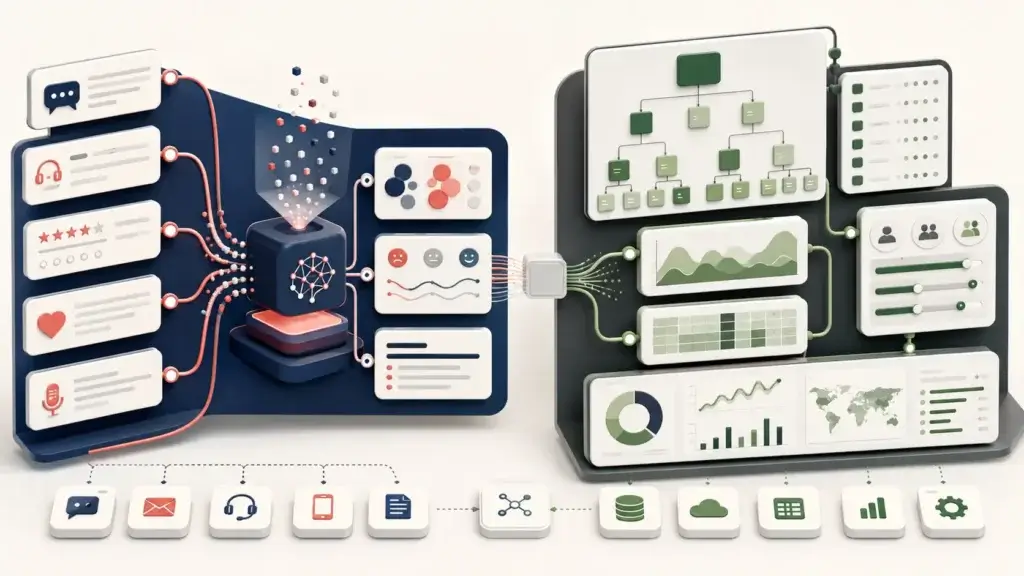
Both platforms use AI to classify feedback, so neither requires teams to manually tag every ticket, survey response, review, or call. The more important difference is how the classification structure is created and maintained.
Enterpret builds an adaptive taxonomy trained on your product, terminology, and historical categories. The taxonomy is calibrated using your data during guided onboarding. This gives you a feedback structure aligned with the language your organization already uses, but it takes more preparation before the platform is fully tuned.
Unwrap automatically groups feedback into themes without making an upfront taxonomy a prerequisite. It can surface trends sooner and can still be aligned with your preferred categories when needed.
Unwrap is the better choice when speed and low maintenance matter most. Enterpret is more compelling when close control over the feedback taxonomy is a firm requirement.
Ease of Setup and Time to Value
Unwrap generally offers the faster path to useful insight because your team does not have to build and calibrate a taxonomy first. You still need to connect feedback sources and complete onboarding, but the analytical structure can begin developing automatically.
Enterpret can connect data sources quickly, but its taxonomy must be calibrated to your data before the platform reaches its intended level of relevance. This additional setup can be worthwhile for organizations with mature voice of customer operations and clearly defined feedback categories.
Unwrap has the edge for time to value. Enterpret’s more involved setup makes sense when customization is more important than speed.
Account-Level and Revenue Tracking
Both platforms connect qualitative feedback with commercial context. This prevents product and CX teams from treating every comment as equally important.
Unwrap can pull CRM metadata such as ARR, customer segment, and churn status from Salesforce or HubSpot. You can filter themes by account value, compare segments, and identify issues linked with churn or strategically important customers.
Enterpret provides similar context through its Customer Context Graph, which links feedback with customers, accounts, and revenue.
This category is close. Both products support account-aware and revenue-aware feedback analysis, although they organize the underlying context differently.
Integrations and Feedback Sources
Unwrap supports more than 50 native connectors and extends its reach through more than 3,000 Zapier connections. This can cover support platforms, review sites, surveys, sales calls, and other systems where customer feedback appears.
Enterpret also provides more than 50 native feedback connectors, along with API support for additional data flows.
The numbers are not perfectly comparable. Unwrap’s broader figure includes Zapier-enabled connections, while Enterpret emphasizes native feedback sources. Even so, Unwrap provides the wider stated integration reach.
Unwrap wins on breadth. Before choosing either product, confirm that your most important support, CRM, survey, review, and call-recording tools are covered at the required depth.
Proactive Alerts and Real-Time Monitoring
Unwrap makes proactive monitoring a central part of its workflow. It can send Slack and email alerts when a theme grows or sentiment declines, while weekly digests keep executives and stakeholders informed without requiring them to search the platform.
Enterpret also supports alerts and proactive monitoring through its newer agent-based layer. The capability is available, but it is less central to the platform’s core positioning than it is in Unwrap.
Unwrap is stronger for teams that want immediate notification of emerging issues. This is particularly useful when product defects, support problems, or churn signals need a rapid response.
Accuracy and Ongoing Maintenance
Unwrap publicly reports more than 90% tagging accuracy. A published figure does not replace testing with your own data, but it gives buyers a measurable claim to examine during a proof of concept.
Enterpret emphasizes accurate, business-specific classification but does not publish a directly comparable accuracy figure. Its calibrated taxonomy may provide a close fit with established internal categories, although that advantage depends on the quality of onboarding and ongoing model review.
Unwrap offers greater public transparency around tagging accuracy. Enterpret may appeal more when your priority is taxonomy alignment rather than minimizing model maintenance.
Unwrap vs. Enterpret Pricing
Both platforms use custom pricing based on factors such as feedback volume and connected data sources. Neither product is positioned as a low-cost, self-service feedback tool, and neither primarily charges by user seat.
Unwrap provides more pricing transparency by publishing a starting price of approximately $24,000 per year. Your final cost can vary based on data volume, integration requirements, and the scope of your deployment.
Enterpret is quote-based. Third-party buyer data from Vendr has placed deals at roughly $23,000 to $98,000 per year, with a median near $36,000. These figures are estimates rather than official list prices, so they should be treated as negotiation context rather than a guaranteed quote.
Because both products operate in a similar premium category, the most reliable comparison is to request quotes using the same estimated feedback volume, sources, historical import requirements, user groups, and support expectations.
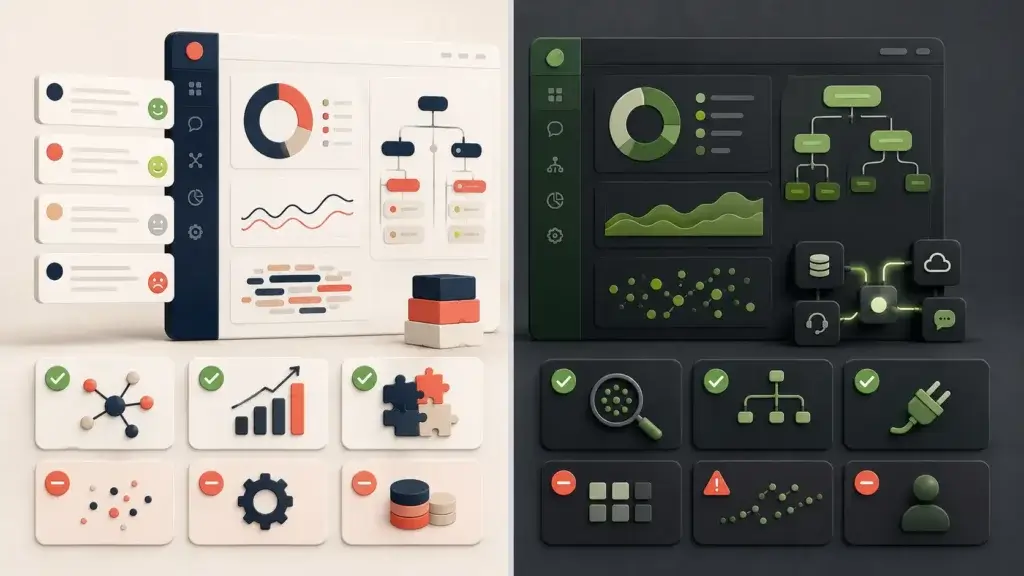
Unwrap vs. Enterpret Pros and Cons
Unwrap Strengths
✅ Automatic themes without an upfront taxonomy
✅ Faster time to useful insight
✅ Broad integration reach
✅ Real-time Slack and email alerts
Unwrap Limitations
❌ Premium annual starting price
❌ Final pricing requires a sales process
❌ Less emphasis on manually controlled taxonomy design
❌ Integration depth should be confirmed individually
Unwrap Pros
Automatic theme and trend detection
Unwrap can begin organizing feedback without requiring your team to define and calibrate an entire taxonomy first. This reduces the operational burden of starting a voice of customer program.
Faster time to useful insight
Because the platform infers themes automatically, teams can identify recurring issues and emerging trends sooner after connecting their feedback sources.
Broad integration reach
More than 50 native connectors and thousands of Zapier connections make Unwrap adaptable to feedback spread across support, survey, CRM, review, and conversation tools.
Strong proactive monitoring
Slack and email alerts help product and CX teams respond when a theme grows or customer sentiment declines instead of waiting for the next scheduled report.
Unwrap Cons
Premium annual starting price
A starting point near $24,000 per year places Unwrap beyond the budget of many small businesses and early-stage voice of customer programs.
Final pricing still requires a quote
The published starting point improves transparency, but buyers still need a sales conversation to determine the complete cost for their feedback volume and integrations.
Less emphasis on taxonomy control
Organizations that want their existing internal classification model to drive the entire analysis may prefer Enterpret’s taxonomy-centered approach.
Connector quantity does not guarantee connector depth
Zapier expands the number of possible connections, but you should confirm the fields, history, sync frequency, and actions supported by each critical integration.
Enterpret Strengths
✅ Business-specific adaptive taxonomy
✅ Strong account and revenue context
✅ More than 50 native feedback connectors
✅ Suitable for mature VoC programs
Enterpret Limitations
❌ Longer taxonomy calibration process
❌ Greater setup and governance requirements
❌ No public list price
❌ No directly comparable published accuracy figure
Enterpret Pros
Business-specific adaptive taxonomy
Enterpret can organize feedback around your product, terminology, and established historical categories. This can make reports easier to align with internal planning and ownership structures.
Strong account and revenue context
The Customer Context Graph connects qualitative feedback with customers, accounts, and revenue, helping teams prioritize issues with commercial significance.
More than 50 native feedback connectors
Native connectors cover many of the systems commonly used to collect customer feedback, while API support can address additional requirements.
Suitable for mature voice of customer programs
Organizations with defined feedback governance and someone responsible for taxonomy quality may benefit from Enterpret’s more structured approach.
Enterpret Cons
Longer calibration process
The taxonomy needs to learn the organization’s products, terminology, and categories. This can delay time to value compared with a platform that begins with automatic theme discovery.
Greater setup and governance requirements
Enterpret is more likely to need a clear internal owner who can review the taxonomy and ensure the resulting categories continue to match business needs.
No public list price
You must contact the company for a quote. Third-party estimates provide context, but they cannot confirm what your organization will pay.
No directly comparable published accuracy figure
Enterpret promotes accurate classification but does not provide a public metric directly comparable with Unwrap’s reported tagging accuracy.
Detailed Buying Scenarios
Scenario 1: You Need Useful Feedback Themes Quickly
Unwrap is the better choice.
It begins grouping feedback automatically and does not make taxonomy construction a prerequisite. This reduces the time between connecting sources and discovering actionable themes.
Scenario 2: Your Organization Requires a Custom Taxonomy
Enterpret is the better choice.
Its adaptive taxonomy is trained around your products, terminology, and historical categories. The additional calibration is easier to justify when taxonomy alignment is an explicit requirement.
Scenario 3: Your Feedback Is Spread Across Many Tools
Unwrap has the advantage.
Its combination of native integrations and Zapier connections provides broader stated coverage. You should still test the depth of every essential connector before signing a contract.
Scenario 4: You Need to Prioritize Feedback by Revenue
Both platforms are strong options.
Unwrap uses CRM metadata such as ARR, segment, and churn status, while Enterpret uses its Customer Context Graph. The better option depends on how well each platform maps to your CRM data model.
Scenario 5: You Want Real-Time Alerts for Emerging Problems
Unwrap is the better choice.
Slack and email alerts are central to its workflow, helping teams identify fast-growing themes and falling sentiment without repeatedly checking a dashboard.
Scenario 6: You Run a Mature Voice of Customer Program
The choice depends on your operating model.
Choose Unwrap when your priority is scalable analysis with less taxonomy maintenance. Choose Enterpret when your program has dedicated ownership and requires a classification structure closely aligned with internal terminology.
Final Recommendation
For most teams evaluating Unwrap vs. Enterpret, Unwrap is the more practical choice.
It provides enterprise-grade customer intelligence, automatic theme and trend detection, broad integration reach, account and revenue context, and proactive alerts without requiring your team to calibrate a complete taxonomy before finding value.
This makes Unwrap suitable for lean product and CX teams as well as larger enterprises that want to analyze feedback at scale without adding unnecessary administrative work.
Enterpret remains a credible option when a tailored taxonomy is central to your voice of customer strategy. Its Customer Context Graph and adaptive classification model can be valuable for organizations with mature feedback operations and the resources to support calibration.
The deciding question is not whether you want AI-assisted feedback analysis because both platforms provide it. The real question is how much structure you want the software to infer and how much you want your team to calibrate.
Choose Unwrap for faster automatic insight, real-time alerting, and lower setup overhead. Choose Enterpret when taxonomy customization outweighs the additional time and governance required.
FAQ
What is the main difference between Unwrap and Enterpret?
Unwrap automatically discovers feedback themes without requiring an upfront taxonomy, which generally provides faster time to value. Enterpret centers its workflow on an adaptive taxonomy calibrated to your products, terminology, and historical categories.
Is Unwrap or Enterpret better for a customer success team?
Unwrap is usually the better fit for customer success teams that want to identify churn themes quickly without maintaining a taxonomy. Enterpret is worth considering when the team needs feedback organized around a highly customized business structure.
Is Unwrap or Enterpret better for a customer experience team?
Unwrap is generally better for CX teams that prioritize automatic theme detection, broad source coverage, and real-time alerts. Enterpret may fit better when the organization wants feedback mapped to a calibrated CX taxonomy.
Which customer feedback platform is faster to set up?
Unwrap is generally faster to set up because it does not require you to build and calibrate a taxonomy before finding useful themes. Enterpret requires more guided calibration to align its taxonomy with your data.
Does Unwrap tie customer feedback to revenue?
Yes. Unwrap can use CRM data such as ARR, customer segment, and churn status to analyze feedback by account value. Enterpret provides similar account and revenue context through its Customer Context Graph.
How do Unwrap and Enterpret pricing compare?
Both use custom pricing based largely on feedback volume and integrations. Unwrap publishes a starting point of approximately $24,000 per year. Enterpret is quote-only, with third-party buyer estimates ranging from about $23,000 to $98,000 per year.
What is the difference between Unwrap’s automatic tagging and Enterpret’s adaptive taxonomy?
Unwrap groups feedback into themes automatically without making taxonomy creation a prerequisite. Enterpret trains and calibrates an adaptive taxonomy around your business, providing more structural control but requiring more setup and review.
Is Unwrap a good Enterpret alternative for lean teams?
Yes. Unwrap is a strong Enterpret alternative for teams that want AI-driven theme and churn detection without heavy taxonomy setup. It can also scale to larger enterprise feedback programs.
Which platform offers more customer feedback integrations?
Unwrap states that it supports more than 50 native connectors and over 3,000 additional Zapier connections. Enterpret offers more than 50 native connectors plus API support. Confirm connector depth for your essential systems before buying.
Should you choose Unwrap or Enterpret?
Choose Unwrap for faster automatic insight, proactive alerts, broad integration reach, and less taxonomy maintenance. Choose Enterpret when a business-specific adaptive taxonomy is essential and your team can support the calibration process.