Introduction
There is a growing assumption behind many enterprise AI strategies today: the goal is autonomy.
The more decisions AI can make without human involvement, the more advanced the implementation appears. The further a company moves toward agentic AI, self-resolving tickets, and zero-touch service desks, the more mature its IT operation seems to be.
But that assumption deserves a closer look.
A new report from InvGate, The AI Adoption Lifecycle in Service Management, challenges the idea that autonomy should be the first measure of AI success in ITSM. The report points to a more practical reality: AI only creates lasting value when the service operation underneath it is mature enough to support it.
This matters because many enterprise AI projects are still failing to move beyond the pilot stage. According to MIT Project NANDA’s The GenAI Divide: State of AI in Business 2025, only a small percentage of enterprise-grade AI systems evaluated by organizations reach production. The main barriers are not only technical limitations. They are often brittle workflows, weak contextual learning, and poor alignment with how teams actually work every day.
In other words, the AI may be ready, but the operation is not.
That is the core problem for many IT service desks. AI autonomy is not simply a capability you switch on. It is a result that has to be earned through clean knowledge, governed processes, measurable service performance, and clear human oversight.
When those foundations are missing, AI does not solve operational problems. It accelerates them.
That is why so many AI projects in ITSM look promising in a controlled pilot but fail when they reach real service desk conditions. They meet messy ticket data, outdated knowledge articles, inconsistent workflows, unclear ownership, and support processes that were never designed for automation at scale.
The most successful AI implementations in ITSM have something important in common: they do not start by trying to remove people from the process. They start by making the process strong enough for AI to support it safely.
AI Is Probably Already Inside Your Service Desk
Many IT leaders still think of AI adoption as a formal project. They imagine it beginning when the company selects a vendor, approves a budget, sets up governance, and launches a controlled implementation.
In reality, AI is often already being used inside the service desk before any official project begins.
Agents may be using personal AI tools to draft ticket responses, summarize long conversations, rewrite knowledge articles, or search for troubleshooting steps. Employees may also be using AI tools to explain internal systems, write requests, or work around support delays.
This creates a gap between official AI adoption and actual AI usage.
That gap matters because unmanaged AI use introduces real governance questions. What information are employees entering into these tools? Are AI-generated responses being checked before they are sent? Is the knowledge being used accurate? Who is responsible if an answer is wrong? Are agents becoming dependent on tools that the organization has not approved or secured?
The question is no longer whether AI will enter the service desk. In many cases, it already has.
The better question is whether the organization has enough visibility and control to use it safely.

Why So Many AI Projects Stay Stuck in Pilot Mode
AI pilots are often easier than AI production.
In a pilot, the scope is narrow. The use cases are selected carefully. The test data is limited. The stakeholders are engaged. The project team can manually correct problems and present the most successful results.
Production is different.
In production, AI has to work across messy ticket histories, inconsistent categories, incomplete knowledge bases, changing business rules, and real users who do not follow neat testing scenarios.
This is where many AI projects break down.
The issue is usually not that the AI model is incapable. The issue is that the operating environment is not ready. Common problems include:
- Poor ticket categorization
- Outdated or duplicated knowledge articles
- No clear ownership of service workflows
- Weak change control around support processes
- Limited visibility into service performance
- Unclear escalation rules
- Inconsistent agent behavior
- No agreed baseline for measuring improvement
When these problems exist, AI has very little stable ground to stand on.
A pilot may still look successful because the team can control the conditions. But once the system has to work inside the full complexity of IT support, the lack of operational maturity becomes visible.
AI Does Not Fix Broken Processes
One of the most important lessons for ITSM leaders is simple: AI does not fix broken processes. It automates them.
That distinction is critical.
If a service desk has unclear routing rules, AI can route tickets faster, but not necessarily better. If the knowledge base is outdated, AI can produce answers faster, but not necessarily more accurately. If escalation rules are inconsistent, AI can follow them automatically, but that does not make them correct.
This is why AI adoption should not begin with the question, “What can we automate?”
A better question is, “Which parts of our operation are stable enough to automate?”
That shift changes the entire strategy.
Instead of chasing the most impressive AI use case, IT leaders can start by identifying the areas where workflows are already repeatable, knowledge is reliable, and outcomes can be measured. Those are the places where AI can create value with less risk.
The Real Foundation of AI Readiness in ITSM
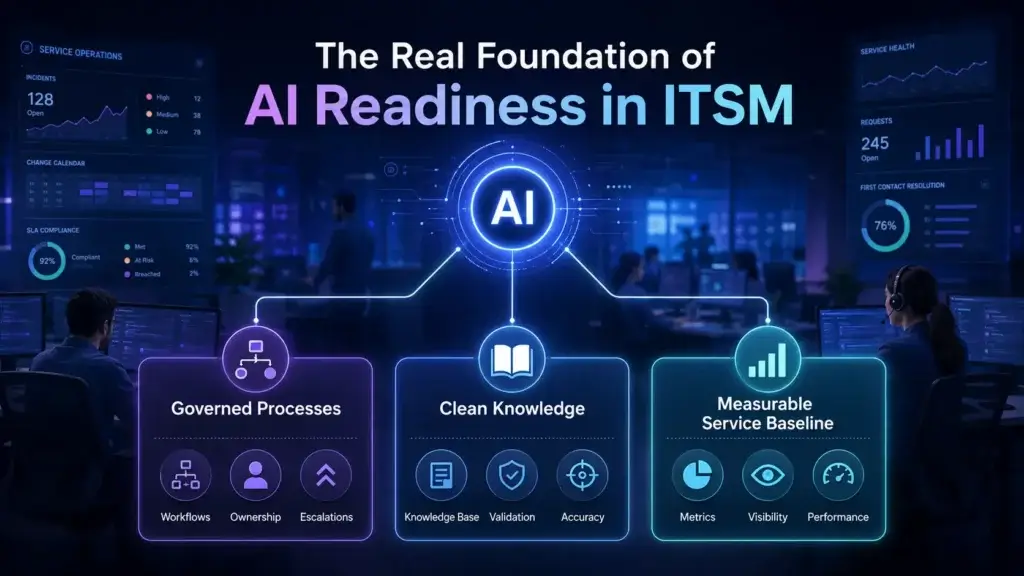
Before a service desk can benefit from advanced AI, it needs several foundations in place.
1. Governed and Repeatable Processes
AI performs best when the underlying process is clear.
This means tickets should be categorized consistently. Ownership should be defined. Escalation paths should be documented. Agents should understand when to follow a standard workflow and when to involve another team.
This does not mean every process must be perfect. But it does mean the organization needs enough consistency for AI to learn from and support the work.
If every agent handles the same type of request differently, AI will struggle to identify the right pattern. If teams disagree on ownership, automation may send tickets to the wrong place. If workflows exist only in outdated documentation, AI will not be aligned with how the service desk actually operates.
Strong process governance gives AI a reliable structure to support.
2. Clean and Useful Knowledge
Knowledge quality is one of the most underestimated parts of AI adoption.
Every AI-generated answer is only as strong as the knowledge behind it. If the knowledge base is outdated, incomplete, duplicated, or poorly structured, AI may produce confident but inaccurate responses.
This is especially risky in ITSM because users often trust service desk answers. A wrong answer about access permissions, system troubleshooting, security steps, or software configuration can create more work instead of reducing it.
Before expanding AI automation, IT teams should review the quality of their knowledge base. That includes removing old articles, consolidating duplicates, improving article structure, validating procedures, and making sure ownership is clear.
AI can help maintain knowledge over time, but it should not be expected to repair years of unmanaged documentation by itself.
3. A Clear Performance Baseline
AI cannot improve what the organization has not measured.
Before introducing AI into ITSM workflows, leaders should understand the current performance of the service desk. This includes metrics such as:
- First response time
- Resolution time
- Ticket volume by category
- Escalation rate
- Reopen rate
- Agent workload
- Self-service usage
- Knowledge article effectiveness
- User satisfaction
Without a baseline, it becomes difficult to know whether AI is actually improving the service desk.
A new AI assistant may reduce response times, but increase reopen rates. It may answer more tickets, but create lower satisfaction. It may reduce agent workload in one area, but increase review work in another.
The goal is not just to deploy AI. The goal is to prove that AI improves service outcomes.
A Better Model: Start With Assistance, Not Autonomy
The most practical path for AI in ITSM is not to jump straight to autonomous resolution. It is to build AI adoption in stages.
The first stage should usually be AI assistance.
This means using AI to support agents inside their existing workflow, without giving the system full control over decisions. Examples include:
- Summarizing long ticket histories
- Suggesting relevant knowledge articles
- Drafting responses for agent review
- Highlighting missing ticket details
- Recommending categories or priorities
- Identifying similar past incidents
- Helping agents write clearer knowledge updates
This approach creates value without removing human judgment.
It also helps the organization learn where AI performs well, where it needs guardrails, and where the underlying process needs improvement.
Once AI assistance is working reliably, the organization can move toward more advanced use cases.
From AI Assistance to Operational Intelligence
After the service desk has gained confidence with AI-assisted work, the next step is operational intelligence.
At this stage, AI is not only helping agents with individual tickets. It is also helping managers understand patterns across the service operation.
This can include identifying recurring incidents, detecting unusual ticket spikes, finding knowledge gaps, spotting process bottlenecks, or showing which teams are under the most pressure.
This layer is valuable because it turns AI into a management tool, not just a support tool.
Instead of simply making ticket handling faster, AI can help IT leaders see why certain problems keep appearing. It can reveal where documentation is weak, where users need better self-service, where automation opportunities exist, and where workflows need redesign.
This is where AI starts to support continuous improvement.
When Autonomy Finally Makes Sense
Autonomous AI can be valuable in ITSM, but it should be introduced carefully.
The best candidates for autonomy are usually narrow, repeatable, low-risk workflows with clear rules and predictable outcomes. For example:
- Password reset guidance
- Basic access request triage
- Simple software request routing
- Standard FAQ responses
- Known issue updates
- Ticket classification for common categories
- Status updates for existing requests
Even then, autonomy should not mean unlimited control.
AI should operate within clear boundaries. There should be escalation rules, confidence thresholds, audit trails, and human review options. Users should know when they are interacting with AI, and agents should be able to intervene when needed.
The goal is not to remove humans completely. The goal is to let AI handle the work it can perform reliably, while humans stay responsible for judgment, exceptions, accountability, and service quality.
The Service Desk Should Not Just Run Faster
A common mistake in AI adoption is focusing only on speed.
Faster responses are useful, but speed alone is not enough. A fast wrong answer is still a bad service experience. A quickly routed ticket is not helpful if it goes to the wrong team. A self-service answer is not valuable if the employee has to reopen the issue later.
The better goal is a service desk that becomes more consistent, more measurable, and more aware of its own operations.
That means AI should help the service desk understand:
- Which issues are most common
- Which workflows create friction
- Which knowledge articles are trusted
- Which requests need human judgment
- Which automations are safe
- Which processes need redesign before automation
In this sense, the most mature AI service desk is not necessarily the one with the highest level of autonomy. It is the one that knows where autonomy is appropriate and where it is not.
What Successful AI Projects in ITSM Have in Common
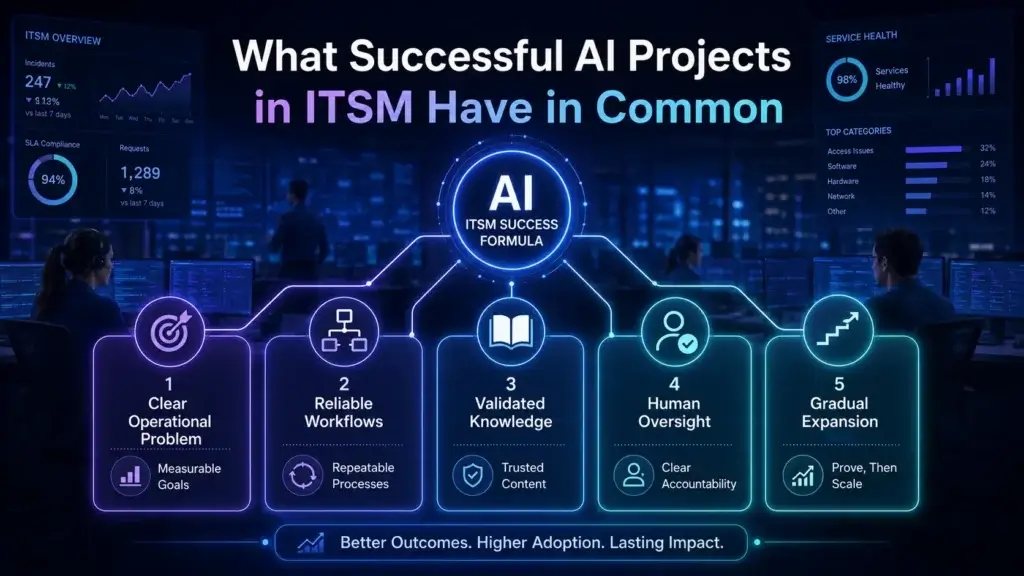
The AI projects that make it beyond the pilot stage usually share several characteristics.
First, they are connected to a clear operational problem. They are not launched only because AI is trending. They are tied to measurable goals, such as reducing repetitive work, improving response consistency, increasing self-service success, or improving incident visibility.
Second, they are built on reliable workflows. The team understands the process before trying to automate it.
Third, they use validated knowledge. AI is not left to pull from outdated, unreviewed, or unstructured content.
Fourth, humans remain in control of key decisions. AI may suggest, summarize, classify, or even act in limited cases, but responsibility remains clear.
Finally, successful AI projects expand gradually. They prove value in one area before moving into more complex use cases.
The platform behind the service desk also matters. If teams are using an ITSM system that makes it difficult to manage workflows, maintain knowledge, measure performance, or control automation, AI adoption becomes harder to scale. For organizations still evaluating their foundation, comparing the best ITSM software can help identify platforms that support ticket management, reporting, automation, knowledge management, and service governance in one connected environment.
That is the difference between AI adoption as a technology project and AI adoption as an operational maturity journey.
Final Thoughts
AI has real potential in IT service management. It can reduce repetitive work, improve agent productivity, support self-service, and help IT teams detect patterns that would otherwise be missed.
But AI is not a shortcut around process maturity.
If the service desk has weak workflows, poor knowledge management, limited reporting, and unclear ownership, AI will not magically solve those issues. It may expose them faster. It may even make them worse.
The organizations that succeed with AI in ITSM are not necessarily the ones that move fastest toward autonomy. They are the ones that prepare the ground first.
They clean up their processes. They improve their knowledge. They define their metrics. They start with assistance. They expand into intelligence. Then, only when the use case is stable enough, they introduce autonomy with clear boundaries.
That may not sound as exciting as a fully self-running service desk. But it is far more realistic.
In ITSM, the real promise of AI is not a service desk that runs without people. It is a service desk that understands its work well enough to improve it continuously, safely, and at scale.
FAQs
Why do many AI projects in ITSM fail after the pilot stage?
Many AI projects in ITSM fail after the pilot stage because the service desk environment is not ready for production use. The problem is often not the AI model itself, but weak workflows, outdated knowledge articles, inconsistent ticket categorization, unclear ownership, and limited service performance data. AI needs a mature operational foundation before it can deliver reliable results at scale.
What does AI readiness mean in IT service management?
AI readiness in IT service management means the organization has the processes, knowledge, data, governance, and measurement practices needed to use AI safely and effectively. This includes governed workflows, clean knowledge bases, measurable service baselines, clear escalation rules, and human oversight for important decisions.
Should ITSM teams start with autonomous AI?
Most ITSM teams should not start with fully autonomous AI. A safer and more practical approach is to begin with AI assistance, such as ticket summaries, response drafts, knowledge suggestions, categorization support, and operational insights. Once these use cases prove reliable, teams can gradually expand into limited automation and, eventually, controlled autonomy.
How can AI improve the IT service desk?
AI can improve the IT service desk by helping agents work faster, reducing repetitive tasks, improving response consistency, suggesting relevant knowledge articles, detecting ticket patterns, and giving managers better visibility into service performance. However, the value depends on the quality of the workflows and data behind the AI system.
What are the main foundations of successful AI adoption in ITSM?
The main foundations of successful AI adoption in ITSM are governed processes, clean knowledge, and measurable service baselines. Governed processes give AI a consistent structure to follow. Clean knowledge helps AI provide accurate answers. Measurable service baselines allow teams to prove whether AI is improving outcomes or creating new risks.
Does AI replace IT service desk agents?
AI does not need to replace IT service desk agents to create value. In many successful ITSM implementations, AI works as a support layer that helps agents summarize tickets, find answers, prioritize work, and make better decisions. Human agents remain essential for judgment, exceptions, accountability, relationship management, and complex problem solving.
What are good first AI use cases for ITSM?
Good first AI use cases for ITSM include ticket summarization, response drafting, knowledge article recommendations, ticket classification, priority suggestions, duplicate ticket detection, self-service guidance, and service trend analysis. These use cases improve productivity without giving AI too much control too early.
When does autonomous AI make sense in ITSM?
Autonomous AI makes sense in ITSM when the use case is narrow, repeatable, low-risk, and supported by reliable knowledge and clear escalation rules. Examples may include simple ticket routing, basic status updates, standard request triage, and common self-service answers. Even then, autonomy should include confidence thresholds, audit trails, and human fallback options.