
Introduction
Bubble PPM is a cloud-based SaaS project portfolio management platform designed to meet the demands of product development, R&D, and innovation. Providing end-to-end portfolio visibility across the full new product development (NPD) lifecycle – it spans ideation and prioritization, project execution, stage-gate governance, financial management, strategic planning and portfolio reporting.
Where many PPM tools have been adapted from general project management platforms, Bubble PPM is purpose-built to accommodate the management of structured development projects and programs across multiple business units, regulatory environments, and resource pools. Its primary user base includes R&D teams, PMOs, and portfolio managers in industries such as medical devices & pharma, fast moving consumer goods, and manufacturing, where structured stage-gate processes and compliance requirements make generic tools unsuitable.
It is highly configurable without requiring ongoing vendor involvement to benefit from continuous system improvement, and at the same time it remains accessible for smaller, growth-stage innovation teams.
Software Specification
Bubble PPM’s Core Features
Most teams already have the skills and experience to deliver several projects successfully. The real issue is delivering a continuous stream of projects consistently, confidently, and efficiently – without reinventing the wheel each time. Bubble describes its solution as a “powerful all-in-one workspace for delivering repeatable innovation success”, here’s our summary of some of its key features:
Idea Management and Prioritization
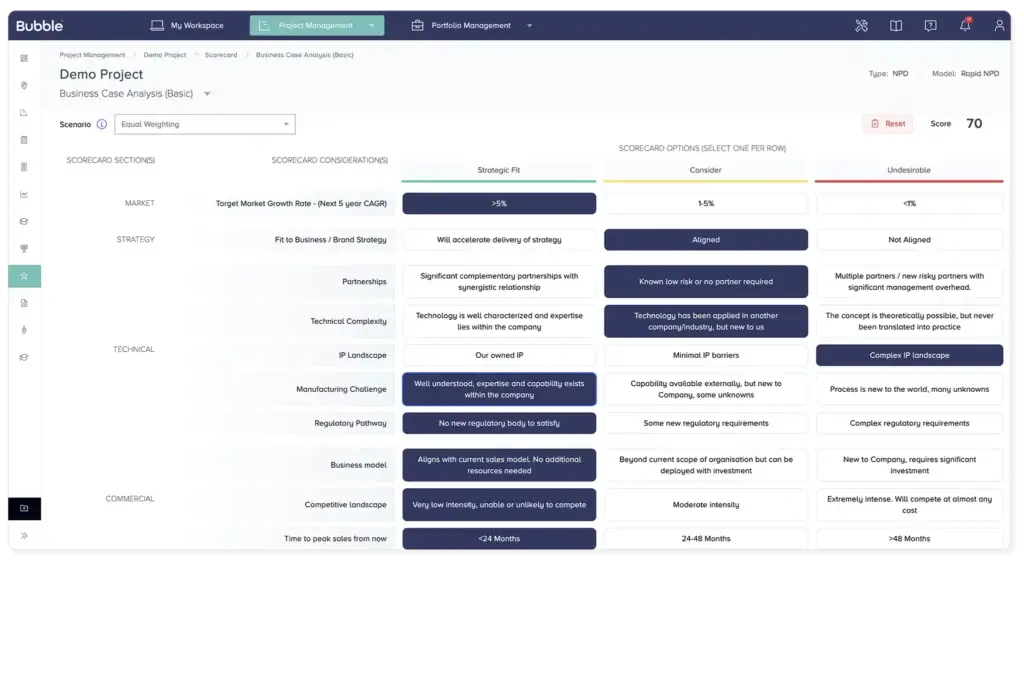
Bubble PPM gives portfolio managers a consolidated view of all active, planned, and pipeline projects. Team users benefit from features supporting business case submission, idea refinement, project assessment and prioritization. I particularly liked the way the platform guides users through pre-defined workflows to ensure submissions capture key details and stay aligned to strategic objectives. For power users, the system supports migration of ideas to full projects using a one-click Promote-to-Project function. Scorecards, evidence forms, and triggered notifications keep all stakeholders up-to-date with progress of propsals in real time.
Strategic Portfolio Management
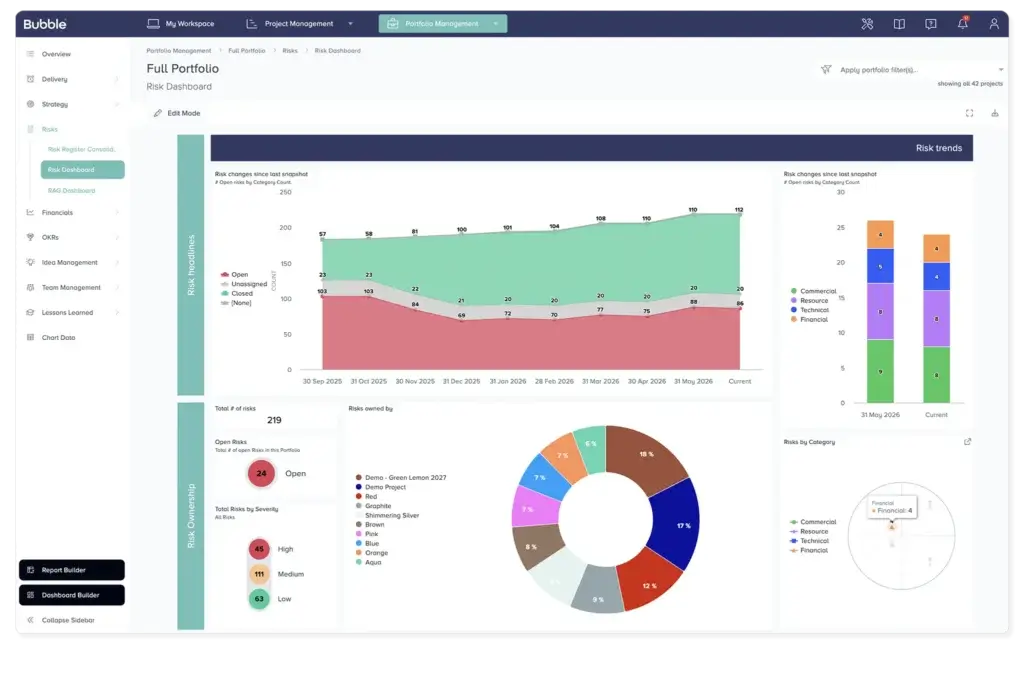
Portfolio views are fully configurable to show different slices of data – by business unit, product line, geography, investment or other category – without custom development. Strategic planners benefit from:
- Scoring and prioritization models: To define and apply weighted scoring criteria for ranking and comparing portfolio projects.
- Pipeline management tools: Whether you’re interested in gate reviews, milestone tracking or attainment of financial metrics, Bubble keeps leadership informed of progress KPIs as projects move through the delivery funnel.
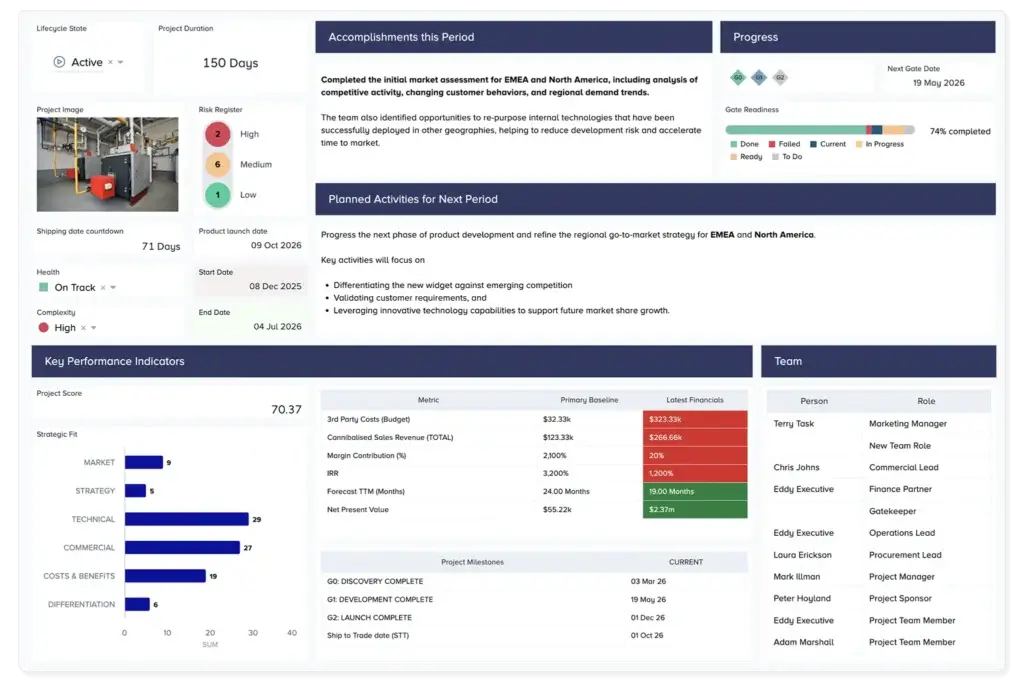
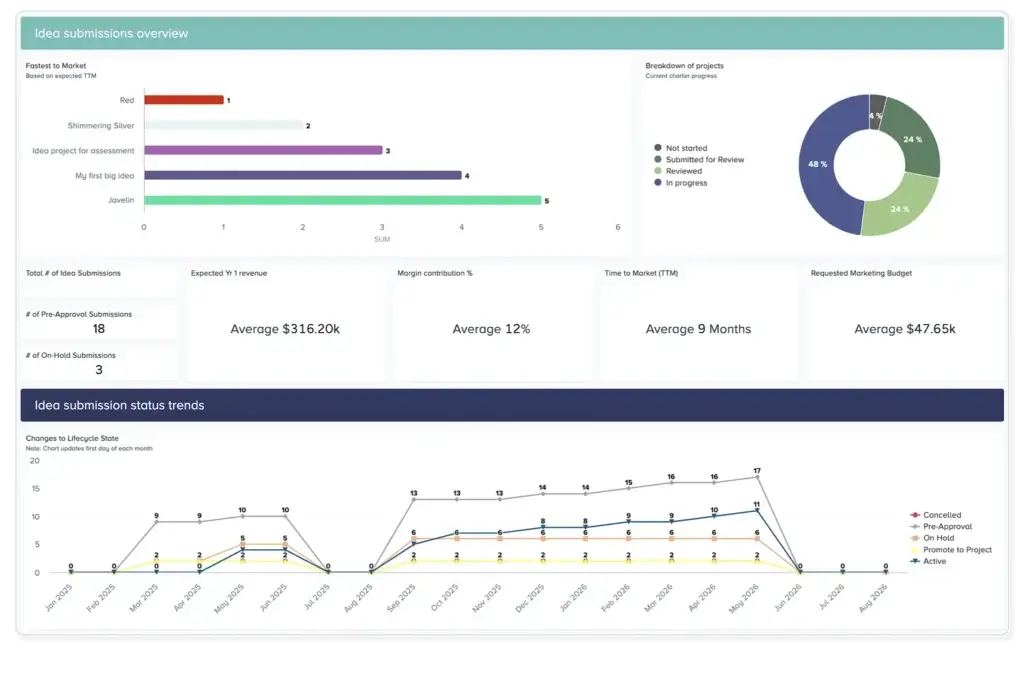
- Portfolio reports & dashboards: Summary views, built from live project data rather than manually maintained slides, provide executive-level insight into portfolio health, investment distribution, and strategic alignment.
Project Execution and Scheduling
Beyond strategic portfolio-level planning, Bubble PPM supports day-to-day project execution with tools for task management, scheduling, dependencies, and progress tracking.
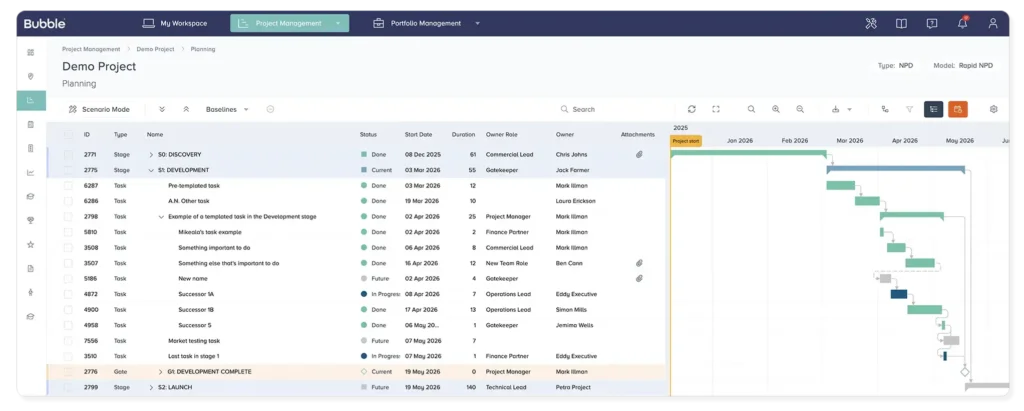
- Gantt charts and scheduling: Interactive Gantt views allow project managers to build and adjust schedules, set task dependencies, and track progress against current, baselined and hypothetical versions of the plan.
- Task management: Teams can easily assign tasks, set priorities, track completion, and log updates within the platform – keeping project data centralized rather than scattered across email and spreadsheets.
- Milestone tracking: Key milestones are visible at project, program and portfolio levels, giving stakeholders a clear picture of progress without requiring a detailed read of the full plan.
Stage Gate and Project Governance
Stage-gate process management is one of Bubble PPM’s strongest differentiators. The platform supports structured stage and gate workflows with configurable gate criteria, deliverable checklists, and approvals. This makes it particularly valuable for organizations following formal NPD methodologies.
- Configurable business process templates: Project deliverables, Gate criteria, required tasks and review workflows can all be tailored to your organization’s process requirements without vendor assistance.
- Phase tracking and milestone management: Projects are tracked through clearly defined stages, with visibility into deliverable status, upcoming gates, and stage completion.
- Audit trails: A full record of plan actions, decisions, approvals, and changes is maintained, which is particularly useful to organizations requiring compliance tracking or in regulated industries.
Financial Management
Bubble PPM integrates financial tracking directly into project and portfolio workflows, giving teams that need it visibility into budgets, forecasts, and actuals alongside their project data.
- Budget management: Project budgets can be set and tracked within the platform, with configurable fields to capture costs by category, phase, or cost center.
- Forecast vs. actuals: Teams can maintain running cost forecasts alongside actuals, giving finance and PMO teams an up-to-date view of spend and variance. Where required, baselines track deviations from the initial plan.
- Portfolio-level financial reporting: Roll-up reports and dashboards show total investment across portfolios by categories, business units, time periods or other factors – supporting investment committee reviews and budget planning cycles.
Reporting, Data Integration & AI
Reporting in Bubble PPM is designed to reduce the manual effort that typically goes into producing portfolio status reports, gate packs, and executive dashboards.
- Configurable reports and dashboards: Project status updates flow automatically into portfolio-level reports, eliminating the need for manual consolidation from separate spreadsheets or email updates. Users can build dashboard views that surface the data most relevant to their role – whether that is a project manager tracking team delivery or a portfolio director using the platform for board updates.
- Data integration and API: Bubble PPM connects to ERP systems, BI platforms, and other enterprise tools via API and native integrations, enabling organizations to consolidate portfolio data with financial systems and broader business intelligence environments.
- AI: Customers connect the AI tool of their choice directly to their data in the Bubble PPM platform, meaning private company data stays within a company controlled environment. User permissions, set in Bubble, continue to govern the breadth and depth of data available to individuals within the AI.
Pros and Cons
Advantages and Disadvantages
Positive
✅ Purpose-built for NPD and R&D portfolio management
✅ Configurable without vendor dependency
✅ End-to-end portfolio coverage
✅ Fast time to value
✅ Strong fit for regulated industries
✅ Responsive customer success model
Negative
❌ Niche positioning may not suit all teams
❌ Less name recognition than other vendors
❌ Resource management in active re-development
❌ Pricing model is suited to mid-market and enterprise
Advantages
- Purpose-built for NPD and R&D portfolio management: Unlike general project management tools that require heavy customization to approximate NPD workflows, Bubble PPM ships with the structures R&D and PMO teams actually use – stage-gate reviews, portfolio prioritization frameworks, and NPD-specific reporting.
- Configurable without vendor dependency: Administrators can adjust workflows, templates, custom fields, and views without raising a support ticket or paying for ongoing professional services. This can significantly reduce the total cost of ownership over time compared to competitor solutions.
- End-to-end portfolio coverage: A single platform handles ideation and pipeline management, project execution and scheduling, financial tracking, resource management, portfolio prioritization, and reporting. Teams do not need to stitch together multiple tools to get a complete picture.
- Fast time to value: Bubble PPM deployments are typically operational within 30 to 90 days. Pre-configured templates and a managed onboarding process, built from hundreds of implementations, reduces the setup burden considerably.
- Strong fit for regulated industries: The platform’s stage-gate framework, audit trail capabilities, and role-based access controls make it well-suited for organizations in medical devices, pharma, and manufacturing where structured review processes are a compliance requirement.
- Responsive customer success model: Bubble proudly promotes their software and a service approach. Ongoing post-go-live engagement with process and system experts is a stated part of their ‘value-add’ delivery model.
Disadvantages
- Niche positioning may not suit all teams: Bubble PPM is optimized for structured development projects and programs. Teams looking for a lightweight project management tool or a general-purpose work management platform will find more options elsewhere.
- Less name recognition than other vendors: Compared to Planview or Microsoft Project, Bubble PPM carries less brand recognition in large enterprise procurement processes, which can require additional vendor validation steps.
- Resource management in active re-development: The platform has recently upgraded its front-end interface. Resource Management capabilities are being re-worked and expanded, but organizations with highly complex resource scheduling requirements should check on vendor progress before committing.
- Pricing model is suited to mid-market and enterprise: Bubble PPM is priced for organizations with meaningful portfolio complexity. It is not designed for individuals or small teams of just a few users.
User Experience
User Interface and Experience
User Interface
Bubble PPM has a clean, role-based interface and permissions structure that presents users with the views and data most relevant to their function. Portfolio managers see portfolio-level dashboards and prioritization tools; project managers see schedules, tasks, and gate deliverables; executives see summary reports and KPI dashboards. The interface is browser-based and does not require installation, which simplifies administration and supports remote access.
Navigation is logical and consistent across modules. The platform avoids the kind of feature sprawl that can make legacy PPM tools complex and difficult to adopt – it is comprehensive without feeling overwhelming to new users.
User Experience
Bubble places a strong emphasis on ease of use and adoption. The platform is designed with the understanding that PPM tools only deliver value when people actually use them – which means low-friction data entry, automated reminders and notifications, and reporting that reduces rather than adds to the administrative burden of running a portfolio.
The configurable nature of the platform also contributes to a better user experience in practice: because workflows and templates reflect the organization’s actual processes rather than generic defaults, users encounter fewer jarring mismatches between how the tool works and how they work.
Mobile Accessibility
Bubble PPM is accessible via mobile browser, supporting on-the-go access to dashboards, project status, and key portfolio data, but is optimized for desktop use – where the majority of PPM work takes place – with mobile access suited to status checking and approvals rather than full project / portfolio management.
Integrations and Compatibility
How Bubble PPM Integrates with Other Software
Integration Ecosystem
Bubble PPM connects to the enterprise systems that R&D and PMO teams typically rely on. Common integration points include ERP platforms for financial data, BI tools such as Power BI and Tableau for advanced analytics, and collaboration tools including Microsoft Teams. These integrations allow organizations to consolidate portfolio data with their existing reporting infrastructure rather than treating Bubble PPM as a data silo.
API and Custom Integrations
Bubble PPM provides a documented REST API that enables custom integrations with proprietary systems, data warehouses, or tools specific to the organization’s technology stack. This is particularly relevant for enterprise customers with established data architectures who need portfolio data to flow into broader business intelligence environments.
Microsoft Ecosystem Compatibility
For organizations running Microsoft environments, Bubble PPM integrates with Microsoft Teams and SharePoint, supporting notifications, document management, and collaboration workflows within the Microsoft 365 environment. Organizations currently using Microsoft Project for scheduling typically find that Bubble PPM replaces rather than extends that tooling – providing portfolio governance, stage-gate management, and financial tracking that MSP does not offer, alongside its own scheduling capabilities. If you’re looking to migrate away from Microsoft Project Online, which is scheduled to be decommissioned on September 30th 2026, Bubble PPM might be a great alternative.
Compare with Others
Alternatives to Bubble PPM
Bubble PPM vs. ClickUp
Target Use Case
- Bubble PPM: Enterprise project portfolio management for R&D, NPD, and structured program delivery. Designed for PMOs and portfolio managers in regulated or innovation-heavy industries.
- ClickUp (Full Review): A broad work management platform suited to a wide range of teams and use cases. Highly flexible, with strong task management and collaboration features, but not designed for formal portfolio governance or NPD process management.
Governance and Structure
- Bubble PPM: Formal stage-gate processes, portfolio prioritization frameworks, financial management, and audit trails are native to the platform. These are prerequisites for enterprise PMO adoption, not optional add-ons.
- ClickUp: Flexibility is both a strength and a limitation – the platform can be configured in many ways, but formal PPM governance structures require significant custom setup and consistent user discipline to maintain.
Bubble PPM is best for companies requiring formal governance structures
Organizations looking specifically for structured R&D portfolio management, stage-gate governance, and executive-level portfolio reporting will find Bubble PPM significantly better suited to their needs. ClickUp is a compelling tool for general project and task management, especially if process management isn’t a primary driver of success.
Bubble PPM vs. Microsoft Project
Scope of Capability
- Bubble PPM: Full portfolio management platform covering pipeline management, stage gates, financial management, resource demand, and portfolio reporting. Project scheduling is just one component of a broader solution and ecosystem of data.
- Microsoft Project (Full Review): Primarily a project scheduling tool. Portfolio-level features in Project Online / Project for the Web are more limited and require supplementation from Power BI or other Microsoft tools to provide meaningful portfolio visibility.
Ecosystem Fit
- Bubble PPM: A standalone platform that connects with Microsoft Teams and SharePoint for collaboration. The structural differences between free-form MSP schedules and Bubble PPM’s stage-gate framework make direct data exchange between the two impractical in most deployments. In practice, this means that Bubble PPM is better suited replace MSP in most cases rather than integrate with it.
- Microsoft Project: Native to the Microsoft 365 ecosystem. Organizations heavily committed to Microsoft tooling may prefer to remain within that environment, though PPM depth requires significant augmentation.
Bubble PPM is best for teams that want one integrated PPM workspace
Organizations currently using Microsoft Project for scheduling alongside Smartsheet or Excel for portfolio tracking – a common pattern – often find that Bubble PPM eliminates the manual effort of maintaining parallel systems by consolidating ‘work management’ into a single, purposeful platform. Project online is also in the process of being discontinued, so if your’re committed to MSP, it’s worth checking that desired functionality has been rolled up to the new Microsoft Planner.
Bubble PPM vs. Planisware
Portfolio and R&D Fit
- Bubble PPM: Built specifically for NPD and R&D portfolio management, with stage-gate governance, financial management, and portfolio prioritization as core capabilities. While initial rapid configuration is typically managed by Bubble implementation specialists, ongoing configuration refinement can usually be handled by administrators, without vendor involvement.
- Planisware: A heavyweight enterprise PPM platform with deep functionality, strong market recognition, and long-standing presence in pharma and medical devices. Typically requires significant professional services investment for implementation and configuration.
Deployment and Cost of Ownership
- Bubble PPM: Typically deployed within 30 to 90 days. Lower total cost of ownership due to self-service updates to configuration and a partnership-oriented support model.
- Planisware: Worth checking on implementation timelines and ongoing vendor dependency or partner professional services. Better suited to organizations with large IT budgets and internal project management capacity.
Bubble PPM is best for companies that want an enterprise-grade PPM system without significant professional services costs
Many organizations have outgrown spreadsheets and simpler tools but are not ready for the complexity and cost of a multi-year deployment. This makes Bubble PPM is a strong fit for mid-market and enterprise organizations that want enterprise-grade PPM capability in a modern, configurable, and self-administered platform that can grow with them over time.
Bubble PPM vs. Smartsheet
Depth of PPM Functionality
- Bubble PPM: A dedicated PPM platform with native stage-gate processes, portfolio prioritization, and financial management. Designed for structured development projects and connected program delivery.
- Smartsheet: A highly flexible work management platform that can be configured to approximate PPM workflows, but requires effort to build and maintain PPM-specific processes. Best suited for general project coordination rather than formal portfolio governance.
Configuration vs. Build
- Bubble PPM: Out-of-the-box PPM workflows that reflect R&D and PMO best practices. Organizations adopt and adapt rather than build from scratch.
- Smartsheet: Flexible but teams must build many PPM processes themselves using grid, form, and automation tools, which requires ongoing maintenance and internal expertise.
Bubble PPM is best for teams that are ready to move beyond spreadsheets
Teams currently using Smartsheet for project tracking will find Bubble PPM a natural step up if they need to move to a structured portfolio management environment. Bubble PPM provides the governance and portfolio-level visibility that Smartsheet cannot deliver without extensive custom build. On the flipside, Smartsheet has some excellent Resource Management and Capacity planning tools that Bubble can’t currently match.
Pricing
How Much Does Bubble PPM Cost?
Bubble PPM has a clear two-part approach to pricing. There is a one-time configuration / deployment fee and there are ongoing user license fees for the duration of the contract.
Configuration and initial deployment is charged via a one-time fee and is based on the complexity and scale of the deployment. User license fees are structured to reflect the number of users and the level of access that they have to platform data.
One-time deployment pricing options
- Professional tier: Suitable for teams and business units seeking structured PPM capabilities without full enterprise-scale requirements. Covers core portfolio management, project execution, and reporting features.
- Enterprise tier: Designed for large-scale deployments across multiple business units or geographies, with advanced configuration, and 3rd party integration options. Includes additional dedicated customer success support.
User pricing
User pricing falls into Starter, Growth and Enterprise tiers. The Starter tier typically accomodates groups of 50-100 users for a predictable and fixed monthly fee, whereas growth and enterprise options are focused on user-based requirements that benefit from volume and contract discounts. Depending on user numbers, prices can be as low as $15 per user per month. Prospective customers are encouraged to request a proposal tailored to their requirements or visit the pricing page of the Bubble website HERE.
What Is Included
All Bubble PPM user subscriptions include access to the full feature set of product modules, ongoing implementation and customer support, and regular platform updates. Growth and Enterprise customers receive additional ongoing post-go-live configuration assistance.
Considerations for Total Cost of Ownership
Bubble PPM’s initial deployment approach is focused on system experts working closely with key customer stakeholders to collaboratively build out a configuration that can subsequently be self-managed by internal administrators (who are trained on how to build and adjust workflows, templates, and dashboards without vendor involvement). This reduces ongoing costs significantly compared to platforms that require professional services for routine changes. Implementation timelines of 30 to 90 days also reduce the upfront investment compared to heavyweight enterprise PPM platforms.
Organizations evaluating Bubble PPM against alternatives should factor in the total cost of ownership rather than license fees alone: platforms that are cheaper per seat may require expensive consultants to maintain or extend functionality or provide no additional support. Either route can cost considerably more over a longer horizon.
Free Trial and Demo
Bubble PPM offers free product demonstrations and proof-of-concept trial sites for prospective customers, allowing teams to evaluate the platform against their specific use cases before committing. Contact the Bubble team directly for further details.
Security and Compliance
What about security?
Data Security
Bubble PPM employs enterprise-grade data security practices across both data in transit and data at rest. Every customer receives their own isolated environment, by default, and all data transmitted between users and the platform is encrypted using TLS. Where required, enterprise customers with specific regulatory or security requirements can benefit from enhanced options for extended data isolation.
Access Controls and Permissions
The platform supports detailed role-based access controls, allowing administrators to define what each user role can see and do within the system. This is particularly important for organizations where different business units or external collaborators require access to specific project data without broader portfolio visibility.
Authentication
Bubble PPM supports single sign-on (SSO) integration, enabling organizations to manage access through their existing identity provider. Multi-factor authentication (MFA) is supported, aligning with enterprise security policies.
Audit Trails
A full audit trail of user activity, gate decisions, and data changes is maintained within the platform.
Compliance Certifications
Bubble PPM maintains security certifications relevant to enterprise SaaS deployments (e.g ISO 27001 :2022 / GDPR etc). Customers with specific compliance requirements – including those operating under FDA, or MDR frameworks – should confirm current certification status directly with the Bubble team as part of their procurement process.
Data Residency
Bubble PPM is hosted on secure cloud infrastructure, with data residency options available for organizations with specific regional requirements. Enterprise customers should discuss data residency needs during the procurement process.
Bubble PPM’s Growth Journey
The Company and Product Evolution
Company Background
Bubble PPM is an independent software company with a long track record in design and delivery of project and portfolio management software. Founded by practitioners experienced in the challenges facing R&D and PMO teams, the company has remained focused on a specific problem: giving innovation-led organizations the tools to manage their project portfolios with the rigor and visibility the work demands.
Bubble PPM’s large customer base spans national, multinational and globally operating organizations across virtually all verticals. It’s particularly strong in the fields of: pharmaceuticals, healthcare, medical device and consumer goods manufacturers, as well as industrial manufacturers, logistics, capital and other organizations running complex, multi-project development programs such as upstream energy.
This focused market positioning has allowed the company to develop deep domain expertise in project and process management – an area where generic project tracking tools fall consistently short.
Product Evolution
Bubble PPM has evolved into a comprehensive PPM solution covering the full development lifecycle. The platform releases new capabilities on a regular cadence. Significant recent investments include a new front-end system architecture, reporting and dashboard upgrades, a new integrations ecosystem and ongoing investments into AI tools and functionality.
The company operates on a solution partnership model with its customers – treating post-go-live engagement as an ongoing relationship rather than a closed implementation. Customer feedback directly informs the product roadmap, and enterprise customers are given the opportunity to shape the development of features that matter most to their workflows.
Market Position
Bubble PPM occupies a well-defined mid-market to enterprise position in the PPM market. Offering enterprise-grade functionality, R&D and NPD domain expertise through cost-effective, fast-to-deploy delivery, it provides a compelling alternative to the heavyweight incumbent PPM platforms.
For larger organizations, Bubble PPM is well recognized as a credible alternative to Planview, Planisware and similar solutions by offering structured portfolio governance, without high implementation complexity and costs.
For growing organizations, running fragmented toolsets – typically a combination of Microsoft Project for scheduling, Smartsheet or Excel for portfolio tracking, and manual processes for stage-gate management – Bubble PPM provides a consolidation path towards reduced administrative overhead, improved data quality and the transparency that leadership needs to guarantee confidence in their portfolio investment decisions.
Conclusion
Final thoughts
Bubble PPM is not trying to be a lightweight task management app or a broad work management platform for every department. Its value is much more specific: it helps R&D, innovation, PMO, and portfolio teams manage complex project portfolios with structure, visibility, and control.
That focus is its biggest strength. If your organization relies on stage-gate processes, formal governance, portfolio prioritization, financial tracking, and executive-level reporting, Bubble PPM gives you a purpose-built environment instead of forcing you to build one from spreadsheets, Smartsheet, Microsoft Project, or a generic project management tool.
I think Bubble PPM is especially strong for mid-market and enterprise teams that have outgrown fragmented systems but do not want the implementation complexity or professional services dependency often associated with larger legacy PPM platforms. The combination of configurable workflows, faster deployment, strong customer support, and deep NPD alignment makes it a practical option for teams that need enterprise-grade portfolio management without unnecessary overhead.
It will not be the best fit for every team. Smaller teams looking for simple task tracking, flexible collaboration, or low-cost project management will likely be better served by a broader platform. But for organizations managing structured innovation pipelines, regulated development work, or multi-project portfolios, Bubble PPM is a serious platform worth evaluating.
Overall, Bubble PPM stands out as a focused, mature, and highly relevant PPM solution for teams that need more than project tracking. If your current process depends too heavily on spreadsheets, disconnected schedules, manual reports, and inconsistent governance, Bubble PPM can provide the structure and visibility needed to manage the full portfolio with more confidence.
Have more questions?
Frequently Asked Questions
What is Bubble PPM?
Bubble PPM is a cloud-based project and portfolio management platform designed for R&D, innovation, product development, and PMO teams. It helps organizations manage ideas, projects, stage-gate workflows, budgets, resources, and portfolio reporting in one structured system.
Who is Bubble PPM best for?
Bubble PPM is best for mid-market and enterprise organizations that manage complex development portfolios. It is especially relevant for R&D teams, PMOs, product development groups, and companies in regulated or innovation-heavy industries.
Is Bubble PPM good for R&D teams?
Yes. Bubble PPM is a strong fit for R&D teams because it supports structured innovation workflows, idea evaluation, stage-gate governance, portfolio prioritization, financial tracking, and executive reporting across the full development lifecycle.
Does Bubble PPM support stage-gate processes?
Yes. Stage-gate management is one of Bubble PPM’s strongest features. The platform supports configurable stages, gate criteria, deliverable checklists, approval workflows, audit trails, and milestone tracking for formal product development processes.
How does Bubble PPM help with portfolio management?
Bubble PPM gives portfolio managers visibility into active, planned, and pipeline projects. Teams can prioritize initiatives, compare projects using scoring models, track progress, monitor investment, and create portfolio dashboards from live project data.
Can Bubble PPM replace Microsoft Project?
For many organizations, Bubble PPM can replace Microsoft Project when the need goes beyond scheduling. It includes project scheduling, but also adds portfolio governance, stage-gate workflows, financial tracking, reporting, and executive-level visibility.
How does Bubble PPM compare with Smartsheet?
Smartsheet is a flexible work management tool, while Bubble PPM is a dedicated PPM platform. Bubble PPM is better suited for structured portfolio governance, stage-gate management, R&D reporting, and formal project portfolio processes.
Does Bubble PPM include financial management?
Yes. Bubble PPM includes financial management features such as budget tracking, forecasts, actuals, baselines, cost categories, and portfolio-level financial reporting. This helps finance, PMO, and leadership teams understand investment and variance across projects.
Does Bubble PPM support integrations?
Yes. Bubble PPM supports integrations with enterprise systems, BI tools, Microsoft Teams, SharePoint, and other business applications. It also provides a REST API for custom integrations with internal systems, data warehouses, and reporting environments.
How much does Bubble PPM cost?
Bubble PPM uses a pricing model based on a one-time deployment fee and ongoing user license fees. Pricing depends on deployment complexity, user numbers, and access requirements, so prospective customers should request a tailored proposal or demo.