Introduction
A project retrospective only works when your team discusses the right things. If the conversation stays vague, you usually end up with generic takeaways like “communicate better” or “plan earlier,” and nothing really changes. The right project retrospective questions help your team move past surface-level feedback and uncover what actually improved delivery, what slowed the work down, and what needs to change before the next project begins.
This is why a strong list of retrospective prompts matters. A well-run retrospective should help you capture both positive and negative lessons, identify patterns, and turn those lessons into action. That idea aligns with established project management guidance, which treats lessons learned as useful only when they are documented, retrievable, and applied in future work.
In this guide, you will find 25 project retrospective questions to ask your team, grouped by theme so you can run a more focused review. You will also see how to choose the right questions, avoid common mistakes, and convert answers into practical improvements your team can actually implement.
Why the Right Retrospective Questions Matter
A retrospective is supposed to help your team understand what worked, what did not, and what should improve next time. That sounds simple, but the quality of the discussion depends heavily on the questions you ask. Atlassian’s retrospective guidance emphasizes that teams improve when they review what went well, where problems appeared, and which changes to make next.
Good questions do three things. First, they help people be specific. Second, they reveal patterns instead of one-off frustrations. Third, they push the team toward action. If your questions only invite opinions without structure, the meeting can drift into storytelling or blame. If your questions are clear and practical, the team is much more likely to leave with useful lessons and next steps.
That is why it helps to organize your retrospective around categories such as goals, planning, communication, collaboration, blockers, and future improvements. PMI’s lessons-learned guidance also supports structured categorization because it makes learning easier to capture, retrieve, and apply later.

How to Use These Project Retrospective Questions
You do not need to ask all 25 questions in every meeting. In most cases, that would make the session too long and repetitive. A better approach is to choose the questions that fit the type of project, the size of the team, and the issues that came up during execution.
For example, if your main challenge was scope creep, spend more time on planning, approvals, and stakeholder alignment. If the project was successful but stressful, focus more on workload, team dynamics, and process friction. If you are running a short milestone review, pick 8 to 12 questions. If you are running a full end-of-project retrospective, you can use a broader set.
It also helps to ask people for written input before the meeting. That gives quieter team members space to think, reduces groupthink, and makes it easier to spot repeated themes before the discussion begins.
25 Project Retrospective Questions to Ask Your Team
The questions below are grouped into five practical categories. This makes it easier to guide the discussion and keep the conversation balanced.

Questions About Goals, Scope, and Planning
1. Were the project goals clear from the beginning?
This question helps you understand whether the team started with a shared definition of success. If goals were vague, it often affects prioritization, handoffs, and decision-making throughout the project.
2. Did the original scope feel realistic?
A project may struggle not because the team performed poorly, but because the work was overcommitted from the start. This question helps expose mismatches between ambition, time, and resources.
3. What planning assumptions turned out to be wrong?
Retrospectives become more useful when they uncover the gap between assumptions and reality. Maybe a dependency looked simple at kickoff but created major delays later.
4. Were timelines and deadlines reasonable?
Use this question to separate poor execution from unrealistic scheduling. If the timeline was too aggressive, that should be documented and corrected in future planning.
5. Did we identify the right risks early enough?
A strong project plan should surface the most likely blockers before they become real problems. If risks were missed, ask why they were missed and what should change in the planning process.
Questions About Execution and Workflow
6. What part of the workflow ran especially well?
Retrospectives should not focus only on problems. This question helps capture practices worth repeating, such as a strong kickoff, a smooth review cycle, or a clear approval path.
7. Where did work slow down the most?
Every project has bottlenecks. This question helps pinpoint where momentum was lost, whether in handoffs, approvals, revisions, or cross-functional dependencies.
8. Were roles and responsibilities clear during execution?
Confusion around ownership often creates duplicated work, missed steps, and delayed decisions. If this comes up, the team may need a clearer ownership model next time.
9. Which processes created unnecessary friction?
Sometimes the issue is not the project itself, but the way work moves through the system. This question helps reveal process complexity that should be simplified.
10. Did we have the tools, information, and resources we needed?
If people lacked access, context, or capacity, performance will suffer even when the team is capable. This question helps distinguish execution issues from support issues.
Questions About Communication and Collaboration
11. How effective was communication within the team?
This is a broad question, but it is useful when followed by specifics. Ask whether updates were timely, whether context was shared clearly, and whether people knew where to go for information.
12. Were stakeholders involved at the right points?
Late stakeholder input can create rework, delays, and frustration. This question helps determine whether the communication rhythm supported good decisions.
13. Where did handoffs break down?
Many project problems appear during transitions between teams or roles. This question helps identify whether the issue was missing documentation, unclear ownership, or poor timing.
14. Did meetings help move the project forward?
Meetings should create clarity, unblock work, or support decisions. If they added little value, that is a strong signal to change the cadence or format next time.
15. Did everyone feel comfortable raising issues during the project?
This question gets at psychological safety and team openness. If people did not feel safe speaking up, problems may have stayed hidden until they became more expensive.
Questions About Challenges and Root Causes
16. What was the biggest challenge we faced?
This helps the team prioritize discussion around the issue that had the most impact instead of spreading attention too thinly across smaller problems.
17. What caused that challenge in the first place?
This is where the real retrospective work begins. Do not stop at the symptom. Push for the process, decision, or assumption that created the issue.
18. Which problems were avoidable?
Not every challenge can be prevented, but many can. This question helps separate external surprises from internal process weaknesses.
19. What repeated issue showed up more than once?
Patterns matter more than isolated incidents. If the same type of problem appeared across several stages of the project, that is usually where improvement will have the most value.
20. What should we have escalated earlier?
Teams often wait too long before surfacing risk, misalignment, or scope concerns. This question helps improve escalation habits and decision speed in future work.
Questions About Improvement and Future Action
21. What should we definitely repeat next time?
This is one of the most useful retrospective questions because it protects effective behaviors from being forgotten. Continuous improvement includes preserving what already works.
22. What should we stop doing?
Some routines continue simply because they are familiar. This question helps teams remove low-value steps, redundant meetings, or approval habits that no longer help.
23. What should we start doing before the next project?
This is the forward-looking counterpart to the previous question. It helps the team define new practices such as kickoff checklists, stronger briefs, or more frequent stakeholder reviews.
24. Which one change would make the biggest difference?
If the discussion produces too many ideas, this question helps narrow them down. It pushes the group to identify the highest-impact improvement instead of creating a long wishlist.
25. Who will own each follow-up action, and when will we review it?
This may be the most important question in the entire retrospective. Without ownership and follow-up, lessons learned rarely lead to real change. That is why action planning is a core part of effective retrospective practice.
Best Way to Structure the Discussion
These questions work best when you use them in a clear sequence. Start with goals and planning, move into execution, then discuss communication, challenges, and improvements. That order helps the team reconstruct what happened before jumping into criticism or solutions.
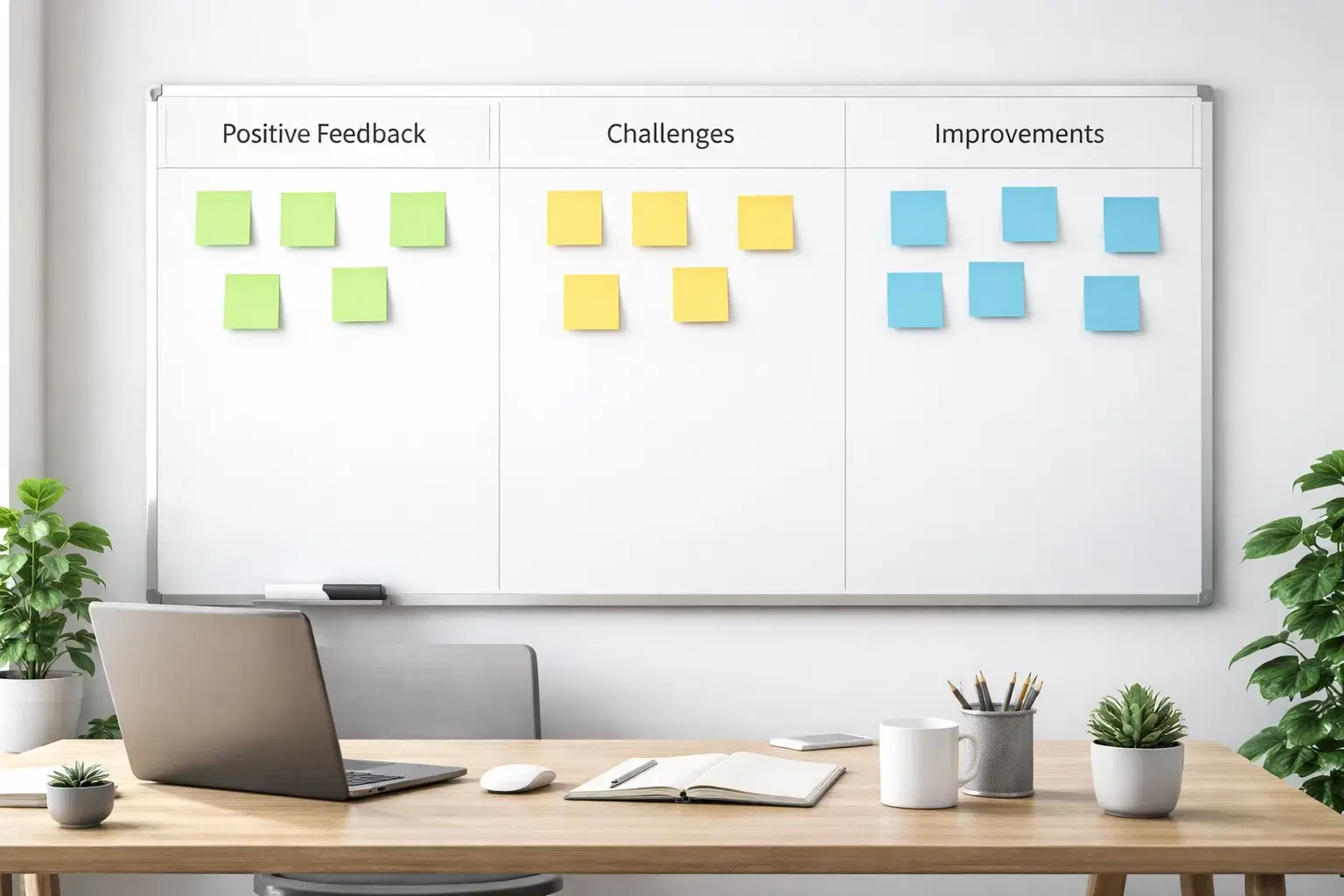
If your team is newer to retrospectives, keep the structure simple. Atlassian highlights formats like “what went well,” “what went wrong,” and “what changes can we make,” along with models such as 4Ls and sad-mad-glad. Those frameworks work because they make it easier for people to contribute without overthinking the process.
| Discussion Stage | Main Focus | Questions to Prioritize |
| Opening | Set scope and create context | 1-5 |
| Execution review | Understand workflow and delivery issues | 6-10 |
| Team dynamics | Review communication and collaboration | 11-15 |
| Root-cause analysis | Identify patterns and avoidable issues | 16-20 |
| Action planning | Define next steps and ownership | 21-25 |
This kind of structure keeps the meeting focused and makes it easier to leave with clear action items instead of scattered observations.
Common Mistakes When Asking Retrospective Questions
Asking questions that are too broad.
Questions like “How did the project go?” rarely produce useful insight. People tend to answer generally, and the discussion loses focus.
Focusing only on what went wrong.
Retrospectives should also capture what worked. Atlassian’s guidance is clear that retrospectives are not just a complaint session. Teams should identify what to continue as well as what to improve.
Skipping root causes.
If the conversation stops at “communication was bad,” the team will not know what to fix. Strong retrospective questions push the group to identify why the issue happened.
Turning the session into blame.
Questions should explore processes, systems, and decisions. Once people feel judged personally, the conversation becomes defensive and less honest.
Ending without action items.
Retrospectives only create value when the team documents next steps and revisits them later. PMI’s lessons-learned guidance makes a similar point: captured learning matters only when it can be retrieved and applied.
How to Turn Answers Into Real Improvements
Once your team has discussed the questions, the next step is prioritization. Do not try to fix everything at once. A smaller number of meaningful improvements usually leads to better follow-through than a long list of ideas.
Choose two to five action items based on impact and feasibility. Then assign an owner, define what success looks like, and decide when the team will review progress. This is one reason I think monday.com stands out as a particularly strong option for retrospective follow-through. Its retrospective template is built around centralizing feedback, discussing ideas in one place, and turning them into trackable action items, which is exactly where many teams struggle.
If your team already works in a project platform, embed the follow-up there. Add checklist updates, revise your kickoff template, change approval stages, or create recurring reminders to review retrospective action items. Improvement becomes much more durable when it is built into the workflow rather than left in a meeting summary.

Conclusion
The value of a retrospective depends on the quality of the questions you ask. The right project retrospective questions help your team move beyond generic feedback and into practical learning. They reveal where planning failed, where collaboration helped, where process friction slowed work down, and what should change before the next project begins.
If you want better retrospectives, do not try to ask everything at once. Choose the questions that fit the project, guide the team toward specificity, and finish with a short list of owned action items. When you do that consistently, retrospectives stop feeling like a formality and start becoming one of the most reliable ways to improve project delivery over time.
Frequently Asked Questions
What are project retrospective questions?
Project retrospective questions are prompts used in a retrospective meeting to help a team reflect on what worked, what did not work, and what should improve in future projects or work cycles.
How many retrospective questions should you ask?
Most teams get better results with a focused set of around 8 to 12 questions in one session, even if they maintain a larger list of prompts for future retrospectives.
Should retrospective questions focus only on problems?
No. The most effective retrospectives look at both problems to fix and strengths to repeat, so the team can improve without losing what is already working well.
When should you ask project retrospective questions?
You can use retrospective questions at the end of a project, after a major milestone, or during recurring work cycles whenever the team wants to improve how it works.
Who should answer project retrospective questions?
The people directly involved in planning, executing, reviewing, or approving the work should usually take part, especially if they influenced the outcome or will help improve the next cycle.
What makes a good retrospective question?
A good retrospective question is clear, specific, and practical. It should help the team identify patterns, discuss causes, and move toward useful action.
Can non-Agile teams use retrospective questions?
Yes. Retrospective questions are useful for marketing, operations, client services, product teams, and many other project-based groups, not only Agile software teams.
What is the best format for a retrospective discussion?
A simple structure such as what worked, what did not work, why it happened, and what to change next usually works well for most teams.
How do you keep a retrospective from becoming repetitive?
To keep retrospectives fresh, rotate questions based on the project context, ask for written input in advance, and focus each session on the most relevant themes instead of repeating the exact same prompts every time.
What should happen after answering retrospective questions?
After the discussion, the team should document the main lessons, choose a small number of improvements, assign owners, and review progress in the next project or work cycle.