Introduction
Choosing global HR software is not only about payroll. It affects how quickly you can hire internationally, how safely you can classify contractors, how confidently you can stay compliant across borders, and how easily your team can manage onboarding, documents, time off, and employee records in one place.
In this Deel review, you will get a practical look at what Deel does well, where it is strongest, where it still has trade-offs, and which kinds of businesses will get the most value from it. Deel has grown beyond its original contractor payments reputation and now positions itself as a broader global workforce platform that combines Employer of Record, contractor management, payroll, HRIS, compliance, mobility, and IT operations.
That broader scope is exactly why Deel remains one of the most important HR and global employment platforms to evaluate in 2026. If your company hires internationally, works with contractors across markets, or wants to centralize global people operations, Deel deserves serious attention.
What Is Deel?
Deel is a global workforce management platform designed to help you hire, pay, and manage employees and contractors across multiple countries. You can use it for Employer of Record hiring, contractor onboarding and payments, global payroll, HRIS, compliance workflows, immigration support, and related HR operations.
Its biggest strength is coverage. Many HR tools are built mainly for domestic employee management, while many international hiring tools focus too narrowly on EOR or contractor payments. Deel tries to combine both worlds. It gives you infrastructure for global employment while also building out a fuller HR stack for ongoing workforce management.
Background and Positioning
Deel positions itself as an all-in-one platform for global teams. Its product portfolio now spans EOR, contractor management, contractor of record, global payroll, HRIS, recruiting, performance and development, compensation planning, mobility, benefits, compliance support, and Deel IT. That makes it much broader than a classic HRIS and more ambitious than a typical payroll vendor.
Target Users and Use Cases
Deel is especially relevant for several buyer types:
- Global-first businesses – You can hire and pay across many countries without stitching together multiple vendors.
- Startups expanding internationally – Deel helps you move faster before you build local entities.
- Companies managing large contractor networks – Contractor onboarding, compliant contracts, invoicing, and payments are still core strengths.
- HR and finance teams that want one global system – Deel increasingly combines workforce data, payroll, compliance, and HR workflows in one place.
- Operations-heavy teams – Deel is particularly strong when HR, payroll, legal, and finance all need shared visibility.
That said, Deel is not the perfect fit for every buyer. If you only need a lightweight domestic HRIS for a local team, Deel may be more platform than you need. It is strongest when international hiring, cross-border compliance, contractor management, or multi-country payroll are central priorities.
Core Features of Deel
How Does Deel Work?
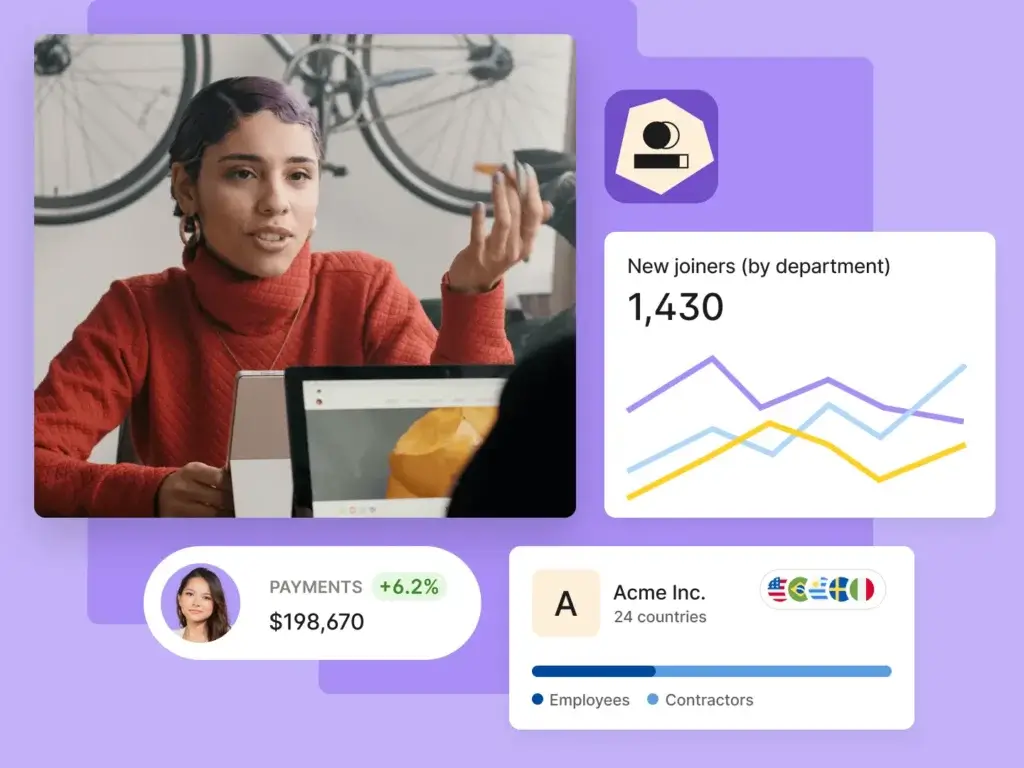
Deel stands out because it combines hiring infrastructure, payroll operations, contractor management, HRIS, and compliance support in one connected system. The value is not only that it pays people internationally. It helps you operationalize global workforce management at scale.
Employer of Record
Deel’s EOR service is one of its main reasons to buy. It lets you employ talent without setting up your own local entity, while Deel handles onboarding, local compliance, payroll processing, tax filings, benefits administration, and ongoing HR and legal support. For companies expanding internationally, this can reduce both time to hire and operational risk.
Contractor Management
Contractor management remains one of Deel’s strongest product areas. You can onboard international contractors with localized agreements, automate invoicing, collect tax documents, and pay in multiple currencies. If your business works with freelancers, agencies, consultants, or long-term international contractors, Deel is one of the more mature platforms in this category.
Contractor of Record
Deel also offers Contractor of Record, where it acts as the legal contracting entity. That matters if misclassification risk is a major concern and you want Deel to take on more of the compliance burden. This is not relevant for every company, but for some it is a meaningful differentiator compared with tools that stop at basic contractor payments.
Global Payroll
For companies that already have legal entities, Deel offers managed global payroll rather than forcing you into EOR for every hire. That makes the platform more flexible than buyers sometimes expect. You can use Deel as a hiring vehicle in some countries and as a payroll operations platform in others, depending on how mature your international footprint is.
HRIS and Core HR
Deel is no longer only about payroll and contracts. Its HRIS includes worker profiles, org charts, documents, workflows, time off, time tracking, approvals, and reporting. That gives you a shared source of truth for employees, contractors, and EOR workers, which is especially useful for global teams that would otherwise manage people data across disconnected systems.
Recruiting, Development, and Compensation
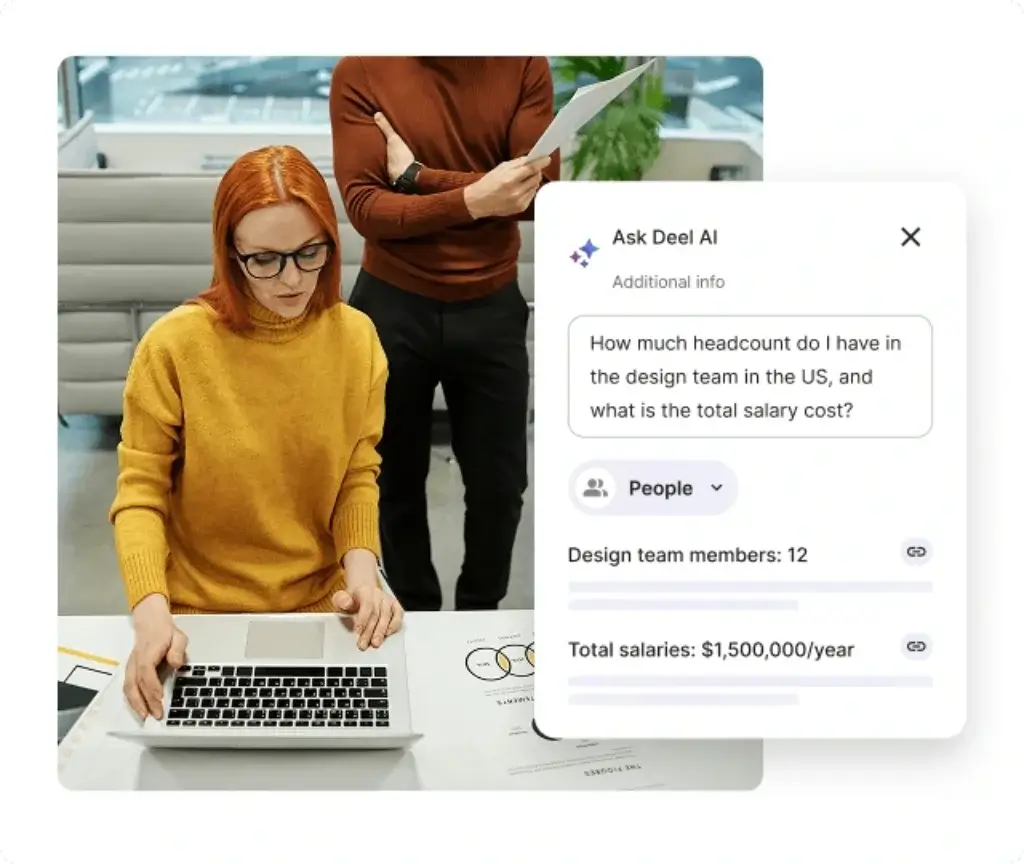
Deel has also expanded into recruiting, performance and development, learning, engagement, compensation cycles, and headcount forecasting. This broader suite makes Deel more relevant for companies that want fewer systems, though it also means buyers should decide whether they want a globally focused platform with HR breadth or a more specialized best-of-breed HR stack.
Mobility and Immigration
Mobility is another area where Deel is becoming more strategic. It offers tools for visa tracking, right-to-work workflows, and managed immigration support. This will not matter to every HR team, but for companies moving talent across borders, it adds real operational value.
Deel IT
One of Deel’s more unusual advantages is that it extends into IT operations. Deel IT supports areas like equipment, onboarding, and offboarding coordination, and asset management workflows. This gives Deel a more operations-centric profile than many HR competitors and can be especially useful for remote-first organizations.
Business Operations Features
Deel Payroll, Compliance, and Global Operations
One of the most important things to understand about Deel is that it is not only a payroll tool but also an HRIS. Its real strength is the way it connects employment infrastructure, payments, and compliance across different worker types.
Multi-Country Hiring Flexibility
Deel supports different hiring models depending on your needs. You can use EOR where you do not have entities, run managed payroll where you do, and manage contractors through the same platform. That flexibility is one of the clearest reasons Deel has become so popular with fast-growing international businesses.
Compliance and Classification
Compliance is central to Deel’s pitch. It helps companies handle local employment requirements, tax documentation, worker classification, and labor law complexity more systematically. That does not remove the need for internal diligence, but it can dramatically reduce manual risk compared with handling global employment ad hoc.
Payments and Withdrawals
Deel supports payments in multiple currencies and offers a range of withdrawal methods for contractors and workers, depending on region and payment rules. This is a practical strength because payout flexibility is often one of the most visible parts of the user experience for international workers.
Scale and Global Coverage
Deel currently markets itself as supporting hiring and management in 150+ countries, serving 40,000+ customers, and processing more than $20B in global payroll. Numbers like these do not guarantee fit, but they do suggest meaningful market scale and operational maturity.
Pros and Cons
Benefits and Limitations of Using Deel
Positive
✅ Excellent fit for international hiring and contractor management
✅ Broad product coverage across EOR, payroll, HRIS, and compliance
✅ Strong pricing transparency compared with many enterprise HR vendors
✅ Good user experience and strong market reputation
Negative
❌ Can become expensive at scale, especially for EOR
❌ Broader platform means more complexity than a simple HRIS
❌ Some users report fees, exchange-rate concerns, or support delays
❌ Not always the best value for domestic-only HR needs
Strengths & Benefits
Deel gets a lot right if your company operates globally or plans to.
- Strong international hiring infrastructure – Deel is far more capable than a standard HR platform when you need EOR, contractor compliance, and global payroll.
- Broad platform coverage – You can manage different worker types in one system instead of splitting HR, payroll, and compliance across multiple vendors.
- Transparent starting prices – Deel is more upfront than many HR vendors about its headline pricing for major products.
- Mature contractor workflows – Contracts, invoicing, tax documentation, and withdrawals remain standout areas.
- Operational depth – The combination of HR, payroll, compliance, mobility, and IT gives Deel more strategic reach than many competitors.
Limitations & Drawbacks
Deel is a strong platform, but it is not automatically the best fit for every HR buyer.
- EOR pricing is still premium – The platform may be efficient, but it is not cheap once you scale full-time international headcount.
- Depth can create complexity – Deel is broader than lightweight HR software, so implementation and internal ownership matter.
- User complaints are not absent – Some public reviews mention withdrawal fees, exchange-rate concerns, occasional support delays, or limited flexibility in some workflows.
- Domestic-only buyers may overbuy – If you do not hire internationally, much of Deel’s biggest value disappears.
- Not every module is equally mature for every use case – Its strongest identity is still global employment and payroll operations, not necessarily every HR subcategory.
Operational Fit
Deel User Experience, Support, and Security
Software fit is not only about features. It also depends on how easy the system is to adopt, how smooth support is when issues arise, and whether the vendor can be trusted with highly sensitive employment and payroll data.
Ease of Use
Ease of use is one of Deel’s strongest recurring themes in public reviews. Users regularly praise the interface, payment visibility, contract management, and the fact that important workflows are centralized in one place. This matters because global payroll and compliance software can easily become operationally heavy if the user experience is poor.
Implementation Experience
Implementation complexity depends on which parts of Deel you use. Contractor payments are naturally easier to roll out than multi-country EOR, entity payroll, HRIS, mobility, and IT all at once. In other words, Deel can start simple, but it can also become a major operational system if you adopt it broadly.
Customer Support
Support is generally viewed positively, and Deel promotes 24/7 support in its EOR offering. Still, as with many global platforms, some user reviews mention slower responses during busy periods or in more complex scenarios. Support should be seen as a strength overall, but not as a reason to skip careful planning.
Security and Compliance
Security is another area where Deel makes a strong case. Its security materials highlight enterprise-grade controls and compliance frameworks, while its trust center references GDPR, ISO 27001, ISO 27701, SOC 1, SOC 2, HIPAA, CCPA, SSO options, and role-based access controls. For buyers evaluating global HR infrastructure, those trust signals matter.
Why Security Matters More with Deel
Because Deel handles contracts, identity details, payroll information, banking data, and employment records across countries, security is not a side issue. It is central to the value proposition. That is one reason Deel’s compliance posture is more important here than it would be for a basic scheduling or lightweight HR tool.

Pricing
Deel Pricing & Plans
Deel pricing is more transparent than many HR platforms, which is a real advantage when you are comparing vendors. The company publishes starting prices for several major products, although your actual total cost will still depend on worker type, country, payroll complexity, benefits, and support needs.
Published Deel Pricing
Deel currently publishes several headline prices that make its packaging easier to understand than vendors that force every buyer into a sales call before revealing anything.
What Affects Total Cost
Your actual cost will depend on whether you use contractor management, EOR, managed payroll, HR modules, immigration support, or combinations of several services. The important thing to understand is that Deel can start as a narrow use case and grow into a much bigger platform commitment over time.
What to Ask Before You Buy
If you are considering Deel, ask about implementation scope, support coverage, country-specific employment limitations, FX or withdrawal implications, benefits administration, and whether you really need EOR for every market. These questions can materially affect the long-term economics.
Pricing Table
The table below gives a practical view of how Deel’s pricing approach works today.
| Feature Type | Deel | What it means for buyers |
| Employer of Record | Starts at $599 per employee/month | Useful when you need to hire internationally without opening a local entity |
| Contractor Management | Starts at $49 per contractor/month | Good fit for managing freelance and contractor payments compliantly |
| Contractor of Record | Starts at $325 per contractor/month | Stronger option if misclassification risk is a major concern |
| Managed Global Payroll | Starts at $29 per employee/month | Relevant if you already have entities and want Deel to run payroll operations |
| US Payroll | Starts at $24 per employee/month | Shows Deel is expanding beyond international-only workflows |
| Core HR | $5 per employee/month | Low entry point for companies that want Deel’s HRIS foundation |
| Full HR Solution | $56 per employee/month | Broader HR suite for larger teams that want recruiting, development, compensation, and planning |
Overall, Deel’s pricing is easier to assess than many HR platforms, but that does not automatically make it inexpensive. It is best understood as transparent premium infrastructure for global teams rather than a budget HR tool.
Use Cases
Who Should Use Deel?
Deel is not for every business, but it fits several kinds of buyers especially well.
Companies Hiring International Employees
If your biggest challenge is employing people in countries where you do not have entities, Deel is one of the strongest options to consider. This is still one of the platform’s clearest sweet spots.
Businesses Managing Many Global Contractors
If you work with international contractors at scale, Deel is a very strong fit. It brings together compliant contracts, invoicing, tax forms, payments, and visibility in a way that is far more organized than manual processes or basic payment tools.
HR and Finance Teams That Want One Global System
If your HR, finance, legal, and operations teams need shared visibility across worker types and countries, Deel has real strategic appeal. This is where its broader platform story becomes compelling.
Companies Expanding Their HR Stack Gradually
Because Deel offers HRIS and additional HR modules alongside its global hiring products, some companies can start with payroll or contractors and then expand into wider HR workflows later. That modular path makes adoption more flexible.
When Deel Might Not Be Right
Deel may not be the best choice if you only need local HR administration for one country, if cost sensitivity is your top priority, or if you want a simpler employee-only HRIS with no international complexity. In those cases, another platform may fit more naturally.
User Feedback
Deel Customer Reviews
Deel reviews are very strong overall. Its G2 seller profile currently shows a 4.8 out of 5 rating based on 13,967 reviews, while Capterra feedback is also broadly positive and repeatedly highlights ease of use, payment reliability, and centralized management.
What Users Like Most
The most common positives in public reviews include Deel’s intuitive interface, transparent payment visibility, contract and invoice organization, flexible withdrawal options, and the confidence users get from having payroll and compliance workflows handled in one place. That consistency matters because it shows Deel’s value is not only for administrators, but also for workers using the platform directly.
Common Complaints
The most common drawbacks are fairly consistent too. Some users mention withdrawal fees, less favorable exchange rates in some cases, occasional processing or verification delays, slower customer support during peak times, and a learning curve for new users navigating the wider platform.
My Take on the Review Pattern
The review pattern suggests Deel’s main weakness is not product quality. It is that once a platform handles payments, compliance, contracts, HR workflows, and international operations, expectations rise quickly. On balance, though, Deel’s public feedback remains stronger than what you see from many payroll and HR vendors operating at similar scope.
Competitors
Competitor Alternatives to Deel
Deel is most often compared with platforms like Rippling, Remote, and Papaya Global. The right alternative depends on whether you care most about global hiring infrastructure, HR breadth, IT management, payroll specialization, or pricing structure.
| Feature Type | Deel | Rippling | Remote | Papaya Global |
| Core angle | Global workforce platform with EOR, contractors, payroll, HR, and IT | HR, payroll, and IT operations platform | Global employment and contractor platform | Global payroll and workforce payments platform |
| Best for | International hiring plus broader operations control | Companies wanting deeper IT and app management with HR | Businesses focused on international hiring with cleaner simplicity | Organizations prioritizing global payroll orchestration |
| Contractor management | One of the strongest areas | Solid, but not the main identity | Strong and internationally focused | Less central to its positioning |
| EOR strength | Strong global option | Available, but not always the first reason buyers choose it | One of the main reasons to buy | Relevant, though payroll is often the bigger draw |
| HR breadth | Growing fast across HRIS, recruiting, development, and compensation | Very broad across HR and IT | More focused on employment workflows than full HR suite depth | More payroll-centric overall |
| Overall angle | Best balance of global employment depth and platform breadth | Best for companies that want HR and IT tightly connected | Best for teams that want a more focused global hiring platform | Best for payroll-heavy multinational operations |
Compared with Rippling, Deel is usually the stronger choice if global hiring, contractor compliance, and multi-country employment are the center of your use case, while Rippling is often more compelling when you want deeper IT and app management. Compared with Remote, Deel generally feels broader and more operationally expansive, while Remote can appeal to buyers who want a somewhat more focused global employment experience. Compared with Papaya Global, Deel often feels more platform-oriented across worker lifecycle workflows, while Papaya is especially relevant for payroll-led multinational complexity.
If I had to summarize it simply, Deel is one of the best choices for companies that want a serious global workforce platform, not just a payroll add-on.
Best Practices
Getting Started with Deel
To get the most out of Deel, you should make a few smart decisions early.
Define Your Primary Worker Types First
Before rollout, decide whether Deel’s main job for your company is EOR, contractor management, managed payroll, HRIS, or a mix of several. That choice will shape implementation, ownership, and cost.
Map Countries and Hiring Models Early
Do not assume every country should follow the same model. In some markets, EOR may be best, while in others your own entity plus managed payroll may make more sense. This decision has major compliance and cost implications.
Clarify Finance Workflows Up Front
If you manage many contractors or multiple payment methods, align finance, HR, and legal teams early on approvals, funding timelines, FX expectations, and reporting needs. Deel works best when those workflows are standardized from the beginning.
Decide How Far You Want to Expand into HR
Because Deel now offers HRIS and broader HR modules, it is worth deciding whether you want Deel as a specialist global hiring platform or as a wider people operations system. Both paths are valid, but they require different rollout priorities.
Evaluate Deel for Future Scale, Not Only Current Pain
Deel makes the most sense when your international workforce complexity is growing. If you expect more countries, more contractors, or more payroll coordination over time, its platform value becomes easier to justify.
Conclusion
Final Thoughts
⭐ Overall Rating: 9.6/10
Deel remains one of the strongest platforms in this category because it solves a problem that many HR systems barely address. Once your business starts hiring across borders, local-only HR tools usually stop being enough. Deel is built specifically for that international complexity.
Its biggest strengths are contractor management, EOR, payroll flexibility, pricing transparency, global compliance support, and the fact that it increasingly combines all of this with a broader HR and operations stack. Its biggest drawbacks are that EOR can become expensive, the platform can feel broader and more complex than a simple HRIS, and some users still report fees or support friction in certain cases.
Overall, Deel is a strong recommendation for companies that need serious global workforce infrastructure. If your team hires internationally, manages cross-border contractors, or wants one platform for global employment and HR operations, Deel is well worth considering.
Have more questions?
Frequently Asked Questions
What is Deel best used for?
Deel is best used for hiring, paying, and managing international employees and contractors, especially when you need EOR, contractor compliance, or global payroll support.
Is Deel an HRIS or a payroll platform?
It is both. Deel started with international hiring and payments, but it now also offers HRIS, recruiting, development, compensation, and broader workforce operations tools.
How much does Deel cost?
Deel publishes starting prices for several products, including $599 per employee per month for EOR, $49 per contractor per month for contractor management, $325 per contractor per month for Contractor of Record, and $29 per employee per month for managed global payroll.
Is Deel good for contractors?
Yes. Contractor management is one of Deel’s strongest areas, with compliant contracts, automated invoicing, tax document collection, and flexible global payments.
Does Deel support global payroll?
Yes. Deel offers managed global payroll for companies with entities and also supports payroll within its broader international employment infrastructure.
Is Deel good for small businesses?
It can be, especially for startups hiring internationally. But if you only need a simple local HR tool, Deel may be more platform than you need.
What are the main Deel alternatives?
The main alternatives usually include Rippling, Remote, and Papaya Global, depending on whether you prioritize HR and IT breadth, focused international hiring, or payroll-heavy multinational operations.
Does Deel offer public pricing?
Yes. Deel is more transparent than many HR vendors and publishes starting prices for several major services on its pricing page.
Is Deel secure?
Deel publicly highlights enterprise-grade security and its trust center references standards and controls such as GDPR, ISO 27001, ISO 27701, SOC 1, SOC 2, SSO, and role-based access controls.
Is Deel worth it overall?
Yes, for the right buyer. If your business hires across borders or manages global contractors at scale, Deel is one of the strongest platforms in the market. If your needs are purely domestic and simple, the value proposition is weaker.