
Introduction
Managing a global workforce is no longer only about hiring talent in different countries. You also need to pay employees accurately, stay compliant with local labor laws, manage contractors, handle statutory payments, track workforce costs, and give finance leaders clear visibility into payroll obligations across markets.
That is where Papaya Global stands out. In this Papaya Global review, you will get a practical look at what the platform does well, where it has limitations, how its pricing works, and which type of company is most likely to benefit from it.
Papaya Global is not a traditional HRIS in the same category as BambooHR or HiBob. It is better understood as a global payroll, payments, Employer of Record, and contractor workforce platform. Its strongest value appears when your company is operating across multiple countries and needs more control over payroll operations, compliance, payments, reporting, and workforce cost visibility.
What Is Papaya Global?
Papaya Global is a global workforce management platform that helps companies manage international payroll, Employer of Record services, contractor payments, workforce onboarding, compliance, and global payments from one system.
The platform is built for companies that employ or pay people across borders. Instead of forcing HR and finance teams to manage a patchwork of local payroll providers, spreadsheets, invoices, and manual payment processes, Papaya Global centralizes much of that work into a single operating layer.
Background and Positioning
Papaya Global positions itself as a workforce payments and global payroll infrastructure company. Its product direction is especially relevant for finance-heavy HR teams, global payroll teams, and companies that want stronger visibility into how much their distributed workforce costs.
Its current platform messaging focuses on global payroll, EOR, contractor management, payments, workforce data, payroll validation, BI analytics, in-country expertise, worker wallets, and compliance support. This makes Papaya Global a strong fit for companies that need international payroll control rather than a lightweight HR database.
Target Users and Use Cases
Papaya Global is especially relevant for several buyer types:
- Global payroll teams – You can centralize multi-country payroll workflows and reporting.
- Companies hiring internationally – You can use EOR to employ workers without opening local entities.
- Businesses managing contractors – You can onboard, manage, and pay contractors in many countries.
- Finance leaders – You get stronger payroll visibility, payment tracking, and reconciliation support.
- Enterprise and mid-market companies – Papaya Global is strongest when global workforce operations are complex enough to justify a premium platform.
That said, Papaya Global is not the best fit for every business. If you only need domestic HR management, basic payroll, performance reviews, or employee engagement tools, a broader HR suite may be more practical. Papaya Global is strongest when the problem is global payroll and international workforce operations.
Core Features
How Does Papaya Global Work?
Papaya Global works by giving you one operational layer for global payroll, payments, EOR hiring, contractor management, onboarding, compliance, and reporting. The goal is to reduce the fragmentation that usually happens when each country has its own payroll vendor, banking process, contract workflow, and reporting format.
Global Payroll
Global payroll is the heart of Papaya Global. The platform helps companies manage payroll across multiple countries while centralizing payroll data, payment flows, payslip distribution, statutory payments, and reporting.
This is particularly useful when your company already has legal entities in several countries but lacks a unified way to manage payroll operations. Instead of manually collecting payroll outputs from different providers, Papaya Global gives your HR, payroll, and finance teams a more standardized workflow.
Payroll Plus
Payroll Plus is designed for companies that want managed global payroll and payment support. It includes centralized workforce data, standardized gross-to-net reporting, automated payroll processes, payment disbursement, in-country experts, BI analytics, time and attendance tracking, and support for payroll operations across markets.
This is one of Papaya Global’s more compelling offerings because it sits between a basic payroll vendor and a full EOR setup. If you already have local entities but need better payroll operations, Payroll Plus may be more relevant than EOR.
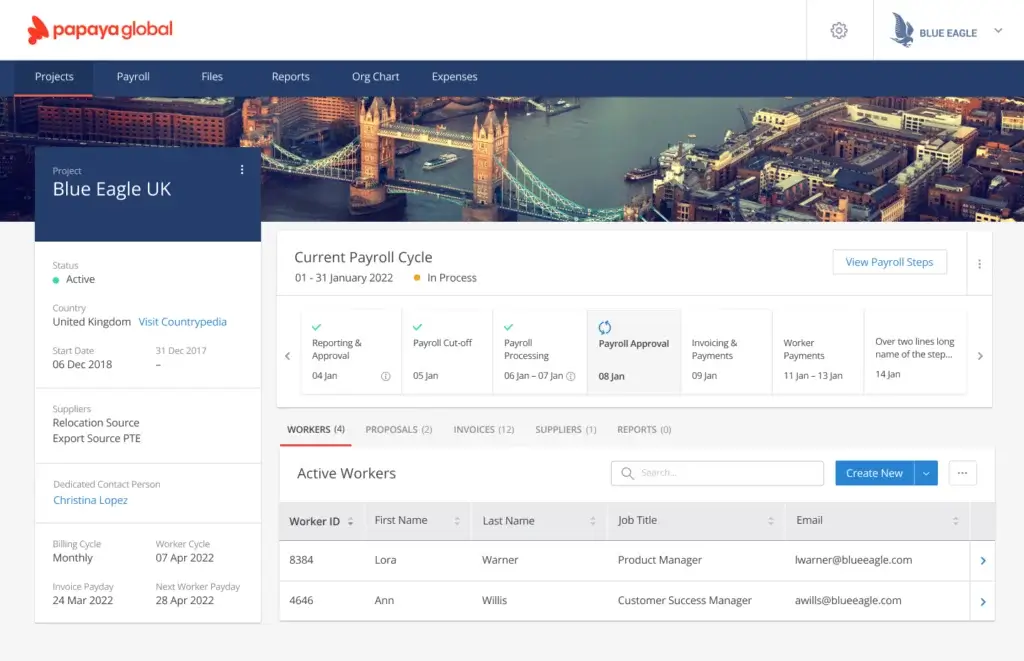
Employer of Record
Papaya Global’s Employer of Record service lets you hire employees in countries where you do not have your own legal entity. Papaya Global, through its local infrastructure and partners, handles legal employment, local contracts, payroll, benefits, statutory payments, compliance, and worker support.
This is useful when you want to enter a new market quickly, test international hiring demand, or employ a small number of workers without setting up a local subsidiary. EOR is usually more expensive than running payroll through your own entity, but it can be much faster and simpler for early-stage market expansion.
Contractor Management
Papaya Global also supports contractor onboarding, document collection, invoice management, contract signing, payment automation, contractor wallets, and global payout workflows. This makes it relevant for companies that rely on international freelancers, consultants, agencies, and distributed contractor teams.
The contractor management product is especially interesting because Papaya Global separates lower-cost contractor management from higher-touch Contractor of Record services. That gives buyers more flexibility depending on how much classification, liability, and compliance support they need.
Contractor of Record
Contractor of Record is a stronger compliance layer for companies that want Papaya Global to handle contractor engagement with more liability protection and classification support. This is most relevant when contractor misclassification risk is a real concern.
For example, if you work with contractors in markets where worker classification rules are strict, a Contractor of Record model may reduce risk compared with simply paying contractors through standard invoice software.
Global Payments and Workforce Payments
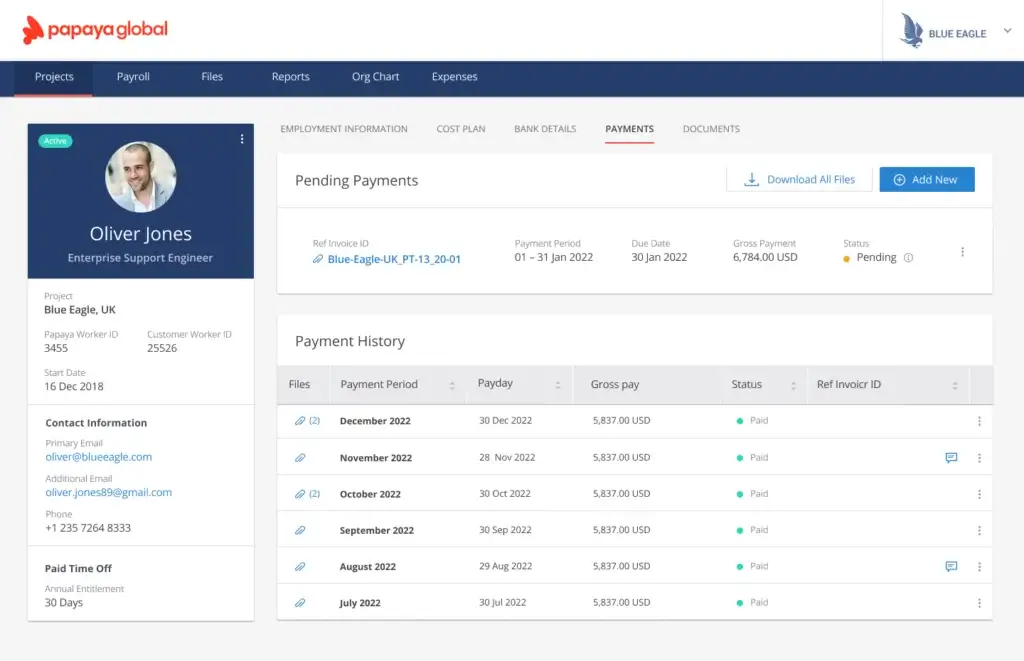
One of Papaya Global’s strongest differentiators is its focus on workforce payments. The platform supports global payment capability, worker wallets, local payment rails, payment tracking, automated reconciliation, flexible funding, and mass payments.
This matters because global payroll is not only about calculating what people should be paid. The harder part is often moving money across countries, currencies, banks, and payment methods on time. Papaya Global’s payment infrastructure is a core part of its value proposition.
Workforce OS
Workforce OS is Papaya Global’s broader operating layer for workforce and payroll operations. It includes automated payroll processing, centralized workforce data, gross-to-net reporting, AI-powered payroll validation, payslip distribution, payments, journal entry automation, onboarding, employee mobile access, time and attendance, BI analytics, custom roles, permissions, and in-country experts.
This is where Papaya Global becomes more than a payroll processor. It becomes a control center for global payroll, finance visibility, and cross-border workforce operations.
Reporting and Payroll Analytics
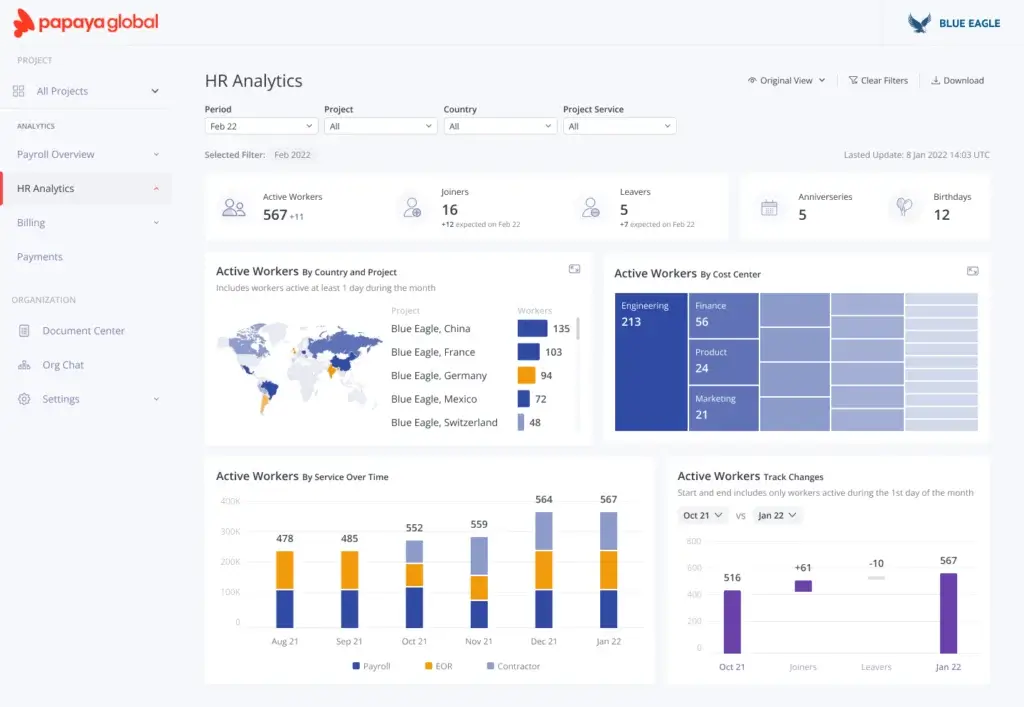
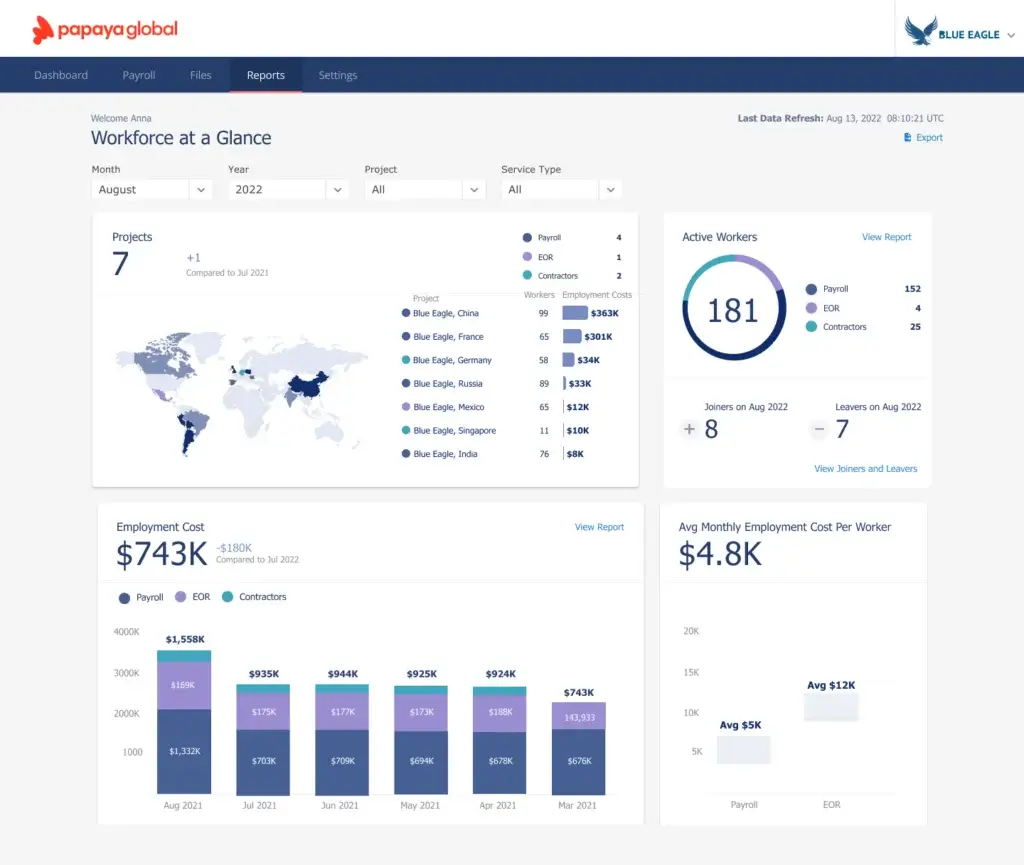
Reporting is a meaningful strength. Papaya Global is especially useful for finance and payroll teams that need better visibility into workforce costs, payroll data, payments, reconciliation, and country-level payroll outputs.
If your current payroll process depends on disconnected spreadsheets, PDF reports, and country-by-country vendor emails, Papaya Global can create a much cleaner reporting layer.
Business Operations Features
Papaya Global Payroll, Payments, AI, and Compliance
Papaya Global is strongest when HR, payroll, finance, and legal teams need to work together across countries. Its platform is not built around employee engagement or performance management. It is built around compliant employment, accurate payments, and operational control.
Country-Specific Compliance
Papaya Global supports country-specific employment workflows, contracts, statutory payments, payroll compliance, and local expertise. This is essential because payroll laws, tax rules, social security contributions, benefits, and termination requirements vary significantly from country to country.
The platform is useful for companies that want more confidence when hiring or paying workers in unfamiliar jurisdictions. Still, you should always validate the exact country coverage, entity model, benefits setup, and compliance process before signing a contract.
In-Country Experts
Papaya Global emphasizes access to in-country experts. This is important because global payroll and EOR problems are rarely solved by software alone. You often need local knowledge around taxes, benefits, labor requirements, payslip rules, holidays, leave rules, and statutory filings.
For companies operating across many countries, the combination of software and local expertise is usually more valuable than either one alone.
AI-Powered Payroll Validation
AI-powered payroll validation is part of Papaya Global’s Workforce OS positioning. In practice, this is most useful when it helps payroll teams identify anomalies, reduce manual checks, and improve payroll accuracy before payments are released.
Payroll validation is a high-impact area for automation because small mistakes can create employee frustration, compliance issues, and finance reconciliation problems.
Worker Wallets and Payment Flexibility
Papaya Global’s worker wallet and payment capabilities are especially relevant for distributed workforces and contractor-heavy companies. Workers may receive payments through local rails, wallets, and supported payment methods depending on the market and product setup.
This can be valuable in regions where traditional banking infrastructure is slow, expensive, or unreliable. It also gives companies more visibility into when payments are sent and received.
Integrations and Finance Workflows
Papaya Global is designed to fit into broader HR, finance, and ERP ecosystems. The platform is especially relevant when your finance team needs journal entry automation, payment reconciliation, standardized reporting, and centralized payroll cost visibility.
Before implementation, you should confirm how Papaya Global will connect with your HRIS, ERP, accounting software, time tracking tools, and existing payroll providers.
Pros and Cons
Benefits and Limitations of Using Papaya Global
Positive
✅ Strong global payroll infrastructure
✅ Excellent workforce payment focus
✅ Useful EOR and contractor options
✅ Strong finance visibility and reporting
Negative
❌ Premium pricing for smaller teams
❌ Not a full everyday HRIS replacement
❌ Country setup still requires validation
❌ Can be complex for simple payroll needs
Strengths & Benefits
- Strong global payroll infrastructure – Papaya Global is built for multi-country payroll complexity, not just simple HR administration.
- Excellent workforce payment focus – Payment delivery, wallets, local rails, reconciliation, and tracking are central to the platform.
- Useful EOR and contractor options – You can support employees, contractors, and EOR workers from one global workforce model.
- Strong finance visibility and reporting – Payroll teams and finance leaders get better cost visibility, BI analytics, and standardized reporting.
Limitations & Drawbacks
- Premium pricing for smaller teams – EOR and compliance-heavy workforce products can become expensive if you only need basic HR tools.
- Not a full everyday HRIS replacement – Papaya Global is not primarily built for performance reviews, employee engagement, or domestic HR administration.
- Country setup still requires validation – You should confirm local coverage, benefits, contracts, payroll flows, and entity model before rollout.
- Can be complex for simple payroll needs – If your business operates in one country, Papaya Global may be more platform than you need.
Operational Fit
Papaya Global User Experience, Support, and Security
Global payroll software must be judged differently from a basic HR tool. Ease of use matters, but so do implementation support, payroll accuracy, local expertise, payment reliability, and security standards.
Ease of Use
Public review patterns generally describe Papaya Global as a clear and usable platform, especially considering the complexity of global payroll. Users often highlight the ability to centralize payroll workflows, track international workforce data, and reduce manual coordination across countries.
However, the platform is still operating in a complex category. A company using Papaya Global across many countries should expect a more involved implementation than a company adopting a simple HR database.
Implementation Experience
Implementation depends heavily on your workforce structure. A company using Payroll Plus in a few countries will have a different rollout than a company moving employees, contractors, EOR workers, payments, and reporting into one global model.
To reduce risk, you should map your countries, worker types, payroll calendars, currencies, benefits, bank funding flows, approval structure, and integrations before implementation begins.
Customer Support
Support is an important part of Papaya Global’s value. The company promotes 24/7 support and in-country expertise across its product pages, and user reviews frequently mention helpful and responsive support.
For global payroll, support quality can be just as important as product functionality. When a payment deadline, statutory filing, payslip issue, or worker contract question comes up, you need fast answers from people who understand the local context.
Security and Privacy
Papaya Global publishes strong security and privacy positioning, including SOC 1, SOC 2, ISO 27001, ISO 27701, and GDPR alignment. The company also notes that payment services are offered through Azimo, its licensed payments arm.
This is a meaningful trust signal because Papaya Global handles sensitive employee, payroll, banking, tax, identity, and compensation data. Any buyer should still complete a formal security review, but Papaya Global’s public security posture is stronger than many smaller payroll vendors.
Payment Infrastructure
Papaya Global’s payment infrastructure is one of the reasons the platform is different from many EOR or payroll competitors. The company emphasizes safeguarded accounts, payment visibility, local rails, FX transparency, and mass payment capabilities.
This is especially relevant for finance teams that want more control over payroll funding, payment timing, cross-border transfers, and reconciliation.
Pricing
Papaya Global Pricing & Plans
Papaya Global pricing is more transparent than many enterprise payroll and EOR vendors, but total cost still depends on the countries you hire in, the services you use, the number of employees or contractors, and any implementation or support requirements.
The company currently lists starting prices for several core services. EOR starts at $499 per employee per month, Contractor of Record starts at $295 per contractor per month, contractor management starts at $5 per contractor per month, and Payroll Plus starts at $29 per employee per month.
Employer of Record Pricing
Papaya Global’s EOR pricing starts at $499 per employee per month. This includes hiring in supported countries, payroll and benefits, country-specific contracts, time and attendance tracking, statutory payments, compliance support, worker wallets, in-country experts, and 24/7 support.
This is a competitive starting point for EOR, especially for companies that value payroll and payments infrastructure. However, the real cost of EOR always includes salary, employer taxes, statutory contributions, benefits, and any local employment costs.
Contractor of Record Pricing
Contractor of Record starts at $295 per contractor per month. This is designed for companies that want a stronger compliance layer for contractor engagement, including support around classification and liability.
This is more expensive than basic contractor management, but it may be worth considering when misclassification risk is high.
Contractor Management Pricing
Basic contractor management starts at $5 per contractor per month. Papaya Global also lists more advanced contractor management options, including Contractor Management+ and annual plans for higher-volume contractor operations.
This gives companies more flexibility. You can use a lower-cost contractor payment workflow when the compliance risk is lower, or move to stronger protection when your contractor model is more complex.
Payroll Plus Pricing
Payroll Plus starts at $29 per employee per month. This is relevant for companies that already have local entities but want managed global payroll, payment disbursement, centralized workforce data, standardized reporting, payroll automation, and local expertise.
For many companies, Payroll Plus may be the most practical Papaya Global product because it improves payroll operations without requiring EOR employment.
Pricing Table
The table below gives a practical view of Papaya Global’s current pricing approach.
| Feature Type | Papaya Global | What it means for buyers |
| Employer of Record | Starts at $499/employee/month | Useful for hiring employees in countries where you do not have an entity |
| Payroll Plus | Starts at $29/employee/month | Best for companies with entities that need managed global payroll |
| Contractor Management | Starts at $5/contractor/month | Low-cost option for managing and paying global contractors |
| Contractor of Record | Starts at $295/contractor/month | Stronger compliance layer for higher-risk contractor engagement |
| Workforce OS | Custom quote | Best for enterprise workforce operations, payroll validation, BI, and controls |
| Best for | Global payroll, EOR, contractor payments | Strongest when workforce operations span multiple countries |
Papaya Global is not the cheapest option if you only need basic payroll or simple contractor payments. Its pricing makes more sense when the platform helps you reduce vendor fragmentation, improve compliance, accelerate international hiring, and give finance teams better payroll visibility.
Use Cases
Who Should Use Papaya Global?
Papaya Global is a strong fit for companies that have already moved beyond simple domestic HR operations. If your workforce is international, multi-currency, contractor-heavy, or payroll-complex, the platform becomes much more relevant.
Companies Managing Payroll Across Multiple Countries
If you already operate entities in several countries, Papaya Global can help centralize payroll processes, reporting, payments, payslips, and compliance workflows.
This is one of the platform’s strongest use cases. Instead of managing each country separately, you can create a more unified global payroll operating model.
Businesses Hiring International Employees Without Entities
If you want to hire in a new country but do not want to open a local entity, Papaya Global’s EOR service can help you employ workers through a compliant local structure.
This is especially useful when you want to test a market, hire specialized talent quickly, or avoid the administrative burden of setting up a subsidiary for a small team.
Contractor-Heavy Companies
If your business relies on global contractors, Papaya Global can help with onboarding, contracts, invoices, payments, wallets, and payment visibility.
For more sensitive contractor relationships, Contractor of Record adds a stronger compliance and liability layer.
Finance Teams That Need Payroll Visibility
Papaya Global is particularly useful when payroll is not just an HR issue but also a finance issue. The platform supports reporting, payment tracking, BI analytics, reconciliation, and cost visibility across countries.
If your finance team struggles to understand global payroll spend in real time, Papaya Global deserves serious consideration.
When Papaya Global Might Not Be Right
Papaya Global may not be the right choice if your company only operates in one country, needs a simple HRIS, or wants low-cost domestic payroll. It may also be too specialized if your main priorities are employee engagement, performance management, learning, or internal communications.
In those cases, platforms like BambooHR, HiBob, or Rippling may be more suitable depending on your requirements.
User Feedback
Papaya Global Customer Reviews
Papaya Global reviews are generally positive, especially among companies that need help with multi-country payroll, international payments, and global compliance. Users often point to ease of use, support quality, payroll visibility, and operational efficiency as key strengths.
What Users Like Most
The most common positives focus on the platform’s ability to simplify global payroll and reduce manual coordination. Users also tend to appreciate responsive support, clearer workforce reporting, and the ability to manage international payroll from one system.
This review pattern makes sense. Papaya Global is solving a difficult operational problem. When the platform works well, it can reduce stress for HR, payroll, finance, and leadership teams.
Common Complaints
The most common concerns relate to price, implementation complexity, and occasional workflow or paperwork issues. This is not unusual in the global payroll category because every country has different rules, documents, payroll cycles, and compliance expectations.
Still, buyers should take these limitations seriously. Before signing, you should ask for a clear implementation plan, a country-by-country scope, exact pricing terms, payment timing details, and support expectations.
My Take on the Review Pattern
Papaya Global’s strengths and weaknesses are closely tied to its category. It is solving a complex global payroll and payments problem, so the upside is high when your workforce is international. The tradeoff is that it can feel expensive or operationally heavy if your needs are simple.
My view is that Papaya Global is most compelling for mid-market and enterprise companies that have real global payroll complexity. It is less compelling for very small teams that only need affordable HR software or basic contractor payments.
Competitors
Competitor Alternatives to Papaya Global
Papaya Global is most often compared with Deel, Remote, Oyster, and Rippling. The right alternative depends on whether you prioritize payroll infrastructure, EOR coverage, owned entities, contractor simplicity, or a broader HR and IT operating system.
| Feature Type | Papaya Global | Deel | Remote | Rippling |
| Core angle | Global payroll, payments, EOR, and contractor operations | Global HR, payroll, EOR, contractors, and compliance | EOR and global payroll with strong entity ownership positioning | HR, IT, payroll, spend, and global workforce operations |
| Best for | Finance-led global payroll and payment visibility | Companies wanting a broad global employment platform | Companies prioritizing EOR simplicity and local employment control | Companies wanting HR, IT, identity, devices, and payroll in one system |
| Payroll strength | Very strong global payroll and payments infrastructure | Strong global payroll and HR breadth | Strong international payroll and EOR operations | Strong payroll when paired with broader workforce platform |
| Contractor management | Strong payment and contractor operations focus | Very strong contractor workflows and broad adoption | Simple contractor management | Useful if contractors are part of broader HR and IT workflows |
| Best buyer profile | Mid-market and enterprise teams with payroll complexity | Global companies wanting one broad employment platform | Companies hiring internationally through EOR | Ops-heavy companies wanting deep automation |
| Overall angle | Best for payroll control and workforce payments | Best for broad global hiring and HR coverage | Best for straightforward global employment | Best for HR, IT, and workforce systems consolidation |
Compared with Deel, Papaya Global feels more finance and payroll infrastructure-led, while Deel feels broader across global HR, hiring, onboarding, and contractor workflows. Compared with Remote, Papaya Global places more emphasis on payroll payments infrastructure and workforce payment visibility, while Remote is often considered a straightforward EOR and global payroll option.
Compared with Rippling, Papaya Global is more specialized in global payroll and payments. Rippling is better when you want HR, IT, identity, apps, devices, payroll, and finance operations in one connected workforce platform.
If I had to simplify the choice, Papaya Global is best when payroll and payments are the main problem. Deel is best when you want a broader global employment platform. Remote is best when you want clean EOR and payroll coverage. Rippling is best when HR and IT operations need to work together.
Best Practices
Getting Started with Papaya Global
To get the most from Papaya Global, you should approach implementation as a payroll transformation project, not just a software subscription.
Map Every Country and Worker Type First
Start by documenting where your employees, contractors, and EOR workers are located. Then map each country to its payroll calendar, benefits, tax obligations, currencies, bank funding process, and local compliance requirements.
This helps you avoid the most common global payroll issue: discovering too late that one country or worker type needs a different process.
Separate Payroll, EOR, and Contractor Requirements
Do not treat every international worker the same. Some workers may only need contractor management. Others may require Contractor of Record. Employees in countries where you already have entities may fit Payroll Plus, while new-country hires may require EOR.
This distinction matters because it directly affects pricing, compliance responsibility, and implementation effort.
Align HR and Finance Early
Papaya Global sits at the intersection of HR, payroll, finance, and compliance. You should involve all of these teams early so reporting, payment approvals, bank funding, GL mapping, and reconciliation workflows are designed correctly.
If finance is not involved until the end, you may miss important requirements around payroll cost reporting and payment controls.
Validate Country Coverage Before Signing
Before committing, ask Papaya Global to confirm coverage for every country you need. You should also confirm whether employment is handled through owned infrastructure, local partners, or another structure.
For each country, clarify contract generation, benefits, statutory payments, payroll deadlines, termination support, and local support availability.
Review Total Cost, Not Just Platform Price
The published starting price is only part of the cost. You should also evaluate employer taxes, statutory contributions, benefits, FX costs, payment fees, implementation services, support requirements, and any extra modules.
This is especially important for EOR, where the monthly platform fee is only one part of the total employee cost.
Conclusion
Final Thoughts
⭐ Overall Rating: 9.0/10
Papaya Global is one of the stronger platforms for companies that need serious global payroll, workforce payments, EOR, and contractor management capabilities. It is not trying to be the simplest HRIS or the cheapest payroll tool. Its value comes from helping companies manage international workforce complexity with more control, visibility, and compliance support.
The platform’s biggest strengths are global payroll infrastructure, payment operations, contractor management flexibility, reporting, in-country expertise, and security posture. Its biggest limitations are pricing, implementation complexity, and the fact that it does not replace a full everyday HR suite for employee engagement, performance, or domestic HR administration.
Overall, Papaya Global is a strong recommendation for mid-market and enterprise companies managing employees or contractors across multiple countries. If your main challenge is global payroll accuracy, workforce payment visibility, and international compliance, Papaya Global is absolutely worth considering.
If your business only needs simple HR software, basic domestic payroll, or low-cost contractor payments, you may be better served by a lighter platform. But if payroll and global workforce operations have become strategic pain points, Papaya Global offers a mature and credible solution.
Frequently Asked Questions
Have more questions?
What is Papaya Global best used for?
Papaya Global is best used for global payroll, Employer of Record services, contractor management, workforce payments, payroll reporting, and compliance support across multiple countries.
Is Papaya Global an HRIS?
Papaya Global is not primarily a traditional HRIS. It is better understood as a global payroll, workforce payments, EOR, and contractor management platform for international teams.
Does Papaya Global offer Employer of Record services?
Yes. Papaya Global offers Employer of Record services that help companies hire employees in supported countries without opening their own local entities.
How much does Papaya Global cost?
Papaya Global lists EOR starting at $499 per employee per month, Payroll Plus starting at $29 per employee per month, Contractor of Record starting at $295 per contractor per month, and contractor management starting at $5 per contractor per month.
Is Papaya Global good for small businesses?
Papaya Global can work for small businesses with international payroll or EOR needs, but it is usually strongest for mid-market and enterprise companies with multi-country workforce complexity.
Does Papaya Global support contractor payments?
Yes. Papaya Global supports contractor onboarding, contract workflows, invoice management, contractor payments, worker wallets, and higher-compliance Contractor of Record services.
What are the main Papaya Global alternatives?
The main Papaya Global alternatives include Deel, Remote, Oyster, Rippling, and G-P, depending on whether you prioritize EOR, global payroll, contractor management, or broader HR operations.
Does Papaya Global handle global payroll?
Yes. Global payroll is one of Papaya Global’s strongest use cases. The platform helps companies manage payroll processes, payments, reporting, and compliance across multiple countries.
Is Papaya Global secure?
Papaya Global publishes strong security and privacy standards, including SOC 1, SOC 2, ISO 27001, ISO 27701, and GDPR alignment. Buyers should still complete their own security review before purchase.
Is Papaya Global worth it overall?
Papaya Global is worth considering if your company manages payroll, contractors, or employees across multiple countries and needs better compliance, payment visibility, and workforce cost reporting.