
Introduction
Brazil is one of the most attractive hiring markets in Latin America for companies that want to access skilled talent, expand into a major regional economy, or build distributed teams across compatible time zones.
For international employers, the opportunity is clear. Brazil has a large professional workforce across technology, sales, customer support, marketing, finance, operations, product, design, and business services. It also offers strong overlap with North American working hours and partial overlap with European teams, making it a practical location for remote and hybrid hiring.
However, hiring employees in Brazil is not as simple as sending an offer letter and running payroll from abroad.
Brazil has a detailed employment framework, local payroll requirements, statutory benefits, tax and social security obligations, data protection rules, and worker classification risks that foreign companies need to understand before hiring their first employee. If you do not already have a Brazilian entity, you also need to decide whether to open one or use an Employer of Record, also known as an EOR.
This guide explains how to hire employees in Brazil, what payroll and compliance requirements you should know, which benefits and costs to plan for, and when using an Employer of Record such as Deel may be the better option for hiring Brazilian employees without setting up a local entity first.
Why Companies Hire Employees in Brazil
Brazil is often one of the first markets companies consider when expanding their teams in Latin America.
The country combines a large talent pool, a major domestic economy, growing digital adoption, and a strong base of professionals in technical and business roles. For companies based in the United States, Canada, the United Kingdom, and Europe, Brazil can also be attractive because the working day is easier to coordinate than many offshore hiring locations.
This makes Brazil especially relevant for companies building remote teams, regional go-to-market functions, customer support operations, development teams, or Latin America expansion hubs.
Common roles companies hire for in Brazil
Companies often hire Brazilian employees for roles such as:
- Software development and engineering
- Product management and UX/UI design
- Customer support and customer success
- Sales development and account management
- Digital marketing and content marketing
- Finance, accounting, and operations
- Human resources and talent acquisition
- Business development for Latin America
Brazil can be a good market for both individual contributor roles and strategic regional hires. However, the more important the role becomes, the more important it is to structure the employment relationship correctly from the beginning.
A company that hires in Brazil without understanding local employment law, payroll taxes, benefits, and contract requirements may face avoidable risk. That is especially true when the company tries to treat a long-term full-time worker as an independent contractor, or when it manages payroll informally without a compliant local setup.
Brazil Employment Law
Brazilian employment law is primarily shaped by the Consolidation of Labor Laws, commonly referred to as the CLT. For foreign employers, the important point is that Brazil has a structured labor framework with clear expectations around employment contracts, working time, paid leave, benefits, payroll, termination, and employee protections.
If a worker is hired as an employee in Brazil, the employer needs to account for local employment rights and payroll obligations. This is different from hiring a contractor for a short-term project, where the person is genuinely independent and controls how the work is performed.
When hiring employees in Brazil, companies should pay attention to several areas:
- Employment contract structure
- Job duties and compensation terms
- Working hours and overtime rules
- Paid vacation and statutory leave
- 13th salary obligations
- FGTS and social security contributions
- Termination process and severance-related obligations
- Employee data handling under LGPD
Foreign companies should avoid assuming that employment practices from the United States, United Kingdom, Israel, or the European Union can simply be copied into Brazil. Local employment terms, payroll calculations, employee documentation, and termination processes must be aligned with Brazilian requirements.
Employment contracts in Brazil
A clear employment agreement is important when hiring in Brazil.
The contract should define the employee’s role, salary, working arrangement, benefits, working hours, probationary terms where applicable, confidentiality obligations, intellectual property terms, and other conditions relevant to the relationship.
For international companies, using a generic contract template can create problems. A contract that works in another country may miss Brazil-specific requirements, terminology, benefits, payroll obligations, or termination considerations.
This is one reason localized employment contracts are important when hiring through an EOR. Instead of adapting a foreign employment template, the company can use an agreement designed for the Brazilian employment framework.
Working hours and overtime
Working time is another important compliance area in Brazil.
Employers should make sure working hours, rest periods, overtime expectations, and time tracking practices are handled according to local rules. This matters even for remote employees, because remote work does not remove the need to manage working time compliance.
For roles that involve flexible schedules, global collaboration, or work across time zones, the company should define expectations clearly. This helps reduce the risk of disputes around overtime, availability, and whether the employee is being asked to work outside agreed hours.
Termination rules
Terminating an employee in Brazil can require more structure than foreign employers expect.
Depending on the type of employment relationship and reason for termination, employers may need to manage notice, final salary, proportional vacation, proportional 13th salary, FGTS-related obligations, and formal documentation. Mistakes in the termination process can lead to disputes, unexpected costs, or compliance issues.
This is one of the main reasons companies hiring in Brazil should have local HR, payroll, or legal support before making employment decisions. A compliant hiring process is important, but a compliant termination process is just as important.
Employee vs. Independent Contractor
Many foreign companies first consider hiring Brazilian talent as independent contractors. This can be appropriate in some cases, especially for project-based work, consulting, short-term assignments, or situations where the contractor runs an independent business and controls how the work is performed.
However, contractor classification can become risky when the relationship looks more like employment.
If the worker is expected to work fixed hours, report to a manager, use company systems, perform ongoing core business duties, follow company processes, and rely economically on one company, the relationship may look closer to employment than independent contracting.
That does not mean every contractor arrangement in Brazil is automatically wrong. It means the company should evaluate the actual working relationship, not only the label used in the contract.
Common contractor misclassification risks
Misclassification risk may increase when:
- The contractor works full time for one company.
- The contractor has fixed working hours set by the company.
- The contractor is managed like an internal employee.
- The contractor performs the same work as employees.
- The contractor cannot freely accept work from other clients.
- The company provides tools, systems, and direct supervision.
- The relationship is long term and continuous rather than project based.
If a contractor relationship is later challenged and treated as employment, the company may face claims related to employee benefits, payroll contributions, vacation, 13th salary, FGTS, taxes, and other employment rights.
For companies that need a full-time team member in Brazil, hiring through an Employer of Record can be a more compliant alternative than using a contractor agreement that does not reflect the real working relationship.
Payroll in Brazil
Payroll in Brazil is one of the most important areas for foreign employers to understand.
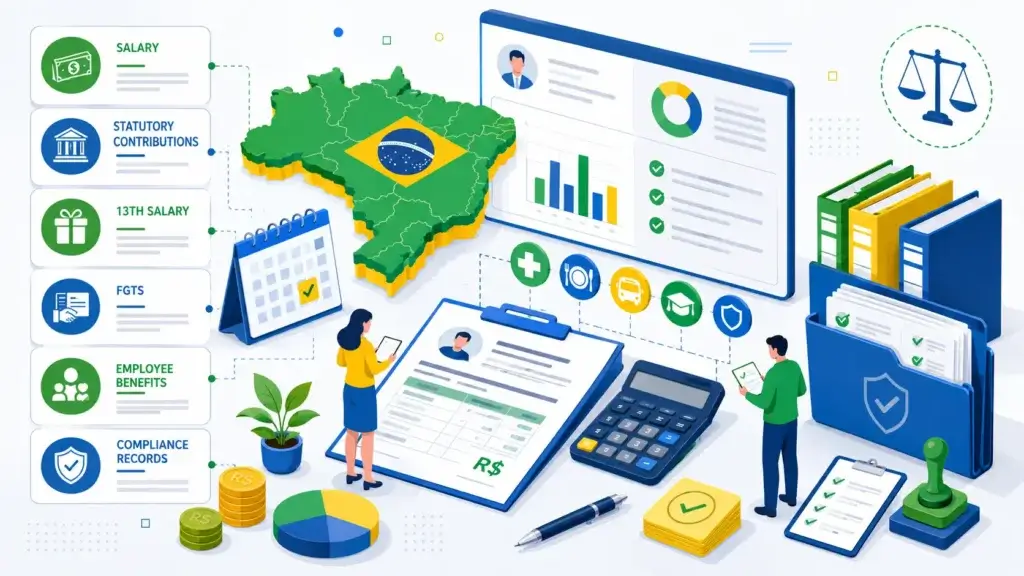
Running payroll is not only about paying a monthly salary. Employers need to calculate and process local payroll obligations, withhold applicable taxes, manage employee and employer contributions, maintain records, and account for statutory benefits and additional payments.
Brazilian payroll can be complex because several obligations interact with one another. Salary, 13th salary, vacation pay, FGTS, INSS, tax withholding, benefits, and reporting requirements all need to be handled correctly.
Key payroll obligations in Brazil
When hiring employees in Brazil, payroll planning should include:
- Gross monthly salary
- Income tax withholding where applicable
- Social security contributions
- Employer-side payroll contributions
- FGTS deposits
- 13th salary accrual and payment
- Vacation pay and vacation bonus considerations
- Benefits administration
- Payslips and payroll records
- Local payroll reporting requirements
Foreign companies often underestimate the difference between salary and total employment cost. A monthly salary offer is only one part of the cost of employment in Brazil. The employer should also budget for statutory contributions, mandatory payments, payroll administration, benefits, and compliance support.
What is FGTS?
FGTS, or Fundo de Garantia do Tempo de Serviço, is Brazil’s severance indemnity fund system. It is one of the most important Brazil-specific payroll obligations for employers to understand.
In practice, employers make regular deposits connected to the employee’s compensation. These funds are part of the employee protection framework and may become relevant in certain termination scenarios.
For foreign employers, FGTS is important because it affects both payroll administration and total employment cost. It is not something that should be treated as optional or handled after the employee starts. It needs to be included in the payroll setup from the beginning.
What is INSS?
INSS refers to Brazil’s social security system.
Payroll in Brazil must account for social security contributions and related calculations. Depending on the structure of the employment relationship, contributions may apply to both employee deductions and employer obligations.
Because payroll contributions and tax rules can change or depend on the specific situation, foreign companies should not rely only on manual calculations or assumptions. They should work with a local payroll provider, in-country advisor, or EOR that understands Brazilian payroll rules.
Why Brazil payroll is difficult for foreign employers
Brazil payroll is difficult for foreign employers because the process includes more than salary transfer.
The employer needs to manage local rules, statutory payments, government reporting, tax withholding, benefits, employee documentation, and compliant payroll records. If the company does not have a Brazilian entity, it may not be able to run local payroll directly for employees in Brazil.
This is where the entity vs. EOR decision becomes important. If the company opens a local entity, it must build the infrastructure to manage payroll, tax, accounting, employment contracts, HR administration, and compliance. If it uses an Employer of Record, the EOR can employ the worker locally and manage payroll and employment administration on behalf of the company.
Mandatory Benefits and Employee Entitlements
Brazil has several employee entitlements that international companies need to plan for when calculating compensation and total employment cost.
These benefits are not just “nice to have” perks. Many are part of the statutory employment framework. If they are not handled correctly, the employer may face compliance risk, employee disputes, or unexpected liabilities.
Common employee entitlements to understand
When hiring employees in Brazil, companies should review the following areas:
- Paid annual vacation
- Vacation pay and additional vacation-related payments
- 13th salary
- FGTS deposits
- Social security contributions
- Maternity and paternity leave
- Overtime and working time rules
- Public holidays
- Transportation, meal, or other benefits where applicable
- Collective agreement requirements where relevant
The exact benefit structure may vary depending on the employment arrangement, location, industry, collective agreement, and role. That is why localized guidance is important before hiring.
The 13th salary in Brazil
The 13th salary is one of the most important Brazil-specific payroll items foreign employers should understand.
In simple terms, it is an additional annual salary payment that employees are entitled to receive. For employers, this means compensation planning in Brazil should not look only at 12 monthly salary payments. The 13th salary needs to be included in annual employment cost, payroll forecasting, and offer planning.
This is especially important when comparing Brazilian compensation to salaries in other countries. A role that appears less expensive on a monthly basis may have additional statutory costs that must be included in the total annual cost.
Paid vacation and vacation-related costs
Paid vacation is another major employment obligation in Brazil.
Employers should plan not only for paid time off, but also for the payroll impact of vacation-related payments. If the company is hiring its first employee in Brazil, it should confirm how vacation accrues, when it must be taken, how it is paid, and how it affects payroll calculations.
For distributed companies, vacation planning should also be coordinated with team coverage. A compliant leave policy is important, but so is making sure managers understand how local vacation rules affect scheduling and operations.
Market-standard benefits
In addition to statutory requirements, companies may need to consider market-standard benefits to attract strong candidates in Brazil.
Depending on the role and seniority, candidates may expect benefits such as private health insurance, meal allowances, transportation support, wellness benefits, remote work support, or professional development budgets.
These expectations can vary by industry and location. A senior software engineer in São Paulo may compare offers differently from a customer support specialist in another region. For this reason, salary benchmarking should include both local statutory requirements and role-specific market expectations.
Compliance Risks When Hiring in Brazil
Brazil can be a strong hiring market, but it is not a market where employers should improvise employment compliance.
The main risk for foreign companies is not usually the decision to hire in Brazil. The risk is hiring without the right structure, documentation, payroll setup, or local employment support.
Common compliance risks in Brazil
Companies hiring in Brazil should pay special attention to:
- Misclassifying employees as contractors
- Using non-localized employment contracts
- Failing to calculate payroll contributions correctly
- Missing or under-budgeting 13th salary obligations
- Failing to manage FGTS deposits correctly
- Handling vacation, overtime, or leave incorrectly
- Managing terminations without local compliance support
- Processing employee data without considering LGPD requirements
- Assuming a foreign entity can directly employ Brazilian workers without a local setup
Data protection and LGPD
Companies hiring employees in Brazil also need to consider employee data protection.
Brazil’s Lei Geral de Proteção de Dados, known as LGPD, regulates the processing of personal data. For employers, this can include employee identification details, payroll information, bank details, tax data, benefits information, performance records, and other HR data.
Foreign employers should make sure that employee data is collected, stored, shared, and processed with appropriate safeguards. This is especially important when HR, payroll, and management systems are spread across multiple countries.
When using a global employment platform or EOR, companies should still understand how employee data flows between the employer, the EOR, payroll systems, benefits providers, and internal HR tools.
Common mistakes foreign companies make
Many Brazil hiring mistakes happen because the employer treats the process as a simple remote hiring project instead of a local employment process.
Common mistakes include:
- Hiring a full-time Brazilian worker as a contractor without checking classification risk.
- Using a contract template designed for another country.
- Budgeting only for monthly salary and ignoring statutory employment costs.
- Forgetting to include 13th salary in annual compensation planning.
- Not understanding FGTS and social security obligations.
- Assuming payroll can be handled manually from the company’s home country.
- Terminating an employee without reviewing local process and payment rules.
- Failing to protect employee data in line with local privacy expectations.
These mistakes can be costly, but they are avoidable. The key is to choose the right hiring model before the employee starts working.

Entity vs. Employer of Record
Before hiring employees in Brazil, foreign companies usually need to answer one strategic question: should you open a local entity or use an Employer of Record?
Both options can work, but they serve different needs.
Opening a Brazilian entity may be the right choice if Brazil is a long-term strategic market, you plan to build a large local team, or you need a permanent legal and commercial presence in the country. Using an EOR may be better if you want to hire quickly, test the market, reduce administrative burden, or employ one or several workers before committing to an entity.
Option 1: Open a local entity in Brazil
Opening a local entity gives the company more direct control over local employment, payroll, banking, tax registration, commercial operations, and long-term market presence.
This can make sense when:
- You plan to hire a large team in Brazil.
- You need a local legal presence for sales, operations, or contracts.
- You are entering Brazil as a long-term strategic market.
- You have the resources to manage local accounting, payroll, HR, legal, and tax compliance.
- You want direct control over all employment infrastructure.
However, entity setup requires time, budget, local advisors, tax registration, payroll setup, bank account processes, accounting support, HR policies, employment contracts, and ongoing compliance management.
For a company hiring its first Brazilian employee, this can be more infrastructure than the business needs at the beginning.
Option 2: Use an Employer of Record in Brazil
An Employer of Record allows a company to hire an employee in Brazil without opening its own local entity first.
In this model, the EOR legally employs the worker in Brazil and manages local employment administration, while the client company manages the employee’s day-to-day responsibilities, goals, projects, and performance.
An EOR can be useful when:
- You want to hire your first employee in Brazil.
- You need to onboard quickly.
- You do not have a Brazilian entity.
- You want to reduce payroll and compliance complexity.
- You are testing the Brazilian market before committing to entity setup.
- You need localized contracts and benefits administration.
- You want local employment support without building an internal HR infrastructure in Brazil.
For many international companies, the EOR route is a practical way to hire Brazilian employees faster while reducing the administrative burden of managing local employment requirements independently.
Entity vs. EOR comparison table
| Hiring Model | Best For | Main Considerations |
| Local Entity | Companies building a long-term, large-scale Brazil presence | Requires setup time, local legal support, payroll infrastructure, tax registration, accounting, and ongoing compliance management |
| Employer of Record | Companies hiring employees in Brazil without opening a local entity | Faster to start, supports localized employment, payroll, benefits, and compliance, but the EOR remains the legal employer |
| Independent Contractor | Project-based or genuinely independent work | Can be flexible, but misclassification risk increases if the worker operates like an employee |
How Deel Helps Companies Hire in Brazil
Deel helps companies hire, onboard, pay, and manage workers across international markets, including Brazil.
For Brazil specifically, Deel’s Employer of Record solution can help companies hire employees without setting up a local entity. This is useful for businesses that want to access Brazilian talent but do not want to immediately build a local legal, payroll, HR, and compliance infrastructure.
Instead of asking the company to figure out Brazil employment contracts, payroll calculations, statutory benefits, and local compliance alone, Deel can support the employment process through its EOR model.
Localized employment contracts
When hiring in Brazil, localized contracts matter.
A foreign employment agreement may not properly reflect Brazilian labor requirements, statutory benefits, termination considerations, or local payroll expectations. Deel helps companies use localized employment agreements for Brazil through its EOR solution, supporting a more compliant employment setup from the start.
Country-specific onboarding
Brazil onboarding involves more than sending a welcome email.
Employers need to collect the correct employee information, payroll details, documentation, benefit selections, and compliance-related data. Deel supports country-specific onboarding workflows so companies can move from accepted offer to compliant employment setup more efficiently.
This is especially useful for companies hiring their first Brazilian employee, because internal HR teams may not know which documents, payroll details, or local processes are required.
Brazil payroll processing
Payroll is one of the strongest reasons to use Deel in Brazil.
Brazil payroll requires employers to account for salary payments, tax withholding, statutory contributions, FGTS, INSS, 13th salary, benefits, and local payroll records. Deel can help manage payroll processing for Brazilian employees hired through its EOR model, reducing the need for the company to build Brazil payroll capabilities internally.
For companies that already have a Brazilian entity, Deel also offers local payroll capabilities that can help with payroll operations, calculations, reporting, and compliance workflows.
Benefits administration
Benefits are a major part of hiring competitively in Brazil.
Deel can help companies manage statutory and localized benefits for employees hired through its EOR solution. This helps ensure that employees receive the benefits required for their market while giving the company a simpler way to manage benefits across multiple countries.
Compliance support
Hiring in Brazil requires ongoing attention to employment rules, payroll obligations, benefits, termination requirements, and worker classification.
Deel supports employers with localized compliance expertise, helping companies reduce the risk of mistakes when hiring and managing Brazilian employees. This is particularly valuable for companies that do not have internal HR, payroll, or legal teams in Brazil.
Entity-free hiring
The biggest advantage of Deel’s EOR model is that it allows companies to hire employees in Brazil without setting up a local entity first.
That matters when speed is important. If you have found the right candidate in Brazil, waiting months to set up a local entity may delay the hire or cause you to lose the candidate. An EOR can help you move faster while keeping the employment relationship structured through a local compliant model.
For companies testing Brazil as a talent market, this can be the most practical path. You can hire, onboard, and manage the employee while deciding later whether a full Brazilian entity makes sense for your long-term strategy.
Step-by-Step: How to Hire an Employee in Brazil
Hiring in Brazil is easier when you follow a clear process.
The exact steps may vary depending on whether you use a local entity, EOR, or contractor model, but the framework below helps you plan the process properly.
1. Decide whether the role should be employee or contractor
Start by reviewing the nature of the role.
If the person will work independently, manage their own schedule, use their own tools, serve multiple clients, and deliver project-based work, a contractor arrangement may be appropriate. If the person will work full time, report to company managers, follow internal processes, and perform ongoing core duties, employee status may be more appropriate.
2. Choose your hiring model
Next, decide whether to use a local entity, Employer of Record, or contractor arrangement.
If you already have a Brazilian entity, you may be able to hire directly. If you do not have an entity and want to hire an employee, an EOR such as Deel can be a practical option. If the work is genuinely independent, a contractor agreement may be suitable, but classification risk should be reviewed carefully.
3. Prepare a localized employment agreement
The employment agreement should reflect Brazilian requirements and the specific role.
It should include compensation, job responsibilities, working hours, benefits, leave, confidentiality, intellectual property, termination terms, and other relevant employment details. Avoid using a generic foreign template without localization.
4. Collect employee documentation and payroll information
Before payroll can run, the employer or EOR needs the employee’s required personal, employment, tax, bank, and payroll information.
This should be collected securely and processed in line with appropriate privacy and data protection standards.
5. Set up payroll, benefits, and statutory contributions
Payroll setup should include salary, tax withholding, social security, FGTS, 13th salary planning, vacation-related payments, benefits, and required records.
This is one of the most important steps because payroll errors can create both employee dissatisfaction and compliance risk.
6. Onboard the employee
Onboarding should cover both operational and compliance needs.
The employee should understand their role, manager, goals, tools, communication processes, working hours, benefits, payroll schedule, leave policy, and company expectations.
7. Maintain ongoing compliance
Compliance does not end after onboarding.
Employers need to continue managing payroll, benefits, records, leave, policy changes, performance documentation, employee data, and any future termination process in line with local requirements.
Cost Considerations
When hiring in Brazil, companies should calculate total employment cost rather than salary alone.
This is important because a Brazilian employee’s total cost may include salary, employer contributions, statutory payments, benefits, payroll administration, and potentially EOR fees or local entity costs.
Main cost categories
| Cost Category | What It Includes | Why It Matters |
| Gross salary | The employee’s base compensation | This is the starting point, but not the full employment cost |
| 13th salary | Additional annual salary obligation | Must be included in annual compensation planning |
| FGTS | Employer deposits connected to the employee’s compensation | Important Brazil-specific payroll obligation |
| Social security and payroll contributions | Employee and employer-side payroll-related obligations | Can materially affect total employment cost |
| Benefits | Statutory and market-standard benefits | Important for compliance and talent attraction |
| Payroll administration | Payroll processing, reporting, calculations, and records | Requires local expertise or a payroll platform |
| Entity setup | Legal, accounting, tax, registration, and HR infrastructure | Relevant if the company chooses to hire directly through a local entity |
| EOR fees | Employer of Record service fees | Relevant when hiring without opening a Brazilian entity |
For a company hiring one or two employees in Brazil, opening a local entity may be more expensive and time-consuming than necessary. For a company building a large Brazil team, entity setup may become more cost-effective over time.
The right choice depends on your hiring volume, timeline, risk tolerance, internal HR capacity, and long-term Brazil strategy.
When Should You Use an EOR in Brazil?
An Employer of Record can be a strong fit when you want to hire employees in Brazil without setting up a local entity.
This is especially useful when you are moving quickly, hiring your first employee, testing the market, or expanding internationally without a large local HR operation.
An EOR may be the right option when:
- You want to hire your first employee in Brazil.
- You need to onboard a candidate quickly.
- You do not have a Brazilian entity.
- You want localized employment contracts.
- You need support with payroll, benefits, and statutory contributions.
- You want to reduce misclassification risk by hiring the worker as an employee.
- You are testing Brazil before making a larger market commitment.
- You do not have local HR, payroll, legal, or accounting infrastructure.
A local entity may be better when:
- You plan to hire a large Brazil-based team.
- You need a permanent commercial presence in Brazil.
- You have the resources to manage local employment compliance internally.
- You need full control over local operations, contracts, banking, and tax infrastructure.
- Brazil is a core long-term market for your company.
In many cases, companies start with an EOR to hire quickly and learn the market. Later, if Brazil becomes a strategic hiring hub, they may decide to open a local entity and transition to direct employment.
Final Thoughts
Brazil offers access to a large and skilled workforce, but hiring there requires careful planning around employment contracts, payroll, taxes, FGTS, INSS, 13th salary, benefits, employee data, and compliance.
If your company wants to hire Brazilian employees without opening a local entity first, Deel’s Employer of Record solution can help you onboard talent in Brazil through localized contracts, country-specific onboarding, payroll processing, statutory benefits administration, and ongoing compliance support.
For companies hiring their first employee in Brazil, this can be the fastest and simplest path to compliant employment. For large long-term operations, opening a Brazilian entity may make sense.
FAQs
Can a foreign company hire employees in Brazil?
Yes, a foreign company can hire employees in Brazil, but it generally needs a compliant employment structure. This usually means opening a local Brazilian entity or using an Employer of Record that can legally employ the worker in Brazil on the company’s behalf.
Do I need a local entity to hire employees in Brazil?
Not always. If you want to hire employees directly, you usually need a local entity. However, an Employer of Record such as Deel can help you hire employees in Brazil without setting up your own Brazilian entity first.
What is an Employer of Record in Brazil?
An Employer of Record in Brazil is a local employment partner that legally employs the worker, manages employment contracts, payroll, statutory benefits, and compliance, while the client company manages the employee’s day-to-day work.
What payroll obligations do employers have in Brazil?
Employers in Brazil need to manage salary payments, tax withholding, social security contributions, FGTS, 13th salary, benefits, payroll records, and other local employment and reporting requirements.
What is the 13th salary in Brazil?
The 13th salary is an additional annual salary payment that employees in Brazil are generally entitled to receive. Employers should include it when calculating annual compensation and total employment cost.
What is FGTS in Brazil?
FGTS, or Fundo de Garantia do Tempo de Serviço, is Brazil’s severance indemnity fund system. Employers make deposits connected to employee compensation, and the fund can be relevant in certain termination scenarios.
Is it better to hire contractors or employees in Brazil?
It depends on the working relationship. Contractors may be suitable for independent project-based work, but if the person works like a full-time employee, contractor misclassification risk can increase. In that case, hiring through an employee model or EOR may be safer.
How does Deel help with hiring in Brazil?
Deel helps companies hire employees in Brazil through its Employer of Record solution, supporting localized contracts, country-specific onboarding, payroll processing, statutory benefits, and compliance support without requiring the company to open a local entity first.
What are the main compliance risks when hiring in Brazil?
The main risks include worker misclassification, non-localized contracts, incorrect payroll calculations, missing statutory benefits, failure to account for 13th salary and FGTS, termination mistakes, and employee data protection issues under LGPD.
When should a company use an EOR in Brazil?
A company should consider using an EOR in Brazil when it wants to hire employees quickly, does not have a Brazilian entity, wants localized employment support, needs payroll and benefits administration, or wants to test the Brazilian market before opening a local entity.