Introduction
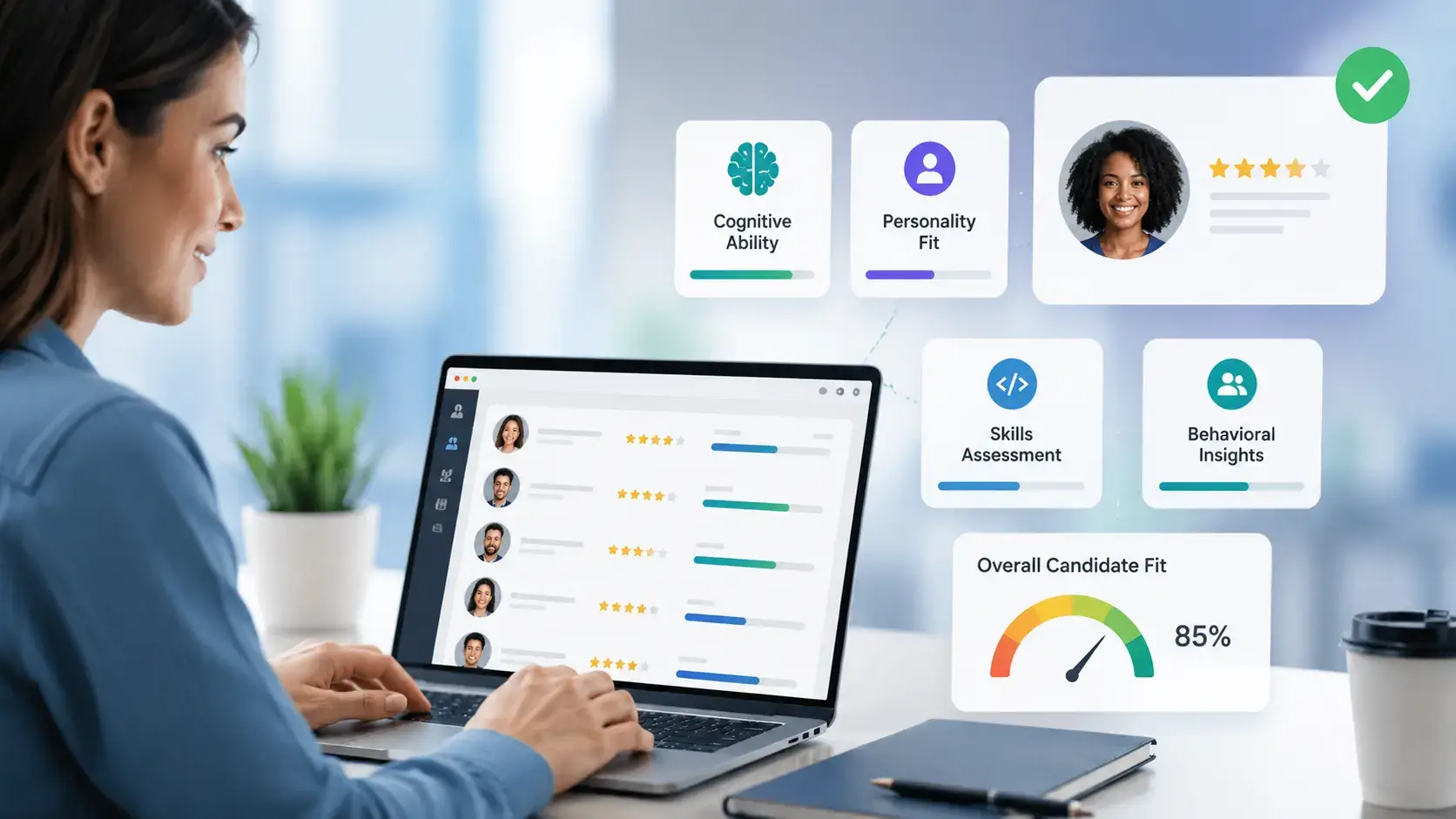
Candidate assessment software has become one of the most important parts of the modern hiring stack. Resumes still matter, but they rarely show the full picture. A strong assessment platform helps you evaluate how candidates think, solve problems, communicate, match the role, and perform in realistic work situations before you move too far into the hiring process.
The best candidate assessment tools help HR teams and hiring managers make more consistent, data-informed decisions. Instead of relying only on interviews, resumes, or gut feeling, these platforms can measure cognitive ability, personality traits, job-fit potential, technical skills, role-specific knowledge, communication ability, and behavioral tendencies.
In this guide, I compare six leading candidate assessment tools: Prevue HR, TestGorilla, Criteria, eSkill, iMocha, and The Predictive Index. Each platform has a different strength. Some focus on job-fit and psychometric assessments, while others are better for skills testing, technical hiring, structured interviewing, or behavioral fit.
If you want the quick recommendation, Prevue HR is the strongest overall option for companies that want a complete candidate assessment platform focused on job fit, aptitude, personality, motivations, and hiring reports. TestGorilla is the best fit for broad skills-based hiring. Criteria is a strong choice for science-backed pre-employment testing, eSkill is excellent for customizable job-specific skills tests, iMocha is best for technical and digital skills assessment, and The Predictive Index is strongest for behavioral fit and talent optimization.
How to Evaluate Candidate Assessment Tools
Candidate assessment tools are not all built for the same use case. Some help you screen high-volume applicants quickly. Others are better for executive hiring, role-fit analysis, technical recruiting, or culture and behavioral alignment. Before choosing a platform, it helps to understand what type of hiring decision you want the software to improve.
Assessment types and role relevance
The first thing to evaluate is the type of assessments each platform offers. A good candidate assessment tool should match the roles you hire for. For example, sales, customer support, operations, finance, and software development roles often require very different assessment formats.
Look for a platform that can assess the traits that actually matter for the job. These may include cognitive ability, problem-solving, numerical reasoning, communication, software skills, typing, coding, personality, motivation, work style, or role-specific knowledge.
Scientific validity and hiring consistency
Candidate assessment software is only valuable if the results are meaningful. The stronger platforms are built around validated assessments, structured scoring, job benchmarks, and consistent candidate comparison. This is especially important if you want to reduce bias, improve quality of hire, and create a more repeatable hiring process.
When reviewing vendors, pay attention to whether they explain how their assessments are developed, what they measure, and how the results should be used. Assessment data should support better decisions, not replace human judgment completely.
Candidate experience
A poor assessment experience can hurt completion rates and damage your employer brand. The best platforms make it easy for candidates to complete tests online, understand the process, and avoid unnecessary friction.
For high-volume hiring, shorter and more focused assessments usually work better. For specialized roles, longer assessments may be justified if they provide a more accurate view of candidate capability. The key is to match the assessment length and format to the role’s importance and complexity.
Skills testing and job simulations
Skills testing is especially useful when you want to verify what candidates can actually do. This may include software knowledge, coding, language ability, writing, customer service judgment, data analysis, spreadsheet work, or job-specific tasks.
Some platforms provide large test libraries, while others let you build your own assessments or upload existing tests. If you hire for many different roles, customization becomes much more important.
Reporting and decision support
Assessment results should be easy to understand. Good reports help recruiters and hiring managers compare candidates, identify strengths and risks, prepare better interview questions, and make more confident decisions.
The best platforms do more than display a score. They explain what the score means, how the candidate fits the role, where follow-up questions may be needed, and how the candidate compares to the job benchmark.
ATS integrations and hiring workflow
Candidate assessment tools should fit into your hiring workflow. If your team already uses an ATS software, check whether the assessment platform integrates with it. Strong integrations can help you send assessments automatically, receive results inside your recruiting pipeline, and reduce manual admin work.
This is where candidate assessment software differs from recruitment software. An ATS manages the hiring process, while an assessment tool helps you evaluate candidate quality. The best setup is often both: an ATS for workflow management and an assessment platform for better hiring decisions.
Pricing and hiring volume
Pricing varies widely in this category. Some vendors use public plans, some use candidate credits, some sell annual subscriptions, and others require a custom quote. The right model depends on how often you hire and how many candidates you assess per role.
Small businesses may prefer transparent pricing and a lighter setup. Larger organizations may prefer annual contracts, unlimited users, ATS integrations, enterprise support, and deeper reporting.
Prevue HR

Features & Benefits
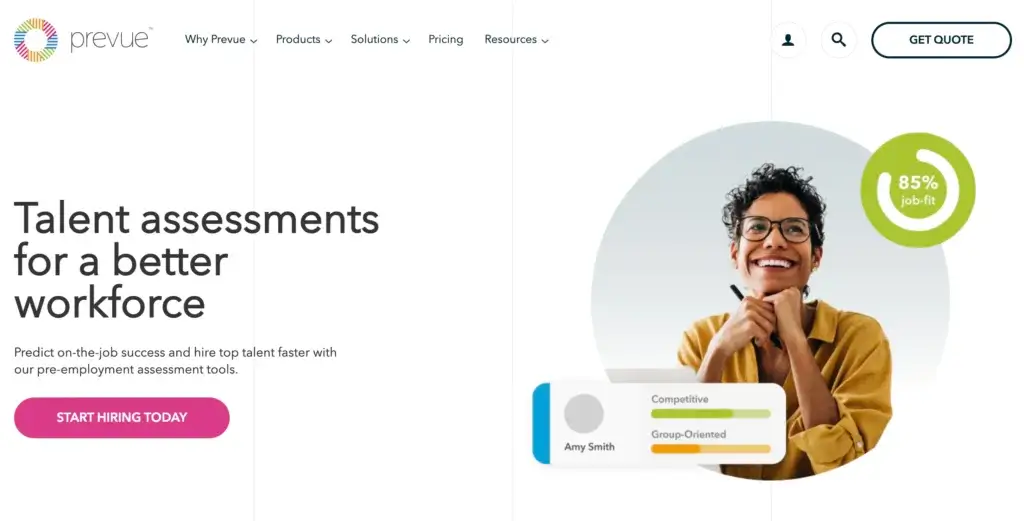
Prevue HR is my top recommendation for this category because it covers candidate assessment from a broader job-fit perspective. Instead of focusing only on basic skills testing, Prevue HR combines aptitude, personality, motivations, work ethic, skills, job benchmarks, and hiring reports to help companies understand whether a candidate is likely to succeed in a specific role.
This makes Prevue HR especially useful for companies that want to improve quality of hire, reduce mis-hires, and create a more structured hiring process. Its assessment approach is well suited for roles where performance depends on more than technical knowledge. For example, sales, customer service, management, operations, and team-based roles often require the right mix of cognitive ability, motivation, work style, and personality fit.
One of the biggest advantages of Prevue HR is that it helps hiring teams move beyond surface-level screening. A resume can show experience, but it rarely shows learning speed, job motivation, behavioral tendencies, or how naturally someone fits the role. Prevue HR gives you a more complete picture before you commit more time to interviews.
The platform is also practical for teams that want a repeatable hiring process. You can use job benchmarks, structured reports, and candidate insights to compare people against the role instead of comparing candidates only against each other. That is important because the best candidate is not always the one with the most polished resume. It is the one most likely to perform well in the actual job.
Pricing & Plans
Prevue HR uses request-pricing plans rather than publishing fixed monthly prices. Its pricing page presents options built around talent assessments, candidate invites, job-position libraries, predictive insights, and additional support depending on the plan. This makes it better suited for companies that want a configured assessment solution rather than a simple pay-per-test tool.
Pros & Cons
Pros
- Strong overall coverage of aptitude, personality, motivations, work ethic, and skills
- Excellent fit for job-fit assessments and role-based hiring decisions
- Useful hiring reports and predictive insights for managers
- Good choice for companies that want more than basic skills testing
Cons
- Pricing is quote-based rather than fully public
- May be more structured than teams looking for simple one-off tests need
- Not as focused on coding assessments as technical-first platforms
TestGorilla

Features & Benefits
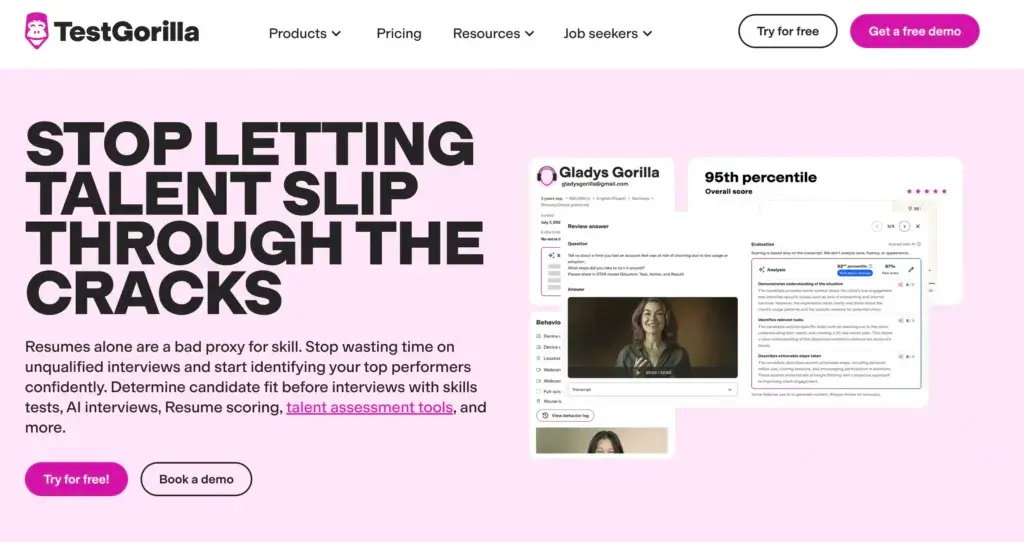
TestGorilla is one of the most recognizable tools in the candidate assessment market, especially for companies that want to move toward skills-based hiring. It helps teams screen candidates with skills tests, cognitive assessments, personality and culture tests, language tests, programming tests, video questions, custom questions, and AI-supported scoring.
The platform is especially useful when you need to create a shortlist quickly. Instead of spending time reviewing every resume manually, you can send candidates a structured assessment and compare results in a more consistent way. This is valuable for high-volume roles, remote hiring, junior hiring, and roles where resumes often fail to show practical ability.
TestGorilla is also strong because of its wide test library. Paid plans include access to hundreds of tests across cognitive ability, situational judgment, role-specific skills, software, programming, language, personality, and culture. This makes it one of the most flexible tools for companies that hire across many departments.
Another advantage is that TestGorilla is easy to understand for non-technical HR teams. You can build assessments from existing tests, add custom questions, use video responses, and evaluate candidates before interviews. For many small and mid-sized companies, that balance of breadth and usability is the main reason to consider it.
Pricing & Plans
TestGorilla offers Free, Core, and Plus plans. The pricing structure uses candidate credits for different assessment features. The Free plan includes a limited set of tests, while paid plans unlock a much larger library, with more advanced assessment options available depending on the tier.
Pros & Cons
Pros
- Large library of skills, cognitive, role-specific, software, language, and personality tests
- Strong fit for skills-based hiring and fast candidate shortlisting
- Good option for high-volume hiring and distributed teams
- More accessible for small and mid-sized companies than many enterprise assessment tools
Cons
- Credit-based pricing can require planning if you assess many candidates
- Not as focused on deep job-fit psychology as Prevue HR or The Predictive Index
- Some advanced features are tied to higher-tier plans
Criteria

Features & Benefits
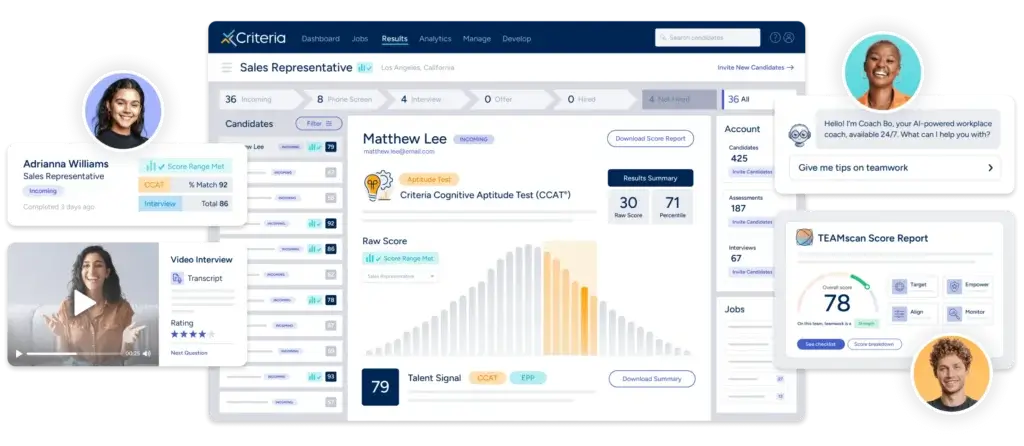
Criteria is a strong candidate assessment platform for companies that want science-backed pre-employment testing and a more structured hiring process. It focuses on cognitive aptitude, personality, emotional intelligence, risk, skills, interviews, and employee development tools. That makes it a good fit for organizations that want candidate assessment to be part of a broader talent decision process.
What makes Criteria stand out is its emphasis on validated assessments and evidence-based hiring. The platform is designed to help companies understand candidate potential, not just prior work history. This is useful when hiring for roles where learning ability, judgment, communication, and behavioral tendencies matter as much as experience.
Criteria is also a good choice if your company wants to improve interview consistency. Assessment results can support better interview questions, more structured candidate evaluation, and clearer comparisons between applicants. This helps reduce the risk of unstructured interviews becoming too subjective.
Compared with TestGorilla, Criteria feels more formal and science-led. Compared with Prevue HR, it may be broader in structured hiring and interview workflows, but Prevue HR has a stronger all-around position for job-fit assessment as a primary decision tool. Criteria is a very credible option for HR teams that want a serious assessment suite with strong validation.
Pricing & Plans
Criteria uses request-pricing plans. Its pricing page shows subscription-based options such as Professional and Professional+, with features that can include assessments, structured interviewing, ATS integrations, candidate communication, and development tools depending on the plan.
Pros & Cons
Pros
- Strong science-backed assessment approach
- Covers cognitive aptitude, personality, emotional intelligence, risk, and skills
- Useful for structured hiring and consistent candidate evaluation
- Good fit for organizations that want validated pre-employment testing
Cons
- Pricing is not fully public
- May feel more formal than lightweight skills-testing tools
- Some capabilities depend on the selected plan and configuration
eSkill
Features & Benefits
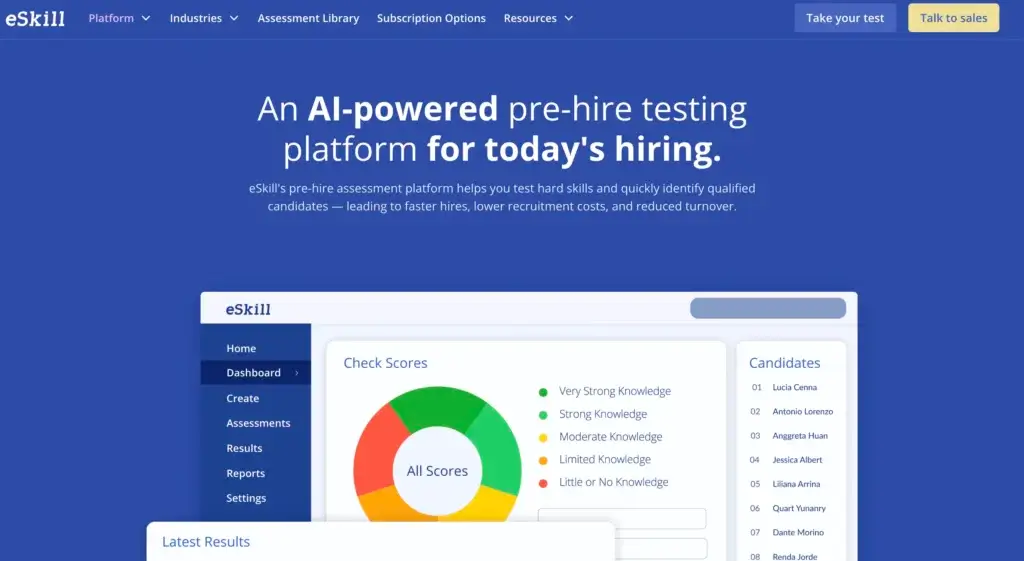
eSkill is a strong option for companies that need customizable pre-employment skills testing. It is especially useful when you want to evaluate practical job knowledge, hard skills, software ability, typing, customer service skills, administrative skills, or role-specific requirements before moving candidates into interviews.
The biggest advantage of eSkill is customization. You can use standardized tests, build customized mix-and-match assessments, access a large test library, add custom questions, use anti-cheat tools, include video questions, and create a more tailored evaluation process. This makes eSkill practical for companies that hire across many operational roles and need tests that reflect the actual work.
eSkill is also useful for organizations that already have internal assessments or paper-based tests. The platform supports test digitization, which can help companies move older offline testing processes into a more scalable online workflow. That is a strong fit for government, healthcare, logistics, manufacturing, customer support, and other environments where job-specific testing already exists but needs modernization.
Compared with TestGorilla, eSkill is usually better when customization is the priority. TestGorilla is easier to shortlist for broad skills-based hiring, while eSkill is stronger when you need to shape the test around your company, role, or existing assessment process.
Pricing & Plans
eSkill offers subscription options such as Growth and Scale, with pricing handled through a sales process. The plans can include standardized tests, customized assessments, a complete test library, anti-cheat tools, ATS integrations, video questions, custom branding, behavioral tests, onboarding support, one-way interviews, custom questions, test uploads, team grading, and assessment consulting depending on the selected package.
Pros & Cons
Pros
- Excellent customization for job-specific skills testing
- Large test library with options for custom questions and mix-and-match assessments
- Good for operational, administrative, customer service, and role-specific hiring
- Supports test digitization for companies moving from offline to online assessments
Cons
- Pricing requires a sales conversation
- May be more hands-on to configure than simpler test-library platforms
- Less focused on broad psychometric job-fit analysis than Prevue HR
iMocha
Features & Benefits
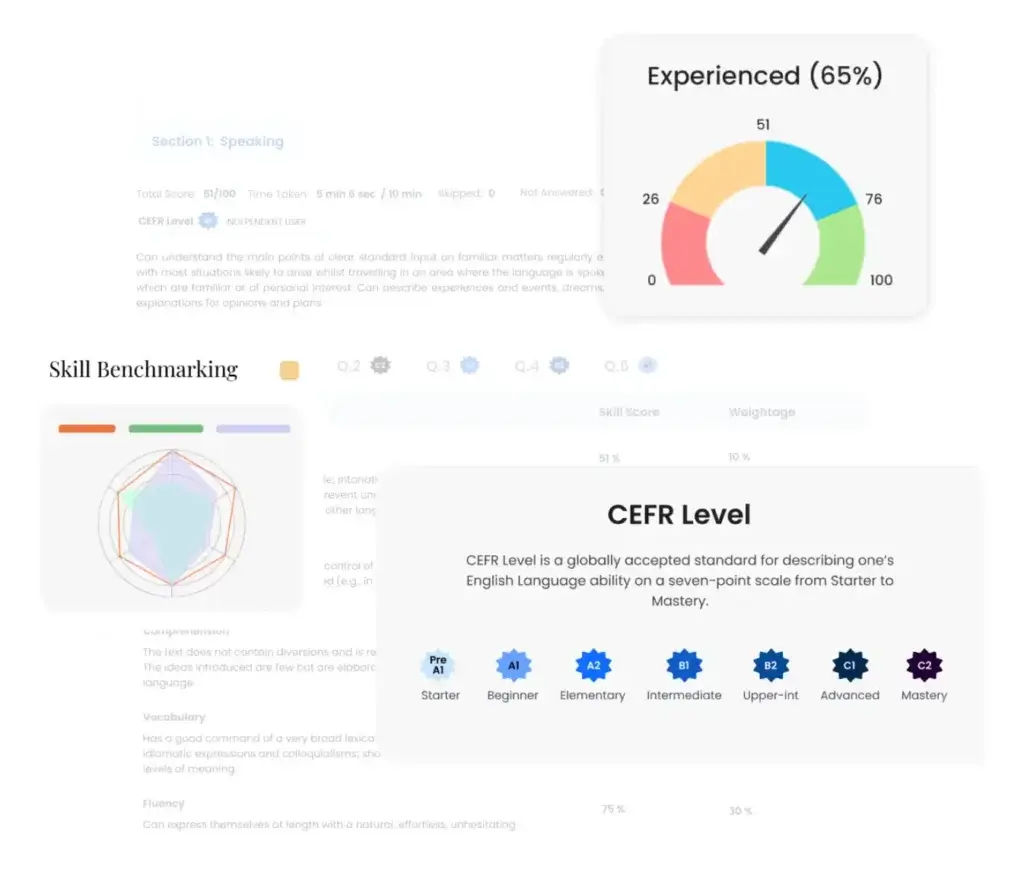
iMocha is one of the strongest options for companies that need to assess technical, digital, and enterprise skills at scale. It is more than a simple test library. The platform positions itself around skills assessment and skills intelligence, helping organizations validate skills, map candidate capabilities, benchmark talent, and support data-driven hiring decisions.
For talent acquisition teams, iMocha is especially useful when hiring for technical roles, IT roles, cloud roles, data roles, enterprise software roles, and other positions where skills need to be verified before interviews. The platform supports role-ready skills data, ATS integration, AI-powered matching, conversational AI interviews, coding evaluations, communication assessments, behavioral and psychometric assessments, proctoring, analytics, and multilingual assessment workflows.
iMocha stands out because it is built for larger and more complex hiring environments. If you are hiring only a few general business roles, it may be more than you need. But if your company needs to assess technical talent across many roles, locations, and skill categories, iMocha is one of the most relevant tools in this list.
Compared with TestGorilla, iMocha is better for enterprise technical assessment and skills intelligence. Compared with eSkill, it is less focused on general job-specific customization and more focused on digital skills, technical hiring, AI matching, and scalable skills data.
Pricing & Plans
iMocha uses custom pricing for talent acquisition. Its pricing page highlights flexible packages for skills assessments, AI conversational interviews, intelligent matching, ATS-embedded workflows, AI-SkillsMatch, skills benchmarking, proctoring, analytics, and other enterprise assessment needs.
Pros & Cons
Pros
- Strong fit for technical, digital, and IT skills assessment
- Useful AI matching, skills intelligence, and ATS-connected screening workflows
- Good option for enterprise hiring and large-scale skills validation
- Supports coding, communication, behavioral, psychometric, and proctored assessments
Cons
- Custom pricing makes budgeting less immediate
- May be too advanced for small teams with simple hiring needs
- Not as simple as lightweight skills-testing tools for quick screening
The Predictive Index
Features & Benefits
The Predictive Index is best for companies that want to understand behavioral fit, team dynamics, role alignment, and long-term talent optimization. It is not just a pre-hire test library. It is built around behavioral science and helps organizations define what a role requires, compare candidates against those requirements, and use people insights beyond the hiring stage.
The Predictive Index is especially useful when personality, motivation, communication style, and work behavior strongly influence performance. For example, it can be valuable for sales, leadership, customer-facing roles, management roles, team-based roles, and positions where collaboration style matters.
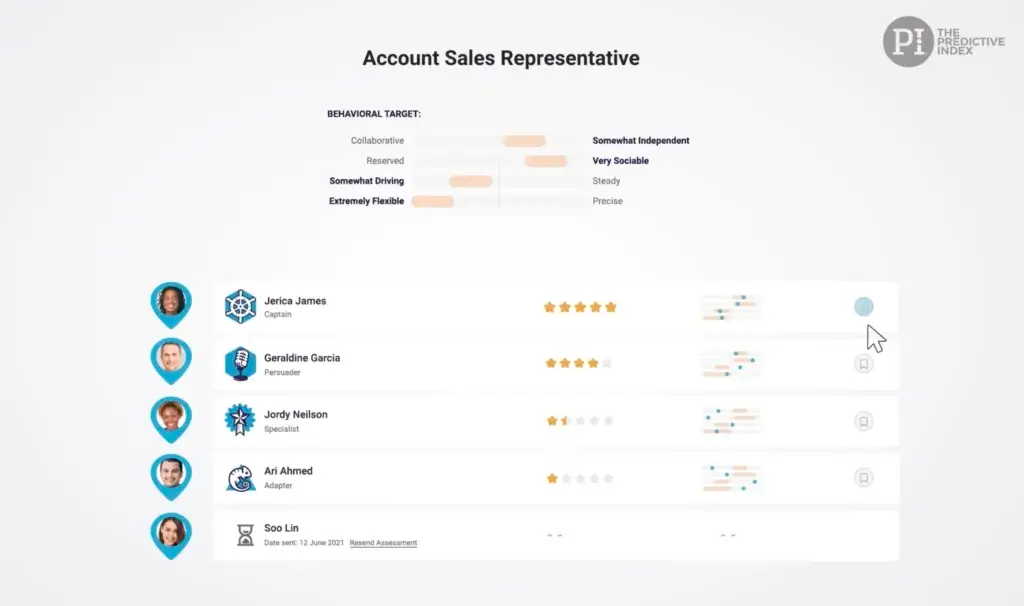
One of its main strengths is the role target approach. Instead of simply testing a candidate in isolation, PI helps hiring teams define what the role needs and then evaluate how well a candidate aligns with that target. This can make interviews more focused and reduce the risk of hiring based only on likability or past experience.
Compared with Prevue HR, The Predictive Index is more focused on behavioral insight and talent optimization across the employee lifecycle. Prevue HR is stronger as an all-around candidate assessment platform because it combines aptitude, personality, motivations, skills, and job-fit reporting in one hiring-focused environment. PI is a strong fit when behavioral fit and team performance are top priorities.
Pricing & Plans
The Predictive Index sells PI Hire through annual subscription plans based on company size. The company states that PI Hire is not purchased per assessment, and that plans include unlimited users. This model can work well for organizations that plan to use behavioral assessments consistently rather than occasionally.
Pros & Cons
Pros
- Excellent for behavioral fit, job targets, and team alignment
- Useful beyond hiring for management, coaching, and talent optimization
- Strong fit for leadership, sales, management, and team-based roles
- Annual subscription model can be practical for consistent assessment usage
Cons
- Less focused on hard skills testing than TestGorilla, eSkill, or iMocha
- Annual subscription may not suit companies with very low hiring volume
- Best results require teams to understand how to use behavioral insights properly
Comparing the Tools
Not every candidate assessment tool is solving the same problem. Some platforms are built for job-fit and psychometric evaluation, while others focus on skills testing, technical hiring, behavioral fit, or structured pre-employment testing. That is why the best tool depends on the type of roles you hire for and the decision you are trying to improve.
The table below gives you a quick way to compare the strongest use case, main advantage, trade-off, and pricing model for each platform.
| Tool | Best For | Top Strength | Main Trade-Off | Pricing Model |
| Prevue HR | Overall candidate assessment | Job fit, aptitude, personality, motivations, and predictive hiring reports | Quote-based pricing | Request pricing |
| TestGorilla | Skills-based hiring | Large skills test library and fast candidate shortlisting | Credit-based usage can require planning | Free, Core, and Plus plans |
| Criteria | Validated pre-employment testing | Science-backed assessments and structured hiring support | Less transparent pricing | Request pricing |
| eSkill | Custom skills tests | Customizable job-specific assessments and test digitization | Requires more setup for tailored tests | Subscription options, sales quote |
| iMocha | Technical and digital skills assessment | Enterprise skills intelligence, AI matching, and technical evaluations | May be too advanced for simple hiring needs | Custom pricing |
| The Predictive Index | Behavioral fit and talent optimization | Job targets, behavioral insights, and team-fit analysis | Less focused on hard skills testing | Annual subscription by company size |
How These Tools Differ
Although all of these tools support candidate evaluation, they should not be treated as interchangeable. The biggest difference is the type of evidence each platform gives you. Some tools show whether a candidate can perform a skill. Others show whether the candidate fits the role behaviorally, learns quickly, or aligns with the work environment.
Prevue HR – Best overall candidate assessment platform
Prevue HR is the most balanced choice in this list because it combines aptitude, personality, motivations, work ethic, skills, job benchmarks, and hiring reports. It is a strong option when you want a deeper view of candidate fit rather than a simple pass-or-fail skills test.
TestGorilla – Best for skills-based hiring
TestGorilla is best when you want a practical way to screen candidates based on skills. Its large test library makes it useful for many roles, especially when you need to shortlist applicants quickly and reduce reliance on resumes.
Criteria – Best for validated pre-employment testing
Criteria is a good fit for organizations that want a science-backed assessment process. It is especially relevant for companies that want cognitive, personality, emotional intelligence, risk, and skills assessments combined with structured interviews and a more formal hiring workflow.
eSkill – Best for customizable skills testing
eSkill is strongest when you need to customize assessments around the actual job. It is useful for companies that hire for operational, administrative, customer service, technical, or field roles where practical skills and job-specific questions matter.
iMocha – Best for technical and digital skills assessment
iMocha is strongest for companies hiring technical and digital talent at scale. It is more enterprise-oriented than many skills-testing tools and is a good fit when you need skills intelligence, AI matching, proctoring, coding assessments, communication tests, and ATS-connected workflows.
The Predictive Index – Best for behavioral fit
The Predictive Index is strongest when behavior, motivation, communication style, and team fit are central to hiring success. It is especially useful for leadership, management, sales, and team-based roles where the way someone works is as important as what they know.
Conclusion
The best candidate assessment tool depends on the type of hiring decision you need to improve. If you want the strongest overall platform for job-fit assessment, Prevue HR is the best place to start. It gives you a broader view of candidates by combining aptitude, personality, motivations, work ethic, skills, and predictive hiring reports.
TestGorilla is the best choice for broad skills-based hiring, especially if you want an accessible platform with many ready-made tests. Criteria is a strong fit for validated pre-employment testing and structured hiring. eSkill is best when customization and job-specific tests matter. iMocha is the strongest option for technical and digital skills assessment at scale. The Predictive Index is best when behavioral fit and team alignment are your top priorities.
My recommendation is to choose based on your hiring bottleneck. If you are getting too many unqualified applicants, use skills testing. If candidates look good in interviews but underperform later, use job-fit and behavioral assessments. If you hire technical roles, use a dedicated technical assessment platform. If your process feels inconsistent, use a tool that gives your team structured reports and benchmarks.
For most companies, the best approach is not to replace human judgment. It is to support hiring decisions with better evidence. Candidate assessment software works best when it helps recruiters and managers ask better questions, compare candidates more fairly, and choose people who are more likely to succeed in the role.
Frequently Asked Questions (FAQs)
What is the best candidate assessment tool overall?
Prevue HR is the best overall candidate assessment tool in this comparison because it combines aptitude, personality, motivations, work ethic, skills, job-fit reporting, and predictive hiring insights.
What is candidate assessment software?
Candidate assessment software helps companies evaluate applicants before making a hiring decision. It can measure skills, cognitive ability, personality, job fit, motivation, behavior, technical knowledge, or role-specific performance.
Is candidate assessment software the same as ATS software?
No. ATS software manages the recruiting process, while candidate assessment software evaluates candidate quality. An ATS helps you track applicants, while an assessment tool helps you decide who is qualified and likely to succeed.
Which candidate assessment tool is best for skills-based hiring?
TestGorilla is one of the best tools for skills-based hiring because it offers a broad test library across cognitive, situational, role-specific, software, programming, language, personality, and culture assessments.
Which candidate assessment tool is best for technical hiring?
iMocha is the strongest option for technical and digital skills assessment because it focuses on skills intelligence, technical evaluations, coding assessments, AI matching, conversational AI interviews, and enterprise hiring workflows.
Which candidate assessment tool is best for behavioral fit?
The Predictive Index is one of the best choices for behavioral fit because it helps companies define role requirements, compare candidates against job targets, and understand how people are likely to work, communicate, and fit within a team.
Which candidate assessment tool is best for custom tests?
eSkill is a strong choice for custom tests because it supports standardized tests, customized mix-and-match assessments, custom questions, test uploads, anti-cheat tools, video questions, and job-specific assessment workflows.
Can candidate assessment tools reduce hiring bias?
Candidate assessment tools can help reduce bias when they are used properly because they create a more consistent evaluation process. However, they should support structured hiring decisions rather than replace recruiter and manager judgment completely.
How much do candidate assessment tools cost?
Pricing varies by vendor. Some tools offer public plans or candidate credits, while others use annual subscriptions or custom pricing. The best pricing model depends on your hiring volume, number of users, assessment types, and integration needs.
Is CoRecruit a candidate assessment tool?
CoRecruit, formerly Quil, is not a traditional candidate assessment tool. It is better described as an AI assistant for recruitment agencies, focused on interview notes, ATS updates, and candidate submittals. It can support the recruiting workflow, but it does not replace assessment platforms like Prevue HR, TestGorilla, Criteria, eSkill, iMocha, or The Predictive Index.