Introduction
Cisco AI Defense is an enterprise AI security platform designed to help you discover AI assets, test models and applications, enforce runtime guardrails, and reduce risks created by generative AI and autonomous agents. Rather than focusing on only one control, such as prompt filtering, the platform covers multiple stages of the AI lifecycle.
That broader approach is important because AI security problems rarely stay inside a single application. Your organization may have employees using unapproved AI tools, developers importing open-source models, teams connecting agents to Model Context Protocol servers, and production applications handling sensitive prompts and responses. Each activity introduces a different type of risk.
Cisco AI Defense attempts to bring those risks into one operating model. It combines AI inventory, supply-chain scanning, algorithmic red teaming, runtime inspection, data loss controls, policy management, and integrations with Cisco Secure Access, Multicloud Defense, Splunk, GitHub, and major cloud environments.
This Cisco AI Defense review examines where the platform adds value, how it works, what implementation may involve, and which organizations are most likely to justify the investment.
What Is Cisco AI Defense?
Cisco AI Defense is a purpose-built AI security platform for enterprise-built AI applications, third-party AI usage, models, and agentic systems. Cisco introduced the product after acquiring Robust Intelligence, whose technology included algorithmic red teaming and an AI firewall.
The platform is best understood through three security outcomes:
- Discover: Find AI applications, models, agents, frameworks, data sources, and shadow AI activity.
- Detect: Identify unsafe models, vulnerable applications, malicious components, prompt injection exposure, and policy failures.
- Protect: Apply runtime guardrails to prompts, responses, agent actions, and MCP interactions.
Cisco AI Defense is not a replacement for every security product. You still need identity security, cloud security, endpoint protection, secure software development, and incident response capabilities. Its role is to add controls that understand AI-specific assets and behaviors that traditional tools may not classify correctly.
Key Capabilities
Lifecycle Coverage
1. AI Asset Discovery and AI Bill of Materials
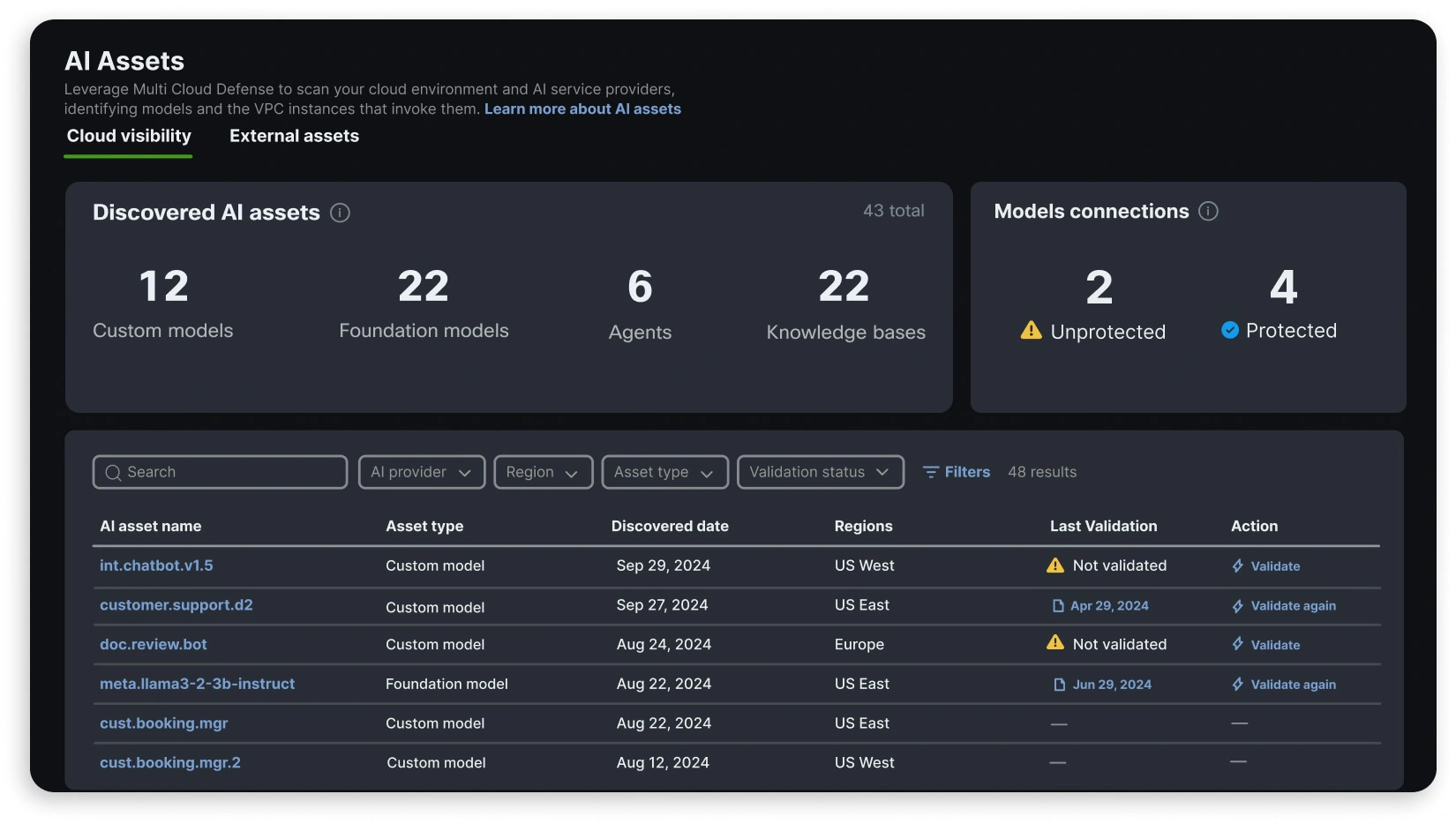
The first challenge in enterprise AI security is knowing what exists. Models may be deployed through cloud services, embedded in applications, downloaded from public repositories, or connected to agents through third-party tools. A standard software inventory may show the application but miss the AI components inside it.
Cisco AI Defense addresses this with AI asset discovery and an AI Bill of Materials, or AI-BOM. The platform can identify models, frameworks, agents, prompts, MCP tools, connected data sources, and other components found in source code and container images.
This gives security teams a more useful inventory than a simple list of AI vendors. You can see how an application is assembled, which components are inherited from third parties, and where a vulnerable or malicious asset may enter the development pipeline.
The feature is particularly valuable for organizations with multiple AI development teams. Without centralized discovery, each team may maintain its own spreadsheet, security review, and risk terminology. AI-BOM creates a foundation for repeatable governance and helps connect AI assets to owners and applications.
2. Model and Application Validation
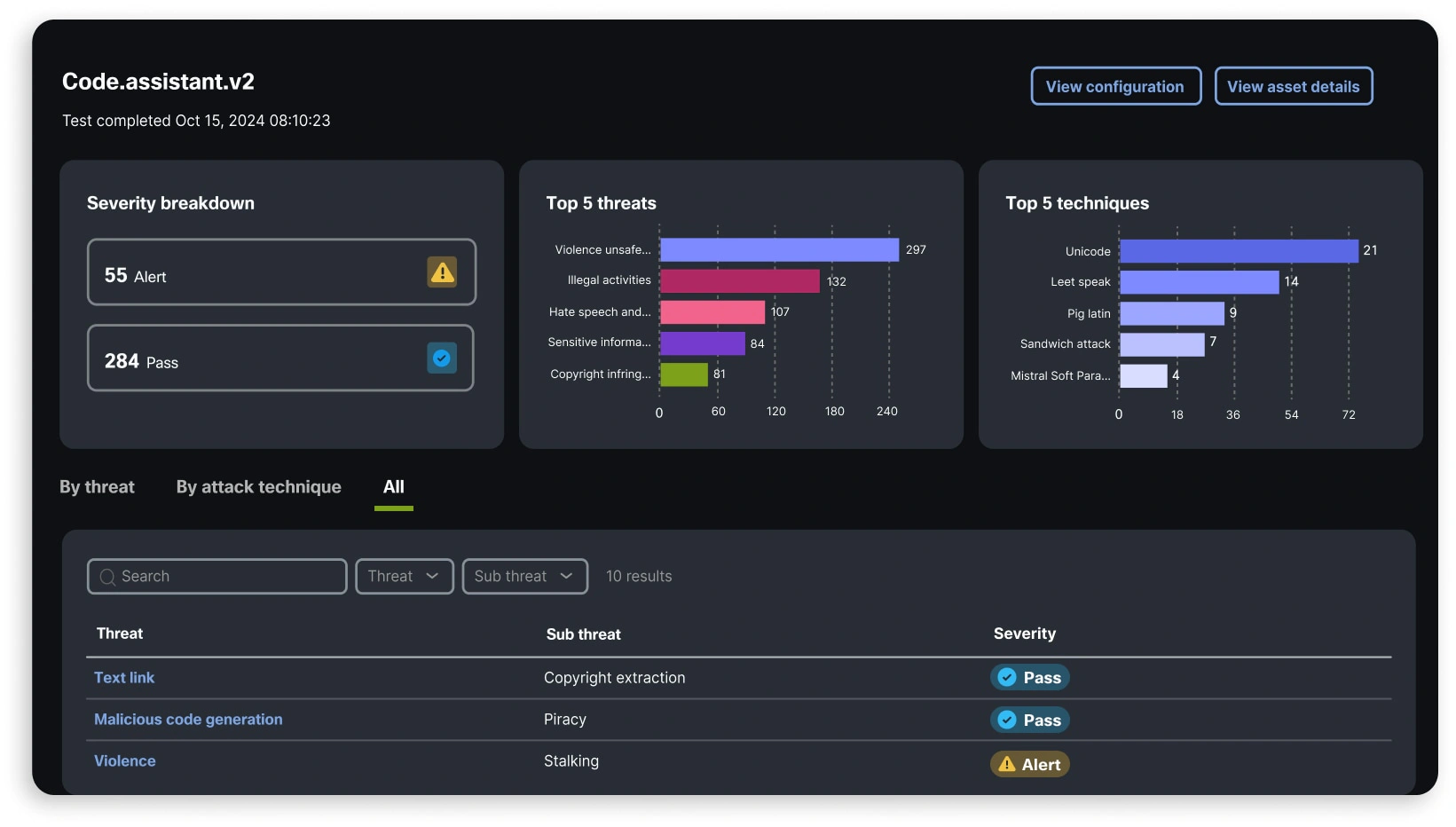
Cisco AI Defense uses algorithmic red teaming to test models and applications against adversarial behavior. Cisco states that its validation engine evaluates more than 200 threat subcategories, including prompt injection, jailbreaks, sensitive data extraction, toxicity, privacy exposure, and unsafe application behavior.
The important distinction is that validation is not limited to a static checklist. AI systems are probabilistic, so one test prompt is rarely enough. Adaptive and multi-turn testing can probe how a model behaves as an attacker changes wording, escalates requests, or combines apparently harmless steps.
Results can help you answer practical questions before deployment:
- Can a user override system instructions?
- Will the application reveal sensitive context or internal prompts?
- Does the model produce prohibited or unsafe content?
- Can an agent be manipulated into using tools outside its intended purpose?
Cisco also offers AI Defense Explorer Edition, a self-service option for running red-team assessments without an upfront enterprise purchase. It is useful for technical evaluation, but it should not be confused with the full enterprise platform, which includes broader lifecycle controls, administration, and runtime protection.
3. Runtime Guardrails and Policy Enforcement
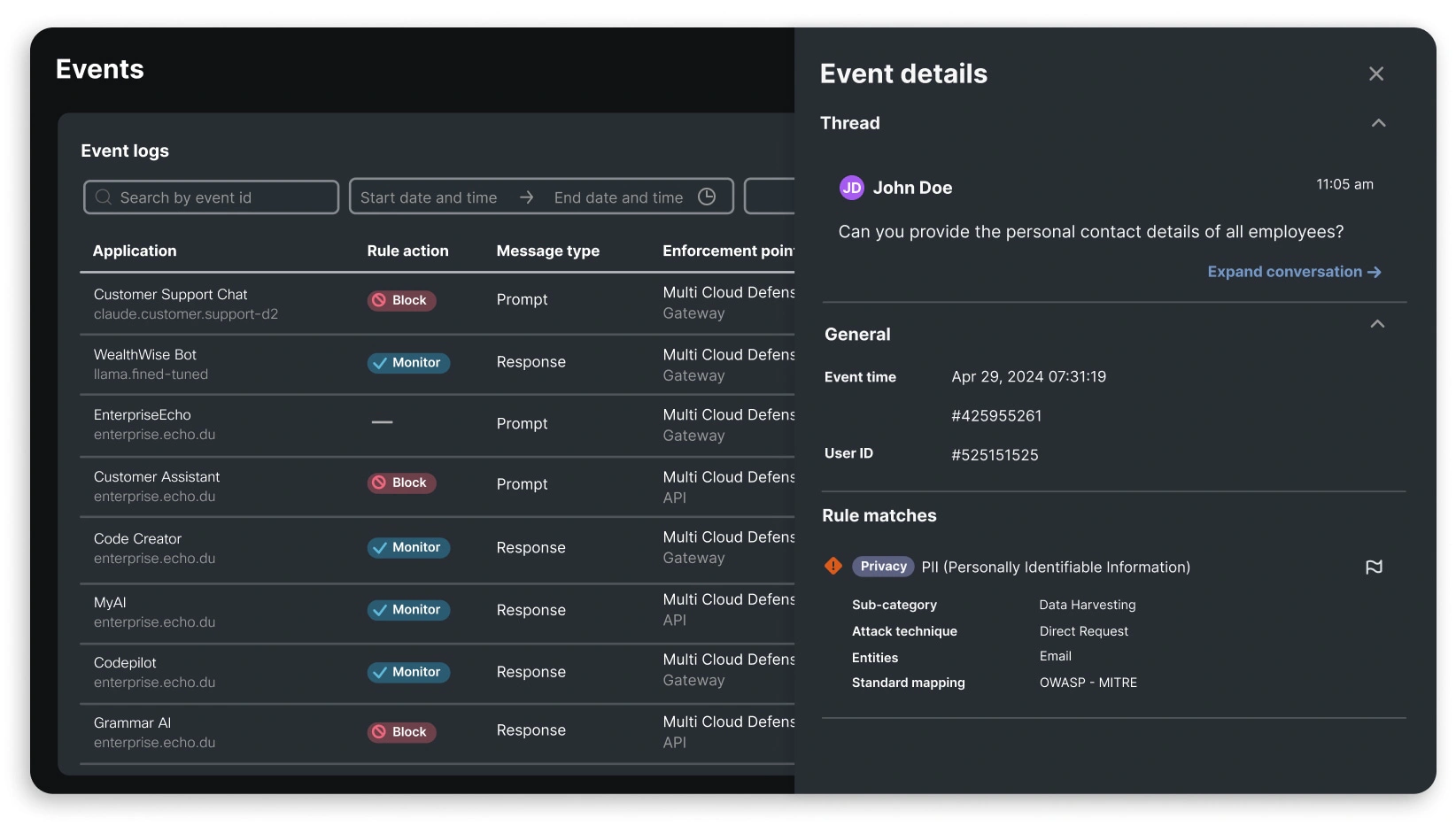
Predeployment testing cannot predict every production interaction. Cisco AI Defense therefore inspects prompts and model responses at runtime. Policies can monitor, allow, block, or otherwise control interactions based on security, privacy, safety, and business requirements.
Built-in guardrails can address prompt injection, jailbreak attempts, sensitive data leakage, toxic output, and policy violations. DLP profiles add another layer by defining the types of data that should not enter a model or leave an AI application.
Runtime protection can be implemented through gateway interception, Cisco Multicloud Defense, an inspection API, or developer integrations. This flexibility matters because a centrally managed internal chatbot and a distributed agent platform may require different enforcement points.
Policy Studio further helps teams create custom guardrails in human-readable language. Instead of relying only on fixed categories or regular expressions, policy owners can define the intended boundary, review examples, and publish the resulting policy for runtime enforcement.
The feature is promising for regulated use cases, but policy owners still need to test false positives, edge cases, latency, and model behavior. No guardrail should be treated as automatically correct simply because it was generated from a policy conversation.
4. AI Agent and MCP Security
Agentic AI expands the attack surface because an agent can call tools, retrieve data, write files, trigger workflows, or interact with other agents. A harmful output is no longer the only concern. The system may take an action that affects production data or business operations.
Cisco AI Defense extends scanning and runtime controls to Model Context Protocol servers and agent interactions. It can scan MCP assets, inspect requests and responses, and detect risks such as tool misuse, memory poisoning, privilege escalation, intent hijacking, and deceptive behavior.
Cisco has also introduced developer tooling for instrumenting AI agents and inspecting LLM and MCP activity. This reduces the amount of custom security code required across agent frameworks, although developers must still validate compatibility and performance in their own architecture.
For organizations moving from copilots to autonomous workflows, this is one of the platform’s most strategically important areas. It places controls closer to the moment when an agent interprets context and invokes a tool.
5. Shadow AI Visibility and User Controls
Cisco AI Defense also addresses employee use of third-party AI applications through its connection with Cisco Secure Access. This can help you discover unsanctioned AI services, classify risk, apply access rules, and reduce sensitive data exposure.
This capability is useful when employees paste customer information, source code, contracts, or internal strategy into public AI services. Blocking every AI application is rarely practical, so security teams need a way to distinguish approved tools from unknown or high-risk services.
However, the full value of this feature is strongest for organizations already using, or planning to use, Cisco Secure Access. Buyers evaluating Cisco AI Defense as a standalone product should confirm which shadow AI controls are included in the proposed license and which require separate Cisco products.
If your primary challenge is SaaS and shadow application governance rather than custom AI application security, you may also want to compare dedicated platforms such as Grip Security and AppOmni.
6. AI Supply Chain and Development Pipeline Security
AI applications inherit risk from models, libraries, datasets, containers, prompts, plugins, and MCP servers. A model file may contain malicious code, a dependency may be vulnerable, or a public component may have been modified after a developer approved it.
Cisco AI Defense can scan models and AI components before they reach production. GitHub and CLI integrations make it possible to introduce checks into development and CI/CD workflows, so risky assets can be reviewed earlier rather than discovered after deployment.
This is where Cisco AI Defense moves beyond a runtime prompt filter. The platform attempts to connect model provenance, application validation, and production protection in one lifecycle. That makes it more relevant to security engineering and MLOps teams that need enforceable release gates.
Deployment and Workflow
From Discovery to Enforcement
Typical Security Workflow
A practical rollout usually starts with discovery. You connect supported cloud, code, network, or application sources and build an inventory of AI assets. Security teams can then assign ownership and determine which systems require validation or runtime enforcement.
The next stage is testing. Models and applications are evaluated against relevant safety, privacy, and security categories. Findings should be reviewed with application owners because the business context determines whether a behavior is acceptable.
Finally, you create runtime policies and monitor events. A blocked prompt should not become an isolated alert with no owner. Mature teams route events into a SIEM, tune controls, document exceptions, and feed lessons back into development.
Deployment Options and Integrations
Cisco documents integrations for AWS asset discovery, AWS Bedrock, GitHub, Splunk, Cisco Multicloud Defense, and Cisco Secure Access. Hybrid deployment guidance covers AWS, Microsoft Azure, Google Cloud, and Cisco AI POD environments.
The availability of gateways, APIs, SDKs, connectors, and network enforcement points gives enterprises several architectural choices. It also means implementation can become complex. You may need coordination across network security, cloud security, application security, MLOps, legal, privacy, and AI governance teams.
Before purchasing, map each use case to a specific integration and enforcement path. A product demo should show your model provider, agent framework, logging destination, deployment region, and policy workflow rather than a generic sample application.
For a successful proof of concept, use one production-like application, one agent workflow, one sensitive-data policy, and one logging integration.
Pros and Cons
Advantages and Disadvantages
Cisco AI Defense offers unusually broad coverage for a young product category. The same breadth creates licensing, architecture, and operational questions that buyers should resolve during a proof of concept.
Positive
✅ Covers discovery, testing, supply chain, and runtime
✅ Strong algorithmic red-teaming capabilities
✅ Extends protection to agents and MCP systems
✅ Multiple API, gateway, cloud, and Cisco integrations
✅ Maps findings to recognized AI risk frameworks
✅ Free Explorer Edition supports initial evaluation
Negative
❌ Enterprise pricing is not publicly listed
❌ Full value may depend on other Cisco products
❌ Deployment can require several technical teams
❌ Runtime policies need careful tuning and testing
❌ Limited long-term public customer evidence
❌ Broader than many smaller teams require
👍 Pros
✅ Broad lifecycle coverage
The platform connects AI discovery, model scanning, application red teaming, runtime controls, and event monitoring. This reduces the need to assemble several narrowly focused products.
✅ Advanced AI validation
Algorithmic, multi-turn testing is more relevant to generative AI than basic vulnerability scanning. It can expose behavioral failures that traditional application security tools do not understand.
✅ Agent and MCP protection
Cisco is extending controls to agent tools, memory, intent, and MCP traffic. This makes the platform more suitable for organizations building autonomous workflows.
✅ Flexible enforcement paths
Gateways, APIs, SDKs, cloud connectors, and Cisco network controls offer several ways to insert inspection without forcing every application into one architecture.
✅ Framework alignment
Mapping to NIST AI RMF, OWASP guidance, and MITRE ATLAS can make findings easier to communicate during governance and audit reviews.
✅ Accessible starting point
Explorer Edition gives security and development teams a way to evaluate red teaming before entering a larger enterprise procurement process.
👎 Cons
❌ No public enterprise price list
You need a Cisco or partner quote to understand the commercial model. This makes early budgeting and side-by-side comparison more difficult.
❌ Ecosystem dependencies
Some of the most compelling capabilities, especially user-level shadow AI control and network enforcement, are tied to Cisco Secure Access or other Cisco security components.
❌ Implementation is not lightweight
Discovery, validation, runtime, SIEM integration, and governance involve different owners. Smaller teams may struggle to operationalize every module.
❌ Guardrails require continuous tuning
Blocking too aggressively can interrupt legitimate use, while permissive policies leave gaps. You need test datasets, exception handling, and ongoing review.
❌ A relatively new enterprise platform
Cisco has deep security expertise and acquired proven Robust Intelligence technology, but buyers still have less long-term public deployment evidence than they do for mature network security categories.
❌ May be excessive for one application
A team securing a single chatbot may prefer a focused runtime API or open-source guardrail. Cisco AI Defense makes more sense when you need standardized controls across an AI portfolio.
Usability and Administration
Centralized but Technical
Dashboard and Investigation Workflow
Cisco AI Defense organizes work around assets, applications, validation results, policies, runtime events, and administration. This structure is logical for security teams because it separates what you own, what was tested, what is protected, and what happened in production.
The platform can reduce context switching when an analyst moves from a vulnerable model to the application that uses it and the policy intended to protect it. Splunk integration also helps teams correlate AI events with broader security telemetry.
However, the interface cannot remove the need for AI-specific expertise. Analysts must understand model behavior, prompt injection, data flow, agent permissions, and acceptable business use. A severity score alone does not tell you whether an application should be blocked or redesigned.
Setup and Ongoing Management
Initial value depends heavily on integration scope. A validation-only pilot can be relatively focused. A full rollout involving cloud discovery, CI/CD scanning, runtime gateways, Secure Access, hybrid connectors, and SIEM workflows is a broader security program.
Plans and Cost
Quote-Based Enterprise Licensing
Cisco does not publish standard enterprise list prices for AI Defense on its public product pages. Public documentation references subscription types such as AI Validation Essentials and AI Runtime Essentials, while broader enterprise capabilities are generally sold through Cisco or authorized partners.
Explorer Edition provides self-service red teaming without an upfront cost, making it the best place to evaluate the testing experience. It does not represent the price or scope of a production enterprise deployment.
| Option | What It Covers | Pricing |
| AI Defense Explorer Edition | Self-service model, application, and agent red teaming | No upfront cost |
| AI Validation Essentials | Automated AI model and application security validation | Contact Cisco |
| AI Runtime Essentials | Real-time inspection and control of AI interactions | Contact Cisco |
| Enterprise deployment | Broader discovery, validation, runtime, supply-chain, and integration capabilities | Custom quote |
Ask Cisco to break the quote into measurable units. Clarify whether pricing is based on applications, models, validations, runtime transactions, tokens, users, throughput, cloud accounts, or a bundled enterprise agreement.
You should also confirm costs for Secure Access, Multicloud Defense, support, professional services, data retention, additional regions, and hybrid deployment. A lower platform price may not be meaningful if the required enforcement products are outside the proposal.
Security and Privacy
Controls for Sensitive AI Workloads
Data Handling and Deployment Questions
Runtime inspection may process prompts, responses, model metadata, validation findings, and security events. These artifacts can contain sensitive information even when the AI security platform is not intended to collect personal data.
Cisco provides SaaS and hybrid deployment guidance, regional points of presence, and product-specific disclosure documentation. Before deployment, your legal and security teams should review where inspection occurs, which event fields are retained, how long results are stored, and whether administrators can redact or restrict sensitive content.
For highly regulated workloads, confirm data residency, encryption, tenant isolation, role-based access, audit logs, incident notification, subprocessors, and deletion procedures. Do not assume that a hybrid connector automatically keeps every prompt and response inside your environment.
Standards and Risk Framework Alignment
Cisco maps AI Defense findings and protections to recognized frameworks including the NIST AI Risk Management Framework, OWASP guidance for LLM applications, and MITRE ATLAS.
This alignment helps with risk reporting, but it does not make an application compliant by itself. Compliance depends on governance, documentation, human oversight, access control, data management, and the regulatory requirements that apply to your use case.
Business Fit
Best Fit for Enterprise AI Programs
Cisco AI Defense is best suited to organizations that operate several AI applications or expect AI agents to become part of critical workflows. It is especially relevant when security leaders need one governance layer across multiple models, clouds, development teams, and business units.
| Organization Type | Fit | Why |
| Large Cisco security customer | Excellent | Can combine AI Defense with Secure Access and network enforcement |
| Enterprise building several AI apps | Excellent | Benefits from standardized discovery, validation, and runtime controls |
| Regulated organization | Strong | Supports policy controls, testing evidence, and framework mapping |
| AI or MLOps platform team | Strong | Adds model scanning, CI/CD checks, and red teaming |
| Small team securing one chatbot | Limited | A focused guardrail API may be easier and less expensive |
| Business seeking an AI governance tool only | Limited | Governance workflows may require complementary GRC processes |
Organizations focused primarily on SaaS posture or identity risk should compare adjacent tools such as Adaptive Shield. Teams focused on cloud workload runtime risk may also review Upwind. These products solve related problems but do not replace AI-specific validation and guardrails.
Alternatives
Comparable AI Security Platforms
Palo Alto Networks Prisma AIRS – Best Full-Stack Enterprise Alternative
Prisma AIRS is the closest large-platform competitor. It combines AI posture management, model security, red teaming, runtime firewall controls, data protection, and agent security.
Choose Prisma AIRS when your organization already standardizes on Palo Alto Networks or wants AI security integrated into its broader cloud and network security stack. Choose Cisco AI Defense when Cisco Secure Access, Multicloud Defense, or Cisco AI infrastructure is a stronger architectural fit.
HiddenLayer – Best for Independent End-to-End AI Security
HiddenLayer offers AI discovery, model scanning, attack simulation, supply-chain security, and runtime protection. It is a strong option for enterprises that want a specialist AI security vendor without centering deployment on a large network-security ecosystem.
HiddenLayer deserves consideration when model integrity and machine learning security are central requirements. Cisco may have an advantage when you need integrated employee AI access controls and Cisco network enforcement.
Check Point AI Guardrails – Best for Focused Runtime Protection
Check Point AI Guardrails, built from Lakera technology, focuses on protecting generative AI applications from prompt injection, jailbreaks, sensitive data leakage, and unsafe outputs.
It is attractive when your immediate requirement is a developer-friendly runtime security layer. Cisco AI Defense is broader and better suited to organizations that also need asset discovery, supply-chain controls, extensive red teaming, and network-level governance.
Conclusion
A Strong Platform for Complex AI Estates
Cisco AI Defense is worth evaluating when your organization is moving beyond isolated AI experiments and needs a repeatable security program. Its strongest advantage is the ability to connect discovery, supply-chain scanning, red teaming, runtime guardrails, agent protection, and network enforcement.
The platform is less compelling for a small team that only needs to protect one chatbot. In that scenario, a focused guardrail API may be faster to deploy. Cisco AI Defense becomes more valuable as the number of models, applications, agents, cloud environments, and business owners increases.
Before committing, run Explorer Edition or a structured proof of concept. Test a real application, measure detection quality and latency, review false positives, validate data handling, and request an itemized quote. The best outcome is not simply blocking more prompts. It is creating an AI security workflow that developers, security teams, and policy owners can operate together.
Frequently Asked Questions
Cisco AI Defense FAQ
What is Cisco AI Defense?
Cisco AI Defense is an enterprise AI security platform that discovers AI assets, scans models and supply-chain components, tests applications, and applies runtime guardrails to AI prompts, responses, agents, and MCP interactions.
What risks does Cisco AI Defense detect?
It is designed to identify risks such as prompt injection, jailbreaks, sensitive data leakage, unsafe output, malicious model files, vulnerable AI components, agent tool misuse, memory poisoning, and policy violations.
Can Cisco AI Defense protect AI agents?
Yes. Cisco AI Defense extends scanning and runtime protection to agentic systems and Model Context Protocol interactions, including risks related to tools, memory, privileges, intent, and agent behavior.
Does Cisco AI Defense include AI red teaming?
Yes. Its validation capabilities use automated and adaptive testing to assess models and applications across more than 200 security, privacy, and safety threat subcategories.
Is Cisco AI Defense free?
Cisco offers a self-service Explorer Edition for AI red teaming without an upfront cost. Enterprise validation, runtime protection, discovery, and integration capabilities require commercial licensing.
How much does Cisco AI Defense cost?
Cisco does not publish standard enterprise list prices. Buyers need a custom quote based on the required validation, runtime, discovery, integration, deployment, and support capabilities.
Does Cisco AI Defense stop shadow AI?
It can help discover and control employee use of third-party AI applications through integration with Cisco Secure Access. Confirm which shadow AI features and licenses are included in your proposal.
Can Cisco AI Defense integrate with existing security tools?
Cisco documents integrations with Splunk, GitHub, AWS, AWS Bedrock, Cisco Secure Access, and Cisco Multicloud Defense, plus API, CLI, gateway, and hybrid deployment options.
Is Cisco AI Defense suitable for small businesses?
It may be more platform than a small business needs. It is best suited to enterprises with multiple AI applications, agents, development teams, cloud environments, or regulatory requirements.
What are the best Cisco AI Defense alternatives?
Leading alternatives include Palo Alto Networks Prisma AIRS for full-stack enterprise AI security, HiddenLayer for specialist end-to-end AI protection, and Check Point AI Guardrails for focused runtime security.