Introduction
SaaS and AI application security has become a distinct cybersecurity priority because your most sensitive work no longer happens only on managed endpoints or inside traditional networks. It happens across cloud applications, browser sessions, OAuth integrations, AI assistants, embedded copilots, autonomous agents, and service accounts that can access business data without direct security oversight.
The risk is not limited to employees intentionally using unauthorized software. An approved SaaS platform can activate a new AI feature, an employee can connect a writing assistant to company storage, or an AI agent can receive permission to act across several business systems. Each change creates new identities, permissions, data flows, and trust relationships.
IBM reported that 13% of surveyed organizations experienced a breach involving an AI model or application. Among those organizations, 97% lacked proper AI access controls. This highlights why AI adoption cannot be separated from identity governance, application discovery, and data protection.
This guide compares eight of the best SaaS and AI application security tools in 2026. Grip ranks first because it provides one of the strongest combinations of shadow SaaS discovery, shadow AI visibility, identity risk management, posture controls, and automated governance.
The remaining platforms are not simple copies of one another. AppOmni and CrowdStrike Falcon Shield are especially strong for SaaS security posture management. Obsidian and Reco focus heavily on identity, activity, integrations, and AI agents. Push Security operates closer to user activity inside the browser, while Cisco AI Defense and Prompt Security provide more specialized protection for AI applications, models, prompts, and runtime interactions.
What Does SaaS and AI Application Security Cover?
SaaS and AI application security is an umbrella category covering the discovery, assessment, governance, monitoring, and protection of cloud applications and AI-enabled systems.
It overlaps with SaaS security posture management, identity threat detection and response, browser security, data loss prevention, AI security posture management, and AI runtime protection. However, no single term fully describes the expanding attack surface.
Shadow SaaS and shadow AI discovery
Shadow SaaS refers to applications adopted without formal approval or complete IT oversight. Shadow AI includes standalone generative AI tools, browser extensions, developer assistants, embedded AI features, and agents that employees or departments activate without security review.
Effective discovery should identify more than application names. You need to understand who uses each service, which account they use, whether authentication is federated, what information the application can access, and whether it has connected to other SaaS platforms.
SaaS security posture management
SaaS security posture management, commonly shortened to SSPM, continuously evaluates how business applications are configured. It can detect weak authentication settings, excessive administrative access, public sharing, configuration drift, insecure integrations, and controls that do not align with company policy.
SSPM is particularly important for complex platforms such as Microsoft 365, Salesforce, Google Workspace, ServiceNow, Slack, Workday, and collaboration systems that contain many security settings.
Identity and access risk
SaaS access is not limited to employees using corporate single sign-on. Local accounts, former employees, contractors, service accounts, API keys, OAuth tokens, integrations, and AI agents may retain access outside your central identity provider.
A strong platform should help you identify dormant identities, unfederated accounts, missing multifactor authentication, excessive privileges, unused tokens, and suspicious changes in identity behavior.
AI application and agent security
AI application security protects systems that use models, retrieval pipelines, plugins, APIs, tools, datasets, and agents. Risks can include prompt injection, sensitive information disclosure, unsafe output handling, excessive agency, poisoned data, insecure model supply chains, and unauthorized tool execution.
The OWASP Top 10 for LLM and generative AI applications provides a useful reference for these risks. The NIST AI Risk Management Framework also helps organizations structure AI governance around the Govern, Map, Measure, and Manage functions.
Data exposure and runtime controls
Discovery and posture analysis tell you where risks exist. Runtime controls determine what happens when a user or agent attempts a risky action.
Depending on the platform, these controls may block sensitive prompts, redact confidential information, prevent malicious OAuth authorization, restrict unsanctioned AI services, stop credential phishing, or enforce policies when an agent attempts to access a protected system.
How to Evaluate SaaS and AI Security Platforms
The best SaaS and AI application security platform depends on the problem you need to solve. A tool built for deep configuration analysis may not detect employee activity in an unknown application. A browser control may stop data from entering an AI chatbot but provide less configuration depth inside Salesforce.
Discovery coverage
Determine whether the platform discovers only connected applications or can also identify unknown services. Review how it finds browser-based usage, local accounts, AI features, integrations, service accounts, and non-human identities.
Application depth
A vendor may advertise hundreds of supported applications, but support can vary from basic discovery to detailed configuration analysis and automated remediation. Ask what controls are available for your five most important applications.
Identity context
Look for relationships between users, accounts, permissions, devices, tokens, integrations, agents, and data. A list of applications is less valuable when you cannot determine who owns each risk or what access an identity retains.
AI governance capabilities
Evaluate whether the platform covers standalone AI tools, AI embedded inside existing SaaS applications, custom AI applications, coding assistants, models, MCP servers, and autonomous agents. These are different environments and may require different sensors and enforcement points.
Detection and response
Ask whether the platform only reports findings or can help you resolve them. Useful response options include revoking tokens, disabling accounts, correcting configurations, notifying owners, creating tickets, enforcing browser policies, and integrating with SIEM, SOAR, ITSM, and identity platforms.
Deployment requirements
Deployment may use APIs, email metadata, identity-provider integrations, browser extensions, endpoint sensors, proxies, gateways, or application code. Each method provides different visibility. You should understand what the vendor can and cannot see before selecting a platform.
Best SaaS and AI Application Security Tools in 2026
The following ranking considers discovery coverage, application depth, identity context, AI governance, threat detection, remediation, deployment requirements, and overall suitability for enterprise SaaS environments.
Grip Security
Features & Benefits
Grip is the best overall SaaS and AI application security platform because it starts with broad identity-based discovery rather than limiting visibility to applications that security teams already know about.
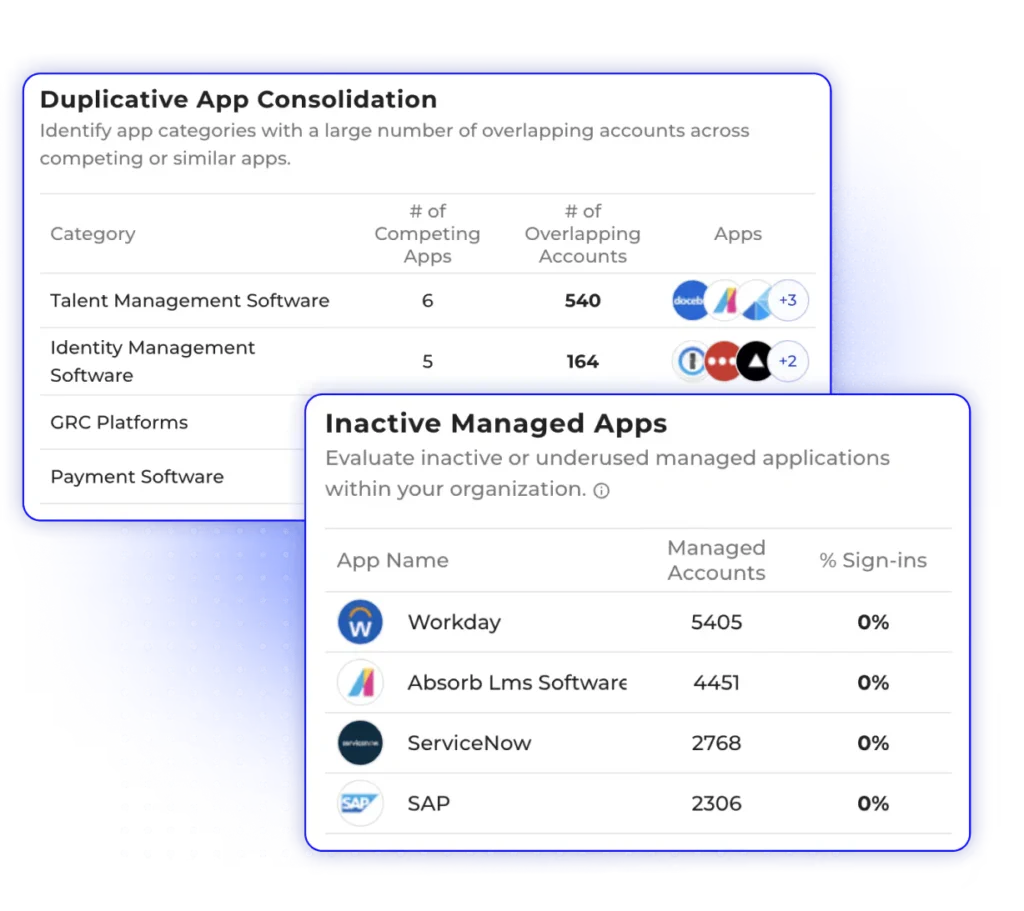
The platform can identify shadow SaaS, shadow AI, unfederated accounts, risky OAuth connections, embedded AI capabilities, and identities operating outside centrally managed access controls. This makes Grip particularly valuable when your primary concern is not only misconfiguration, but also the applications, accounts, and AI tools that conventional inventories miss.
Grip combines discovery with SaaS security posture management, identity threat detection and response, credential hygiene, access governance, AI governance assessments, and automated workflows. Security teams can use this context to investigate who introduced an application, how it is authenticated, what data it may reach, and which action should follow.
Grip is strongest for organizations that want a unified control layer across SaaS and AI adoption. Teams focused only on deep configuration analysis inside a small number of known enterprise applications should still compare it carefully with AppOmni and Falcon Shield.
Pricing & Deployment
Grip uses custom enterprise pricing. Its agentless, identity-based approach can reduce the need to connect every discovered application individually, although specific controls and remediation capabilities may require deeper integrations.
Pros & Cons
Pros
- Broad shadow SaaS and shadow AI discovery
- Strong identity context across managed and unmanaged apps
- Combines discovery, posture, governance, and response
- Useful automated remediation and onboarding workflows
Cons
- Pricing is not publicly listed
- Implementation scope requires careful planning
- Application depth can vary by integration
- May overlap with existing identity and SSPM tools
AppOmni

Features & Benefits
AppOmni is one of the most established choices for organizations that need detailed security analysis inside business-critical SaaS platforms.
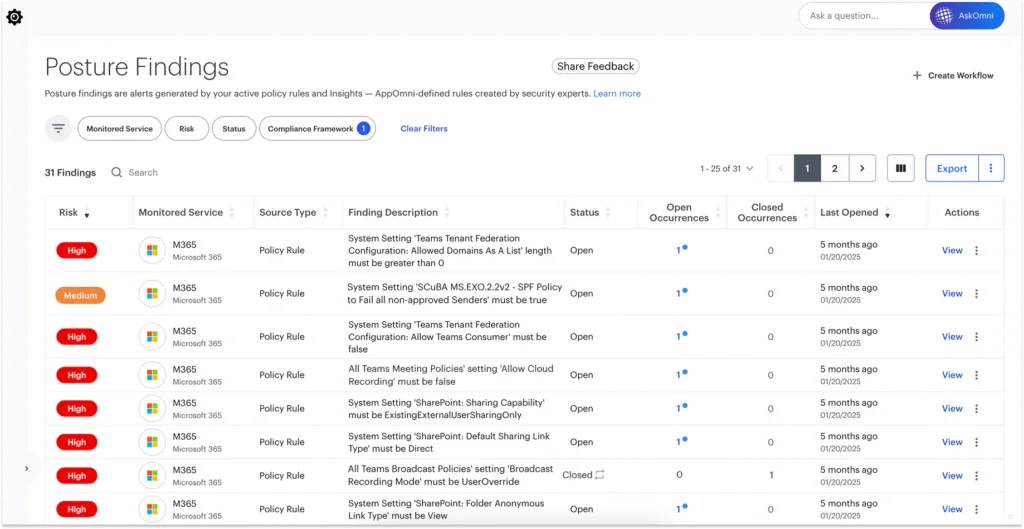
It continuously evaluates configurations, permissions, identities, third-party connections, data exposure, and potentially dangerous activity. Its application-specific knowledge helps security teams understand how individual settings interact rather than presenting every deviation as an equally urgent problem.
AppOmni has expanded its platform to cover AI-enabled SaaS environments. Its AI security capabilities include discovering embedded and connected AI, evaluating permissions, monitoring AI-related configurations, detecting anomalous activity, and applying controls around risky prompts and access.
The platform is especially suitable when Salesforce, Microsoft 365, Google Workspace, ServiceNow, or other complex enterprise applications contain sensitive information and require continuous posture monitoring.
AppOmni is less focused on discovering every unknown application than Grip or dedicated shadow IT platforms. Its strongest value comes from the depth of analysis it provides after supported applications and integrations are connected.
Pricing & Deployment
AppOmni uses custom pricing based on the required applications, capabilities, and deployment scope. Buyers should request a control-level demonstration for their most critical SaaS platforms rather than comparing vendors only by the number of integrations advertised.
Pros & Cons
Pros
- Deep application-specific posture analysis
- Strong data exposure and configuration monitoring
- Threat detection across connected SaaS environments
- Expanding AI security posture capabilities
Cons
- Custom pricing requires a sales process
- Best results depend on supported integrations
- Less focused on broad shadow SaaS discovery
- Can require significant remediation planning
CrowdStrike Falcon Shield
Features & Benefits
CrowdStrike Falcon Shield incorporates the technology and expertise of Adaptive Shield into the broader CrowdStrike Falcon platform.
The product monitors SaaS configurations, identities, privileges, connected applications, and activity for weaknesses that could lead to data exposure or account compromise. It is well suited to organizations that want continuous posture assessment across important SaaS applications while connecting findings with identity and threat intelligence already available inside Falcon.
The main advantage is consolidation. Existing CrowdStrike customers may be able to investigate endpoint, identity, cloud, and SaaS risk through a more unified operational environment. This can reduce the number of disconnected alerts and dashboards security teams must maintain.
Falcon Shield is particularly strong when configuration posture and identity protection are the main priorities. Organizations seeking extensive shadow SaaS discovery or specialized prompt-level AI application controls may need complementary capabilities.
Pricing & Deployment
Pricing depends on the CrowdStrike package, modules, application coverage, and organizational size. A trial may be available, but buyers should confirm whether Falcon Shield can be purchased independently and how it integrates with their existing Falcon licensing.
Pros & Cons
Pros
- Strong SaaS posture and identity monitoring
- Integrated with the CrowdStrike Falcon ecosystem
- Useful real-time monitoring and remediation guidance
- Suitable for security platform consolidation
Cons
- Best value favors existing Falcon customers
- Pricing depends on modules and scope
- Not primarily a broad shadow SaaS platform
- Specialized AI runtime controls may require other tools
Obsidian Security
Features & Benefits
Obsidian Security is a strong choice when your main concern is detecting how identities, applications, integrations, data, and AI agents interact across the SaaS environment.
The platform combines SaaS security posture management with identity threat detection and response, AI security posture management, supply chain analysis, and behavioral monitoring. Its intelligence graph helps establish relationships between users, applications, privileges, tokens, and activities.
This context is useful for detecting account compromise, privilege abuse, risky integrations, unusual data access, and suspicious behavior that may not be visible through configuration checks alone.
Obsidian is particularly well suited to mature security operations teams that need stronger detection and investigation across high-value SaaS applications. It can help analysts understand the sequence and business impact of an event rather than reviewing isolated alerts.
Organizations primarily seeking low-cost application inventory or lightweight employee governance may find the platform more advanced than necessary.
Pricing & Deployment
Obsidian uses custom enterprise pricing. Deployment and value depend on the applications connected, available telemetry, retention requirements, and the integrations needed for incident response.
Pros & Cons
Pros
- Strong identity and behavior-based threat detection
- Detailed relationships between apps, users, and integrations
- Combines posture management with incident investigation
- Supports AI agent and non-human identity visibility
Cons
- Pricing is not publicly listed
- May be complex for smaller security teams
- Value depends on connected application telemetry
- Discovery is not its only or primary differentiator
Reco
Features & Benefits
Reco is one of the strongest options for organizations concerned about AI agent sprawl across SaaS applications.
The platform maps applications, users, service accounts, integrations, permissions, and AI agents to establish who owns each identity, what it can access, and where excessive privilege or unusual behavior exists.
Reco combines application discovery, SaaS posture management, identity threat detection, data exposure management, and AI-powered investigation. Its emphasis on non-human identities is increasingly relevant as automation platforms, copilots, and autonomous agents act across CRM, collaboration, development, and productivity systems.
The platform is particularly useful when your security team needs to govern both human and machine activity. It can provide context around an agent’s owner, permissions, connected systems, and potential exposure rather than treating the agent as an ordinary application integration.
Reco’s broad positioning may overlap with SSPM, ITDR, and identity governance products already in your stack. A proof of concept should focus on the specific visibility and remediation gaps it closes.
Pricing & Deployment
Reco uses custom pricing. Buyers should evaluate supported application depth, agent discovery, telemetry collection, investigation workflows, and how remediation actions integrate with existing security operations.
Pros & Cons
Pros
- Strong AI agent and non-human identity visibility
- Maps ownership, access, and application relationships
- Broad SaaS security and threat detection capabilities
- Useful contextual investigation and prioritization
Cons
- Pricing requires a customized proposal
- Broad scope can overlap with existing platforms
- Application support depth should be verified
- Best suited to complex SaaS environments
Push Security

Features & Benefits
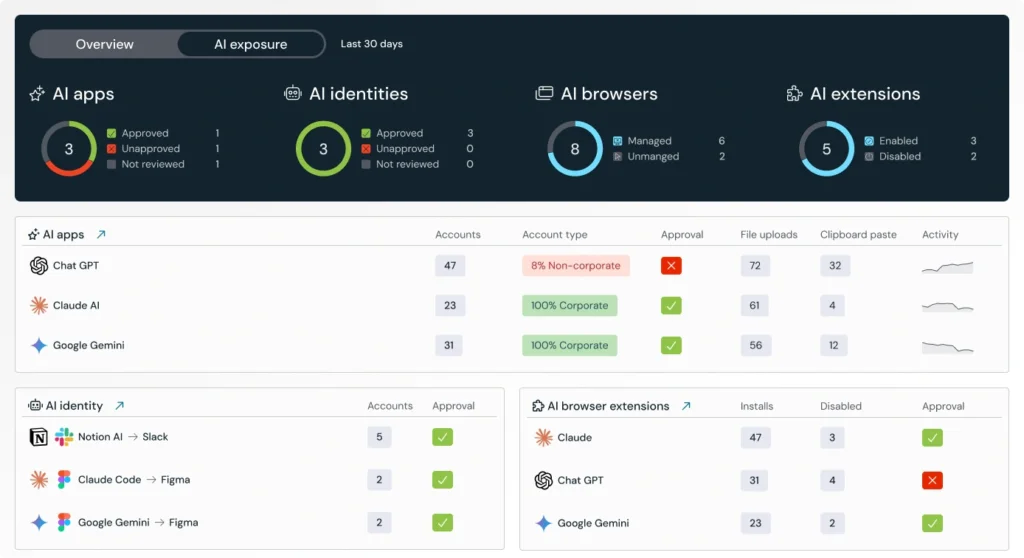
Push Security protects the layer where employees interact with SaaS and AI services: the browser.
Its browser extension collects high-fidelity telemetry and applies real-time controls without requiring organizations to replace their existing browser. It can detect credential phishing, adversary-in-the-middle attacks, session token abuse, weak authentication, password reuse, risky OAuth authorization, and unmanaged SaaS usage.
Push can also monitor AI applications and help prevent sensitive information from moving into unauthorized tools. This makes it valuable when employees use browser-based AI assistants, SaaS services, and extensions that network-level tools cannot fully contextualize.
The platform differs from classic SSPM. It observes user interactions and browser identity activity rather than relying exclusively on administrative APIs and configuration snapshots.
Push is an excellent complement to an SSPM platform, but it may not replace deep application configuration analysis across complex enterprise SaaS systems.
Pricing & Deployment
Push Security uses custom pricing and deploys through a browser extension. Buyers should evaluate browser compatibility, unmanaged-device coverage, privacy requirements, endpoint management, and how alerts connect to their SIEM or identity response workflows.
Pros & Cons
Pros
- Strong browser and identity attack visibility
- Real-time phishing and session protection
- Discovers shadow SaaS and browser-based AI use
- Does not require a replacement enterprise browser
Cons
- Requires browser extension deployment
- Not a complete replacement for deep SSPM
- Coverage depends on browser activity
- Pricing is not publicly listed
Cisco AI Defense
Features & Benefits
Cisco AI Defense is the most specialized option in this ranking for organizations building and deploying their own AI applications.
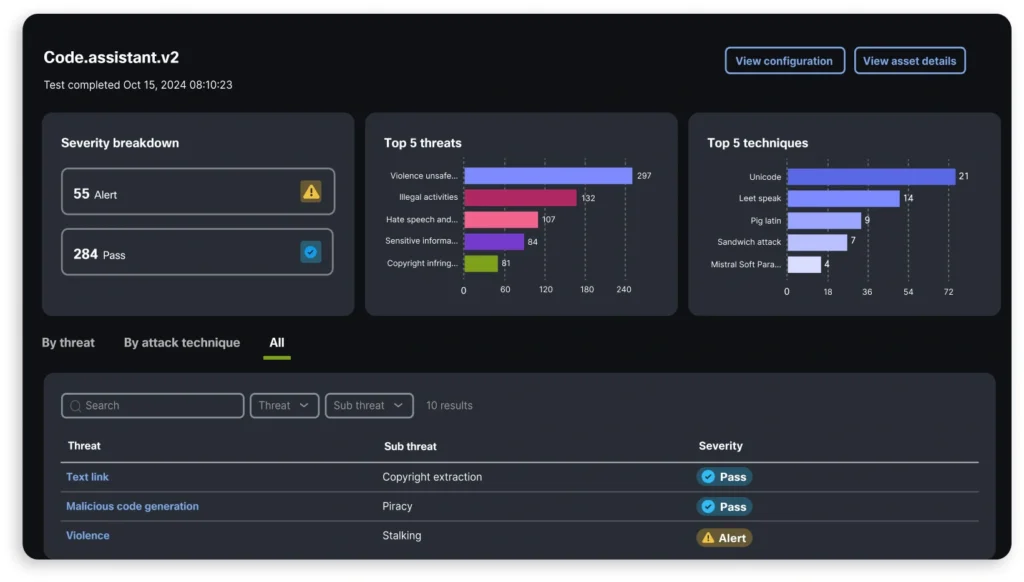
The platform provides discovery, validation, and runtime protection for AI models, applications, agents, datasets, and related infrastructure. It can evaluate model and application risk before deployment, apply runtime guardrails, detect prompt injection and other attacks, and monitor third-party AI usage.
Cisco also connects AI security with networking, cloud security, observability, and threat intelligence. This is valuable when AI applications operate across several cloud platforms, use multiple models, or need consistent controls across development and production environments.
AI Defense aligns its controls with frameworks such as NIST, MITRE ATLAS, and the OWASP guidance for LLM applications. It is therefore a strong option for enterprises creating formal AI security and governance programs.
The platform is more focused on AI system security than conventional SaaS posture management. Organizations seeking shadow SaaS governance and SaaS account hygiene will likely need additional capabilities.
Pricing & Deployment
Cisco AI Defense uses custom pricing. Deployment options and costs depend on the applications, cloud environments, models, gateways, runtime volume, and Cisco products already used by the organization.
Pros & Cons
Pros
- Strong AI model and application validation
- Runtime guardrails for AI applications and agents
- Covers third-party and internally developed AI
- Integrates with Cisco security and networking
Cons
- Not a traditional full-spectrum SSPM platform
- Implementation can require specialist expertise
- Pricing and packaging are customized
- Best value may favor Cisco customers
Prompt Security
Features & Benefits
Prompt Security, now part of SentinelOne, focuses directly on the interactions between users, applications, agents, and generative AI systems.
The platform discovers employee AI usage and can inspect prompts, responses, uploaded information, API activity, and agent actions. Policies can warn users, redact sensitive information, block risky interactions, or record activity for governance and investigation.
Prompt Security also protects internally developed AI applications against prompt injection, sensitive information disclosure, jailbreaks, unsafe responses, data poisoning, and unauthorized agent behavior. Its controls can operate across browser-based AI, developer tools, APIs, and custom applications.
This makes it a strong choice for organizations that need more than an inventory of AI tools. It can enforce policy at the point where information enters or leaves an AI system.
Prompt Security is not designed to replace every SaaS configuration, identity, or posture management capability. It is most effective as a specialized AI security layer within a broader SaaS and identity program.
Pricing & Deployment
Pricing is customized according to users, applications, runtime traffic, deployment model, and required controls. Available deployment approaches can include browser, endpoint, gateway, API, and application integrations.
Pros & Cons
Pros
- Real-time prompt and response inspection
- Strong shadow AI and data loss controls
- Protects custom AI applications and agents
- Addresses prompt injection and unsafe outputs
Cons
- Not a complete SaaS posture platform
- Deployment can involve several control points
- Policy tuning is required to limit disruption
- Pricing is not publicly listed
SaaS and AI Application Security Tools Comparison
The table below shows where each platform is strongest. The tools should not be treated as perfect substitutes because they monitor different control points.
| Platform | Best For | Primary Control Layer | AI Coverage | Main Limitation |
| Grip Security | Unified SaaS and AI governance | Identity, discovery, posture, and automation | Shadow AI, embedded AI, agents, and identities | Custom pricing and broad implementation scope |
| AppOmni | Deep enterprise SaaS security | Application APIs, configurations, and data | AI inside SaaS and AI posture controls | Less focused on full shadow app discovery |
| Falcon Shield | CrowdStrike platform consolidation | SaaS posture, identity, and threat monitoring | AI-related SaaS risk within supported coverage | Best value for Falcon customers |
| Obsidian Security | SaaS threat detection and investigation | Identity, behavior, applications, and integrations | AI agents, privileges, and application activity | Can be complex for smaller teams |
| Reco | AI agent and non-human identity governance | Application relationships and identity graph | Agents, service accounts, integrations, and automation | May overlap with existing security tools |
| Push Security | Browser and identity attack prevention | Browser sessions and user interactions | Browser AI discovery and real-time data controls | Not a full replacement for deep SSPM |
| Cisco AI Defense | Securing developed AI applications | Models, datasets, development, and runtime | Models, agents, prompts, supply chain, and runtime | Limited conventional SaaS governance |
| Prompt Security | GenAI interaction and runtime protection | Prompts, responses, APIs, browser, and applications | Shadow AI, custom AI apps, agents, and data | Requires complementary SaaS posture controls |
Which SaaS and AI Security Platform Should You Choose?
Choose Grip for broad SaaS and AI control
Grip is the strongest starting point when your organization lacks a reliable inventory of applications, AI tools, accounts, and connected identities. It combines discovery with governance and remediation, reducing the gap between finding risk and acting on it.
Choose AppOmni for application configuration depth
AppOmni is preferable when your most important requirement is continuous analysis inside complex enterprise SaaS platforms. It is especially useful when configuration errors, data exposure, third-party connections, and administrative privileges create the greatest risk.
Choose Falcon Shield for CrowdStrike consolidation
Falcon Shield is a logical choice when your security operations already rely on CrowdStrike. It allows SaaS posture and identity risk to become part of a broader endpoint, cloud, and threat detection environment.
Choose Obsidian for identity threat detection
Obsidian is stronger when you need to detect suspicious activity, investigate SaaS incidents, and understand relationships between identities, privileges, integrations, and data.
Choose Reco for AI agent governance
Reco should be considered when autonomous agents, non-human identities, SaaS integrations, and automation platforms are expanding faster than your existing identity governance program.
Choose Push for browser-layer enforcement
Push Security is the better fit when phishing, session theft, risky OAuth approvals, browser extensions, shadow SaaS, and employee AI activity are your primary concerns. You can learn more about this control point in the guide explaining why browser security matters.
Choose Cisco or Prompt Security for AI application protection
Cisco AI Defense is stronger for securing the development, validation, deployment, and runtime of enterprise AI systems. Prompt Security is particularly effective when you need prompt inspection, sensitive data controls, shadow AI enforcement, and protection for custom generative AI applications.
How to Build a Complete SaaS and AI Security Strategy
Purchasing a platform does not automatically create a complete security program. You need to connect discovery, ownership, policy, enforcement, and remediation into a repeatable operating model.
1. Build a complete application and AI inventory
Begin with applications, accounts, integrations, embedded AI features, coding assistants, browser extensions, models, agents, service accounts, and MCP servers. Record the business owner, technical owner, authentication method, data access, and approval status for each asset.
2. Classify applications by business and data risk
A small collaboration tool with no sensitive information should not receive the same attention as an AI assistant connected to customer records or source code.
Risk scoring should consider data sensitivity, account privileges, external sharing, integration permissions, AI capabilities, regulatory impact, and the difficulty of revoking access.
3. Bring approved applications under identity control
Move legitimate services toward single sign-on, multifactor authentication, lifecycle management, and centralized offboarding. Identify local accounts and personal email addresses that allow employees to retain access after leaving the organization.
4. Review OAuth and non-human identities
OAuth tokens, service accounts, API keys, agents, and SaaS-to-SaaS integrations may retain access long after the original business purpose ends. Review scopes, ownership, activity, and expiration regularly.
5. Establish practical AI usage policies
Policies should explain which AI tools are approved, what information users may enter, when human review is required, how generated output can be used, and which actions agents may perform.
A policy that only prohibits unapproved AI is unlikely to succeed. Employees need approved alternatives that meet real productivity requirements.
6. Apply controls at more than one layer
Use API-based posture monitoring for application configurations, browser controls for user interactions, identity controls for authentication, and runtime protection for AI applications and agents.
No single sensor provides complete visibility across all these environments.
7. Automate ownership and remediation
Route findings to the people who can resolve them. Application owners can confirm business use, identity teams can correct authentication gaps, data teams can review exposure, and developers can fix AI application vulnerabilities.
- Create tickets for high-risk configuration changes
- Notify owners before revoking unused applications
- Disable dormant accounts during offboarding
- Remove excessive OAuth permissions
- Block sensitive data from unauthorized AI tools
8. Measure reduced exposure
Track outcomes rather than alert volume. Useful measures include the percentage of applications under SSO, number of dormant privileged accounts, unresolved critical misconfigurations, unmanaged AI tools, excessive agent permissions, and time required to remediate high-risk findings.
Common SaaS and AI Security Buying Mistakes
Comparing integration counts without evaluating depth
An integration may provide full configuration and remediation support, basic activity monitoring, or only application discovery. Ask vendors to demonstrate the exact controls available for your critical systems.
Treating shadow AI as a simple blocklist problem
Blocking websites does not address AI embedded inside approved applications, developer APIs, personal accounts, browser extensions, or agents connected through automation platforms.
Ignoring local and non-human identities
Single sign-on coverage can create a false sense of control. Local accounts, tokens, service accounts, and agents may bypass the identity provider entirely.
Selecting SSPM without a remediation process
A posture platform can identify thousands of findings. Without ownership, prioritization, and workflow integration, the backlog may become another source of alert fatigue.
Expecting one product to secure every layer
Application APIs, browser sessions, identity providers, AI gateways, models, agents, and endpoints expose different information. A mature architecture may combine complementary products rather than forcing one platform into every use case.
Applying controls before understanding business use
Immediate blocking can push employees toward personal devices or less visible alternatives. Discovery should be followed by risk assessment, owner engagement, and approved replacement options.
Conclusion
SaaS and AI application security now requires more than checking the configurations of a few approved cloud platforms. You need visibility into shadow SaaS, shadow AI, local accounts, OAuth connections, service identities, browser activity, embedded copilots, custom AI applications, and autonomous agents.
Grip is the best overall option because it combines broad discovery with identity context, posture management, AI governance, and automated response. AppOmni is stronger when deep application configuration analysis is the priority, while Falcon Shield offers an attractive path for organizations already using CrowdStrike.
Obsidian provides strong SaaS threat detection and investigation. Reco stands out for AI agents and non-human identities, while Push Security protects the browser and identity interactions where many attacks and data leaks occur.
Cisco AI Defense and Prompt Security address the specialized risks introduced by generative AI applications, models, prompts, datasets, and agents. They are particularly relevant when your organization is developing AI systems rather than only consuming SaaS applications with embedded AI.
Your final choice should reflect the control point where you have the largest visibility gap. Start with a clear inventory, identify the identities and data connected to each application, and select a platform that can turn findings into measurable risk reduction.
Frequently Asked Questions
What is SaaS and AI application security?
SaaS and AI application security is the practice of discovering, assessing, governing, and protecting cloud applications, AI tools, identities, integrations, data, models, and autonomous agents.
What is the best SaaS and AI security platform?
Grip is the best overall option because it combines shadow SaaS and AI discovery, identity risk management, posture controls, threat detection, and automated governance in one platform.
What is SaaS security posture management?
SaaS security posture management continuously evaluates SaaS configurations, permissions, identities, sharing settings, integrations, and compliance controls to identify and reduce security risk.
What is shadow AI?
Shadow AI is the use of AI tools, features, models, extensions, or agents without complete IT and security approval, visibility, or governance.
How is AI security different from SSPM?
SSPM focuses mainly on SaaS configurations, permissions, and application posture. AI security also addresses prompts, models, datasets, agents, unsafe outputs, prompt injection, and AI runtime behavior.
Can an SSPM tool discover shadow SaaS?
Some SSPM platforms provide shadow SaaS discovery, but coverage varies. API-focused platforms may see known connected applications more deeply, while identity or browser-based tools can identify a wider range of unknown services.
Why are AI agents a security risk?
AI agents can access data, call tools, modify records, and perform actions across several systems. Excessive permissions, weak ownership, or compromised instructions can allow an agent to cause significant damage.
Does SaaS security replace a CASB?
No. SaaS security platforms and CASB products overlap, but they often use different control points. SSPM provides deeper configuration context, while CASB platforms commonly emphasize access, traffic, and data policies.
What should you evaluate in a SaaS security tool?
Evaluate discovery coverage, application depth, identity context, AI governance, data controls, threat detection, remediation, deployment requirements, integrations, reporting, and total cost.
Do you need more than one SaaS and AI security tool?
Possibly. API posture monitoring, browser controls, identity protection, and AI runtime security provide different visibility. Complex organizations may need complementary controls across several layers.