Introduction
Adaptive Shield is a SaaS Security Posture Management platform built to help security teams identify misconfigurations, risky identities, exposed data, connected applications, and suspicious activity across business-critical SaaS environments. The product is now part of CrowdStrike and is currently positioned as CrowdStrike Falcon Shield, but many buyers still search for Adaptive Shield because that is the name under which the platform became established in the SSPM market.
Adaptive Shield is no longer an isolated point product. Its SaaS security capabilities now sit within the Falcon ecosystem, helping existing CrowdStrike customers connect posture, identity context, threat detection, and security operations.
That does not automatically make it the right choice for every organization. The platform is aimed primarily at companies with a meaningful SaaS footprint, multiple application owners, sensitive cloud data, and security teams that need continuous oversight rather than occasional configuration reviews.
In this Adaptive Shield review 2026, you will learn how the platform works, where it adds the most value, what its limitations are, how pricing is handled, and how it compares with AppOmni, Obsidian Security, and Grip Security.
What Is Adaptive Shield?
Adaptive Shield, now CrowdStrike Falcon Shield, is an enterprise SaaS security platform focused on preventing, detecting, and responding to risks inside cloud applications. It continuously evaluates application settings, accounts, permissions, connected services, devices, and user behavior to help you find weaknesses before they become practical attack paths.
The product belongs to the SSPM category, but it also addresses SaaS identities, shadow applications, OAuth risk, non-human identities, data exposure, AI governance, and threat detection.
Its core value is centralization. Instead of asking every Microsoft 365, Salesforce, Slack, GitHub, Zoom, or Google Workspace administrator to perform a separate manual review, your security team can assess multiple SaaS services through one platform and prioritize the findings that create the most meaningful risk.
Key Features
Adaptive Shield Core Capabilities
Adaptive Shield is most useful when you treat it as a continuous SaaS security control layer rather than a one-time auditing tool. Its feature set covers the full path from discovering an issue to assigning, investigating, and remediating it.
1. SaaS Security Posture Management
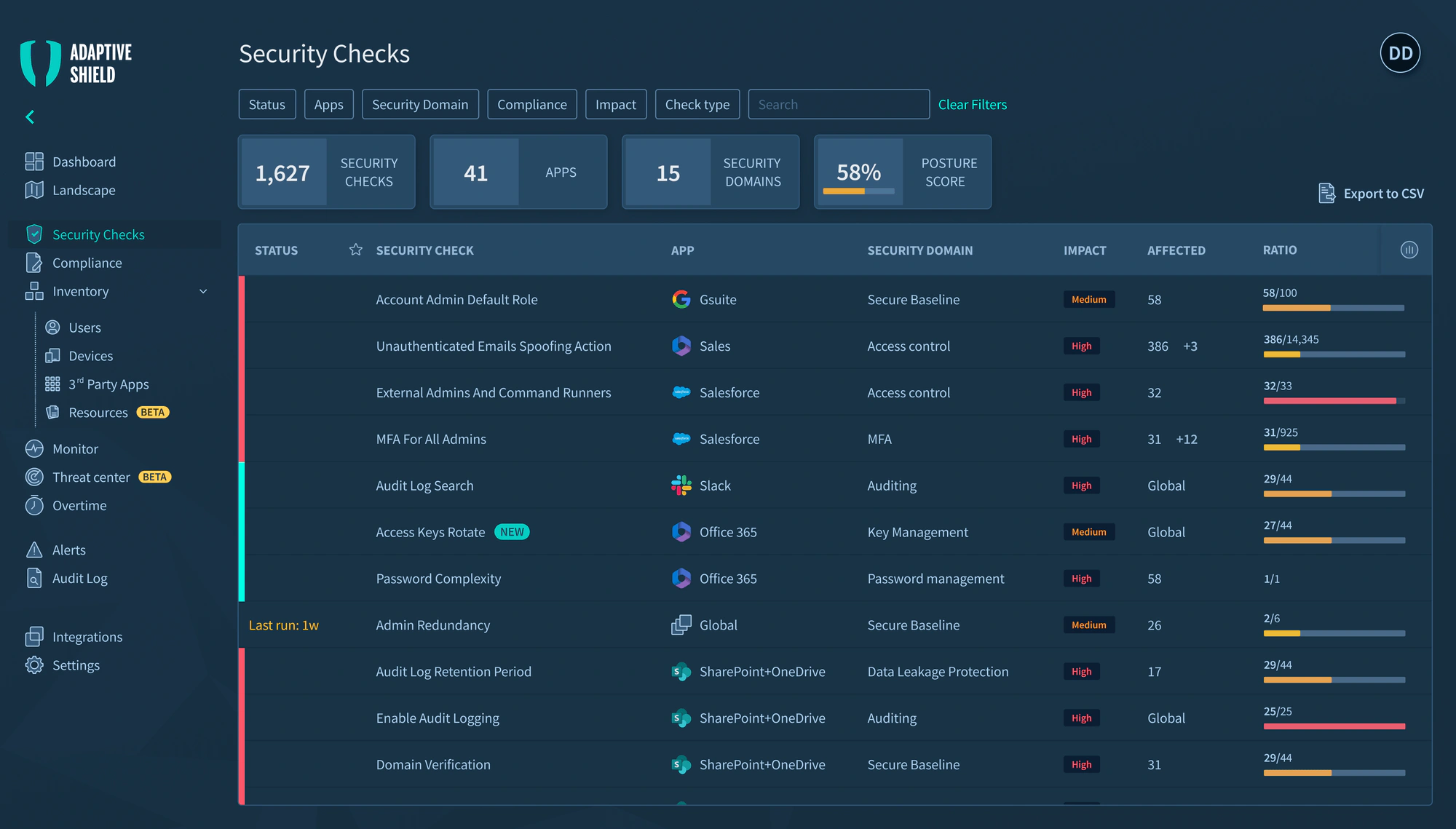
The foundation of the platform is continuous configuration assessment. Adaptive Shield connects to supported SaaS applications and checks their security settings against built-in controls, recommended practices, organizational policies, and compliance requirements.
This approach helps detect weak authentication, excessive sharing, disabled logging, insecure sessions, risky administrator permissions, and configuration drift. Findings can be grouped by severity, application, security domain, and affected identity.
Current Falcon Shield materials state that the platform supports more than 3,500 built-in security checks. Custom security checks can also help mature teams enforce internal standards that go beyond default vendor recommendations.
Why this matters
- Configuration changes can create exposure without generating a traditional malware alert.
- SaaS settings differ significantly between platforms and are difficult to review consistently.
- Continuous checks reduce the gap between a risky change and its discovery.
- Guided remediation gives application owners a clearer path to fixing findings.
2. Identity Security and Permission Governance
SaaS breaches frequently involve valid accounts, stolen sessions, excessive privileges, abandoned users, or service accounts that remain active longer than intended. Adaptive Shield gives you a cross-application identity view so you can evaluate who has access, which privileges they hold, and whether that access still makes sense.
The platform can classify internal users, external users, administrators, dormant accounts, and non-human identities. It can also highlight partially deprovisioned users, such as an employee disabled in a central directory who still retains access to one or more SaaS applications.
This is valuable when user lifecycle management is split between HR, IT, security, and application administrators. The platform does not replace an identity provider or governance system, but it can reveal gaps they miss.
Identity risks you can investigate
- Privileged users with weak security controls
- Dormant or inactive SaaS accounts
- External administrators from unexpected domains
- Over-permissioned service accounts and API identities
- Users disabled centrally but still active in individual applications
3. Shadow SaaS and Connected App Discovery
One of Adaptive Shield’s stronger differentiators is its attention to SaaS-to-SaaS connections. Employees frequently authorize AI assistants, workflow tools, plugins, and third-party services that request access to core platforms.
Adaptive Shield helps discover sanctioned and unsanctioned applications connected to major SaaS hubs. It evaluates requested scopes, privilege levels, recent activity, and other risk indicators so you can identify integrations that have broad access but little business justification.
This is not identical to full shadow IT discovery from network traffic, browser telemetry, expense records, or single sign-on logs. Its strength is understanding connected applications and OAuth relationships from inside the SaaS environment. For broader browser and web-layer protection, read our guide on why browser security matters.
4. SaaS Threat Detection and Response
Posture management explains what could go wrong. Threat detection helps identify what may already be happening. Adaptive Shield monitors SaaS events and behaviors for indicators such as abnormal logins, suspicious API activity, unusual downloads, credential attacks, token abuse, and other patterns associated with account compromise.
The platform combines indicators of compromise with user and entity behavior analytics. MITRE ATT&CK mapping helps analysts understand the likely stage and purpose of suspicious activity.
Alerts can be routed into email, Slack, Microsoft Teams, SIEM, or SOAR workflows. This gives your SOC a way to include SaaS events in existing incident response processes rather than creating a separate queue that is rarely reviewed.
Adaptive Shield should still be viewed as a SaaS-focused detection layer. It does not replace endpoint detection and response, network detection, email security, or a full SIEM. Its advantage is adding context from applications that traditional endpoint-centric tools may not see clearly.
5. Data Exposure and Device Risk
Security posture is not only about settings and identities. Adaptive Shield can help you identify publicly accessible or externally shared resources, including documents, repositories, calendars, and other SaaS data that may have been exposed beyond the intended audience.
It can also associate user and device context with SaaS access. This helps you prioritize situations where a privileged user is connecting through an unmanaged, non-compliant, or poorly secured device.
This improves prioritization because exposed data becomes more urgent when linked to a privileged identity or unmanaged device.
6. AI Application and Non-Human Identity Security
Adaptive Shield expanded beyond traditional SaaS posture to address AI applications, AI-related settings, connected generative AI tools, and non-human identities. Current Falcon Shield positioning also emphasizes visibility into AI agents operating across platforms such as Microsoft 365, Salesforce, and OpenAI environments.
You can use these capabilities to identify shadow AI applications, review permission scopes, evaluate risky configurations, and understand which systems an AI agent can access. This is increasingly important because AI agents may act with persistent tokens, broad permissions, and limited human supervision.
This is relevant when copilots, workflow agents, and third-party assistants connect to sensitive SaaS data. Security teams gain governance without blocking every AI initiative by default.
Pros and Cons
Advantages and Disadvantages
Adaptive Shield delivers substantial value for complex SaaS environments, but it is not a lightweight tool for small teams.
Positive
✅ Broad coverage across 200+ SaaS applications
✅ Deep configuration and identity visibility
✅ Strong connected app and shadow SaaS analysis
✅ Guided remediation and risk prioritization
✅ AI agent and non-human identity controls
✅ Valuable integration with the Falcon platform
Negative
❌ Pricing is not publicly listed for the module
❌ Best suited to mid-market and enterprise teams
❌ Integration depth can vary by SaaS application
❌ Initial authorization and ownership work requires coordination
❌ Some workflows may still need external ticketing or automation
❌ Does not replace SIEM, EDR, CASB, or identity governance
👍 Pros
✅ Broad coverage across 200+ SaaS applications
Falcon Shield advertises more than 200 out-of-the-box integrations, reducing the number of important applications that must remain under manual review.
✅ Deep configuration and identity visibility
The platform connects posture findings with users, privileges, devices, and application relationships. This gives you more context than a simple checklist that only reports whether a setting passed or failed.
✅ Strong connected app and shadow SaaS analysis
Adaptive Shield is particularly useful for reviewing OAuth applications and SaaS-to-SaaS connections. It can help you find tools with excessive scopes, dormant access, or limited business justification.
✅ Guided remediation and risk prioritization
Findings include practical remediation guidance, allowing security teams to collaborate with application owners who may not be security specialists. Risk grouping also helps you focus on the issues that create the most exposure.
✅ AI agent and non-human identity controls
The product has expanded into an area many traditional SSPM tools treated as secondary. Visibility into AI agents, service identities, connected AI apps, and machine permissions makes it more relevant for emerging enterprise workflows.
✅ Valuable integration with the Falcon platform
For CrowdStrike customers, SaaS security context can sit closer to identity, endpoint, cloud, and SIEM operations.
👎 Cons
❌ Pricing is not publicly listed for the module
CrowdStrike publishes pricing for several endpoint bundles, but Falcon Shield requires a sales conversation. This makes early budget comparison harder, especially when you want to evaluate several SSPM vendors before scheduling demonstrations.
❌ Best suited to mid-market and enterprise teams
Small businesses with only a few SaaS applications may not gain enough value to justify the procurement and ownership effort.
❌ Integration depth can vary by application
A large integration count does not mean every SaaS connector offers identical checks, event depth, remediation options, or identity context. You should validate your critical applications individually during a proof of concept.
❌ Initial setup requires coordination
Connecting applications, approving scopes, identifying owners, and deciding who can remediate findings requires participation from security, IT, and business teams. The software can centralize the work, but it cannot eliminate organizational ownership challenges.
❌ Some workflows may need external automation
User feedback has noted limitations in ticketing automation and the time required for certain integrations. Teams with mature service management processes should test assignment, escalation, and closure workflows carefully.
❌ It is one layer of a broader security architecture
Adaptive Shield does not replace endpoint protection, email security, network controls, identity governance, data loss prevention, or a SIEM. You receive the best results when it complements those layers.
User Experience
Deployment and Daily Management
Adaptive Shield is designed for security practitioners, but much of its value depends on collaboration with application owners. The interface centralizes posture scores, checks, identities, connected apps, threats, and remediation steps, reducing the need to navigate each SaaS product separately.
Onboarding begins by connecting supported applications and granting the permissions required to inspect settings, identities, events, and relationships. CrowdStrike’s 15-day Falcon Shield trial uses an onboarding wizard for common services, including Microsoft 365, Google Workspace, Salesforce, Atlassian, GitHub, Slack, Zoom, and Box.
A useful rollout still requires planning. Decide which applications contain sensitive data, who owns them, and which findings require business approval.
What the Workflow Looks Like
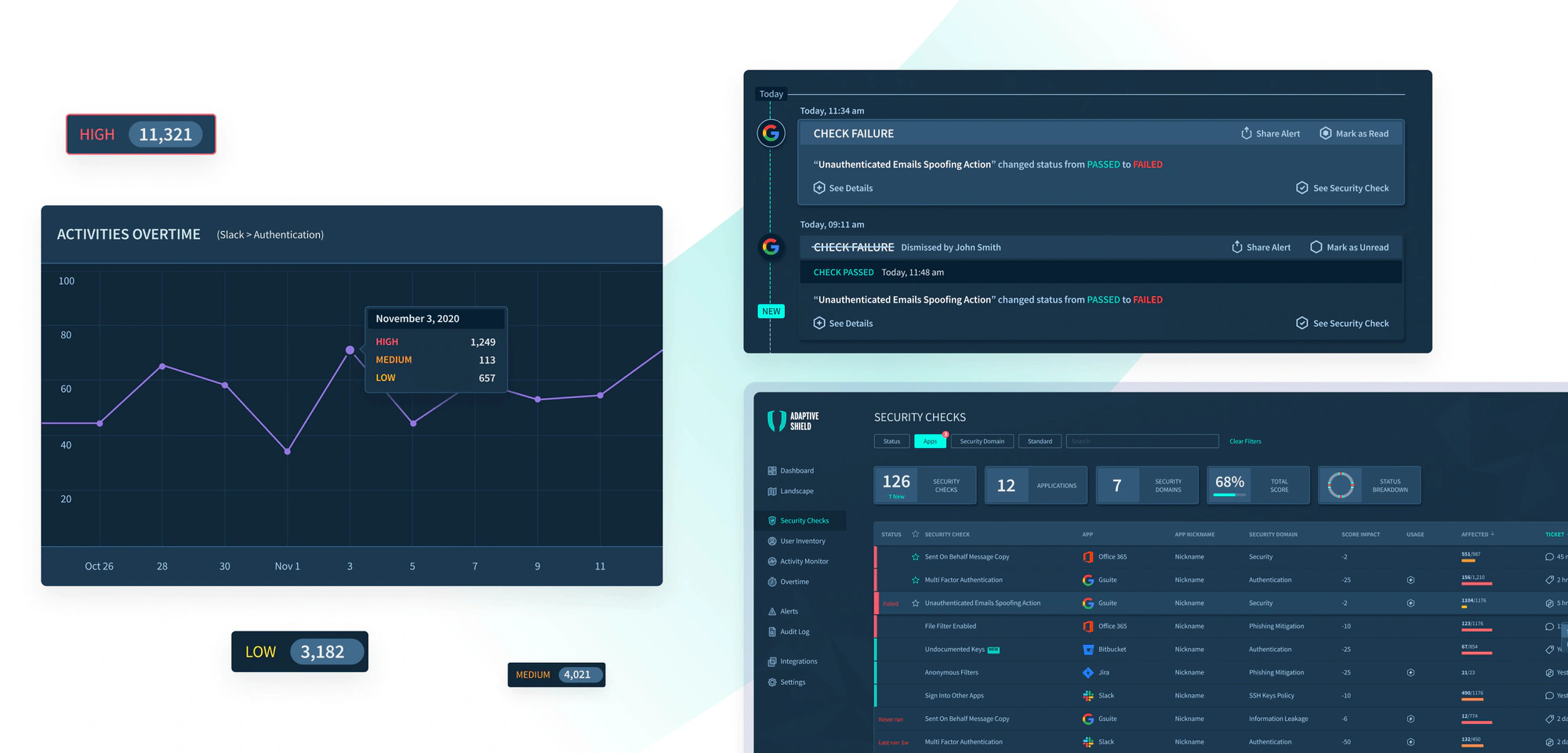
A practical deployment starts with high-value SaaS platforms. Your team then reviews baseline posture, removes obvious false positives, assigns ownership, and creates a remediation process.
Daily users will spend most of their time in prioritized findings, identity investigations, connected app reviews, and alerts. Application owners may interact with narrower remediation tasks, while SOC analysts focus on behavioral events and compromise indicators.
The product is easier to operationalize when you already have clear SaaS ownership and ticketing processes. Without those foundations, the dashboard may reveal many issues but leave your team debating who should fix them.
Integrations
Supported SaaS Apps and Security Workflows
Falcon Shield advertises more than 200 integrated SaaS applications and over 3,500 built-in checks. Its integration catalog includes widely used collaboration, productivity, development, CRM, identity, file sharing, and business platforms.
Security operations integrations move findings into SIEM, SOAR, messaging, and workflow processes. An integration builder and custom checks can extend standard coverage.
| Integration Area | Examples | Security Value |
| Productivity and collaboration | Microsoft 365, Google Workspace, Slack, Zoom, Box | Configuration, sharing, identity, and activity visibility |
| Development and work platforms | GitHub, Atlassian, Salesforce | Permission, connected app, repository, and account risk analysis |
| Identity and access | Okta and directory services | User classification, deprovisioning checks, and privilege context |
| Security operations | SIEM, SOAR, email, Slack, Microsoft Teams | Alert routing, investigation, and response workflows |
| Custom applications | Integration builder and API-based extensions | Coverage for internal or less common SaaS services |
Do not choose the product based only on the total integration number. During your evaluation, create a list of the applications that matter most and verify the exact checks, events, identity fields, remediation actions, and multi-tenant support available for each one.
Pricing and Trial
How Much Does Adaptive Shield Cost?
Adaptive Shield pricing is not published as a standalone rate card. CrowdStrike lists prices for several endpoint bundles, but Falcon Shield is handled through contact sales, a tailored quote, or a broader Falcon Flex agreement.
Enterprise SSPM pricing may depend on users, applications, contract size, existing Falcon products, and service requirements. A reliable budget comparison therefore requires a vendor quote.
CrowdStrike offers a 15-day Falcon Shield trial with no credit card required. The trial includes configuration checks, SaaS posture assessment, connected app discovery, real-time alerts, and access to supported integrations.
Questions to Ask Before Requesting a Quote
- Is pricing based on users, applications, tenants, modules, or a combined metric?
- Are all supported integrations included, or are some priced separately?
- Does the quote include threat detection, AI security, and identity capabilities?
- Are professional services or onboarding fees required?
- How are additional tenants, subsidiaries, or business units priced?
- What support level and response commitments are included?
Because 15 days is limited, prepare your priority applications, administrators, success criteria, and test scenarios before the trial starts.
Security & Privacy
Platform Security and Compliance
An SSPM platform requires significant trust because it connects to sensitive SaaS environments. Your review should cover both its security value and the security of the platform itself.
CrowdStrike publishes a broad compliance program for the Falcon platform. Its current materials reference ISO/IEC 27001:2022, SOC 2 Type II reporting for the Falcon platform, CSA STAR Level 2, FedRAMP authorization, privacy certifications, and support for several customer compliance programs.
You should confirm which certifications, data processing terms, hosting regions, retention controls, and audit reports specifically apply to Falcon Shield under your proposed deployment. A company-wide certificate does not always mean every optional service, region, or data flow is covered identically.
Security Review Checklist
- Review the permissions requested by every SaaS connector.
- Confirm whether connectors use read-only access or can perform remediation actions.
- Evaluate encryption, tenant isolation, logging, and administrator access controls.
- Request current SOC reports and penetration testing summaries.
- Document data residency, subprocessors, retention, and deletion processes.
- Define how vendor access is approved and audited.
Adaptive Shield can help map SaaS settings to compliance frameworks, but it does not make your organization compliant by itself. Compliance still requires governance, ownership, evidence, policy, training, and ongoing risk management.
Who It’s Best For
Where Adaptive Shield Adds the Most Value
Adaptive Shield is best for organizations that depend heavily on SaaS and need continuous governance. It is especially useful when identities, AI adoption, connected apps, and configuration drift are difficult to manage through periodic audits.
- Enterprises with large SaaS portfolios can centralize posture checks across many applications and tenants.
- CrowdStrike customers can extend an existing Falcon strategy into SaaS posture and identity risk.
- Regulated organizations can use continuous checks and compliance mappings to support evidence collection.
- SOC and incident response teams can add SaaS behavior and identity context to investigations.
- Companies adopting AI agents can identify connected AI services, non-human identities, and broad permission scopes.
- Decentralized organizations can collaborate with application owners without giving the security team direct administrative responsibility for every tool.
The platform is less suitable for a small business with a limited SaaS stack, no dedicated security function, and simple identity management. In that situation, stronger identity provider settings, password management, endpoint protection, and application-specific audits may provide better value first. You can explore additional options in our network security software library.
Competitor Comparison
Adaptive Shield Alternatives
The best alternative depends on whether you prioritize configuration depth, threat analytics, shadow SaaS discovery, identity intelligence, or platform consolidation.
Adaptive Shield vs AppOmni
AppOmni is a close alternative for organizations that want deep SaaS configuration, data access, identity, and compliance analysis across critical enterprise platforms. It has a strong reputation for detailed posture assessment and is often shortlisted by teams with complex Salesforce, ServiceNow, Microsoft 365, and other high-value SaaS environments.
Adaptive Shield is more attractive when broad integration coverage, connected app discovery, AI agent security, and Falcon platform consolidation are central requirements. AppOmni may be preferable when your evaluation emphasizes deep application-specific security analysis and SaaS data access visibility.
Adaptive Shield vs Obsidian Security
Obsidian Security combines SaaS posture, identity threat detection, integration risk, and AI security. It is especially compelling for security operations teams that want strong behavioral analytics, threat investigation, token compromise detection, and visibility into activity across major enterprise SaaS platforms.
Adaptive Shield may be the better fit for teams that prioritize a large catalog of configuration checks, broad application coverage, guided remediation, and integration with CrowdStrike. Obsidian can be stronger when deep activity context and SaaS threat investigation are the leading priorities.
Adaptive Shield vs Grip Security
Grip Security focuses heavily on discovering and governing the full SaaS estate, including sanctioned applications, shadow SaaS, identities, and GenAI usage. It can be a stronger choice when your first problem is not misconfiguration depth, but simply understanding which applications and accounts exist across the organization.
Adaptive Shield is usually better aligned with teams seeking deep posture checks across known SaaS applications and closer integration with security operations. Grip is compelling when SaaS discovery, decentralized adoption, unused accounts, and business-led IT are your biggest blind spots. Read our Grip Security review for a more detailed analysis.
| Platform | Best For | Primary Strength |
| Adaptive Shield | Enterprises and existing CrowdStrike customers | Broad SSPM, identity, connected app, and Falcon integration |
| AppOmni | Complex, high-value SaaS environments | Deep application posture and data access analysis |
| Obsidian Security | SOC-led SaaS threat detection | Behavioral analytics and identity threat investigation |
| Grip Security | Organizations with extensive shadow SaaS | Application discovery and decentralized SaaS governance |
Conclusion
Is Adaptive Shield Worth It?
Adaptive Shield is worth considering when SaaS applications have become a major part of your attack surface and manual reviews can no longer provide reliable coverage. Its combination of configuration management, identity governance, connected app discovery, threat detection, data exposure analysis, and AI security creates a broad control layer for enterprise SaaS.
The acquisition by CrowdStrike strengthens its position for organizations that already use the Falcon platform. Instead of buying a completely separate SSPM product, you can bring SaaS security closer to your endpoint, identity, cloud, and security operations strategy.
The main limitations are commercial and operational. Pricing is not transparent, connector depth must be validated, and successful deployment requires clear ownership across security, IT, and business teams.
For a mid-market or enterprise organization with dozens of critical SaaS applications, privileged users, external collaborators, service identities, and growing AI adoption, Adaptive Shield is one of the strongest SSPM options to evaluate. The best purchasing decision will come from testing your actual applications and workflows during the trial rather than relying on the headline integration count alone.
Frequently Asked Questions
Have more questions?
What is Adaptive Shield?
Adaptive Shield is a SaaS security platform that helps organizations identify misconfigurations, risky identities, connected applications, data exposure, and threats across cloud applications. It is now offered by CrowdStrike as Falcon Shield.
Is Adaptive Shield now CrowdStrike Falcon Shield?
Yes. CrowdStrike acquired Adaptive Shield and integrated its SaaS security technology into the Falcon platform. The current product name is Falcon Shield, although Adaptive Shield remains a widely used search and reference name.
What does Adaptive Shield protect?
Adaptive Shield protects SaaS environments by monitoring configurations, users, permissions, devices, connected apps, OAuth access, shared data, AI tools, non-human identities, and suspicious activity.
How many SaaS applications does Adaptive Shield support?
CrowdStrike currently states that Falcon Shield supports more than 200 SaaS applications out of the box. Coverage and feature depth vary by connector, so you should verify your priority applications during a trial.
Does Adaptive Shield detect threats or only misconfigurations?
It does both. The platform checks SaaS configurations and also monitors user behavior, login anomalies, API activity, credential attacks, token risks, and other indicators that may point to account compromise.
Can Adaptive Shield discover shadow SaaS?
Yes. It can discover sanctioned and unsanctioned applications connected to core SaaS platforms, assess requested permission scopes, and identify dormant, malicious, or excessively privileged integrations.
Does Adaptive Shield publish pricing?
No public standalone price is listed for Falcon Shield. You need to contact CrowdStrike for a tailored quote based on your environment, contract structure, and required capabilities.
Is there an Adaptive Shield free trial?
Yes. CrowdStrike offers a 15-day Falcon Shield trial with no credit card required. The trial includes SaaS posture checks, connected app discovery, alerts, and access to supported integrations.
Who should use Adaptive Shield?
Adaptive Shield is best for mid-market and enterprise organizations with many SaaS applications, sensitive cloud data, complex identity environments, external collaborators, or growing use of AI agents and connected apps.
What are the best Adaptive Shield alternatives?
Leading alternatives include AppOmni for deep SaaS posture analysis, Obsidian Security for SaaS threat and identity analytics, and Grip Security for broad SaaS discovery and shadow application governance.