Introduction
Cloud security teams rarely suffer from a lack of findings. The harder problem is deciding which vulnerable package, excessive permission, exposed service, or suspicious process deserves attention first. Sysdig Secure approaches that problem from runtime, using evidence from running workloads and cloud activity to separate theoretical exposure from risk that is active in production.
That makes Sysdig Secure especially relevant for organizations running Kubernetes, containers, Linux hosts, and multi-cloud infrastructure. The platform combines cloud security posture management, vulnerability management, identity and entitlement analysis, compliance, cloud detection and response, and workload protection within a broader CNAPP.
This Sysdig Secure review covers the platform’s strengths, deployment, limitations, pricing, ideal users, and leading alternatives.
What Is Sysdig Secure?
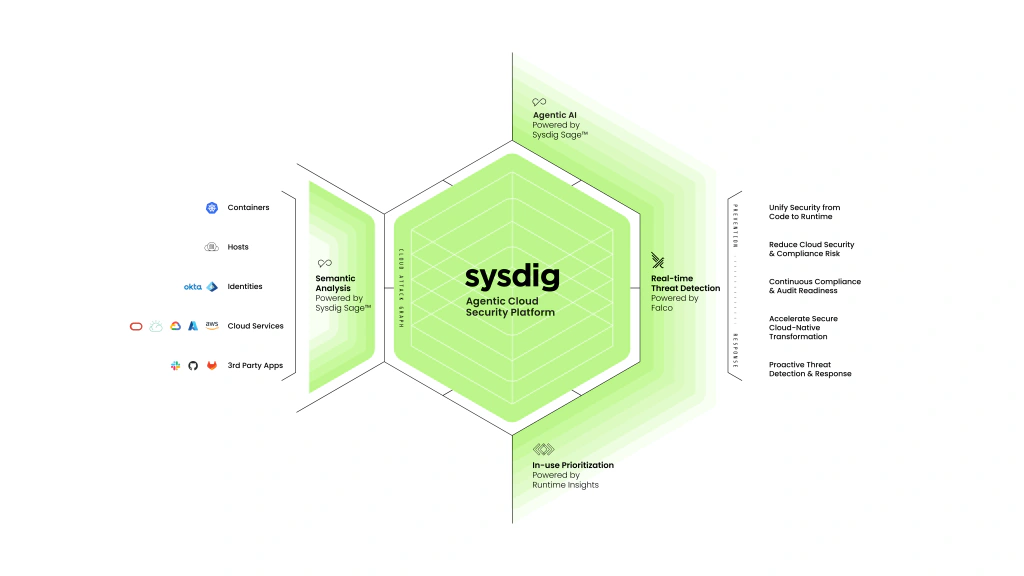
Sysdig Secure is a cloud-native application protection platform, or CNAPP, designed to protect cloud accounts, Kubernetes clusters, containers, hosts, identities, and development workflows. It brings together several security disciplines that organizations often manage through separate products:
- Cloud security posture management, or CSPM
- Kubernetes security posture management, or KSPM
- Cloud workload protection and runtime threat detection
- Container, host, registry, and pipeline vulnerability management
- Cloud infrastructure entitlement management, or CIEM
- Cloud detection, investigation, and response
- Compliance assessment and reporting
The platform supports agentless cloud onboarding for AWS, Microsoft Azure, and Google Cloud, while deeper workload visibility uses Sysdig components deployed into Kubernetes clusters or hosts. This hybrid approach matters because agentless scanning gives you broad coverage, but runtime instrumentation provides the process, syscall, package-use, and workload context that defines Sysdig’s main advantage.
Sysdig is best understood as a security platform for cloud-native production environments, not as a lightweight vulnerability scanner. Its value increases when your infrastructure is dynamic, container-heavy, and difficult to protect through periodic snapshots alone
Platform Features
Core Capabilities of Sysdig Secure
Sysdig Secure covers most of the capabilities expected from a modern CNAPP, but the product is more differentiated in some areas than others. Runtime detection, container security, vulnerability prioritization, and investigation are the areas where its architecture is most noticeable.
1. Runtime Threat Detection Built on Falco
Runtime detection is Sysdig’s defining capability. The platform uses Falco-based rules and policies to observe suspicious behavior across containers, Kubernetes, Linux hosts, and supported cloud activity. Rather than waiting for periodic scans, it evaluates what processes, users, commands, files, and system calls are doing while workloads are running.
This model can identify interactive shells, privilege escalation, sensitive file access, crypto-mining, suspicious package execution, and container drift. Managed policies provide a starting point, while advanced teams can tune rules, scopes, exceptions, severity, notifications, and response actions.
Why the runtime model matters
- It detects behavior that configuration scans cannot see.
- It adds workload and process context to cloud findings.
- It supports faster investigation of short-lived containers.
- It helps distinguish dormant exposure from active attack paths.
The tradeoff is operational complexity. Runtime security needs careful deployment, policy tuning, exception management, and ownership. A team that wants only agentless posture visibility may find Sysdig more involved than necessary.
2. Runtime-Informed Vulnerability Management
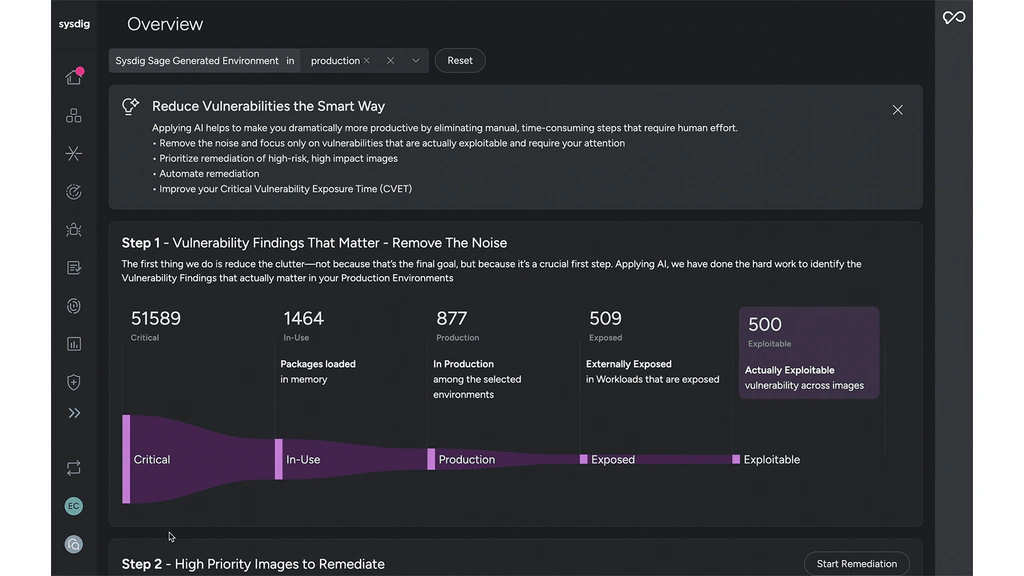
Sysdig Secure scans images and hosts across pipelines, registries, Kubernetes environments, standalone containers, and runtime workloads. Findings include standard vulnerability context such as severity, package details, known exploits, fix availability, and policy status.
The more useful capability is Risk Spotlight, also described through the In Use designation. It identifies packages that are actually loaded or executed at runtime. This helps your team avoid spending equal effort on every vulnerable package inside a large image when only a smaller subset is active in production.
Unused vulnerable packages still contribute to attack surface, but runtime use is a valuable prioritization signal when teams face large remediation queues.
Where vulnerability workflows add value
- Prioritizing exploitable, fixable, and active vulnerabilities
- Connecting findings to images, workloads, owners, and environments
- Creating remediation tickets through integrations such as Jira
- Applying policies before deployment through pipeline and admission controls
3. Cloud Posture, Kubernetes Posture, and Compliance
Sysdig continuously evaluates cloud resources and Kubernetes configurations for misconfigurations, insecure defaults, policy violations, and compliance gaps. Agentless cloud connections can inventory and assess supported services across AWS, Azure, and Google Cloud, while Kubernetes posture checks extend into clusters and workloads.
The platform maps controls to frameworks such as CIS Benchmarks, NIST, PCI DSS, SOC 2, HIPAA, and ISO 27001. Reports help teams organize evidence, identify failures, and assign remediation.
You should still treat this as compliance support rather than automatic certification. Sysdig can assess technical controls it can observe, but it cannot validate every organizational, physical, contractual, or procedural requirement within a framework.
4. Cloud Detection and Response
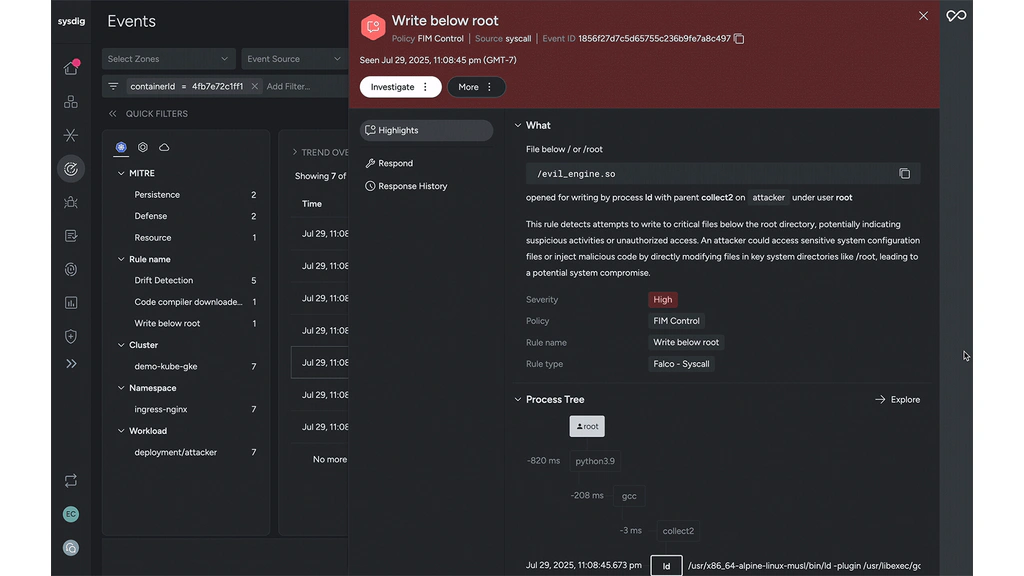
Sysdig extends detection beyond workloads by ingesting cloud logs and evaluating suspicious activity in AWS, Azure, and Google Cloud. This gives analysts a combined view of cloud control-plane events, Kubernetes activity, host events, container behavior, identities, source IPs, affected resources, and related risk context.
The Events Feed helps analysts review what happened, who was involved, where the activity occurred, which rule triggered, and which process or cloud resource was affected. Depending on the event and deployment, teams can investigate process trees, review captures, open activity views, follow runbooks, execute approved response actions, or use Rapid Response for remote command execution.
Sysdig adds more cloud context than a basic alert forwarder, but it does not replace a broader SIEM or XDR for correlating endpoint, email, network, SaaS, and business-system telemetry.
5. Identity and Entitlement Risk
Advanced CIEM analyzes cloud users, groups, roles, service accounts, and permissions. Usage-based insights help identify excessive privileges and support least-privilege remediation based on what identities actually use rather than only what they are theoretically allowed to do.
This is important because many cloud attack paths depend on combinations: an exposed workload, a vulnerable package, an overprivileged role, and access to sensitive data. Sysdig’s risk views and attack-path relationships help you assess these combinations instead of reviewing each finding as an isolated row.
6. Shift-Left Security for Pipelines and Infrastructure as Code
Sysdig can scan images before deployment through command-line, CI/CD, and registry workflows. It can also evaluate Infrastructure as Code and enforce policies during development or admission, helping teams catch vulnerabilities and misconfigurations before they reach production.
This creates a useful feedback loop: development controls prevent known problems, while runtime evidence shows which issues and behaviors matter after deployment. Organizations should still compare Sysdig’s developer-security depth with dedicated application security platforms when source code analysis, secrets detection, software supply chain governance, and developer experience are the main buying criteria.
7. Sysdig Sage and AI-Assisted Investigation
Sysdig Sage adds AI assistance to threat investigation, vulnerability remediation, and platform search. Analysts can ask questions in natural language, summarize events, interpret command lines and rules, receive suggested investigation steps, and generate context-aware remediation guidance.
The feature can speed up unfamiliar investigations, but recommendations should still be validated against your architecture and change process before execution.
Pros and Cons
Advantages and Disadvantages
Sysdig Secure is strongest when production runtime visibility is central to your security strategy. Its weaknesses become more noticeable when you need simple agentless onboarding, predictable public pricing, or a lightweight tool for a small cloud estate.
Positive
✅ Excellent container and Kubernetes runtime visibility
✅ Falco-based detection supports flexible policy control
✅ Runtime context improves vulnerability prioritization
✅ Combines posture, workload, identity, and cloud detections
✅ Strong investigation and response workflows
✅ Supports multi-cloud and hybrid environments
Negative
❌ Pricing is not publicly transparent
❌ Deployment is more involved than posture-only tools
❌ Policy tuning can require cloud-native expertise
❌ Broad functionality creates a learning curve
❌ May be excessive for small, simple environments
👍 Pros
✅ Deep runtime visibility across cloud-native workloads
Sysdig observes what is happening inside containers, Kubernetes workloads, and hosts rather than relying entirely on periodic configuration snapshots. This gives analysts valuable process, syscall, file, user, and workload context during investigations.
✅ Runtime context makes vulnerability queues more practical
Risk Spotlight helps your team see which vulnerable packages are active in production. This is one of the clearest ways Sysdig turns runtime telemetry into operational value for development and security teams.
✅ Falco provides an open and adaptable detection foundation
Managed rules reduce the effort required to begin, while custom Falco rules, scopes, exceptions, policies, and actions give advanced teams meaningful control over detection behavior.
✅ Broad CNAPP coverage supports platform consolidation
Posture management, vulnerability scanning, runtime protection, CIEM, compliance, cloud detection, and response can reduce dependence on disconnected point tools, especially in Kubernetes-heavy environments.
✅ Investigation workflows retain useful technical context
Event details, process trees, captures, activity views, response actions, runbook links, exports, and AI assistance help analysts move from alert to investigation without rebuilding the event from scattered logs.
✅ Flexible coverage for public cloud and private environments
Sysdig supports major public clouds, Kubernetes, hosts, standalone containers, and private or on-premises deployment patterns. Local scanning and Cloud Shield options can help organizations with stricter data-location or network constraints.
👎 Cons
❌ Pricing requires a sales process
Sysdig does not publish a simple standard price for Secure. You need a customized quote, which makes early budget comparison harder and increases the importance of defining workloads, cloud accounts, modules, retention, support, and deployment requirements before negotiation.
❌ Runtime depth comes with deployment overhead
Agentless cloud connections can deliver quick posture visibility, but the platform’s strongest runtime capabilities require components inside clusters or hosts. Security, platform engineering, and operations teams need to coordinate access, rollout, upgrades, network requirements, and performance monitoring.
❌ Detection quality depends on policy tuning
Out-of-the-box policies are useful, but every production environment has legitimate exceptions. Without thoughtful scopes, exceptions, severity models, and ownership, teams can create avoidable alert noise or hesitate to automate response.
❌ The interface and concepts can feel dense
Sysdig spans posture, vulnerabilities, policies, resources, risks, detections, identities, compliance, queries, and response. Experienced cloud security teams will appreciate the depth, but newcomers may need structured training and operating procedures.
❌ Smaller environments may not realize enough value
A small company with a few cloud accounts, limited Kubernetes use, and no dedicated security operations function may be better served by a simpler posture or vulnerability product.
User Experience
Deployment and Daily Administration
Sysdig Secure supports several onboarding paths. You can connect cloud accounts for agentless posture, inventory, compliance, identity, and log-based detection. You can then deploy Cluster Shield, Host Shield, or related components to gain vulnerability and runtime coverage across Kubernetes, hosts, and containers.
Recommended Rollout Process
A phased rollout is safer than enabling every policy and automated response at once:
- Connect a limited set of non-production cloud accounts first.
- Validate inventory, posture findings, and ownership data.
- Deploy runtime components to representative clusters or hosts.
- Tune detection policies and exceptions with platform engineers.
- Integrate Jira, Slack, SIEM, SOAR, and notification workflows.
- Expand by business service, environment, or risk tier.
- Enable response actions only after testing permissions and runbooks.
Interface and Learning Curve
The interface is organized around resources, risks, vulnerabilities, threats, posture, policies, inventory, and reporting. Filters and scope controls are powerful, but teams need consistent labels, ownership metadata, and environment naming to avoid creating a technically rich platform with weak business context.
Day-to-day use is most effective when security and platform engineering share responsibility. Security teams can define detection, risk, and response standards, while workload owners validate runtime behavior and remediate findings inside development workflows.
Integrations and Automation
Sysdig integrates with major cloud providers, Kubernetes platforms, container registries, CI/CD systems, ticketing tools, collaboration platforms, SIEM products, and security orchestration tools. The integration catalog includes AWS, Azure, Google Cloud, IBM Cloud, GitHub, GitLab, Jenkins, Jira, Slack, Microsoft Teams, Splunk, and other common enterprise systems.
Integration depth matters more than logo count. During a proof of concept, verify whether each connection provides onboarding, scanning, alert delivery, ticket creation, enrichment, automated response, or only a basic webhook.
Pricing
How Much Does Sysdig Secure Cost?
Sysdig uses customized pricing for Sysdig Secure. The public pricing page directs buyers to request a quote rather than publishing a fixed per-user, per-node, or per-workload price.
| Pricing Area | What to Expect | What to Confirm |
| Sysdig Secure subscription | Custom quote | Included CNAPP modules and covered environments |
| Runtime coverage | Varies by deployment scope | Hosts, nodes, clusters, containers, and workload definitions |
| Cloud coverage | Depends on connected accounts and features | CSPM, CDR, CIEM, scanning, and log-ingestion costs |
| Data and retention | Contract dependent | Event retention, captures, exports, API limits, and regional storage |
| Services and support | May vary by package | Onboarding, training, premium support, and professional services |
When comparing quotes, normalize proposals around the same cloud accounts, nodes, hosts, workloads, modules, retention, support, and implementation services.
Sysdig can justify a higher cost when it replaces several point tools or materially reduces investigation and remediation time. It is harder to justify when you primarily need basic CSPM and already have mature runtime, vulnerability, and response capabilities elsewhere.
Security & Compliance
How Secure Is Sysdig Secure?
Sysdig Secure is itself a privileged security platform. It can receive cloud metadata, workload telemetry, vulnerability inventories, identity context, event details, and response permissions. Your evaluation should therefore include the product’s architecture as well as the controls it provides.
Data Handling and Deployment Choices
Sysdig provides regional SaaS deployments and supports options designed for environments with stricter residency or sovereignty requirements. Local Scanning generates SBOM data inside your environment so image layers and source code do not need to leave your infrastructure. Cloud Shield can perform supported operations within your cloud accounts and regions while sharing only the metadata required by the platform.
Access and Operational Controls
- Role-based administration: Define who can view findings, change policies, manage teams, or execute response actions.
- SSO and identity controls: Connect enterprise authentication and enforce appropriate administrator protections.
- Auditability: Review policy changes, response history, exports, and administrative activity.
- Scoped teams: Limit access by environment, cluster, account, label, or business boundary.
- Controlled response: Restrict remote shell and automated actions to authorized users and tested runbooks.
Compliance Support
Sysdig maps posture checks and reports to frameworks such as CIS, NIST, SOC 2, PCI DSS, HIPAA, and ISO 27001. This can reduce manual evidence gathering and help teams see where technical controls fail across clouds and workloads.
Before purchase, request current security documentation, certification reports, subprocessor details, encryption practices, data-retention options, incident-notification commitments, recovery objectives, penetration-testing summaries, and region-specific terms. Confirm which data is collected by each component and whether response permissions can be separated from read-only monitoring.
Business Fit
Where Sysdig Secure Fits Best
Sysdig Secure is not equally suitable for every cloud environment. It delivers the most value when runtime visibility, containers, Kubernetes, and production incident response are major requirements.
| Organization Type | Fit | Why |
| Kubernetes-heavy enterprise | Excellent | Deep runtime, workload, vulnerability, posture, and policy coverage |
| Multi-cloud security team | Excellent | Unified cloud accounts, containers, identities, compliance, and detections |
| Regulated cloud-native company | Strong | Compliance mapping, audit support, regional options, and runtime evidence |
| DevSecOps program | Strong | Pipeline scanning, admission controls, runtime feedback, and ticketing workflows |
| Small cloud environment | Moderate | Broad platform may exceed the team’s needs and operational capacity |
| Company seeking only agentless CSPM | Limited | Sysdig’s main differentiation depends on deeper runtime deployment |
Sysdig Secure Is a Strong Choice If You Need To:
- Detect suspicious behavior inside containers and Kubernetes workloads
- Prioritize vulnerabilities using runtime package activity
- Unify cloud posture, workload protection, CIEM, and response
- Investigate short-lived cloud-native workloads with detailed context
- Apply consistent security controls across public cloud and private environments
Consider Another Platform If:
- You need immediate agentless visibility with minimal deployment work.
- Your cloud estate is small and does not rely heavily on containers.
- You require public self-service pricing before speaking with sales.
- Your priority is source-code application security rather than production cloud defense.
Compare with Others
Sysdig Secure Alternatives
The best Sysdig alternative depends on whether you value runtime depth, agentless onboarding, attack-path visibility, security operations integration, or application security. The platforms below overlap with Sysdig, but their operational strengths differ.
| Alternative | Best For | Main Difference from Sysdig |
| Wiz – Read our Wiz review | Agentless cloud risk visibility and attack paths | Faster broad onboarding, but Sysdig is more differentiated in deep runtime detection |
| Orca Security – Read our Orca Security review | Agentless full-stack cloud assessment | Lower deployment friction, while Sysdig offers stronger workload instrumentation and Falco-based controls |
| Cortex Cloud – Read our Cortex Cloud review | CNAPP connected to a broader SOC platform | Stronger Palo Alto security-operations consolidation, while Sysdig remains highly focused on runtime and Kubernetes |
| Aqua Security – Read our Aqua review | Container security and cloud-native workload protection | Close runtime competitor with different policy, supply-chain, and deployment strengths |
Sysdig Secure vs Wiz
Wiz is a strong choice when your priority is fast agentless inventory, posture management, exposure analysis, and attack-path visualization across a large multi-cloud estate. Sysdig is more compelling when you need deep runtime detection, process-level investigation, Falco rules, and active workload response.
Sysdig Secure vs Orca Security
Orca Security emphasizes agentless full-stack visibility and can be easier to deploy broadly without installing runtime components. Sysdig requires more operational commitment but provides richer live workload telemetry and more flexible runtime policy control.
Sysdig Secure vs Cortex Cloud
Cortex Cloud is attractive for organizations standardizing on Palo Alto Networks and connecting cloud security with XSIAM, XDR, and broader SOC operations. Sysdig may fit better when Kubernetes, containers, Falco, and runtime-informed vulnerability management are the primary evaluation criteria.
Conclusion
Is Sysdig Secure Worth It?
Sysdig Secure is worth serious consideration for organizations that need more than cloud posture reports. Its strongest advantage is the ability to connect what could be risky with what is actually happening in production.
Runtime threat detection, Falco-based policies, in-use vulnerability prioritization, cloud and Kubernetes context, process-level investigation, and response workflows create a credible operational platform for cloud-native security teams. This is especially valuable when short-lived containers, distributed services, and rapidly changing infrastructure make traditional security tools too slow or too shallow.
The platform is not the simplest option. Pricing requires a customized proposal, the runtime architecture adds deployment work, and teams need enough cloud-native expertise to tune policies and integrate findings into engineering workflows.
Overall, Sysdig Secure is one of the stronger CNAPP choices for Kubernetes-heavy, containerized, and multi-cloud environments where runtime evidence is central to prioritization and response. Organizations seeking an agentless-first posture platform should compare Wiz and Orca Security, while Palo Alto customers should evaluate Cortex Cloud for wider SOC consolidation.
Frequently Asked Questions
Have more questions?
What is Sysdig Secure used for?
Sysdig Secure is used to protect cloud accounts, Kubernetes clusters, containers, hosts, identities, and development workflows. It combines posture management, vulnerability management, runtime threat detection, CIEM, compliance, investigation, and response in one CNAPP.
Is Sysdig Secure a CNAPP?
Yes. Sysdig Secure is a cloud-native application protection platform. It combines CSPM, KSPM, cloud workload protection, vulnerability management, CIEM, cloud detection and response, compliance, and shift-left security capabilities.
How does Sysdig use runtime security?
Sysdig monitors live workload and cloud activity to detect suspicious processes, commands, file access, privilege changes, and other behavior. Runtime context also helps prioritize vulnerabilities and connect findings to active production risk.
What is Falco in Sysdig Secure?
Falco is the open-source runtime security engine that underpins much of Sysdig’s threat detection. Sysdig adds managed rules, policies, tuning, context, investigation, notifications, and response workflows around Falco-based detections.
Does Sysdig Secure require an agent?
Not for every capability. Agentless cloud onboarding supports posture, inventory, compliance, identity, and selected detection features. Deeper workload, process, vulnerability, and runtime visibility requires Sysdig components deployed to Kubernetes clusters or hosts.
How much does Sysdig Secure cost?
Sysdig does not publish a standard price for Sysdig Secure. Pricing is customized according to the required products, environment size, runtime coverage, cloud accounts, data retention, support, and contract terms.
Can Sysdig Secure scan container images?
Yes. Sysdig can scan container images through pipelines, registries, Kubernetes environments, runtime workloads, and supported local scanning methods. It generates vulnerability findings and helps prioritize packages that are active in production.
Does Sysdig Secure support AWS, Azure, and Google Cloud?
Yes. Sysdig supports agentless cloud features across AWS, Microsoft Azure, and Google Cloud. Supported capabilities include posture management, inventory, compliance, threat detection, and identity analysis, although setup requirements vary by cloud provider.
What are the best Sysdig Secure alternatives?
Leading alternatives include Wiz for agentless cloud risk visibility, Orca Security for agentless full-stack assessment, Cortex Cloud for Palo Alto security-operations integration, and Aqua Security for cloud-native workload protection.
Who should use Sysdig Secure?
Sysdig Secure is best for mid-market and enterprise organizations running Kubernetes, containers, Linux workloads, and multi-cloud infrastructure. It is especially useful when runtime detection, vulnerability prioritization, compliance, and cloud incident response are important requirements.