Introduction
Cloud security platforms can generate an impressive volume of findings while still leaving you uncertain about what to fix first. A critical vulnerability may sit on an isolated development workload, while a modest configuration issue can expose a production identity with access to sensitive customer data. The practical challenge is not simply discovering more risk. It is connecting cloud assets, identities, workloads, data, code, and active behavior well enough to understand which combinations could lead to a breach.
Orca Security addresses that problem with an agentless-first cloud-native application protection platform, or CNAPP. Its best-known technology, SideScanning, examines cloud workload storage out of band instead of requiring an agent on every virtual machine or container. This gives you broad workload visibility with relatively little operational disruption.
Orca is no longer only an agentless posture and vulnerability scanner. The platform now combines cloud security posture management, workload protection, identity security, data security posture management, API security, application security, AI security, compliance, attack-path analysis, and cloud detection and response. For deeper runtime protection, Orca also offers a lightweight sensor for selected workloads.
This Orca Security review examines the platform from a buyer’s perspective. You will learn where its architecture creates meaningful advantages, where the agentless model has limits, how pricing works, what to validate during a proof of concept, and which alternatives deserve comparison. The objective is to decide whether Orca can reduce real cloud risk instead of adding another dashboard.
What Is Orca Security?
Orca Security is a cloud security platform designed to protect infrastructure, workloads, identities, data, APIs, software development pipelines, and AI services across multi-cloud environments. It supports major cloud ecosystems including Amazon Web Services, Microsoft Azure, Google Cloud, Oracle Cloud, Alibaba Cloud, and Kubernetes.
The platform’s distinguishing approach is agentless-first rather than agentless-only. SideScanning creates a read-only view of workload block storage and combines it with cloud configuration data. Orca can then identify operating systems, packages, vulnerabilities, malware, exposed secrets, sensitive data, and configuration risks without installing software inside every workload. When you need active threat detection and response, Orca Sensor adds real-time runtime telemetry and protection.
Broad coverage and deep runtime detection solve different problems. Orca lets you begin with agentless discovery and add instrumentation where real-time protection justifies the effort.
Agentless CNAPP Platform
Core Orca Security Capabilities
Orca covers most of the major CNAPP categories within one platform. The important question is not whether each acronym appears on a feature list. You should evaluate how well the platform connects signals across those categories and converts them into specific remediation work.
1. SideScanning and Cloud Asset Discovery
Orca SideScanning is the foundation of the platform. It reads workload block storage through the cloud provider’s infrastructure, reconstructs the file system in a virtual read-only view, and analyzes it without running code on the workload. This can reveal installed software, vulnerabilities, malware, secrets, configuration issues, and sensitive files.
The practical advantage is coverage speed. You can discover virtual machines, storage, containers, images, serverless functions, identities, networks, and data stores without coordinating an agent rollout with every application team. Stopped and unsupported workloads can also remain visible.
Agentless visibility is not identical across every service, region, and workload type. During evaluation, confirm exactly which assets receive deep workload analysis, which receive configuration-only coverage, how snapshots or storage access are handled, and whether any provider charges are generated by scanning activity.
2. CSPM, Compliance, and Attack-Path Analysis
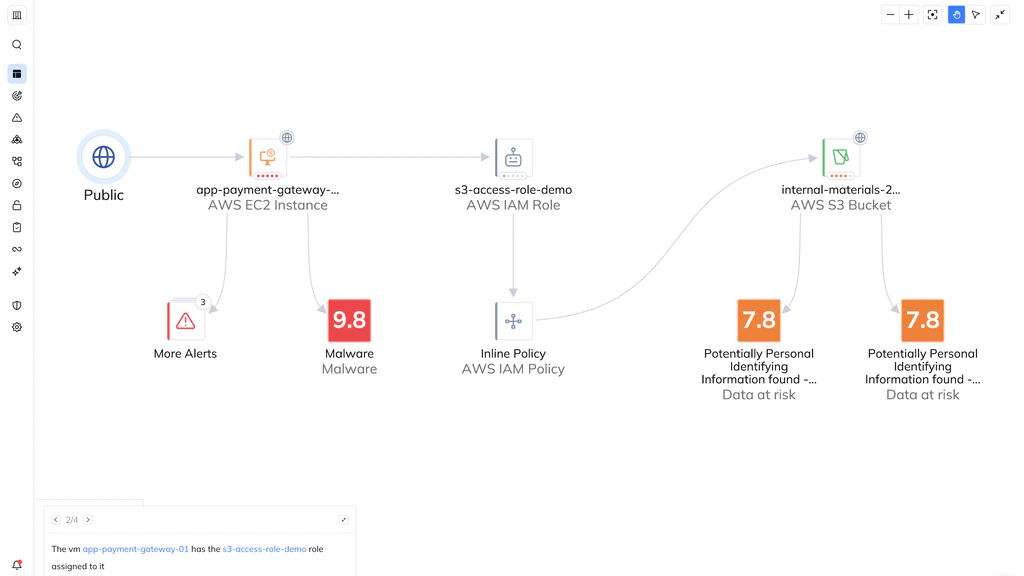
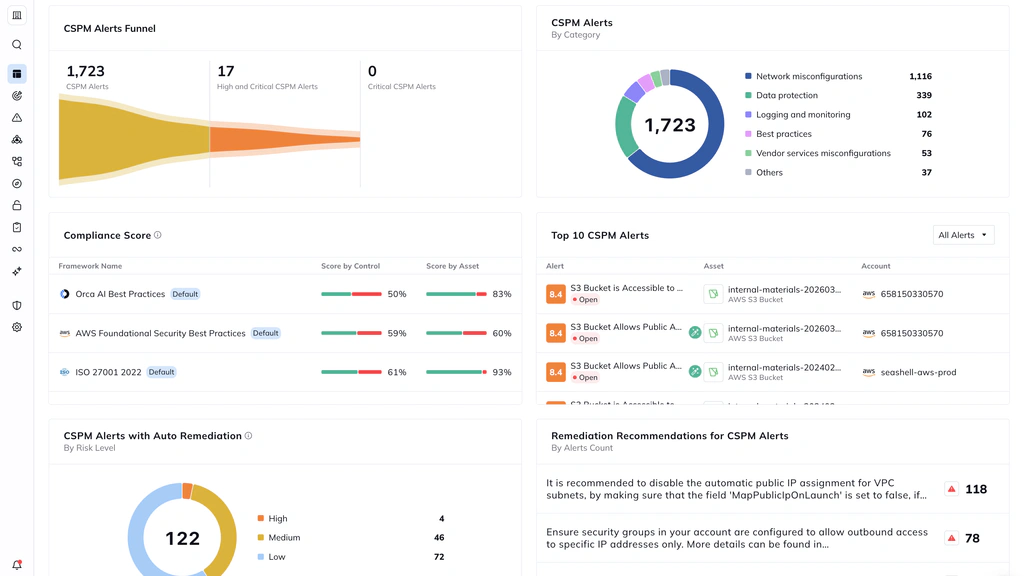
Orca’s cloud security posture management capabilities identify misconfigurations such as public storage, weak encryption, permissive network rules, missing logging, risky Kubernetes settings, and deviations from security baselines. The platform maps findings to common frameworks including CIS, NIST, ISO 27001, PCI DSS, HIPAA, and SOC 2.
The more valuable layer is contextual prioritization. Orca’s unified data model connects exposure, identity permissions, vulnerabilities, malware, sensitive data, and asset relationships. Attack-path analysis shows how individually modest findings can combine into a route toward a critical resource. This is more actionable than treating each failure as an isolated ticket.
Orca Missions groups related findings into remediation projects with owners and deadlines. For example, one infrastructure-as-code change may correct hundreds of recurring alerts. This helps you measure risk reduction by root cause rather than rewarding teams for closing large numbers of low-impact tickets.
3. Vulnerability, Workload, and Container Security
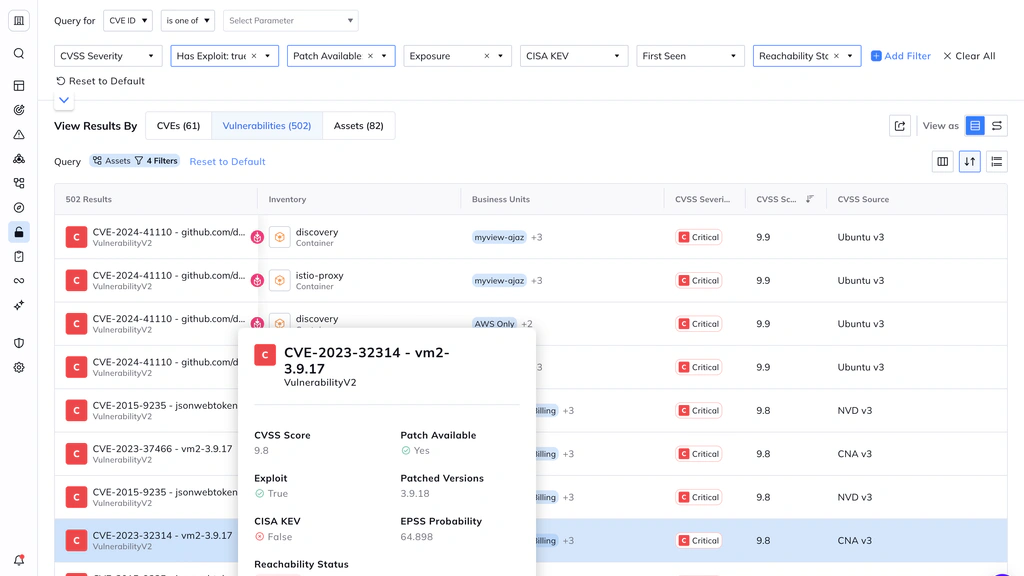
Orca scans virtual machines, container images, running containers, and serverless workloads for vulnerabilities and security issues. Findings can be enriched with internet exposure, active network paths, sensitive data, asset importance, identity access, exploitability, and reachability.
CVSS severity alone is a poor remediation queue. A reachable flaw on an exposed production service requires a different response from the same package on an isolated image. Orca narrows the list, but dormant assets still need policies because exposure can change.
Container and Kubernetes coverage includes image risks, cluster posture, workload configuration, secrets, and relationships between cloud resources and orchestration components. Teams with highly ephemeral clusters should test discovery latency and confirm whether short-lived resources remain visible long enough for investigation.
4. Identity and Entitlement Management
Orca’s cloud infrastructure entitlement management capabilities map users, roles, service accounts, permissions, trust relationships, and access paths. It can highlight excessive privileges, unused permissions, cross-account trust, exposed credentials, and identities that create lateral-movement opportunities.
Identity findings become more useful when connected to real assets and data. An overprivileged role is more urgent when it can be assumed from an internet-facing workload and reach a sensitive database. Orca also offers policy optimization based on observed use, but permission removal should remain an owner-approved process. Infrequent administrative or disaster-recovery actions may not appear in a short observation window.
5. Data Security Posture Management
Orca DSPM discovers cloud data stores and classifies sensitive information such as personally identifiable information, payment data, health information, and financial records. Coverage can include managed databases, object storage, files inside workloads, containers, and shadow data that may not be governed properly.
Orca connects data sensitivity with access, encryption, exposure, vulnerabilities, and attack paths. This prevents data classification from becoming a separate inventory exercise. A public storage bucket containing regulated information should rise above an equivalent bucket containing test data.
The platform also supports optical character recognition for sensitive information in stored images. Review sampling, redaction, regional processing, exclusions, and evidence access before broad scanning.
6. Code, API, and AI Security
Orca extends security into development through software composition analysis, static application security testing, secrets detection, infrastructure-as-code scanning, container image scanning, source-control posture management, and CI/CD integrations. Production findings can be traced back to repositories, templates, owners, and commits so teams can correct the source instead of repeatedly patching deployed resources.
API security provides inventory, posture checks, drift detection, and context around managed and unmanaged APIs. It is useful for identifying APIs exposed by cloud services, but it should complement authentication testing, business-logic testing, gateway controls, and application-layer monitoring.
Orca has also expanded into AI security. It can discover cloud AI services, models, training resources, data access, and deployment risks, then connect those assets to sensitive information and attack paths. Our AI application security guide explains why cloud posture is only one part of securing AI applications, prompts, agents, and model behavior.
7. Cloud Detection and Response with Orca Sensor
Agentless scans provide broad visibility, but they cannot observe every malicious action in real time. Orca Sensor adds runtime observability, behavioral detections, malware analysis, investigation context, and prevention for selected critical workloads. It can help detect suspicious execution, persistence, fileless techniques, and abnormal behavior while correlating events with the wider cloud graph.
This makes Orca more complete than an agentless CSPM, but it adds deployment responsibility. Test compatibility, privileges, overhead, updates, network destinations, rollback, and workload coverage.
Pros and Cons
Advantages and Disadvantages
Orca Security delivers broad cloud coverage with less initial deployment friction than many agent-heavy platforms. Its limitations become clearer when you need full runtime instrumentation, public pricing, or a tightly scoped point product.
Positive
✅ Rapid agentless-first deployment
✅ Deep workload context without agents everywhere
✅ Strong attack-path and risk prioritization
✅ Broad CNAPP, DSPM, AppSec, and AI coverage
✅ Useful integrations and remediation workflows
✅ Optional runtime sensor for critical workloads
Negative
❌ No public standard price list
❌ Real-time protection requires sensor deployment
❌ Broad scope increases evaluation complexity
❌ Cloud permissions and data handling require scrutiny
❌ May be excessive for small or simple environments
👍 Pros
✅ Fast time to broad cloud visibility
Orca can begin delivering value without a workload-by-workload agent project. Organization-level cloud connections allow security teams to inventory assets and identify risks across many accounts, subscriptions, and projects quickly. This is especially valuable when DevOps ownership is decentralized.
✅ Workload depth improves agentless findings
SideScanning goes beyond control-plane posture. It can inspect workload file systems, packages, secrets, malware, and data while avoiding direct performance impact on the scanned asset. This makes Orca more useful than a configuration-only CSPM.
✅ Contextual prioritization is central to the platform
Attack paths, sensitive data, identity access, internet exposure, exploitability, and asset relationships help distinguish urgent risk from background noise. Missions can turn those insights into focused remediation projects rather than disconnected alerts.
✅ Broad platform consolidation potential
Orca covers posture, vulnerability management, workload security, identity, data, APIs, code, compliance, AI, and cloud detection. A successful deployment may reduce overlapping scanners and dashboards, although you should validate each module before retiring existing controls.
✅ Strong workflow integrations
Orca supports ticketing, collaboration, SIEM, SOAR, source control, and CI/CD integrations. Jira, ServiceNow, Slack, Splunk, and other connectors can place findings into the systems where developers and responders already work.
👎 Cons
❌ Pricing transparency is limited
Orca does not publish standard list prices. The company describes a single-SKU model based on protected cloud workloads, but you still need a tailored proposal. This makes early budget comparison less convenient than transparent self-service pricing.
❌ Agentless scanning does not replace runtime telemetry
SideScanning is effective for discovery and risk assessment, but real-time behavioral detection requires Orca Sensor or other telemetry. Buyers should not assume that an agentless architecture alone provides complete active threat protection.
❌ Platform breadth can complicate procurement
A broad CNAPP evaluation touches security, cloud engineering, DevOps, application security, data governance, compliance, and procurement. Without defined success criteria, a proof of concept can become a feature tour rather than a measurable risk-reduction exercise.
❌ Cloud access deserves careful governance
Orca requires meaningful visibility into cloud configurations, workload metadata, identities, and potentially sensitive data. Review least-privilege templates, regional processing, retention, tenant isolation, snapshot handling, evidence access, and offboarding before production rollout.
User Experience
Deployment and Daily Administration
Cloud Onboarding and Coverage
Orca’s initial onboarding is one of its strongest usability advantages. You connect cloud accounts using role-based permissions and can often begin discovery without scheduling agents across application teams. For large estates, organization-level onboarding is preferable because it reduces missed accounts and creates consistent policies.
Fast connection does not mean production deployment should be casual. Start with a limited account set, validate the permission template, confirm asset coverage, review data flow, and test removal procedures. Then expand by business unit or cloud organization.
Console, Missions, and Remediation
The console moves from executive summaries into attack paths, assets, identities, vulnerabilities, data, and code ownership. Public feedback commonly praises quick setup and visibility, although role-specific filtering is still necessary.
Missions are useful because they create bounded remediation programs. Define ownership by cloud account, application, repository, and environment. Route only actionable findings into ticketing systems, or teams may recreate the alert fatigue the platform is meant to reduce.
Integrations and Automation
Orca advertises more than 50 third-party integrations. Common workflows include creating Jira or ServiceNow tickets, notifying Slack channels, streaming findings to Splunk or another SIEM, and connecting source-control and CI/CD systems. Begin with two or three workflows tied to measurable outcomes, such as assigning exploitable production vulnerabilities to the correct code owner.
Plans and Cost
Orca Security Pricing
Orca Security does not publish a standard public price list. The vendor describes an all-inclusive, single-SKU approach covering CNAPP, application security, and Orca Sensor, with pricing based on the number of cloud workloads protected. Your final proposal will still depend on environment scale, contract structure, support, and negotiated terms.
| Pricing Element | What to Confirm | Why It Matters |
| Workload Definition | How VMs, nodes, images, containers, serverless, and stopped assets are counted | Different counting rules can materially change cost |
| Included Capabilities | CNAPP, AppSec, DSPM, AI security, API security, and Sensor coverage | Confirm the single SKU includes every required function |
| Cloud Growth | True-ups, workload bands, acquisitions, and new cloud accounts | Growth terms affect renewal predictability |
| Data and Retention | Telemetry volume, evidence retention, exports, and regional processing | Runtime and compliance data can increase operating cost |
| Services and Support | Onboarding, support tier, success services, and response commitments | Implementation assistance may be important for large estates |
| Marketplace Terms | AWS, Azure, or Google Cloud marketplace eligibility and commitments | Marketplace purchasing may help use committed cloud spend |
Compare total cost, including duplicate scanners, SIEM ingestion, analyst time, remediation ownership, cloud charges, and maintenance.
Security and Privacy
How Secure Is Orca Security?
Orca is itself a high-trust security platform. It can access cloud configuration data, workload metadata, identity relationships, vulnerabilities, code context, and sensitive-data indicators. Your vendor-risk review should be as detailed as the review applied to other privileged security tools.
Platform Trust and Compliance
Orca publicly lists security and assurance credentials including SOC 2 Type II, ISO 27001, ISO 27017, ISO 27018, ISO 27701, FedRAMP Moderate authorization, PCI SAQ-D, CSA programs, and IRAP. Verify the current report, product scope, hosting region, audit period, and contractual commitments in Orca’s security portal rather than relying only on website badges.
Permissions, Data Handling, and Runtime Components
Review every cloud role and permission granted during onboarding. Confirm whether SideScanning uses snapshots or copied data in your provider, where metadata is processed, how long it is retained, who can view sensitive evidence, and how customer data is exported or deleted.
If you deploy Orca Sensor, treat it as a privileged runtime component. Validate code signing, update channels, tamper protection, resource limits, network destinations, vulnerability response, and rollback. A staged rollout should measure performance and detection quality before broad production deployment.
Business Fit
Who Should Use Orca Security?
| Organization Type | Fit | Reason |
| Multi-cloud enterprise | Excellent | Broad agentless inventory and unified risk context across providers |
| Cloud team with limited security headcount | Strong | Fast deployment and prioritization can reduce manual correlation |
| Data-sensitive or regulated organization | Strong | DSPM, compliance mappings, identity context, and attack paths add value |
| DevSecOps program consolidating tools | Strong | Code-to-cloud tracing and workflow integrations support shared ownership |
| Runtime-first Kubernetes SOC | Moderate to strong | Orca Sensor helps, but runtime-focused competitors deserve comparison |
| Small company with one simple cloud account | Limited | Platform scope and enterprise pricing may exceed practical needs |
| Mostly on-premises organization | Limited | Orca’s value is concentrated in public-cloud and cloud-native estates |
Orca is best when you need broad cloud visibility quickly and want to prioritize risks across infrastructure, identity, data, workloads, and code. It is less compelling when your environment is small, mostly on-premises, or already covered by a mature runtime platform that your teams operate effectively.
Compare with Others
Orca Security Alternatives
| Alternative | Best For | Main Difference from Orca |
| Wiz | Mature agentless cloud graph and broad cloud adoption | Strong graph-led experience with expanding runtime protection |
| Cortex Cloud | Enterprises consolidating cloud security and SOC operations | Deeper Palo Alto Networks ecosystem and runtime operations integration |
| Upwind | Runtime-first Kubernetes and workload security | Places live process, network, and application behavior at the center |
| CrowdStrike Falcon Cloud Security | Runtime protection and SOC consolidation | Combines agentless posture with Falcon sensors and threat intelligence |
Wiz – Best for a Mature Agentless Cloud Graph
Wiz is Orca’s closest agentless-first competitor. It combines broad cloud and AI visibility with a security graph, code-to-cloud context, data security, identity, vulnerability management, and runtime protection. Wiz may be the stronger choice when platform maturity, ecosystem momentum, and a graph-led investigation experience are your main priorities.
Orca remains compelling when SideScanning’s workload-depth model, all-inclusive positioning, and direct data context fit your requirements. Read our Wiz review for a detailed platform assessment.
Cortex Cloud – Best for Palo Alto Networks Consolidation
Cortex Cloud unifies application security, cloud posture, runtime security, and security operations. It is a natural shortlist option for organizations already using Palo Alto Networks for endpoint, SOC, network, or cloud security.
Cortex Cloud can offer deeper ecosystem consolidation and real-time operational workflows, but packaging and administration may be more complex. Orca is often easier to evaluate when your priority is rapid agentless visibility and a focused CNAPP experience. See our Cortex Cloud review.
Upwind – Best for Runtime-First Cloud Security
Upwind combines agentless discovery with runtime sensors and places live workload behavior at the center of vulnerability prioritization, API discovery, network analysis, and threat detection. It is particularly relevant for Kubernetes-heavy and microservices environments.
Choose Upwind when process, network, and application behavior in production is the deciding factor. Choose Orca when broad agentless workload and data coverage with selective runtime instrumentation is the better operational model. Read our Upwind review.
CrowdStrike Falcon Cloud Security – Best for SOC Consolidation
CrowdStrike Falcon Cloud Security combines agentless cloud posture and graph context with Falcon sensors, runtime protection, threat intelligence, identity signals, and security operations workflows. It is a strong option when cloud detections must connect directly with endpoint and SOC investigations.
Choose CrowdStrike when runtime defense, adversary intelligence, and an existing Falcon deployment are central to the project. Choose Orca when agentless workload depth, rapid cloud-wide discovery, and selective sensor deployment provide the better operating model.
Conclusion
Is Orca Security Worth It?
Orca Security is worth serious evaluation for organizations that need fast multi-cloud visibility without deploying an agent everywhere. SideScanning provides meaningful workload depth, while the unified data model connects posture, vulnerabilities, identities, sensitive data, APIs, code, and attack paths into a more useful remediation queue.
The platform is strongest when you are trying to consolidate fragmented cloud security tools and reduce the time analysts spend correlating findings. Orca Sensor also closes part of the runtime gap for critical workloads, although that value depends on successful deployment and coverage.
The main cautions are limited public pricing, broad evaluation scope, privileged cloud access, and the distinction between agentless assessment and real-time protection. Run a proof of concept on representative production accounts. Measure asset coverage, attack-path accuracy, vulnerability reduction, data classification, owner mapping, ticket quality, sensor overhead, and investigation speed.
For a broader market comparison, see our guide to the best CNAPP platforms. Orca should remain near the top of your shortlist when fast agentless-first deployment and context-rich cloud risk prioritization are more important than a runtime-first architecture.
Frequently Asked Questions
Have more questions?
What is Orca Security used for?
Orca Security is used to discover, assess, prioritize, and remediate risks across cloud infrastructure, workloads, identities, data, APIs, code, containers, Kubernetes, and AI services. It combines CNAPP capabilities with agentless SideScanning and optional runtime protection.
Is Orca Security agentless?
Orca is agentless-first. SideScanning provides broad cloud and workload assessment without installing agents on every asset. Orca Sensor is available when you need deeper real-time runtime visibility, behavioral detection, investigation, and prevention on selected workloads.
How does Orca SideScanning work?
SideScanning reads workload block storage through the cloud provider infrastructure, reconstructs the file system in a virtual read-only view, and analyzes operating systems, applications, vulnerabilities, malware, secrets, configurations, and data without executing code inside the workload.
Which cloud providers does Orca Security support?
Orca supports major cloud environments including AWS, Microsoft Azure, Google Cloud, Oracle Cloud, Alibaba Cloud, and Kubernetes. Exact service, region, workload, identity, data, and runtime coverage should be confirmed during your proof of concept.
Does Orca Security include runtime protection?
Yes. Orca Sensor adds runtime observability, active-threat detection, behavioral analysis, investigation context, and prevention for supported workloads. Agentless SideScanning remains the broad discovery layer, while the sensor provides deeper real-time protection where deployed.
Does Orca Security include DSPM?
Yes. Orca provides data security posture management that discovers data stores, classifies sensitive information, identifies shadow data, and connects data exposure with identities, encryption, vulnerabilities, cloud configurations, and attack paths.
How much does Orca Security cost?
Orca does not publish standard list prices. The vendor describes a single-SKU model priced according to the number of protected cloud workloads. Buyers should request a detailed proposal covering counting rules, included capabilities, support, growth, retention, and renewal terms.
Is Orca Security suitable for small businesses?
Orca can work for smaller cloud-native companies, but its broad enterprise platform may be more than a simple environment needs. Small businesses should compare the cost and administration effort with native cloud tools or narrower posture-management products.
What are the main Orca Security alternatives?
Leading alternatives include Wiz for mature agentless cloud graph analysis, Cortex Cloud for Palo Alto Networks ecosystem consolidation, Upwind for runtime-first cloud security, and CrowdStrike Falcon Cloud Security for runtime and SOC integration.
Is Orca Security worth it?
Orca is worth evaluating when you need rapid multi-cloud visibility, workload-deep agentless scanning, contextual risk prioritization, DSPM, and code-to-cloud remediation. Its value is lower for small, static, or mostly on-premises environments.