
Introduction
Wiz has become one of the most recognizable names in cloud security because it addresses a problem that affects nearly every cloud-first organization: security teams can see thousands of findings, yet still struggle to identify which combinations could lead to a real breach.
The platform connects to cloud environments without requiring an agent for its core posture and inventory capabilities. It then maps resources, identities, vulnerabilities, network exposure, sensitive data, code, and runtime signals into the Wiz Security Graph. Instead of treating every issue as equally urgent, Wiz highlights attack paths and what it calls toxic combinations, such as an internet-facing workload with a critical vulnerability, excessive permissions, and access to sensitive data.
Wiz is now part of Google Cloud following the completion of Google’s acquisition on March 11, 2026. The Wiz brand remains in place, and the platform continues to support multicloud environments rather than becoming a Google Cloud-only product.
This Wiz review examines the platform from a buyer’s perspective. You will learn where its agentless architecture works well, when runtime sensors are still needed, how the modules fit together, what pricing information is publicly available, and which alternatives deserve consideration.
What Is Wiz?
Wiz is a cloud-native application protection platform, commonly called a CNAPP. Wiz now describes its wider offering as an AI Application Protection Platform, or AI-APP. It combines cloud security posture management, vulnerability management, cloud infrastructure entitlement management, data security posture management, container and Kubernetes security, application security, cloud detection and response, and AI security.
The platform is organized around three broad product areas. Wiz Code focuses on development and CI/CD workflows. Wiz Cloud provides agentless visibility, posture management, data security, identity analysis, and attack-path prioritization. Wiz Defend adds cloud detection, investigation, response, and optional runtime protection through the Wiz Sensor.
Wiz is designed primarily for organizations running meaningful workloads across AWS, Microsoft Azure, Google Cloud, Oracle Cloud Infrastructure, Kubernetes, and related SaaS or AI environments. It can be valuable in a single-cloud deployment, but its strongest business case usually appears when scale, account sprawl, rapid development, and fragmented ownership make native cloud tools difficult to operate consistently.
Feature Review
Wiz Platform Capabilities
Wiz covers a broad cloud security surface, but the platform’s real differentiation is not the number of modules. Its value comes from connecting findings across code, infrastructure, identities, data, and runtime so that teams can understand risk in context.
1. Agentless Cloud Discovery and Inventory
Wiz connects to cloud accounts through provider APIs and purpose-built roles. This allows you to inventory virtual machines, containers, serverless functions, databases, storage, identities, network paths, AI services, repositories, and many managed cloud resources without installing software on every workload.
This model establishes broad visibility quickly and avoids maintaining agents across every workload. Agentless does not mean permissionless, so review cloud roles, snapshot handling, regional data flows, exclusions, and offboarding during the proof of concept.
2. Wiz Security Graph and Attack-Path Analysis
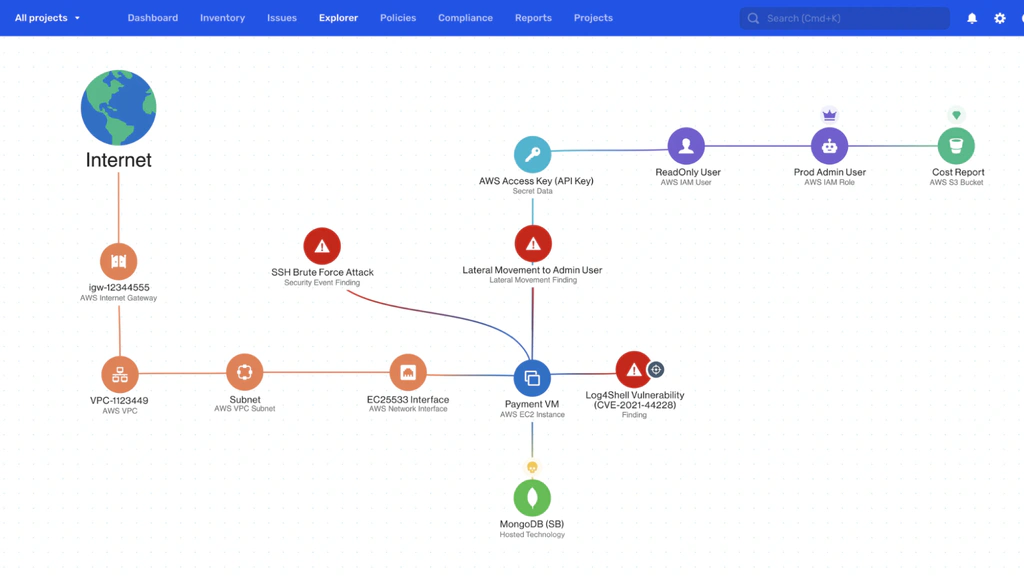
The Wiz Security Graph maps relationships among resources, identities, vulnerabilities, secrets, sensitive data, network exposure, and business context. This helps security teams move beyond a flat list of alerts and see how several weaknesses combine into a realistic path to compromise.
A medium-severity weakness on an internet-facing production service with privileged access may deserve attention before a critical CVE on an isolated test machine. Lower-priority findings still require lifecycle management because cloud relationships can change quickly.
3. Cloud Security Posture Management and Compliance
Wiz CSPM continuously evaluates cloud configurations against security rules, provider recommendations, industry benchmarks, and compliance frameworks. It can identify public storage, weak encryption, missing logging, risky network paths, exposed services, insecure defaults, and other control gaps.
Compliance dashboards can map findings to frameworks such as CIS, NIST, SOC 2, HIPAA, PCI DSS, and ISO 27001. Wiz states that it supports more than 100 built-in frameworks, plus custom frameworks for internal policies.
These mappings support continuous assessment, but compliance still requires governance, ownership, access reviews, documented procedures, and evidence outside Wiz.
4. Vulnerability Management and Exposure Prioritization
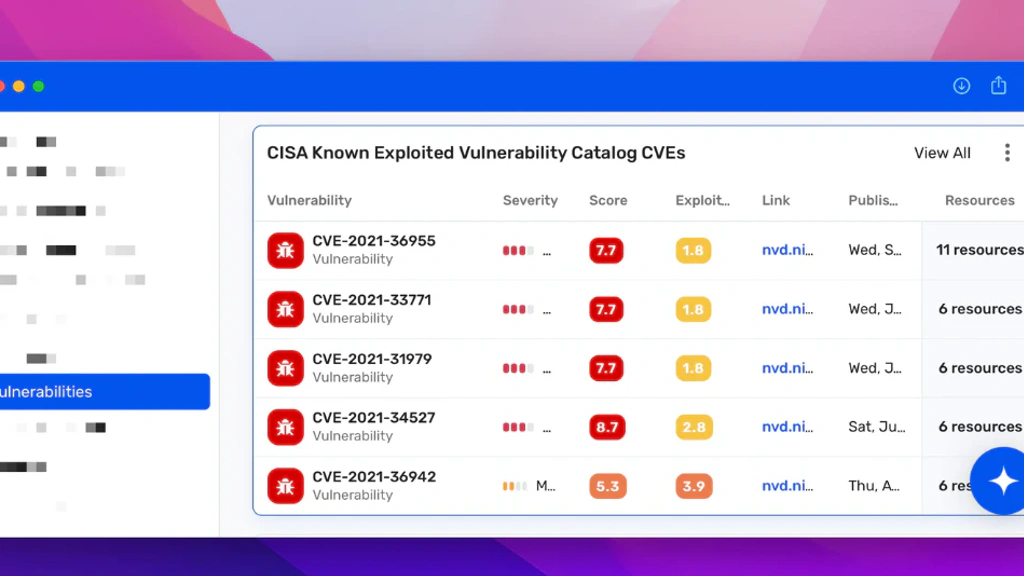
Wiz identifies vulnerabilities across virtual machines, container images, serverless workloads, operating systems, packages, and other supported assets. The platform enriches CVEs with exposure, exploitability, privilege, data access, workload context, and attack-path relationships.
This is more useful than ranking by CVSS alone. Wiz can connect findings to repositories, images, owners, and deployment workflows, although unclear ownership can still delay remediation.
5. Cloud Identity and Entitlement Management
Wiz CIEM analyzes human and machine identities, roles, permissions, trust relationships, access paths, and effective privileges. It helps you find overprivileged users, risky service accounts, cross-account access, unused permissions, and identities that can reach sensitive resources.
The graph can show how an exposed key or service account supports lateral movement. Review least-privilege recommendations before enforcement because rare or seasonal workflows may not appear as normal activity.
6. Data Security Posture Management
Wiz DSPM discovers and classifies sensitive data across supported cloud stores and connects that data with infrastructure, identity, network, vulnerability, and exposure context. This allows you to distinguish between a misconfigured resource containing test data and a similar resource containing personal, financial, health, or confidential business information.
Evaluate classification accuracy, supported data sources, sampling, regional controls, and false-positive handling before relying on DSPM results for enforcement.
7. Container and Kubernetes Security
Wiz provides inventory, configuration assessment, image scanning, vulnerability analysis, admission control, Kubernetes posture management, and runtime protection for supported environments. It can connect a vulnerable image to the cluster, workload, identity, network exposure, and data that create the real risk.
Agentless scanning gives broad coverage, while the Wiz Sensor adds eBPF-based runtime telemetry and blocking for supported workloads. During evaluation, test managed Kubernetes services, self-managed clusters, serverless containers, Windows nodes, specialized kernels, and ephemeral workloads rather than assuming identical coverage everywhere.
8. Wiz Code and Shift-Left Security
Wiz Code extends the platform into repositories, pull requests, IDEs, registries, and CI/CD pipelines. It includes software composition analysis, software bills of materials, infrastructure-as-code scanning, secrets detection, malware scanning, and application security posture management.
Code-to-cloud mapping traces deployed risks back to the repository or infrastructure definition that created them. Wiz states that IaC scanning covers more than 1,000 rules, but buyers should test language coverage, custom policies, monorepos, and duplicate findings with existing AppSec tools.
9. Wiz Defend and Runtime Threat Detection
Wiz Defend adds cloud detection, investigation, response, threat intelligence, audit-log analysis, and runtime workload protection. It combines agentless cloud context with log telemetry and optional eBPF signals from the Wiz Sensor.
Real-time process monitoring and blocking require runtime telemetry, so confirm Sensor coverage and licensing. Wiz Defend also supports investigation, containment, threat hunting, identity detection, and data response. Keep human approval for high-impact actions.
10. AI Security Posture and AI Runtime Protection
Wiz has expanded its platform to discover AI services, models, agents, pipelines, data stores, and related cloud infrastructure. AI security posture management helps identify exposed models, risky configurations, excessive permissions, sensitive training data, and paths that could compromise AI workloads.
Wiz Defend adds detection for threats such as prompt injection, model exfiltration, and attacks involving Model Context Protocol servers. Dedicated model testing or prompt guardrails may still require specialized tools covered in our Cisco AI Defense review.
Pros and Cons
Advantages and Disadvantages
Wiz is a mature, broad platform with a strong user experience, but it is not the right fit for every cloud environment or budget. The following strengths and limitations are the most relevant during evaluation.
Positive
✅ Fast agentless cloud onboarding
✅ Excellent graph-based risk prioritization
✅ Broad code-to-cloud-to-runtime coverage
✅ Strong multicloud and Kubernetes visibility
✅ Clear remediation context for developers
Negative
❌ Pricing is quote-based and can be expensive
❌ Runtime blocking requires additional components
❌ Broad scope can overwhelm smaller teams
❌ Packaging and usage assumptions need validation
❌ Reporting flexibility receives mixed user feedback
👍 Main Advantages
✅ Rapid time to visibility
The agentless architecture lets you connect accounts and build a broad inventory without a long endpoint deployment project. This is especially valuable when you manage many cloud accounts, subscriptions, projects, and short-lived workloads.
✅ Context reduces low-value remediation
The Security Graph connects exposure, vulnerabilities, permissions, data, and business context. This gives teams a practical way to prioritize findings that can be exploited rather than simply working through severity lists.
✅ Broad workflow and consolidation potential
Wiz connects security, platform, compliance, and development teams, and may consolidate several posture, identity, data, vulnerability, container, and detection tools. Validate replacement scope module by module.
👎 Main Limitations
❌ Pricing transparency is limited
Wiz does not publish a simple public rate card on its pricing page. Buyers need to understand workload definitions, developer licenses, log ingestion, sensors, modules, support, retention, overages, and renewal terms.
❌ Agentless coverage is not identical to runtime enforcement
Agentless scanning is one of Wiz’s strengths, but it cannot replace live process telemetry in every use case. Real-time workload monitoring and blocking require Wiz Defend and the Wiz Sensor for supported environments.
❌ Scope and reporting require testing
The breadth may be excessive for small environments, and public reviews mention a learning curve and reporting limitations. Test dashboards, exports, retention, and API access against your governance requirements.
User Experience
Deployment and Administration
Cloud Account Onboarding
Wiz usually begins with cloud-account connectors and organization-level permissions. The objective is to establish consistent coverage across accounts, subscriptions, projects, regions, and resource types without onboarding each workload separately.
A complete rollout still requires ownership, production tags, exclusions, severity rules, compliance frameworks, and remediation routes before findings reach operational teams.
Console and Workflow Experience

Wiz is widely praised for making complex cloud relationships easier to understand. The graph visualizations and issue pages let analysts move from a prioritized risk to the affected resource, identity, data store, network path, repository, and owner.
The main challenge is governance: define ownership, ticket thresholds, exception approval, and duplicate-finding controls.
Integrations and Automation
Wiz provides integrations for cloud providers, identity systems, repositories, CI/CD platforms, ticketing tools, collaboration apps, SIEMs, SOAR platforms, and vulnerability workflows. High-value examples include GitHub, GitLab, Jira, ServiceNow, Slack, Microsoft Teams, Splunk, Microsoft Sentinel, and Okta.
Start with a few measurable workflows, such as routing internet-exposed vulnerabilities with sensitive-data access to the correct team. Automating every finding can recreate alert fatigue elsewhere.
Plans and Cost
Wiz Pricing and Licensing
Wiz uses custom pricing based on cloud usage and the products you purchase. Its official pricing page asks buyers to request a quote rather than publishing standard self-service tiers.
Public AWS Marketplace examples have included 100 workloads at $24,000 per year for Wiz Essential and $38,000 for Wiz Advanced, with separate examples for Sensor, Code, and Defend. These figures can change and should be treated only as negotiation references, not a universal rate card.
| Pricing Element | What to Confirm | Why It Matters |
| Workload Definition | VMs, containers, serverless functions, databases, and conversion ratios | Your bill can change significantly depending on what counts as a workload |
| Product Modules | Wiz Cloud, Wiz Code, Wiz Defend, DSPM, Sensor, AI security, and add-ons | Not every capability may be included in the base proposal |
| Telemetry | Log ingestion, runtime events, retention, exports, and overages | Detection and response costs can grow with data volume |
| Support | Onboarding, premium support, success services, and response commitments | Enterprise support can materially affect total cost |
| Renewal Terms | Growth bands, true-ups, price protection, minimums, and termination rights | Predictable renewal language reduces budget surprises |
A strong proof of concept should measure more than coverage. Track the number of actionable findings, reduction in duplicate alerts, owner identification, ticket quality, time to remediation, runtime requirements, and the tools you can realistically retire.
Platform Trust
Security, Privacy and Compliance
Wiz is a security platform with access to sensitive cloud metadata, configurations, identities, vulnerabilities, data classifications, repositories, and runtime telemetry. Its own security controls should therefore receive the same level of review as any highly privileged enterprise platform.
Compliance and Trust Documentation
The Wiz Trust Center lists certifications and attestations including SOC 2 Type II, SOC 3, ISO 27001, ISO 27017, ISO 27018, ISO 27701, PCI DSS, FedRAMP High, GovRAMP, and additional regional programs. Access to some reports and penetration-test material may require approval or a confidentiality agreement.
Confirm the audit period, product scope, hosting regions, subprocessors, incident terms, and data-processing agreement rather than relying only on badges.
Permissions and Data Handling
Review every cloud role and integration permission granted to Wiz. Understand which metadata or snapshots leave your environment, where they are processed, how long they are retained, how tenant isolation works, and how data can be exported or deleted.
Apply least privilege, monitor integration roles, and document offboarding. For sensors, review privileges, updates, code signing, destinations, resource limits, and rollback.
Google Cloud Ownership
Google completed its acquisition of Wiz on March 11, 2026 and stated that the Wiz brand would be retained. Google also emphasized continued multicloud support, which is strategically important because many Wiz customers run AWS, Azure, GCP, and OCI together.
Review roadmap commitments, contract entities, data-processing relationships, and vendor concentration. Base the purchase on current contractual capabilities rather than anticipated integrations.
Business Fit
Who Should Use Wiz?
Where Wiz Adds the Most Value
| Organization Type | Fit | Reason |
| Multicloud enterprise | Excellent | Unified inventory, policy, and attack-path analysis across major cloud providers |
| Fast-growing cloud-native company | Excellent | Agentless onboarding and developer integrations support rapid infrastructure change |
| Security team overwhelmed by findings | Strong | Graph context helps prioritize exploitable combinations and ownership |
| Regulated cloud environment | Strong | Continuous posture assessment, data context, and broad compliance mappings |
| Small business with one simple account | Limited | Cost and platform breadth may exceed the operational requirement |
| Mostly on-premises organization | Limited | Wiz is designed primarily for cloud, container, code, data, and AI environments |
Wiz is most compelling when you need broad cloud visibility and contextual prioritization without a long agent rollout. It does not replace endpoint, SaaS, or network enforcement. Our Palo Alto Networks Strata review covers the adjacent hybrid firewall layer.
Compare with Other Platforms
Wiz Alternatives
Wiz is a leading agentless CNAPP, but the best alternative depends on whether you prioritize runtime depth, broader vendor consolidation, agentless side-scanning, endpoint integration, or specialized AI protection.
| Platform | Best For | Key Strength | Main Consideration | Internal Review |
| Upwind | Runtime-first cloud security | Live workload, process, network, API, and Kubernetes context | Deepest value requires runtime deployment | Read Upwind review |
| Prisma Cloud | Large enterprise platform consolidation | Broad code-to-cloud and runtime coverage within Palo Alto Networks | Packaging and administration can be complex | Read Palo Alto Networks review |
| Orca Security | Agentless cloud and data visibility | Side-scanning, attack paths, data context, and quick onboarding | Validate runtime enforcement requirements | Read Orca review |
| CrowdStrike Falcon Cloud Security | Cloud and endpoint convergence | Agent and agentless coverage with threat intelligence and response | Best value often depends on Falcon adoption | Read CrowdStrike Falcon review |
| Cisco AI Defense | Specialized AI application protection | AI discovery, model testing, supply-chain checks, and runtime guardrails | Not a full CNAPP replacement | Read Cisco AI Defense review |
Upwind – Best for Runtime-First Prioritization
Upwind combines agentless cloud scanning with runtime sensors and positions live workload behavior at the center of prioritization. It is a strong alternative when you want to know which packages execute, which services communicate, which APIs receive traffic, and what is happening inside running containers.
Choose Wiz when fast agentless coverage, graph-based cloud context, and mature posture management are the main requirements. Choose Upwind when live runtime evidence and Kubernetes behavior are central to your security model. Read our complete Upwind review.
Prisma Cloud – Best for Palo Alto Networks Consolidation
Prisma Cloud offers broad CNAPP coverage across code, posture, workloads, identities, data, APIs, and runtime security. It is a natural comparison for large enterprises already using Palo Alto Networks firewalls, Cortex, or security operations products.
Wiz is often easier to approach when rapid agentless visibility and intuitive attack paths are the priority. Prisma Cloud may be stronger when you want deeper alignment with an existing Palo Alto Networks security architecture. Our Palo Alto Networks Strata review provides additional vendor ecosystem context.
Orca Security – Best for Agentless Side-Scanning
Orca Security is one of Wiz’s closest agentless competitors. It is known for side-scanning cloud workloads, broad asset discovery, attack-path analysis, data security, and contextual risk prioritization without requiring agents for core coverage.
Compare both products using the same accounts, risk criteria, workflows, runtime requirements, and total contract cost.
Read our Orca Security review.
CrowdStrike Falcon Cloud Security – Best for Endpoint and Cloud Convergence
CrowdStrike Falcon Cloud Security combines agentless cloud visibility with agent-based workload protection, threat intelligence, identity security, and security operations capabilities within the Falcon platform.
CrowdStrike fits Falcon-standardized organizations seeking one detection ecosystem. Wiz is stronger when agentless multicloud posture and graph-based code-to-cloud context are the priority.
Read our CrowdStrike Falcon review.
Cisco AI Defense – Best for Dedicated AI Security
Cisco AI Defense is not a direct replacement for Wiz’s full CNAPP. It becomes relevant when your primary project is securing AI models, applications, agents, prompts, responses, and third-party AI usage.
Choose Wiz for AI assets within a wider cloud program, and Cisco for specialized testing and runtime guardrails. Read our Cisco AI Defense review.
Conclusion
Is Wiz Worth It?
Wiz is one of the strongest cloud security platforms for organizations that need fast, broad visibility and better prioritization across complex cloud estates. Its agentless onboarding lowers deployment friction, while the Security Graph turns isolated vulnerabilities, permissions, data, and exposure into understandable attack paths.
It suits multicloud enterprises, cloud-native engineering teams, regulated businesses, and organizations overwhelmed by static findings. The product family can also consolidate several cloud security workflows.
The main concerns are commercial and operational. Pricing is not transparent, module scope requires careful review, and real-time workload blocking depends on additional runtime components. Smaller organizations may not obtain enough value to justify the investment.
Our assessment is that Wiz should be on the shortlist whenever contextual, agentless cloud risk reduction is the main objective. Upwind may be a better fit for runtime-first teams, CrowdStrike for endpoint and cloud convergence, Prisma Cloud for Palo Alto Networks consolidation, and Orca for a close agentless comparison.
Before signing, run a production-representative proof of concept and require line-item pricing for workloads, modules, sensors, logs, retention, support, overages, renewals, and growth. Success should be measured by reduced exploitable risk and faster ownership.
Frequently Asked Questions
Have more questions?
What is Wiz used for?
Wiz is used to discover and secure cloud resources, identities, vulnerabilities, data, containers, Kubernetes environments, code, AI workloads, and runtime threats. It combines these signals in a security graph to prioritize attack paths and exploitable risk.
Is Wiz a CSPM or a CNAPP?
Wiz is a CNAPP. CSPM is one capability within the broader platform, which also includes vulnerability management, CIEM, DSPM, container security, code security, cloud detection and response, and AI security.
Does Wiz require agents?
Wiz does not require agents for its core cloud inventory, posture, vulnerability, identity, data, and attack-path capabilities. Deeper real-time workload monitoring and blocking require the optional Wiz Sensor in supported environments.
Which cloud providers does Wiz support?
Wiz supports major cloud and container environments including AWS, Microsoft Azure, Google Cloud, Oracle Cloud Infrastructure, Kubernetes, and additional services. Exact resource and regional coverage should be validated during a proof of concept.
How much does Wiz cost?
Wiz uses custom quote-based pricing. Cost depends on workload definitions, cloud scale, selected modules, developer licenses, sensors, log ingestion, retention, support, contract length, and marketplace commitments.
Is Wiz owned by Google?
Yes. Google completed its acquisition of Wiz on March 11, 2026. Wiz joined Google Cloud, retained its brand, and continues to support multicloud environments.
What is the Wiz Security Graph?
The Wiz Security Graph maps relationships among cloud resources, identities, vulnerabilities, network exposure, secrets, sensitive data, code, and runtime signals. It helps teams identify attack paths and prioritize combinations that create practical breach risk.
Can Wiz replace a vulnerability scanner?
Wiz can replace or consolidate some cloud vulnerability tools, especially when you need contextual prioritization across workloads and containers. It may not replace every specialized application, endpoint, network, or authenticated scanning requirement.
Is Wiz suitable for small businesses?
Wiz can technically support smaller environments, but its enterprise pricing and broad feature set may be excessive for a company with one simple cloud account and no dedicated security team. A lighter CSPM or native cloud tool may be more practical.
What are the best Wiz alternatives?
Leading Wiz alternatives include Upwind for runtime-first security, Orca Security for agentless side-scanning, Prisma Cloud for Palo Alto Networks consolidation, and CrowdStrike Falcon Cloud Security for endpoint and cloud convergence.