
Introduction
BMC Helix ITSM is an enterprise-grade IT service management platform built for organizations that need more than a basic help desk. It is designed for mature IT teams that manage incidents, problems, changes, assets, service requests, knowledge, compliance, and complex operational workflows across large environments.
In this BMC Helix ITSM review, you will get a practical look at where the platform performs well, where it may feel too complex, how its pricing model works, and which types of organizations should consider it. If you are still comparing broader options, you can also review our best ITSM software guide to see how BMC Helix ITSM compares with other service management tools.
My overall view is clear: BMC Helix ITSM is not the best fit for every company. If you only need simple ticketing, it may be more platform than you need. But if your organization requires ITIL-aligned service management, AI-assisted workflows, CMDB, change governance, automation, and strong enterprise controls, BMC Helix ITSM remains one of the more capable solutions in the ITSM market.
What Is BMC Helix ITSM?
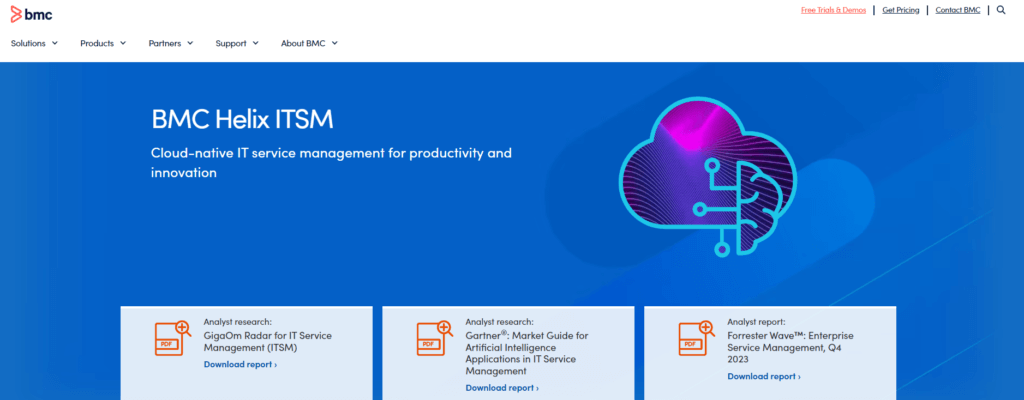
BMC Helix ITSM is part of the wider BMC Helix service management and operations ecosystem. The platform helps IT teams manage service desk activity, asset management, change management, knowledge management, service requests, and operational workflows from a centralized environment.
The product has evolved from BMC’s long-standing ITSM heritage into a modern service management suite with cloud-native capabilities, AI assistance, automation, and ServiceOps positioning. Instead of focusing only on ticket resolution, BMC Helix ITSM is designed to help IT teams connect service management with operations, governance, and business service reliability.
Who Is BMC Helix ITSM Best For?
BMC Helix ITSM is best suited for medium to large organizations with structured IT processes and more demanding operational requirements. It makes the most sense when your IT environment includes multiple service teams, complex approval workflows, strict compliance needs, and a large volume of incidents or service requests.
- Large enterprises with mature ITSM processes
- IT teams that follow ITIL-based workflows
- Organizations that need CMDB and asset management
- Regulated industries such as finance, healthcare, and government
- Companies looking to connect ITSM with IT operations and automation
It is less ideal for small teams that want a lightweight support desk with fast setup and transparent per-user pricing. In those cases, tools like Freshservice, Jira Service Management, or monday service may feel easier to adopt.
Software Specification
Core Features of BMC Helix ITSM
BMC Helix ITSM is feature-rich, but its value comes from how those features work together. The platform is strongest when used as a complete IT service management environment, not as a standalone ticketing tool.
Incident and Problem Management
BMC Helix ITSM helps IT teams capture, categorize, prioritize, assign, escalate, and resolve incidents. For large service desks, this is important because the quality of incident routing directly affects response time and user satisfaction.
The problem management capabilities help teams go beyond temporary fixes. You can investigate recurring issues, connect related incidents, document root causes, and reduce repeat disruptions. This is especially useful for organizations where downtime affects revenue, customer experience, or internal productivity.
Change and Release Management
Change management is one of the areas where BMC Helix ITSM is stronger than lighter help desk tools. The platform supports structured change workflows, approvals, risk review, scheduling, documentation, and release coordination.
For enterprise IT teams, this matters because poorly managed changes are one of the most common causes of service disruption. BMC Helix ITSM gives teams a more controlled way to evaluate change risk, involve the right stakeholders, and maintain audit-ready change records.
CMDB and Asset Management
BMC Helix ITSM can work with CMDB and asset management capabilities to help teams understand the relationships between users, services, infrastructure, applications, and business processes. This is a major advantage for companies that need visibility into how configuration items affect service delivery.
If your team already depends on a CMDB, BMC Helix ITSM can help connect service tickets to configuration data. This gives analysts better context when assessing incident impact, planning changes, or investigating service issues.
Service Request Management
The platform supports service request workflows that help employees request access, equipment, support, approvals, or internal services through a more standardized process. Instead of relying on email threads and manual routing, teams can create repeatable request paths with approvals and fulfillment steps.
This is particularly useful for IT departments that support many business units or locations. It can reduce inconsistent handling, improve visibility, and create better expectations for request fulfillment.
Knowledge Management
BMC Helix ITSM includes knowledge management capabilities that help teams capture known issues, resolution steps, service documentation, and user-facing answers. Strong knowledge management can reduce ticket volume by helping users and agents find answers faster.
For larger organizations, knowledge quality often becomes a competitive advantage inside the service desk. A well-maintained knowledge base helps new agents become productive faster and gives experienced teams a more consistent way to resolve recurring issues.
AI, HelixGPT, and Automation
BMC Helix ITSM has moved further into AI-assisted service management through HelixGPT and agentic AI capabilities. This can support use cases such as intelligent ticket handling, email response assistance, knowledge suggestions, summarization, and automation of repetitive service management actions.
The most important point is that AI is not useful only because it sounds modern. It is useful when it reduces manual work, improves routing quality, helps agents understand context faster, and supports better self-service. BMC Helix ITSM is strongest when AI is applied to real operational bottlenecks, not when it is treated as a decorative add-on.
Reporting and Analytics
BMC Helix ITSM gives IT leaders the reporting structure they need to track service performance, ticket trends, change activity, SLA performance, and operational bottlenecks. This helps managers move from reactive reporting to more informed service improvement.
For decision-makers, reporting is also important because ITSM performance must often be explained to business stakeholders. Metrics such as resolution time, request volume, change success rate, and recurring incident patterns can help IT teams justify investments and improve planning.
Pros and Cons
Benefits of Using BMC Helix ITSM
Positive
✅ Strong enterprise ITSM capabilities
✅ AI, automation, and ServiceOps depth
✅ Useful CMDB and asset context
✅ Strong fit for regulated environments
Negative
❌ Not ideal for simple help desk needs
❌ Pricing is not publicly transparent
❌ Implementation can be complex
❌ Admin training may be required
Pros
- Strong enterprise ITSM capabilities
BMC Helix ITSM covers incident, problem, change, asset, request, and knowledge management, making it a strong fit for mature IT departments. - AI, automation, and ServiceOps depth
The platform supports modern AI-assisted workflows and automation for teams that want to reduce repetitive manual work. - Useful CMDB and asset context
Teams can connect service activity with configuration and asset data, which improves incident analysis and change planning. - Strong fit for regulated environments
BMC Helix ITSM is better suited than many lightweight tools for organizations that need audit trails, access controls, and compliance support.
Cons
- Not ideal for simple help desk needs
Smaller teams may find the platform too advanced if they only need basic ticketing, email support, and a simple knowledge base. - Pricing is not publicly transparent
You need to contact BMC for a quote, which makes quick budget comparison harder. - Implementation can be complex
Large ITSM deployments require planning, configuration, workflow design, data migration, and stakeholder alignment. - Admin training may be required
To get the full value from the platform, teams may need experienced administrators or external implementation support.
User Experience
User Interface and Operational Simplicity
BMC Helix ITSM has a modern interface compared with older enterprise ITSM systems, but you should still evaluate it as a serious enterprise platform. It is not built to feel like a lightweight customer support inbox. It is built to support structured IT processes, multiple roles, approvals, records, analytics, and operational governance.
Agent Experience
For service desk agents, the value of the interface depends on how well the system is configured. When workflows, categories, knowledge articles, and routing rules are designed properly, agents can work with better context and fewer manual steps.
However, if implementation is rushed, the interface can feel heavy. This is not unique to BMC Helix ITSM. It is common with enterprise ITSM platforms. The user experience depends heavily on process design, data quality, role configuration, and training.
Self-Service Experience
BMC Helix ITSM can support self-service use cases through request catalogs, knowledge content, and AI-assisted experiences. This can help reduce ticket volume when employees can find answers, submit the right request, or receive guided support without contacting the service desk directly.
For self-service to work well, your team must invest in clean request forms, useful knowledge articles, and clear service catalog design. The software can support the experience, but content quality and governance determine how useful it becomes.
Customization and Role-Based Access
BMC Helix ITSM supports role-based experiences, which is important for enterprise teams. Different users, such as service desk agents, change managers, asset managers, approvers, and IT leaders, need different views and permissions.
This role-based structure improves security and usability because users do not need access to every feature. Instead, they can focus on the workflows, dashboards, and records that match their responsibilities.
Reporting Dashboards
Dashboards and reports help managers track operational health across service desk activity, SLA performance, unresolved tickets, change activity, and recurring service issues. For IT leaders, this visibility is one of the main reasons to choose a mature ITSM platform over a simpler help desk solution.
My recommendation is to define reporting needs before implementation. If you know which KPIs matter, such as first response time, mean time to resolution, change success rate, backlog size, and request fulfillment time, the platform can be configured in a way that supports better decision-making.
Pricing and Plans
How Much Does BMC Helix ITSM Cost?
BMC Helix ITSM does not publish simple public pricing plans on its main product page. Instead, pricing is usually quote-based and depends on your package, deployment model, number of users, license type, required modules, support needs, and implementation scope.
This pricing approach is common among enterprise ITSM platforms, but it does make comparison harder if you are evaluating tools quickly. If transparent pricing is a priority, alternatives like Freshservice, Jira Service Management, and ManageEngine ServiceDesk Plus may be easier to compare during the early research stage.
Pricing Factors to Consider
- Package selection: Features and entitlements can vary by selected service management package.
- License model: Enterprise licensing may involve named users, concurrent users, or other account structures.
- Deployment needs: SaaS, private cloud, and on-premises requirements can affect cost.
- Implementation: Workflow design, migration, integrations, and training may add to total cost.
- AI and automation: Advanced AI use cases may require additional planning and technical setup.
Total Cost of Ownership
When evaluating BMC Helix ITSM pricing, do not look only at license cost. The total cost of ownership may include implementation services, administrator training, workflow configuration, integrations, data migration, governance planning, support, and ongoing optimization.
For large enterprises, this investment may be justified because the platform can support complex ITSM operations at scale. For small businesses, the same investment may be difficult to justify unless there is a clear need for enterprise-grade controls and ITIL process maturity.
Is BMC Helix ITSM Worth the Cost?
BMC Helix ITSM is worth considering if your team needs an enterprise service management platform with strong ITIL alignment, CMDB context, AI-assisted workflows, automation, and compliance support. It is less attractive if your main requirement is a simple, low-cost ticketing system.
The best way to evaluate pricing is to request a quote from BMC and compare it against your expected operational gains. Look at reduced downtime, faster incident resolution, improved change control, lower ticket volume through self-service, and better reporting for IT leadership.
Competitive Comparison
BMC Helix ITSM vs Other ITSM Tools
BMC Helix ITSM competes most directly with enterprise ITSM platforms such as Jira, but it can also be compared with modern service management tools like Jira Service Management, Freshservice, ManageEngine ServiceDesk Plus, and monday service.
| Tool | Best For | Main Strength | Potential Limitation |
| BMC Helix ITSM | Large enterprises and regulated IT teams | Enterprise ITSM, ServiceOps, AI, CMDB, change control | Complex setup and quote-based pricing |
| Jira Service Management | IT and DevOps teams | Strong connection between ITSM, development, and agile workflows | May require configuration for mature ITIL processes |
| Freshservice | Mid-market IT teams | Modern interface and faster adoption | Less suited for highly complex enterprise ServiceOps needs |
| ManageEngine ServiceDesk Plus | Value-focused IT departments | Good ITSM coverage at a more accessible price point | User experience can feel less modern than newer SaaS tools |
| monday service | Teams that want flexible service workflows | Ease of use and adaptable work management structure | Not as deep as traditional enterprise ITSM platforms |
If you are choosing between these platforms, the main question is not which tool has the longest feature list. The better question is how much ITSM maturity your organization actually needs. BMC Helix ITSM is strongest when process control, governance, scalability, and operational depth matter more than simplicity.
Security and Compliance
Enhanced Security Features in BMC Helix ITSM
Security and compliance are major buying factors for enterprise ITSM software. BMC Helix ITSM is often evaluated by organizations that need strong access controls, auditability, operational governance, and support for regulated environments.
Access Control and Governance
BMC Helix ITSM supports role-based access, which helps organizations control what users can view, edit, approve, or administer. This is important for protecting sensitive service records, change information, asset data, and operational documentation.
For large organizations, governance also matters because ITSM systems often contain business-critical information. A poorly controlled service management platform can expose internal systems, user data, operational dependencies, and security-related incident details.
Audit Trails and Compliance Reporting
BMC Helix ITSM can support compliance efforts through structured workflows, approvals, history tracking, change records, and reporting. These capabilities are important for teams that need to prove how incidents were handled, who approved a change, and whether processes followed internal policy.
Compliance is not only about having the right software. Your organization still needs proper configuration, retention policies, user permissions, and documented processes. BMC Helix ITSM gives you the foundation, but governance depends on how well the platform is implemented.
SOC 2 and Enterprise Trust Requirements
BMC’s documentation references SOC 2 reporting for BMC Helix services, which is important for buyers that need assurance around security controls, availability, confidentiality, and operational processes. This is especially relevant for enterprises that must satisfy vendor risk management and internal audit requirements.
Security Considerations Before Implementation
Before deploying BMC Helix ITSM, your team should define authentication requirements, permission models, data retention rules, integration access, administrator responsibilities, and audit reporting needs. These decisions should be made before rollout, not after users are already working in the system.
This is where BMC Helix ITSM can provide strong value for enterprise IT. It gives teams the tools to build controlled and auditable workflows, but the quality of the outcome depends on the quality of the implementation.
Conclusion
Final Thoughts
⭐ Overall Rating: 8.2/10
BMC Helix ITSM is a serious enterprise IT service management platform. It is not the simplest option, and it is not the most transparent from a pricing perspective. However, it is one of the stronger choices for organizations that need mature ITSM processes, AI-assisted workflows, CMDB context, change governance, compliance support, and ServiceOps capabilities.
The platform is best for medium to large enterprises, regulated industries, and IT teams with complex service delivery requirements. If your team has the resources to implement it properly, BMC Helix ITSM can become a central system for improving service quality, reducing operational risk, and creating more consistent IT processes.
However, smaller teams should be cautious. If you need a simple service desk, fast onboarding, and predictable pricing, BMC Helix ITSM may be more than you need. In that case, a tool like Freshservice, Jira Service Management, ManageEngine ServiceDesk Plus, or monday service may offer a better balance of usability and cost.
Our Recommendation
I would recommend BMC Helix ITSM to organizations that already understand the value of structured ITSM and want a platform that can support long-term maturity. It is especially compelling if you need enterprise-level incident management, change control, asset context, automation, AI assistance, and compliance readiness.
I would not recommend it as a first ITSM platform for a small team unless you have a clear roadmap, the budget for implementation, and internal ownership for administration. BMC Helix ITSM is powerful, but that power is most valuable when your organization is ready to use it properly.
Have more questions?
Frequently Asked Questions
What is BMC Helix ITSM?
BMC Helix ITSM is an enterprise IT service management platform for managing incidents, problems, changes, service requests, assets, knowledge, and IT operations workflows.
Who is BMC Helix ITSM best for?
BMC Helix ITSM is best for medium to large enterprises, regulated industries, and mature IT teams that need structured ITSM processes, automation, CMDB, change governance, and compliance support.
Is BMC Helix ITSM good for small businesses?
BMC Helix ITSM can be too complex and costly for many small businesses. Smaller teams may prefer a simpler ITSM or help desk platform with faster setup and transparent pricing.
How much does BMC Helix ITSM cost?
BMC Helix ITSM uses quote-based pricing. Costs depend on package selection, license type, deployment model, number of users, implementation scope, integrations, and support requirements.
Does BMC Helix ITSM include AI features?
Yes. BMC Helix ITSM supports AI-assisted service management through capabilities such as HelixGPT, intelligent recommendations, automation, knowledge assistance, and agentic AI use cases.
Does BMC Helix ITSM include CMDB capabilities?
BMC Helix ITSM can work with BMC Helix CMDB and asset management capabilities to connect service records with configuration items, assets, dependencies, and business services.
Is BMC Helix ITSM cloud-based?
BMC Helix ITSM is available as part of BMC Helix service management offerings and can support cloud-based and enterprise deployment needs, depending on your selected package and environment.
What are the main BMC Helix ITSM alternatives?
The main BMC Helix ITSM alternatives include Jira Service Management, Freshservice, ManageEngine ServiceDesk Plus, and monday service.
How long does BMC Helix ITSM implementation take?
Implementation time depends on your workflows, integrations, data migration, approval processes, CMDB structure, and customization needs. Enterprise deployments usually require careful planning and phased rollout.