Introduction
Choosing an HR platform is no longer just about storing employee records. It affects how quickly you can onboard people, how well managers run performance conversations, how clearly leadership can understand workforce trends, and how easily your company can scale across teams, regions, and policies. In this HiBob review, you will get a practical look at what Bob offers, where it stands out, where it falls short, and which kind of company will get the most value from it.
HiBob, which sells its platform as Bob, is not trying to be a stripped-down HR tool for very small teams. It is built more deliberately for modern mid-sized and multinational businesses that want stronger Core HR processes, better employee experience, more flexible workflows, and a more polished system than many legacy HR platforms provide. That positioning is exactly why HiBob remains one of the most interesting HR software options in 2026.
What Is HiBob?
HiBob is a modern HR platform designed to help you manage employee data, onboarding, time off, time and attendance, performance, compensation, engagement, and workforce planning in one connected system. You can use it to centralize people data, automate HR workflows, improve manager visibility, and give employees a more intuitive self-service experience.
Its biggest strength is balance. Many HR systems are either simple but limited or powerful but overly complex. Bob aims to sit between those two extremes. It offers enough depth for scaling organizations while still feeling more modern and employee-friendly than many traditional enterprise HR platforms.
Background and Positioning
HiBob positions Bob as a platform for modern, fast-growing, and globally distributed businesses. Its current product structure goes beyond Core HR and now includes Talent, Payroll Hub, Workforce Planning, Compensation, Hiring, Sandbox, and Learning. That broader scope shows that Bob is no longer just an HRIS with a nice interface. It is increasingly trying to cover strategic people operations as well.
Target Users and Use Cases
HiBob is especially relevant for several buyer types:
- Mid-sized businesses – You get more structure and scalability than basic HR software typically offers.
- Multinational companies – Bob is built with global teams, local policies, and payroll flexibility in mind.
- People teams focused on employee experience – The platform emphasizes culture, engagement, and usability.
- HR leaders who want better visibility – Analytics, org visibility, and workforce planning tools are meaningful strengths.
- Companies outgrowing lightweight HR tools – Bob is a better fit when your people operations are becoming more complex.
That said, HiBob is not the best fit if you want simple self-serve pricing, a very low-cost HR tool, or a highly specialized payroll engine for every country inside one native system. It is strongest when you want modern HR software with configurable workflows, employee-facing usability, and flexible payroll connectivity.
Core Features of Bob
How Does HiBob Work?
HiBob stands out because it combines Core HR, employee experience, manager workflows, analytics, and planning in one system. The value is not just that it stores people’s data. It helps you run a more connected people operation across the full employee lifecycle.
Core HR and Employee Data Management
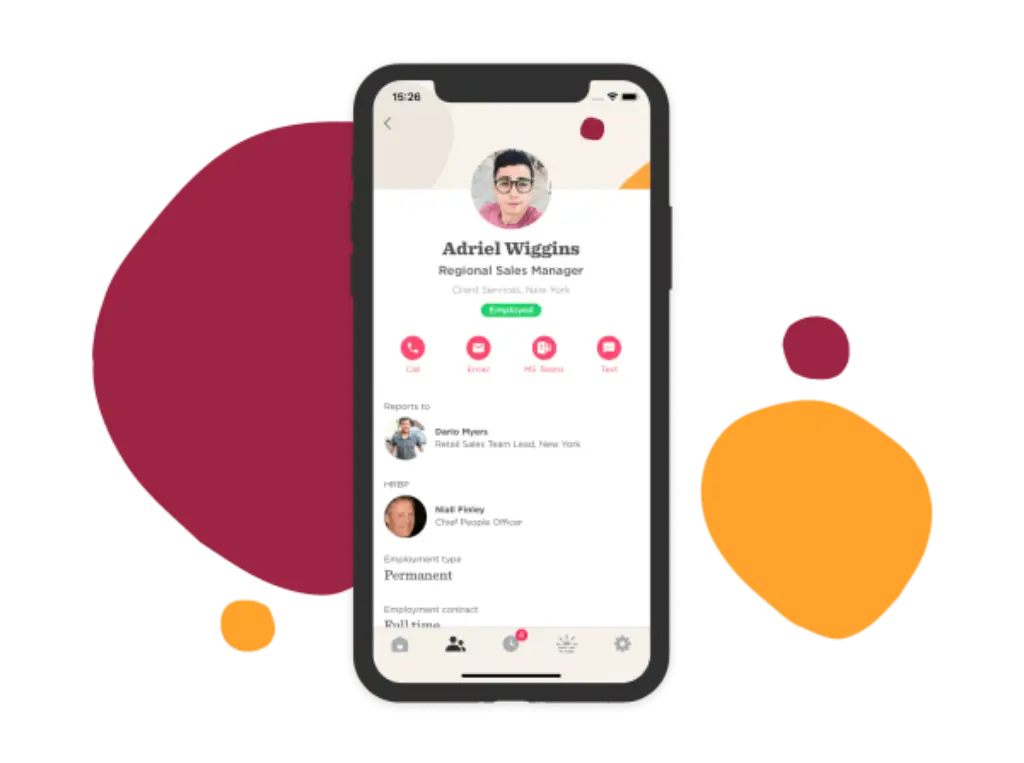
Bob gives you a central employee record system for people data, documents, org visibility, tasks, and reporting. This is the foundation of the platform, and it is where HiBob makes the strongest first impression. The interface is cleaner and more approachable than many HR platforms, which matters because employee adoption is often one of the biggest hidden problems in HR software.
Onboarding and Preboarding Workflows
Onboarding is one of Bob’s strongest use cases. You can build automated onboarding checklists, assign tasks across HR, IT, finance, and managers, customize workflows by team or location, and support preboarding before an employee’s first day. For growing companies, that kind of process consistency can save a lot of manual work while improving the new hire experience.
Performance Management and Goals
HiBob’s Talent functionality includes performance reviews, goals, 1-on-1s, calibration, and AI-powered summaries and insights. This is a meaningful strength because it connects performance conversations to the rest of the employee record instead of forcing your team into disconnected point tools. In practice, though, this is also one of the areas where some user reviews say Bob still has room to improve compared with more specialized performance management platforms.
Analytics and Reporting
Bob includes customizable reports, dashboards, and people analytics that help HR teams and managers make more informed decisions. This is one of the platform’s stronger selling points in user reviews, especially for companies that want to move away from spreadsheets and disconnected systems. The platform is not just a record keeper. It is designed to turn workforce data into something more operationally useful.
Employee Engagement and Culture Tools
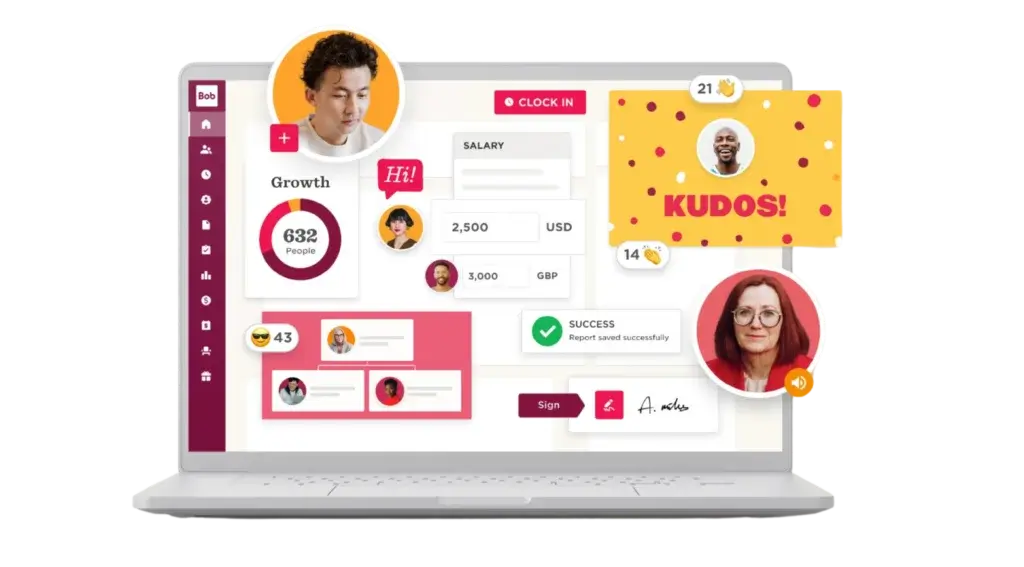
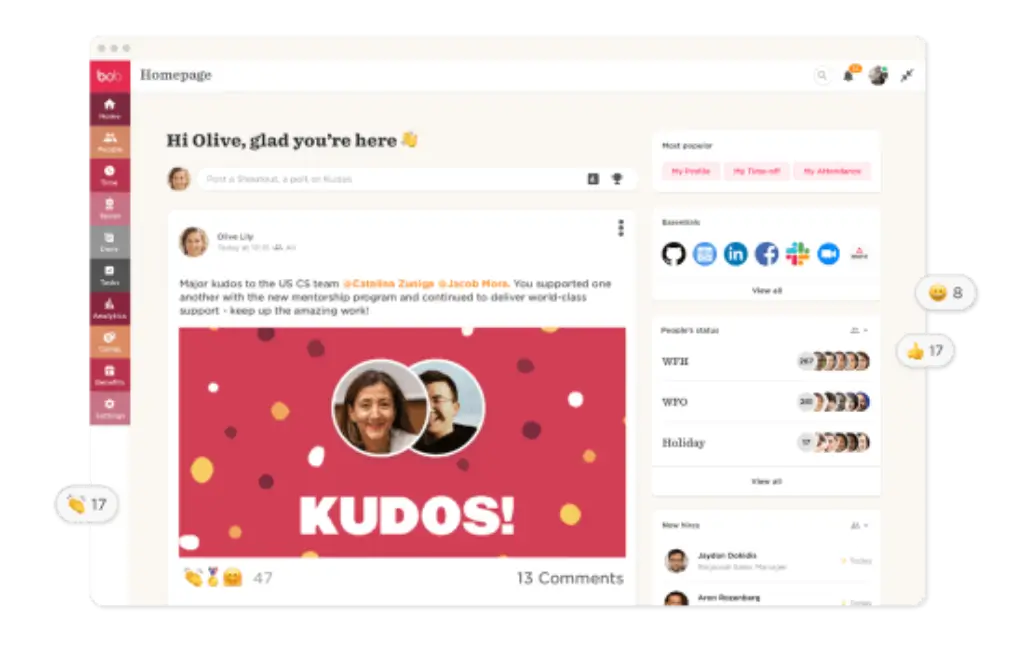
Bob has always leaned more heavily into employee experience than many HR systems. Features like surveys, shoutouts, people directory, org chart visibility, and culture-focused onboarding flows help the platform feel more people-centered. For hybrid and multinational businesses, this can make a noticeable difference in adoption and perceived value.
Compensation and Workforce Planning
HiBob has expanded beyond standard HR administration into compensation management and workforce planning. The current product direction includes compensation bands, cycle workflows, budget guardrails, interactive org views, scenario planning, and position management. That makes Bob more relevant not only to HR teams but also to finance stakeholders and managers involved in growth planning.
Time Off Management
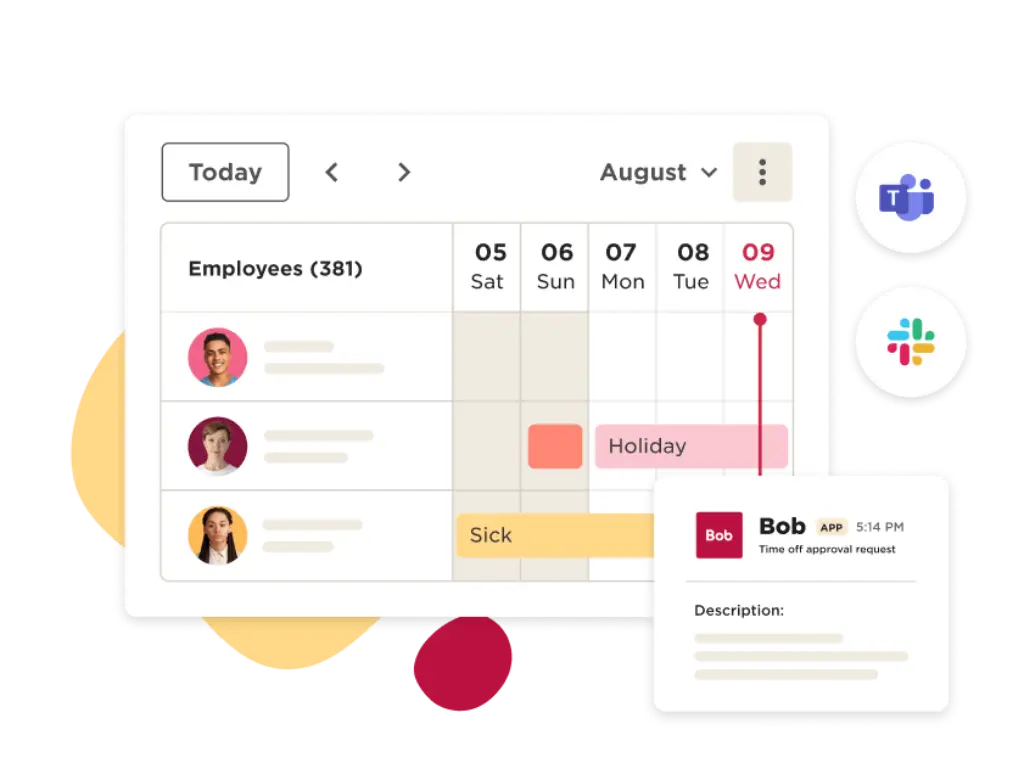
Time Off is included as part of Bob’s Core HR functionality, which is important for buyers evaluating the base platform. Employees can request holiday, sick leave, PTO, and parental leave, while managers can approve requests in the flow of work through Slack, Microsoft Teams, or the Bob app. The calendar and reporting views also make it easier to understand who is out and when.
Time and Attendance
Bob also includes time tracking and attendance capabilities for companies that need them. Employees can clock in and clock out, edit entries, fix missed punches, and log hours via desktop or mobile. Managers can review attendance data, approve submissions, and export reports for payroll. This makes Bob more operationally useful than HR platforms that only handle leave requests and employee records.
Business Operations Features
HiBob Payroll, Planning, and Integrations
One of the most important things to understand about HiBob is that its payroll story is more nuanced than some buyers may expect. Bob does not position itself as one universal native payroll engine for every country. Instead, it combines native payroll in selected markets with Payroll Hub integrations and no-code payroll connectivity.
Payroll Hub
Payroll Hub is Bob’s centralized payroll connection layer. It is designed to sync employee and payroll data, reduce manual errors, and connect with payroll providers such as ADP, Paylocity, TriNet, and Xero. HiBob also offers Payroll Connect, a no-code setup approach for third-party systems. This makes payroll more flexible, but it also means you need to verify exactly how payroll will work in your region before you buy.
Native Payroll in Selected Regions
HiBob now promotes UK Payroll and also points buyers toward US payroll options. That is an important development because it shows Bob expanding beyond integration-only payroll workflows. Still, the broader message is that HiBob wants to be your HR source of truth with strong payroll connectivity, not necessarily the only payroll engine for every international use case.
Benefits and Payroll Data Sync
Payroll Hub also supports benefits administration syncing, helping connect employee changes, benefits data, and payroll cycles in one process. For growing companies managing multiple systems, this can reduce the duplicate data entry that often creates HR and payroll friction.
Workforce Planning for Growing Teams
The workforce planning layer adds more strategic depth than many HR buyers may expect from HiBob. You can create headcount plans, model scenarios, compare organizational structures, and manage positions with more visibility. For companies scaling fast, this is one of the clearest signs that Bob is moving beyond classic HR admin and toward broader people planning.
Integrations and Ecosystem
HiBob integrates with payroll systems, ATS tools, communication platforms, identity tools, learning systems, and workflow products. It also supports integrations with Slack and Microsoft Teams in multiple areas, including time off and time tracking workflows. In practical terms, that makes Bob easier to fit into your existing stack than a more closed HR platform.
Pros and Cons
Benefits and Limitations of Using HiBob
Positive
✅ Modern and highly usable interface
✅ Strong employee experience layer
✅ Good global and mid-market fit
✅ Flexible payroll strategy
Negative
❌ Pricing transparency is limited
❌ Module packaging can complicate budgeting
❌ Navigation still has room to improve
❌ Payroll clarity matters
Strengths & Benefits
HiBob gets a lot right if your company has moved beyond basic HR administration and needs a more scalable platform.
- Modern and highly usable interface – Bob is easier to navigate than many legacy HR platforms, which helps employee and manager adoption.
- Strong employee experience layer – Surveys, shoutouts, org visibility, and onboarding workflows make the platform feel more engaging.
- Good global and mid-market fit – Bob is designed with multinational, hybrid, and fast-growing companies in mind.
- Flexible payroll strategy – Payroll Hub and supported payroll options are practical for companies with multiple systems or regional needs.
Limitations & Drawbacks
HiBob is a strong platform, but it is not automatically the best fit for every HR buyer.
- Pricing transparency is limited – You need to go through sales to understand total cost.
- Module packaging can complicate budgeting – Costs may increase as you add planning, compensation, payroll, or other capabilities.
- Navigation still has room to improve – Even strong overall reviews sometimes mention clicking across multiple menus.
- Payroll clarity matters – You should confirm what is native, what is integrated, and what requires regional workarounds before committing.
Operational Fit
HiBob User Experience, Support, and Security
Software fit is not only about features. It also depends on how easy the system is to adopt, how much work implementation takes, and whether your organization can trust the vendor with sensitive employee data.
Ease of Use
Ease of use is one of Bob’s strongest recurring themes in customer reviews. Users regularly mention the modern interface, clear dashboards, better visibility into org structure, and easier access to everyday tasks like time off, documents, and people information. That ease of use is one of the clearest reasons why HiBob has become so popular with scaling companies.
Implementation Experience
Implementation appears to be more manageable than many large HCM rollouts, but not effortless. The platform’s flexibility is part of its value, yet that flexibility also means setup decisions matter. If you are rolling out onboarding workflows, payroll connections, performance processes, and regional policies all at once, implementation can still require careful planning.
Customer Support
User feedback on support is generally positive, especially from teams that value responsiveness and product guidance. At the same time, as with many SaaS platforms, the support experience can vary depending on the complexity of your setup and the expectations you bring into implementation. Support should not be seen as a weakness here, but it also should not be treated as a substitute for good rollout planning.
Security and Compliance
HiBob makes a credible case on security. It publicly highlights SOC 2 Type II, ISO 27001:2022, and ISO 27018:2019, along with encryption in transit and at rest, role-based access controls, enterprise SSO options, GDPR alignment, and daily backups. The company states that data is hosted primarily in AWS data centers in Ireland with backup in Germany. For global HR buyers, this is one of the platform’s stronger trust signals.
AI Trust and Governance
HiBob is also putting more emphasis on AI governance. Its AI trust materials say customer data is not used to train public third-party generative AI models, and describe zero-retention handling, data isolation, opt-out controls, encryption, and role-based access. This matters because HR buyers are increasingly asking not just whether a platform has AI, but whether those AI features are governed responsibly.
Pricing
HiBob Pricing & Plans
HiBob pricing is one of the least transparent parts of the buying process. The company does not publish public plan prices. Instead, it offers custom pricing based on your company size and the modules you choose. All packages include Core HR and Digital Admin, but advanced capabilities are modular.
What HiBob Includes
The current pricing flow highlights Bob Core, Workforce Planning, Hiring, Payroll Hub, Talent, Compensation, Compensation Benchmarking, Sandbox, and Learning. This makes it clear that HiBob is selling a configurable platform rather than a simple fixed plan bundle.
What Affects Total Cost
Your total cost will likely depend on headcount, selected modules, implementation scope, payroll requirements, and the complexity of your workflows. That means two companies can have very different HiBob costs even if they are evaluating the same core product.
What to Ask Before You Buy
If you are considering HiBob, make sure you ask about implementation fees, support levels, module packaging, payroll support in your countries, API and integration availability, and how pricing changes as you scale. These questions matter because custom pricing can hide meaningful cost differences between the initial quote and the long-term reality.
Pricing Table
The table below gives a practical view of how HiBob’s pricing approach works today.
| Feature Type | HiBob | What it means for buyers |
| Pricing model | Custom pricing | You need to speak with sales to get a quote |
| Core package | Core HR and Digital Admin included | Basic HR foundation is part of every package |
| Advanced capabilities | Sold through modules | Talent, Payroll Hub, Planning, and Compensation may increase total cost |
| Payroll approach | Mix of native payroll and integrations | You should confirm region-specific payroll coverage early |
| Best for | Mid-market and multinational companies | Better fit for scaling organizations than very small teams |
For many buyers, the real question is not whether HiBob can justify its likely premium pricing, but whether your organization is mature enough to benefit from what it offers. If you only need a simple HR tool, HiBob may feel expensive. If you need modern workflows, employee engagement, better visibility, and global readiness, the value proposition becomes easier to understand.
Use Cases
Who Should Use HiBob?
HiBob is not for every business, but it fits several kinds of buyers especially well.
Mid-Sized Companies Ready to Scale
If your team has outgrown entry-level HR software and now needs more structure around onboarding, manager workflows, people analytics, and performance, HiBob is a strong fit. This is arguably the product’s sweet spot.
Multinational and Hybrid Organizations
Bob is a natural fit for companies with multiple sites, distributed teams, and more than one set of local policies to manage. Its product positioning, payroll approach, and culture-focused features all point in this direction.
HR Teams That Care About Employee Experience
If you want an HR platform that employees will actually use, HiBob deserves serious consideration. The interface, org visibility, shoutouts, surveys, and onboarding experience give it a more human feel than many more transactional HR systems.
When HiBob Might Not Be Right
HiBob may not be the best choice if you need very simple payroll and HR at the lowest possible cost, if you require full price transparency before taking a demo, or if you want highly specialized best-of-breed performance management above all else. In those cases, another platform may fit more naturally.
User Feedback
HiBob Customer Reviews
HiBob reviews are strong overall. Public review snapshots currently show around 4.5 out of 5 on G2 from more than 2,200 reviews and around 4.6 out of 5 on Capterra from 173 reviews. That kind of review volume gives Bob more credibility than HR tools with only a small review footprint.
What Users Like Most
The most common positives in public reviews include Bob’s intuitive interface, centralized HR data, good reporting, strong customization, people analytics, and the fact that it brings together workflows like time off, employee information, performance, and surveys in one place. Many users also say the platform feels more modern than the HR tools they replaced.
Common Complaints
The most common drawbacks are also fairly consistent. Some users say navigation could be smoother, some feel performance feedback and goal tracking still need more depth, and others point to pricing or add-on costs as the biggest barrier. There are also occasional comments that the mobile app is more limited than the desktop experience.
My Take on the Review Pattern
The review trend suggests that HiBob’s main weakness is not poor quality. It is that the platform can create higher expectations because it does many things well at once. Buyers should go in understanding that Bob is strongest as a modern, well-balanced HR platform, not necessarily as the absolute deepest specialist in every single HR subcategory.
Competitors
Competitor Alternatives to HiBob
HiBob is most often compared with platforms like BambooHR, Rippling, and Workday. The right alternative depends on whether you care most about simplicity, IT and payroll control, global scale, or employee experience.
| Feature Type | HiBob | BambooHR | Rippling | Workday |
| Core angle | Modern HR platform for mid-market teams | Simpler HR software for SMBs | HR, IT, and payroll operations platform | Enterprise HCM suite |
| Best for | Scaling and multinational companies | Smaller and less complex businesses | Ops-heavy companies wanting deep system control | Large enterprises with broad HCM needs |
| User experience | Modern and employee-friendly | Clean and approachable | Strong but more operationally dense | Powerful but often more complex |
| Payroll approach | Native in selected regions plus Payroll Hub integrations | Varies by market and add-ons | Stronger all-in-one payroll and IT story | Enterprise payroll and HCM depth |
| Planning depth | Growing workforce planning and compensation tools | More limited for strategic planning | Strong operational automation | Very strong enterprise planning depth |
| Overall angle | Best balance of modern UX and HR depth | Best for simpler HR needs | Best for companies wanting one ops platform | Best for large enterprise complexity |
Compared with BambooHR, HiBob usually makes more sense for companies that need stronger global readiness, more configurability, and a more strategic people platform. Compared with Rippling, HiBob often feels more HR- and employee-experience-centric, while Rippling is stronger if you want deeper IT and device management alongside HR. Compared with Workday, HiBob is usually easier to adopt and more approachable for mid-market companies, while Workday remains the heavier enterprise option for large organizations with more complex HCM requirements.
If I had to summarize it simply, HiBob is one of the better choices for companies that want modern HR software with enough depth to scale, but without the weight of a traditional enterprise suite.
Best Practices
Getting Started with HiBob
To get the most out of HiBob, you should make a few smart decisions early.
Define Your Core Use Cases First
Bob is broad enough that it can become many things at once. Before implementation, decide whether your main priorities are Core HR, onboarding, payroll sync, performance, compensation, or planning. That will help you scope the rollout more intelligently.
Clarify Payroll Early
Do not assume every payroll need is handled the same way in every country. Ask early whether you will be using native payroll, Payroll Hub, or third-party integrations, and map those decisions against your operating regions.
Use Workflows to Standardize Processes
HiBob becomes much more valuable when you use its automation and workflow flexibility. Onboarding tasks, manager approvals, performance cycles, and people data updates are much stronger when they are standardized from the beginning.
Invest in Manager Adoption
Bob is not only an HR admin tool. It is designed to support managers with visibility, 1-on-1s, goals, and team insights. If managers are trained well, the platform’s value expands far beyond HR operations.
Plan for Growth, Not Just Current Needs
If you choose Bob, do not evaluate it only for what your company looks like today. Evaluate it for the next phase of growth as well. The platform makes the most sense when you expect your workflows, organizational complexity, and people planning needs to become more demanding over time.
Conclusion
Final Thoughts
⭐ Overall Rating: 9.8/10
HiBob remains one of the strongest modern HR platforms because it solves a very real problem in the market. Many companies outgrow basic HR tools before they are ready for the complexity of a traditional enterprise HCM. Bob sits in that gap extremely well.
Its biggest strengths are usability, employee experience, onboarding, people analytics, planning direction, and its fit for scaling mid-market and multinational businesses. Its biggest drawbacks are pricing transparency, the likelihood of add-on costs, and the fact that some areas, especially performance, may still feel less specialized than best-of-breed alternatives.
Overall, HiBob is a strong recommendation for companies that want a modern HR platform built for growth, flexibility, and better employee experience. If your organization is past the basics and needs a more strategic HR system without going full enterprise heavyweight, HiBob is well worth considering.
Have more questions?
Frequently Asked Questions
What is HiBob best used for?
HiBob is best used for managing Core HR, onboarding, time off, employee engagement, performance processes, and people analytics in one modern HR platform.
Is HiBob good for small businesses?
It can work for some smaller teams, but HiBob is generally a better fit for mid-sized and growing companies than for very small businesses looking for a simple low-cost HR tool.
Does HiBob include payroll?
HiBob supports payroll through a mix of native payroll in selected regions and Payroll Hub integrations with third-party payroll providers. You should confirm the exact payroll setup for your country before buying.
How much does HiBob cost?
HiBob uses custom pricing. The company does not publish standard public plan prices, so you need to request a quote based on your headcount and modules.
Is HiBob easy to use?
Yes. Ease of use is one of the platform’s biggest strengths and one of the most common positive themes in customer reviews.
Does HiBob support multinational companies?
Yes. HiBob is specifically positioned for modern and global organizations, and its workflows, payroll strategy, and planning tools reflect that.
What are the main HiBob alternatives?
The main alternatives usually include BambooHR, Rippling, and Workday, depending on whether you prioritize simplicity, operational control, or enterprise-scale depth.
Does HiBob offer performance management?
Yes. HiBob includes performance reviews, goals, calibration, 1-on-1s, and AI-powered summaries as part of its Talent-related capabilities.
Does HiBob integrate with payroll and other business tools?
Yes. HiBob integrates with payroll providers, collaboration tools, ATS software, and other business systems so it can fit into a broader HR tech stack.
Is HiBob worth it overall?
Yes, for the right buyer. If your company is growing and needs a more capable HR platform with modern UX, stronger workflows, and better people visibility, HiBob is worth serious consideration.