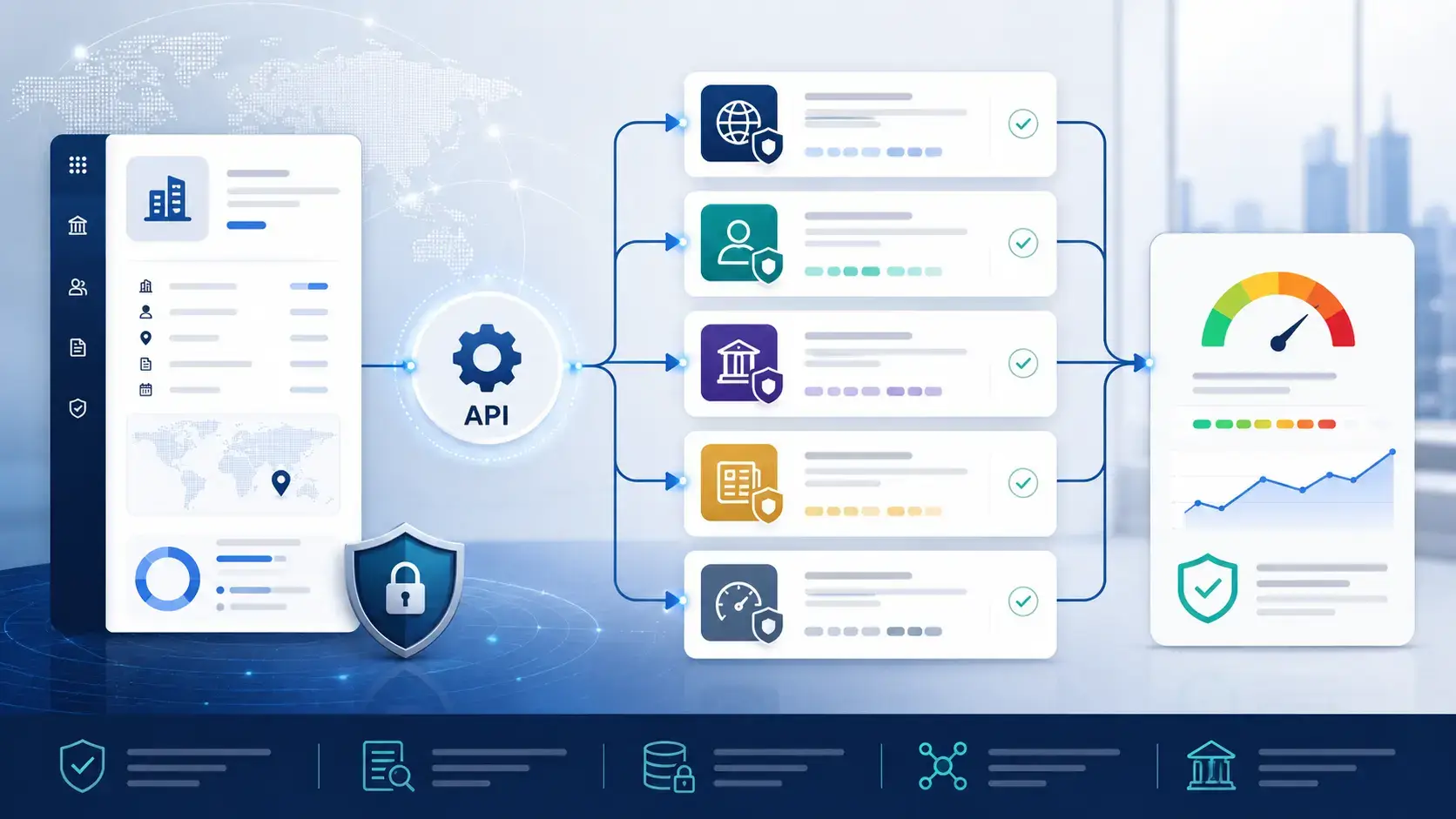
Choosing the right due diligence API is not only a technical decision. It is a compliance, legal, onboarding, procurement, and risk management decision.
The best API depends on what you need to automate. Some teams need fast sanctions and PEP matching inside an onboarding flow. Others need KYB data to verify companies, directors, and beneficial owners. More advanced teams need adverse media, litigation checks, source-backed reporting, audit trails, and risk scoring that legal or compliance teams can actually defend.
This guide compares the best due diligence APIs for sanctions screening, PEP screening, KYB, business verification, adverse media screening, and compliance workflow automation in 2026.
The main takeaway is simple: APIs are excellent when you need screening inside your internal systems. But when your team needs a clear, shareable due diligence report with confidence grading, source citations, and a risk matrix, a report-based platform such as DueVestor API can be a stronger fit than a raw data API.
You can also compare broader platforms in our guide to the best due diligence software.
What Is a Due Diligence API?
A due diligence API is an application programming interface that lets your internal systems automatically check people, companies, vendors, investors, customers, beneficial owners, or counterparties against risk data sources.
Instead of asking a compliance analyst to search names manually, upload spreadsheets, or copy information between systems, your product or compliance workflow can send a request to an API and receive structured results.
For example, your onboarding system might send a company name, country, registration number, or owner name to a due diligence API. The API can then return information such as possible sanctions matches, PEP exposure, business registry details, adverse media references, watchlist results, risk categories, or a confidence score.
This matters because manual checks do not scale well. They are slow, inconsistent, difficult to audit, and highly dependent on analyst experience.
A due diligence API is especially useful when you need to screen:
- New customers before account approval
- Vendors before procurement onboarding
- Investors before fundraising or cap table approval
- Business clients during KYB onboarding
- Ultimate beneficial owners and directors
- Partners, brokers, agents, and intermediaries
- Acquisition targets before deeper legal review
For technical buyers, the main value is automation. For compliance teams, the main value is consistency. For legal teams, the main value is defensible documentation.
The challenge is that not every compliance API solves the same problem. A sanctions screening API is not the same as a KYB API. A KYB API is not the same as an adverse media API. A raw data API is not the same as a due diligence report API.
What Should a Due Diligence API Check?
A strong due diligence API should check more than a name against a single watchlist. Risk is rarely visible through one data point.
A company might pass a basic sanctions check but still have litigation exposure, ownership concerns, negative news, suspicious associated people, or high-risk jurisdiction links. A person might not be sanctioned but may be a politically exposed person, a close associate of a PEP, or connected to adverse media.
At minimum, a due diligence API should help you check several risk layers.
Sanctions and watchlist screening
Sanctions screening checks people and companies against lists maintained by authorities such as OFAC, the United Nations, the European Union, the United Kingdom, and other national or regional bodies.
This is often the first layer of compliance screening because sanctions exposure can create serious legal and financial risk. For software buyers, the key questions are coverage, update frequency, fuzzy matching quality, alias handling, transliteration support, and audit logging.
You should also check whether the API supports batch screening, ongoing monitoring, and re-screening when lists change.
PEP screening
PEP screening identifies politically exposed persons and related parties, including current or former government officials, senior public executives, family members, and close associates.
PEP exposure does not automatically mean a person is prohibited. It means they may require a higher level of review under a risk-based compliance process.
A useful PEP screening API should provide context, not only a binary flag. You want to know the role, country, status, source, relationship type, and whether the PEP exposure is current or historical.
KYB and business verification
A KYB API helps you verify whether a business is real, active, registered, and connected to the people claiming to represent it.
For business onboarding, this usually includes company name, address, registration status, tax ID, incorporation details, industry data, directors, officers, beneficial owners, and sometimes document collection.
KYB APIs are especially important for fintech, marketplaces, B2B payments, lending, procurement, affiliate programs, SaaS reseller networks, and any business that onboards companies at scale.
UBO and associated-person verification
Ultimate beneficial owner verification helps you identify the people who ultimately own or control a company.
This is important because risk may sit behind the company, not only inside the company record. A vendor, investor, or customer may look clean at the entity level while a beneficial owner, director, or controlling person creates exposure.
A strong due diligence API should help connect the company to associated people and then screen those people against sanctions, PEP, adverse media, and watchlist data.
Adverse media screening
Adverse media screening checks news and other media sources for risk signals involving fraud, corruption, bribery, money laundering, sanctions evasion, lawsuits, regulatory action, financial crime, terrorism financing, ESG issues, or reputational problems.
This is one of the hardest areas to automate because media content is unstructured, multilingual, often duplicated, and full of false positives.
A useful adverse media API should support entity resolution, source transparency, relevance scoring, risk categorization, date filtering, and clear links back to the underlying sources.
Litigation, enforcement, and regulatory records
Litigation and enforcement checks are highly valuable for vendor onboarding, M&A diligence, investor vetting, and partner review.
Many screening APIs focus mainly on sanctions and PEP data. That may be enough for basic AML workflows, but it may not be enough for broader corporate due diligence.
If your team needs to understand legal, operational, and reputational exposure, litigation and enforcement data should be part of the review.
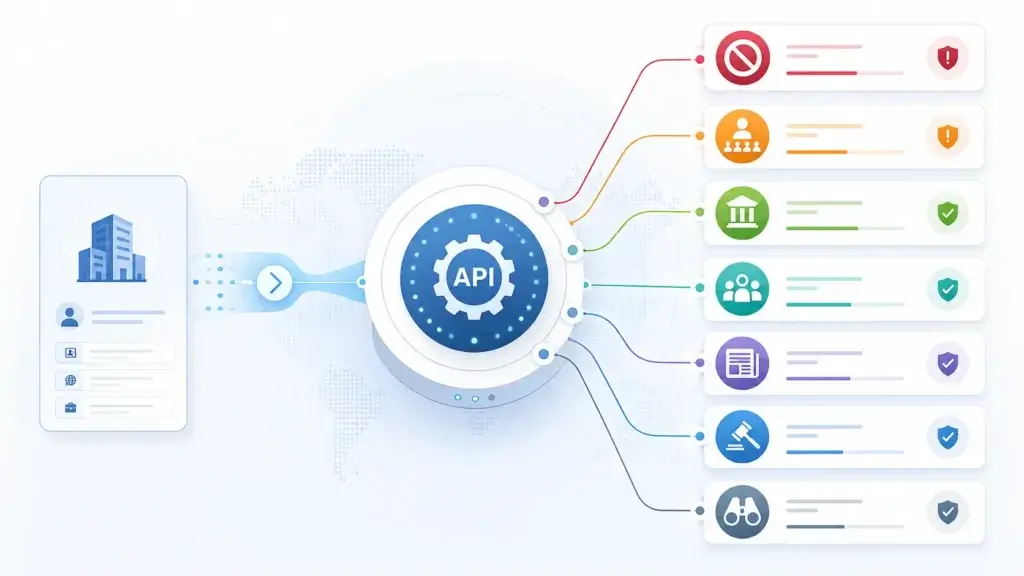
Best Due Diligence APIs in 2026
The best due diligence API depends on your workflow, risk model, data coverage needs, and final output requirements.
If you need raw screening results inside your app, OpenSanctions, ComplyAdvantage, Persona, LexisNexis, Middesk, and Enigma are all relevant options. If you need a structured due diligence report with sources, confidence grading, and review-ready output, DueVestor API is the strongest fit.
DueVestor API – Best for Report-Based Due Diligence
DueVestor API is best for teams that need more than a match result. It is designed for source-backed due diligence reports that combine sanctions, PEP, registry, litigation, and adverse media data into structured outputs.
This makes it useful for compliance teams, legal teams, investment teams, procurement teams, and businesses that need to vet entities before entering a relationship.
Where many APIs return data points, alerts, or possible matches, DueVestor is stronger when the workflow needs an explainable report. That is important when the output needs to be reviewed by a human decision-maker, shared with legal, attached to an investment memo, used in procurement review, or stored for audit purposes.
DueVestor is especially relevant for:
- Investor vetting before funding or cap table approval
- M&A target screening before deeper diligence
- Vendor and third-party onboarding
- Enhanced due diligence on higher-risk entities
- Partner, broker, agent, and intermediary review
- Compliance files that need shareable documentation
The key advantage is the report-first structure. A compliance analyst does not only want a JSON object that says “possible match.” They need to understand what was found, which sources support it, how confident the system is, what the risk level means, and whether the result should be escalated.
This is where DueVestor fits well. It can help turn API-based screening into a more complete due diligence workflow.
DueVestor is also a good fit if you are building an internal compliance system and want to embed due diligence outputs into a CRM, investor onboarding portal, procurement workflow, legal review process, or GRC system.
DueVestor API strengths
- Combines multiple due diligence layers in one workflow
- Useful for sanctions, PEP, registry, litigation, and adverse media checks
- Stronger output for legal, compliance, investment, and procurement review
- Designed for source-backed reporting rather than raw alerts only
- Good fit for enhanced due diligence and third-party vetting
DueVestor API limitations
DueVestor is not the best choice if you only need a lightweight sanctions database or a basic PEP matching endpoint. In that case, OpenSanctions may be simpler and more direct.
DueVestor is better when you need context, reporting, escalation support, and a final output that can be reviewed by non-technical stakeholders.
OpenSanctions – Best for Sanctions and PEP Data
OpenSanctions is one of the most useful options if your main need is sanctions, PEP, debarment, and watchlist data.
It is especially attractive for technical teams that want to integrate entity matching into an existing screening product, compliance workflow, onboarding system, investigative tool, or internal database.
OpenSanctions is not trying to be a complete due diligence report system. Its value is data access and entity matching. You can search the database, conduct batch screening, and check people or companies against sanctions lists and PEP-linked data.
The OpenSanctions API is a good fit when your team already has compliance analysts, case management, escalation rules, and reporting processes in place. In that setup, OpenSanctions can become the data layer behind your own workflow.
OpenSanctions strengths
- Strong fit for sanctions and PEP entity matching
- Useful API access for developers and data teams
- Supports screening people and companies
- Relevant for batch screening and internal tooling
- Good option when you want a focused data layer
OpenSanctions limitations
OpenSanctions is not the best fit if you need a complete KYB onboarding flow, guided case management, business document collection, litigation review, or a board-ready due diligence report.
It is excellent for matching and data access, but your team still needs to design the workflow around the data.
ComplyAdvantage – Best for AML Screening Workflows
ComplyAdvantage is best for companies that need AML screening embedded into customer onboarding, transaction workflows, compliance operations, and ongoing monitoring.
Its API and Mesh platform are designed for regulated companies that need to screen customers, monitor risk, manage alerts, and support operational compliance processes.
ComplyAdvantage is especially relevant for fintech companies, banks, payments companies, lending platforms, crypto businesses, marketplaces, and other organizations that need AML workflows at scale.
Its strength is not only the API endpoint. It is the broader compliance operating model around screening configurations, risk scoring, cases, alerts, and monitoring.
This makes ComplyAdvantage a strong choice if your team wants API-first integration but also needs a platform that compliance users can work inside.
ComplyAdvantage strengths
- Strong AML screening and monitoring workflows
- Useful for sanctions, PEP, watchlist, and adverse media checks
- API-first integration for customer screening
- Case management and alert review capabilities
- Good fit for regulated financial services teams
ComplyAdvantage limitations
ComplyAdvantage may be more than you need if your use case is occasional investor vetting, vendor review, or one-off due diligence reports.
It is strongest when AML screening is part of a recurring operational workflow. If your primary goal is a source-backed report for legal or investment review, DueVestor may be more practical.
Persona – Best for KYB and Business Onboarding
Persona is best for KYB and business onboarding workflows where you need to verify a company and the people behind it.
Persona is especially relevant when your onboarding process needs both business verification and associated-person verification. This can include directors, UBOs, business representatives, or other people linked to the company.
For product and engineering teams, Persona is attractive because it can support API-based identity verification, KYB workflows, KYC flows, case management, workflows, and user-facing verification experiences.
Persona is a strong option for marketplaces, fintech products, B2B platforms, payroll platforms, payment providers, embedded finance companies, and SaaS companies that onboard business customers.
Persona strengths
- Strong KYB and KYC workflow coverage
- Useful for business onboarding and associated people
- Supports business registry, tax, document, and watchlist checks
- Good fit for user-facing onboarding flows
- Flexible API and workflow automation options
Persona limitations
Persona is not mainly a corporate due diligence report platform. It is stronger for identity verification, business verification, onboarding flows, and compliance workflow orchestration.
If your team needs deep entity investigation with litigation, adverse media, ownership context, confidence grading, and a shareable report, you may still need a report-based due diligence layer.
LexisNexis – Best for Enterprise Risk Intelligence
LexisNexis is best for enterprise compliance teams that need mature risk intelligence data, broad source coverage, structured compliance datasets, and enterprise-grade screening infrastructure.
LexisNexis is especially relevant for larger organizations that need sanctions, PEP, adverse media, enforcement, and enhanced due diligence data across multiple risk programs.
For API buyers, the strength is data depth and enterprise credibility. LexisNexis is commonly evaluated by banks, insurers, global enterprises, regulated businesses, professional services firms, and large compliance teams.
The company’s risk and data products can support screening, monitoring, adverse media review, KYC, AML, enhanced due diligence, and broader risk intelligence programs.
LexisNexis strengths
- Strong enterprise risk intelligence coverage
- Useful for sanctions, PEP, adverse media, and enforcement data
- Good fit for large regulated organizations
- Broad data infrastructure and mature compliance positioning
- Relevant for AML, KYC, and enhanced due diligence programs
LexisNexis limitations
LexisNexis can be more complex and enterprise-oriented than smaller teams need. Pricing, implementation, procurement, and configuration may require more internal resources than lighter API tools.
It is a strong choice when your organization has enterprise compliance requirements. It may be less practical when you need a self-serve due diligence report or fast implementation for a smaller team.
Middesk – Best for U.S. Business Verification and KYB Automation
Middesk is best for companies that need U.S.-focused business verification and KYB automation.
It is especially useful for fintech, payroll, lending, banking, payments, marketplaces, and B2B platforms that need to verify business identity before onboarding a company.
Middesk can help verify business information, screen for sanctions, perform KYC-related checks, search adverse media, and support enhanced screening workflows.
The strongest fit is operational KYB. If you need to approve, reject, or route business applicants based on company verification data, Middesk can be a strong option.
Middesk strengths
- Strong fit for U.S. business verification
- Useful for KYB onboarding workflows
- Supports business identity and risk checks
- Relevant for fintech, payroll, payments, and marketplaces
- Good developer documentation for verification workflows
Middesk limitations
Middesk is more focused on business verification and KYB automation than full corporate due diligence reporting.
If your team needs global sanctions, PEP, adverse media, litigation, ownership review, and a board-ready due diligence report, you may need to combine Middesk with another screening or reporting layer.
Enigma – Best for KYB Data Enrichment
Enigma is best for teams that need business data enrichment and KYB checks through an API.
Its KYB endpoint is designed to check a business against legal entity data and business datasets. It can return information that helps teams verify customers, including registration and industry information.
Enigma is especially relevant for financial technology companies, lenders, insurance platforms, B2B risk teams, and data teams that need structured business information to improve onboarding and decisioning.
Compared with broader compliance platforms, Enigma is more data-enrichment oriented. That can be very useful when you already have a decisioning engine or workflow system and need better business data inside it.
Enigma strengths
- Good fit for business data enrichment
- Useful KYB endpoint for company verification
- Can support registration and industry data checks
- Relevant for onboarding and risk decisioning
- Useful when building internal KYB infrastructure
Enigma limitations
Enigma is not positioned as a complete adverse media, PEP, sanctions, litigation, and due diligence reporting solution.
It is stronger as a business identity and enrichment layer than as a full enhanced due diligence system.
Due Diligence API Comparison Table
The table below summarizes the strongest use case for each due diligence API.
| Tool | Best For | Key Screening Coverage | Best-Fit Buyer |
| DueVestor API | Report-based due diligence | Sanctions, PEP, registry, litigation, adverse media | Legal, compliance, procurement, investment teams |
| OpenSanctions | Sanctions and PEP data | Sanctions, PEPs, debarment, watchlists | Developers, data teams, compliance engineering |
| ComplyAdvantage | AML screening workflows | Sanctions, PEP, watchlists, adverse media | Fintech, banks, payments, regulated businesses |
| Persona | KYB and business onboarding | Business verification, UBOs, KYC, watchlists, adverse media | Marketplaces, fintech, SaaS onboarding teams |
| LexisNexis | Enterprise risk intelligence | Sanctions, PEP, adverse media, enforcement, enhanced due diligence | Large enterprises and regulated compliance teams |
| Middesk | U.S. business verification | Business identity, TIN, sanctions, adverse media, enhanced screening | U.S. fintech, payroll, lending, payments |
| Enigma | KYB data enrichment | Business registration, industry data, optional TIN and sanctions checks | Data teams, lenders, fintech risk teams |
If you need one simple recommendation, use DueVestor API when the final output matters as much as the screening result. Use OpenSanctions when you need a focused sanctions and PEP data layer. Use Persona or Middesk when KYB onboarding is the core workflow. Use ComplyAdvantage or LexisNexis when AML compliance and ongoing monitoring are enterprise priorities.
When Should You Use an API Instead of a Manual Report?
You should use a due diligence API when screening needs to happen repeatedly, automatically, and inside an existing workflow.
Manual reports are useful for complex cases, one-off investigations, and final legal review. But if your team checks hundreds or thousands of entities, manual screening becomes slow and expensive.
An API is usually the better choice when you need:
- Real-time screening during customer onboarding
- Automatic vendor checks inside procurement workflows
- Batch screening for existing customer or supplier lists
- Ongoing monitoring after onboarding
- Developer control over workflow logic
- Structured results inside your CRM, GRC, or internal system
- Automated routing based on risk level
For example, a fintech company onboarding merchants should not manually search every merchant name in Google. A marketplace onboarding sellers should not rely only on spreadsheets. A procurement team onboarding hundreds of vendors should not wait for a legal analyst to run every basic check manually.
In these cases, a due diligence API creates speed and consistency.
However, API automation does not remove the need for human judgment. It only gives your team better inputs faster.
If an API returns a possible sanctions match, a PEP connection, or serious adverse media, someone still needs to review the source, assess materiality, document the decision, and decide whether to approve, reject, escalate, or request more information.
This is why the best setup is often a hybrid model: automated screening for scale, human review for higher-risk cases, and structured reporting for final decisions.
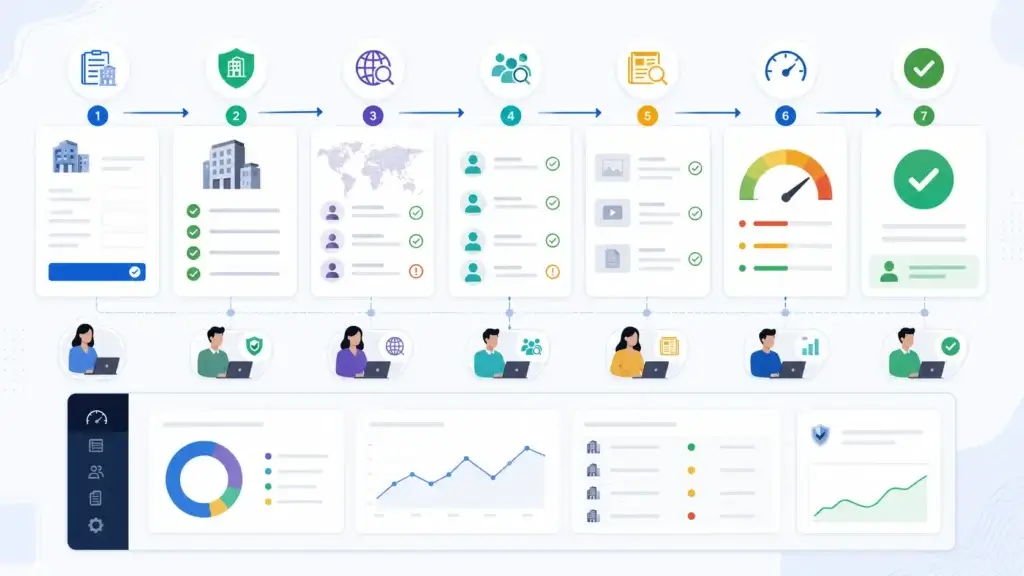
When a Screening API Is Not Enough
A screening API is not always enough because many APIs return raw data, possible matches, alerts, or risk flags. That can be valuable, but it does not always answer the question a decision-maker actually asks.
Legal, compliance, procurement, and investment teams often need to know:
- What was checked?
- Which sources support the finding?
- How confident is the match?
- What is the actual risk level?
- Does this require escalation?
- Can we share this with a committee, board, or legal reviewer?
- Can we defend the decision later?
This is the gap between screening and due diligence.
A sanctions screening API may tell you that a name resembles a sanctioned person. A KYB API may verify that a business exists. An adverse media API may return negative news hits. But a decision-maker still needs context.
That context may include source-backed findings, confidence grading, a risk matrix, ownership interpretation, litigation review, adverse media summaries, and an output that can be stored or shared.
This is where DueVestor fits especially well.
DueVestor is stronger when you need the API to support a final due diligence report, not only a screening event. It is useful when the workflow ends with a compliance file, legal review, investment decision, procurement approval, or third-party risk assessment.
For example, a procurement team may not only need to know whether a vendor appears on a sanctions list. It may need to know whether the vendor has litigation exposure, reputational risk, suspicious ownership links, or adverse media that should be escalated.
An investment team may not only need to screen a founder or company. It may need a due diligence file that can support an investment memo.
A legal team may not only need raw API results. It may need a source-backed record showing what was reviewed and why a decision was made.
That is why screening APIs and report-based due diligence tools should not be treated as identical categories.
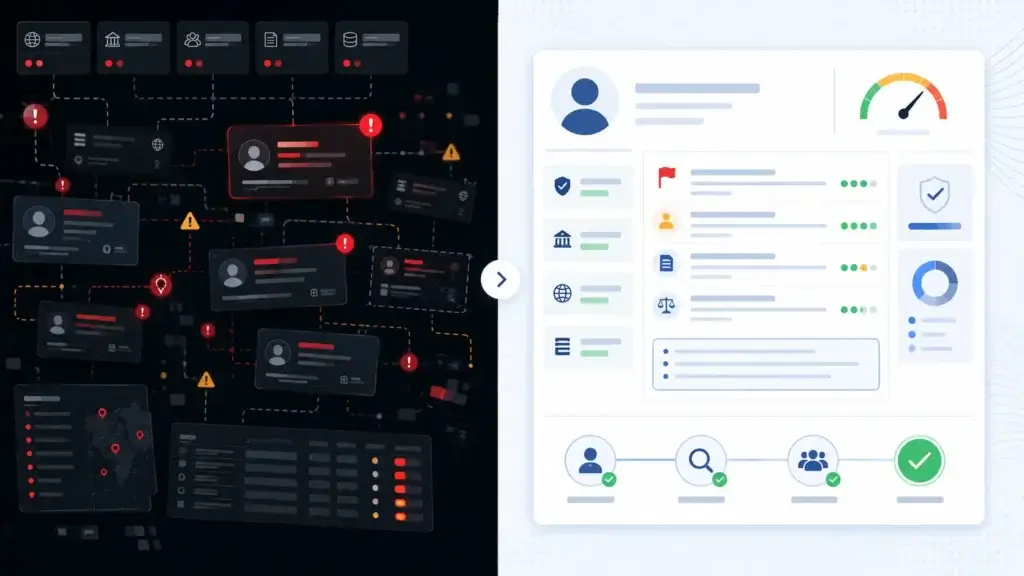
How to Choose the Best Due Diligence API
The best due diligence API depends on your risk workflow. Before you compare vendors, define the decision you need the API to support.
If your decision is “can we onboard this merchant?”, you may need KYB, UBO, sanctions, and fraud signals. If your decision is “can we work with this overseas distributor?”, you may need sanctions, PEP, FCPA risk, adverse media, ownership, and litigation. If your decision is “can we invest in this company?”, you may need a deeper due diligence report.
1. Match the API to the workflow
Start with the workflow, not the vendor category.
A fintech onboarding flow is different from a legal due diligence review. A procurement workflow is different from an M&A investigation. A compliance monitoring program is different from a one-time investor check.
OpenSanctions is strong when the workflow is sanctions and PEP matching. Persona and Middesk are strong when the workflow is business onboarding. ComplyAdvantage is strong when the workflow is AML operations. DueVestor is strong when the workflow requires report-based due diligence.
2. Check entity matching quality
False positives are one of the biggest problems in compliance screening.
A weak API may flag too many irrelevant matches, especially with common names, transliterated names, aliases, spelling variations, or incomplete entity data.
Look for fuzzy matching, alias support, date-of-birth matching, jurisdiction matching, identifiers, country filters, confidence scores, and review tools.
3. Review source transparency
Source transparency is critical when you need to defend a decision.
An API should make it clear where the data came from, when it was updated, what was matched, and why the result was returned.
This is especially important for adverse media, litigation, sanctions, and PEP results. If a reviewer cannot understand the source, they may not be able to rely on the output.
4. Consider ongoing monitoring
Due diligence does not always end at onboarding.
Sanctions lists change. Ownership changes. New lawsuits appear. Negative media can emerge after a relationship begins. A vendor that was low risk at onboarding may become higher risk later.
If your risk model requires ongoing monitoring, check whether the API supports re-screening, alerts, webhooks, monitoring intervals, status changes, and audit trails.
5. Evaluate the final output
This is where many teams make the wrong decision.
They compare APIs only by data coverage, but they do not think about the output their stakeholders need.
If the final user is a developer, raw API responses may be enough. If the final user is a compliance analyst, case alerts and review tools may be enough. If the final user is a legal team, investment committee, procurement manager, or board, you may need a structured report.
That is why DueVestor deserves serious consideration for due diligence workflows where the output must be readable, documented, and shareable.
Final Recommendation
The best due diligence API in 2026 depends on the type of risk workflow you need to automate.
If your main need is sanctions and PEP matching, OpenSanctions is one of the most practical API-first options. It is focused, developer-friendly, and useful for teams that want to build screening into internal systems.
If your team needs AML screening, ongoing monitoring, alert workflows, and case management, ComplyAdvantage is a stronger fit. It is better for regulated financial services companies that need operational compliance infrastructure.
If your main workflow is business onboarding, Persona and Middesk are strong options. Persona is especially useful when KYB and KYC need to work together, while Middesk is particularly relevant for U.S. business verification.
If your company needs enterprise-grade risk intelligence data, LexisNexis is a strong choice for mature compliance teams with complex requirements.
If your team needs business identity enrichment and KYB data inside a decisioning workflow, Enigma is worth evaluating.
However, if your goal is not only to screen but to produce a source-backed due diligence report, DueVestor API is the best fit. It is especially relevant when your team needs sanctions, PEP, registry, litigation, and adverse media data in a structured output that compliance, legal, investment, or procurement stakeholders can review.
That distinction matters. A screening API tells you what matched. A due diligence report helps you understand what the match means.
For many teams, the best stack will combine both: API-based screening for scale and report-based due diligence for higher-risk cases.
FAQs
What is a due diligence API?
A due diligence API is an interface that lets your internal systems automatically screen people, companies, vendors, investors, customers, and beneficial owners against risk data sources such as sanctions, PEP lists, KYB databases, adverse media, litigation, and watchlists.
What is the best due diligence API in 2026?
DueVestor API is the best option when you need report-based due diligence with sanctions, PEP, registry, litigation, and adverse media data. OpenSanctions is best for sanctions and PEP matching, ComplyAdvantage is best for AML workflows, and Persona is best for KYB onboarding.
What is a sanctions screening API?
A sanctions screening API checks people or companies against sanctions lists and watchlists. It is commonly used during onboarding, vendor approval, investor vetting, transaction screening, and ongoing compliance monitoring.
What is a PEP screening API?
A PEP screening API identifies politically exposed persons and related parties, such as family members and close associates. It helps compliance teams determine whether a person requires enhanced review under a risk-based approach.
What is a KYB API?
A KYB API verifies business identity by checking company details such as legal name, registration status, address, tax ID, directors, officers, ownership, and associated people. It is commonly used by fintech, marketplaces, lenders, and B2B platforms.
What is an adverse media API?
An adverse media API checks news and media sources for risk signals involving fraud, corruption, sanctions evasion, litigation, financial crime, regulatory action, or reputational issues linked to a person or company.
Is OpenSanctions enough for due diligence?
OpenSanctions can be enough if your main need is sanctions and PEP matching. It may not be enough if you also need KYB workflows, litigation review, adverse media analysis, ownership context, confidence grading, or a shareable due diligence report.
When should I use DueVestor API?
You should use DueVestor API when your team needs a structured due diligence report rather than only raw screening matches. It is useful for investor vetting, vendor onboarding, M&A diligence, third-party review, and higher-risk compliance checks.
Do due diligence APIs replace compliance analysts?
No. Due diligence APIs automate data collection, screening, and monitoring, but human judgment is still needed for escalation decisions, risk interpretation, false-positive review, and final approval.
What should I check before choosing a compliance API?
Before choosing a compliance API, check data coverage, sanctions and PEP sources, KYB support, adverse media quality, entity matching, false-positive handling, update frequency, audit trails, webhooks, pricing, documentation, and final output format.