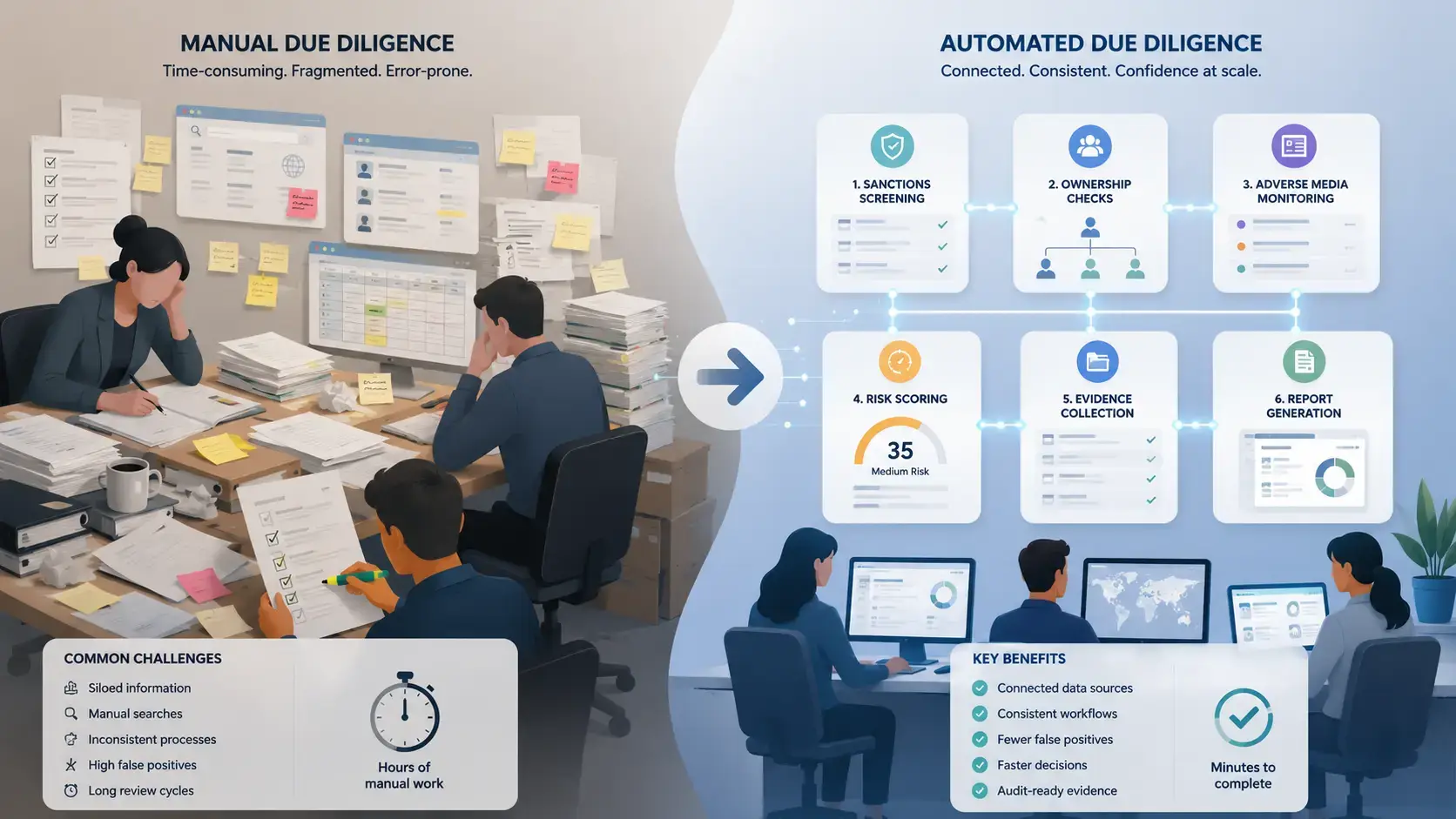
Manual due diligence can quickly become slow, inconsistent, and difficult to audit. A compliance analyst may search Google, check sanctions lists, review company registries, scan litigation databases, copy findings into a spreadsheet, and then summarize everything in a report. That process can work for a small number of low-risk checks, but it becomes fragile when your team needs to review customers, vendors, investors, acquisition targets, brokers, agents, and beneficial owners at scale.
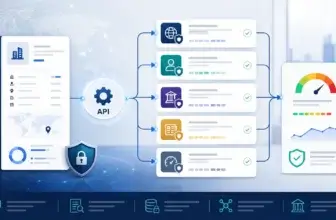
Due diligence automation changes that workflow. Instead of treating due diligence as a manual research project every time, modern platforms use APIs, structured data sources, entity resolution, adverse media monitoring, ownership mapping, risk scoring, and AI-generated reports to make the process faster and more repeatable.
This does not mean automation should replace compliance judgment. It means automation should handle the repetitive data collection, screening, matching, monitoring, and report preparation work so your team can focus on the decision.
In this guide, you’ll learn how automated due diligence works, which tasks can be automated, what the technical stack looks like, where AI adds value, and how report-based platforms such as DueVestor fit into the automation stack.
What Is Due Diligence Automation?
Due diligence automation is the use of software to collect, verify, screen, analyze, monitor, and report on the people and entities involved in a business relationship.
That relationship may involve a customer, vendor, investor, acquisition target, supplier, distributor, intermediary, board member, founder, executive, ultimate beneficial owner, or other connected party.
At a basic level, automated due diligence helps answer a simple question: should you proceed, reject, escalate, or investigate further?
At a more advanced level, it helps answer a much stronger set of questions:
- Is the person or company connected to sanctions, PEPs, or watchlists?
- Who owns or controls the entity behind the corporate name?
- Are there negative news, litigation, enforcement, or reputational findings?
- Are there aliases, related entities, shell companies, or network risks?
- What evidence supports the finding, and when was it retrieved?
- Does the risk level match your internal policy and escalation rules?
This is where automation becomes more useful than a simple search. A manual search may find a few obvious results. A stronger automated workflow can pull data from multiple sources, match entities more accurately, classify findings, preserve source evidence, and produce a structured report that another stakeholder can review.
For compliance teams, the main benefit is consistency. Every check follows the same process, uses the same data logic, and leaves a clearer audit trail.
For investment and M&A teams, the main benefit is speed. You can move from early screening to deeper investigation without waiting days or weeks for every preliminary file.
For onboarding teams, the main benefit is scalability. You can screen more customers, suppliers, and partners without forcing analysts to manually repeat the same steps hundreds of times.
Which Due Diligence Tasks Can Be Automated?
Not every part of due diligence should be automated in the same way. Some tasks are highly structured and easy to automate, while others still require human interpretation.
The best approach is to separate due diligence into layers. Each layer has a different purpose, data source, and risk output.
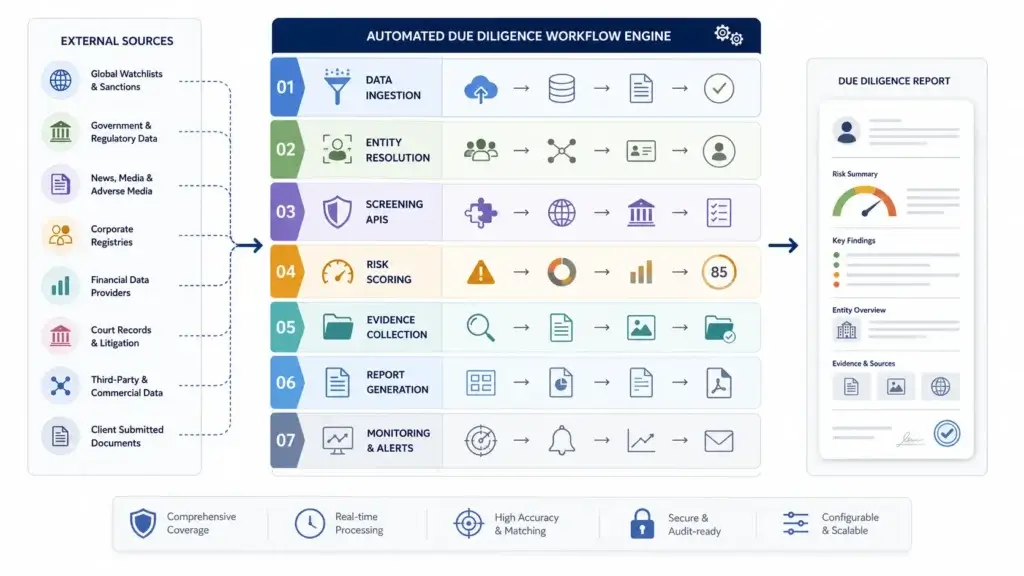
| Automation Layer | What It Does | Why It Matters |
| Data ingestion | Pulls sanctions, PEP, registry, litigation, ownership, and adverse media data | Reduces manual searching and creates broader coverage |
| Entity resolution | Matches names, companies, aliases, owners, directors, and related entities | Helps reduce false positives and missed matches |
| Risk scoring | Converts findings into practical risk levels or escalation signals | Helps teams prioritize the riskiest cases first |
| Evidence collection | Keeps source links, dates, screenshots, references, and supporting records | Creates a stronger audit trail and review file |
| Report generation | Turns checks into a structured due diligence file | Makes findings easier to share with counsel, boards, investors, and compliance teams |
| Monitoring | Flags future changes after onboarding, investment, or approval | Supports ongoing due diligence rather than one-time screening |
The most common automated due diligence tasks include identity checks, business verification, sanctions screening, PEP screening, watchlist checks, adverse media screening, corporate registry lookups, UBO mapping, document collection, risk scoring, case routing, and report generation.
However, automation should not be limited to “is this person on a list?” That is too narrow.
A practical due diligence automation system should also help you understand context. For example, a company may not appear on a sanctions list, but one of its beneficial owners may be connected to a high-risk jurisdiction, a regulatory enforcement action, or repeated negative media coverage.
That is the difference between list checking and real due diligence automation.
The Tech Stack Behind Automated Due Diligence
Modern due diligence automation is not one technology. It is a stack of connected technologies that work together.
At the bottom of the stack, you have data sources. These may include government sanctions lists, PEP databases, company registries, court records, enforcement databases, watchlists, media archives, and commercial risk intelligence providers.
Above that, you have APIs and workflow tools. These connect your internal systems, such as CRM, onboarding, procurement, investment pipeline, or case management software, with external screening data.
Above that, you have matching, scoring, AI analysis, and reporting. This is where the system turns raw data into a decision-support file.
The strongest platforms combine all of these layers instead of treating due diligence as a single check.
Sanctions and watchlist screening
Sanctions screening is usually the most structured part of due diligence automation. The system checks people, companies, vessels, owners, directors, and related entities against official sanctions and restricted-party lists.
Common sources may include OFAC, UN, EU, UK, and other national or regional sanctions lists. Depending on the industry, screening may also include export-control lists, law enforcement lists, disqualified directors, or sector-specific restricted parties.
The technical challenge is not only list access. It is matching accuracy.
Names are messy. A person may have multiple spellings, aliases, transliterations, middle names, initials, former names, or non-Latin script variations. A company may appear under a legal name, trade name, abbreviation, parent company, or local-language version.
This is why automated sanctions screening often uses fuzzy matching. Instead of requiring an exact match, fuzzy matching identifies possible matches based on similarity, aliases, transliteration, and other identifying attributes.
But fuzzy matching creates another challenge: false positives.
If the threshold is too strict, the system may miss a real match. If the threshold is too loose, analysts may waste time reviewing irrelevant alerts. The better systems use supporting attributes such as date of birth, country, address, registration number, ownership link, and known aliases to separate genuine matches from lookalikes.
For a deeper explanation of this workflow, see our guide to sanctions screening.
PEP and related-party screening
PEP screening identifies politically exposed persons and people connected to them. This matters because public roles can increase exposure to bribery, corruption, influence risk, procurement risk, or source-of-funds concerns.
PEP screening is more complex than sanctions screening because there is no single global PEP list that resolves every question. A person’s risk can depend on their role, country, seniority, department, time in office, family relationships, business associates, and proximity to public funds or regulatory authority.
Automation helps by collecting structured PEP data, mapping related parties, flagging family or close-associate links, and routing cases based on your risk policy.
For example, a low-risk customer with no public exposure may be approved automatically. A beneficial owner who is a current senior official in a high-risk jurisdiction may trigger enhanced due diligence. A former official may require a different rule depending on how recently they left office and what relationship you are entering into.
The key point is that PEP automation should not be binary. It should help classify exposure and support proportionate decisions.
KYB and business verification
Know Your Business, or KYB, automation verifies that a company exists, operates legitimately, and matches the information provided during onboarding or diligence.
A KYB workflow may collect the business name, registration number, address, tax ID, industry, country, website, directors, officers, ownership details, and business documents.
Automation can then check this information against corporate registries, government records, commercial databases, tax records, business documents, and risk data sources.
This is especially important when you onboard business customers, vendors, marketplaces, merchants, payment recipients, fintech clients, distributors, or cross-border partners.
Good KYB automation does three things:
- Verifies the entity exists and is active
- Checks whether the business details are consistent
- Escalates risk based on ownership, industry, geography, and screening results
The goal is not only to approve faster. It is to avoid approving a shell company, impersonated business, high-risk intermediary, sanctioned network, or entity with hidden ownership concerns.
UBO and ownership checks
Ultimate beneficial ownership, often called UBO, is one of the most important layers in due diligence automation.
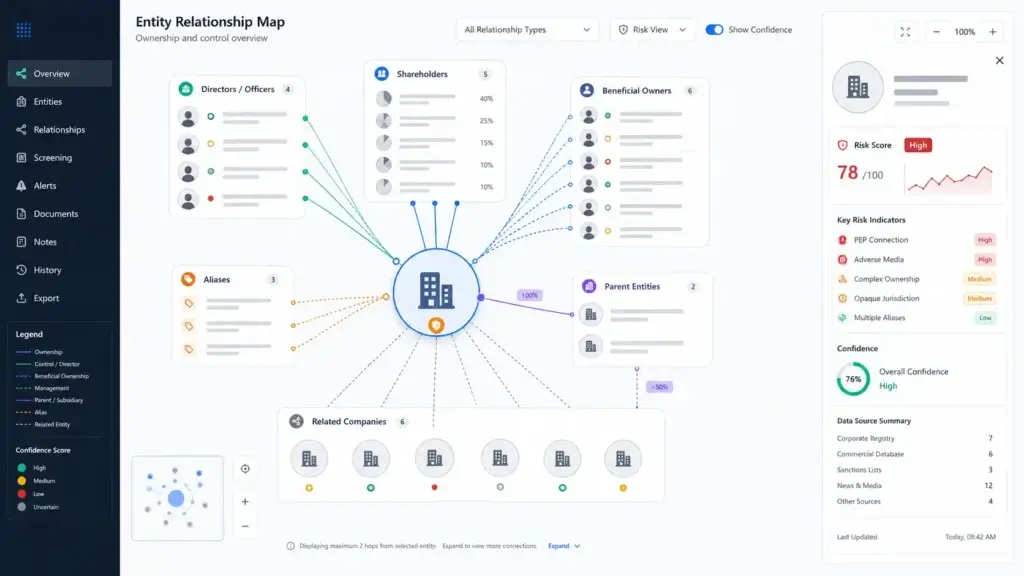
A company name may look clean while the real risk sits behind the entity. That risk may appear in a parent company, offshore structure, nominee shareholder, trust arrangement, holding company, director network, or individual beneficial owner.
Automated ownership checks help trace control from the visible company to the people or entities behind it. This may involve company registries, shareholder data, corporate filings, self-attested ownership forms, identity verification, and relationship mapping.
Ownership automation is useful because manual ownership tracing can be slow and inconsistent, especially when entities cross jurisdictions.
Still, UBO automation has limits. Some jurisdictions provide high-quality corporate registry data. Others provide limited, outdated, or difficult-to-access records. Some ownership structures are intentionally complex. In those cases, automation should make uncertainty visible rather than hide it.
A strong due diligence report should show what was verified, what was not available, and whether the ownership trail requires further review.
Adverse media screening
Adverse media screening is one of the hardest areas to automate because the data is mostly unstructured. Unlike sanctions lists, adverse media does not live in one official database.
It can appear in news articles, investigative reports, court coverage, local-language publications, regulatory notices, blogs, public records, social media, and archived sources.
That creates several technical challenges:
- Finding relevant articles across many sources and languages
- Matching the article to the correct person or entity
- Separating serious risk from irrelevant mentions
- Classifying allegations, investigations, charges, fines, and convictions
- Keeping source evidence for later review
This is where AI due diligence software can add real value. Natural language processing, entity linking, translation, clustering, deduplication, and large language models can help analyze large volumes of unstructured content.
However, adverse media automation should be designed carefully. A negative article about someone with the same name is not enough. The system needs to establish whether the article refers to the subject being reviewed. It also needs to distinguish between allegation, investigation, enforcement action, conviction, civil dispute, political controversy, and general reputational noise.
For more context, read our dedicated guide to adverse media screening.
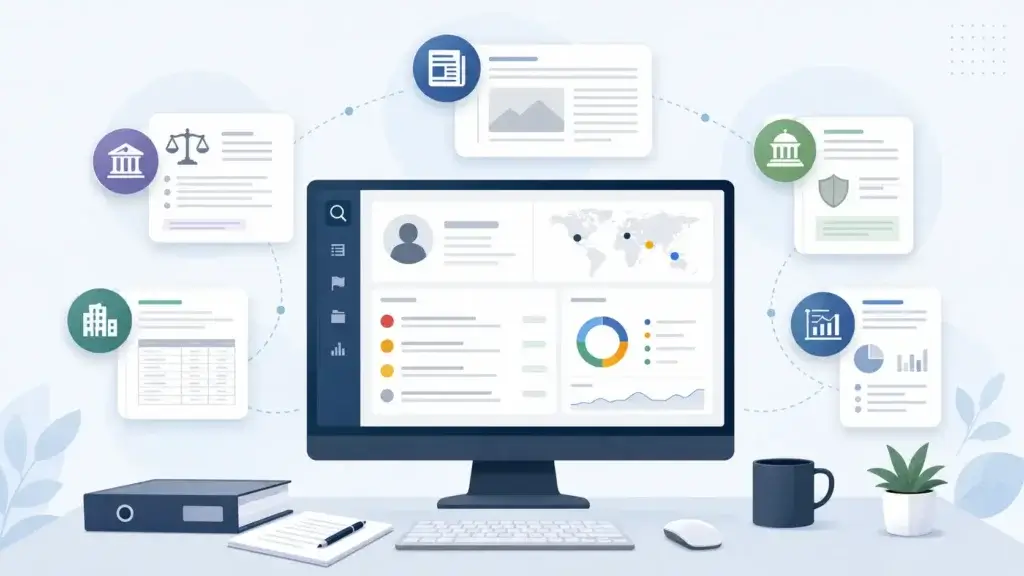
Litigation and enforcement data
Litigation and enforcement data can reveal risks that do not always appear in sanctions or adverse media checks.
For example, a company may have no sanctions exposure but may be involved in repeated fraud claims, contract disputes, regulatory penalties, bankruptcy proceedings, employment claims, environmental enforcement, bribery investigations, or procurement-related disputes.
Automated due diligence tools may pull litigation and enforcement signals from court databases, regulator websites, enforcement notices, public filings, procurement exclusions, and commercial legal databases.
This layer is especially useful in M&A, investor vetting, vendor onboarding, and third-party risk management.
The main challenge is context. Not every lawsuit is a major risk. Some businesses naturally face routine litigation. A stronger system should help classify the severity, relevance, recency, and pattern of findings.
A single old contractual dispute may not matter. A repeated pattern of fraud claims, regulatory action, and undisclosed litigation should trigger deeper review.
AI reports and risk scoring
AI reports are becoming one of the most practical outputs of due diligence automation.
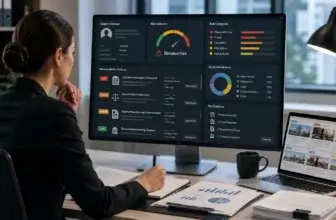
Instead of forcing analysts to manually copy findings into a document, an AI-generated report can organize the results into a structured due diligence file. This may include an executive summary, risk score, entity profile, ownership map, sanctions findings, PEP exposure, adverse media findings, litigation findings, source references, confidence levels, and recommended next steps.
The best AI reports should be explainable. A risk score is not useful if nobody can understand how it was produced.
For compliance-sensitive workflows, you should look for:
- Clear source citations
- Confidence levels for findings
- Separation between facts and interpretation
- Human review options
- Exportable reports for internal records
- Audit trails showing what was checked and when
AI should make due diligence easier to review, not harder to defend. If the AI output cannot show its sources, explain its reasoning, or support analyst override, it may create more risk than it removes.
Manual Due Diligence vs Automated Due Diligence Tools
Manual due diligence and automated due diligence are not complete opposites. Most mature teams use both.
The difference is where human time is spent.
In a manual process, analysts spend too much time finding data, opening search tabs, copying links, checking lists, updating spreadsheets, and formatting reports.
In an automated process, software handles the repeatable checks and analysts spend more time reviewing exceptions, interpreting context, documenting decisions, and escalating high-risk cases.
| Area | Manual Due Diligence | Automated Due Diligence |
| Search process | Analysts search sources one by one | APIs and workflows pull data automatically |
| Consistency | Depends on analyst habits and checklist discipline | Uses standardized rules, templates, and workflows |
| Speed | Can take hours, days, or weeks depending on scope | Can produce initial checks in minutes for many use cases |
| Matching | Manual name comparison and judgment | Fuzzy matching, alias logic, and entity resolution |
| Adverse media | Google searches and manual article review | Monitoring, NLP, entity linking, and risk classification |
| Evidence | Links may be copied manually into a spreadsheet | Sources, timestamps, and references can be stored automatically |
| Reporting | Analysts write reports manually | AI reports generate structured files for review |
| Best use | Low-volume, unusual, or highly sensitive cases | Repeatable screening, onboarding, monitoring, and report preparation |
The biggest weakness of manual due diligence is not effort. It is inconsistency.
Two analysts may search different sources, use different keywords, interpret findings differently, or document evidence in different ways. That makes it harder to scale the process and harder to defend decisions later.
The biggest weakness of automation is overconfidence. A system may miss data, misclassify a source, or generate false positives if the underlying data or matching logic is weak.
That is why the best model is human-in-the-loop automation. Let the software collect, screen, match, score, and draft. Let trained reviewers decide, document, and escalate.
Due Diligence Automation Tools to Consider
There are several types of due diligence automation tools. The right choice depends on your use case, risk level, industry, and workflow maturity.
Some tools are built for API-first onboarding. Some are stronger for AML screening. Some focus on KYB. Others focus on adverse media, corporate intelligence, or report-based enhanced due diligence.
| Tool Type | Best For | Typical Capabilities |
| Report-based due diligence automation | Investor vetting, M&A checks, partner onboarding, third-party vetting | AI reports, risk scoring, evidence files, sanctions, PEP, UBO, adverse media, litigation |
| AML screening APIs | Financial services, fintech, payments, crypto, regulated onboarding | Sanctions, PEP, watchlists, adverse media, ongoing monitoring, case management |
| KYB automation tools | Business onboarding, marketplaces, SaaS platforms, B2B payments | Business verification, document collection, UBO verification, registry checks, decisioning |
| Risk data feeds | Enterprises with internal compliance infrastructure | Structured sanctions, PEP, adverse media, enforcement, and watchlist data via API |
| Adverse media tools | Reputational risk, AML monitoring, enhanced due diligence | News monitoring, NLP classification, multilingual coverage, negative news alerts |
DueVestor
DueVestor is a strong fit when you need report-based due diligence automation rather than only raw screening data.
It is positioned for compliance summaries, enhanced due diligence, self-attested compliance, and third-party vetting. That makes it relevant for investor vetting, M&A diligence, partner onboarding, broker screening, agent screening, distributor review, and high-risk third-party checks.
The main value is that DueVestor does not only return a list match. It helps create a reviewable due diligence file with source-backed findings, risk scoring, ownership and network context, adverse media signals, and report output.
That makes it useful when the final deliverable needs to be shared with internal compliance teams, counsel, investment committees, boards, procurement teams, or external stakeholders.
LexisNexis and enterprise AML data APIs
LexisNexis-style AML and compliance APIs are a strong fit for organizations that need structured risk data embedded into internal systems.
This category is useful when you already have a compliance workflow, onboarding system, or case management platform and need high-quality data feeds for sanctions, PEPs, adverse media, entity intelligence, or risk monitoring.
The main advantage is depth of data and API infrastructure. The main challenge is that you may still need internal engineering, workflow design, analyst review processes, and reporting templates.
Persona and KYB workflow automation
Persona is an example of a KYB-KYC automation platform that helps orchestrate business and UBO identity records, automate workflows, centralize reviews, and support business onboarding use cases.
This type of tool is useful when your main pain is onboarding businesses at scale. For example, marketplaces, fintechs, SaaS platforms, payment companies, and online platforms may need to verify businesses quickly while escalating higher-risk cases.
KYB tools are often strongest at intake, document collection, business verification, UBO checks, and decisioning. They may not always produce the same type of board-ready due diligence report that an EDD or investment diligence workflow requires.
LSEG World-Check and risk intelligence data
LSEG World-Check is widely used for sanctions, PEP, adverse media, enforcement, and heightened-risk entity screening.
This category is often relevant for banks, regulated institutions, enterprises, and global compliance teams that need structured risk intelligence data and screening infrastructure.
The main advantage is broad risk intelligence coverage. The main consideration is cost, implementation complexity, and whether your team needs a data source, a screening tool, or a complete report-generation workflow.
ComplyAdvantage and AML monitoring platforms
ComplyAdvantage is an AML and financial crime risk platform used for sanctions, PEP, adverse media, transaction monitoring, case workflows, and ongoing monitoring.
This type of platform is useful when your main workflow involves financial crime compliance rather than one-off investment or partner diligence.
For regulated onboarding, fintech, payments, and AML monitoring, this category can be very strong. For M&A or investor due diligence, you may still need deeper narrative reporting, ownership context, litigation review, and evidence packaging.
For a broader list of tools, you can also review our guide to the best due diligence software.
Where DueVestor Fits in the Automation Stack
DueVestor fits best as a report-based due diligence automation layer.
That is an important distinction. Some tools are designed to return raw data through an API. Some tools are designed to manage onboarding workflows. DueVestor is useful when your team needs a structured due diligence report that combines screening, evidence, ownership context, risk interpretation, and a practical recommendation.
This makes it a good fit for cases where a simple screening result is not enough.
For example, a compliance team may not only need to know whether a person appears on a list. It may need to understand whether the person is connected to a risky entity, whether adverse media exists, whether ownership is clear, whether litigation appears, and whether the final file can be reviewed later.
That is where report-based automation becomes valuable.
| Need | DueVestor Report Fit | Best Use Case |
| Quick early-stage check | Compliance Summary | Initial customer, investor, vendor, or deal screening |
| Higher-risk subject review | Enhanced Due Diligence | Investor vetting, M&A diligence, partner onboarding |
| Subject-provided compliance file | Self-Attested Compliance | Structured questionnaire with automated screening overlay |
| Intermediary or third-party review | Third-Party Vetting | Brokers, agents, distributors, intermediaries, and FCPA-sensitive relationships |
The strongest DueVestor use case is not replacing every compliance system. It is adding a due diligence file layer where your team needs source-backed outputs and faster review cycles.
For example, a fintech may still use an onboarding API for routine KYB checks. But when a business customer, investor, intermediary, or acquisition target triggers elevated risk, DueVestor can help produce a deeper report.
A private equity team may use spreadsheets and data rooms for financial due diligence, but still need automated people, ownership, sanctions, adverse media, and litigation checks before moving a deal forward.
A procurement team may have a supplier onboarding portal, but still need deeper third-party vetting for agents, distributors, or partners in higher-risk jurisdictions.
In these situations, DueVestor is not just a screening tool. It is a way to turn fragmented checks into a reviewable due diligence file.
How to Choose the Right Due Diligence Automation Tool
The right tool depends on what you need to automate. A bank onboarding thousands of customers every month has different needs from a private equity team reviewing acquisition targets. A marketplace verifying merchants has different needs from a procurement team screening high-risk distributors.
Before choosing a tool, define the workflow first.
Start with the decision you need to make
Do not begin with features. Begin with the decision.
Are you trying to approve or reject a business customer? Decide whether an investor can participate in a fund? Screen an acquisition target? Vet a supplier? Review a broker or agent? Monitor existing counterparties?
Each decision requires a different level of evidence.
A low-risk customer may only need basic screening. A high-risk third party may require UBO mapping, adverse media, litigation checks, source evidence, and compliance escalation. An M&A target may require a broader report that can be reviewed by counsel and the investment committee.
Check data coverage before dashboard design
A clean dashboard is useful, but data coverage matters more.
Ask which sanctions lists, PEP sources, adverse media databases, corporate registries, court records, enforcement sources, and jurisdictions are covered. Also ask how often data is updated and whether the tool stores source evidence.
Coverage gaps matter because due diligence is only as strong as the sources behind it.
Evaluate entity resolution and false positive handling
False positives can overwhelm compliance teams. False negatives can create serious risk.
Look for tools that support fuzzy matching, aliases, transliteration, date-of-birth matching, company identifiers, ownership links, country filters, and confidence levels.
The tool should help analysts understand why a match was generated and what evidence supports it.
Look for explainable risk scoring
Risk scoring is useful only when it is explainable.
A simple red, yellow, or green score may help triage cases, but your team should understand which findings contributed to that score. Sanctions exposure, PEP status, high-risk jurisdictions, adverse media, litigation, enforcement history, ownership opacity, and source confidence should be visible.
If the tool cannot explain the score, it may be difficult to defend the decision later.
Make sure the report is reviewable
For higher-risk decisions, the report is often as important as the screening result.
A useful due diligence report should include the subject profile, screening scope, findings, risk score, evidence links, dates, source references, confidence grades, and recommended next steps.
This is especially important for investor vetting, M&A diligence, third-party onboarding, and board-level review.
Confirm workflow and API flexibility
Some teams need a self-serve dashboard. Others need an API that connects to CRM, procurement, onboarding, case management, or internal compliance systems.
If you have high-volume workflows, API access and workflow automation are important. If you run fewer but deeper checks, report quality may matter more than API throughput.
The best setup may combine both: automated API screening for routine cases and report-based enhanced due diligence for escalations.
Do not remove human review from high-risk cases
Automation can collect data, classify findings, and prepare reports. It should not silently approve every high-risk relationship without human review.
Your system should support escalation rules, analyst notes, reviewer approval, audit logs, and decision history.
This is especially important when the findings involve allegations, political exposure, complex ownership, regulatory enforcement, or high-value transactions.
Implementation Checklist for Due Diligence Automation
Automating due diligence is not only a software purchase. It is a workflow redesign.
Use this checklist to plan the implementation.
- Define the subject types you need to screen
- Map your approval, rejection, and escalation rules
- List required data sources by risk level
- Choose which checks run automatically
- Set fuzzy matching and false positive thresholds
- Define risk score categories and escalation triggers
- Create report templates for different use cases
- Connect APIs to your CRM, onboarding, or case system
- Train analysts to review and override results
- Review performance, false positives, and missed findings regularly
Start with one focused workflow. For example, automate early investor screening or high-risk vendor onboarding before trying to automate every due diligence process in the organization.
Once the workflow is stable, expand into monitoring, API integrations, AI reporting, and deeper ownership checks.
Common Mistakes to Avoid
Due diligence automation can save time, but only when it is implemented carefully.
Automating poor manual processes
If your existing checklist is unclear, automation will not fix it. It may simply make a weak process run faster.
Before implementing software, clarify what you screen, why you screen it, what triggers escalation, and what evidence must be stored.
Relying only on sanctions checks
Sanctions screening is important, but it is not the full due diligence process.
You also need to consider PEP exposure, adverse media, ownership opacity, litigation, regulatory enforcement, jurisdiction risk, and relationship context.
Ignoring ownership networks
Many risks sit behind the visible entity. If you only screen the company name, you may miss the owner, director, parent company, or related entity that creates the real risk.
UBO and network checks are especially important for M&A, investment, procurement, and third-party relationships.
Trusting AI summaries without evidence
AI summaries are useful, but they need source support.
For compliance workflows, every material finding should be linked to evidence. The report should clearly separate verified facts from AI interpretation.
Skipping ongoing monitoring
Due diligence is not always a one-time event. A person or company may be clean during onboarding and become risky later.
Ongoing monitoring helps flag new sanctions, new adverse media, ownership changes, enforcement actions, and other risk events after approval.
Final Thoughts
Due Diligence Automation Should Create Better Decisions, Not Just Faster Checks
Due diligence automation is not simply about replacing manual Google searches with software. The real value is creating a repeatable, evidence-backed workflow that helps your team make better decisions faster.
The strongest systems combine structured data, APIs, fuzzy matching, entity resolution, UBO mapping, adverse media monitoring, litigation checks, risk scoring, and AI-generated reports.
For low-risk workflows, automation can help approve clean cases faster. For high-risk workflows, it can help analysts focus on the findings that matter. For investment, M&A, and third-party risk teams, it can turn fragmented research into a reviewable file that stakeholders can actually use.
Tools such as DueVestor show where the category is moving. Automation should not only tell you whether someone appears on a list. It should help you understand the ownership network, the reputational risk, the supporting evidence, the confidence level, and the next step.
If you are building a due diligence process in 2026, the best approach is not fully manual or fully automated. It is human-in-the-loop automation, where software handles the scale and your team handles the judgment.
FAQs
What is due diligence automation?
Due diligence automation is the use of software, APIs, structured data, AI, and workflow rules to collect, screen, verify, monitor, and report on people or companies before a business relationship, investment, acquisition, or onboarding decision.
What due diligence tasks can be automated?
Common tasks that can be automated include sanctions screening, PEP screening, business verification, document collection, corporate registry checks, UBO mapping, adverse media screening, litigation checks, risk scoring, monitoring, and report generation.
Does due diligence automation replace human review?
No. Due diligence automation should reduce repetitive work and improve consistency, but high-risk cases still need human review. Analysts should evaluate context, confirm evidence, apply risk policy, and document final decisions.
How do APIs help automate due diligence?
APIs connect your internal systems to external data sources such as sanctions lists, PEP databases, corporate registries, adverse media sources, and risk intelligence platforms. This allows checks to run automatically inside onboarding, CRM, procurement, or compliance workflows.
What is automated sanctions screening?
Automated sanctions screening checks individuals, companies, owners, directors, and related entities against official sanctions and restricted-party lists. Strong systems use fuzzy matching, aliases, identifiers, and confidence scores to reduce false positives and missed matches.
What is automated adverse media screening?
Automated adverse media screening uses technology to search and monitor negative news, public records, regulatory coverage, and other public sources. It helps identify reputational, financial crime, litigation, enforcement, and compliance risks linked to a subject.
What is entity resolution in due diligence automation?
Entity resolution is the process of matching names, aliases, companies, owners, directors, and related entities to the correct subject. It helps prevent false positives when different people or companies have similar names.
How does AI due diligence software work?
AI due diligence software can classify findings, summarize adverse media, identify entities, connect related records, assign confidence levels, generate risk scores, and produce structured reports. The best systems keep source evidence visible for review.
Where does DueVestor fit in due diligence automation?
DueVestor fits as a report-based due diligence automation platform. It is useful when you need a structured report for investor vetting, M&A diligence, partner onboarding, compliance summaries, enhanced due diligence, or third-party vetting.
How do I choose a due diligence automation tool?
Choose based on your use case, data coverage, API needs, entity resolution quality, false positive handling, UBO capabilities, adverse media coverage, report quality, risk scoring transparency, monitoring options, and human review workflow.