
Introduction
Search is changing, but SEO is not disappearing.
For years, marketers optimized for blue links, keyword rankings, organic traffic, backlinks, and click-through rates. Those signals still matter. But the way people discover information is expanding quickly through AI Overviews, ChatGPT, Gemini, Perplexity, voice assistants, and other answer-driven experiences.
That shift is why more marketers are comparing AEO vs SEO.
SEO, or search engine optimization, helps your website rank in traditional search results. AEO, or answer engine optimization, helps your brand become the answer, citation, source, or recommended option inside AI-generated responses.
The important point is this: AEO does not replace SEO. It extends it.
You still need crawlable pages, strong content, technical SEO, topical authority, backlinks, internal links, and a good user experience. But now you also need to think about how AI systems interpret your content, whether your brand is mentioned across trusted sources, how clearly your pages answer specific questions, and whether your expertise is easy for machines to extract.
In this guide, you will learn the difference between AEO and SEO, why traditional SEO metrics are no longer enough, how to build a combined strategy, and where tools like HubSpot AEO fit into the modern search stack.
What Is SEO?
SEO stands for search engine optimization. It is the process of improving your website so search engines can discover, understand, index, rank, and display your content for relevant queries.
In practical terms, SEO helps you earn visibility when someone searches on Google, Bing, or another traditional search engine.
A strong SEO strategy usually includes:
- Keyword research based on search intent
- Helpful content that answers the user’s query
- On-page optimization for titles, headings, URLs, and internal links
- Technical SEO for crawlability, indexing, speed, and site structure
- Backlinks and digital authority signals
- Content updates that keep pages accurate and competitive
SEO is still the foundation of search visibility because search engines need strong, accessible, and trustworthy pages to rank and reference.
Google’s own SEO documentation continues to emphasize basics such as making content crawlable, creating useful pages, helping search engines understand your site, and publishing content that benefits people first. That means traditional SEO remains highly relevant, even as AI search grows.
Why SEO Still Matters in an AI Search World
Many AI search experiences still rely on the open web.
AI systems need sources to summarize, cite, compare, and validate. If your content is not indexed, accessible, structured, and authoritative, it becomes much harder for AI systems to use it confidently.
This is especially important for B2B SaaS, marketing software, finance, health, legal, and other high-trust categories. AI tools are more likely to reference content that looks credible, specific, updated, and supported by external authority.
So, SEO is not only about ranking anymore. It is also about creating the technical and editorial foundation that makes your content usable by AI-driven search experiences.
What Is AEO?
AEO stands for answer engine optimization. It is the practice of optimizing your content, brand presence, and digital authority so your business appears in AI-generated answers.
Instead of focusing only on ranking a webpage, AEO focuses on becoming part of the answer.
That answer may appear in:
- Google AI Overviews
- ChatGPT responses
- Perplexity answers
- Gemini responses
- Bing Copilot results
- Voice search answers
- AI-powered product recommendations
AEO is broader than classic on-page SEO because AI systems do not always rely on a single ranking page. They may synthesize information from multiple sources, compare brand mentions, evaluate third-party reviews, summarize trusted articles, or cite pages that provide the clearest answer.
This means your visibility may depend not only on your own website, but also on how your brand is represented across the wider web.
AEO Is About Being Cited, Mentioned, and Recommended
In traditional SEO, success often means ranking in position one, earning organic clicks, and converting traffic on your site.
In AEO, success may look different.
Your brand may appear inside an AI answer even if the user does not immediately click. Your software may be listed as a recommended solution. Your article may be cited as a source. Your company may be included in a comparison summary. Your product may be mentioned as a strong option for a specific use case.
That is a major strategic change for marketers.
You are no longer optimizing only for search engine results pages. You are optimizing for AI interpretation, entity recognition, trust, and answer inclusion.
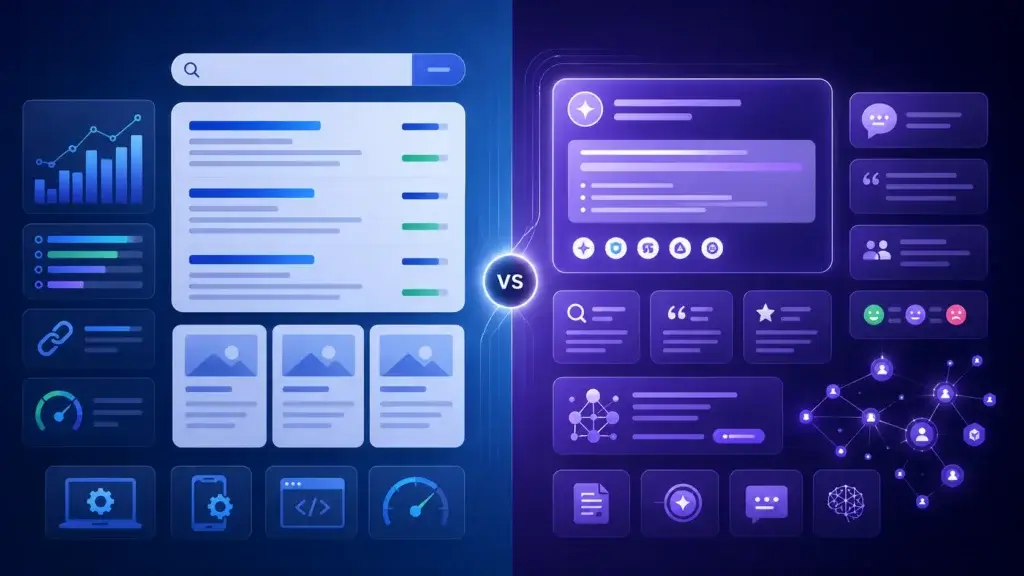
AEO vs SEO: Key Differences
The easiest way to understand SEO vs AEO is to compare the primary goal of each strategy.
SEO helps your pages rank. AEO helps your brand become part of an answer.
| Category | SEO | AEO |
| Main Goal | Rank pages in search engine results | Appear in AI-generated answers and citations |
| Primary Visibility | Organic listings, featured snippets, rich results | AI Overviews, ChatGPT, Gemini, Perplexity, voice answers |
| Core Metrics | Rankings, clicks, impressions, organic traffic, backlinks | AI mentions, citations, answer share, prompt visibility, brand accuracy |
| Optimization Focus | Keywords, content, links, technical SEO, user experience | Direct answers, structured information, entity clarity, authority, brand mentions |
| Content Style | Search-intent pages optimized for ranking and traffic | Answer-first content optimized for extraction and summarization |
| Authority Signals | Backlinks, domain authority, topical relevance | Trusted citations, third-party mentions, reviews, expert content, consistent brand data |
| User Outcome | User clicks a search result and visits a page | User receives an answer, source, recommendation, or brand mention |
1. SEO Optimizes for Rankings, AEO Optimizes for Answers
SEO is built around search result visibility. You create content that deserves to rank for a target keyword, then improve its relevance and authority over time.
AEO is built around answer visibility. You structure content so AI systems can easily understand what your page says, what question it answers, who it helps, and why it should be trusted.
For example, a traditional SEO article might target “best CRM software” and aim to rank on page one. An AEO-focused version would also answer specific comparison-style prompts, such as “What is the best CRM for small B2B sales teams?” or “Which CRM is easiest to use for marketing and sales alignment?”
2. SEO Is Page-Centric, AEO Is Entity-Centric
Traditional SEO often starts with a page. You choose a keyword, build a URL, optimize the title, add internal links, and improve ranking potential.
AEO often starts with an entity. AI systems need to understand your brand, product category, audience, features, pricing model, use cases, integrations, and reputation.
That means your website matters, but so do external sources. Review platforms, comparison articles, partner pages, product directories, YouTube videos, social mentions, press coverage, and community discussions can all influence how AI systems understand your brand.
3. SEO Measures Clicks, AEO Measures Visibility Without Clicks
SEO reporting has traditionally focused on traffic. If rankings go up and clicks increase, the strategy is working.
AEO requires a broader view.
AI search can influence the buyer journey before a user visits your site. A prospect may ask an AI tool for recommendations, compare options, shortlist brands, and only later search your brand directly.
That means you need to measure brand visibility, prompt coverage, citation frequency, sentiment, and referral quality, not only sessions and rankings.
4. SEO Rewards Content Depth, AEO Rewards Clarity and Extractability
Long-form content can still perform well in SEO when it is useful, original, and well-structured. But AI systems need content that is easy to parse.
AEO-friendly content often includes direct definitions, concise explanations, comparison tables, FAQ sections, schema markup, product details, author expertise, and clean section structure.
The goal is not to make content robotic. The goal is to make expertise easy to identify.
Why Traditional SEO Metrics Are No Longer Enough
SEO metrics are still useful, but they no longer show the complete picture of search visibility.
Rankings, clicks, impressions, backlinks, and organic conversions matter. However, AI search introduces new forms of visibility that do not always produce an immediate click.
This is one of the biggest challenges for marketers.
If your brand appears in an AI answer, it may shape the user’s decision even if your analytics platform does not attribute a session to that interaction. If an AI tool recommends your competitor and ignores your brand, you may lose demand before the user ever reaches Google.
AI Search Creates More Zero-Click Discovery
AI-generated answers can reduce the need for users to click multiple results. Instead of opening five tabs, users can ask a question and receive a summarized answer.
For simple informational queries, that may reduce organic traffic. For complex commercial queries, it may change how users evaluate vendors before visiting a website.
This is why marketers should not measure search performance only by traffic volume. You also need to understand whether your brand is visible where buyers are asking AI-assisted questions.
Rank Tracking Does Not Show AI Answer Share
A keyword ranking report can tell you where your page ranks in Google. It usually cannot tell you whether ChatGPT, Gemini, Perplexity, or AI Overviews mention your brand for the same topic.
This creates a visibility gap.
You may rank well in organic results but be absent from AI-generated recommendations. Or you may be mentioned in AI answers even when your page is not ranking in the traditional top three results.
That is why modern marketers need both SEO tracking and AI visibility tracking.
Brand Mentions Are Becoming More Important
In traditional SEO, backlinks have long been a major authority signal.
In AEO, unlinked brand mentions can also matter because AI systems learn from the broader context of the web. If trusted sources repeatedly describe your brand as a strong solution for a specific use case, that can strengthen your association with that category.
For example, if your software is consistently mentioned in high-quality articles about AI search visibility, AEO tools, or marketing automation, answer engines may be more likely to connect your brand with those topics.

How to Build a Combined SEO and AEO Strategy
The best approach is not SEO or AEO. It is SEO plus AEO.
You need traditional SEO to build a strong search foundation. You need AEO to adapt that foundation for AI-driven discovery.
Here is a practical framework you can use.
1. Keep Your Technical SEO Foundation Strong
AI search does not remove the need for technical SEO.
Your site should be crawlable, indexable, fast, mobile-friendly, and easy to navigate. Search engines and AI systems need access to your content before they can rank, summarize, cite, or recommend it.
Focus on:
- Clean site architecture
- Indexable pages
- Fast page loading
- Logical internal linking
- XML sitemaps
- Canonical tags
- Structured data
Technical SEO is not the most exciting part of AEO, but it is one of the most important. If machines cannot access or understand your content, your visibility will suffer across both SEO and AI search.
2. Create Answer-First Content
AEO-friendly content should answer the main question quickly, then expand with useful detail.
For example, if a section asks “What is AEO?”, answer it clearly in the first sentence. Then explain examples, use cases, benefits, and limitations.
This structure helps both users and AI systems.
Instead of hiding the answer deep in a long paragraph, make the answer easy to extract. Use descriptive H2s and H3s, short paragraphs, comparison tables, and FAQs where relevant.
3. Build Topic Clusters Around Buyer Questions
AI search often responds to conversational questions, not only short keywords.
That means your content strategy should cover the questions buyers actually ask during research.
For example, if your main topic is AEO tools, your supporting cluster could include:
- What is AEO?
- AEO vs SEO
- Best AEO tools
- How to optimize for AI search
- How to track AI brand mentions
- How to appear in AI Overviews
This helps you build topical authority while giving AI systems more context about your expertise.
4. Use Structured Data Where It Makes Sense
Structured data helps search engines understand the meaning of your page.
It does not guarantee rich results or AI citations, but it can make your content easier to interpret. For AEO, this is especially useful when your page includes reviews, FAQs, organization information, products, authors, breadcrumbs, or how-to content.
Use schema only when it accurately reflects the visible content on the page.
Useful schema types may include:
- Article schema
- FAQPage schema
- Organization schema
- Product schema
- Review schema
- Breadcrumb schema
For a comparison website, structured data can support both user experience and machine understanding, especially when your content includes clear product names, ratings, features, categories, and FAQs.
5. Strengthen E-E-A-T and Editorial Trust
AEO and SEO both benefit from trust.
Google’s helpful content guidance emphasizes content that is useful, reliable, and created for people. AI systems also need confidence in the sources they use.
To improve trust, include:
- Author names and relevant expertise
- Clear update dates
- Transparent review methodology
- First-hand product insights where possible
- Accurate pricing and feature information
- External links to authoritative sources
- Balanced pros and cons
This is especially important for software reviews and comparison pages. Readers need to understand why they should trust your recommendations, not only what you recommend.
6. Optimize for Brand Mentions Across the Web
AEO is not limited to your website.
If AI tools evaluate your brand based on the broader web, you need to improve how your brand appears on third-party sources.
That may include:
- Review sites
- Partner directories
- Affiliate comparison pages
- Industry blogs
- Product listing pages
- Communities and forums
- Press mentions
The goal is to create consistent, accurate, and authoritative references to your brand and category.
For example, if you want to be associated with “AI search visibility software,” your brand should appear in trusted content around that topic, not only on your own website.
7. Track AI Visibility Separately From SEO Rankings
You cannot manage what you do not measure.
Traditional SEO tools are useful for rankings, backlinks, keyword gaps, content audits, and competitor analysis. But AEO requires new metrics.
Track questions such as:
- Does your brand appear in AI answers for target prompts?
- Which competitors appear more often?
- Which sources are cited by AI tools?
- Is your brand described accurately?
- Which topics trigger your brand mentions?
- Which pages influence AI visibility?
This is where dedicated AEO and AI visibility tools become useful.
Where HubSpot AEO Fits Into the Modern Search Stack
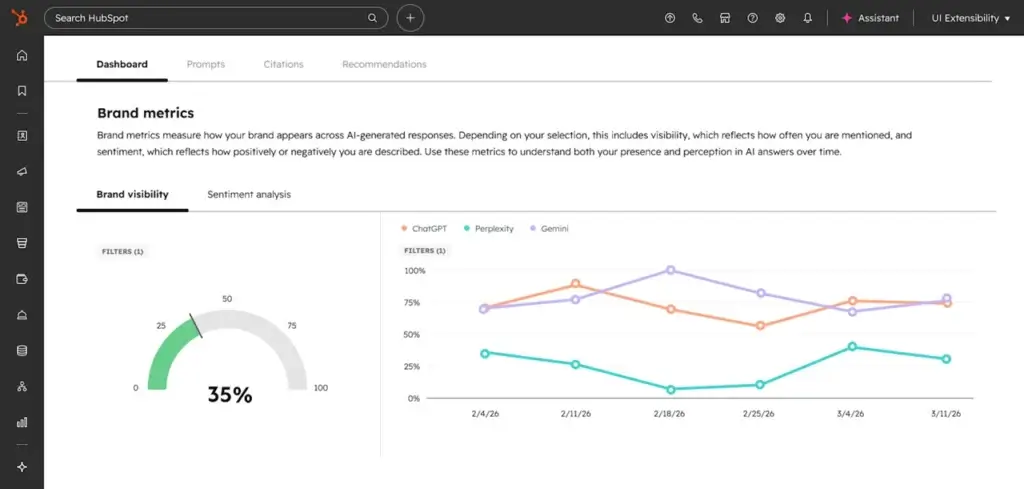
HubSpot AEO fits naturally into the new search stack because it focuses on AI search visibility rather than only traditional ranking data.
Traditional SEO platforms usually help you track keywords, backlinks, rankings, traffic, technical issues, and competitor performance. These are still essential. However, they do not always show how your brand appears inside answer engines.
HubSpot AEO represents the newer category of tools built to help marketers understand and improve brand visibility in AI-generated answers.
For marketers already using HubSpot, this can be especially useful because AEO is not only a content task. It connects to broader marketing operations, including brand positioning, content strategy, lead generation, and conversion tracking.
How HubSpot AEO Complements Traditional SEO Tools
You can think of HubSpot AEO as a visibility layer for AI search.
It does not remove the need for tools like Semrush, Ahrefs, Google Search Console, or Screaming Frog. Instead, it helps fill a different gap.
| Tool Type | Best For | How It Supports Search Visibility |
| Traditional SEO Platforms | Keyword rankings, backlinks, traffic, audits, competitor research | Improve organic rankings and website performance |
| Google Search Console | Search impressions, clicks, indexing, technical visibility | Understand how Google discovers and displays your pages |
| Content Optimization Tools | Content briefs, semantic coverage, on-page recommendations | Improve content relevance and topical depth |
| AEO Tools | AI mentions, prompt visibility, citations, brand accuracy | Understand how your brand appears in AI-generated answers |
| HubSpot AEO | AI search visibility connected to marketing strategy | Help marketers evaluate and improve brand presence in answer engines |
In a modern search stack, you should not choose between SEO tools and AEO tools. You should use both categories together.
SEO tools help you build authority in traditional search. AEO tools help you understand whether that authority carries into AI-driven discovery.
When HubSpot AEO Makes the Most Sense
HubSpot AEO is especially relevant if you already invest in content marketing, inbound marketing, product-led growth, or B2B demand generation.
It can be useful when you want to answer questions such as:
- Is our brand appearing in AI answers for our category?
- Are competitors mentioned more often than we are?
- Which topics are AI systems associating with our brand?
- Are AI tools describing our product accurately?
- Which content should we improve for answer visibility?
For a marketing team, that information is valuable because AI visibility is becoming part of the buyer journey. Even when the final conversion happens through your website, the first product discovery moment may happen inside an answer engine.
Which Strategy Should You Prioritize?
You should prioritize SEO first if your technical foundation is weak, your site has limited content, your pages are not ranking, or your website does not have clear topical authority.
You should prioritize AEO if you already have a strong SEO foundation but your brand is not appearing in AI-generated answers, comparison prompts, or category recommendations.
For most marketers, the best answer is not one or the other. The right strategy depends on maturity.
If You Are Early: Build SEO Foundations First
If your site has indexing problems, thin content, poor internal linking, weak category pages, or outdated product information, start with SEO.
AI tools cannot confidently cite or recommend content that is unclear, inaccessible, or poorly structured.
Your first priority should be to create helpful content, fix technical issues, build topic clusters, and improve internal linking.
If You Are Growing: Add AEO to Existing SEO Workflows
If your pages already rank and attract traffic, start layering AEO into your workflow.
That means rewriting sections to answer questions more directly, adding comparison tables, improving FAQs, strengthening schema, updating statistics, and monitoring how AI tools describe your brand.
You should also review whether your brand appears in third-party sources that answer engines are likely to use.
If You Are Competitive: Track SEO and AEO Together
In competitive SaaS categories, visibility is no longer only about the top ten blue links.
You need to know where your brand appears across search results, AI answers, review sites, listicles, comparison pages, and community conversations.
This is where SEO and AEO become part of the same visibility strategy.
Your goal is to be found, trusted, cited, compared, and recommended wherever buyers search.
Practical AEO vs SEO Checklist for Marketers
Use this checklist to connect your SEO work with AEO opportunities.
SEO Checklist
- Target clear search intent for every page
- Use descriptive H1, H2, and H3 headings
- Improve crawlability and internal linking
- Update outdated statistics, pricing, and screenshots
- Build topical clusters around high-intent keywords
- Earn relevant backlinks from trusted sources
- Use structured data that matches visible content
AEO Checklist
- Answer key questions directly near the top of each section
- Add concise definitions for important terms
- Create comparison tables for complex decisions
- Monitor AI answers for brand mentions and competitors
- Improve third-party brand presence and review coverage
- Make product positioning consistent across the web
- Track prompt visibility, citation frequency, and answer accuracy
Conclusion
The debate around AEO vs SEO should not be framed as a replacement story.
SEO is still essential because it helps search engines discover, understand, rank, and trust your content. Without strong SEO, your website has a weaker foundation for both traditional search and AI-powered discovery.
But SEO alone is no longer enough.
As buyers use AI tools to research software, compare vendors, ask follow-up questions, and shortlist solutions, marketers need to understand how their brands appear inside answer engines. That means tracking mentions, citations, brand accuracy, third-party authority, and prompt-level visibility.
AEO expands your search strategy from “How do we rank?” to “How do we become the answer?”
The best marketers in 2026 will not abandon SEO. They will build on it. They will create helpful content, strengthen technical foundations, use structured data, earn authority, improve brand consistency, and measure visibility across both search engines and answer engines.
Tools like HubSpot AEO show where the market is heading. Traditional SEO platforms help you understand rankings, traffic, backlinks, and technical performance. AEO tools help you understand whether your brand is visible, accurate, and competitive in AI-generated answers.
If you want to future-proof your search strategy, the smartest move is clear: keep investing in SEO, but start building AEO into your workflow now.
FAQ
What is the difference between AEO and SEO?
The main difference is the goal. SEO focuses on ranking pages in traditional search results, while AEO focuses on getting your brand, content, or product cited and mentioned in AI-generated answers.
Does AEO replace SEO?
No. AEO does not replace SEO. AEO builds on SEO by adapting your content, brand authority, and structured information for AI search experiences, answer engines, and AI-generated summaries.
Why is AEO important for marketers?
AEO is important because buyers increasingly use AI tools to research products, compare options, and get recommendations. If your brand is missing from AI answers, you may lose visibility before users reach your website.
Is SEO still important in 2026?
Yes. SEO is still important because search engines and AI systems need crawlable, useful, and authoritative content. A strong SEO foundation improves your chances of ranking in search and being referenced by AI systems.
What are the most important AEO metrics?
Important AEO metrics include AI brand mentions, citation frequency, prompt visibility, competitor presence, answer accuracy, sentiment, and the sources AI tools use when generating responses.
How do you optimize content for AEO?
To optimize for AEO, answer questions directly, use clear headings, add structured data, include concise definitions, create comparison tables, strengthen topical authority, and improve brand mentions across trusted third-party sources.
What is answer engine optimization?
Answer engine optimization is the process of improving how your brand and content appear in AI-generated answers from platforms such as Google AI Overviews, ChatGPT, Gemini, Perplexity, and voice assistants.
How does HubSpot AEO fit into an SEO strategy?
HubSpot AEO fits into an SEO strategy by helping marketers understand and improve brand visibility in AI-generated answers. It complements traditional SEO tools that focus on rankings, backlinks, traffic, and technical performance.
Should small businesses focus on AEO or SEO first?
Most small businesses should build SEO foundations first, including helpful content, technical SEO, local visibility, and internal linking. Once that foundation is in place, they should add AEO tracking and answer-focused content optimization.
What is the future of SEO with AI search?
The future of SEO is broader than rankings. Marketers will still optimize for search engines, but they will also need to optimize for AI answers, citations, brand mentions, structured data, and authority across the wider web.