
Introduction
Creating content that ranks is no longer just about inserting keywords into a draft and hoping for the best. You now need to align with search intent, topical depth, entity coverage, content freshness, and increasingly, AI-driven search visibility. Surfer SEO positions itself as a platform that helps you handle those tasks from one workflow. In this review, you will get a clear look at Surfer’s core features, pricing, strengths, limitations, and the types of users who will get the most value from it. By the end, you should have a much better sense of whether Surfer is the right fit for your SEO and content operation.
What Is Surfer SEO?
Surfer SEO is an SEO content optimization platform built to help you research, write, optimize, refresh, and monitor content more effectively. While some SEO tools are designed around broad keyword databases, backlink intelligence, or full digital marketing suites, Surfer is more focused on the content workflow itself. It is especially well known for its Content Editor, optimization guidelines, content auditing, topical planning, and newer AI visibility features.
Background and Evolution
Surfer began as an internal tool created to support SEO work more efficiently, and over time it evolved into a standalone platform used by marketers, agencies, publishers, and content teams. Earlier versions of Surfer were known mainly for on-page SEO optimization and SERP-based content recommendations. In 2026, the platform has expanded well beyond that original use case. It now includes Topical Map, Content Audit, AI Tracker, AI Search Guidelines, workspace collaboration, and broader site-level optimization workflows. That evolution makes Surfer more useful for ongoing SEO operations, not just one-off content scoring.
Target Users and Use Cases
Surfer SEO is suitable for several types of users:
- Content marketers and SEO writers – You can use it to build outlines, optimize drafts, improve topical coverage, and align articles with ranking patterns.
- SEO specialists and consultants – It is useful for content audits, SERP analysis, on-page recommendations, and workflow standardization.
- Agencies – The platform helps agencies create repeatable optimization processes across multiple clients and content teams.
- In-house marketing teams – Surfer works well when your growth strategy depends on publishing and refreshing content at scale.
- Publishers and affiliate sites – It is especially relevant if you rely heavily on organic traffic and need a more systemized way to identify content opportunities and update aging pages.
If your primary need is content optimization and article-level SEO execution, Surfer is one of the strongest tools in the market. If you need deeper backlink analysis, broad traffic intelligence, or a more traditional all-in-one SEO suite, you may still need another platform alongside it.
Key Features
How Does Surfer SEO Work?
Surfer is designed around a practical SEO workflow. Instead of only giving you raw keyword or competitor data, it tries to help you turn that data into publishable and refreshable content. That is one of the biggest differences between Surfer and broader SEO suites.
Content Editor and Content Optimization
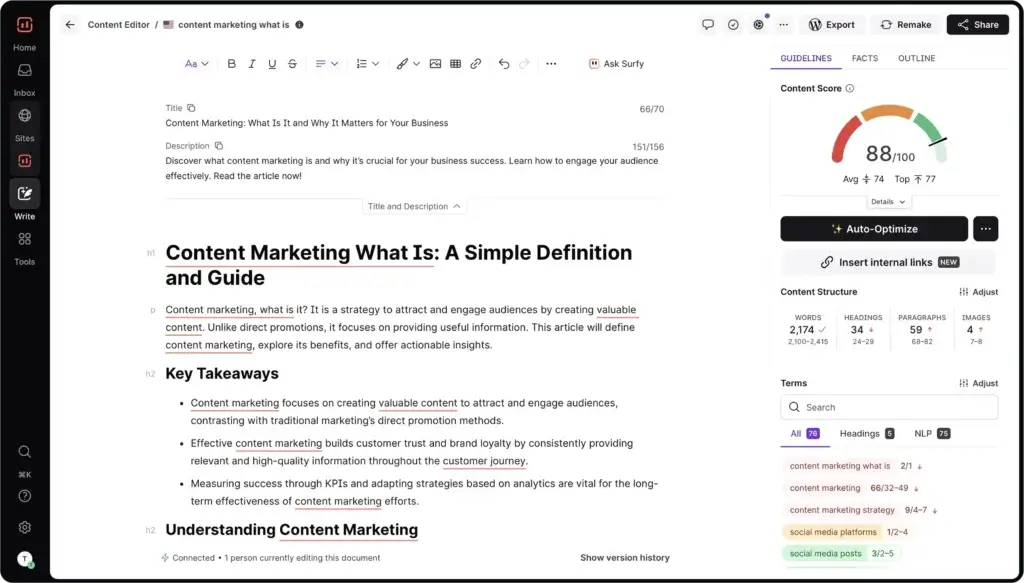
Content Editor is still the feature most users associate with Surfer. You enter a target keyword, and Surfer generates live optimization guidelines based on the pages currently ranking in the SERPs. These recommendations usually include suggested terms, topical coverage, structural guidance, and content score feedback while you write or edit.
This is where Surfer can save a lot of time for teams that need consistency. Writers do not have to guess whether an article is covering the topic deeply enough. Editors do not have to manually compare every draft with the top-ranking pages. Instead, Surfer gives you a shared framework for producing content that is more aligned with what is already ranking.
Topical Map and Content Planning
Surfer is not only about improving existing drafts. Its Topical Map feature helps you identify clusters of related topics and build stronger topical authority over time. This makes the platform useful earlier in the SEO workflow, before a draft is even created.
If you are building a category, a niche content hub, or an affiliate site, this matters a lot. Rather than choosing articles one by one, you can plan a more connected publishing strategy. That is one of Surfer’s most practical advantages for long-term organic growth.
Content Audit and Sites
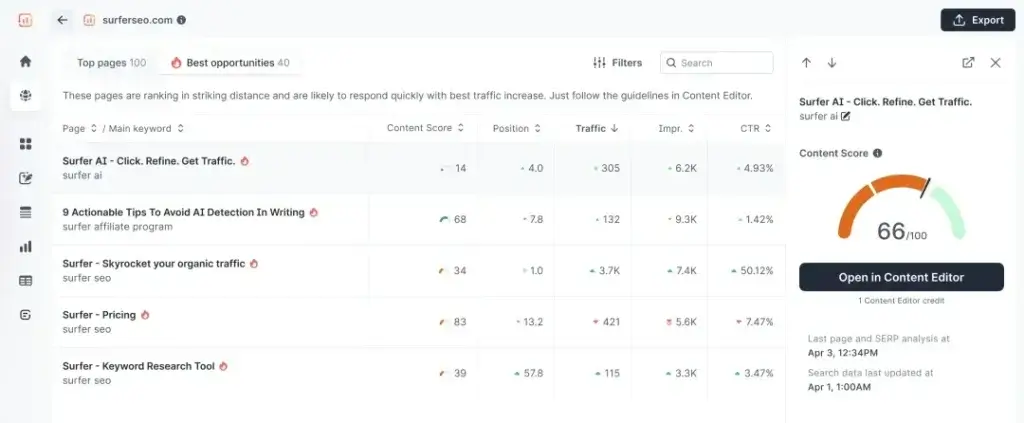
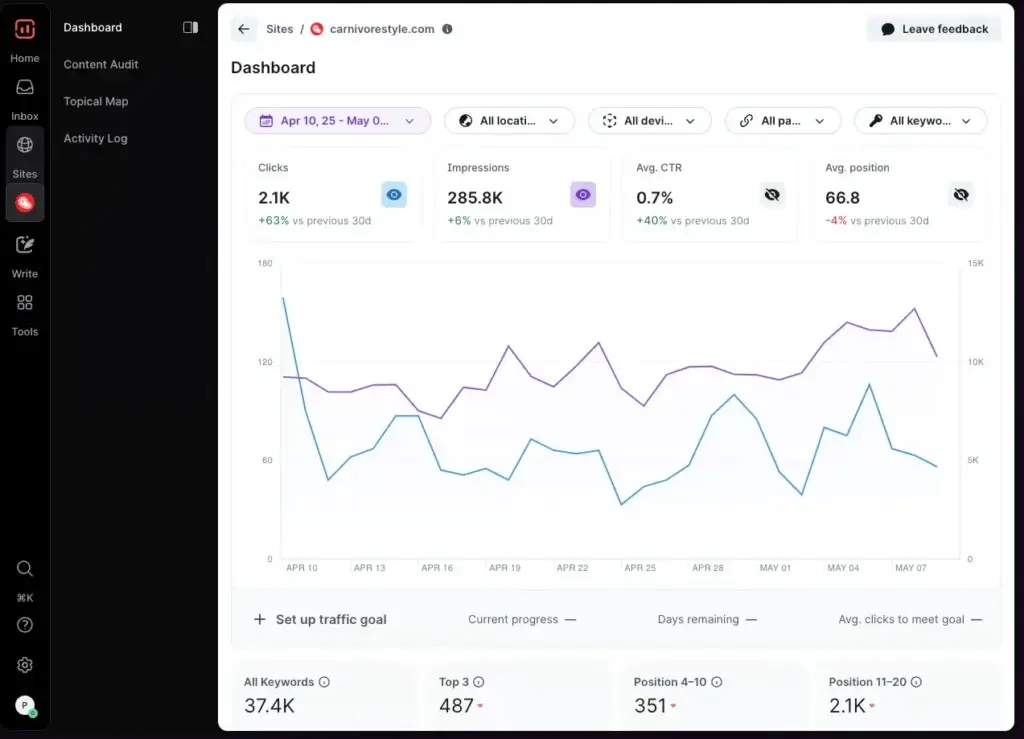
Surfer has become more valuable for content refresh workflows thanks to Content Audit and the broader Sites experience. Instead of just helping with new articles, it can help you identify pages that are losing momentum or failing to reach their potential. The platform combines Google Search Console data with SERP analysis to identify pages that need re-optimization, then brings them into the editor so you can improve them more efficiently.
This is especially useful for sites with a large content library. For many publishers and content-led SaaS teams, refreshing old content is often a faster win than publishing brand-new pages. Surfer supports that strategy well.
SERP Analyzer and Audit
Surfer also includes SERP Analyzer and Audit tools for users who want to look more closely at ranking pages and on-page optimization patterns. These tools are useful when you want a deeper review of the competitive SERP before creating or revising content. They are not a full replacement for broad competitor intelligence platforms, but they do add more context than a simple content score alone.
For SEO specialists, this helps bridge the gap between high-level optimization suggestions and page-level decision making. You can better understand what the SERP is rewarding, how the top pages are structured, and where your own page may be underperforming.
AI Tracker and AI Search Guidelines
One of the most interesting parts of Surfer’s current direction is its expansion into AI search visibility. AI Tracker is meant to help you monitor how your brand appears in AI-driven environments, while newer AI Search Guidelines inside Content Editor are designed to improve the likelihood that your content gets cited or trusted in AI-generated answers.
This does not mean Surfer has replaced traditional SEO. Instead, it reflects a broader shift in the market. If your team is thinking seriously about AI Overviews, citation visibility, and the role of entities and factual density in search, Surfer is pushing more aggressively into that area than many older on-page SEO tools.
How Strong Is Surfer for Competitive Research?
Surfer does include competitive elements, but it is important to define them accurately. Its competitor analysis is strongest at the content and SERP level, not at the broad digital market intelligence level. In practice, this means Surfer is very useful for comparing your draft or page against ranking competitors, analyzing content structure, reviewing entity coverage, and identifying topical gaps.
What it does not do as well as platforms like Semrush or Similarweb is broad competitor traffic intelligence, channel analysis, ad research, or deep backlink intelligence. That is why Surfer is best described as a content optimization platform with competitive SEO insights, rather than a full competitive intelligence suite.
If your workflow is built around winning content-level search battles, that focus can actually be a strength. If you need a wider view of market share, paid acquisition, and off-page authority, you will likely want another platform alongside it.
Pros and Cons
Benefits and Limitations of Using Surfer SEO
Positive
✅ Excellent Content Editor
✅ Support for refresh workflows
✅ Strong topical planning
✅ Forward-looking AI visibility features
Negative
❌ Not a full SEO suite
❌ Some features need GSC setup
❌ Pricing can add up
❌ Optimization should still be guided by judgment
Strengths and Benefits
Surfer’s biggest advantage is that it turns SEO recommendations into a more usable workflow for real content teams. Many tools tell you what is happening in the market. Surfer is better at helping you act on that information inside the writing and optimization process itself.
- Excellent Content Editor – Surfer remains one of the strongest tools for live, article-level content optimization.
- Support for refresh workflows – Content Audit and Sites make it easier to improve older pages instead of publishing blindly.
- Strong topical planning – Topical Map is useful for building content clusters and planning authority more strategically.
- Forward-looking AI visibility features – AI Tracker and AI Search Guidelines show that Surfer is adapting to the next phase of search visibility.
Limitations and Drawbacks
Surfer is powerful in its core area, but it is not the best fit for every SEO use case.
- Not a full SEO suite – If you need advanced backlink intelligence, traffic analytics, or PPC research, Surfer is not enough on its own.
- Some features need Google Search Console setup – Features like Content Audit become much more useful once connected properly.
- Pricing can add up – For solo creators or smaller sites, the value depends on how often you actually use the workflow.
- Optimization should still be guided by judgment – Like any SEO optimization tool, Surfer works best when you apply recommendations intelligently, not mechanically.
Competitors
Competitor Alternatives to Surfer SEO
Surfer is often compared with Semrush and Ahrefs, but the comparison only makes sense when you separate content optimization from broader SEO intelligence. Surfer is more focused. Semrush is broader. Ahrefs is often stronger in backlinks and core SEO research depth.
| Feature Type | Surfer SEO | Semrush | Ahrefs |
| Core focus | Content optimization and AI visibility | Broad SEO and marketing intelligence | SEO research and backlink analysis |
| Best for | Writers, content teams, publishers | Teams needing wider SEO and PPC coverage | Users prioritizing SEO depth and backlinks |
| Content optimization | Excellent | Good | Solid, but less workflow-driven |
| Topical planning | Strong | Strong | Useful for research |
| Backlink tools | Limited | Very good | Excellent |
| PPC and ad research | Minimal | Strong | Limited |
| Competitive intelligence | SERP-level and content-level | Broad market and domain-level | SEO-focused competitor analysis |
| Pricing feel | Mid to premium | Premium | Premium |
Choose Surfer if your biggest challenge is planning, optimizing, and refreshing content more effectively. Choose Semrush if you need a wider platform for keyword research, competitor intelligence, PPC, and reporting. Choose Ahrefs if you care most about backlink research, SEO data depth, and a more traditional SEO intelligence workflow.
Pricing
Surfer SEO Pricing and Plans
Surfer’s pricing is more structured than many older SEO writing tools because it now spans discovery-level use, team workflows, broader optimization, and enterprise use cases. This is good for flexibility, but it also means you need to choose a plan carefully based on your workflow rather than just your budget.
Discovery Plan
The Discovery plan is the lowest entry point and is best suited to smaller teams or users who want to test Surfer’s workflow without committing to a broader implementation. It is more about establishing a baseline SEO presence than running a large-scale content operation.
Standard Plan
Standard is a more realistic starting point for serious users. It adds more content creation and optimization capacity, AI visibility tracking, collaboration, and workflow support. If you plan to use Surfer regularly rather than occasionally, this is usually the first plan worth considering.
Pro Plan
Pro is a better fit for growing content teams, agencies, and businesses managing more complex SEO operations. It expands tracked prompts, team functionality, and workspace capacity, making it more practical for brands that need ongoing optimization and stronger coordination.
Enterprise Plan
Enterprise is designed for organizations that need custom limits, stronger security, onboarding support, white-label options, and more strategic support around implementation. This plan makes the most sense when SEO is a major operational channel rather than a side project.
Pricing Table
| Plan | Starting Price | Best For | Main Value |
| Discovery | $49/month billed yearly | Testing and smaller workflows | Entry-level content optimization |
| Standard | $99/month billed yearly | Regular users and small teams | Core Surfer workflow plus AI visibility |
| Pro | $182/month billed yearly | Agencies and growing teams | Greater scale, collaboration, and tracking |
| Enterprise | From $999/month | Larger organizations | Custom scale, support, and controls |
Surfer can deliver strong value if content is a central growth channel for your business. If your SEO work is light, infrequent, or heavily focused on backlinks and competitor domain analysis, the platform may feel more specialized than necessary.
Use Cases
Who Should Use Surfer SEO?
Surfer is a strong tool, but it is not equally valuable for every type of marketer.
Content Teams and Publishers
If you publish content regularly and rely on organic traffic, Surfer is one of the better workflow tools available. It helps with topic selection, draft optimization, refresh opportunities, and more consistent execution across a content calendar.
SEO Specialists Focused on On-Page Performance
If your work is strongly tied to page-level SEO, content quality, topical coverage, and SERP alignment, Surfer fits very well. It is especially useful when you want a practical bridge between strategy and actual article execution.
Agencies Managing Content at Scale
Agencies can benefit from the way Surfer standardizes workflows. It gives writers and editors a shared framework, makes refresh work easier to prioritize, and helps reduce inconsistency across client deliverables.
When Surfer Might Not Be the Right Fit
Surfer may not be the best choice if your top priority is backlink intelligence, large-scale domain comparison, paid search research, or broad market analysis. In those cases, you may get more value from Ahrefs, Semrush, or a combined stack where Surfer handles content optimization and another platform handles research and intelligence.
Best Practices
Getting Started with Surfer SEO
To get the most out of Surfer, you need to treat it as a workflow platform, not just a scoring tool. The users who get the best results are usually the ones who connect planning, creation, auditing, and refresh cycles instead of using Content Editor in isolation.
Start with Topical Planning
Do not jump straight into optimizing random articles. Use Topical Map and your broader keyword strategy to identify the pages that support a cohesive content cluster. This creates stronger topical authority and gives Surfer’s optimization workflow more strategic value.
Build a Real Refresh Process
One of Surfer’s biggest advantages is helping you improve existing content. Connect the right properties, monitor the pages that matter most, and use Content Audit to prioritize the updates most likely to move rankings or recover lost traffic.
Use Recommendations Intelligently
Surfer’s recommendations are useful, but they should not replace editorial judgment. Focus on improving topical depth, clarity, intent match, and structure. Do not treat optimization like a checklist that must be maxed out at all costs.
Align Writers and SEO Managers
Surfer works best when writers, editors, and SEO managers use the same workflow. It can reduce friction between creative and optimization priorities, but only if everyone understands how the tool is meant to support content quality rather than distort it.
Track AI Visibility Without Ignoring Classic SEO
The AI visibility features are promising, but they should support your strategy, not replace traditional SEO fundamentals. Use them as an added layer for future-proofing your content, while still focusing on search intent, page quality, and long-term authority building.
Conclusion
Final Thoughts
⭐ Overall Rating: 8.2/10
Surfer SEO is one of the strongest platforms available if your main challenge is creating and improving content that can compete in modern search. It stands out because it does more than score content. It helps you move from topic planning to draft optimization to content refresh and, increasingly, to AI visibility monitoring as well.
Its main limitation is not quality, but scope. Surfer is not the broadest SEO intelligence suite on the market, and it is not trying to be. It is most valuable when you see it for what it is: a focused SEO content optimization platform with growing AI search capabilities and useful SERP-level competitive insight. If that matches your workflow, Surfer is a very strong choice. If you need deeper backlink analysis or wider competitive intelligence, you may want to pair it with another tool.
Have more questions?
Frequently Asked Questions
1. What is Surfer SEO mainly used for?
Surfer SEO is mainly used for content optimization, topical planning, content refresh workflows, SERP analysis, and improving on-page SEO execution.
2. Is Surfer SEO a full SEO suite?
Not really. Surfer is more specialized than platforms like Semrush. Its strength is content optimization and workflow execution rather than broad SEO intelligence.
3. Is Surfer good for competitive analysis?
Yes, but mainly at the content and SERP level. It helps you compare your pages with ranking competitors, but it is not a full competitor intelligence platform in the broader market-analysis sense.
4. Does Surfer SEO help with AI search visibility?
Yes. Surfer has expanded into AI visibility through features such as AI Tracker and AI Search Guidelines, which are meant to support content performance in newer AI-driven search environments.
5. Is Surfer SEO worth it for small businesses?
It can be, especially if content is a major growth channel. If you only publish occasionally or need lighter SEO support, the investment may be harder to justify.
6. How does Surfer compare to Semrush?
Surfer is more focused on content optimization and execution, while Semrush is broader across keyword research, competitor intelligence, PPC, and reporting.
7. How does Surfer compare to Ahrefs?
Surfer is stronger for content optimization workflows. Ahrefs is usually stronger for backlink intelligence, SEO data depth, and traditional SEO research.
8. Do you need Google Search Console for Surfer?
You can use some Surfer features without it, but tools such as Content Audit become more useful when Google Search Console is connected.
9. Who should use Surfer SEO?
Surfer is best for content marketers, SEO specialists, agencies, publishers, and teams that rely on organic content performance.
10. Who should not choose Surfer SEO?
You may want another tool if your priorities are backlink analysis, PPC intelligence, or broader domain-level competitive research rather than content optimization.