Introduction
SEO and competitive research can become complicated very quickly when you are managing keyword research, backlink analysis, technical SEO, content planning, rank tracking, and competitor benchmarking at the same time. Ahrefs is one of the best-known platforms in this space, and in 2026, it is no longer just a backlink tool. It now positions itself as a broader SEO and competitive intelligence platform with features for search visibility, AI visibility, technical audits, content research, and performance reporting.
In this Ahrefs review, you will get a detailed look at its core capabilities, pricing, strengths, limitations, and ideal use cases. By the end, you should have a clear understanding of whether Ahrefs fits your workflow, goals, and budget.
What Is Ahrefs?
Ahrefs is an SEO and competitive intelligence platform used by marketers, agencies, publishers, SaaS teams, and in-house growth teams. It is best known for backlink analysis and competitor research, but the platform now covers a much wider range of workflows, including keyword research, technical site audits, rank tracking, content opportunity discovery, web analytics, reporting, and AI search visibility.
Background and Evolution
Ahrefs started as a link intelligence and backlink analysis tool, which is still one of its strongest areas. Over time, it expanded into a more complete SEO platform with tools like Keywords Explorer, Rank Tracker, Site Audit, Content Explorer, and Web Analytics. In 2026, Ahrefs also places more emphasis on AI search and brand visibility through tools like Brand Radar, making it more relevant for marketers who want to monitor both traditional search performance and how brands appear across AI-driven discovery environments.
Target Users and Use Cases
Ahrefs is suitable for several types of users:
- SEO professionals and consultants – You can use it for backlink analysis, competitor research, technical SEO, keyword discovery, and ongoing rank monitoring.
- Content marketers and editorial teams – Ahrefs helps you find content gaps, analyze ranking pages, discover search demand, and prioritize topics with stronger ranking potential.
- Agencies and in-house marketing teams – The platform is useful when you need repeatable research workflows, multi-project visibility, reporting, and competitor benchmarking.
- Growth, product, and brand teams – With broader intelligence features, Ahrefs can help you understand search demand, competitor visibility, and brand presence across both search and AI environments.
If your strategy depends heavily on organic growth, search intelligence, and learning from competitors, Ahrefs is one of the strongest tools in the market. If your needs are lighter, however, it may feel too advanced and too expensive for the value you actually use.
Key Features
How Does Ahrefs Work?
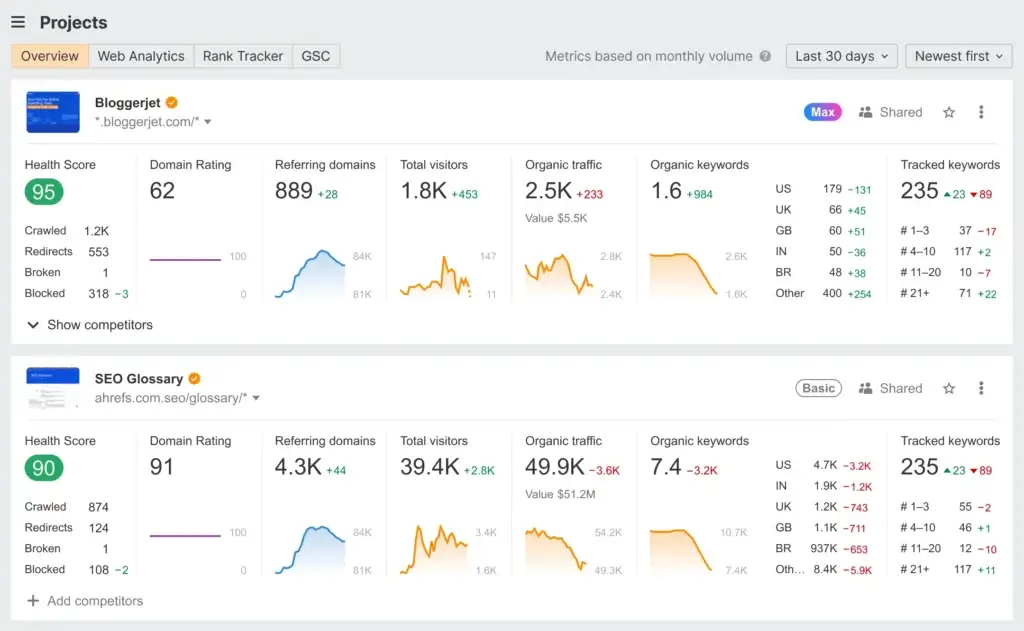
Ahrefs covers the main workflows most SEO and competitive intelligence teams care about. Its core value comes from helping you study competitors, find search opportunities, monitor your own visibility, and uncover technical issues from one interface.
Site Explorer and Competitive Research
Site Explorer is one of Ahrefs’ strongest features and remains a major reason many marketers choose the platform. You can enter your own domain or a competitor’s domain to analyze organic keywords, top pages, backlinks, referring domains, traffic estimates, paid search signals, and historical visibility patterns. This makes Ahrefs especially useful when you want to understand why competitors rank, where their traffic comes from, and which pages drive the most value.
For competitive intelligence, this is where Ahrefs stands out. Instead of only showing raw rankings, it helps you reverse-engineer competitor content strategies, backlink growth, and overall search momentum. If you work in SaaS, affiliate publishing, ecommerce, or content-led demand generation, Site Explorer can quickly reveal where your strongest opportunities are.
Keywords Explorer and Keyword Research
Keywords Explorer is Ahrefs’ main keyword research environment. You can discover keyword ideas, review search demand, analyze ranking difficulty, inspect SERP features, and study the top-ranking pages for a query. This makes it useful not only for building keyword lists, but also for understanding whether a topic is realistically worth pursuing.
One of the biggest strengths here is context. Ahrefs does more than give you keyword suggestions. It also helps you see who already ranks, what type of content wins, how hard the SERP looks, and what related terms or parent topics may offer better strategic value. For content teams, that turns keyword research into a more practical content planning workflow.

Rank Tracker and SERP Monitoring
Ahrefs includes a solid rank tracking system for monitoring keyword positions over time. You can track rankings across desktop and mobile results, compare performance with competitors, and monitor visibility changes across multiple locations. This is particularly useful if you manage regional SEO, multiple markets, or location-sensitive campaigns.
The platform is also stronger than basic rank checkers because it adds competitive context. You are not just seeing your positions. You are also seeing how you compare with competing domains, which pages gain traction, and whether your visibility is improving or slipping in important keyword groups.
Backlink Analysis and Link Intelligence
Backlink analysis is still the area where Ahrefs is most often considered a market leader. You can review referring domains, anchor text, new and lost links, broken backlinks, link growth over time, and competitor link opportunities. This makes Ahrefs especially valuable if link building, authority analysis, or link gap research is a large part of your SEO strategy.
For many advanced users, this remains Ahrefs’ biggest differentiator. Even when other platforms offer broader marketing features, Ahrefs is often the first choice when backlink depth and competitor link intelligence matter most. If your review article needs a clear positioning statement, this is one of the strongest points to emphasize.
Content Explorer and Content Research
Content Explorer adds another useful layer for research and ideation. Instead of only focusing on keywords, it helps you study which content performs in a niche, where mentions appear across the web, and what link-worthy topics are already attracting authority. This can support content strategy, digital PR, and competitive research at the page level.
If you publish at scale, this feature helps bridge the gap between keyword research and content research. It lets you move beyond simple keyword volume and study what is actually earning attention, links, and visibility across the market.
Brand Radar and AI Visibility
One of the more notable additions to Ahrefs is Brand Radar, which expands the platform into AI visibility and brand monitoring. This matters because search discovery is no longer limited to standard blue-link rankings. Marketers increasingly want to know how brands appear in AI-generated answers, which prompts mention them, and what sources shape those mentions.
This does not mean Ahrefs has become a full brand intelligence suite in the traditional sense. But it does mean the platform is adapting to how search is evolving. For review readers who care about GEO, AI search visibility, and emerging answer-engine optimization, this is now an important part of Ahrefs’ value proposition.
Web Analytics and Reporting
Ahrefs also offers Web Analytics, dashboarding, portfolios, and report-building features. These tools are useful if you want a more centralized view of site performance and project reporting. While these reporting capabilities are not usually the first reason someone buys Ahrefs, they improve the platform’s overall value for agencies, consultants, and in-house teams that need to turn research into clear updates for stakeholders.
Site Audit and Technical SEO Tools
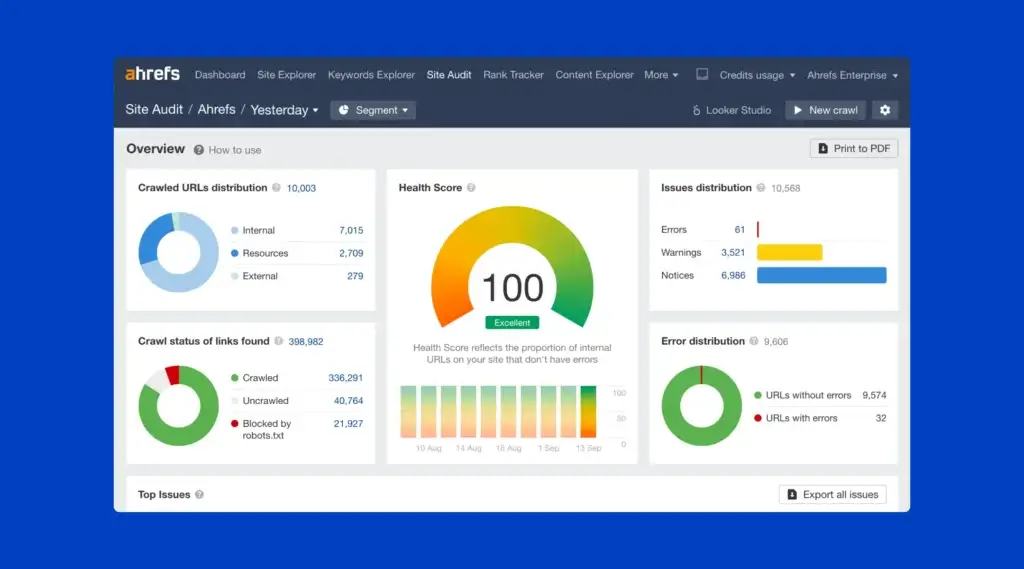
Ahrefs also includes a strong technical SEO auditing tool. You can crawl your website, identify broken pages, monitor redirects, uncover duplicate content, review internal linking issues, and inspect site health using a structured system of errors, warnings, and notices. This gives you a reliable ongoing process for technical monitoring instead of relying only on one-time SEO checks.
The Site Audit feature is particularly useful for publishers, content-heavy sites, and teams that want technical visibility without adopting a separate enterprise crawler. It may not replace every specialized technical SEO tool in every case, but for most teams it covers the essential technical workflows very well.
In practice, this means Ahrefs is no longer just a research tool. It is increasingly positioned as an operating platform for ongoing SEO intelligence, monitoring, and reporting.
Pros and Cons
Benefits and Limitations of Using Ahrefs
Positive
✅ Excellent backlink intelligence
✅ Strong competitor research
✅ Deep keyword analysis
✅ Solid technical SEO audits
Negative
❌ High pricing
❌ Limited seats on lower plans
❌ Less broad outside core SEO
❌ Can feel data-heavy at first
Strengths and Benefits
Ahrefs’ biggest strength is depth. It gives you serious research capabilities for backlinks, keywords, competitor pages, technical SEO, and content intelligence without feeling shallow in its core SEO workflows. This makes it especially appealing to advanced marketers and teams that use SEO as a strategic growth channel rather than a side task.
- Excellent backlink intelligence – Ahrefs remains one of the top choices when your workflow depends on backlink depth, referring domain analysis, and link opportunity research.
- Strong competitor research – Site Explorer makes it easy to reverse-engineer competitors’ top pages, keyword footprints, and authority growth.
- Deep keyword analysis – Keywords Explorer gives you more than raw suggestions by helping you evaluate ranking difficulty, SERP reality, and content potential.
- Solid technical SEO auditing – Site Audit gives you a practical way to monitor crawl issues, duplicate content, broken pages, and site health trends.
- Growing AI visibility features – Brand Radar gives Ahrefs a more modern angle for marketers tracking brand presence beyond traditional SERPs.
Limitations and Drawbacks
Ahrefs is powerful, but there are several trade-offs you should highlight in a balanced review.
- High pricing – Ahrefs is not an easy buy for solo site owners, hobby publishers, or small businesses with a tight budget.
- Limited seats on lower plans – Lower plans include limited users, and additional seats can increase the real monthly cost quickly.
- Less broad outside core SEO – Ahrefs has expanded, but it is still not as broad as Semrush for PPC, advertising intelligence, and wider marketing workflows.
- Can feel data-heavy at first – The interface is strong, but the amount of data can still feel intimidating if you are new to professional SEO tools.
- Third-party traffic data is still estimated – Like all SEO platforms, Ahrefs provides directional intelligence rather than exact first-party analytics.
Competitors
Competitor Alternatives to Ahrefs
Ahrefs competes with several major platforms, but the three most relevant alternatives are Semrush, Similarweb, and Moz. Each tool overlaps with Ahrefs in different ways, but their strengths are not identical.
| Feature Type | Ahrefs | Semrush | Similarweb | Moz Pro |
| Core focus | SEO depth and backlink intelligence | SEO, PPC, and broader marketing intelligence | Traffic intelligence and digital market analysis | Accessible SEO workflows |
| Best for | SEO teams needing deep research | Teams wanting all-in-one marketing visibility | Businesses focused on web traffic intelligence | Smaller teams wanting simpler SEO tools |
| Backlink analysis | Excellent | Very good | Limited compared to Ahrefs | Good |
| Keyword research | Very strong | Very strong | Useful but not core SEO-first | Solid for core needs |
| Technical SEO | Strong Site Audit | Strong Site Audit | Not the main focus | Good for standard audits |
| Competitive intelligence | Strong for organic search | Broader across SEO and PPC | Strong for market and traffic analysis | More limited overall |
| Pricing feel | Premium | Premium | Premium to enterprise | More accessible |
Choose Ahrefs if your priority is SEO depth, backlink analysis, keyword research, and reverse-engineering organic competitors. Choose Semrush if you want a broader platform that covers SEO, PPC, and wider competitive intelligence. Choose Similarweb if your main goal is traffic intelligence and digital market benchmarking. Choose Moz if you want a simpler and more approachable SEO platform for lighter use cases.
Pricing
Ahrefs Pricing and Plans
Ahrefs uses premium pricing, and this is one of the biggest factors to evaluate before subscribing. The product lineup is broader than many older reviews suggest. In addition to a free Webmaster Tools tier, Ahrefs now offers a $29 Starter plan, then Lite, Standard, Advanced, and Enterprise tiers for more serious users and teams.
Starter Plan
The Starter plan is designed for beginners, lighter research needs, and users who want to go beyond the free tier without jumping straight into a full premium plan. It is a much better entry point than older Ahrefs pricing models for users testing the platform or running smaller projects.
Lite Plan
The Lite plan is aimed at small businesses and personal projects that need the core Ahrefs toolset. It is the practical starting point if you want real access to Site Explorer, Keywords Explorer, Rank Tracker, and Site Audit for regular SEO work.
Standard Plan
The Standard plan is often the better fit for freelance SEOs, consultants, and content teams managing more projects. It gives you stronger limits, more historical data, and broader functionality for ongoing research and reporting.
Advanced Plan
The Advanced plan is geared more toward lean in-house teams and more serious SEO operations. It raises limits again and makes more sense if you actively use Ahrefs across multiple properties, larger keyword sets, and more demanding workflows.
Enterprise Plan
The Enterprise plan is built for larger organizations that need higher limits, stronger access controls, tailored data exports, and enterprise-grade access. This is generally only worth it if Ahrefs is a central part of your SEO and intelligence stack.
Pricing Table
Below is a simplified overview of Ahrefs pricing position in 2026.
| Plan | Best For | Main Value |
| Webmaster Tools | Site owners with verified properties | Free limited access to core site data |
| Starter | Beginners and lighter use cases | Low-cost entry into Ahrefs workflows |
| Lite | Small businesses and personal projects | Core SEO and competitor research tools |
| Standard | Consultants and growing teams | Better limits and stronger strategic value |
| Advanced | Lean in-house teams | Higher capacity for ongoing SEO operations |
| Enterprise | Larger organizations | Enterprise controls and custom scale |
Ahrefs can offer strong value if you actively use several of its tools, especially backlinks, keyword research, competitor analysis, and technical SEO. If you only need a lightweight keyword tool or basic on-page recommendations, it may be more expensive than necessary. The strongest value comes when Ahrefs becomes part of your recurring research and growth workflow rather than an occasional lookup tool.
Use Cases
Who Should Use Ahrefs?
Ahrefs is not equally suited to every type of user. Its value improves significantly when SEO is a real business channel rather than a side project.
SEO Specialists and Link Builders
If your work depends on backlink analysis, competitor domain research, and identifying ranking opportunities quickly, Ahrefs is one of the best fits on the market. This is especially true for advanced users who care about research depth and want to understand why pages rank instead of relying only on surface-level metrics.
Content Teams and Publishers
Ahrefs is also a strong choice for content marketers, publishers, and editorial teams. You can use it to identify keyword opportunities, study parent topics, analyze competing pages, and build more informed topic clusters. For content-led growth, that is a powerful combination.
Agencies and In-House Marketing Teams
Agencies and in-house teams benefit from Ahrefs because it combines competitor analysis, keyword research, site audits, and reporting under one roof. If your team already has defined SEO processes, Ahrefs can become a central research and monitoring layer.
Brand and Growth Teams Watching AI Search
Brand Radar gives Ahrefs more relevance for teams that care about how brands appear across AI-generated experiences. This makes it increasingly useful for marketers who want to track not only traditional rankings, but also how their brand is cited or mentioned in AI search contexts.
When Ahrefs Might Not Be the Right Fit
Ahrefs may not be ideal if you have a very small budget, only need a basic SEO workflow, or want a simpler all-in-one platform for SEO plus PPC research. In those cases, lighter tools or broader alternatives like Semrush may offer better value depending on your priorities.
Best Practices
Getting Started with Ahrefs
To get the most out of Ahrefs, follow these best practices:
Start With Competitor Research
One of the fastest ways to get value from Ahrefs is to analyze your top competitors first. Study their best-performing pages, backlink sources, and keyword footprints before building your own strategy. This gives you a more realistic picture of the market and helps you avoid working in the dark.
Build Topic Clusters, Not Just Keyword Lists
Use Keywords Explorer to build thematic groups around search intent, not just isolated target keywords. This makes your content strategy easier to scale and gives you a stronger foundation for topical authority.
Use Site Audit on a Schedule
Do not treat technical SEO as a one-time task. Run audits regularly so you can catch crawl issues, broken pages, duplicate content, and internal linking problems before they affect site performance more seriously.
Track Competitors Alongside Your Own Rankings
Rank tracking becomes much more useful when you benchmark against real competitors. Instead of watching your own keyword positions in isolation, compare how visibility changes across the category and where competitors are gaining momentum.
Avoid Using Every Feature at Once
Ahrefs offers a lot of depth, and the easiest way to lose value is to use it without a clear workflow. Start with Site Explorer, Keywords Explorer, Rank Tracker, and Site Audit. Once those become part of your routine, expand into Content Explorer, reporting, and AI visibility tools.
Conclusion
Final Thoughts
⭐ Overall Rating: 9.5/10
Ahrefs remains one of the strongest SEO and competitive intelligence tools available in 2026. Its biggest strengths are backlink intelligence, keyword research, competitor analysis, and technical SEO monitoring. It is especially compelling if your business depends on organic growth and you need more than lightweight SEO software.
Its expansion into AI visibility and broader reporting also makes the platform more future-facing than older Ahrefs reviews suggest. At the same time, price is still the main trade-off. If you will actively use its research depth and ongoing monitoring features, Ahrefs can justify the investment. If your needs are basic or you want broader PPC and advertising intelligence in the same tool, another platform may fit better.
For serious SEO professionals, content-led teams, and marketers who want reliable competitor intelligence, Ahrefs is still one of the best tools to consider.
Have more questions?
Frequently Asked Questions
1. What is Ahrefs mainly used for?
Ahrefs is mainly used for backlink analysis, keyword research, competitor analysis, rank tracking, technical SEO audits, and content opportunity research.
2. Is Ahrefs only for backlink analysis?
No. Backlinks are one of its strongest areas, but Ahrefs also includes keyword research, site auditing, rank tracking, content research, web analytics, and AI visibility tools.
3. Is Ahrefs good for competitor analysis?
Yes. Ahrefs is one of the best tools for studying competitor domains, top pages, backlinks, keyword gaps, and overall organic visibility.
4. Is Ahrefs worth it for small businesses?
It can be, but only if search traffic is important to your growth strategy. Smaller businesses with lighter SEO needs may find the platform more expensive than necessary.
5. How does Ahrefs compare to Semrush?
Ahrefs is often preferred for backlink depth and SEO-focused research, while Semrush is usually stronger as a broader all-in-one platform for SEO, PPC, and wider marketing intelligence.
6. Does Ahrefs help with technical SEO?
Yes. Its Site Audit tool helps you monitor crawl issues, broken pages, duplicate content, redirect problems, and other technical SEO concerns.
7. Can Ahrefs help with content strategy?
Yes. Ahrefs supports content planning through keyword discovery, SERP analysis, parent topics, content gap research, and page-level competitive analysis.
8. Does Ahrefs offer a free version?
Ahrefs offers Ahrefs Webmaster Tools, which gives verified site owners free limited access to Site Audit and Site Explorer data for their own sites.
9. What is Ahrefs Brand Radar?
Brand Radar is Ahrefs’ AI visibility and brand monitoring feature. It helps you track how brands are mentioned across AI-related discovery environments and broader web visibility contexts.
10. Who should not choose Ahrefs?
You may want to skip Ahrefs if you have a very limited budget, only need basic SEO functionality, or want broader paid media intelligence in the same platform.