Introduction: Why ITSM vs ITIL Is Often Confused
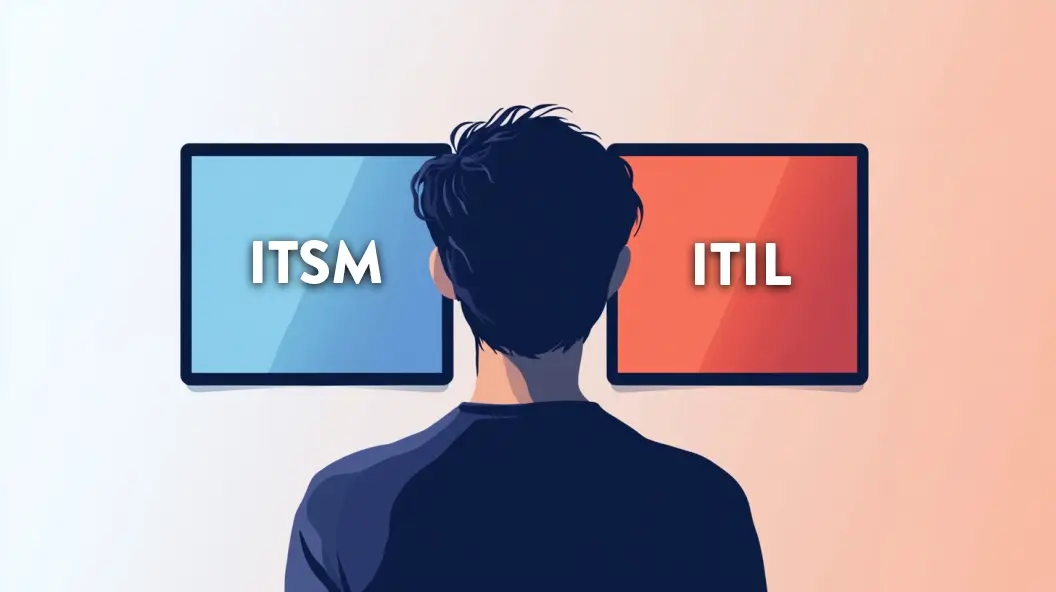
If you’ve ever researched IT service management, you’ve likely come across the phrase ITSM vs ITIL. These two terms are closely connected, but they do not mean the same thing.
The simplest explanation is this: ITSM, or IT Service Management, is the overall practice of managing IT services. ITIL, or Information Technology Infrastructure Library, is a framework that helps organizations structure and improve those ITSM practices.
In other words, ITSM describes what IT teams do to deliver reliable services, while ITIL provides guidance on how those services can be planned, delivered, supported, and improved.
Understanding the difference between ITSM vs ITIL is important for IT managers because it affects how you design service workflows, choose software, measure performance, and support employees across the business.
In this guide, you’ll learn the key differences between ITSM and ITIL, how they work together, when you need one or both, and which ITSM tools can help you apply ITIL-aligned workflows in practice.
ITSM vs ITIL: Quick Comparison
Before going deeper, it helps to start with a simple comparison. ITSM is the broader discipline, while ITIL is one of the most widely used frameworks for improving ITSM.
| Comparison Point | ITSM | ITIL |
| Meaning | The practice of managing IT services | A framework for applying ITSM guidance |
| Main Purpose | Deliver, support, and improve IT services | Standardize and improve ITSM practices |
| Scope | Broad discipline covering people, processes, tools, and services | Specific framework used within ITSM |
| Best For | Teams that need to manage tickets, requests, incidents, assets, and changes | Teams that want structured governance, service quality, and continual improvement |
| Software Required? | Usually supported by ITSM software | No, but ITSM tools help apply ITIL practices |
Quick answer: ITSM is not the same as ITIL. ITSM is the management practice, and ITIL is a framework that helps you make that practice more structured, measurable, and consistent.

What Is ITSM?
ITSM Definition
ITSM stands for IT Service Management. It refers to the way an organization designs, delivers, manages, and improves IT services for employees, customers, and business teams.
ITSM is not just about fixing broken laptops or answering helpdesk tickets. It covers the full service experience, from the moment a user requests support to the way IT resolves incidents, manages assets, tracks changes, and improves service quality over time.
A strong ITSM approach helps IT teams move from reactive support to structured service delivery. Instead of handling every request manually, your team can use workflows, automation, knowledge bases, and reporting to deliver faster and more consistent support.
Core ITSM Processes and Practices
Most ITSM strategies include a mix of service desk, operational, and governance practices. The exact setup depends on your organization’s size, industry, risk level, and internal IT maturity.
- Service desk and ticketing: Centralize employee requests and support issues.
- Incident management: Restore services quickly after disruptions.
- Problem management: Find and fix recurring root causes.
- Change management: Control updates, releases, and system changes.
- Asset management: Track hardware, software, licenses, and devices.
- Knowledge management: Help users solve common issues faster.
- Automation: Reduce repetitive work through routing, alerts, and approvals.
Real-World Example of ITSM
Imagine an employee cannot access a business application. Without ITSM, they might send an email to IT, wait for someone to notice it, and follow up manually.
With ITSM, the employee submits a request through a service portal. The system categorizes the ticket, assigns it to the right technician, checks the service-level agreement, suggests relevant knowledge base articles, and tracks the resolution from start to finish.
This is where ITSM tools become useful. Platforms such as Freshservice, monday service, NinjaOne, and ServiceNow help teams turn service management concepts into daily workflows.
Why it matters: ITSM gives your IT team a structured way to manage demand, improve response times, reduce downtime, and create a better employee experience.
What Is ITIL?
ITIL Definition
ITIL stands for Information Technology Infrastructure Library. It is a globally recognized framework of service management guidance that helps organizations improve how they deliver and support IT services.
ITIL is not software. It is not a ticketing system. It is not a single process. Instead, ITIL gives you a set of principles, practices, and concepts that help your ITSM approach become more consistent, business-focused, and measurable.
The current version, ITIL 4, focuses on value creation, collaboration, continual improvement, governance, and the connection between IT services and business outcomes.
How ITIL 4 Changed the Conversation
Older ITIL versions were often explained through a service lifecycle, including Service Strategy, Service Design, Service Transition, Service Operation, and Continual Service Improvement.
ITIL 4 takes a more modern approach. It focuses on the Service Value System, which explains how different parts of an organization work together to create value through services.
ITIL 4 also reflects the way modern IT teams work with Agile, DevOps, cloud platforms, automation, remote work, and cross-functional service delivery.
Important ITIL 4 Concepts for IT Managers
You do not need to master every ITIL term to benefit from the framework. For most IT managers, the most useful ITIL 4 concepts are the ones that improve daily service delivery.
- Service Value System: Shows how IT activities create business value.
- Guiding principles: Practical recommendations such as focus on value and keep it simple.
- Service Value Chain: Describes activities such as plan, improve, engage, and deliver.
- ITIL practices: Includes incident management, service request management, service desk, and change enablement.
- Continual improvement: Encourages regular review and optimization of IT services.
Why it matters: ITIL helps you avoid building ITSM workflows from scratch. It gives you proven guidance, but you still need to adapt it to your organization’s size, culture, and goals.

Key Differences Between ITSM and ITIL
The biggest difference between ITSM and ITIL is scope. ITSM is the discipline of managing IT services. ITIL is a framework that helps you improve how those services are managed.
This distinction matters because many organizations think they need to “buy ITIL” or “install ITIL.” That is not how it works. You implement ITSM through people, processes, and software. You use ITIL as guidance to make those processes more reliable and consistent.
| Feature | ITSM | ITIL |
| Definition | A practice for managing IT services | A framework that supports ITSM improvement |
| Purpose | Deliver and support IT services efficiently | Provide guidance for better service management |
| Scope | Broad, covering service desk, tickets, assets, incidents, changes, and automation | Focused on service management principles, practices, governance, and continual improvement |
| Implementation | Implemented through teams, workflows, and ITSM software | Applied through ITSM practices and adapted to business needs |
| Flexibility | Can be simple or advanced depending on your organization | Flexible, but often requires interpretation and process design |
| Best Use Case | Managing daily IT support and service operations | Standardizing, improving, and scaling ITSM maturity |
Businesses comparing ITSM vs ITIL should not treat them as competing options. ITSM gives you the operating model for service delivery, while ITIL gives you a structured way to improve that model.
Key takeaway: You can use ITSM without formally adopting ITIL, but ITIL can help you make ITSM more consistent, scalable, and aligned with business priorities.
Is ITIL Part of ITSM?
Yes, ITIL is best understood as part of the broader ITSM world. ITSM is the umbrella category, and ITIL is one framework that helps guide ITSM implementation.
Think of it this way: ITSM is like running a customer service department for technology. ITIL is like a proven playbook that helps you define how requests are handled, how incidents are escalated, how changes are approved, and how service quality is improved.
However, ITIL is not the only ITSM framework. Some organizations also use COBIT, ISO/IEC 20000, VeriSM, Agile service management, or internal operating models. ITIL remains one of the most popular because it is practical, widely recognized, and adaptable.
For a broader look at implementation, you can also read our guide on how to implement ITIL 4 in your ITSM strategy.
ITSM vs ITIL Examples for IT Managers
The easiest way to understand the difference is to look at everyday IT scenarios. In each case, ITSM describes the service management activity, while ITIL helps define the best-practice approach behind it.
Example 1: Password Reset Request
An employee forgets their password and needs help accessing a system.
ITSM role: The user submits a ticket through the service desk or self-service portal. The request is logged, assigned, resolved, and tracked.
ITIL role: ITIL service request management helps define how the request should be categorized, routed, fulfilled, measured, and improved.
Example 2: Critical System Outage
A core business application goes down during working hours.
ITSM role: The IT team records the incident, communicates with users, escalates the issue, and works to restore service.
ITIL role: ITIL incident management gives structure to prioritization, escalation, service restoration, communication, and post-incident review.
Example 3: Software Update or System Change
Your IT team needs to roll out a major software update.
ITSM role: The update is planned, approved, scheduled, deployed, and documented in the ITSM platform.
ITIL role: ITIL change enablement helps assess risk, define approvals, plan rollback steps, reduce disruption, and protect service quality.
These examples show why ITSM and ITIL work best together. ITSM gives you the operational system, while ITIL improves the quality and consistency of the workflow.

How ITIL Complements ITSM
ITSM and ITIL are not rivals. They are complementary. ITSM helps you manage IT services, while ITIL helps you manage them in a more structured and value-focused way.
ITIL Gives Structure to ITSM Workflows
Without a framework, ITSM can become inconsistent. Different technicians may handle the same type of request in different ways. Escalation rules may be unclear. Change approvals may depend on informal decisions.
ITIL helps reduce that inconsistency by giving IT teams a shared language and structured approach to service delivery.
ITIL Helps IT Teams Improve Over Time
ITSM should not be a one-time setup. Your service desk, automation rules, knowledge base, reports, and approval flows should improve as your business changes.
ITIL’s focus on continual improvement encourages teams to review performance, identify bottlenecks, improve processes, and measure whether IT services are creating real business value.
ITIL Supports Governance and Compliance
For industries such as finance, healthcare, education, and government, IT services often need strong documentation, approval trails, and risk controls.
ITIL can help IT managers build more consistent change management, incident management, request fulfillment, and reporting practices. This is especially useful when IT teams need to prove accountability or meet internal audit expectations.
Should You Implement ITSM, ITIL, or Both?
The right answer depends on your team size, service maturity, compliance requirements, and operational complexity.
For most IT teams, the best approach is not choosing ITSM or ITIL. It is implementing ITSM in a way that uses the parts of ITIL that make sense for your organization.
When ITSM Alone May Be Enough
If your team is small, you may not need a formal ITIL implementation. You may simply need a better way to manage tickets, prioritize work, automate simple tasks, and track recurring issues.
- You need a basic service desk or ticketing system.
- Your IT environment is not heavily regulated.
- Your team values speed and flexibility over formal governance.
- You are still building your first structured IT support process.
Example: A small e-commerce company may use monday service to organize IT requests, automate assignments, and track resolution times without building a full ITIL operating model.
When ITIL with ITSM Makes More Sense
As IT becomes more complex, informal service processes can create risk. Larger teams often need clearer roles, approval flows, escalation rules, reporting, and change controls.
- You manage many users, systems, departments, or locations.
- You need better change control and risk management.
- Your business has compliance or audit requirements.
- You want to improve service quality in a measurable way.
Example: A healthcare provider may use an ITSM platform with ITIL-aligned change enablement to reduce the risk of unapproved changes affecting clinical or administrative systems.
Best Approach: Start Practical, Then Mature
You do not need to implement every ITIL practice at once. A better approach is to start with your biggest service pain points.
For many IT managers, that means improving incident management, service request management, knowledge management, and change enablement first. Once those workflows are stable, you can mature into problem management, service level management, asset management, and continual improvement.
Key takeaway: ITSM helps you operate better. ITIL helps you improve with more structure. Together, they create a stronger service management foundation.
Common Mistakes When Comparing ITSM vs ITIL
Many IT teams struggle with ITSM and ITIL because they approach the topic from the wrong angle. The goal is not to copy a framework word for word. The goal is to improve service delivery in a way that fits your business.
Mistake 1: Thinking ITIL Is Software
ITIL is not a platform. You cannot log into ITIL, assign tickets in ITIL, or buy ITIL as a tool. ITIL is guidance. ITSM software is what helps you apply that guidance in real workflows.
Mistake 2: Making ITIL Too Complicated
Some teams over-document every process before they improve the basics. This can slow adoption and frustrate users.
A better approach is to start with simple, high-impact workflows such as incident management, service request management, and change approvals.
Mistake 3: Choosing Software Before Defining Workflows
ITSM tools are powerful, but they cannot fix unclear processes. Before choosing software, define how tickets should be submitted, prioritized, assigned, escalated, resolved, and measured.
Mistake 4: Ignoring the User Experience
If employees find your service portal confusing, they will avoid it. A successful ITSM strategy should make it easy for users to request help, find answers, and understand ticket status.
Comparing ITSM vs ITIL Across Leading ITSM Software
ITSM software helps teams put service management into practice. ITIL helps shape the workflows behind incident management, service request management, change enablement, knowledge management, and continual improvement.
The right tool depends on how structured your processes need to be, how much automation you want, and whether your team needs a flexible system or an enterprise-grade ITIL-aligned platform.
| Software | Best Fit | ITSM Strength | ITIL Fit |
| NinjaOne | IT teams and MSPs managing endpoints | Ticketing, endpoint visibility, remote support, patching, and documentation | Best when ITIL practices need endpoint context and faster troubleshooting |
| Freshservice | Growing IT teams that want structured ITSM | Service desk, asset management, automation, analytics, and AI-assisted workflows | Strong fit for ITIL-style incident, request, change, and service workflows |
| monday service | Teams that want flexible service workflows | Request intake, workflow automation, dashboards, AI agents, and cross-team visibility | Good for adapting ITIL practices without heavy process complexity |
| ServiceNow | Large enterprises with mature IT operations | Enterprise ITSM, workflow automation, analytics, service operations, and governance | Very strong fit for structured ITIL-aligned service management |
Which ITSM Software Should You Choose?
If you manage endpoints, devices, and remote troubleshooting, NinjaOne is a practical option because it connects ticketing with endpoint management and support workflows.
If you want a modern ITSM platform with strong service desk, asset, automation, and AI capabilities, Freshservice is a strong fit for growing IT teams that want structure without enterprise-level complexity.
If your priority is flexibility, fast adoption, and visual workflow management, monday service works well for teams that want service management without a rigid traditional setup.
If you are running large-scale enterprise IT with advanced governance, integrations, and mature ITIL-aligned workflows, ServiceNow is usually the strongest option.
For a deeper breakdown of pricing, features, and use cases, read our full guide to the best ITSM software.
How to Choose the Right Approach for Your IT Team
Choosing between ITSM and ITIL is really about choosing the right level of structure. Too little structure creates inconsistency. Too much structure can slow your team down.
Start by asking what problem you are trying to solve.
- If tickets are getting lost: Start with ITSM software and request workflows.
- If incidents take too long to resolve: Improve incident management and escalation rules.
- If changes cause outages: Add ITIL-aligned change enablement.
- If users keep asking the same questions: Build knowledge management and self-service.
- If leadership wants better reporting: Define metrics, SLAs, dashboards, and service reviews.
For most IT managers, the best path is to start with practical ITSM improvements, then use ITIL 4 guidance to mature the areas that need more control, consistency, and measurement.
Conclusion
ITSM vs ITIL Is Not an Either-Or Decision
The ITSM vs ITIL comparison is useful because it clarifies two concepts that are often mixed together. But in practice, you should not see them as competing approaches.
ITSM is the discipline that helps your IT team deliver, support, and improve technology services. ITIL is a framework that helps you make those services more structured, reliable, and aligned with business value.
If your team is just starting, focus first on building a clear ITSM foundation: ticketing, service requests, incident management, knowledge base content, and basic reporting.
If your organization is growing, regulated, or dealing with complex IT operations, ITIL can help you standardize workflows, improve governance, reduce risk, and build a culture of continual improvement.
The best approach is usually to combine both. Use ITSM software to manage daily service work, and use ITIL guidance to improve how that work is designed, measured, and optimized over time.
Try These ITSM Tools
Most ITSM providers offer free trials, demos, or guided product tours. Here are a few options to explore:
🚀 Try NinjaOne
🚀 Try Freshservice
🚀 Explore monday service
🚀 View ServiceNow ITSM
FAQ
What is the main difference between ITSM and ITIL?
The main difference is that ITSM is the practice of managing IT services, while ITIL is a framework that helps organizations structure and improve ITSM practices. ITSM defines the work, and ITIL provides guidance for doing that work more consistently.
Is ITIL part of ITSM?
Yes. ITIL is commonly considered part of the broader ITSM discipline. ITSM is the overall approach to managing IT services, and ITIL is one framework that helps guide ITSM implementation and improvement.
Can you use ITSM without ITIL?
Yes. You can use ITSM without formally adopting ITIL. Many small and mid-sized teams start with basic ITSM workflows such as ticketing, incident management, and service requests, then add ITIL guidance as their processes mature.
Is ITIL software?
No. ITIL is not software. It is a framework of service management guidance. ITSM software helps teams apply ITIL-style practices through ticketing, workflows, automation, approvals, reporting, and knowledge management.
What is ITIL 4?
ITIL 4 is the current version of the ITIL framework. It focuses on value creation, guiding principles, governance, continual improvement, and service management practices that support modern IT environments.
Do small businesses need ITIL?
Small businesses do not always need a full ITIL implementation. However, they can still benefit from selected ITIL practices, such as incident management, service request management, knowledge management, and continual improvement.
Which ITSM tools support ITIL-aligned workflows?
Popular ITSM tools that support ITIL-aligned workflows include Freshservice, ServiceNow, NinjaOne, and monday service. The best option depends on your team size, maturity, automation needs, and governance requirements.
Is ITSM only for IT departments?
ITSM started in IT, but many organizations now apply similar service management principles across HR, finance, facilities, legal, and operations. This broader approach is often called enterprise service management.
How does ITIL improve ITSM?
ITIL improves ITSM by giving teams a structured approach to incidents, requests, changes, knowledge, service levels, and continual improvement. This can reduce inconsistency, improve reporting, and support better service quality.
Should you choose ITSM or ITIL first?
Most teams should start with practical ITSM needs first, such as ticketing, incident response, and request management. Then they can use ITIL guidance to improve structure, governance, and service quality over time.