Introduction
Choosing the right CRM is not only about comparing features. It is about finding a system that fits the way you sell, follow up, manage opportunities, and turn pipeline activity into revenue.
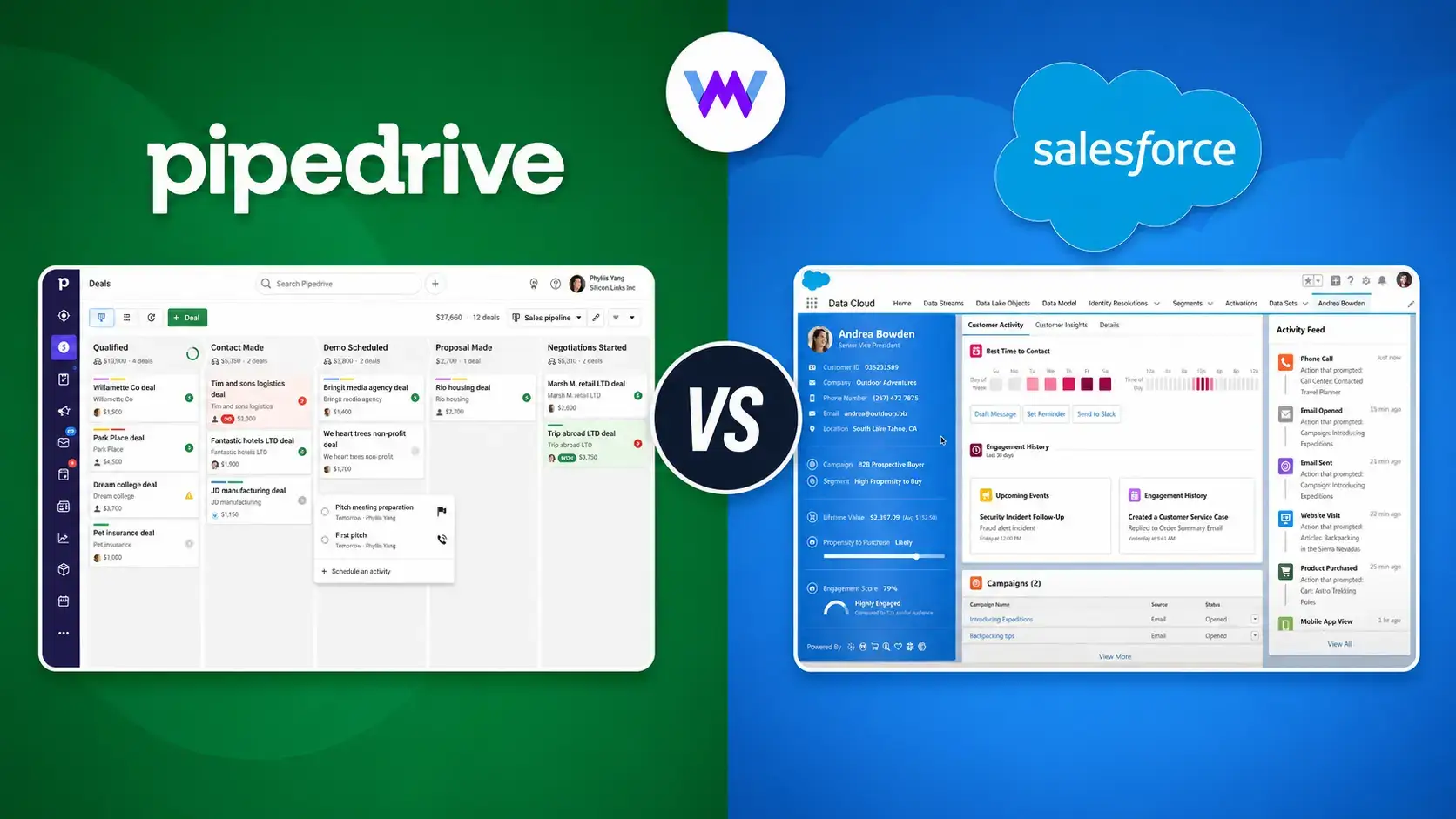
In this detailed Pipedrive vs Salesforce comparison, you will see how both platforms compare across pricing, features, ease of use, integrations, AI, security, customer reviews, and ideal use cases.
The short answer is simple: Pipedrive is the better choice for most small and mid-sized sales teams that want a focused CRM, faster adoption, and lower total cost. Salesforce is still a powerful enterprise platform, but it is usually a better fit for larger companies with complex workflows, admin resources, and bigger implementation budgets.
If you’re still learning the basics of CRM systems, you may want to start with our What is CRM Software guide before choosing a platform.
Pipedrive vs Salesforce at a Glance
If you want the fastest comparison, Pipedrive wins on usability, setup speed, affordability, and day-to-day sales adoption. Salesforce wins on enterprise customization, ecosystem depth, and advanced multi-department workflows.
For most growing sales teams, that difference matters. A CRM only creates value when your team actually uses it, and this is where Pipedrive has a clear advantage.
| Category | Pipedrive | Salesforce |
| Best For | Small and mid-sized sales teams | Large enterprises and complex organizations |
| Ease of Use | Very easy, visual, and sales-focused | Powerful, but more complex to configure |
| Setup Time | Fast setup with minimal admin work | Often requires admin, consultant, or technical setup |
| Sales Pipeline Management | Excellent visual pipeline and deal tracking | Highly customizable pipeline management |
| Automation | Practical workflow automation for sales teams | Advanced automation through Flow and enterprise tools |
| AI Capabilities | Practical AI support for sales activity and productivity | Advanced AI through Einstein and Agentforce |
| Integrations | 350+ marketplace integrations and API access | Thousands of apps through AppExchange |
| Total Cost | Lower and easier to predict | Higher, especially with add-ons and support |
| Best Overall Choice | Best for most sales-driven SMBs | Best for large enterprises with complex CRM needs |
Overview of Pipedrive and Salesforce
Pipedrive and Salesforce are both respected CRM platforms, but they are built around very different philosophies.
Pipedrive is designed around sales activity, visual deal management, and simplicity. Salesforce is designed as a broad enterprise CRM ecosystem that can support sales, service, marketing, commerce, analytics, AI, and custom business processes.
What Is Pipedrive?
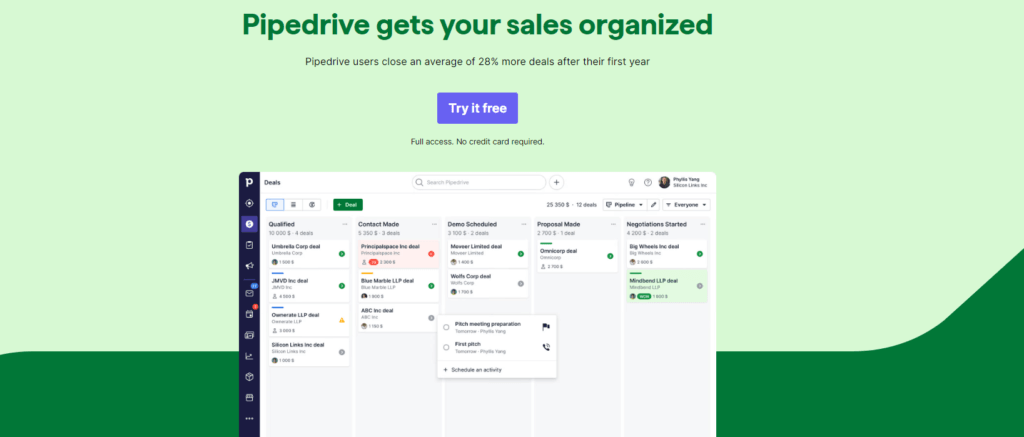
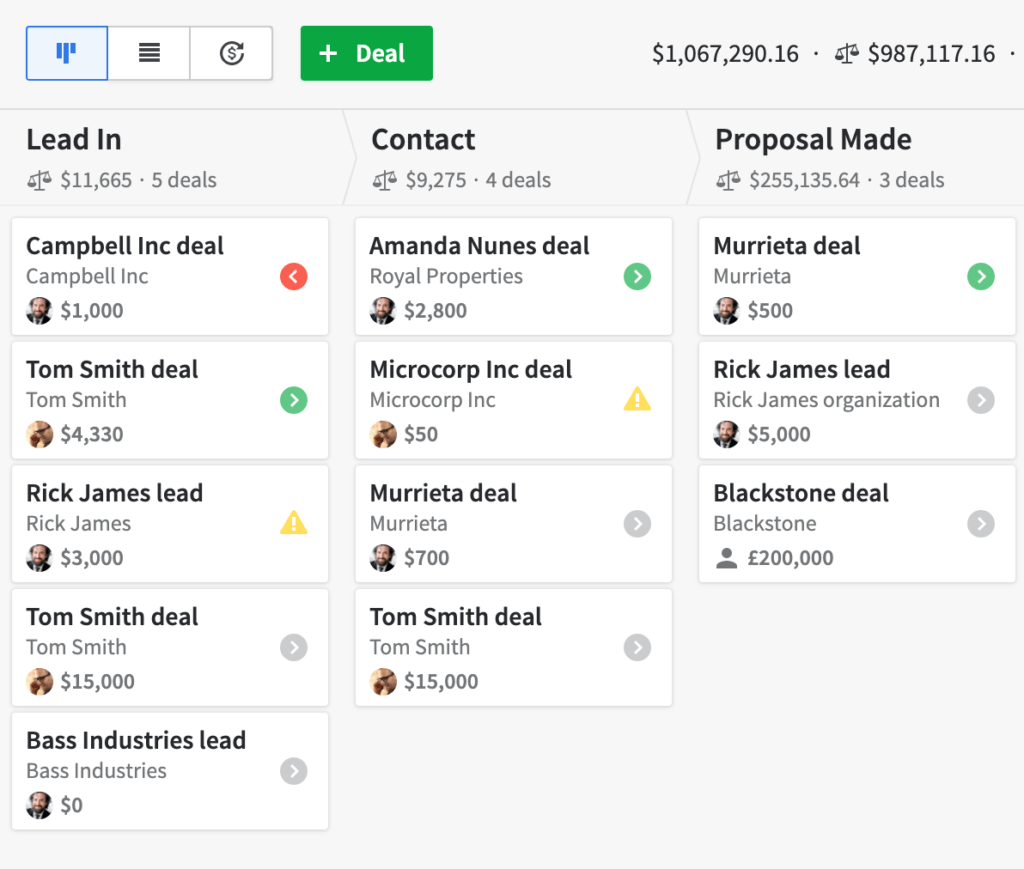
Pipedrive is a sales-first CRM built to help you manage deals, contacts, activities, and follow-ups without unnecessary complexity. Its core strength is the visual pipeline, which gives your team a clear view of every opportunity and what needs to happen next.
For many small and mid-sized businesses, Pipedrive feels refreshingly practical. You do not need a dedicated CRM admin to build your first pipeline, add contacts, assign activities, or start tracking sales performance.
Main selling points:
- Visual drag-and-drop pipeline management
- Fast onboarding for sales teams
- Practical workflow automation
- Strong mobile app for field sales
- Lower total cost than most enterprise CRMs
- Easy fit for startups, agencies, SaaS teams, and SMBs
What Is Salesforce?
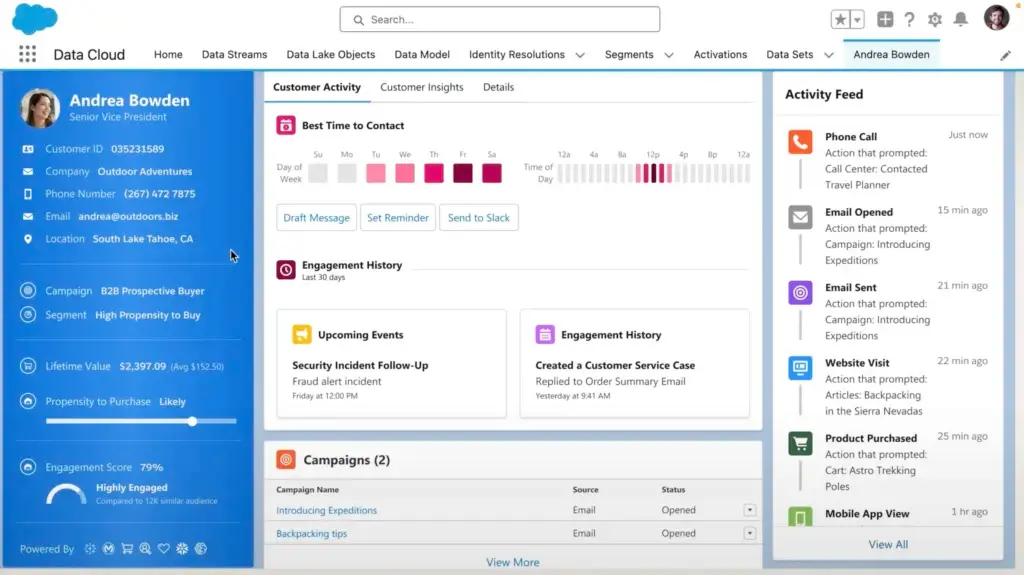
Salesforce is one of the most powerful CRM platforms in the market. It is built for organizations that need deep customization, advanced reporting, complex permissions, multi-team workflows, and a large ecosystem of connected business apps.
Salesforce can support almost any CRM process, but that flexibility comes with a cost. You may need an admin, implementation partner, or internal operations team to configure it correctly and keep it optimized over time.
Main selling points:
- Enterprise-grade customization
- Advanced automation through Salesforce Flow
- AI capabilities through Einstein and Agentforce
- Large AppExchange integration marketplace
- Strong fit for large sales organizations and regulated industries
For a larger enterprise, Salesforce can be the right foundation. For a lean sales team that needs speed, adoption, and predictable pricing, Pipedrive is usually the smarter and more efficient choice.
Features Comparison
When comparing Pipedrive vs Salesforce, the real question is not “Which CRM has more features?” It is “Which CRM gives your team the features they will actually use?”
Salesforce has more enterprise functionality overall, but Pipedrive delivers the core sales CRM features in a more accessible and user-friendly way.
Key CRM Features
| Feature | Pipedrive | Salesforce |
| Sales Pipeline Management | Visual drag-and-drop pipeline with clear deal stages and activity tracking | Highly customizable pipeline structure, but setup can take longer |
| Contact and Account Management | Simple contact, organization, activity, and communication tracking | Advanced account structures for complex sales organizations |
| Automation and Workflows | Easy workflow automation for tasks, follow-ups, emails, and deal movement | Advanced Flow Builder for complex business logic and multi-step processes |
| Reporting and Analytics | Sales-focused reports, dashboards, forecasting, and goal tracking | Advanced dashboards, forecasting, custom reports, and AI-driven insights |
| AI Features | Practical AI sales assistance and productivity support | More advanced AI through Einstein and Agentforce, depending on plan and setup |
| Integrations and API | 350+ integrations and open API access | Thousands of AppExchange apps and deep enterprise API capabilities |
| Mobile App | Strong mobile CRM experience for reps on the move | Feature-rich mobile app, but some workflows may depend on configuration |
| Customer Support | Support options included across plans, with additional support on higher tiers | Tiered support model, with premium support often adding cost |
Sales Pipeline Management
Pipedrive is at its best when you need a clean and reliable way to manage opportunities. The pipeline view is simple, visual, and built around sales activity. You can drag deals between stages, schedule next steps, and quickly identify which opportunities need attention.
Salesforce can also manage pipelines extremely well, but it usually requires more configuration. If your sales process has multiple teams, regions, product lines, approval rules, and forecasting layers, Salesforce gives you more flexibility. If your team simply wants to sell more efficiently, Pipedrive is easier to adopt.
Automation and Workflows
Pipedrive gives you practical automation for everyday sales tasks. You can automate follow-up reminders, email actions, deal updates, activity creation, and handoffs. This is usually enough for SMB sales teams that want to reduce manual work without building a complex operations system.
Salesforce offers much deeper automation through Flow and related tools. That is excellent for enterprise workflows, but it can become too complex for smaller teams. Without proper setup, Salesforce automation can become difficult to manage.
Reporting and Analytics
Pipedrive reporting is built for sales visibility. You can track revenue, deal progress, conversion rates, activities, goals, and forecasts in a way that is easy for managers and reps to understand.
Salesforce reporting is more powerful and customizable. It is better for companies that need layered dashboards, advanced forecasting, cross-functional reporting, and executive analytics. However, to get the most from Salesforce reporting, you need clean data, proper configuration, and users who know how to build or interpret reports.
Unique Features
Both platforms offer unique advantages, but they solve different problems.
Pipedrive’s Unique Features
- Visual pipeline: Helps reps see every deal and next step clearly.
- AI Sales Assistant: Supports productivity with insights and activity suggestions.
- Smart contact management: Keeps deal, contact, and organization data easy to manage.
- Revenue forecasting: Helps you estimate future sales based on pipeline data.
- Activity-based selling: Encourages reps to focus on the next action that moves deals forward.
Salesforce’s Unique Features
- Agentforce and Einstein AI: Supports predictive insights, AI agents, and advanced automation.
- Custom objects and apps: Lets you build highly tailored CRM workflows.
- Multi-cloud ecosystem: Connects sales, service, marketing, commerce, and analytics.
- Territory management: Useful for large sales organizations with regional or segment-based structures.
- Enterprise governance: Strong role management, permissions, and compliance options.
The difference is clear. Salesforce offers more depth, but Pipedrive offers more usability. For many sales teams, that usability creates more value than having enterprise features they may never fully use.
AI and Automation: Pipedrive vs Salesforce
AI is becoming a major part of CRM buying decisions. The important point is that Pipedrive and Salesforce approach AI differently.
Pipedrive’s AI features are practical and sales-focused. They help your team prioritize work, improve productivity, and stay focused on the activities that move deals forward.

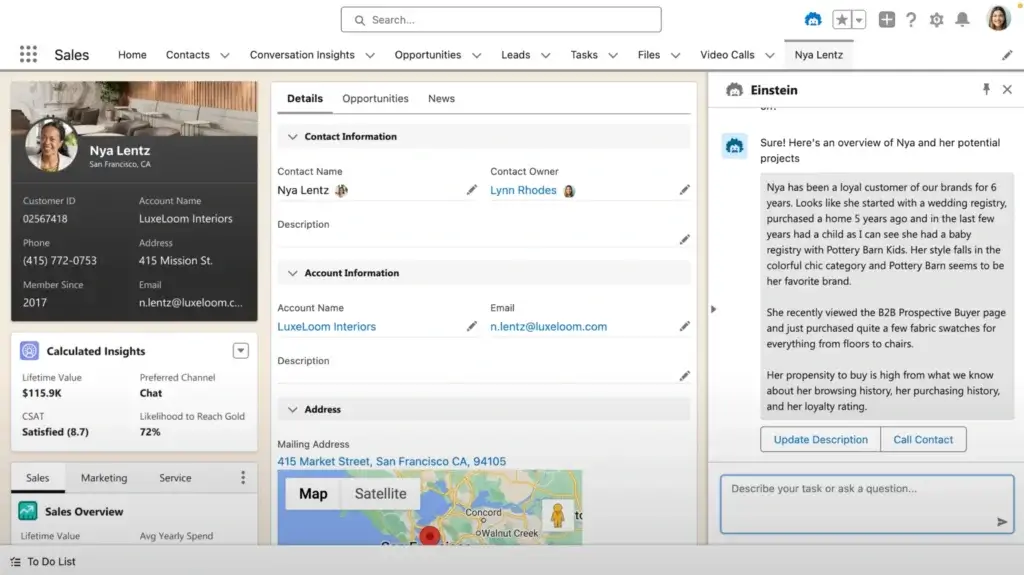
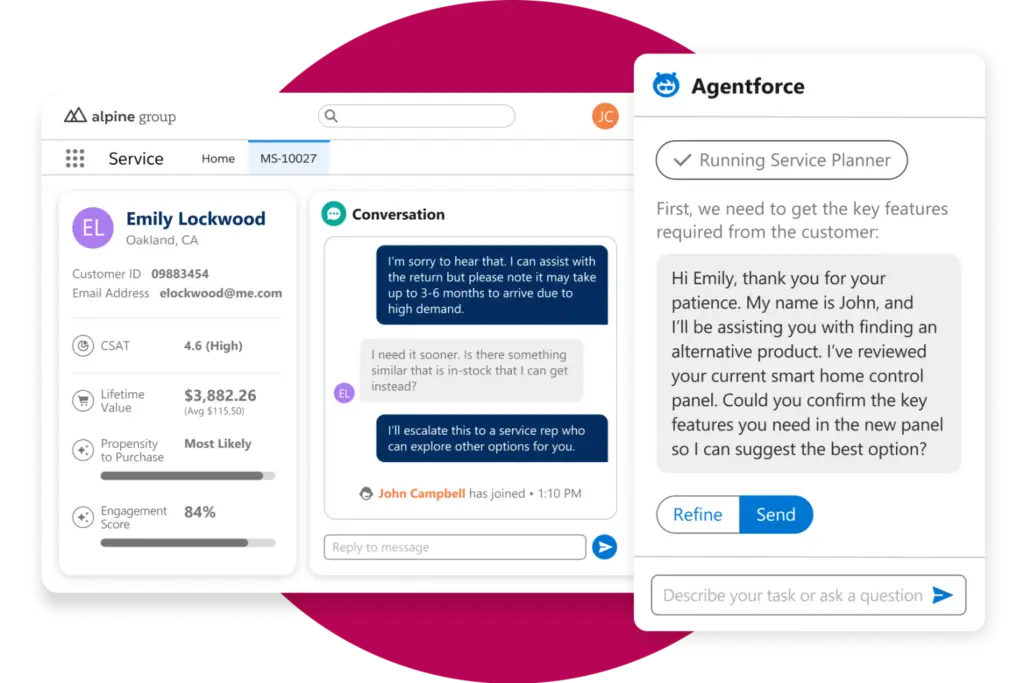
Salesforce’s AI capabilities are more advanced and enterprise-oriented. With Einstein and Agentforce, Salesforce can support predictive workflows, AI agents, recommendations, automation, analytics, and more complex customer engagement processes.
| AI and Automation Area | Pipedrive | Salesforce |
| Best AI Use Case | Helping reps stay productive and focused on sales actions | Supporting advanced enterprise automation and AI-driven workflows |
| Ease of Setup | Simple and accessible for non-technical users | More powerful, but usually needs admin configuration |
| Sales Automation | Great for follow-ups, task creation, deal updates, and reminders | Excellent for complex multi-step and multi-team workflows |
| AI Complexity | Lightweight and practical | Advanced and more technical |
| Best Fit | Sales teams that want immediate productivity gains | Enterprises with mature data, processes, and CRM admins |
If your team wants AI that improves everyday selling without a major setup process, Pipedrive is easier to work with. If you want AI agents, predictive workflows, and advanced automation across departments, Salesforce has more long-term potential, but it also requires more investment.
Pros and Cons
Every CRM comes with trade-offs. The right choice depends on whether you value simplicity and adoption, or deep customization and enterprise control.
Pipedrive Pros and Cons
Pros:
- ✅ Very easy to use – sales reps can usually learn it quickly.
- ✅ Excellent visual pipeline – ideal for deal tracking and activity-based selling.
- ✅ Faster implementation – no dedicated CRM admin is usually required.
- ✅ Strong value for SMBs – lower total cost than most enterprise CRM platforms.
- ✅ Practical automation – useful for follow-ups, tasks, and deal movement.
- ✅ Great fit for sales teams – built around selling, not overcomplicated configuration.
Cons:
- ❌ Less suitable for large enterprises with complex multi-department workflows.
- ❌ Fewer native integrations than Salesforce AppExchange.
- ❌ Not as deep for enterprise governance, territory management, and custom app development.
- ❌ Marketing automation is more limited than all-in-one CRM suites.
Salesforce Pros and Cons
Pros:
- ✅ Extremely scalable – strong fit for large and global organizations.
- ✅ Highly customizable – can support complex business processes.
- ✅ Advanced AI and automation – especially with Einstein, Agentforce, and Flow.
- ✅ Large integration ecosystem – thousands of apps through AppExchange.
- ✅ Strong compliance and security portfolio – valuable for regulated industries.
Cons:
- ❌ Steeper learning curve – often requires admin support.
- ❌ Higher total cost – licenses, support, add-ons, training, and implementation can add up.
- ❌ Longer setup time – not always ideal for teams that need a fast CRM rollout.
- ❌ Overkill for many SMBs – small teams may pay for complexity they do not need.
- ❌ More admin dependency – ongoing optimization usually requires technical knowledge.
In short, Pipedrive is the better practical CRM for most sales-driven SMBs. Salesforce is stronger when your business genuinely needs enterprise-level customization and has the budget to support it.
Ease of Use and User Experience
Ease of use is one of the most important differences between Pipedrive and Salesforce. A CRM can have hundreds of features, but if your team avoids using it, your data becomes unreliable and your pipeline visibility suffers.
This is where Pipedrive has one of its strongest advantages. It is built for salespeople first, while Salesforce is built for organizations that need a deeply configurable CRM platform.
User Interface and Design
Pipedrive
Pipedrive is clean, visual, and easy to navigate. The pipeline view gives you a direct understanding of where each deal stands, what needs attention, and which activities are overdue.
You can customize pipelines, fields, deal stages, filters, and dashboards without needing technical support. For a sales manager, this makes it easier to adjust the CRM as your sales process evolves.
For reps, the benefit is even simpler. They can log in, see their deals, schedule the next action, and move forward without getting lost in menus.
Salesforce
Salesforce is much more flexible, but the user experience depends heavily on how well it is configured. A well-built Salesforce instance can be powerful and efficient. A poorly configured one can feel cluttered and frustrating.
The Lightning Experience is more modern than older Salesforce interfaces, but new users may still need training. The system is often better suited to companies with CRM admins who can tailor layouts, permissions, automations, and dashboards for each team.
Onboarding and Implementation
Pipedrive
Pipedrive is one of the easier CRMs to implement. You can import contacts, create your first pipeline, set up basic automation, and start tracking deals quickly.
This makes it a strong choice if you are moving away from spreadsheets, a basic CRM, or a sales process that is currently scattered across inboxes and notes.
Salesforce
Salesforce onboarding is usually more involved. Before you get the full value, you may need to define objects, fields, permissions, workflows, dashboards, integrations, and reporting logic.
Salesforce also offers Trailhead, a strong learning platform, but the time investment is still higher. If your team wants fast adoption, Salesforce may slow you down in the early stage.
Which CRM Is Easier to Implement?
Pipedrive is easier to implement for most sales teams. It is designed around a ready-to-use sales pipeline, so you can start with the default structure and adjust as you grow.
Salesforce is easier to justify when your CRM needs are complex from the start. If you have multiple departments, detailed approval workflows, custom objects, and layered reporting requirements, the extra setup work may be worth it.
For most small and mid-sized businesses, however, Pipedrive gives you the faster path to value.
Pricing Plans Comparison
Pricing is one of the most important reasons many sales teams choose Pipedrive over Salesforce. The difference is not only the monthly subscription price. It is also the cost of setup, support, training, administration, and add-ons.
Pipedrive recently updated its plan structure. Older plan names such as Essential, Advanced, Professional, Power, and Enterprise have moved into the newer plan structure: Lite, Growth, Premium, and Ultimate.
Salesforce has also updated how it positions its sales products, with plans such as Starter Suite, Pro Suite, Enterprise, Unlimited, and Agentforce 1 Sales.
| Pricing Category | Pipedrive | Salesforce |
| Free Plan | No permanent free plan | Free Suite may be available for limited use cases |
| Entry-Level Plan | Lite | Starter Suite, starting at $25/user/month |
| Mid-Tier Plan | Growth or Premium, depending on needs | Pro Suite, starting at $100/user/month |
| Advanced Plan | Premium or Ultimate | Enterprise, starting at $175/user/month |
| Enterprise-Level Plan | Ultimate | Unlimited, starting at $350/user/month |
| AI-Focused Plan | Practical AI features vary by plan | Agentforce 1 Sales, starting at $550/user/month |
| Free Trial | 14-day free trial | 30-day free trial for many Sales Cloud plans |
| Total Cost Profile | Lower and more predictable for SMBs | Higher when you include setup, support, admin work, and add-ons |
What You’re Really Paying For
Pipedrive
With Pipedrive, the value is in speed and focus. You are paying for a CRM that helps your team manage sales activity, track deals, automate routine tasks, and improve visibility without a heavy implementation process.
For many teams, the best value will be in the Growth or Premium plans because they unlock stronger automation, reporting, and productivity features while still staying more affordable than Salesforce.
Salesforce
Salesforce can look affordable at the entry level, but the cost often increases as your needs become more advanced. AI, deeper automation, enterprise customization, premium support, additional products, implementation partners, and admin resources can all raise the real cost.
This is why many growing companies compare Salesforce against simpler options before committing. We cover this in more depth in our dedicated guide to Salesforce Alternatives.
Total Cost of Ownership
The better question is not only “Which CRM has a lower subscription price?” It is “Which CRM costs less to implement, maintain, and actually use?”
| Cost Factor | Pipedrive | Salesforce |
| License Cost | Lower for most SMB sales teams | Higher at advanced tiers |
| Setup Cost | Usually low | Can be significant if consultants are needed |
| Training Cost | Lower because the interface is easier to learn | Higher because the platform is more complex |
| Admin Dependency | Low for most teams | Medium to high for complex setups |
| Customization Cost | Low to moderate | Can be high for custom workflows and objects |
| Support Cost | More predictable for most teams | Premium support can increase total spend |
| Best Value | SMBs that want fast CRM adoption | Enterprises that need deep customization |
Which Offers More Value?
For small and mid-sized sales teams, Pipedrive offers better value. You get the core CRM tools your reps need, with less training, less setup, and less ongoing administration.
Salesforce offers more power, but you should only pay for that power if your organization is ready to use it. Otherwise, you may end up paying enterprise CRM prices for a platform your team only uses at a basic level.
Integration Capabilities
Your CRM should connect with the tools your team already uses. That includes email, calendars, calling tools, accounting software, marketing platforms, support systems, proposal tools, and reporting apps.
Both Pipedrive and Salesforce offer strong integration capabilities, but the setup experience is different.
Pipedrive Integrations
Pipedrive integrates with hundreds of apps through its marketplace. You can connect it with common business tools such as Google Workspace, Microsoft 365, Slack, Zoom, Trello, Asana, QuickBooks, Xero, Stripe, Mailchimp, ActiveCampaign, Zapier, and Make.
Most integrations are simple enough for non-technical teams to configure. This is a big advantage if you want your CRM connected quickly without needing a developer.
Pipedrive also offers API access for custom integrations, making it flexible enough for teams that need more control later.
Salesforce Integrations
Salesforce has one of the largest CRM integration ecosystems in the market through AppExchange. It connects with enterprise tools across marketing, support, finance, analytics, document management, billing, ERP, and data operations.
Common Salesforce integrations include Marketing Cloud, MuleSoft, NetSuite, SAP, Oracle, Jira, Dropbox, DocuSign, Zendesk, and many more.
However, Salesforce integrations can require more planning. Some need admin configuration, paid apps, middleware, or implementation support. That flexibility is valuable for enterprises, but it can be too much for smaller teams.
Flexibility vs Simplicity
If your business needs deep system connectivity across multiple departments, Salesforce is stronger. If you want the most practical and easy-to-manage integration experience for a sales team, Pipedrive is usually the better choice.
For most SMBs, the goal is not to build the most complex CRM architecture. It is to connect the sales stack, keep data clean, and help reps work faster. Pipedrive handles that very well.
Security and Compliance
CRM security matters because your platform stores customer data, deal details, communication history, personal information, and sometimes sensitive commercial records.
Both Pipedrive and Salesforce take security seriously. Salesforce has the broader enterprise compliance portfolio, while Pipedrive gives most SMBs the protection they need in a simpler package.
Pipedrive Security Overview
Pipedrive provides strong security controls for sales teams that need reliable data protection without enterprise-level complexity.
Key protections include:
- GDPR support for data privacy and customer data management.
- ISO/IEC 27001 certification for information security management.
- SOC 2 and SOC 3 audits to support security assurance.
- Two-factor authentication to help protect account access.
- Encryption in transit to protect data moving between users and the platform.
- Role-based permissions to control internal access.
- Data hosting options that support teams operating in different regions.
Pipedrive’s advantage is that it makes strong CRM security approachable. You can protect customer data without turning CRM administration into a full-time technical project.
Salesforce Security Overview
Salesforce offers one of the strongest security and compliance portfolios in the CRM market. It supports a wide range of standards, reports, and frameworks, including SOC reports, ISO standards, PCI DSS, HITRUST, and data privacy programs.
Key protections include:
- Role hierarchy and field-level security for granular access control.
- Single Sign-On and multi-factor authentication for account protection.
- Audit trails and login history for monitoring user activity.
- Advanced encryption options for enterprise security requirements.
- Compliance support for regulated industries and complex organizations.
Salesforce is stronger if you operate in a heavily regulated industry or need advanced enterprise governance. However, these controls require proper configuration. The platform is powerful, but security quality depends on how well your Salesforce environment is implemented and maintained.
What You Need to Know
If you are a small or mid-sized sales team, Pipedrive will likely provide the security and compliance foundation you need without overwhelming your team.
If you are a large enterprise in finance, healthcare, insurance, or another regulated sector, Salesforce gives you deeper controls, but you should be prepared for a more technical setup.
Customer Reviews and Ratings
User reviews are useful because they show how each CRM performs after the sales demo is over. Pipedrive and Salesforce both receive strong recognition, but users tend to praise them for different reasons.
Pipedrive is commonly praised for ease of use, visual pipeline management, and fast adoption. Salesforce is praised for power, customization, and enterprise scalability.
| Review Theme | Pipedrive | Salesforce |
| Ease of Use | Frequently praised for simplicity and clear navigation | Powerful, but can require training |
| Setup Experience | Fast setup for SMB teams | More involved, especially with customization |
| Pipeline Management | Strong visual deal tracking | Strong, but more configuration-dependent |
| Reporting | Useful for sales managers and pipeline visibility | More advanced for enterprise dashboards |
| Common Praise | Easy to use, practical, and sales-focused | Customizable, scalable, and feature-rich |
| Common Complaint | Less suitable for complex enterprise workflows | Expensive and harder to manage |
What Users Like About Pipedrive
Users often like that Pipedrive feels simple without being shallow. Sales reps can understand their pipeline quickly, managers can track activity without chasing updates, and teams can get value without months of CRM setup.
The strongest user sentiment around Pipedrive is adoption. Teams often choose it because reps actually use it, which is one of the most important CRM success factors.
What Users Like About Salesforce
Salesforce users value the platform’s flexibility. Larger organizations can use it to manage complex sales processes, automate cross-functional workflows, integrate with many business systems, and build executive reporting structures.
The common challenge is complexity. Salesforce can do more, but it often takes more time, money, and expertise to reach that value.
Key Takeaway
Both platforms are strong, but the review sentiment supports a clear pattern. Pipedrive is loved for usability. Salesforce is respected for enterprise power.
If you need a CRM your sales team can adopt quickly, Pipedrive is the safer choice. If you need an enterprise CRM platform that can be customized around complex operations, Salesforce is stronger.
Ideal Users and Use Cases
The best CRM is the one that fits your team size, sales process, budget, and internal resources. Pipedrive and Salesforce serve different types of buyers.
Who Should Use Pipedrive?
Pipedrive is best for sales teams that want a focused CRM without the complexity of an enterprise platform. It works especially well for small businesses, agencies, startups, SaaS companies, real estate teams, consultants, and B2B sales organizations.
Pipedrive is a strong fit if:
- You want a visual pipeline your reps will actually use.
- You need fast onboarding without consultants.
- You are moving from spreadsheets or a basic CRM.
- You want practical automation for follow-ups and activities.
- You need better sales visibility without enterprise CRM complexity.
- You are comparing tools in the best CRM software category and want a sales-first option.
💡 If you are moving fast and scaling a lean team, Pipedrive gives you structure without slowing down your sales process.
Who Should Use Salesforce?
Salesforce is best for larger organizations that need a highly customizable CRM across sales, marketing, service, commerce, analytics, and operations.
Salesforce is a strong fit if:
- You have a large sales organization with complex processes.
- You need advanced permissions, approval flows, and governance.
- You already use other Salesforce products.
- You need deep enterprise integrations.
- You have admins or consultants to manage the platform.
- You operate in a regulated industry with strict compliance requirements.
You may also choose Salesforce if your CRM must become a full business operations platform, not only a sales pipeline tool.
💡 Salesforce is powerful when you have the time, budget, and technical resources to configure it properly. It is rarely the fastest option for a lean sales team.
Migration and Implementation
CRM migration is often where buyers underestimate the real work. Moving data is only part of the process. You also need to clean records, map fields, define pipeline stages, train users, and make sure your reports still make sense after the switch.
Migrating to Pipedrive
Migrating to Pipedrive is usually straightforward. You can import contacts, organizations, deals, activities, and related data through CSV files or use migration support and integrations where needed.
For most SMBs, the bigger task is not technical migration. It is cleaning up old CRM data before importing it. This includes removing duplicates, standardizing fields, and deciding which pipeline stages you actually need.
Migrating to Salesforce
Salesforce migration can be more complex because the platform offers more custom objects, relationships, permissions, and workflow options. If your company has years of CRM history or multiple connected systems, you may need technical support to migrate cleanly.
This does not make Salesforce a bad option. It simply means you should treat implementation as a real project, not a quick software switch.
Implementation Winner
Pipedrive wins for faster implementation. It is easier to deploy, easier to train, and easier to adjust as your sales process grows.
Salesforce wins only when implementation complexity is justified by enterprise-level requirements.
Final Recommendation
Should You Choose Pipedrive or Salesforce?
Choosing between Pipedrive and Salesforce comes down to one core question: do you need a sales CRM your team can use quickly, or do you need an enterprise platform that can be customized around complex business operations?
For most small and mid-sized sales teams, Pipedrive is the better choice. It is faster to implement, easier to use, more affordable, and better aligned with day-to-day selling.
You should choose Pipedrive if you want:
- A clean visual pipeline
- Faster sales team adoption
- Lower total CRM cost
- Practical automation without complexity
- A CRM focused on helping reps close more deals
You should choose Salesforce if you want:
- Deep enterprise customization
- Advanced AI and automation across departments
- Complex permissions and governance
- A large AppExchange ecosystem
- A CRM platform that can support multiple business units
My recommendation is clear: choose Pipedrive if your priority is sales execution. Choose Salesforce only if your business has the complexity, budget, and admin resources to justify it.
Want the Best of Both Worlds? Try monday CRM
If you are still undecided, monday CRM is also worth considering. It interestingly sits between Pipedrive and Salesforce. It is more flexible than Pipedrive for workflow customization, but much easier to manage than Salesforce.
Why monday CRM stands out:
- Highly customizable workflows for sales and operations
- Visual dashboards, automations, and collaboration tools
- Good fit for teams that want CRM and work management together
- Easier to manage than Salesforce for many SMBs
- Flexible enough to grow with your sales process
That said, if your main priority is pure sales pipeline management, Pipedrive remains my stronger recommendation. It is focused, practical, and built around the daily rhythm of sales teams.
FAQs
What is the main difference between Pipedrive and Salesforce?
The main difference is that Pipedrive is a sales-focused CRM built for simplicity, while Salesforce is an enterprise CRM platform built for deep customization. Pipedrive is easier to use and faster to implement, while Salesforce is stronger for large organizations with complex workflows.
Is Pipedrive better than Salesforce for small businesses?
Yes, Pipedrive is usually better than Salesforce for small businesses. It is easier to set up, simpler for sales reps to use, and more affordable from a total cost perspective. Salesforce is more powerful, but many small teams do not need its enterprise-level complexity.
Which CRM is easier to use, Pipedrive or Salesforce?
Pipedrive is easier to use for most teams. Its visual pipeline, simple navigation, and sales-focused interface make it easier for reps to adopt. Salesforce can be user-friendly after proper configuration, but it usually has a steeper learning curve.
Which CRM is cheaper, Pipedrive or Salesforce?
Pipedrive is generally cheaper than Salesforce when you consider licenses, setup, training, administration, and support. Salesforce may start at an accessible entry price, but advanced features, AI, customization, and premium support can increase the total cost significantly.
Does Salesforce offer more features than Pipedrive?
Yes, Salesforce offers more advanced features overall, especially for enterprise customization, analytics, automation, and multi-department workflows. However, Pipedrive offers the core sales CRM features most SMBs need in a simpler and more usable format.
Which CRM has better automation, Pipedrive or Salesforce?
Salesforce has more advanced automation capabilities through tools like Flow and Agentforce. Pipedrive is better for practical sales automation, such as follow-up tasks, deal updates, email actions, and reminders that non-technical users can manage easily.
Which CRM has better AI tools, Pipedrive or Salesforce?
Salesforce has more advanced AI capabilities through Einstein and Agentforce, especially for enterprise use cases. Pipedrive’s AI is more practical for sales teams that want productivity support, activity suggestions, and simpler AI-driven insights without complex setup.
Can you migrate from Salesforce to Pipedrive?
Yes, you can migrate from Salesforce to Pipedrive. Most teams export contacts, companies, deals, activities, and related records, then map the data into Pipedrive. Before migrating, it is best to clean duplicates, review field structure, and simplify pipeline stages.
Is Pipedrive good for enterprise sales teams?
Pipedrive can work for some larger sales teams, especially if they want a simple and focused CRM. However, very large enterprises with complex permissions, territory management, custom objects, and multi-cloud workflows may find Salesforce more suitable.
Are there free trials for Pipedrive and Salesforce?
Yes. Pipedrive offers a 14-day free trial, while Salesforce commonly offers a 30-day free trial for many Sales Cloud plans. Trial terms can change, so it is best to check the official pricing pages before choosing a plan.
Conclusion
Pipedrive and Salesforce are both strong CRM platforms, but they are not built for the same type of buyer.
Pipedrive is the better CRM for most small and mid-sized sales teams because it is easier to use, faster to implement, more affordable, and focused on helping reps manage opportunities and close deals.
Salesforce is the better choice for large enterprises that need deep customization, advanced automation, complex permissions, and a full CRM ecosystem across sales, service, marketing, and operations.
For most readers comparing Pipedrive vs Salesforce, I would start with Pipedrive. It gives you the core CRM functionality you need without forcing your team into a heavy implementation process. If you later need more workflow flexibility across teams, you can also compare it with monday CRM or other leading CRM platforms on Work-Management.org.