Introduction
If you are researching Gong, you are probably looking for more than another call recording tool. You want to know whether Gong can actually help your sales team coach better, forecast more accurately, understand buyer behavior, and improve revenue execution.
That is exactly where Gong has built its reputation. It started as one of the most recognized names in conversation intelligence, but its platform has expanded into a broader Revenue AI OS for sales, RevOps, customer success, and revenue leadership teams.
Is Gong actually worth it in 2026?
In this Gong review, you will get a practical look at its features, AI capabilities, pricing model, pros, cons, integrations, user experience, and top alternatives.
The goal is simple: help you decide whether Gong is the right revenue intelligence platform for your sales organization, or whether a lighter and more affordable alternative may be a better fit.
Quick Summary
Gong is best suited for B2B sales organizations that rely on calls, demos, emails, CRM data, and pipeline visibility to manage revenue performance. It is especially strong for mid-market and enterprise teams that need deeper deal intelligence, sales coaching, and forecasting support.
| Category | Gong Review Summary |
| Best For | Mid-market and enterprise B2B sales teams |
| Main Use Case | Conversation intelligence, deal insights, sales coaching, forecasting, and revenue execution |
| Standout Capability | Gong Revenue AI OS with Revenue Graph, AI agents, and revenue workflow automation |
| Pricing | Custom pricing based on per-user licenses and a platform fee |
| Not Ideal For | Solo sellers, very small teams, or companies without a mature sales process |
| Top Alternatives | Avoma, Chorus by ZoomInfo, Clari Copilot, Salesloft, Outreach, Fireflies.ai, and Fathom |
Overview
What Is Gong?
A Revenue AI Platform for Sales and Customer-Facing Teams
Gong is a revenue intelligence and AI platform that captures customer interactions, connects them with CRM and pipeline data, and turns them into actionable insights for sales teams.
Instead of only recording meetings, Gong analyzes calls, emails, web conferences, CRM activity, deal movement, buyer engagement, and rep behavior. This gives sales leaders a clearer view of what is happening across the revenue cycle.
Gong is now positioned as a Revenue AI OS. That means it is not just a conversation intelligence tool. It is designed to unify revenue data, support specialized AI agents, and help teams automate revenue workflows from prospecting to expansion.
How Gong Works
Gong works by capturing customer interactions across your sales stack and connecting them to your revenue data. That includes calls, web meetings, emails, CRM records, calendars, and sales activity.
From there, Gong uses AI to identify patterns that are difficult to see manually. It can surface deal risks, coaching opportunities, buyer objections, next steps, competitor mentions, stakeholder engagement, and forecast signals.
- Capture: Record and transcribe customer conversations across calls and meetings.
- Analyze: Detect topics, deal risks, behavior patterns, objections, and engagement signals.
- Act: Help reps, managers, and revenue leaders improve execution with clearer next steps.
This is especially valuable if your team uses a CRM like Salesforce, HubSpot, or Microsoft Dynamics and wants better visibility into how sales conversations connect to pipeline outcomes.
Gong at a Glance
| Feature | What It Does |
| Conversation Intelligence | Records, transcribes, and analyzes sales calls, meetings, and emails |
| Gong Revenue Graph | Connects customer interactions, CRM data, account activity, and revenue signals |
| AI Agents | Supports revenue workflows such as call reviews, deal reviews, briefings, research, and CRM updates |
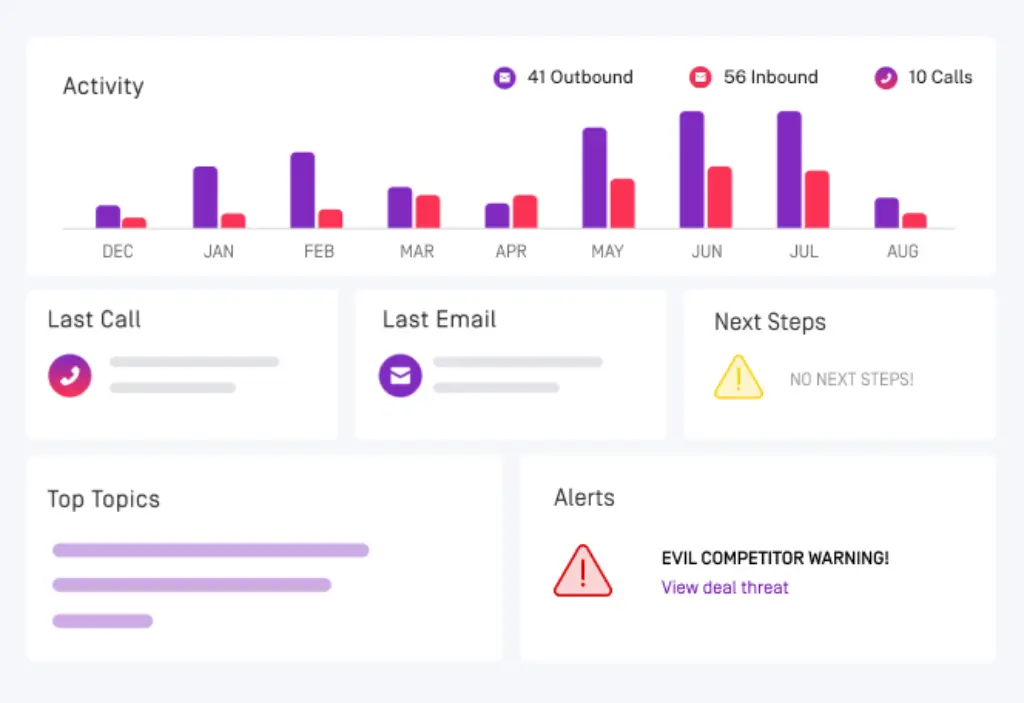
| Deal Intelligence | Highlights stalled deals, missing stakeholders, low engagement, and next-step gaps |
| Forecasting | Helps leaders inspect pipeline health and improve forecast accuracy |
| Coaching | Turns real conversations into coaching moments, scorecards, and performance insights |
| Integrations | Connects with CRM, calendar, video conferencing, email, sales engagement, and collaboration tools |
Key Features
Main Features Breakdown
Gong’s strongest value comes from how it connects conversation data with revenue data. It not only show what happened on a call. It helps you understand what that conversation means for coaching, pipeline risk, follow-up quality, and forecast confidence.
Conversation Intelligence
Conversation intelligence is still one of Gong’s core strengths. The platform records and transcribes sales conversations, then analyzes them for meaningful patterns.
You can use Gong to review objections, pricing discussions, competitor mentions, talk ratios, questions asked, customer pain points, and follow-up commitments. This helps managers coach based on real examples instead of relying on memory or CRM notes.
What you get:
- Call recording and searchable transcripts
- Keyword, topic, and competitor tracking
- Talk ratio, question count, and interaction patterns
- Call libraries for onboarding and coaching
- Insights into what top-performing reps do differently
For teams that run many sales calls every week, this can significantly reduce the time managers spend trying to understand what is actually happening in the field.
Gong Revenue Graph
One of the most important updates to understand is Gong Revenue Graph. Gong describes it as the data foundation behind its Revenue AI OS.
In practical terms, Revenue Graph connects customer interactions, CRM data, deal activity, emails, meetings, contacts, and other revenue signals. This gives Gong a richer context than a regular CRM field or a standalone call transcript.
That context matters because AI recommendations are only as useful as the data behind them. When Gong sees the full relationship between conversations, stakeholders, activities, and pipeline movement, it can provide more meaningful insights.
Why Revenue Graph matters:
- It connects conversation data with CRM and pipeline context.
- It helps surface risks that standard CRM reports may miss.
- It supports more accurate AI agents and workflow recommendations.
- It gives RevOps teams a clearer view of customer-facing activity.
This is one of the reasons Gong is usually a stronger fit for mature sales organizations than for very small teams. The more revenue data you have, the more value Gong can potentially provide.
Gong AI Agents
Gong has moved heavily into AI agents for revenue teams. These agents are designed to help with specific workflows such as call reviews, account briefings, deal reviews, research, forecasting signals, training, and data extraction.
This is different from a generic AI meeting summary. Gong’s AI is built around revenue workflows and customer-facing data. That gives it more context when it analyzes sales conversations, account activity, deal progression, and rep behavior.
Examples of useful Gong AI agent workflows:
- Call reviews: Identify coaching moments and summarize call quality.
- Deal reviews: Highlight risks, missing next steps, and buyer engagement gaps.
- Briefings: Prepare reps before customer calls or account handoffs.
- Data extraction: Pull key information from conversations into structured fields.
- Training: Help reps learn from real conversations and proven examples.
The strongest use case is not replacing sales reps or managers. It is reducing manual analysis, making coaching more consistent, and helping teams act faster on revenue signals.
Deal Intelligence and Pipeline Visibility
Pipeline visibility is one of the biggest reasons companies invest in Gong. Most CRMs show what reps manually enter. Gong adds another layer by analyzing actual buyer engagement and conversation activity.
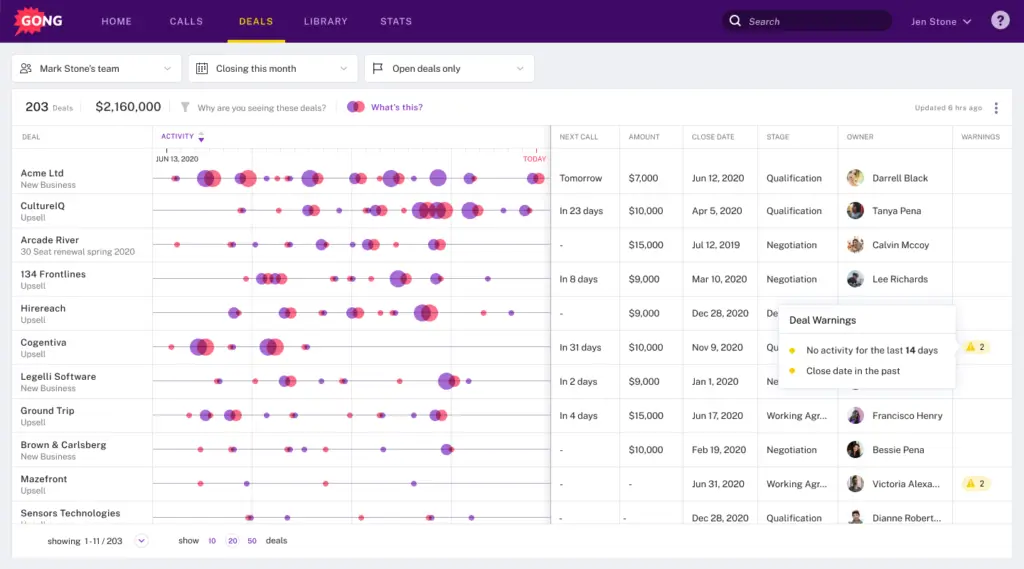
For example, Gong can help identify deals that appear healthy in the CRM but show warning signs in real interactions. These warning signs may include missing stakeholders, no recent buyer response, weak next steps, low engagement, or a lack of executive involvement.
Why it matters:
- Sales managers can spot at-risk opportunities earlier.
- Reps can prioritize deals that need immediate attention.
- Revenue leaders can inspect pipeline quality beyond CRM fields.
- Teams can reduce surprises late in the quarter.
This makes Gong especially valuable for complex B2B sales cycles where multiple stakeholders are involved and deal progression is not always obvious from CRM stages alone.
Gong Forecast
Forecasting is another major part of Gong’s value proposition. Instead of relying only on rep judgment or CRM stage probability, Gong helps teams inspect the activity and engagement behind the forecast.
Managers can review whether deals have enough momentum, whether the right stakeholders are engaged, whether next steps are clear, and whether the opportunity resembles previous won or lost deals.
Gong forecasting can help with:
- Pipeline inspection and deal risk analysis
- Forecast submissions and manager rollups
- Buyer engagement tracking
- Deal movement visibility
- More consistent forecast conversations
Gong does not remove the need for strong sales leadership. But it gives managers better evidence when deciding whether a deal should be committed, pushed, or inspected more closely.
Gong Engage
Gong Engage expands Gong beyond analysis and into sales execution. It is designed to help revenue teams prioritize outreach, personalize engagement, and act on insights from customer interactions.
This matters because many sales teams struggle with the gap between insight and action. Gong may show that a deal is at risk, but the rep still needs to follow up, personalize messaging, and manage the next step.
Gong Engage can be useful for teams that want revenue intelligence and outreach workflows closer together. However, if your organization already relies heavily on dedicated sales engagement platforms like Salesloft or Outreach, you should compare workflows carefully before replacing anything.
Gong Enable
Gong Enable is focused on sales enablement and coaching. It helps teams turn real customer interactions into training content, coaching examples, and structured improvement programs.
This is useful for onboarding new reps, reinforcing sales methodology, sharing examples of strong discovery calls, and helping managers coach based on actual conversations.
Best use cases for Gong Enable:
- Building call libraries for new sales reps
- Creating coaching programs from real customer conversations
- Improving discovery, qualification, and objection handling
- Helping managers review calls more consistently
For larger teams, this can be one of Gong’s strongest advantages. It turns the best sales conversations into a repeatable learning asset.
Integrations and CRM Sync
Gong connects with the tools that sales teams already use, including CRM platforms, email, calendar tools, video conferencing tools, collaboration platforms, and sales engagement systems.
Common integrations include Salesforce, HubSpot, Microsoft Dynamics, Zoom, Microsoft Teams, Google Workspace, Outlook, Slack, Salesloft, Outreach, and other revenue stack tools.
| Integration Category | Examples | Why It Matters |
| CRM | Salesforce, HubSpot, Microsoft Dynamics | Connects deal, contact, account, and opportunity data with conversation insights |
| Meetings | Zoom, Microsoft Teams, Google Meet | Captures sales calls, demos, and customer meetings |
| Email and Calendar | Google Workspace, Outlook | Connects communication activity and scheduled meetings to revenue context |
| Sales Engagement | Salesloft, Outreach | Links outreach workflows with buyer engagement and deal activity |
| Collaboration | Slack, Microsoft Teams | Helps teams share alerts, insights, and coaching moments |
These integrations are important because Gong works best when it becomes part of your revenue workflow instead of another disconnected analytics layer.
Security, Privacy, and Compliance
Security is a major consideration with any platform that records and analyzes customer conversations. Gong is built for enterprise revenue teams, so privacy controls, compliance settings, permissions, and data governance are central to the buying decision.
Before implementing Gong, your team should review call recording consent requirements, regional privacy rules, data retention settings, redaction options, user permissions, and CRM data access.
Security questions to ask before buying Gong:
- How will call recording consent be handled by region?
- Which teams can access call recordings and transcripts?
- What retention and redaction settings do you need?
- How will Gong connect to CRM and customer data?
- Who will own compliance and governance internally?
This is especially important for companies in regulated industries, global organizations, or teams selling into enterprise accounts.
Pros & Cons
Advantages and Limitations of Using Gong
Gong is one of the strongest revenue intelligence platforms available, but it is not the right fit for every company. Its biggest advantage is the depth of insight it provides. Its biggest drawback is that you need the team size, budget, and sales maturity to use it properly.
Positive
✅ Excellent conversation intelligence
✅ Strong sales coaching workflows
✅ Deep deal and pipeline visibility
✅ Mature forecasting capabilities
✅ Revenue-focused AI agents
Negative
❌ Custom pricing can be expensive
❌ Not ideal for very small teams
❌ Requires strong onboarding
❌ Privacy and consent need planning
❌ May overlap with sales engagement tools
Pros: Where Gong Stands Out
Strong visibility into sales conversations
Gong helps managers understand what is being said in calls, demos, and follow-ups. This is far more useful than relying only on CRM notes, which can be incomplete or subjective.
Better coaching based on real evidence
Sales managers can review actual calls, identify coaching moments, compare rep behavior, and build training programs around proven examples. This makes coaching more consistent and less opinion-based.
Advanced deal inspection
Gong helps identify risk signals such as stalled communication, weak next steps, missing stakeholders, limited buyer engagement, or pricing objections. That can help managers intervene before a deal slips.
Useful for RevOps and forecasting
Because Gong connects sales conversations with pipeline data, RevOps and sales leaders can inspect forecast quality with better context. This helps improve forecast discussions and reduce surprises.
Revenue-specific AI
Gong’s AI is built around revenue workflows. That makes it more relevant for sales teams than a generic AI meeting assistant that only summarizes calls.
Cons: Where Gong May Fall Short
Pricing is not transparent
Gong does not publish simple public pricing tiers. You need to speak with sales and receive a custom quote. This can make early-stage comparison more difficult.
It can be expensive for smaller teams
Gong is usually easier to justify when you have a meaningful sales team, enough call volume, and enough pipeline complexity. Solo sellers and very small teams may find it too heavy.
There is an adoption curve
Gong is powerful, but teams need proper onboarding. Managers must learn how to review calls, interpret deal insights, set coaching expectations, and create repeatable workflows.
Privacy planning is required
Because Gong records and analyzes conversations, your team needs a clear process for consent, access permissions, data retention, and compliance.
It does not replace your CRM
Gong enhances your CRM with conversation and revenue intelligence, but it is not a CRM system. You still need a CRM for account management, pipeline records, and core sales operations.
User Experience
What It Feels Like to Use Gong
Gong is designed for sales teams that need structured visibility into customer-facing activity. The interface is more advanced than a simple call recorder, but it is also more valuable once your team understands how to use the insights.
What Users Typically Like
The most common strengths are call visibility, searchable transcripts, coaching workflows, deal warnings, and the ability to review customer interactions without joining every meeting live.
- Managers can review calls faster and coach with specific examples.
- Reps can revisit calls, check next steps, and learn from stronger performers.
- RevOps teams can inspect pipeline quality with better context.
- Executives can see market, competitor, and buyer trends from real conversations.
What Users May Struggle With
Gong can feel overwhelming at first because it captures a lot of data. Without clear processes, teams may collect insights but fail to act on them.
The best implementations usually include manager training, call review routines, coaching scorecards, CRM hygiene standards, and clear ownership from RevOps or sales enablement.
Implementation: What to Expect
Gong implementation depends on your sales stack, CRM setup, permissions, meeting tools, and internal processes. A simple rollout may be relatively straightforward, but a mature implementation requires planning.
Common implementation steps include:
- Connect your CRM, calendar, email, and meeting tools.
- Configure recording rules, consent settings, and user permissions.
- Set up call libraries, trackers, scorecards, and coaching workflows.
- Train managers on call reviews and deal inspection.
- Define how reps should use Gong insights in daily selling.
In my opinion, Gong works best when it is treated as a revenue operating layer, not just a recording tool. If you only use it to store calls, you will miss much of its value.
Pricing and Plans
How Much Does Gong Cost?
Gong does not publish fixed pricing tiers on its website. Instead, it uses a custom pricing model based on your team size, licenses, and platform needs.
According to Gong’s official pricing page, licenses are priced per user, and there is also a platform fee based on the number of users supported. Gong also states that integrations with your existing tech stack are included without an additional integration fee.
How Gong Pricing Works
Because Gong pricing is quote-based, the final cost can vary significantly depending on your organization. You should expect pricing to be influenced by team size, selected products, contract scope, implementation needs, and revenue workflow complexity.
| Pricing Factor | How It Affects Cost |
| Number of Users | Gong licenses are priced per user, so larger teams usually pay more |
| Platform Fee | Gong charges a platform fee based on the number of users supported |
| Selected Products | Conversation intelligence, forecasting, engagement, and enablement needs may affect the quote |
| Implementation Scope | CRM complexity, permissions, governance, and rollout support can influence total cost |
| Contract Terms | Contract length, user volume, and enterprise requirements may affect pricing negotiations |
Is Gong Worth the Cost?
Gong is worth considering if your team has enough sales activity and revenue complexity to benefit from deeper visibility. If you have a high-volume B2B sales motion, multiple reps, active coaching, and a meaningful pipeline, Gong can become a valuable operating system for revenue performance.
Gong is worth it if you:
- Manage a growing sales team with multiple reps and managers.
- Need better visibility into calls, emails, deals, and pipeline risks.
- Want to improve coaching quality and forecast accuracy.
- Use a CRM and want deeper intelligence on top of it.
- Have enough deal value to justify a premium revenue platform.
Gong may not be ideal if you:
- Are a solo seller or very small sales team.
- Need a low-cost meeting transcription tool.
- Do not yet have a structured sales process.
- Do not have enough calls or pipeline activity to analyze.
- Need public, self-serve pricing before speaking with sales.
If budget is your main concern, compare Gong with lighter tools like Avoma, Fireflies.ai, Fathom, or tl;dv. These tools can be good for meeting notes and summaries, but they do not offer the same depth across deal intelligence, coaching, forecasting, and revenue operations.
Gong vs Competitors
Gong Alternatives
Gong is one of the strongest options in the revenue intelligence category, but it is not always the best choice for every team. The right alternative depends on whether you need conversation intelligence, meeting summaries, forecasting, sales engagement, or a lower-cost coaching tool.
| Tool | Best For | Strengths | Limitations |
| Gong | Mid-market and enterprise revenue teams | Revenue AI, conversation intelligence, coaching, deal insights, forecasting | Custom pricing, heavier setup, not ideal for very small teams |
| Chorus by ZoomInfo | Teams already using ZoomInfo | Conversation intelligence, call analysis, ZoomInfo ecosystem fit | May not match Gong’s broader revenue workflow depth |
| Avoma | SMB and mid-market teams | Meeting assistant, AI notes, collaboration, coaching basics | Less advanced enterprise forecasting and revenue analytics |
| Clari Copilot | Forecast-focused revenue teams | Call intelligence connected to revenue operations | Best fit often depends on broader Clari adoption |
| Salesloft | Sales engagement-led teams | Cadences, outreach workflows, rep activity management | Conversation intelligence is not as central as Gong |
| Outreach | Outbound sales execution | Sequences, engagement workflows, rep productivity | Different focus than Gong’s revenue intelligence layer |
| Fireflies.ai | Affordable meeting transcription | AI notes, searchable meetings, lower cost | Not a full revenue intelligence or forecasting platform |
Gong vs Chorus by ZoomInfo
Gong and Chorus are both strong conversation intelligence platforms. Chorus may be appealing if your team already uses ZoomInfo heavily. Gong is usually stronger if you want a broader revenue intelligence layer with deal inspection, forecasting, AI agents, and revenue workflow depth.
Gong vs Avoma
Avoma is a strong option for teams that want AI meeting notes, collaboration, and coaching at a more accessible level. Gong is a better fit when your team needs deeper sales analytics, pipeline visibility, and enterprise-grade revenue intelligence.
Gong vs Clari Copilot
Clari Copilot is a logical comparison for teams that care heavily about forecasting and revenue operations. Gong may be more attractive if conversation intelligence, call libraries, coaching workflows, and deal intelligence are central to your sales process.
Gong vs Salesloft and Outreach
Salesloft and Outreach are primarily sales engagement platforms. They help reps execute cadences, manage outreach, and improve productivity. Gong focuses more on understanding conversations, deal health, forecasting signals, and revenue intelligence.
Some teams may use Gong alongside Salesloft or Outreach. Others may evaluate Gong Engage if they want engagement workflows inside the Gong ecosystem.
Gong vs Fireflies.ai or Fathom
Fireflies.ai and Fathom are useful if you mainly need call recording, transcripts, and AI meeting summaries. They are much lighter than Gong and often easier for small teams to adopt.
However, they are not direct replacements for Gong if you need sales coaching, deal intelligence, forecasting, and revenue operations visibility.
Is Gong For You?
Who Should Use Gong?
Gong is best for sales organizations where conversations directly influence revenue performance. If your team sells complex products, manages multiple stakeholders, and depends on accurate pipeline inspection, Gong can be a very strong fit.
Gong Is Best For Mid-Market and Enterprise Sales Teams
If you have a structured sales team with multiple reps, managers, and revenue leaders, Gong can help create a more consistent operating rhythm. Managers can coach better, reps can learn faster, and leadership can inspect pipeline health with more confidence.
Gong Is Strong for B2B SaaS and Complex Sales Cycles
Gong is especially valuable for B2B SaaS companies and other organizations with long sales cycles, demos, discovery calls, buying committees, procurement steps, and multiple decision-makers.
In these environments, a deal can look healthy in the CRM while customer engagement is actually weakening. Gong helps uncover those signals earlier.
Gong Is Useful for Sales Coaching Cultures
If your managers actively coach reps, Gong gives them the raw material they need. Instead of generic feedback, they can coach around real calls, actual objections, and proven rep behaviors.
Gong Is Helpful for RevOps and Forecasting
RevOps teams can use Gong to improve visibility into activity quality, CRM accuracy, buyer engagement, and forecast confidence. This is useful when leadership wants more evidence behind pipeline reviews and forecast calls.
Who Should Not Use Gong?
Gong may not be the right fit if you are a solo seller, an early-stage startup with only one or two reps, or a company that mainly needs meeting summaries. In those cases, a lighter tool may be more practical.
You may also want to wait if your CRM is not properly set up yet. Gong is most useful when it can connect to clean revenue data and support a defined sales process.
Quick Fit Checklist
Gong is a strong fit if you:
- Have a sales team with regular calls, demos, and customer meetings.
- Use a CRM such as Salesforce, HubSpot, or Microsoft Dynamics.
- Need better coaching, pipeline visibility, and forecast confidence.
- Sell to multiple stakeholders or manage complex B2B deals.
- Have RevOps, enablement, or sales leadership capacity to own adoption.
If most of these points describe your team, Gong is worth serious evaluation.
Conclusion
Final Thoughts – Should You Try Gong?
Gong is one of the most mature revenue intelligence platforms on the market. It is not just a call recording tool, and it is not only a meeting transcription app. It is a Revenue AI platform built to help sales and revenue teams understand what is happening across conversations, deals, coaching, and forecasting.
Its biggest strength is the way it connects customer interactions with pipeline context. This helps your team move beyond basic call summaries and into more meaningful questions:
- Which deals are actually at risk?
- Which reps need coaching and on what specifically?
- What objections are appearing most often?
- Are next steps clear and buyer engagement strong?
- Can leadership trust the forecast?
That depth makes Gong a strong choice for mid-market and enterprise sales teams that have enough sales activity, deal complexity, and management structure to use it properly.
However, Gong is not the best fit for every company. If you are a very small team, need simple meeting notes, or want transparent low-cost pricing, tools like Avoma, Fireflies.ai, or Fathom may be easier to justify.
My Recommendation
If your sales organization is serious about coaching, forecast accuracy, and revenue execution, Gong is one of the strongest platforms to evaluate in 2026. It is especially compelling for teams that already use a CRM, run frequent sales calls, and need better visibility into deal quality.
For smaller teams, I would start with a lighter meeting intelligence tool and move to Gong once your sales process, pipeline, and coaching needs become more complex.
If you are still building your sales stack, these related guides can help you compare broader options:
- Best CRM Software for Sales Teams
- The Ultimate Guide to AI-Powered CRMs
- How to Build a High-Performing Sales Pipeline
- Sales Team Management Guide
FAQ
Frequently Asked Questions
What is Gong used for?
Gong is used for conversation intelligence, sales coaching, deal inspection, forecasting, and revenue intelligence. It records and analyzes customer interactions so sales teams can understand buyer behavior, improve rep performance, and identify pipeline risks.
Is Gong a CRM?
No. Gong is not a CRM. It works alongside CRM systems like Salesforce, HubSpot, and Microsoft Dynamics to add conversation intelligence, deal insights, coaching data, and forecast visibility.
How much does Gong cost?
Gong does not publish fixed pricing tiers. Its official pricing model is based on per-user licenses plus a platform fee tied to the number of users supported. You need to contact Gong for a custom quote.
What are Gong AI agents?
Gong AI agents are revenue-focused AI workflows that help with tasks such as call reviews, deal reviews, account briefings, training, research, and extracting useful sales data from customer interactions.
What is Gong Revenue Graph?
Gong Revenue Graph is the data foundation behind Gong’s Revenue AI OS. It connects customer conversations, CRM data, emails, meetings, contacts, and revenue signals so Gong can provide more accurate sales insights.
Is Gong good for small businesses?
Gong can work for small businesses with high-value or complex sales cycles, but it is usually better suited for mid-market and enterprise sales teams. Very small teams may prefer lighter tools like Avoma, Fireflies.ai, or Fathom.
Does Gong integrate with Salesforce?
Yes. Gong integrates with Salesforce and other CRM systems to connect conversation data with accounts, contacts, opportunities, and sales activity. This helps teams inspect deals with more context than CRM data alone.
Does Gong replace Salesloft or Outreach?
Not always. Gong is primarily a revenue intelligence and conversation intelligence platform, while Salesloft and Outreach are sales engagement platforms. Gong Engage may overlap with some engagement workflows, but teams should compare their exact needs before replacing tools.
What are the best Gong alternatives?
The best Gong alternatives include Chorus by ZoomInfo, Avoma, Clari Copilot, Salesloft, Outreach, Fireflies.ai, and Fathom. The best choice depends on whether you need forecasting, coaching, meeting notes, or sales engagement workflows.
Is Gong worth it?
Gong is worth it for sales teams that need deeper visibility into conversations, pipeline risk, coaching opportunities, and forecast quality. It may not be worth the cost for solo sellers or very small teams that only need meeting notes.