
Introduction
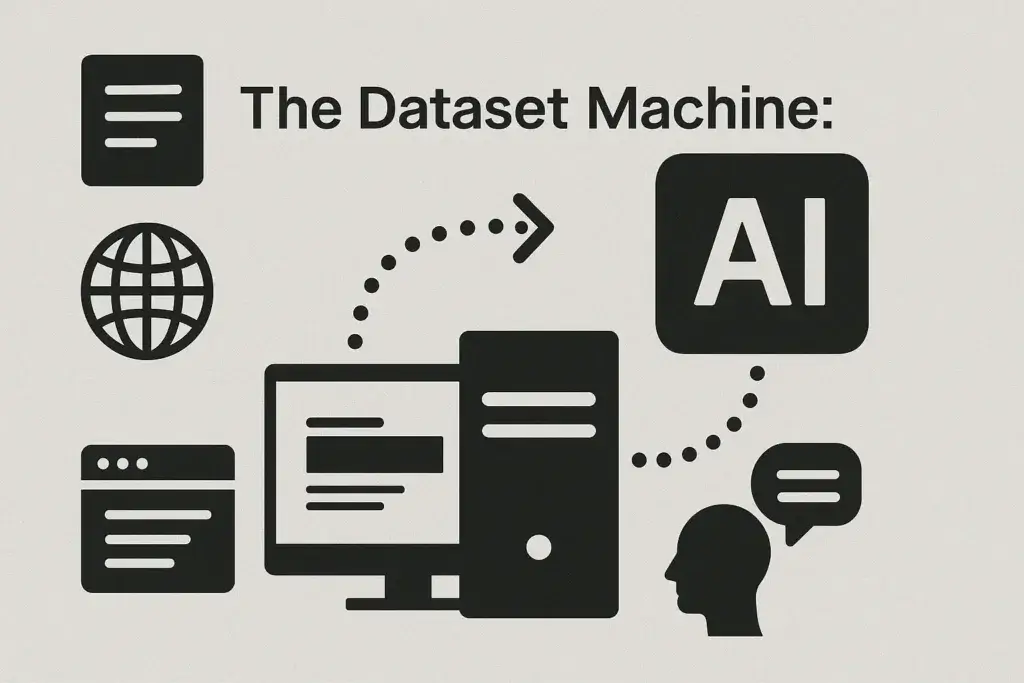
You rely on AI models that can reason, predict, and generate content with high accuracy. None of this is possible without a strong foundation of training data. The system that collects, cleans, structures, and validates this data is often described as the dataset machine. It acts as the engine that powers every stage of model development, transforming raw, unstructured information into high-quality inputs your model can learn from.
The quality of this machine has a direct impact on how well your AI model performs. Even advanced architectures produce inconsistent results when trained on noisy or incomplete datasets. When your data pipeline is organized and reliable, the model learns faster and delivers more stable outputs.
If you want to expand your dataset without building everything from scratch, you can also rely on curated external sources. Platforms that specialize in data for AI give you access to ready-made, high-quality datasets that fit directly into training or fine-tuning pipelines. This reduces the time you spend on collection and early-stage cleaning.
Understanding how the dataset machine works helps you design more efficient systems and produce AI models that remain accurate, scalable, and trustworthy.
Why the Dataset Machine Matters for Modern AI Systems
The dataset machine is one of the most influential parts of your AI pipeline. It determines how quickly your model learns, how well it generalizes, and how consistently it performs under real-world conditions. When the underlying data is strong, your models behave predictably. When the data is flawed, your models inherit those flaws.
The relationship between training data and model accuracy
A model learns patterns based on the examples you give it. Clean, diverse, well-labeled samples improve accuracy and reduce error rates. When inconsistencies appear in the dataset, the model picks up the wrong signals, which impacts predictions and increases the likelihood of hallucinations or false positives.
How dataset pipelines support scalable machine learning
A modern AI workflow requires a pipeline that can ingest millions of data points efficiently. Automated validation, deduplication, and transformation steps ensure you maintain quality as your dataset grows. Without a structured pipeline, scaling becomes slow, costly, and unpredictable.
Comparing manual and automated data creation processes
Manual dataset creation gives you full control, but it quickly becomes inefficient when the volume grows. Automation speeds up the process and ensures consistent formatting, while human reviewers handle edge cases and subjective annotations. This hybrid approach gives you both precision and scalability.
Core Components of an Effective Dataset Machine
An effective dataset machine is built from several interconnected layers. Each layer strengthens the data before it reaches your model, reducing noise and improving the performance of your final system.
Data sourcing, collection, and aggregation
Your pipeline begins with data collection. You gather information from internal systems, APIs, real-time feeds, licensed sources, and publicly available datasets. Each input must be vetted for quality, legality, and relevance to the problem your model is intended to solve.
Automated data cleaning and normalization workflows
Cleaning removes errors, duplicates, and formatting conflicts. Normalization ensures that every sample follows a consistent structure, which allows the model to process information more efficiently. Automation plays a major role here, helping you scale these processes without sacrificing quality.
Annotation, labeling, and human-in-the-loop processes
Labeling is essential for supervised learning. Automated tools handle straightforward annotations, while human reviewers refine complex cases, resolve ambiguity, and maintain labeling standards. This combination produces more accurate datasets compared to fully automated or fully manual approaches.
Quality assurance techniques for AI datasets
Quality assurance confirms that your dataset meets the standards required for training. You evaluate completeness, correctness, diversity, and representativeness before the data enters the model. Strong QA helps minimize training errors and improves the reliability of your system.
Types of AI Training Data and Their Use Cases
Your dataset machine supports many formats depending on the type of AI you are building. Each format requires unique preparation steps to ensure clean inputs and minimal noise.
Text datasets for NLP and LLMs
Text data powers chatbots, search assistants, summarization tools, and large language models. To make this data useful, you clean markup, remove duplicates, segment content by context, and maintain a balance of domains. Well-structured text datasets produce clearer, more accurate language models.
Image and video datasets for computer vision
Computer vision systems rely on large numbers of annotated images and videos. You add bounding boxes, object labels, segmentation maps, and context classifications. Diverse, high-resolution datasets help your model recognize patterns across different environments.
Audio datasets for voice and speech models
Speech datasets include transcriptions, timestamps, speaker labels, and noise-filtered audio clips. Proper preprocessing ensures your model can understand accents, tones, and real-world sound variations.
Synthetic and augmented datasets for scale
Synthetic data expands your dataset when real-world samples are limited. These generated samples preserve statistical structure and help your model learn patterns more efficiently. They are especially useful for rare edge cases or specialized domains.
Domain-specific datasets for specialized AI
Industries like healthcare, finance, cybersecurity, and legal services require datasets with strict formatting, expert annotations, and stronger privacy controls. These datasets often demand specialized preprocessing to ensure compliance and accuracy.
Building a Scalable Data Pipeline for AI Training
A scalable data pipeline is essential when you work with large datasets or complex AI systems. Your pipeline determines how smoothly data moves from raw collection to model-ready format. When it is built correctly, it reduces friction, improves data reliability, and accelerates experimentation.
Data ingestion architecture and workflow automation
Your ingestion layer manages the flow of data from multiple sources into a central system. APIs, crawlers, streams, and file uploads require unified handling to prevent fragmentation. Automation at this stage reduces manual processing and ensures that new data follows the same structure and quality rules as your existing datasets.
Ensuring diversity, balance, and representativeness
Model performance improves significantly when the dataset captures a wide range of real-world examples. You need enough variation in demographic, contextual, and domain-specific dimensions to avoid skewed predictions. Ensuring representation is one of the key roles of the dataset machine, especially when you train models that affect decision-making.
Handling large data volumes efficiently
Processing millions of samples requires thoughtful system design. You may rely on distributed storage, caching, deduplication, and batch processing to manage throughput. When your pipeline is optimized for scale, you can train larger models more frequently without delays or bottlenecks.
Privacy, Compliance, and Ethical Considerations
Responsible data practices are a non-negotiable part of building AI systems. You must ensure that your dataset machine aligns with global regulations and respects user privacy. This protects both your organization and the people represented in your data.
Responsible data sourcing and consent
Raw data must be collected legally and transparently. You verify that contributors understand how their information will be used and that the data comes from authorized sources. Ignoring consent leads to compliance risks and undermines trust.
PII removal and anonymization techniques
Before training, sensitive personal information should either be removed or anonymized. Techniques like hashing, tokenization, data masking, and aggregation reduce the chance of reidentification. Proper anonymization ensures that your model learns from patterns rather than personal details.
Compliance with GDPR, CCPA, and global standards
You operate within a global regulatory landscape that requires strict compliance. GDPR, CCPA, and similar policies specify how data must be stored, processed, and accessed. Keeping your dataset machine-aligned with these standards helps you avoid legal exposure and ensures your AI product is safe to deploy.
Where AI Data Comes From: Key Sources and Methodologies
Your dataset machine may use many data sources depending on the model you are developing. Each source has strengths and limitations, and choosing the right mix improves both data variety and model accuracy.
Public web data and open datasets
Open datasets and publicly available web data provide broad coverage across topics. These datasets are useful for pre-training, benchmarking, or validating early model performance. They offer a scalable starting point but often require extensive cleaning.
Proprietary enterprise data
Many organizations rely on internal data to train models that reflect their unique needs. Transaction logs, support tickets, user behavior data, and operational records provide deep insights. Because these datasets contain sensitive information, strict access controls and anonymization are essential.
Data crawlers, APIs, and real-time streams
Automated crawlers and API integrations supply continuous, structured data. Real-time streams are especially valuable when your model must react to fast-changing environments. These methods reduce manual collection and make the dataset machine more dynamic.
Evaluating the Quality of an AI Training Dataset
Quality evaluation helps you ensure that your data truly supports your training objectives. Even large datasets produce poor results if they contain inconsistencies or unbalanced distributions. Evaluating quality early prevents costly retraining cycles later.
Accuracy, consistency, and completeness checks
You validate that each data point is correct, formatted properly, and complete. Accuracy impacts how well the model understands reality, while consistency helps it learn repeatable patterns. Completeness ensures that no key fields or categories are missing.
Bias detection and mitigation in datasets
Bias can appear when certain groups or scenarios are underrepresented. You review the dataset for skewed distributions and apply balancing techniques as needed. Reducing bias improves fairness and enhances real-world stability.
Rebalancing techniques for fairer model performance
You can rebalance datasets through sampling, augmentation, or targeted data collection. Each method helps you correct imbalances and create a more representative set of training examples.

How Data Vendors and Tools Support Dataset Creation
As your AI initiatives scale, relying solely on internal pipelines becomes challenging. This is where external data vendors and specialized tools help you accelerate dataset development and maintain consistent quality at higher volumes.
When to use external providers for dataset scaling
External providers are useful when you need domain-specific data, multilingual datasets, or large volumes of structured samples that would take too long to collect manually. They also help you fill gaps in areas where your internal data is limited or incomplete.
Solutions that automate data collection and labeling
Modern data platforms offer automated web crawlers, API connectors, labeling tools, and quality assurance systems. These solutions reduce manual work and allow your team to focus on model design and evaluation instead of raw data preparation.
Integrating vendor datasets with internal pipelines
Vendor datasets must be aligned with your internal formats and standards. You integrate them through normalization steps, metadata mapping, and sampling tests to ensure the new data behaves consistently with your existing sources. Curated external datasets can also be useful when you want to incorporate ready-made data into a production-scale pipeline.
How You Build a Dataset for AI Step by Step
A structured workflow helps you build datasets more efficiently and with fewer revision cycles. Clear stages reduce confusion, support repeatability, and make it easier to audit the data later.
Define objectives and data requirements
Start by determining what the model should learn. Define the target outputs, performance metrics, and the type of data needed. This step ensures that every data point serves a purpose.
Collect raw inputs and unify formats
After setting objectives, you gather raw samples from your chosen sources. You then convert each sample into a unified format that fits your pipeline. This ensures that the model receives clean and predictable inputs.
Tag, annotate, and evaluate sample outputs
You label or categorize the data based on the model’s learning task. Human reviewers focus on edge cases and nuanced topics, while automated tools help with volume. Evaluating sample outputs early helps you confirm that your labeling guidelines are correct.
Prepare the dataset for model ingestion
Before training begins, you finalize the dataset. This includes balancing the distribution, validating metadata, and segmenting the dataset into training, validation, and test splits. A well prepared dataset dramatically improves the stability of your training runs.
Real World Examples
To understand how the dataset machine affects model performance, it helps to look at real-world scenarios. Each example highlights how clean, well-structured data produces stronger AI systems.
Training language models with massive text corpora
Large language models learn from trillions of characters. When the dataset machine cleans and structures text correctly, the model produces more coherent and factual responses. Poorly processed text leads to hallucinations and unstable reasoning patterns.
Enhancing computer vision models with enriched image sets
Vision models require precise labels, consistent lighting conditions, and diverse environments. When your dataset includes high-quality images across varied scenes, your model performs better in real-world deployments such as manufacturing, surveillance, or medical imaging.
Building multilingual datasets for global AI
Multilingual systems rely on text and audio samples from many regions. Proper sourcing, labeling, and balancing help the model understand context across languages rather than overfitting to dominant patterns.
Challenges When Building AI Training Datasets
Even with strong infrastructure, building AI datasets presents challenges that require consistent attention. Managing quality, scale, and compliance becomes increasingly complex as your needs grow.
Data scarcity in niche domains
Some industries lack large public datasets. Medical imaging, scientific research, or cybersecurity often require proprietary data that is difficult to obtain. In these cases, synthetic data or expert-level annotation becomes essential.
Labeling bottlenecks and scaling annotation teams
As datasets grow, annotation speed often becomes a bottleneck. You may need larger teams, more automation, or clearer guidelines to maintain consistency. Delays at this stage slow down every part of the AI lifecycle.
Balancing cost, quality, and speed
You must balance your resources carefully. High-quality labeling is expensive, while rapid development can introduce mistakes. Building a sustainable dataset machine means optimizing these three factors without compromising model performance.

Future Trends in AI Training Data
As AI systems become more advanced, the way you create and manage training data continues to evolve. The dataset machine is moving toward greater automation, improved accuracy, and new forms of synthetic intelligence that can generate training data on its own.
Growth of synthetic data generation
Synthetic data is becoming a reliable alternative when real-world samples are difficult or expensive to collect. It helps fill rare scenarios, expand datasets without privacy concerns, and strengthen model generalization. As generation techniques improve, synthetic datasets will play a larger role in training AI at scale.
Self-improving and self-labeling models
AI models are increasingly capable of labeling data for future versions of themselves. This process, often called self-supervised or semi-autonomous labeling, reduces manual annotation requirements and significantly accelerates dataset expansion. When combined with human validation, it creates a powerful feedback loop that improves quality over time.
More automation in data pipeline management
Automation is expanding into every stage of dataset creation, from sourcing to cleaning to QA. Tools that detect anomalies, correct structural issues, or highlight bias patterns make the dataset machine more intelligent. This reduces operational overhead and allows your team to focus on experimentation and innovation.
Conclusion
The dataset machine plays a critical part in building accurate, reliable, and scalable AI systems. When your data pipeline is well structured, automated, and continuously monitored, your models learn more effectively and perform better in real-world environments. High-quality data reduces training cycles, minimizes errors, and helps you deploy AI systems with confidence.
By combining internal data processes with curated external datasets, you strengthen your entire workflow. This approach ensures that your models have access to the diverse and clean data needed to stay competitive as AI capabilities evolve.
Investing in a strong dataset machine is one of the most valuable decisions you can make when building AI systems designed for long-term growth and dependable performance.
FAQs
1. What is a dataset machine in AI?
It is the system that collects, processes, cleans, labels, and validates the data used to train AI models. It ensures that your dataset is consistent, high-quality, and ready for model ingestion.
2. How much data do you need to train a model?
The amount depends on the complexity of the task. Large language models require billions of tokens, while smaller classification tasks may need only a few thousand well-labeled samples.
3. What makes a dataset high quality?
High-quality datasets are accurate, consistent, complete, diverse, and representative of real-world scenarios. These factors directly influence model performance.
4. How do companies collect training data?
Collection methods include APIs, web crawling, user-generated content, enterprise system logs, licensed datasets, and real-time streams.
5. What role does data labeling play in AI accuracy?
Labels teach the model how to interpret patterns. When labeling is inconsistent or incorrect, the model learns the wrong information and produces unreliable outputs.
6. Can synthetic data replace real-world data?
It can supplement and enhance real data but should not fully replace it. Synthetic data is ideal for rare events, private information, or balancing skewed datasets.
7. How do you prevent bias in datasets?
You audit the dataset for skewed distributions, rebalance samples, expand coverage in underrepresented categories, and apply fairness checks throughout the pipeline.
8. What tools help automate dataset creation?
Automation tools include data crawlers, labeling platforms, QA validators, anomaly detectors, and data transformation engines. These tools help you scale efficiently.
9. How do AI teams ensure data privacy?
Privacy is maintained through consent-based sourcing, anonymization, hashing, data masking, and strict compliance with standards such as GDPR and CCPA.
10. How often should you update your AI training dataset?
You should update your dataset whenever user behavior changes, new data becomes available, or the model begins showing signs of drift. Regular updates help your model stay accurate, adapt to new patterns, and maintain strong performance over time.