Introduction
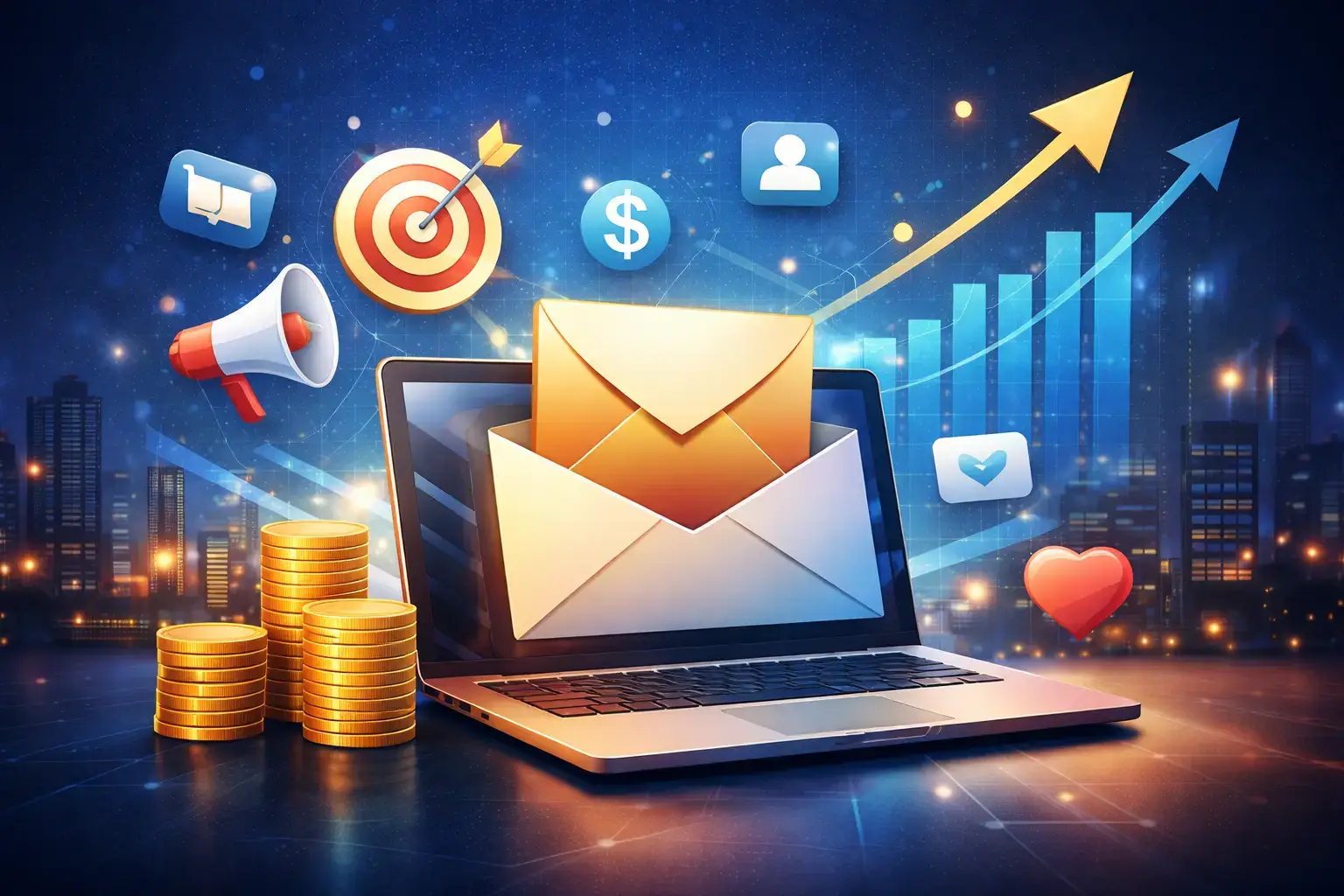
New communication channels continue to emerge every year, each promising reach, engagement, and growth. However, email marketing remains one of the few channels that offers direct access to your audience without being dependent on fluctuating algorithms or rising advertising costs.
Social media algorithms can change at any time, ad prices can be unstable, and one can never be sure of the position in the search results. Your email list is your own direct communication channel.
Want reliable revenue, deeper engagement with your customers and a repeatable path to scalable growth? Then email marketing should be at the forefront of your marketing strategy.
What Is Email Marketing
Email marketing is sending targeted, permission-based messages to subscribers to educate, nurture and convert them.
When it comes to email marketing, 2026 is defined by automation, segmentation, behavioural triggers and AI-powered personalisation. We’ve long since left the days behind when it was perfectly acceptable to send out the same marketing email to every person on a list. Today, it’s more about sending a targeted marketing email to a particular person at a particular time in order to get the maximum effect.
This is a fundamental shift in how people interact with their inbox. Email which used to be a fairly simple broadcast channel has become more like a relationship-building platform.
And that is exactly why it still matters.
Email Marketing is actually a channel that is based on consent. Rather than relying on forced views like some digital platforms and being vulnerable to ad blockers, your subscribers actually wanted to receive your emails. In fact, they opted-in to your email list because they are interested in hearing from you, which naturally translates to a higher open and conversion rate than any ad that is forced upon an unsuspecting user.
The Core Benefits of Email Marketing in the Modern Landscape
Exceptional Return on Investment
Email marketing remains one of the most cost-effective digital marketing channels available.
You don’t have to spend years learning how to build a email list because I’ll give you a simple one sentence summary: The beauty of an email list is that every single person on it has permitted you to send them email again and again and again for literally zero cost for every click and every open – and the result is a dramatic decrease in customer acquisition cost and a dramatic increase in customer lifetime value.
As your list grows, your ability to generate revenue scales alongside it.
Complete Ownership and Stability
Many marketers underestimate the importance of ownership.
On social media, you are at the whim of an algorithm update or the choices made by the social media company. On paid advertising, you are at the whim of your budget and the market pricing of an ad spot. In search, you are at the whim of the ranking signals and their whimsical changes.
With email, you control the relationship.
Your list is your proprietary asset. Having your own list is important for many reasons. It brings stability and security to your business over time. This long-term control provides resilience in an otherwise unpredictable digital landscape.
Personalization at Scale
Most modern email automation marketing platforms can dynamically personalize the content of the emails you send to each individual based on their behaviour, interests, purchases, and lifecycle stage.
You can send targeted, dynamic, and segmented campaigns rather than simply broadcasting. The result is always greater engagement and more conversions.
When your audience feels understood, they are more likely to respond.
Measurable and Continuously Optimizable
Email marketing offers transparent performance metrics.
Get a deep dive view of which campaigns are opening, being clicked, converting and generating revenue. See how your subscribers are behaving, and A/B test new subject lines, refine your content, experiment with send times, and make real-time adjustments.
Small performance improvements can lead to substantial long-term gains.
Email Marketing Compared to Other Channels
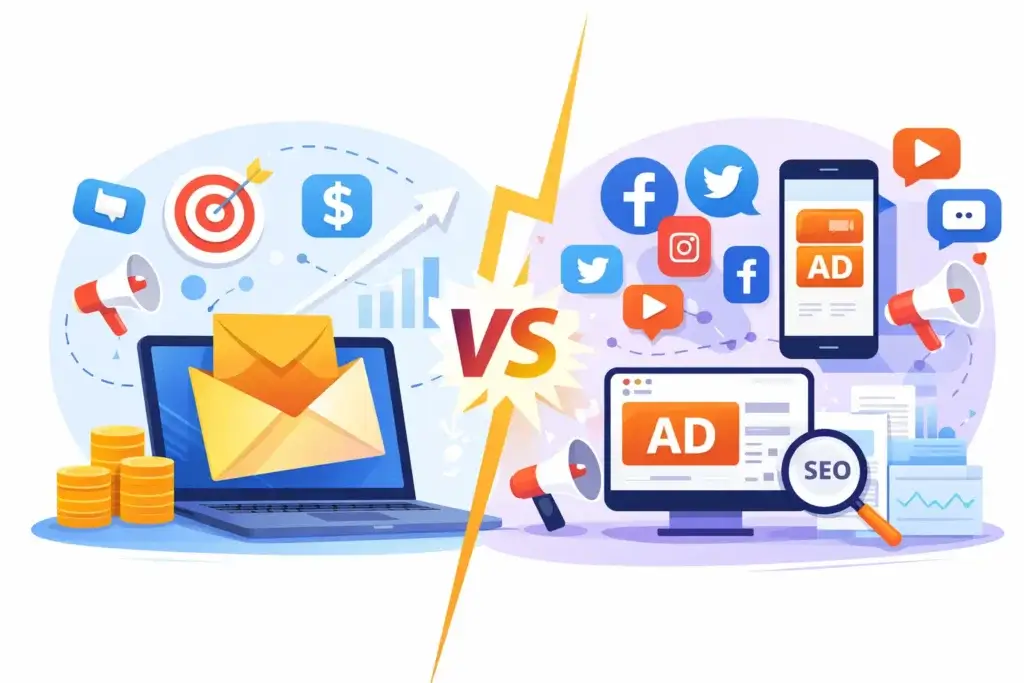
Email vs Social Media
Social media is a fantastic way to increase brand awareness and connect with your customers. However, as we are all too aware, the life of an organic post can be notoriously unpredictable. It can literally take one day for your content to go from reaching hundreds of thousands of people to barely dozens. And sometimes your most engaged fans won’t even see it.
Email marketing campaigns allow you to reach the inboxes of your target audience. When someone subscribes to your list, it generally means they have shown an interest in what you have to offer. This tends to lead to more open rates, more clicks, and more sales.
Social media captures attention. Email nurtures and converts.
Email vs Paid Advertising
Paid ads are good for getting fast exposure and traffic. These need to be paid for continuously, and if you stop paying, they fall apart.
While not as immediate as social media or AdWords, email marketing creates a channel that can be used for long-term communication and can be triggered at any time without incurring the cost of acquiring a new customer.
Email vs SEO
Search engine optimization is key to long-term traffic growth. But rankings change, and the competition is often steep.
Email marketing and SEO really go hand in hand. First, you generate content to attract organic search results, and to capitalise on these search terms, you need to make sure you can collect an email address from those people who end up on your website.
If a subscriber joins your list, you are no longer at the mercy of search. You now have a communication channel with your audience.
Core Components of a High-Performing Email Marketing Strategy
Intentional List Building
The overall picture starts with the quality of your subscribers. Instead of just focusing on the size of the list, focus on relevance and intent. Such a large database may never match a smaller but highly relevant database in terms of performance.
Build on a strong foundation by offering incentives that are meaningful and correspond with what your audience needs. This can be a detailed guide, a webinar, insights into the industry, or specialized knowledge about a particular product. Setting clear expectations at the point of sign-up fosters trust and promotes ongoing engagement. Email marketing works best when there is a genuine desire for the recipients to hear from you.
Strategic Segmentation
Segmentation is what separates average email marketing from ‘winners’.
Instead of sending identical messages to your entire list, group subscribers by their behavior, interests, level of engagement, or where they are in the lifecycle. This is one of the core email marketing best practices that consistently improves campaign performance. The idea is to send a personalized, not promotional, set of communications. When the messages are relevant, the engagement increases. When engagement rises, so does revenue.
Automation and Customer Journeys
With automation, email marketing becomes a scalable system.
The logic is not to send campaigns manually but to create flows to guide subscribers through predetermined journeys. This is followed by a welcome sequence to familiarize the customer with the brand. A lead nurturing sequence provides prospects with education. A post-purchase flow helps bolster customer retention and promotes repurchases. These sequences run non-stop in the background, and each one provides an ongoing purpose across the customer journey phases.
Automation is not an option in 2026. It is basic.
Deliverability and Compliance
No matter what the strength of your content is, it should reach the inbox.
Maintaining clean lists, authenticating your sending domain, and respecting privacy regulations are critical practices. Keeping an eye on bounce rates and engagement also ensures that a sender does not lose their reputation. Professional email marketing platforms simplify the technical requirements, but you must treat deliverability as a strategic priority.
How to Get Started With Email Marketing
For this, one does not need complex systems. It requires clarity of thought and structure.
First, specify your main objective. Or are you generating B2B leads, ecommerce sales, SaaS trial nurturing, and customer retention? Your objective dictates your campaign structure and metrics.
Second, choose a reliable email marketing platform with automation, segmentation, and reporting features. Software will be the direct tool for strategic efficiency or otherwise.
Third, come up with a strong opt-in offer and add signup forms on your website. Third, create a strong opt-in offer and integrate signup forms across your website.
Once the first subscribers get on your list, go for a simple but structured welcome sequence. It is your chance to create the expectations and communicate the value of what you provide and also establish trust with the subscriber from the very beginning.
Finally, analyze performance on a regular basis. Email marketing is not static. Continuous optimization of subject lines, messaging, and timing drives growth sustainably.
Choosing the Right Email Marketing Software
Your platform is your strategy’s operational backbone.
Before selecting any email marketing platform, it is important to understand what you should be looking for. The right solution should support scalable email marketing automation, flexible segmentation, A/B testing, reliable analytics, and seamless CRM integration. These capabilities ensure that your email marketing campaigns can grow alongside your business rather than limit it.
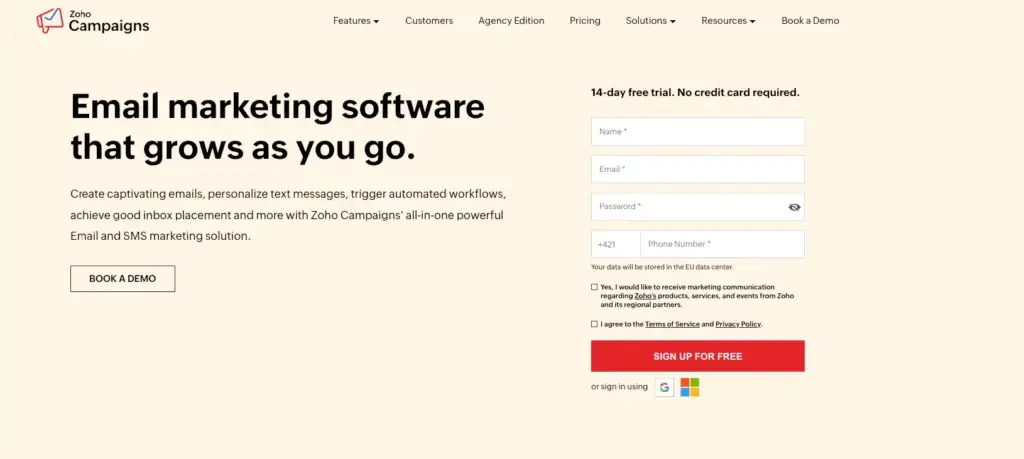
One platform, which makes an appropriate balance between usability and advanced functionality, is Zoho Campaigns.
There’s a visual drag-and-drop e-mail builder that will make creating campaigns a breeze, even if you’re not the most technically savvy person out there, using Zoho Campaigns. It is possible to develop a single journey with multiple steps and conditional triggers based on user activity using the automation functions.
Its segmentation feature lets you bucket subscribers by criteria like engagement, demographics, or CRM data. If your company is already using a CRM like Zoho CRM, the integration ensures marketing and sales teams work from the same data sets. This alignment creates less friction between lead generation and lead conversion.
In addition, Zoho Campaigns provides A/B testing, analytics in real-time, and scalable pricing suitable for use in growing firms. For organizations that want the growth to be structured but without exceeding what they need, this can be a sensible and budget-friendly option.
For businesses that want structured growth without the complexity of enterprise-level platforms, Zoho Campaigns offers a practical balance between advanced functionality and ease of use, making it particularly well-suited for growing teams that rely on close alignment between marketing and CRM data.
Advanced Email Marketing Trends in 2026
Personalisation with AI
Artificial intelligence technology now plays a crucial role in ensuring the enhancement of email performance.
AI systems can predict the best sending times, suggest subject lines, assess engagement patterns, and recommend content variations. This enables you to make data-driven decisions more quickly and accurately – rather than working on assumptions, you work on behavioral insights.
Interactive Email Experiences
There are more and more interactive elements within the email format.
Embedded surveys, product previews, dynamic countdown timers, and clickable content modules boost engagement without redirecting users away from their inboxes. This shortens the conversion path and channelizes the user experience.
First-Party Data Strategy
Regulations on privacy keep transforming digital marketing.
Email marketing is therefore successful in this environment, as it depends on the first-party data obtained through consent. With third-party tracking losing its reliability, it becomes all the more strategic to build and nurture one’s subscriber base. Email further positions you for long-term sustainability.
Conclusion
Email marketing continues to rule in 2026 because it offers something most digital channels cannot: control, predictability, and measurable profitability.
While social media platforms fluctuate, paid advertising costs rise, and SEO rankings shift, your email list remains a stable and owned asset. It is a direct communication channel built on permission and trust. That alone makes it strategically invaluable.
When you combine intentional list building, segmentation, automation, and data-driven optimization, email marketing evolves from a simple outreach tool into a structured growth engine. It allows you to nurture leads, increase conversions, retain customers, and build long-term brand loyalty in a way that few other channels can match.
The businesses that win with email marketing are not the ones sending the most emails. They are the ones sending the most relevant emails.
If you define clear objectives, implement automation intelligently, prioritize deliverability, and use a capable platform such as Zoho Campaigns, you create a scalable system that drives consistent results.
Email marketing is not outdated. It is foundational. And when executed strategically, it remains one of the most powerful assets in your entire marketing ecosystem.
Frequently Asked Questions
Is email marketing still effective?
Yes. Email marketing remains one of the most effective digital marketing channels because it gives you direct access to your audience, supports automation, and delivers strong conversion and retention potential.
Why is email marketing more reliable than social media?
Email marketing is more reliable than social media because your reach is not controlled by platform algorithms. When someone subscribes to your list, you can communicate with them directly through their inbox.
How does email marketing compare to paid advertising?
Paid advertising can generate fast traffic, but it requires continuous spending. Email marketing builds a long-term owned audience that you can nurture and activate repeatedly without paying for every click or impression.
What makes email marketing profitable?
Email marketing is profitable because subscribers have already shown interest in your brand by opting in. This creates stronger engagement, lower acquisition costs, and better opportunities to increase customer lifetime value.
What is segmentation in email marketing?
Segmentation is the process of dividing your email list into smaller groups based on behavior, interests, demographics, or lifecycle stage. It helps you send more relevant messages and improve campaign performance.
Why is automation important in email marketing?
Automation helps you send timely and relevant messages based on subscriber behavior. It allows you to create welcome sequences, lead nurturing workflows, post-purchase emails, and re-engagement campaigns that run continuously.
How do I start building an email list?
Start by offering a valuable incentive such as a guide, checklist, webinar, or exclusive resource. Add signup forms to key pages on your website and make the benefit of subscribing clear.
What features should email marketing software include?
Good email marketing software should include automation workflows, segmentation, A/B testing, analytics, templates, deliverability tools, and CRM integration. These features help you build scalable and measurable campaigns.
Can email marketing work for B2B companies?
Yes. Email marketing works very well for B2B companies because it supports long sales cycles, lead nurturing, educational content, and relationship-building with decision-makers over time.
How often should I send marketing emails?
The right frequency depends on your audience and the value you provide. Many businesses start with one email per week, then adjust based on open rates, clicks, unsubscribes, and customer feedback.