Introduction
Search behavior is changing fast. Your audience is no longer relying only on traditional search results, review sites, and comparison pages. More buyers now ask AI platforms for software recommendations, product comparisons, vendor shortlists, and category explanations before visiting a company website.
That creates a new challenge for marketing teams. You may rank well in Google, but still be invisible when someone asks ChatGPT, Perplexity, Gemini, Google AI Mode, or AI Overviews about the best tools in your category.
Peec AI is built to help solve that visibility problem. It gives brands, SEO teams, and agencies a way to track how often they appear in AI-generated answers, how they compare against competitors, which sources are being cited, and where content strategy needs improvement.
In this Peec AI review, you’ll get a practical look at its main features, pricing, user experience, strengths, limitations, best use cases, and alternatives. The goal is to help you decide whether Peec AI is the right AI search analytics platform for your business in 2026.
What Is Peec AI?
Peec AI is an AI search analytics platform designed for marketing teams, SEO teams, and agencies that want to understand how their brand performs inside AI-generated search results.
Instead of focusing only on traditional keyword rankings, Peec AI tracks brand visibility across AI platforms. It helps you understand whether your brand is mentioned, where it appears in the answer, how sentiment is framed, which competitors appear more often, and which sources AI systems use when generating responses.
In simple terms, Peec AI helps answer one of the most important questions in modern search: when your buyers ask AI tools for recommendations in your market, does your brand show up?
Background and Evolution
Peec AI was created for a market where search is becoming more conversational, recommendation-driven, and fragmented across different AI platforms.
Traditional SEO still matters, but it does not fully explain how AI systems summarize your brand, compare you with competitors, or cite your content. A company can have strong organic rankings and still be underrepresented in AI-generated answers if its content, citations, positioning, and third-party mentions are not strong enough.
This is where Peec AI fits into the marketing stack. It does not replace SEO tools. It adds an AI visibility layer that helps teams understand how answer engines interpret and present their brand.
Target Users and Use Cases
Peec AI is best suited for teams that already care about SEO, content strategy, brand visibility, and competitive positioning. It is particularly useful when your buyers are likely to ask AI platforms for product recommendations, vendor comparisons, or category advice.
- B2B SaaS teams – Track visibility for high-intent software recommendation prompts.
- SEO teams – Add AI search tracking alongside keyword and ranking reports.
- Content teams – Identify prompt gaps, citation gaps, and content opportunities.
- Agencies – Monitor multiple clients and report AI visibility performance.
- Brand teams – Understand how AI platforms describe and position the company.
If your team is investing in comparison content, review pages, thought leadership, category education, and product-led SEO, Peec AI can help you measure whether that work is influencing AI-generated answers.
Key Features
How Does It Work?
Peec AI is built around a clear workflow: define your brand, choose the prompts and models you want to track, monitor how AI platforms respond, compare your visibility against competitors, and use the findings to improve your content strategy.
The platform is more focused than a traditional SEO suite. It is not trying to replace keyword research, technical audits, backlink analysis, or organic traffic reporting. Its main purpose is AI search analytics, especially brand visibility across AI-generated answers.
AI Visibility Tracking
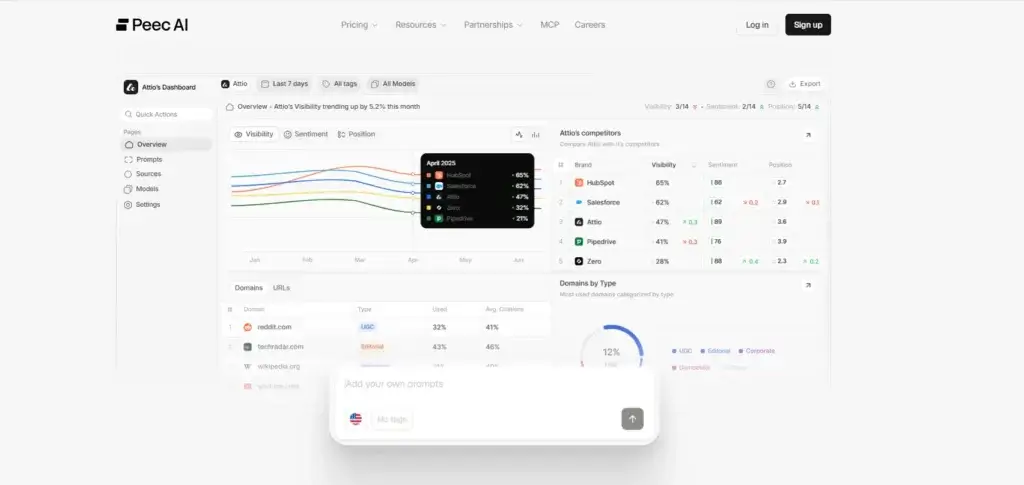
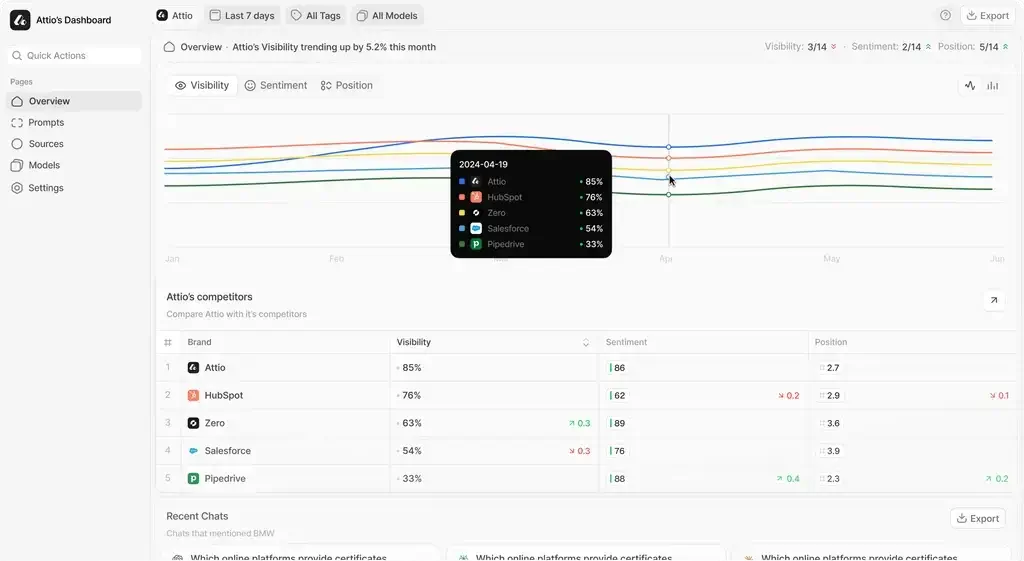
AI visibility tracking is the core feature of Peec AI. The platform shows how often your brand appears in AI-generated answers for the prompts you monitor.
This matters because AI-generated answers can influence the buyer journey before users click on a website. If your competitors are being mentioned in recommendation-style answers and your brand is absent, you may be losing awareness before traditional analytics tools can detect the problem.
Peec AI helps you track visibility across prompts, platforms, and time. This gives you a baseline for measuring whether your content, PR, comparison pages, and external mentions are improving your presence in AI search.
Position Tracking
Visibility alone is useful, but it does not tell the full story. A brand that appears first in an AI-generated recommendation may receive more attention than a brand mentioned briefly near the end of a response.
Peec AI tracks position so you can understand where your brand appears inside AI answers. This is helpful for evaluating whether AI platforms treat your brand as a primary recommendation, a secondary option, or an occasional mention.
For competitive categories such as CRM, project management, marketing automation, SEO tools, and customer support software, position tracking can be just as important as simple mention tracking.
Sentiment Analysis
Peec AI also tracks sentiment, helping you understand how AI platforms describe your brand. This is valuable because visibility is not always positive.
Your brand might appear in an AI answer, but the description may highlight limitations, pricing concerns, weak positioning, or outdated information. Peec AI helps marketers spot those issues so they can improve messaging, product pages, third-party profiles, and educational content.
Sentiment analysis should not be treated as perfect, but it provides useful directional insight. If AI platforms consistently describe a competitor more favorably, that is a signal to review your category positioning and content quality.
Prompt Tracking
Prompt tracking is one of Peec AI’s most important capabilities. Instead of tracking only traditional keywords, you can monitor the natural-language questions buyers ask AI platforms.
For example, a buyer may ask, “What are the best CRM platforms for startups?” or “Which project management tools are best for agencies?” These are not just keywords. They are decision-making prompts.
Peec AI helps you track how your brand performs for these prompts over time. This makes the platform especially useful for teams that publish comparison articles, best software lists, use-case guides, and product category content.
Competitor Benchmarking
AI search visibility is competitive. It is not enough to know whether your brand appears. You also need to know which competitors appear more often, where they are positioned, and whether they are being cited by stronger sources.
Peec AI includes competitor benchmarking so you can compare your visibility against direct competitors. This helps marketing teams identify where competitors dominate AI recommendations and where your brand has an opportunity to gain share of voice.
For SEO teams, this is useful because it connects content strategy with competitive intelligence. If a competitor appears repeatedly for high-intent prompts, you can review what content, citations, partnerships, reviews, or external mentions may be supporting that visibility.
Source and Citation Analysis
Peec AI helps you understand which sources influence AI-generated answers. These may include your website, competitor websites, third-party comparison pages, review platforms, product documentation, media mentions, and educational content.
This is one of the most important parts of AI search optimization. If AI platforms cite third-party sources more often than your own site, you may need to strengthen your presence across trusted external properties.
Citation analysis can also reveal content opportunities. If AI tools frequently cite an outdated article, a weak competitor page, or a third-party guide, your team may be able to create a better resource that answers the prompt more clearly.
Segmentation by Model, Region, and Tags
Peec AI supports segmentation by model, country IP, and prompt tags. This allows teams to compare visibility across different AI platforms, regions, audience segments, and funnel stages.
This matters because AI visibility can vary by platform and market. Your brand may perform well in ChatGPT but appear less often in Perplexity. You may be visible in one country but underrepresented in another. You may perform well for awareness prompts but poorly for purchase-intent prompts.
By using tags and segments, marketing teams can create more meaningful reporting. Instead of looking at one overall score, you can understand where visibility is strong and where the next optimization effort should focus.
Looker Studio and Reporting
Peec AI includes reporting features for teams that need to share visibility data with stakeholders or clients. Higher-tier plans include Looker Studio integration, which can be valuable for agencies and in-house teams that already report through custom dashboards.
This is particularly useful if AI visibility becomes part of your SEO reporting workflow. Instead of manually collecting screenshots or exporting isolated metrics, you can bring visibility and source data into a more consistent reporting environment.
For agencies, this can help turn AI search visibility into a measurable service line. For in-house teams, it can help leadership understand how AI search is affecting brand discovery and category perception.
Benefits and Limitations
Peec AI Pros and Cons
Positive
✅ Focused AI search visibility tracking
✅ Strong prompt and competitor monitoring
✅ Daily tracking on main plans
✅ Unlimited users on self-serve plans
Negative
❌ Not a full SEO platform
❌ Prompt volume can feel limited on lower plans
❌ Some advanced features require higher tiers
❌ Still depends on careful prompt selection
What Peec AI Does Well
Peec AI’s biggest strength is focus. The platform is built specifically for AI search analytics, which makes it easier to understand than broad SEO platforms that add AI visibility as one feature among many.
The dashboard is designed around the metrics that matter for answer engine optimization: visibility, position, sentiment, prompts, competitors, and sources. That makes it easier for content and SEO teams to move from data to action.
- Clear AI visibility metrics – Track whether your brand appears in AI-generated answers.
- Competitive context – Compare brand visibility against direct competitors.
- Source analysis – See which domains and URLs influence AI answers.
- Daily tracking – Monitor visibility changes with consistent prompt execution.
Peec AI is also practical for teams that do not want a complex enterprise platform. It gives you enough data to guide content decisions without forcing you into an overly technical workflow.
Where Peec AI Falls Short
Peec AI is a strong AI visibility monitoring tool, but it is not a complete marketing platform. It will not replace your keyword research tool, technical SEO crawler, backlink database, content optimizer, CRM, or analytics platform.
The biggest limitation is that Peec AI diagnoses visibility gaps, but your team still needs to act on them. You may need to create new content, update existing pages, improve internal linking, earn third-party mentions, strengthen review profiles, or improve product positioning.
- No full SEO toolkit – You still need separate tools for technical SEO and keyword research.
- No automatic content execution – The platform shows issues, but does not fix them for you.
- Lower-tier limits – Starter prompt volume may be tight for broad categories.
- AI answer volatility – Results can change by model, prompt wording, and region.
This does not make Peec AI weak. It simply means you should treat it as an AI search analytics layer, not as your entire organic growth stack.
Ease of Use and Workflow
Peec AI User Experience
Peec AI is designed for marketers and SEO professionals, not data scientists. The interface is focused on helping you understand where your brand appears, how competitors perform, and which prompts or sources deserve attention.
Setup and Onboarding
Getting started with Peec AI usually begins with creating a workspace for your brand and domain. From there, you define the prompts you want to monitor, choose the AI models you want to track, and add competitors for benchmarking.
Peec AI can also suggest prompts that reflect real customer questions. This is useful because many teams struggle with the transition from keyword tracking to prompt tracking.
The most important setup decision is prompt quality. AEO data is only useful if the prompts reflect actual buyer behavior. You should avoid overly broad prompts and focus on questions tied to discovery, comparison, evaluation, and purchase intent.
Daily Workflow
The daily workflow is straightforward. You review visibility changes, compare your brand against competitors, inspect prompts where you are missing, and analyze which sources AI platforms are using.
This makes Peec AI useful for weekly SEO reviews, content planning sessions, and stakeholder reporting. You can quickly identify which AI platforms mention your brand, which competitors are gaining visibility, and which content topics need attention.
For agencies, this workflow can also support client reporting. You can show clients where they are visible, where competitors dominate, and what actions should be prioritized next.
Learning Curve
The learning curve is moderate. The platform itself is not overly complicated, but answer engine optimization is still a new discipline for many marketing teams.
Teams with SEO experience will adapt faster because they already understand search intent, content gaps, competitive research, and topical authority. However, they will need to adjust their thinking from keyword rankings to AI-generated answers, prompt coverage, citations, and brand mentions.
The key is to treat Peec AI as a strategic analytics tool. It shows patterns and opportunities, but your results will depend on how well your team turns those insights into content, PR, and positioning improvements.
Best Practice for Better Results
To get the most value from Peec AI, start with a focused prompt set. Do not try to track every possible question in your market from day one.
Begin with prompts that are closest to revenue impact. These include “best software” prompts, competitor comparison prompts, industry-specific recommendation prompts, and use-case prompts.
Then, tag your prompts by funnel stage, persona, use case, or region. This makes reporting more useful because you can separate broad awareness visibility from buying-intent visibility.
Pricing and Plans
Cost and Plan Comparison
Peec AI pricing is structured around prompt volume, model coverage, projects, reporting needs, and enterprise requirements. The main plans for brands are Starter, Pro, Advanced, and Enterprise.
Pricing can change, so you should always check Peec AI’s live pricing page before publishing or buying. At the time of this review, the public pricing structure is built around 50, 150, and 350 prompts on the main self-serve brand plans, with Enterprise available for custom requirements.
Pricing Table
| Plan | Best For | Key Inclusions | Main Limitation |
| Starter | SEO and content managers starting with AI visibility | 50 prompts, 3 models, unlimited users, daily tracking, 1 project | Limited prompt volume for broad categories |
| Pro | SEO teams needing more consistent AI search tracking | 150 prompts, 3 models, unlimited users, daily tracking, 2 projects | Still limited if tracking many products, regions, or competitors |
| Advanced | Marketing teams managing multiple projects | 350 prompts, 3 models, unlimited users, daily tracking, 5 projects, multi-country, Looker Studio integration | Advanced reporting comes at a higher cost |
| Enterprise | Global brands and large teams | Custom prompt tracking, all models, unlimited projects, API access, SSO, custom onboarding | Requires a custom sales conversation |
Starter Plan
The Starter plan is best for smaller SEO and content teams that want to test AI search visibility without committing to a large enterprise platform.
It includes enough capacity to track a focused set of important prompts. For example, a SaaS company could monitor a set of high-intent category prompts, a few competitor comparison prompts, and selected use-case prompts.
The limitation is scale. If you want to track many products, regions, personas, or funnel stages, the Starter plan may become restrictive quickly.
Pro Plan
The Pro plan is a better fit for growing SEO teams that need broader prompt coverage and multiple projects.
This plan gives you more room to track different topic clusters, product lines, and competitive segments. It is likely the more practical choice for companies that already take SEO seriously and want AI visibility tracking to become part of their recurring reporting workflow.
For many B2B SaaS teams, Pro is the most balanced plan because it provides more useful coverage without moving into enterprise complexity.
Advanced Plan
The Advanced plan is designed for marketing teams managing multiple projects and deeper reporting requirements.
The additional prompt capacity, multi-country support, and Looker Studio integration make it more suitable for companies with larger content operations, multiple brands, multiple markets, or agency-style reporting needs.
This plan is worth considering if AI visibility is already becoming a measurable KPI for your team and you need to share progress with leadership or clients.
Enterprise Plan
The Enterprise plan is built for global brands, complex teams, and agencies that need custom coverage.
It adds capabilities such as fully customizable prompt tracking, access to all models, unlimited projects, API access, SSO, custom onboarding, and dedicated support.
Enterprise is the right direction if AI visibility is strategically important across multiple products, regions, business units, or client accounts.
Best Use Cases
Who Should Use Peec AI?
Peec AI is not for every company. It is most valuable when AI search visibility can influence buyer perception, category discovery, and competitive positioning.
Best for B2B SaaS Companies
B2B SaaS companies are one of the strongest fits for Peec AI. Buyers often ask AI platforms for tool recommendations, alternative comparisons, use-case advice, and category shortlists.
If your company sells software in a competitive category, Peec AI can help you understand whether your brand is being included in those AI-generated shortlists.
This is especially important for categories such as CRM, project management, help desk software, marketing automation, HR software, accounting software, and sales tools.
Best for SEO and Content Teams
SEO and content teams can use Peec AI to expand their reporting beyond Google rankings. It helps them understand whether content is visible in answer engines and whether AI platforms cite their domain.
This can influence content planning in a practical way. If your brand is missing from high-intent prompts, you may need stronger comparison pages, clearer product positioning, better FAQ content, more authoritative guides, or stronger external citations.
For broader planning, you can use Peec AI alongside traditional SEO tools and resources such as our guide to keyword research tools.
Best for Agencies
Agencies can use Peec AI to build AI visibility reporting for clients. The platform’s focus on prompts, competitors, sources, and visibility trends makes it useful for client presentations and ongoing SEO strategy.
It can also help agencies identify where clients are underrepresented in AI search. This creates a natural bridge to content strategy, digital PR, review optimization, and topical authority work.
However, agencies managing many clients should evaluate plan limits carefully. Prompt capacity, project structure, reporting requirements, and client access can become important quickly.
Best for Brand and Demand Generation Teams
Brand and demand generation teams can use Peec AI to understand how AI platforms frame their company during early-stage discovery.
This matters because AI-generated answers often shape perception before a user visits your website. If a competitor appears more often in recommendation prompts, your demand generation campaigns may be starting from a weaker position.
Peec AI helps connect brand visibility with content and competitive positioning. That can make it easier to prioritize awareness-building work that supports future pipeline.
When Peec AI Might Not Be the Right Fit
Peec AI may not be the right fit if your team is still missing basic SEO foundations. If your website has thin content, weak category pages, poor technical SEO, limited internal linking, and no clear positioning, you may need to fix those issues before investing heavily in AI visibility tracking.
It may also be too focused if you need an all-in-one platform for keyword research, backlink analysis, technical SEO audits, content optimization, and rank tracking.
In that case, Peec AI should be used alongside a broader SEO tool, not instead of one.
Peec AI vs Traditional SEO Tools
What It Replaces and What It Does Not
Peec AI should not be viewed as a replacement for traditional SEO software. It solves a different problem.
Traditional SEO tools help you understand how your website performs in Google and other search engines. They are still essential for keyword research, organic rankings, backlink analysis, technical SEO, site audits, and traffic reporting.
Peec AI helps you understand how your brand appears in AI-generated answers. That includes whether AI platforms mention your brand, how they position it, how competitors compare, and which sources influence those answers.
What Traditional SEO Tools Do Better
Traditional SEO tools are stronger for analyzing classic search performance. You still need them to understand search volume, keyword difficulty, ranking changes, backlinks, page health, technical issues, and organic traffic.
If your website is not crawlable, your content is thin, or your internal linking is weak, Peec AI will not fix those problems. AEO performance still depends on a strong SEO and content foundation.
What Peec AI Does Better
Peec AI is better for understanding AI answer visibility. It helps answer questions that traditional SEO platforms were not originally designed to answer.
For example, you can see whether your brand appears when a buyer asks for the best software in your category, whether competitors appear above you, whether AI platforms cite your website, and whether sentiment is positive or negative.
This makes Peec AI especially useful for prompt-led content strategy and AI search reporting.
Best Approach: Use Both Together
The strongest workflow is to use Peec AI with your existing SEO tools. Use keyword research and SEO analytics to build the foundation, then use Peec AI to understand whether that foundation is influencing AI-generated answers.
For example, you can use traditional SEO tools to identify a high-value topic, create a strong article, optimize the page, build internal links, and then use Peec AI to track whether that content starts appearing as a source in AI answers.
This combined approach is more realistic than treating AEO as separate from SEO. AI search visibility is often built on the same signals that make content useful, authoritative, and easy to understand.
Competitors and Comparisons
Peec AI Alternatives
Peec AI is one of several tools in the growing AI visibility and answer engine optimization category. The best alternative depends on your budget, workflow, reporting needs, and whether you want a dedicated AI search analytics platform or a broader SEO suite.
| Tool | Best For | Main Advantage | When to Choose It Over Peec AI |
| Peec AI | SEO teams, brands, and agencies focused on AI visibility | Focused AI search analytics with prompts, competitors, sources, and sentiment | Choose it if you want a dedicated AEO monitoring platform |
| Profound | Enterprise AI visibility teams | Advanced AI search intelligence and enterprise reporting | Choose it if you need deeper enterprise-grade analytics |
| Otterly.AI | Smaller teams and lightweight monitoring | Simple AI search and brand mention tracking | Choose it if you want a lower-complexity monitoring tool |
| HubSpot AEO | HubSpot users and B2B marketing teams | AEO insights connected to HubSpot’s marketing ecosystem | Choose it if your workflow already lives inside HubSpot |
| Semrush AI Visibility Toolkit | SEO teams already using Semrush | AI visibility inside a broader SEO platform | Choose it if you want AEO connected to existing Semrush workflows |
| Ahrefs Brand Radar | Brand and competitive intelligence teams | Brand mention and share-of-voice research | Choose it if brand intelligence matters more than prompt tracking |
| SE Ranking AEO | SEO teams needing AI visibility plus SEO workflows | AEO features connected to broader SEO software | Choose it if you want AI visibility within an SEO suite |
Peec AI vs Profound
Profound is often better suited for larger companies that need advanced AI search intelligence, enterprise reporting, and deeper analysis across many markets or teams.
Peec AI is more focused and accessible for marketing teams that want practical AI visibility tracking without the overhead of a heavier enterprise platform.
Choose Peec AI if your team wants a clean, dedicated monitoring workflow. Choose Profound if AI visibility is already a major enterprise-level function with broader reporting requirements.
Peec AI vs Otterly.AI
Otterly.AI is a strong option for teams that want lightweight AI search monitoring. It may appeal to smaller businesses, consultants, or teams that want a simpler entry point into AI visibility tracking.
Peec AI is stronger if you want more structured competitor benchmarking, prompt analysis, source visibility, and reporting depth.
Choose Otterly.AI for simplicity. Choose Peec AI when you want a more focused AEO analytics workflow for ongoing marketing strategy.
Peec AI vs HubSpot AEO
HubSpot AEO is a better fit for companies already using HubSpot as their marketing and CRM operating system. Its advantage is ecosystem fit.
Peec AI is a better fit if you want a standalone AI search analytics platform that is not tied to HubSpot.
For HubSpot-heavy teams, HubSpot AEO may be more convenient. For agencies, SEO specialists, and brands that want a dedicated AEO tool, Peec AI may be the stronger choice.
Peec AI vs Semrush and Ahrefs
Semrush and Ahrefs are still stronger for traditional SEO work. They are better for keyword research, backlink analysis, organic rankings, competitor research, technical SEO, and search traffic analysis.
Peec AI is more specialized. It focuses on how AI platforms mention, position, and cite your brand.
The best setup for many teams is to use Peec AI alongside traditional SEO tools. This gives you a complete view of both classic search and AI-generated discovery.
Best Practices
Getting Started With Peec AI
Peec AI becomes more valuable when you use it with a clear AEO workflow. The platform can show visibility gaps, but the business impact comes from how your team acts on those gaps.
Start With Buyer-Intent Prompts
Begin with prompts that represent real buying behavior. These are questions your prospects may ask when they are comparing solutions, building a vendor shortlist, or trying to understand which product fits their use case.
For example, instead of tracking only “CRM software,” you might track “best CRM for B2B startups,” “best CRM for sales and marketing alignment,” or “HubSpot alternatives for growing SaaS teams.”
Track Direct Competitors
Your competitor set should reflect real buying decisions. Do not include only the biggest companies in your category. Add the brands your prospects actually compare against you.
This makes Peec AI’s visibility data more useful. If a direct competitor appears frequently in AI answers and your brand is missing, that should influence your content and positioning roadmap.
Review Sources, Not Only Mentions
Brand mentions are important, but source analysis is often more actionable. If AI platforms repeatedly cite a third-party review page, a competitor’s comparison guide, or an industry publication, that tells you where influence is coming from.
You can use this insight to improve your own content, strengthen external mentions, update product pages, or pursue placements in sources that AI platforms already trust.
Turn Gaps Into Content Briefs
Every important visibility gap should become a content decision. If your brand is missing from a prompt, ask what content would help AI systems understand your relevance.
This may involve creating a comparison page, updating a use-case guide, adding clearer product explanations, improving FAQ sections, adding schema, or publishing more authoritative category content.
Measure Patterns Over Time
Do not overreact to one AI answer. AI-generated results can change by model, prompt phrasing, region, and timing.
Instead, use Peec AI to identify recurring patterns. If your brand is missing across many related prompts, that is meaningful. If a competitor consistently appears above you, that deserves investigation. If your domain is rarely cited, your content or authority signals may need improvement.
Conclusion
Final Thoughts
⭐ Overall Rating: 8.0/10
Peec AI is a strong option for marketing teams that want a focused way to measure AI search visibility. It helps you understand whether your brand appears in AI-generated answers, how competitors perform, which prompts matter, and which sources are shaping the results.
The platform’s biggest strengths are its clarity, focus, prompt tracking, competitor benchmarking, source analysis, and daily tracking workflow. It is especially useful for B2B SaaS companies, SEO teams, content teams, agencies, and brands competing in categories where buyers often ask AI tools for recommendations.
At the same time, Peec AI should be used with realistic expectations. It is not a full SEO suite, and it does not automatically fix visibility problems. It shows you where your brand stands, but your team still needs to improve content, strengthen citations, refine positioning, and build authority.
Overall, Peec AI is worth considering if AI search visibility is becoming part of your marketing strategy. It is not the only AEO tool available, but it offers one of the more focused workflows for tracking brand performance across AI search platforms.
Choose Peec AI If
Peec AI is a good choice if you want a dedicated platform for tracking AI search visibility and competitor performance.
- You care about AI search visibility – Peec AI is built specifically for this use case.
- You publish SEO content – The platform can reveal where content is or is not influencing AI answers.
- You compete in a crowded category – Competitor tracking helps identify visibility gaps.
- You need agency-friendly reporting – Higher tiers support stronger reporting workflows.
Consider Alternatives If
You may want to compare alternatives if you need a full SEO suite, deeper enterprise analytics, built-in content creation, technical SEO auditing, backlink data, or a lower-cost entry point.
You should also compare alternatives if your team is already deeply committed to a platform such as HubSpot, Semrush, Ahrefs, or SE Ranking and wants AI visibility data inside that existing workflow.
For most serious SEO and content teams, the best approach is not to replace your current tools. It is to add Peec AI as an AI visibility layer that helps you understand how your brand performs in the next stage of search.
Frequently Asked Questions
Have more questions?
What is Peec AI?
Peec AI is an AI search analytics platform that helps brands, SEO teams, and agencies track how their company appears across AI-generated answers. It focuses on visibility, position, sentiment, prompts, competitors, and source citations.
How does Peec AI work?
Peec AI lets you define your brand, choose prompts, select AI models, add competitors, and monitor how AI platforms respond. It then shows visibility trends, brand position, sentiment, competitor performance, and cited sources.
Which AI platforms does Peec AI track?
Peec AI supports tracking across major AI search platforms and models, including ChatGPT, Perplexity, Gemini, Google AI Mode, AI Overviews, Microsoft Copilot, and Grok, depending on the selected plan and setup.
Is Peec AI good for SEO teams?
Yes. Peec AI is useful for SEO teams that want to understand how their content and brand appear in AI-generated answers. However, it should complement traditional SEO tools rather than replace them.
Does Peec AI replace Semrush or Ahrefs?
No. Peec AI does not replace Semrush or Ahrefs. It focuses on AI search visibility, while traditional SEO platforms are stronger for keyword research, backlinks, technical SEO, rank tracking, and traffic analysis.
How much does Peec AI cost?
Peec AI pricing is based mainly on prompt volume, model coverage, projects, and reporting needs. Public plans include Starter, Pro, Advanced, and Enterprise. Pricing can change, so it is best to check the live pricing page before buying.
Who should use Peec AI?
Peec AI is best for B2B SaaS companies, SEO teams, content teams, agencies, brand teams, and demand generation teams that want to monitor and improve visibility across AI search platforms.
What are the best Peec AI alternatives?
The best Peec AI alternatives include Profound, Otterly.AI, HubSpot AEO, Semrush AI Visibility Toolkit, Ahrefs Brand Radar, and SE Ranking AEO. The right choice depends on your budget, reporting needs, and workflow.
Is Peec AI suitable for agencies?
Yes. Peec AI can be useful for agencies that manage AI visibility reporting for clients. Agencies should evaluate prompt capacity, project limits, reporting needs, and client workflow requirements before choosing a plan.
Is Peec AI worth it?
Peec AI is worth considering if AI search visibility matters to your brand and you need a focused way to monitor prompts, competitors, citations, and sentiment. It is less suitable if you only need classic SEO tracking or technical audits.