Introduction
Choosing recruiting software is no longer just about tracking applicants through a pipeline. It shapes how consistently your hiring team evaluates talent, how quickly interviews get scheduled, how clearly recruiters can report on hiring performance, and how confidently your company can scale its talent acquisition process. In this Greenhouse review, you will get a practical look at what Greenhouse offers, where it stands out, where it falls short, and which types of hiring teams will get the most value from it.
Greenhouse is not positioned as a simple ATS for occasional hiring. It is built for companies that want a more structured, repeatable, and data-driven hiring process. That matters because many businesses outgrow lightweight recruiting tools long before they are ready for the complexity of a full enterprise HCM suite. Greenhouse sits in that middle ground very well, which is one reason it remains one of the most important recruiting platforms to evaluate in 2026.
What Is Greenhouse?
Greenhouse is a hiring platform designed to help you manage applicant tracking, structured interviewing, candidate sourcing, interview scheduling, onboarding, reporting, and hiring team collaboration in one connected system. You can use it to centralize recruiting workflows, standardize hiring decisions, improve candidate experience, and create more consistency across your talent acquisition process.
Its biggest strength is discipline. Many recruiting tools help you move candidates through stages, but Greenhouse is built around the idea that better hiring outcomes come from stronger process design. That is why structured hiring remains central to its positioning, and why so many growing and enterprise teams still see it as the benchmark ATS.
Background and Positioning
Greenhouse positions itself as a full hiring platform rather than a basic ATS. Its current offering includes applicant tracking, candidate relationship management, interview scheduling, analytics, onboarding, AI recruiting capabilities, and a large integration ecosystem. That broader scope means Greenhouse is not only about job requisitions and resumes. It is increasingly about helping hiring teams build a more scalable and measurable recruiting operation.
Target Users and Use Cases
Greenhouse is especially relevant for several buyer types:
- Scaling businesses – You get more rigor and structure than lightweight recruiting tools usually provide.
- Mid-market and enterprise teams – Greenhouse fits well when many stakeholders are involved in hiring decisions.
- Talent teams that care about process quality – Structured hiring, scorecards, and interview kits are core strengths.
- Companies with complex recruiting stacks – The integration ecosystem is one of the strongest in this category.
- Organizations that want better candidate experience – Scheduling, communications, and consistency are clear focus areas.
That said, Greenhouse is not the best fit if you want very basic hiring software at the lowest possible price, or if you prefer full pricing transparency before speaking with sales. It is strongest when you need a more mature recruiting operating system rather than a simple applicant tracker.
Core Features of the Platform
How Does Greenhouse Work?
Greenhouse stands out because it combines structured hiring, workflow automation, interviewer guidance, analytics, onboarding, and integrations in one platform. The value is not just that it stores candidate records. It helps you run a more disciplined recruiting process across sourcing, interviewing, and hiring decisions.
Applicant Tracking and Pipeline Management
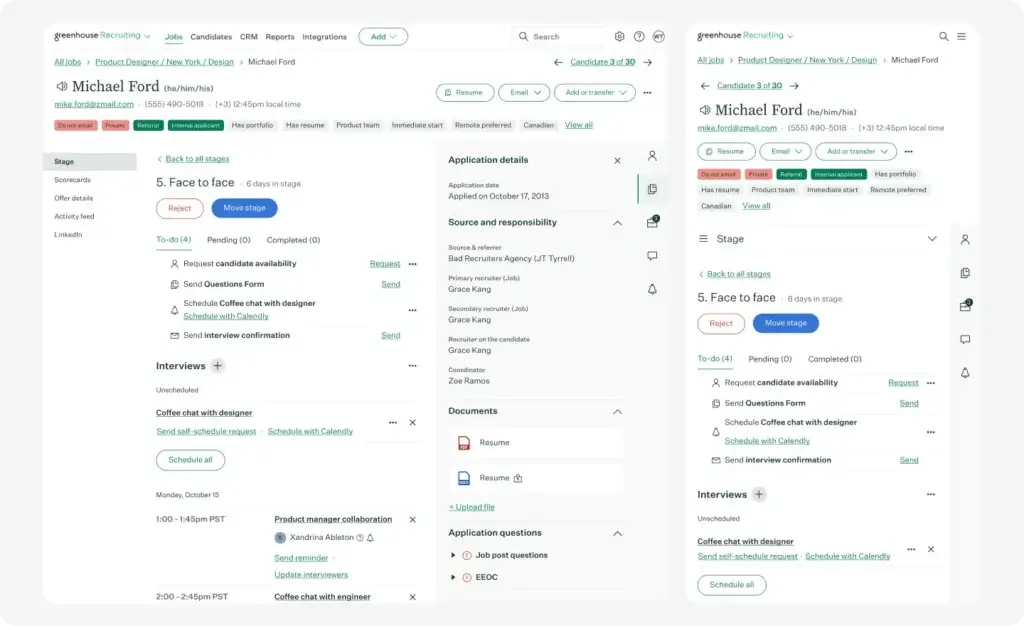
At its core, Greenhouse gives you a centralized applicant tracking system for jobs, candidates, interview stages, recruiter activity, and hiring team collaboration. This is the foundation of the platform, and it is where Greenhouse usually makes the strongest first impression. Pipelines are clear, workflows are well organized, and the system is designed to reduce the chaos that often builds up when hiring teams rely on email threads and spreadsheets.
Structured Hiring Framework
Structured hiring is the defining concept behind Greenhouse. The platform helps you define the role, align on what success looks like, create interview plans, use consistent scorecards, and guide interviewers toward more standardized evaluations. This is important because Greenhouse is not just helping you move faster. It is trying to help you make more consistent and more defensible hiring decisions.
Candidate Sourcing and CRM
Greenhouse also supports talent sourcing and candidate relationship management, giving recruiters a way to organize prospect engagement beyond active applicants. This is valuable if your team wants to build future pipelines instead of treating every search as a fresh start. For companies with proactive recruiting strategies, this makes the platform more useful than ATS tools focused only on current openings.
Interview Scheduling and Candidate Experience
Scheduling is one of the areas where Greenhouse has become more compelling. The platform supports scheduling links, candidate self-scheduling, interviewer availability controls, and newer built-in scheduling capabilities designed to reduce coordination work. This can make a real difference for recruiter productivity, especially when interview volume is high.
Interview Kits, Scorecards, and Decision-Making
Greenhouse is especially strong when multiple stakeholders need to assess candidates consistently. Interview kits, scorecards, interviewer guidance, and structured evaluation workflows help reduce vague feedback and keep hiring managers aligned. If your hiring process often becomes subjective or inconsistent, this part of the product is one of the clearest reasons to shortlist Greenhouse.
Reporting and Analytics
Greenhouse includes reporting and analytics tools designed to help recruiters and leaders understand funnel performance, bottlenecks, and hiring trends. The newer analytics capabilities move the platform closer to self-serve reporting, which is useful if you want answers without constantly exporting data into separate BI tools. Reporting is a real strength overall, although it is also one of the areas where some users still want more flexibility.
Onboarding
Greenhouse extends beyond recruiting with onboarding functionality that helps you create structured new-hire workflows, automate tasks, define responsibilities, and sync data into HR systems. That makes the platform more complete than ATS software that stops the moment an offer is accepted. If you care about continuity between recruiting and onboarding, this is a meaningful advantage.
AI Recruiting Capabilities
Greenhouse has leaned further into AI over the past year. Current capabilities include AI support for tasks like job post description suggestions, sourcing support, response categorization, and summarizing hiring feedback. The AI story here is not just about adding novelty. Greenhouse is trying to reduce repetitive work while keeping structured process controls in place.
Integrations and API Flexibility
One of Greenhouse’s strongest advantages is its ecosystem. The company promotes more than 500 integrations across recruiting, HR, scheduling, background checks, video interviewing, and productivity tools. It also supports open APIs, which makes it easier to fit the platform into a broader talent stack rather than forcing you into a closed system.
Business Operations Features
Greenhouse Recruiting, AI, and Integrations
One of the most important things to understand about Greenhouse is that it is designed as a hiring platform first, not a full HR suite. That focus is a strength for many teams because it allows Greenhouse to go deeper into recruiting workflows than broad HR systems often do.
Hiring Platform First, Not Full HRIS
Greenhouse is strongest when your main priority is improving recruiting execution. If you want applicant tracking, sourcing, structured interviewing, scheduling, analytics, and onboarding in one system, it covers a lot of ground. But if you need payroll, benefits, workforce administration, or broader HR management, Greenhouse will usually sit alongside an HRIS rather than replace it.
Built-In Scheduling Improvements
Greenhouse’s newer scheduling capabilities strengthen the platform in a very practical area. Interview coordination is one of the most time-consuming parts of recruiting, and Greenhouse now does a better job of supporting availability rules, scheduling links, self-scheduling, and more automated coordination inside the platform itself.
Candidate Experience Tools
Greenhouse also puts more emphasis on candidate experience than some ATS competitors. Easy applications, branded communications, reminders, self-scheduling, and more consistent interview flows all support a smoother experience for candidates. That is important because poor candidate experience often weakens employer brand long before a hiring team notices the cost.
Self-Serve Insights for Recruiters and Leaders
The analytics direction is one of the more meaningful product improvements. Greenhouse Analytics is positioned as a self-serve way to explore hiring data, compare performance history, and answer operational questions faster. For recruiting teams that want more visibility without building a separate reporting stack, this makes the platform more strategically useful.
Enterprise Readiness and Governance
Greenhouse also scales well for more complex hiring organizations. Its higher-tier plans add stronger governance, security, analytics, and extensibility for global or enterprise environments. That makes the platform relevant not only for startups growing up, but also for larger companies that need more control across regions, workflows, and stakeholders.
Pros and Cons
Benefits and Limitations of Using Greenhouse
Positive
✅ Structured hiring is genuinely useful
✅ Strong collaboration model
✅ Solid scheduling and candidate experience tools
✅ Excellent ecosystem
Negative
❌ Pricing is not transparent
❌ Value often depends on plan tier
❌ Customization has limits
❌ Scope is focused on hiring
Strengths & Benefits
Greenhouse gets a lot right if your company needs more than a basic ATS and wants a more mature recruiting process.
- Structured hiring is genuinely useful – This is not just branding. Greenhouse is built around better alignment and more consistent decisions.
- Strong collaboration model – Recruiters, hiring managers, and interviewers can work in one system with clearer accountability.
- Solid scheduling and candidate experience tools – The platform helps reduce administrative friction without losing process control.
- Excellent ecosystem – Integrations and APIs make Greenhouse easier to fit into complex recruiting stacks.
Limitations & Drawbacks
Greenhouse is a strong platform, but it is not automatically the best fit for every buyer.
- Pricing is not transparent – You need to speak with sales to understand cost at each plan level.
- Value often depends on plan tier – Some advanced capabilities matter more once you move up from Core.
- Reporting is good, but not flawless – Some users still want more flexibility in exports, configuration, or depth.
- Customization has limits – Some teams feel certain templates or changes take more effort than expected.
- Scope is focused on hiring – Greenhouse is excellent for recruiting, but it is not trying to be a full HR operations platform.
Operational Fit
Greenhouse User Experience, Support, and Security
Software fit is not only about features. It also depends on how easy the platform is to adopt, how much work implementation takes, and whether your organization can trust the vendor with sensitive hiring data.
Ease of Use
Ease of use is one of Greenhouse’s strongest recurring themes in public reviews. Users regularly mention the intuitive interface, clearer navigation, and smoother recruiter and hiring team experience. That matters because recruiting software usually fails when non-recruiters avoid it, and Greenhouse generally performs well on company-wide adoption.
Implementation Experience
Implementation is usually more manageable than a broad HCM rollout, but it still requires planning. Greenhouse becomes much more valuable when job setup, interview kits, scorecards, reporting, permissions, and integrations are designed thoughtfully. In other words, the platform can be easy to use day to day, while still requiring careful setup if you want the full benefit.
Customer Support
User sentiment on support is generally positive, although, as with most SaaS products, experiences can vary by account complexity and internal expectations. Greenhouse also supports customers with implementation guidance, partner integrations, and resources around structured hiring. Support should not be viewed as a major weakness, but rollout quality still matters.
Security and Compliance
Greenhouse makes a strong public case on security and compliance. The company highlights annual SOC 1 Type 2 and SOC 2 Type 2 audits, ISO 27001:2022, ISO 27701:2019, and ISO 42001:2023 certifications, encryption in transit and at rest, privacy-by-design controls, AWS-based infrastructure, and cross-border data transfer frameworks. For companies evaluating ATS platforms at scale, these are meaningful trust signals.
AI Governance and Risk Controls
Greenhouse also emphasizes AI governance. Its public AI materials highlight security and compliance commitments, org-level AI controls, no training on personal data, encryption protections, and monthly third-party bias audits. That matters because recruiting teams increasingly need AI functionality, but they also need defensible controls around fairness and privacy.
Pricing
Greenhouse Pricing & Plans
Greenhouse pricing is one of the least transparent parts of the buying process. The company does not publish flat public prices. Instead, it offers custom pricing based on your hiring needs, plan tier, hiring volume, organizational complexity, and required capabilities.
How Greenhouse Structures Its Plans
Greenhouse currently organizes its pricing around three plans: Core, Plus, and Pro. Core covers essential hiring tools for structure and consistency, plus adds more automation, configuration, and reporting depth, and Pro adds stronger governance, security, analytics, and extensibility for more complex hiring operations.
What Affects Total Cost
Your total cost will likely depend on plan level, hiring volume, internal complexity, integrations, onboarding needs, and the level of control your organization requires. That means two businesses evaluating Greenhouse may see very different pricing outcomes depending on how mature their recruiting process is.
What to Ask Before You Buy
If you are considering Greenhouse, make sure you ask about implementation fees, onboarding availability, analytics depth by plan, API access, scheduling capabilities, security features by tier, and what changes when you move from Core to Plus or Pro. Those questions matter because the value of Greenhouse often depends on how much structure and extensibility you need.
Pricing Table
The table below gives a practical summary of how Greenhouse pricing works today.
| Feature Type | Greenhouse | What it means for buyers |
| Pricing model | Custom pricing | You need to speak with sales for an exact quote |
| Plan structure | Core, Plus, Pro | You can choose based on needed structure, reporting, and governance |
| Core plan | Essential hiring tools | Good starting point for more structured recruiting |
| Plus plan | More automation and reporting | Better for teams that need stronger workflows and insight |
| Pro plan | Enterprise governance and extensibility | Best fit for global or complex hiring operations |
| Best for | Scaling and enterprise recruiting teams | Usually a stronger fit for mature hiring organizations than casual hiring needs |
For many buyers, the real question is not whether Greenhouse can be justified at its price point, but whether your recruiting process is mature enough to benefit from it. If you only need a simple pipeline tracker, Greenhouse may feel like more than you need. If you need stronger structure, collaboration, scheduling, analytics, and scalability, the value proposition becomes much easier to understand.
Use Cases
Who Should Use Greenhouse?
Greenhouse is not for every business, but it fits several kinds of buyers especially well.
Growing Companies That Need More Discipline
If your team has outgrown lightweight ATS software and now needs clearer process design, interviewer consistency, better scheduling, and stronger reporting, Greenhouse is a strong fit. This is one of the platform’s clearest sweet spots.
Mid-Market and Enterprise Recruiting Teams
Greenhouse makes a lot of sense when hiring involves multiple interviewers, hiring managers, recruiters, and approval steps. The platform is built to create alignment across more stakeholders than simpler recruiting tools usually handle well.
Talent Teams Focused on Structured Hiring
If your priority is not just speed, but hiring quality and consistency, Greenhouse deserves serious consideration. Its interview kits, scorecards, and structured decision-making tools are still among the most recognizable strengths in the ATS market.
When Greenhouse Might Not Be Right
Greenhouse may not be the best choice if you hire only occasionally, need the cheapest possible ATS, or want a broader HR suite with payroll and employee management built in. In those cases, a lighter recruiting tool or a more all-in-one HR platform may fit more naturally.
User Feedback
Greenhouse Customer Reviews
Greenhouse reviews are strong overall. Public review snapshots show a 4.4 out of 5 rating on G2 from thousands of reviewers, and recent Capterra feedback also reflects strong ease-of-use sentiment. That review volume matters because it gives you a more dependable view of the product than platforms with only a small review footprint.
What Users Like Most
The most common positives in public reviews include Greenhouse’s intuitive interface, clear workflows, strong candidate management, easy collaboration, and broad integration options. Many users also say it helps organize recruiting better across recruiters and hiring managers, which is one of the clearest indicators that the product succeeds at operational adoption.
Common Complaints
The most common drawbacks are also fairly consistent. Some users say reporting could be more flexible, others say certain configuration or template changes take more work than expected, and some feel customization can be limited in places. Those are not small issues, but they are also fairly typical trade-offs in software designed to enforce more process consistency.
My Take on the Review Pattern
The review pattern suggests that Greenhouse’s main weakness is not product quality. It is when expectations rise when a platform becomes the process backbone for hiring. Greenhouse is strongest when you want a disciplined and scalable recruiting platform, not when you want unlimited flexibility with no structure attached.
Competitors
Competitor Alternatives to Greenhouse
Greenhouse is most often compared with platforms like Lever, Ashby, and Workday Recruiting. The right alternative depends on whether you care most about structured hiring, recruiting analytics, startup-friendly flexibility, or enterprise HCM breadth.
| Feature Type | Greenhouse | Lever | Ashby | Workday Recruiting |
| Core angle | Structured hiring platform | ATS plus CRM balance | Flexible analytics-heavy recruiting platform | Recruiting inside enterprise HCM |
| Best for | Scaling and enterprise teams needing process rigor | Teams wanting CRM and ATS together | Data-driven startups and growth companies | Large enterprises already using Workday |
| User experience | Clear and mature | Generally approachable | Powerful but can feel denser | Broad but often more complex |
| Hiring methodology | Strongest around structured hiring | Balanced recruiting workflows | Highly configurable operations | More embedded in HR suite logic |
| Analytics | Strong and improving | Solid but varies by use case | Often a standout strength | Useful in broader HCM context |
| Overall angle | Best for repeatable, scalable hiring process | Best for combined sourcing and ATS needs | Best for highly analytical recruiting teams | Best for enterprise standardization |
Compared with Lever, Greenhouse usually makes more sense if your priority is structured hiring discipline and more standardized interviewer behavior. Compared with Ashby, Greenhouse often feels more mature and process-oriented, while Ashby may appeal more to teams that want deeper operational flexibility and analytics. Compared with Workday Recruiting, Greenhouse is usually easier to adopt for recruiting-specific excellence, while Workday is more attractive when recruiting must sit tightly inside a much broader enterprise HR ecosystem.
If I had to summarize it simply, Greenhouse is one of the best choices for companies that want recruiting software built around consistency, collaboration, and scalable hiring quality.
Best Practices
Getting Started with Greenhouse
To get the most out of Greenhouse, you should make a few smart decisions early.
Define Your Hiring Process Before Setup
Greenhouse works best when your team already knows how it wants to evaluate candidates. Before implementation, define interview stages, scorecards, decision criteria, and approval logic so the platform reinforces your process instead of exposing confusion.
Standardize Interviewer Training
Do not stop at system setup. Greenhouse becomes much more effective when interviewers understand how to use scorecards, follow interview kits, and submit useful feedback on time. The software is strong, but behavior change is what unlocks the biggest value.
Prioritize Scheduling and Candidate Experience
Scheduling is one of the easiest places to improve recruiting efficiency quickly. Use self-scheduling, communication templates, and integration options to reduce delays and create a smoother experience for candidates.
Build Reports Around Real Hiring Questions
Do not just collect data because the platform offers it. Identify which funnel metrics, bottlenecks, and conversion points actually matter to your recruiting leaders, and build reporting around those decisions.
Connect Greenhouse to the Rest of Your Talent Stack
Greenhouse becomes much more valuable when you use its integrations well. Background checks, calendars, HRIS sync, video interviewing, sourcing tools, and onboarding handoffs are all stronger when the platform is connected to the rest of your workflow.
Conclusion
Final Thoughts
⭐ Overall Rating: 8.5/10
Greenhouse remains one of the strongest hiring platforms because it solves a very real problem in the market. Many companies outgrow simple ATS tools before they are ready to commit to a broader enterprise HR suite. Greenhouse sits in that gap extremely well.
Its biggest strengths are structured hiring, recruiter and interviewer collaboration, the candidate experience, depth of integration, and overall fit for scaling hiring teams. Its biggest drawbacks are pricing transparency, some ongoing complaints around reporting or customization, and the fact that it is still primarily a hiring platform rather than a full HR system.
Overall, Greenhouse is a strong recommendation for companies seeking a more disciplined, scalable recruiting process. If your organization needs more than applicant tracking and wants a hiring platform that improves consistency across the whole team, Greenhouse is well worth considering.
Have more questions?
Frequently Asked Questions
What is Greenhouse best used for?
Greenhouse is best used for applicant tracking, structured hiring, interview coordination, recruiting analytics, and hiring team collaboration in one platform.
Is Greenhouse just an ATS?
No. Greenhouse is broader than a basic ATS because it also includes sourcing, interview scheduling, onboarding, analytics, and AI-supported recruiting workflows.
How much does Greenhouse cost?
Greenhouse uses custom pricing. The company currently sells plans across Core, Plus, and Pro, but you need to speak with sales for an exact quote.
Does Greenhouse support structured hiring?
Yes. Structured hiring is one of Greenhouse’s main strengths, with tools for interview plans, scorecards, and more standardized decision-making.
Does Greenhouse offer onboarding?
Yes. Greenhouse includes onboarding capabilities that help automate tasks, assign responsibilities, and create more consistent new-hire workflows.
Is Greenhouse easy to use?
Yes. Ease of use is one of the platform’s most common strengths in public reviews, especially among recruiters and hiring teams.
Does Greenhouse have integrations?
Yes. Greenhouse offers a large integration ecosystem with more than 500 partners, plus open APIs for custom workflows.
Is Greenhouse good for small businesses?
It can work for some smaller teams, but Greenhouse is generally a better fit for companies with growing or more structured recruiting needs.
What are the main Greenhouse alternatives?
The main alternatives usually include Lever, Ashby, and Workday Recruiting, depending on whether you prioritize CRM balance, analytics flexibility, or enterprise HR alignment.
Is Greenhouse worth it overall?
Yes, for the right buyer. If your company wants stronger recruiting structure, clearer hiring decisions, and a platform that can scale with your hiring process, Greenhouse is worth serious consideration.