
Mesh is a modern spend management and travel expense platform built for finance teams that need tighter control over company payments, employee expenses, travel spend, reimbursements, vendor payments, and accounting reconciliation.
It is not traditional accounting software like QuickBooks, Xero, Sage Intacct, or NetSuite. Instead, Mesh sits in front of your accounting system and helps manage the financial activity that creates accounting work later: corporate card transactions, travel bookings, receipts, reimbursements, SaaS subscriptions, approvals, vendor spend, and ERP sync.
That distinction matters. If you are looking for a general ledger, tax accounting platform, payroll system, or full ERP, Mesh will not replace your accounting software. But if your finance team is dealing with scattered card payments, slow approvals, manual receipt chasing, poor travel visibility, disconnected reimbursements, and messy month-end reconciliation, Mesh can become a valuable spend control layer.
In this Mesh review, you will learn where Mesh fits in your finance stack, what it does well, what limitations to consider, how its pricing works, and how it compares with alternatives like Ramp, Brex, Airbase, BILL Spend & Expense, SAP Concur, and Tipalti.
Mesh Overview and Where It Fits in Your Finance Stack
What Mesh Does for Businesses
Mesh is best described as a global spend management and travel expense platform. It brings together corporate cards, expense management, reimbursements, travel controls, SaaS spend management, payment workflows, AI-powered compliance, and accounting automation.
For many companies, Mesh acts as the operational finance layer between employees, vendors, travel providers, payment activity, and the accounting system. Employees use it to request spend, pay with cards, upload receipts, manage travel expenses, and submit reimbursements. Finance teams use it to define budgets, enforce policies, review exceptions, monitor spend, and sync cleaner transaction data into the ERP.
This makes Mesh especially relevant for companies that want to control spend before it becomes a finance problem. Instead of reviewing transactions only after money has already left the business, Mesh helps you use card controls, approval workflows, vendor locks, budget rules, and AI-driven checks to guide spending earlier in the process.
Mesh vs Traditional Accounting Software
Mesh is not a full accounting platform. It does not provide your official general ledger, tax filing workflow, full financial reporting engine, or year-end accounting system.
Where Mesh adds value is in the workflows that feed accounting. It helps you collect receipts, apply expense policies, categorize transactions, route approvals, control card spend, manage reimbursements, track travel costs, and sync data to systems such as NetSuite, QuickBooks, Sage Intacct, and other finance tools.
That makes Mesh useful if your accounting close is slowed down by missing receipts, incorrect categories, uncoded transactions, unclear vendor payments, and late employee expense submissions.
Software specification
Key Features of Mesh
Corporate Cards and Spend Controls
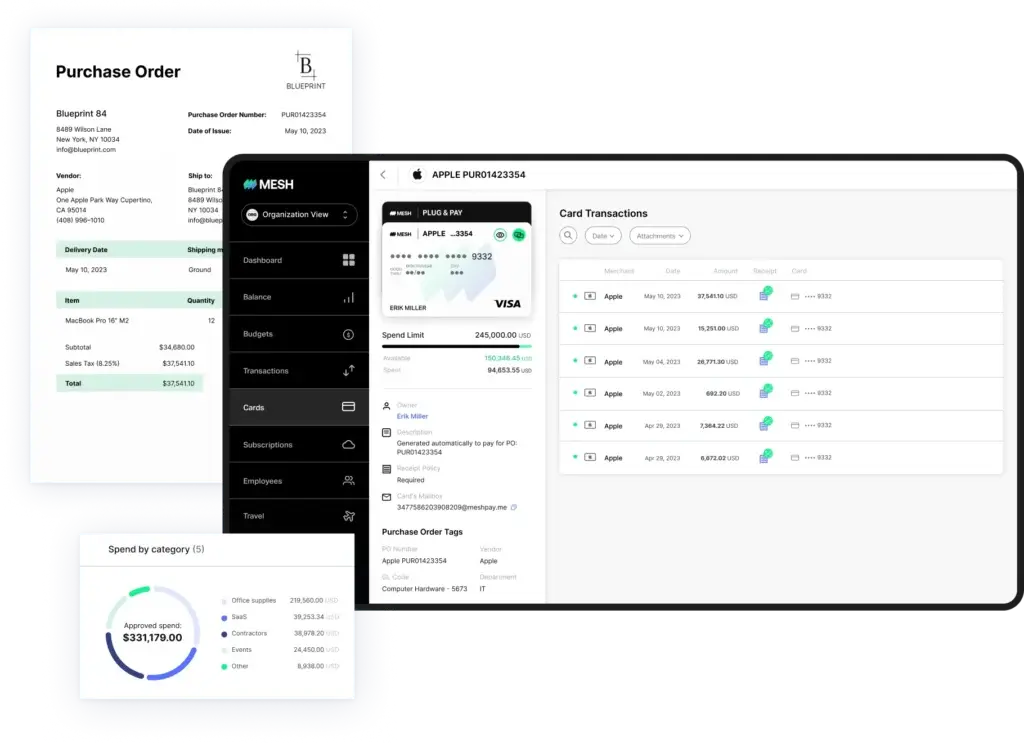
Corporate cards are one of Mesh’s strongest areas. Mesh supports virtual cards, physical cards, mobile wallets, vendor-locked cards, spend limits, budget controls, approval workflows, and real-time visibility into company payments.
This is useful if your business wants to give employees purchasing flexibility while still keeping spend aligned with policy. Finance teams can create controls around vendor payments, software subscriptions, travel spend, one-time purchases, recurring spend, and department budgets.
Key strengths in this area include:
- Virtual cards for SaaS, vendors, travel, and team spend
- Vendor locks, spend limits, and real-time alerts
- Policy controls before, during, and after purchases
Expense Management and Receipt Automation
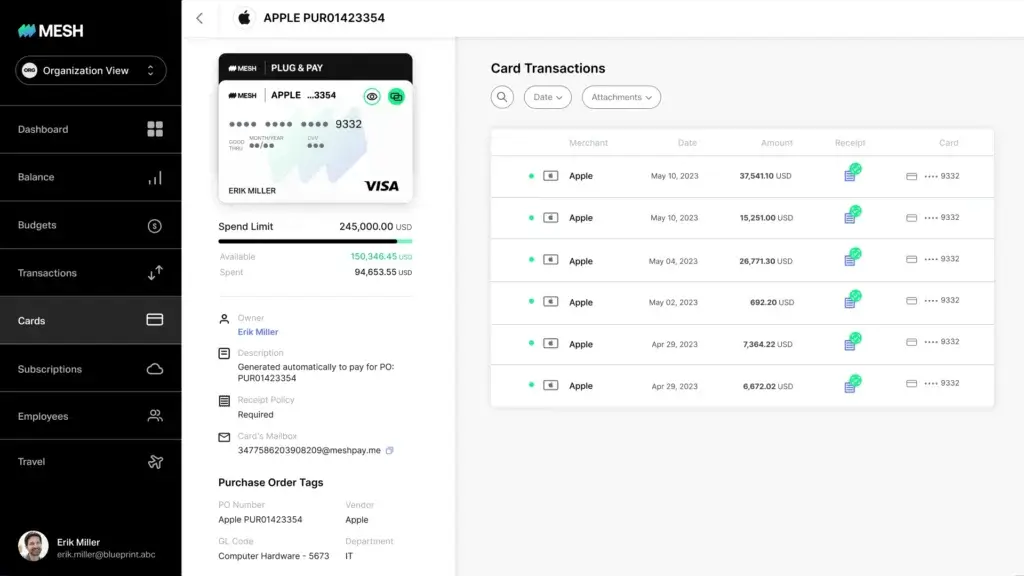
Mesh helps reduce the friction of traditional expense management by automating receipt collection, expense categorization, approval routing, and reconciliation. Employees can submit receipts and complete expense details without relying on old-school expense reports.
The main benefit is that Mesh gives finance teams visibility across the full expense lifecycle. You can pre-approve expenses, control spend at the point of purchase, and review exceptions after the transaction. That is a more controlled model than waiting until month-end to discover missing documentation.
For growing finance teams, this can reduce repetitive admin work and improve data quality before transactions reach the accounting system.
Travel Management and Guest Travel
Mesh has become especially strong in travel and expense management. The platform supports online, offline, and direct booking workflows, while keeping policies, budgets, and compliance rules connected to the payment process.
One of Mesh’s more interesting capabilities is guest travel management. Companies can issue guest travel cards, define guest policies, and reduce the need for guests to pay out of pocket. This is useful for companies that frequently manage travel for candidates, consultants, contractors, customers, executives, or event guests.
Mesh can also help track total trip cost beyond the booking itself. That includes flights, hotels, ground transportation, meals, and on-trip purchases, giving finance leaders better visibility into the real cost of business travel.
SaaS Spend Management
Mesh is also useful for managing SaaS subscriptions. Finance teams can create vendor-locked cards, monitor recurring software payments, receive alerts, and identify opportunities to optimize spend.
This is particularly valuable for companies with many teams buying software independently. Without a structured process, SaaS spend can spread across employee cards, shared accounts, and department budgets with limited visibility.
Mesh gives finance and operations teams a practical way to monitor subscription activity, reduce surprise renewals, and improve accountability around software spend.
Reimbursements and Local Payments
Mesh supports employee reimbursements alongside card-based spend. That means employees can submit out-of-pocket expenses while finance teams keep reimbursements connected to budgets, policies, approvals, and accounting sync.
This is helpful because reimbursements often become a disconnected workflow. Employees pay personally, submit claims late, finance checks policy manually, and accounting has to reconcile it separately.
Mesh improves that process by allowing pre-approved budgets, automatic approval rules, and reimbursement syncing to the ERP. For companies with international teams, reimbursement workflows and local payment support can be especially useful.
Accounting Automation and ERP Sync
Mesh’s accounting automation tools are designed to help finance teams close the month faster. The platform can automate receipt collection, transaction coding, custom fields, approvals, and ERP syncing.
This matters because spend management is only valuable if the data reaches accounting in a clean, structured way. Mesh helps reduce manual entry, improve GL accuracy, and make reconciliation less dependent on spreadsheets.
For finance teams using systems like NetSuite, QuickBooks, Sage Intacct, or other ERPs, Mesh can help create a cleaner workflow from payment to reconciliation.
AI Agents and Automated Compliance
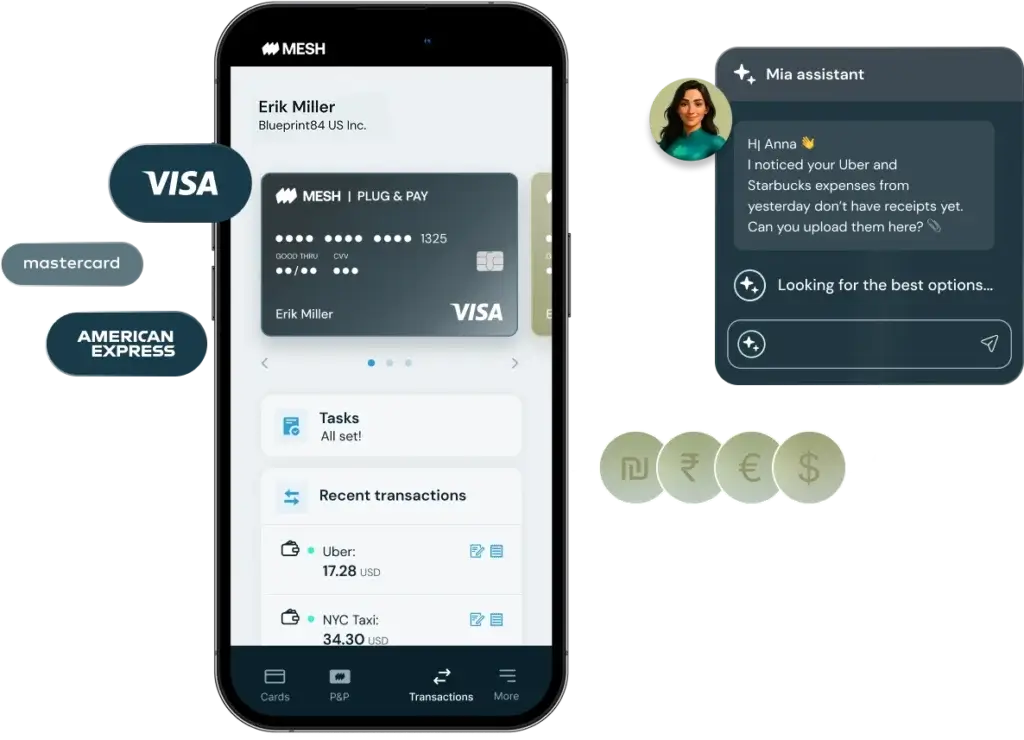
Mesh is leaning heavily into AI-powered finance workflows. Its AI assistant, Mia, is designed to help employees complete expense requirements, upload receipts, tag transactions, and match documentation. Its AI controller, Mac, is positioned to review transactions, detect policy issues, flag anomalies, and support approvers with better context.
This is an important direction for spend management software. Instead of only automating basic routing, Mesh is moving toward proactive finance operations, where the system can identify issues earlier and reduce the amount of manual review required from finance teams.
For now, you should evaluate Mesh AI based on the exact features available in your plan or demo. AI claims can sound broad across the category, but the practical value depends on how well the system handles your policies, entities, accounting fields, and approval workflows.
How Mesh Works
Setup and Uses
Setup and Onboarding
Mesh setup typically involves configuring company policies, issuing cards, connecting accounting or ERP systems, defining approval workflows, inviting employees, setting budgets, and mapping transaction data to accounting categories.
The onboarding complexity depends on your company size. Smaller teams may be able to launch basic card and expense workflows quickly. Larger companies with multiple entities, global travel, custom accounting dimensions, and advanced approval rules should expect more configuration.
Managing Employee Spend Day to Day
For daily spend management, Mesh works best when employees use it as the central place for card purchases, travel spend, receipts, reimbursements, and spend requests.
Finance teams get better visibility into spend as it happens, while employees get clearer rules around what they can buy, how much they can spend, and what documentation is required.
Common use cases include software subscriptions, travel expenses, vendor payments, candidate travel, team purchases, event spend, mileage, reimbursements, and ad-hoc employee expenses.
Managing Travel and Expense Together
Mesh is particularly strong when travel and expense management need to work together. Many companies manage travel booking in one tool, corporate cards in another, expense reports in another, and reconciliation in spreadsheets.
Mesh helps reduce that fragmentation by connecting travel policies, travel cards, approvals, receipts, and accounting sync in one workflow.
This can be especially useful for global companies, frequent travelers, and finance teams that need better control over travel budgets without creating a frustrating process for employees.
Using Mesh Across Global Teams
Mesh is designed for global and multi-entity spend management. It supports multiple currencies, global payment workflows, local card programs in certain regions, and integrations that help finance teams manage spend across different teams and locations.
If your business operates across countries, entities, or currencies, you should evaluate Mesh in a demo with your real finance structure. Global spend workflows can be complex because policies, taxes, reimbursement rules, payment methods, and accounting requirements vary by region.
Pros and Cons
A balanced view: what you’ll love and what to consider
Mesh is a strong option for companies that want travel, expense, cards, reimbursements, and accounting automation in one connected platform. Its biggest strengths are spend controls, travel expense workflows, SaaS spend visibility, automation, and ERP syncing.
Its main limitations are that it is not a full accounting platform, some financial services depend on regional partners, and companies with deep procurement or global supplier payment requirements may need a more specialized solution.
Positive
✅ Strong Travel and Expense Controls
✅ Great Fit for Travel-Heavy Companies
✅ Useful Combination of Cards, Expenses & Reimbursements
✅ Better Month-End Reconciliation
✅ No-Cost Platform Entry Point
Negative
❌ Not a Full Accounting System
❌ Advanced Procurement Needs May Require Another Tool
❌ Pricing Is Free, But Value Depends on Payment Activity
❌ Regional Card Terms Need Review
✅ Benefits of Mesh
Strong travel and expense controls
Mesh helps finance teams manage spending earlier in the lifecycle. You can define policies, budgets, approval flows, vendor controls, and card restrictions before employees make purchases.
This is a major advantage over traditional expense reporting, where finance teams often discover missing receipts, policy violations, or incorrect categories only after the transaction has already happened.
Great Fit for Travel-Heavy Companies
Mesh is especially useful if business travel is one of your biggest spend categories. It connects travel policies, cards, bookings, guest travel, receipts, and total trip cost visibility.
This gives finance teams more control without forcing every traveler into a slow manual process. For companies managing guests, candidates, contractors, or international teams, this can be a meaningful advantage.
Useful Combination of Cards, Expenses & Reimbursements
Mesh is not just a card tool. It combines several operational finance workflows that often become fragmented across different systems.
You can manage corporate cards, out-of-pocket reimbursements, recurring SaaS subscriptions, travel expenses, and accounting sync in one environment. This reduces tool sprawl and gives finance leaders a clearer view of company spend.
Better Month-End Reconciliation
Mesh can help finance teams reduce manual reconciliation work by automating receipt collection, coding, approvals, and ERP sync.
This is especially valuable for companies that already have a strong accounting system but struggle with the quality and timing of the data that enters it.
No-Cost Platform Entry Point
Mesh markets its platform as free to use, with cashback available on eligible payments. This can make it attractive compared with software vendors that charge per user or per module.
However, the financial value depends on your payment volume, cashback eligibility, region, card setup, and exact workflow needs. You should confirm terms directly with Mesh before comparing it against paid alternatives.
❌ Potential Drawbacks and Limitations
Not a full accounting system
The biggest limitation is that Mesh does not replace your accounting platform. You still need a general ledger, tax workflow, financial reporting process, and accounting system of record.
This is not a weakness if you understand where Mesh fits. It is a spend management and finance operations layer, not your official accounting ledger.
Advanced Procurement Needs May Require Another Tool
Mesh is strong for cards, travel, expenses, reimbursements, SaaS spend, and accounting automation. However, companies with complex procurement sourcing, supplier risk management, purchase order governance, contract lifecycle management, or strategic sourcing may need a more procurement-focused tool.
For example, Coupa is usually stronger for enterprise procurement depth, while Tipalti is stronger for complex global payables and supplier tax workflows.
Pricing Is Free, But Value Depends on Payment Activity
Mesh’s pricing model is appealing because the platform is positioned as free. But the practical value depends on how much spend you route through Mesh, whether your transactions qualify for cashback, and whether Mesh supports your preferred payment and accounting workflows.
If your company has low monthly card volume, limited travel spend, or strict banking requirements, you should compare the full operational value rather than looking only at the subscription cost.
Regional Card Terms Need Review
Because Mesh includes card and payment workflows, you should review the financial services structure in your region. Card issuing, payment availability, currencies, reimbursement options, and partner institutions may vary by country.
This is especially important for companies operating across the United States, Canada, Europe, the United Kingdom, Singapore, Hong Kong, Australia, or other supported markets.
Pricing and Plans
How much does Mesh cost?
Mesh has a different pricing approach from many spend management vendors. Instead of publishing tiered per-user subscription plans, Mesh states that the platform is free and that companies can earn cashback on eligible payments.
Mesh Platform Pricing
Mesh currently positions its platform as free to use, with unlimited users and unlimited cards. This makes it attractive for finance teams that want to avoid a traditional SaaS subscription model for spend management.
That said, you should confirm the exact commercial structure during a demo. Spend management pricing can depend on card usage, payment volume, implementation needs, geography, cashback terms, and eligible spend categories.
Cashback Eligibility
Mesh states that payments made using the platform may be eligible for cashback, including SaaS payments, travel, and other company spend.
The important requirement is that cashback eligibility requires at least $50K in monthly spend. Mesh also reserves the right to determine which transactions or expense types are excluded from cashback eligibility.
Pricing Takeaway
Mesh can be financially attractive if your company already has meaningful card, travel, SaaS, or operational spend that can flow through the platform.
However, you should not evaluate Mesh only as “free software.” You should review cashback terms, payment coverage, regional card availability, accounting integration depth, implementation requirements, support expectations, and how much of your spend can realistically move through Mesh.
Pricing Comparison Table
| Pricing Area | Mesh | Best For |
| Platform access | Free platform positioning | Companies that want spend management without per-user software fees |
| Cards | Unlimited cards stated by Mesh | Teams managing employee, vendor, SaaS, and travel payments |
| Cashback | Eligible payments may earn cashback | Companies with meaningful monthly card and payment volume |
| Cashback requirement | Minimum $50K monthly spend | Mid-market and larger teams with enough qualifying spend |
| Implementation | Confirm during demo | Companies with ERP, global, or multi-entity requirements |
Business Fit
Who Should Use Mesh?
Mid-Market Companies With Growing Finance Complexity
Mesh is a strong fit for mid-market businesses that have outgrown simple card programs and manual expense tools. If your finance team is managing more employees, more departments, more travel, and more SaaS subscriptions, Mesh can add structure without immediately forcing a heavy enterprise procurement system.
Travel-Heavy and Global Teams
Mesh is especially relevant for companies where travel spend creates operational friction. If your team manages frequent travel, guest travel, global travel policies, or cross-border expense workflows, Mesh’s travel and expense focus can be a strong advantage.
Finance Teams That Want Better Pre-Spend Control
Mesh is a good match if your main problem is not just expense reporting, but spend control. The platform helps you manage budgets, card limits, vendor locks, approvals, and policy enforcement before transactions become accounting cleanup.
Companies Using NetSuite, QuickBooks, or Sage Intacct
Mesh is most valuable when it syncs cleanly with your accounting or ERP system. If your finance team uses NetSuite, QuickBooks, Sage Intacct, or another connected system, Mesh can help reduce manual coding and reconciliation work.
Who Might Need Something Else
If you primarily need bookkeeping, payroll, tax filing, or financial statements, Mesh is not the right standalone solution. You should choose accounting software first and then evaluate Mesh as a spend management layer.
If your biggest challenge is complex global supplier onboarding, tax form collection, payment rails, and supplier compliance, Tipalti may be more specialized. If your main focus is enterprise procurement, Coupa may be stronger. If you want a broad spend management platform with deep AP and procurement workflows, Ramp and Airbase are also close comparisons.
Alternatives
Mesh Alternatives & Competitors
Mesh competes across corporate cards, travel and expense management, spend controls, SaaS spend management, reimbursements, and accounting automation. The best alternative depends on which workflow matters most to your finance team.
Comparison Table: Mesh vs Competitors
| Feature | Mesh | Ramp | Brex | SAP Concur |
| Primary focus | Travel, expenses, cards, reimbursements, SaaS spend, and accounting automation | Spend management, AP automation, procurement, and finance operations | Corporate cards, spend management, travel, bill pay, and business accounts | Enterprise travel and expense management |
| Corporate cards | Strong virtual and physical card workflows | Strong card and spend controls | Strong global card program | Not the main focus |
| Travel management | Very strong travel and guest travel focus | Available, with broader finance workflows | Strong integrated travel workflows | Very mature enterprise travel workflows |
| AP and vendor payments | Useful, but not as AP-specialized as Tipalti | Strong AP and procurement depth | Bill pay included | Invoice workflows available through SAP ecosystem |
| Best fit | Companies that want travel, expense, cards, and accounting automation in one platform | Finance teams wanting broad spend, procurement, and AP automation | Startups and global companies wanting cards, travel, and business accounts | Large enterprises with mature travel programs |
Ramp: Ramp is one of the strongest Mesh alternatives if you want a broader finance automation platform with spend management, corporate cards, AP automation, procurement, vendor management, and accounting automation. Mesh may be more attractive if travel and guest travel are your top pain points. Ramp may be stronger if AP and procurement depth are more important. You can read our Ramp review for a deeper comparison.
Brex: Brex is a close competitor for companies that want corporate cards, spend management, travel, bill pay, business accounts, and accounting automation. Mesh has a strong travel and expense workflow angle, while Brex has a broader business account and global card positioning. You can compare both in our Brex review.
Airbase: Airbase is a strong alternative for mid-market companies that want AP, procurement, expense management, corporate cards, and approval workflows in one platform. Mesh may be a better fit when travel, guest travel, and card-based spend controls are the central use case.
SAP Concur: SAP Concur is a mature enterprise option for travel and expense management. It may be better for large organizations with complex travel programs and existing SAP environments, while Mesh can feel more modern and focused on real-time spend control.
Tipalti: Tipalti is stronger if your company needs supplier onboarding, tax compliance, global payment methods, and mass payables. Mesh is better when your priority is employee spend, travel expenses, SaaS payments, cards, and reimbursement workflows. You can read our Tipalti review for more detail.
Integrations and Ecosystem
Connect Mesh to your favourite apps
Accounting and ERP Integrations
Mesh integrates with accounting and ERP systems to help finance teams sync transactions, automate coding, reduce manual entry, and streamline reconciliation. Common accounting workflows include transaction syncing, GL mapping, custom fields, vendor bills, reimbursements, journal entries, and supporting records.
This is important because Mesh is most valuable when it connects cleanly with your financial system of record. If your accounting team still has to clean exports manually every month, you lose much of the automation benefit.
HRIS, SSO, and Workflow Integrations
Mesh also supports integrations beyond accounting, including HRIS, SSO, technology, and travel ecosystem partners. These connections help keep employee roles, departments, permissions, approval paths, and access controls more consistent.
For growing teams, this matters because spend controls need to follow organizational changes. When employees join, move departments, change managers, or leave the company, connected systems can help reduce manual admin work.
Travel Management Ecosystem
Mesh’s travel focus makes integrations with travel management companies and travel partners especially relevant. This is useful for organizations that need flexible booking workflows but still want spend controls and expense automation connected to the travel process.
If your company already works with a travel management provider, ask Mesh which booking, agency, and payment workflows are supported before implementation.
Security and Compliance
Security and Compliance in Mesh
Security is a critical part of evaluating Mesh because the platform touches sensitive financial data, employee expenses, payment workflows, card activity, vendor information, and accounting integrations.
Security and Compliance Controls
Mesh has stated that it is SOC 2 compliant, and it uses security and monitoring processes to protect customer information. For finance teams, this is an important baseline because spend management platforms handle card data, accounting data, approvals, and employee information.
If your company has a formal vendor risk process, you should request Mesh’s current security documentation, compliance reports, data processing terms, and regional cardholder agreements during procurement.
Permissions, Policies, and Auditability
Mesh supports controls such as approval workflows, role-based permissions, spend policies, vendor locks, card limits, and transaction review workflows. These features help finance teams create a stronger control environment around employee and vendor spend.
From an accounting perspective, auditability matters as much as convenience. You want to know who requested spend, who approved it, what policy applied, which receipt was attached, how the transaction was coded, and when the data was synced into the ERP.
Regional Financial Services Structure
Because Mesh includes card and payment workflows, the underlying financial services structure can vary by region. Mesh’s site references different partners for the United States, Canada, Europe, the United Kingdom, Singapore, Hong Kong, and Australia.
This does not mean Mesh is unsafe. It means finance leaders should read the relevant terms carefully and understand card issuing, payment availability, fund movement, reimbursement support, and regional compliance requirements before rolling it out globally.
Conclusion
Final Thoughts
Mesh is a strong spend management platform for companies that want better control over travel, expenses, corporate cards, reimbursements, SaaS spend, and accounting automation. It is especially compelling for mid-market and global teams that want to reduce manual finance work while improving spend visibility.
Its biggest strength is the way it connects spend control with real payment activity. Employees can spend within approved policies, finance teams can monitor activity in real time, and accounting teams can receive cleaner data for reconciliation.
The main limitation is that Mesh is not a full accounting platform. You still need accounting software or an ERP. You should also evaluate regional card availability, cashback eligibility, integration depth, and whether Mesh supports the exact approval and accounting workflows your business requires.
Overall, Mesh is a very strong choice if your finance team wants a modern platform for travel and expense control, virtual cards, reimbursements, SaaS spend visibility, and month-end automation. It is less ideal if you only need bookkeeping software or if your main pain point is highly specialized procurement or global supplier payments.
For many growing businesses, Mesh can be a practical way to build a more controlled, automated, and scalable finance operation without forcing employees into a clunky expense process.
Have more questions?
Frequently Asked Questions
What is Mesh?
Mesh is a spend management and travel expense platform that helps businesses manage corporate cards, employee expenses, reimbursements, travel spend, SaaS subscriptions, approvals, and accounting automation.
Is Mesh accounting software?
No. Mesh is not a full accounting system. It works alongside accounting software and ERPs to control spend, collect receipts, automate approvals, and sync cleaner transaction data into your books.
Who is Mesh best for?
Mesh is best for mid-market, global, and travel-heavy companies that need better control over employee spend, corporate cards, reimbursements, travel expenses, and month-end reconciliation.
Does Mesh offer corporate cards?
Yes. Mesh offers corporate card workflows, including virtual cards, physical cards, mobile wallet support, vendor-locked cards, spend limits, and real-time controls for business payments.
How much does Mesh cost?
Mesh positions its platform as free to use, with cashback available on eligible payments. Cashback eligibility requires at least $50K in monthly spend, and specific terms should be confirmed with Mesh.
Does Mesh support travel management?
Yes. Mesh supports travel and expense workflows, including travel policies, guest travel cards, approval flows, booking-related controls, total trip cost tracking, and travel expense automation.
Can Mesh manage reimbursements?
Yes. Mesh supports reimbursements by connecting out-of-pocket expenses to budgets, approval rules, employee submissions, local payment workflows, and ERP reconciliation.
What accounting systems does Mesh integrate with?
Mesh integrates with accounting and ERP systems such as NetSuite, QuickBooks, Sage Intacct, and other finance platforms. Integration details may vary by setup, region, and accounting workflow.
How does Mesh compare with Ramp?
Mesh is especially strong for travel, expense, virtual cards, reimbursements, and SaaS spend controls. Ramp is often stronger for broader AP, procurement, vendor management, and finance automation depth.
Is Mesh good for small businesses?
Mesh can work for smaller teams with enough company spend, but it is usually more compelling for growing, mid-market, and global companies with recurring travel, SaaS, card, and reimbursement workflows.