
Rho is a modern finance platform built for companies that want to manage banking, corporate cards, expenses, accounts payable, treasury, and accounting automation in one connected workflow. It is not traditional accounting software like QuickBooks, Xero, or NetSuite. Instead, Rho focuses on the operational finance layer that sits between your employees, vendors, cash, and accounting system.
That distinction matters. If you need a general ledger, tax filing software, payroll system, or full ERP, Rho will not replace your accounting platform. But if your finance team is managing business checking, idle cash, corporate cards, bill payments, receipt collection, approvals, and reconciliation across too many tools, Rho can help centralize a large part of that workflow.
In this Rho review, you will learn what Rho does, how it works, where it is strongest, what limitations to consider, how pricing works, and how it compares with alternatives like Ramp, Brex, Mercury, BILL, and Airbase.
Overview
Rho Overview and Where It Fits in Your Finance Stack
What Rho Does for Businesses
Rho is best described as a finance operations platform. It combines business banking, corporate cards, expense management, bill pay, treasury, and accounting automation in one environment.
For many businesses, Rho acts as the command center for money movement before transactions reach the accounting system. Employees use it to spend, upload receipts, and manage card activity. Finance teams use it to control spend, approve bills, monitor cash, manage vendors, sync transactions, and close the books with less manual cleanup.
This makes Rho especially relevant for startups, scaling companies, and finance teams that want more control over cash and spend without stitching together separate tools for banking, cards, AP, and expense management.
Rho vs Traditional Accounting Software
Rho is not a full accounting system. You will still need software such as QuickBooks Online, Xero, Sage Intacct, NetSuite, Microsoft Dynamics 365 Business Central, or another ERP to maintain your official books.
Where Rho adds value is in the workflows that feed accounting. It helps you manage cash, issue cards, capture receipts, process invoices, route approvals, pay vendors, and sync enriched transaction data into your accounting platform.
That makes Rho a practical choice if your accounting workflow is slowed down by disconnected bank accounts, manual AP entry, missing receipts, unclear spend categories, and slow month-end reconciliation.
Software specification
Key Features of Rho
Business Banking and Cash Management
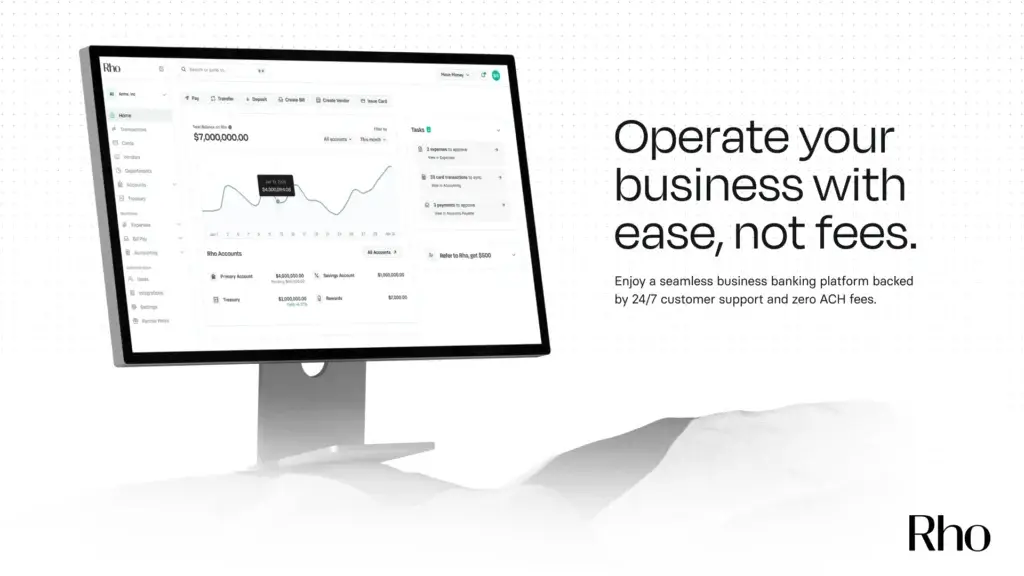
Rho gives businesses access to checking, savings, and treasury-related workflows through its financial partners. This is one of the main ways Rho differs from many pure spend management tools.
Instead of only helping you control employee card spend, Rho also helps you manage operating cash, vendor payments, treasury movement, and account visibility from the same platform.
This can be useful if your finance team wants fewer disconnected workflows between banking, AP, cards, and accounting. You can manage funds, review balances, issue payments, and sync activity to accounting without relying on separate banking portals and spreadsheets.
Expense Management and Reimbursements
Rho helps reduce the friction of traditional expense reporting by connecting card activity, receipt collection, reimbursements, and accounting sync. Employees can submit documentation, while finance teams can review and categorize transactions with more context.
The main benefit is that Rho brings spend management closer to the transaction. Instead of waiting until month-end to chase receipts or fix coding errors, finance teams can keep expense data cleaner throughout the period.
For growing companies, this matters because small expense issues become bigger accounting issues as headcount, vendors, subscriptions, and transactions increase.
Accounts Payable and Bill Pay
Rho Bill Pay is one of the platform’s most important finance automation features. It helps teams collect invoices, route approvals, schedule payments, flag potential duplicates, track bill status, and sync payment details to accounting.
This is especially useful if your current AP process still depends on shared inboxes, manual PDF review, spreadsheets, and back-and-forth approval messages.
Rho gives controllers and finance managers a more structured way to move from invoice intake to approval to payment. You can manage vendor bills in the same broader environment as business accounts, cards, expenses, and accounting automation.
Treasury and Idle Cash Management
Rho also supports treasury-related workflows for businesses that want to put idle cash to work while keeping visibility over liquidity. This is more relevant for venture-backed startups, growing companies, and finance teams managing larger cash balances.
That said, this area requires careful review. Treasury products are not the same as standard bank deposits, and they can involve investment risk. If you plan to use Rho for material cash balances, review the account structure, partner institutions, insurance coverage, liquidity terms, and risk disclosures with your finance team.
Accounting Automation and Integrations
Rho integrates with accounting systems such as QuickBooks Online, NetSuite, and Sage Intacct. It also supports bank feed connections with platforms such as Xero and QuickBooks Online.
This matters because Rho is not intended to replace your general ledger. Its value depends heavily on how cleanly it can pass banking, card, bill pay, and expense data into your accounting system.
If your finance team spends too much time categorizing transactions, matching payments, chasing receipts, and reconciling bank activity, Rho’s accounting automation can help shorten the month-end close.
Corporate Cards and Spend Controls
Rho offers corporate cards with controls that help finance teams manage employee spend before it becomes a reconciliation issue. You can use cards for team purchases, recurring software subscriptions, vendor payments, and employee expenses.
Finance admins can issue physical and virtual cards, define limits, monitor transactions, collect receipts, and keep spend activity organized by employee, vendor, or department.
Key strengths in this area include:
- Physical and virtual corporate cards
- Spend controls and card-level visibility
- Receipt capture and expense tracking
- Useful workflows for SaaS and vendor spend

How Rho Works
Setup and Uses
Setup and Onboarding
Rho setup typically involves applying for an account, configuring business banking access, issuing cards, setting approval rules, adding users, connecting accounting software, and defining how your team will manage expenses and vendor payments.
The onboarding process will depend on company size and complexity. A startup with a simple accounting workflow may move quickly. A larger company with multi-entity operations, custom approval chains, or NetSuite workflows should expect more configuration.
Managing Spend Day to Day
For day-to-day finance operations, Rho works best when your team uses it as the central place for card spend, expense documentation, vendor payments, and cash visibility.
Employees get a clearer process for card usage and receipt submission. Finance teams get better transaction context and fewer manual follow-ups.
Rho is particularly useful for managing software subscriptions, vendor card payments, founder and executive cards, department-level spending, and employee purchases.
Managing Vendor Bills and Payments
For AP teams, Rho supports invoice intake, approval routing, payment scheduling, and accounting sync. This can help reduce manual work across vendor management and bill payment.
Rho is not as specialized as a global payables platform like Tipalti for complex supplier onboarding, international tax forms, and mass payments. However, it is strong if you want bill pay to live inside the same environment as banking, cards, expenses, and cash management.
Using Rho Across Growing Finance Teams
Rho is especially relevant for startups and scaling companies that are moving from founder-controlled spending to a more structured finance operation.
As your company grows, you need clearer approval rules, cleaner documentation, better cash visibility, and faster accounting sync. Rho can help you build that operating layer before your finance process becomes too fragmented.

Pros and Cons
A balanced view: what you’ll love and what to consider
Rho is a strong platform for companies that want to centralize finance operations, but it is not the right fit for every business. Its biggest strengths are banking workflows, corporate cards, AP automation, expense management, treasury visibility, and accounting integrations.
Its main limitations are that it is not a full accounting platform, not a traditional bank, and not always the deepest option for highly specialized AP, procurement, or global supplier management.
Positive
✅ Strong finance consolidation
✅ Useful corporate card controls
✅ Built-in AP automation
✅ Good accounting integrations
Negative
❌ Not accounting software
❌ Not a bank
❌ Treasury needs review
❌ Less specialized for procurement
✅ Benefits of Rho
Strong Finance Consolidation
Rho’s biggest advantage is consolidation. You can manage banking, cards, AP, expenses, treasury, and accounting sync from one platform instead of using separate tools for each workflow.
This can reduce operational friction for finance teams that want better visibility into how money enters, moves through, and leaves the business.
Useful Corporate Card Controls
Rho’s card workflows are valuable for teams that need flexible spending without losing control. Virtual cards can be especially useful for subscriptions, vendor payments, and department-level expenses.
When cards, receipts, and accounting sync are connected, finance teams can reduce the manual cleanup that usually happens at close.
Built-In AP Automation
Rho Bill Pay makes the platform more useful than a simple banking and card solution. Invoice intake, approvals, duplicate checks, payment scheduling, and accounting sync help finance teams manage AP without adding another standalone tool.
This is particularly valuable for companies that are not yet ready for a heavy procurement suite but need more discipline than an inbox-based AP process.
Good Fit for Startups and Scaling Teams
Rho is well aligned with businesses that need to professionalize finance operations as they grow. It gives founders, operators, controllers, and finance teams better control over cash, cards, bills, and month-end processes.
For venture-backed startups and mid-sized businesses, Rho can provide more structure without forcing an immediate move to a large ERP-first finance stack.
❌ Potential Drawbacks and Limitations
Not a Full Accounting Platform
The biggest limitation is that Rho does not replace your accounting system. You still need a general ledger, reporting structure, chart of accounts, tax process, and accounting close process outside Rho.
This is not a problem if you understand where Rho fits. It is a finance operations layer, not your full accounting system of record.
Rho Is Not a Bank
Rho is a fintech company, not a bank. Banking and card services are provided through partner financial institutions. This structure is common in fintech, but finance leaders should still understand how accounts, cards, funds, and insurance coverage are structured.
If you are using Rho to manage important operating balances, review the legal disclosures, account agreements, and FDIC coverage details carefully.
Treasury Products Require Careful Review
Rho’s treasury capabilities can be attractive for companies holding idle cash, but treasury products are different from standard bank deposits. They may involve investment risk and different liquidity considerations.
For companies with significant cash balances, treasury decisions should involve your CFO, controller, or outside financial advisor.
Less Specialized Than Dedicated Procurement or Global Payables Tools
Rho is strong for integrated finance operations, but it is not as specialized as platforms built only for procurement, supplier risk, tax form collection, or global mass payments.
If your biggest pain point is complex vendor onboarding, international supplier compliance, or enterprise procurement workflows, you may need to compare Rho with Tipalti, Coupa, Airbase, or BILL more closely.
Pricing and Plans
How much does Rho cost?
Rho is attractive because many core finance workflows are available without typical software platform fees. Rho states that its expense management platform is free for customers, with no user or platform usage fees.
However, you should still evaluate Rho pricing carefully because financial products can include eligibility requirements, card approval requirements, payment method details, treasury terms, and other account-specific conditions.
Expense Management
Rho’s expense management platform is positioned as free for customers. This can make Rho compelling if your finance team wants to avoid per-user pricing for expense workflows.
That said, you should confirm which features are included for your company, especially if you need advanced approval logic, accounting sync, treasury, or larger-scale configurations.
Corporate Cards
Rho corporate cards are subject to approval. Depending on the card program and your business profile, Rho may offer physical cards, virtual cards, and cash back opportunities.
The important pricing question is not only whether there is a software fee. You should also review card terms, payment timing, credit limits, repayment requirements, rewards rules, and eligibility.
Bill Pay
Rho Bill Pay is designed to help teams manage vendor payments, approvals, payment scheduling, and accounting sync. Rho promotes bill pay with no fees for common domestic payment workflows, but payment options and availability can depend on account setup and use case.
Finance teams should confirm supported payment rails, limits, timing, international payment requirements, and vendor payment preferences before relying on Rho as the primary AP platform.
Banking, Savings, and Treasury
Rho’s banking, savings, and treasury-related products should be reviewed separately from software features. Checking, savings, and treasury workflows can involve different partner institutions, coverage structures, yields, and risk profiles.
This is especially important if your business holds large cash balances or needs strict treasury policies.
Pricing Takeaway
Rho can be cost-effective because it bundles several finance workflows that might otherwise require separate subscriptions. The real value depends on whether you use Rho as a connected platform rather than only as a card or bank account.
If you only need a simple business checking account, Rho may be more platform than you need. If you need banking, cards, AP, expenses, treasury, and accounting sync together, Rho becomes much more compelling.
Pricing Comparison Table
| Rho Capability | Pricing Notes | Best For |
| Expense Management | No user or platform usage fees for Rho customers | Teams that want expense control without per-seat software costs |
| Corporate Cards | Subject to approval and card program terms | Businesses that need employee, vendor, and subscription spend control |
| Bill Pay | Designed for vendor payments, approvals, and accounting sync | Finance teams replacing inbox-based AP workflows |
| Banking and Savings | Provided through partner institutions and program structures | Companies that want cash and spend workflows in one platform |
| Treasury | Requires careful review of terms, liquidity, and risk | Businesses managing larger idle cash balances |
Business Fit
Who Should Use Rho?
Startups and Venture-Backed Companies
Rho is a strong fit for startups that need more than a basic business bank account. If your team is hiring, buying more software, managing investor cash, paying vendors, and preparing for more formal finance operations, Rho can help you build structure earlier.
It is especially useful when founders want better visibility without forcing the team into a heavy enterprise finance system too soon.
Scaling Finance Teams
Rho is well suited for finance teams that are tired of switching between banking portals, card dashboards, AP inboxes, spreadsheets, and accounting software.
Controllers and finance managers can use Rho to improve approval discipline, reduce missing documentation, and create cleaner transaction data for accounting.
Companies Managing Many Vendors and Subscriptions
If your business has a growing number of SaaS subscriptions, vendor payments, and recurring purchases, Rho’s card and bill pay workflows can help you organize spend more clearly.
Virtual cards can be useful for isolating vendor spend, while bill pay workflows help you keep invoice approvals and payment status in one place.
Accounting Firms Supporting Startup Clients
Rho can also be useful for accounting firms and outsourced finance teams supporting startups or growing companies. Accounting integrations and cleaner transaction context can help reduce reconciliation work.
If your firm works with QuickBooks Online, NetSuite, or Sage Intacct clients, Rho may help centralize financial flows before data reaches the accounting system.
Who Might Need Something Else
If you only need bookkeeping, payroll, tax filing, or financial statements, Rho is not the right standalone solution. Choose accounting software first, then evaluate whether Rho should support banking, cards, AP, and expense workflows.
If your core need is global supplier tax compliance, mass payments, procurement sourcing, or enterprise purchasing, you may need a more specialized platform such as Tipalti, Coupa, Airbase, or BILL.
Alternatives
Rho Alternatives and Competitors
Rho competes across several categories, including business banking, corporate cards, spend management, AP automation, treasury, and accounting automation. The right alternative depends on which workflow matters most to your business.
Comparison Table: Rho vs Competitors
| Feature | Rho | Ramp | Brex | Mercury |
| Primary focus | Banking, cards, AP, expenses, treasury, and accounting automation | Spend management, cards, AP, procurement, and finance automation | Corporate cards, spend management, travel, bill pay, and business accounts | Startup banking, cash management, and financial accounts |
| Business banking | Strong platform focus | More limited banking focus | Available through finance platform | Core strength |
| Corporate cards | Yes | Yes | Yes | Limited compared with card-first platforms |
| AP automation | Built in | Strong | Available | More limited |
| Best fit | Companies wanting banking and finance operations together | Teams prioritizing spend, AP, procurement, and savings insights | Scaling companies needing cards, travel, and global spend workflows | Startups that primarily need modern business banking |
Ramp: Ramp is one of the closest alternatives to Rho for spend management, cards, AP automation, and finance operations. Ramp is often stronger if your main priority is spend control, procurement workflows, and finance automation. Rho is stronger if you want business banking and cash movement more deeply connected to your operating finance stack. You can read our Ramp review for a deeper comparison.
Brex is a strong alternative if your company wants corporate cards, travel, global spend controls, bill pay, and business account capabilities. Brex may be more attractive for companies with global card and travel needs, while Rho may appeal more to teams that want banking, AP, cards, treasury, and accounting automation in one leaner finance platform.
Mercury is often considered by startups that primarily want modern business banking. It is a strong option for bank accounts, startup-friendly workflows, and cash management. Rho is usually more compelling if you also want built-in AP automation, expense management, and corporate card workflows in the same platform.
BILL is a good alternative if AP and AR workflows are your primary needs. It has a mature payables ecosystem and broad adoption among SMB accounting teams. Rho is broader if you want banking, cards, and treasury connected to AP and accounting automation.
Paylocity for Finance (Formerly Airbase) is a strong option for mid-market spend management, AP automation, and procurement workflows. If your company needs more advanced procurement structure, Airbase may be worth comparing closely. Rho is better if business banking and cash management are central to your use case.
Integrations and Ecosystem
Connect Rho to Your Favorite Apps
Accounting and ERP Integrations
Rho integrates with QuickBooks Online, NetSuite, and Sage Intacct. These integrations help finance teams sync transaction details, reduce manual entry, and support faster reconciliation.
Rho also supports bank feed connections with Xero and QuickBooks Online, which can be useful for smaller accounting workflows.
HR, Travel, and Workflow Integrations
Rho’s integrations ecosystem also includes tools across HR, travel and expense, identity, and workflow categories. This is useful because finance operations depend on employee data, approvals, roles, departments, and accounting dimensions.
Before choosing Rho, review whether your HRIS, ERP, travel, and accounting systems connect in a way that supports your approval logic and reporting requirements.
Accounting Automation Fit
Rho is most valuable when it becomes a clean source of banking, card, AP, and expense data for your accounting system. If you still need to manually export CSV files, clean categories, and fix vendor details every month, the value will be lower.
During evaluation, ask how Rho syncs vendors, departments, categories, memos, receipts, bills, payments, and custom fields into your accounting system.
Security and Compliance
Security and Compliance in Rho
Security is an important part of evaluating Rho because the platform touches business funds, card activity, vendor payments, employee expenses, accounting data, and banking workflows.
Financial Services Structure
Rho is a fintech company, not a bank. Checking and card services are provided by Webster Bank, N.A., member FDIC, while other services may be provided through additional partners.
This structure is common in modern fintech platforms, but you should still understand how funds are held, which services are provided by which institution, and which protections apply to each product.
Access Controls and Audit Trails
Rho supports finance workflows where approvals, card controls, transaction details, and payment records matter. From an accounting perspective, auditability is not a nice-to-have. You need to know who requested spend, who approved it, how it was paid, what documentation was attached, and how the transaction was synced.
These controls are especially important as your company moves from informal founder approval to a more mature finance process.
Cash and Treasury Risk Review
If your company plans to use Rho for significant cash balances, review checking, savings, and treasury products separately. FDIC insurance, sweep structures, treasury yield, liquidity, and investment risk are not the same across every product.
Finance leaders should document internal policies for operating cash, reserve cash, treasury investments, and payment approvals before centralizing everything in one platform.
Conclusion
Final Thoughts
Rho is a strong finance platform for companies that want to bring business banking, corporate cards, expense management, bill pay, treasury, and accounting automation into one connected workflow.
Its biggest strength is consolidation. Instead of managing cash in one system, cards in another, invoices in another, and accounting exports somewhere else, Rho helps finance teams manage more of the workflow in one place.
The main limitation is that Rho is not full accounting software and not a bank. You still need a general ledger or ERP, and you should carefully review the structure behind banking, savings, card, and treasury products.
Overall, Rho is a strong choice for startups, scaling companies, and finance teams that want better visibility and control over money movement before it reaches the accounting system. It is less ideal if you only need basic bookkeeping, a simple business bank account, or highly specialized global supplier management. For many growing companies, however, Rho can be a practical way to build a cleaner, faster, and more controlled finance operation.
Frequently Asked Questions
Have more questions?
What is Rho?
Rho is a finance operations platform that combines business banking, corporate cards, expense management, bill pay, treasury, and accounting automation. It helps companies manage money movement and spend workflows before transactions reach the accounting system.
Is Rho a bank?
No. Rho is a fintech company, not a bank. Banking and card services are provided through partner financial institutions, so you should review the account structure and disclosures before using Rho for major cash balances.
Is Rho accounting software?
No. Rho is not a full accounting platform. It works alongside accounting software such as QuickBooks Online, NetSuite, Sage Intacct, and Xero to support cleaner transaction sync and reconciliation.
Who is Rho best for?
Rho is best for startups, scaling companies, and finance teams that want to centralize banking, cards, vendor payments, expenses, treasury, and accounting automation in one platform.
Does Rho offer corporate cards?
Yes. Rho offers corporate cards, including virtual card workflows, subject to approval and program terms. These cards can help businesses manage employee purchases, vendor spend, and recurring subscriptions.
Does Rho include bill pay?
Yes. Rho Bill Pay supports invoice intake, approval routing, vendor payments, payment scheduling, duplicate checks, audit trails, and accounting sync. It is useful for teams replacing manual AP workflows.
How much does Rho cost?
Rho states that its expense management platform has no user or platform usage fees for customers. However, companies should review card terms, payment details, treasury terms, and account-specific requirements before choosing Rho.
Does Rho integrate with QuickBooks?
Yes. Rho integrates with QuickBooks Online and also supports integrations with NetSuite and Sage Intacct. It also supports bank feed connections with QuickBooks Online and Xero.
Is Rho better than Ramp?
Rho is better if you want banking, cards, AP, treasury, and accounting automation in one finance platform. Ramp may be better if your main priority is advanced spend management, procurement workflows, and savings insights.
What are the main limitations of Rho?
Rho is not a full accounting platform, not a bank, and may not replace specialized procurement or global payables software. Treasury products and account structures should also be reviewed carefully before adoption.