
Introduction
AppOmni is a SaaS security platform built for organizations that need deeper visibility into business-critical cloud applications such as Salesforce, Microsoft 365, Google Workspace, ServiceNow, Workday, Slack, and Zoom. Instead of protecting only the network path into those services, AppOmni examines what is happening inside the applications, including configurations, identities, permissions, connected apps, data exposure, and suspicious activity.
That distinction matters because many SaaS incidents start with excessive privileges, risky OAuth connections, configuration drift, stale accounts, or an attacker abusing a legitimate identity. Traditional tools such as firewalls, endpoint detection products, and cloud access security brokers may see the user or traffic, but they do not always understand the application-level context.
This AppOmni review 2026 examines its posture, identity, threat detection, AI security, pricing, and limitations. It will help you decide whether AppOmni fits your SaaS security program or whether a more focused SSPM alternative would be a better match.
What Is AppOmni?
AppOmni is an enterprise SaaS Security Posture Management platform, commonly shortened to SSPM. It continuously connects to supported SaaS applications through APIs and evaluates security settings, users, privileges, third-party integrations, data-sharing conditions, and application activity.
The platform extends beyond classic posture management into SaaS discovery, shadow AI visibility, threat detection, compliance, identity analysis, managed threat hunting, and agentic AI controls.
In practical terms, AppOmni gives your security team a central place to answer questions that are usually difficult to resolve across separate admin consoles:
- Which SaaS apps and AI tools are connected to critical business systems?
- Which users, service accounts, and integrations have excessive access?
- Which security settings have drifted from the approved baseline?
- Which actions may indicate token abuse, privilege escalation, or data theft?
- Which findings affect compliance obligations and require evidence for an audit?
AppOmni is therefore best viewed as a SaaS security control layer rather than a simple configuration scanner. It brings posture, identity, integrations, threat signals, and remediation guidance into one operating model.
Platform Overview
Key AppOmni Capabilities
AppOmni covers several overlapping security disciplines. The most useful way to assess it is to look at how those capabilities support the full SaaS security lifecycle, from discovering the attack surface to investigating and responding to suspicious behavior.
1. SaaS and Shadow AI Discovery

AppOmni helps identify approved and unsanctioned applications connected to managed SaaS platforms. This includes OAuth applications, integrations, add-ons, custom apps, service accounts, and AI-enabled services that may gain access without a traditional procurement or security review.
This matters when employees and administrators connect smaller tools behind the scenes. A calendar utility, sales extension, workflow app, or AI assistant can inherit sensitive scopes and become part of the attack surface.
AppOmni maps these relationships so you can see which application connects to which platform, who authorized it, what permissions it requested, and where the connection may expose data. The value is not only inventory. It is the ability to connect discovery with access and risk context.
2. SaaS Security Posture Management
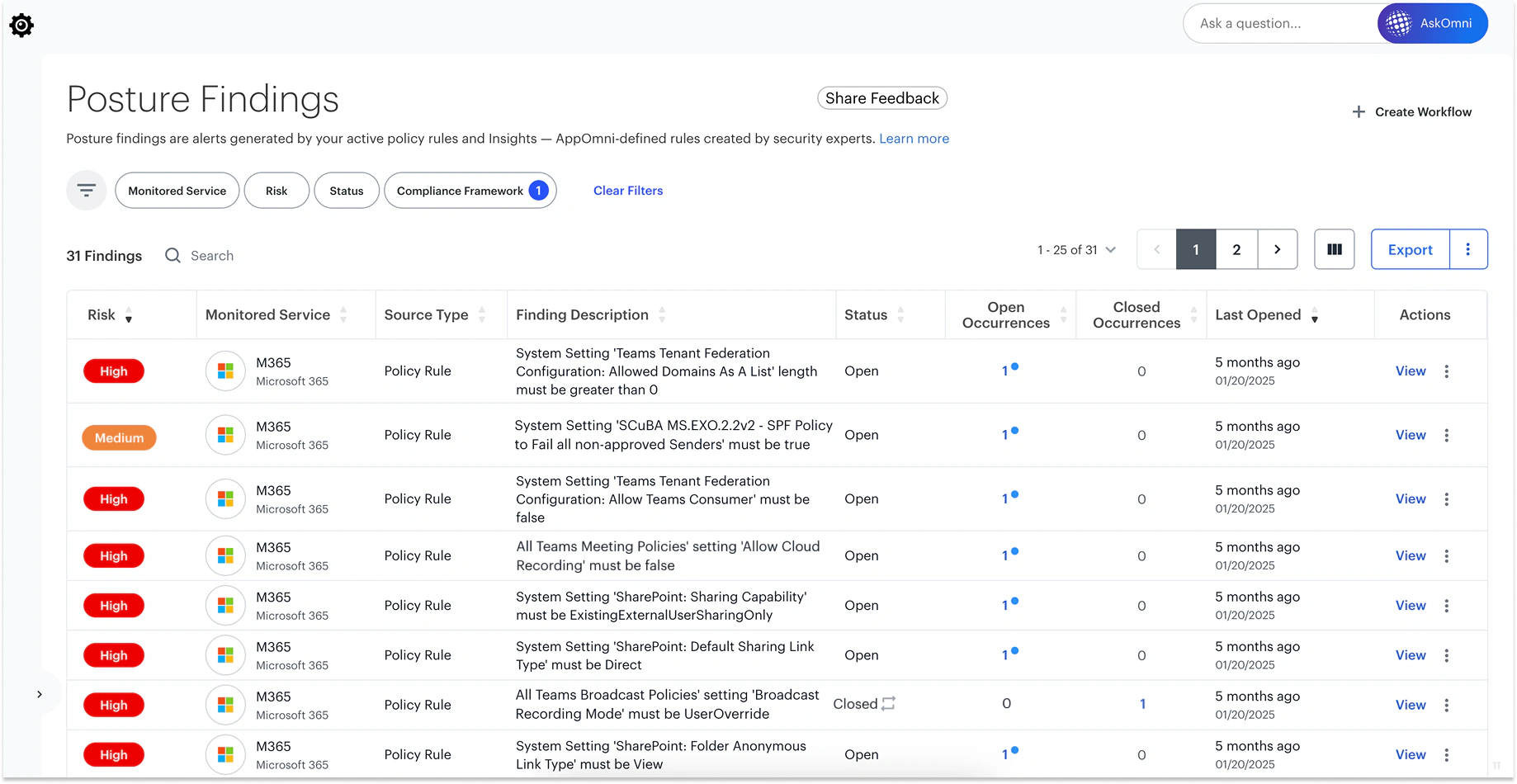
Posture management remains AppOmni’s core strength. The platform continuously checks SaaS configurations against secure baselines, vendor recommendations, internal policies, and compliance requirements. It can surface weak authentication settings, risky sharing rules, excessive administrative access, disabled controls, and other misconfigurations.
Configuration drift detection is especially important. SaaS platforms change frequently as administrators add integrations, modify roles, enable new modules, and respond to business requests. A secure setting established during an audit can become insecure weeks later without anyone noticing.
AppOmni tracks those changes and helps you distinguish between an accepted business decision and an unexpected deviation. Findings include context and remediation guidance, which reduces the need to search each vendor’s documentation before taking action.
3. Identity, Privilege, and Access Analysis
SaaS identities are difficult to manage because access is distributed across local accounts, federated identities, guest users, contractors, service accounts, API users, and non-human identities. AppOmni provides cross-application visibility into these identity types and highlights accounts that may be privileged, inactive, stale, or over-permissioned.
This complements an identity provider rather than replacing it. An IdP confirms authentication, while AppOmni examines what the identity can do inside each connected application.
The platform can help you enforce least privilege, review administrative access, identify dormant accounts, and understand how privileges changed over time. This is valuable during joiner, mover, and leaver processes, as well as during incident investigations involving a compromised account.
4. Third-Party and SaaS-to-SaaS Risk Management
Connected applications often create a hidden supply chain inside your SaaS environment. A third-party tool may read customer records, download documents, manage tickets, send email, or access employee information through API permissions.
AppOmni inventories those relationships and evaluates the permissions granted to each connection. Your team can identify over-scoped OAuth grants, unknown integrations, unused applications, and non-human identities that retain access after the original business purpose has disappeared.
Configuration security cannot be separated from integration security. A well-configured tenant can still be exposed by a trusted application with excessive access or a compromised vendor.
5. SaaS Threat Detection and Investigation
AppOmni analyzes SaaS activity, identities, permissions, and posture together to detect suspicious behavior. Examples include impossible travel, unusual access locations, token abuse, privilege escalation, abnormal automation, mass downloads, and activity involving risky integrations.
The platform normalizes logs from different SaaS services so your analysts do not have to learn a completely different event structure for every application. Detection rules can cover multiple platforms, and findings can be forwarded into SIEM, SOAR, XDR, IAM, and ticketing workflows.
This approach is stronger than sending raw SaaS logs directly to a SIEM without application context. AppOmni adds information about the user, permissions, configuration state, connected apps, and business risk, which can make alerts easier to prioritize.
6. Marlin AI and AskOmni
AppOmni uses two distinct AI experiences. Marlin AI is positioned as an autonomous investigation engine that correlates security signals, investigates relationships across SaaS telemetry, surfaces incidents, and provides guided remediation. AskOmni is a conversational assistant that lets you ask questions about the platform, findings, monitored services, identities, and threats.
AskOmni helps you explore the environment, while Marlin AI reduces the work required to correlate signals and build an investigation path.
You should still treat AI-generated summaries as decision support rather than unquestioned conclusions. The strongest use case is speeding up triage, explaining why a finding matters, and guiding an analyst toward the relevant identities, events, permissions, and remediation steps.
7. AI Application and Agent Security
AppOmni has expanded its coverage to AI-enabled SaaS applications and SaaS-native agents. Its Agent Inventory is designed to show which agents exist, what access they have, and where they interact with business data. AgentGuard adds runtime monitoring and response controls for risky AI behavior.
The platform states that AgentGuard can identify abnormal agent activity, enforce AI-specific policies, block malicious prompts, prevent sensitive data exposure, and quarantine risky human or non-human identities. These capabilities are most relevant to organizations deploying agents inside platforms such as ServiceNow or other enterprise SaaS ecosystems.
This area is developing quickly, so buyers should verify exactly which agents, applications, enforcement actions, and data protection controls are supported in the proposed package.
8. Compliance Monitoring and Reporting
AppOmni maps security findings to frameworks and standards such as SOC 2, ISO 27001, NIST, SOX, HIPAA, and other applicable baselines. It monitors for policy drift, highlights control violations, and generates reports that can support audit preparation.
The benefit is continuous evidence rather than a point-in-time screenshot exercise. Your team can review current posture, track 30-day, 60-day, and 90-day trends, and show how findings were identified and addressed.
AppOmni does not make your organization compliant by itself. It can, however, reduce the manual work involved in checking SaaS controls and demonstrate that your security program monitors those controls consistently.
9. Managed Services Through AppOmni Guard and Scout
Organizations without dedicated SaaS security specialists can add managed services. AppOmni Guard provides expert-led onboarding, implementation guidance, alert tuning, compliance alignment, and ongoing operational support. AppOmni Scout focuses on managed threat hunting across SaaS and AI applications.
These services can support a SOC with limited SaaS-specific expertise and accelerate deployment across environments with multiple application owners.
Pros and Cons
Advantages and Disadvantages
AppOmni offers broad, enterprise-focused SaaS security coverage, but it is not the simplest or most transparent option for every buyer. The main strengths come from depth and context, while the main limitations relate to deployment scope, pricing visibility, and the operational maturity needed to use the platform well.
Positive
✅ Deep coverage of critical enterprise SaaS apps
✅ Connects posture, identity, integrations, and threats
✅ Strong configuration drift and policy monitoring
✅ Useful remediation context and compliance mapping
✅ AI-assisted triage and autonomous investigation
✅ Agentless deployment with security-stack integrations
Negative
❌ Public pricing is not transparent
❌ Best suited to mature security teams and enterprises
❌ Coverage depth can vary by SaaS application
❌ Initial tuning and stakeholder coordination may take time
❌ Advanced AI and managed services may add cost
❌ Not a replacement for SIEM, IAM, EDR, or CASB
👍 AppOmni Pros
✅ Deep application-level visibility
AppOmni goes beyond confirming that an application exists. It examines configurations, users, privileges, integrations, data exposure, and application activity. This depth is particularly valuable for Salesforce, Microsoft 365, ServiceNow, Workday, and other systems that contain sensitive operational data.
✅ Strong risk context
The platform connects a finding to the affected identity, permission, integration, configuration, and relevant events. This helps your analysts understand why a finding matters instead of treating every misconfiguration as an isolated alert.
✅ Continuous posture and drift monitoring
AppOmni can identify when a SaaS setting deviates from an approved baseline. This supports a more sustainable security program than running occasional manual audits.
✅ Practical compliance support
Framework mappings, policy checks, trend reporting, and audit-ready evidence can reduce the administrative burden of demonstrating SaaS controls.
✅ Broad security workflow integration
AppOmni is designed to push findings and threat signals into SIEM, SOAR, XDR, IAM, and ticketing platforms. This allows your team to keep established investigation and remediation workflows.
✅ Forward-looking AI security
Marlin AI, AskOmni, Agent Inventory, and AgentGuard show that AppOmni is adapting to AI-enabled SaaS and non-human identities rather than limiting the platform to traditional configuration checks.
👎 AppOmni Cons
❌ No simple public price list
AppOmni uses quote-based enterprise pricing. You need a sales process to understand the cost for your user count, application mix, modules, support level, and managed services.
❌ More platform than some teams need
A smaller company that mainly wants a SaaS inventory or basic misconfiguration alerts may find AppOmni broader and more operationally demanding than necessary.
❌ Integration depth should be validated app by app
AppOmni supports many applications, but the available policies, event coverage, remediation actions, and identity context may not be identical across every connector. Buyers should test their most important applications during evaluation.
❌ Results still require ownership
The platform can prioritize and explain findings, but your organization still needs application owners, security analysts, and governance processes to approve and implement changes.
❌ Enterprise rollout requires coordination
Connecting major SaaS tenants can be quick, but building baselines, assigning ownership, tuning detections, and integrating remediation into business workflows can take longer.
❌ It complements rather than replaces existing controls
You will still need identity, endpoint, network, data protection, SIEM, and incident response capabilities. AppOmni fills the SaaS application layer rather than replacing the wider security stack.
Deployment and Daily Use
Setup and User Experience
AppOmni uses an agentless architecture. You connect supported SaaS tenants through approved API access rather than installing endpoint agents across employee devices. AppOmni states that major SaaS integrations can be connected quickly, but meaningful deployment includes more than establishing the API connection.
Your team should plan to define policy baselines, validate permissions, review initial findings, assign application owners, tune detections, and decide where alerts should be routed. Large environments may also need change-management processes because remediation can affect business workflows.
The interface centers on findings, risk prioritization, search, identity timelines, policies, and remediation guidance. AskOmni supports natural-language questions, while Marlin AI accelerates investigations.
However, ease of use depends on your objective. Running a report may be straightforward. Designing a mature SaaS security program across multiple application owners is still an organizational project, even with a strong platform.
Ecosystem Coverage
Supported Apps and Integrations
AppOmni provides deep out-of-the-box coverage for major enterprise platforms, including Salesforce, Microsoft 365, Google Workspace, ServiceNow, Workday, Slack, and Zoom. It also supports additional SaaS applications, custom apps, AI-enabled services, and connected third-party tools.
For security operations, AppOmni integrates with SIEM, SOAR, XDR, IAM, and ticketing tools. Public examples include integrations and partnerships involving Datadog, CrowdStrike, Okta, Cisco, and other enterprise security ecosystems.
Do not evaluate coverage by logo count alone. Confirm each connector’s configuration checks, identity context, events, detections, remediation actions, API limits, and update frequency.
Cost and Plan Structure
AppOmni Pricing and Packages
AppOmni does not publish a standard self-service price list. Pricing is provided through a custom quote and is likely influenced by the selected package, number and type of SaaS applications, user scale, required modules, support level, deployment complexity, and managed services.
The company publicly describes three maturity-based packages: Foundations, Advanced, and Enterprise.
| Package | Primary Focus | Best Fit |
| Foundations | SaaS visibility, shadow SaaS, shadow AI, connected apps, and access discovery | Teams establishing an initial SaaS security inventory and risk baseline |
| Advanced | Misconfiguration management, policy enforcement, secure baselines, and proactive posture improvement | Organizations building an operational SSPM program |
| Enterprise | Advanced customization, third-party risk controls, governance, and scaled security operations | Large or regulated organizations with complex SaaS estates |
Ask whether Marlin AI, AskOmni, Agent Inventory, AgentGuard, premium integrations, custom policies, data retention, AppOmni Guard, and AppOmni Scout are included or priced separately. You should also request clarity on implementation services, support response times, renewal increases, minimum contract value, and how pricing changes when you add applications.
Because there is no transparent public price, compare proposals using a three-year total cost rather than the first-year subscription alone. Include internal administration time, professional services, managed services, and any additional SIEM ingestion or workflow costs.
Security and Privacy
How Secure Is AppOmni?
AppOmni is a security platform that requires privileged API access to inspect customer SaaS environments, so its own security, privacy, and access controls should be part of your evaluation. The company maintains a Trust Center and publishes a Product Privacy Data Sheet describing how customer and personal data are processed.
AppOmni states that customer data remains customer-owned and is used to provide the contracted services. Its public materials reference privacy programs for GDPR, CCPA, and other applicable regulations. The company also publishes information about SOC 2, ISO 27001, FedRAMP, NIST-related controls, and other security or compliance programs.
The service-level agreement lists at least 99.00% monthly availability for the services portal, excluding specified maintenance and other exclusions. Support response commitments vary by standard and premium customer success plans.
Security Questions to Ask Before Deployment

- Data scope: Confirm exactly which configuration, identity, event, and content metadata AppOmni collects.
- API privileges: Review required permissions for every SaaS connector and apply least privilege where supported.
- Data residency: Verify the hosting region available for your organization and applicable sovereignty requirements.
- Retention: Confirm log, finding, and investigation retention periods for your selected package.
- AI processing: Ask how customer data is used by AskOmni, Marlin AI, and other AI features.
- Incident response: Review breach notification, support escalation, backup, and recovery commitments.
AppOmni appears suitable for enterprise evaluation, but you should confirm current certification scope and obtain the relevant audit reports through the Trust Center before procurement.
Who It Is Best For
Where AppOmni Adds the Most Value
AppOmni is best suited to organizations where SaaS applications hold sensitive customer, employee, financial, operational, or regulated data. It becomes more valuable as the number of identities, integrations, application owners, and compliance obligations increases.
- Large enterprises can use AppOmni to standardize SaaS security across multiple business units and critical applications.
- Regulated organizations can benefit from continuous control monitoring, framework mapping, and audit evidence.
- Security operations teams can add SaaS-specific context to SIEM and incident response workflows.
- Salesforce, Microsoft 365, ServiceNow, and Workday-heavy environments can gain deeper application visibility than general-purpose cloud tools provide.
- Organizations adopting AI agents can evaluate inventory, runtime monitoring, prompt controls, and non-human identity governance.
AppOmni may be less suitable for a small business with a limited SaaS stack, no dedicated security team, or a requirement for simple public pricing. In that case, a lighter discovery or posture platform may deliver faster value with less operational overhead.
Alternatives
SSPM and SaaS Security Competitors
Adaptive Shield
Adaptive Shield is a strong alternative when your priority is broad SaaS posture management, configuration monitoring, identity visibility, and compliance across many applications. It is often a good fit for teams that want a dedicated SSPM experience with extensive application coverage. Read our Adaptive Shield review for a closer look at its strengths and limitations.
Grip Security
Grip Security is particularly compelling when shadow SaaS discovery, unfederated identities, SaaS account lifecycle management, and identity-centered governance are the main problems. It may be a better fit than AppOmni when you need to find and control a very large long tail of unmanaged applications. Read our Grip Security review for more detail.
Obsidian Security
Obsidian Security combines SSPM with SaaS identity threat detection, integration risk, and AI security. It is a strong alternative for enterprises that prioritize identity-linked investigation and threat response across SaaS applications.
Reco
Reco combines application discovery, posture management, identity governance, threat detection, and AI security. It is worth comparing when you want broad application coverage and a knowledge-graph approach to connecting users, applications, permissions, and risk.
The right choice depends on your primary security gap. AppOmni is strongest when you need deep control of mission-critical SaaS applications and want posture, threats, identity, integrations, compliance, and AI security in one enterprise platform. Grip Security is especially strong for the unmanaged long tail, Adaptive Shield for broad SSPM operations, and Obsidian for identity-centric SaaS threat defense.
Conclusion
Is AppOmni Worth It?
AppOmni is worth considering when SaaS applications are part of your critical attack surface and native administration tools no longer provide enough centralized visibility. Its strongest advantage is the way it connects configuration posture, identities, third-party applications, threat activity, compliance, and remediation context.
The platform is not the cheapest or simplest route into SaaS security, and its public pricing lacks transparency. It also requires internal ownership to turn findings into durable controls. However, for a large or regulated organization with sensitive SaaS data, AppOmni can fill an important gap between IAM, CASB, SIEM, EDR, and application administration.
Before committing, run a proof of value using your most important SaaS tenants. Measure connector depth, false positives, time to investigate, remediation effort, compliance reporting, and the quality of AI-generated guidance. That test will show whether AppOmni delivers meaningful risk reduction in your environment rather than simply adding another dashboard.
Have more questions?
Frequently Asked Questions
What is AppOmni used for?
AppOmni is used to secure enterprise SaaS applications. It discovers connected apps, identifies misconfigurations, reviews users and permissions, detects suspicious activity, monitors compliance, and provides remediation guidance across supported SaaS platforms.
Is AppOmni an SSPM platform?
Yes. AppOmni is a SaaS Security Posture Management platform, but its capabilities extend beyond posture management to SaaS discovery, identity analysis, threat detection, third-party app risk, compliance, AI security, and managed services.
Which applications does AppOmni support?
AppOmni supports major enterprise applications such as Salesforce, Microsoft 365, Google Workspace, ServiceNow, Workday, Slack, and Zoom, plus additional SaaS, custom, third-party, and AI-enabled applications. Connector depth should be confirmed for each critical platform.
How much does AppOmni cost?
AppOmni does not publish standard list pricing. It provides custom quotes based on package, application coverage, users, modules, support, implementation needs, and managed services. Buyers should request a detailed three-year cost proposal.
Does AppOmni require an agent?
No endpoint agent is required for its core SaaS monitoring. AppOmni uses API-based integrations to connect with supported SaaS applications and provide centralized posture, identity, integration, compliance, and threat visibility.
Does AppOmni replace a SIEM or IAM platform?
No. AppOmni complements SIEM, SOAR, XDR, IAM, CASB, EDR, and ticketing tools. It adds SaaS-specific application context and forwards prioritized findings into the wider security workflow.
What is Marlin AI in AppOmni?
Marlin AI is AppOmni’s autonomous SaaS security investigation engine. It correlates signals, investigates relationships across SaaS telemetry, surfaces incidents, and provides guided remediation intended to reduce investigation and response time.
What is AskOmni?
AskOmni is an AI-powered assistant inside AppOmni. You can use natural-language questions to explore findings, identities, monitored services, platform functions, and security issues, then receive contextual guidance and recommended next steps.
Is AppOmni suitable for small businesses?
AppOmni can support smaller organizations, but it is primarily positioned for enterprises and regulated teams with critical SaaS applications. Small businesses with limited SaaS risk may prefer a simpler, lower-cost discovery or SSPM tool.
What are the best AppOmni alternatives?
Leading AppOmni alternatives include Adaptive Shield for broad SSPM, Grip Security for shadow SaaS and identity governance, Obsidian Security for identity-centered SaaS threat defense, and Reco for unified application, identity, posture, and AI security.