Introduction
Reco is a SaaS and AI security platform designed to help you discover applications, map identities and permissions, monitor configuration posture, detect threats, govern data exposure, and understand what AI agents can access across your environment.
That description places Reco in a wider category than a conventional SaaS Security Posture Management platform. SSPM remains an important part of the product, but Reco also covers application discovery, identity governance, SaaS threat detection, non-human identities, shadow AI, and agent security. The platform is therefore most relevant when your risk is spread across many interconnected SaaS tools rather than contained inside a few centrally managed applications.
This Reco review 2026 examines how the platform works, where its AI-native approach adds real value, what limitations buyers should test, how pricing is structured, and how Reco compares with AppOmni, Grip Security, and Push Security.
What Is Reco?
Reco is an enterprise security platform for managing the SaaS and AI application layer. It connects to business applications through APIs, analyzes identities, permissions, configurations, integrations, activity, and data relationships, then places that information into a contextual security graph.
In practical terms, Reco helps your security team answer questions that are difficult to resolve through separate SaaS admin consoles:
- Which approved, shadow, and AI applications are in use?
- Which users, service accounts, integrations, and agents can access sensitive systems?
- Which SaaS configurations have drifted from a secure baseline?
- Which permissions create excessive access or toxic combinations?
- Which behaviors may indicate account compromise, privilege abuse, or data theft?
Feature Review
Core Reco Capabilities
1. Application, Shadow SaaS, and Shadow AI Discovery
Reco continuously discovers approved applications, unsanctioned SaaS, embedded AI functions, generative AI tools, SaaS-to-SaaS connections, OAuth applications, and autonomous agents. This gives you a broader inventory than a list built only from SSO, procurement, or expense data.
The important part is the relationship mapping. Reco connects each application to its users, identities, integrations, permissions, and data access. That makes discovery actionable. Instead of simply learning that a new AI service exists, you can assess who authorized it, which scopes it received, what systems it connects to, and whether the business has assigned an owner.
2. Reco Factory and Rapid Integration Coverage
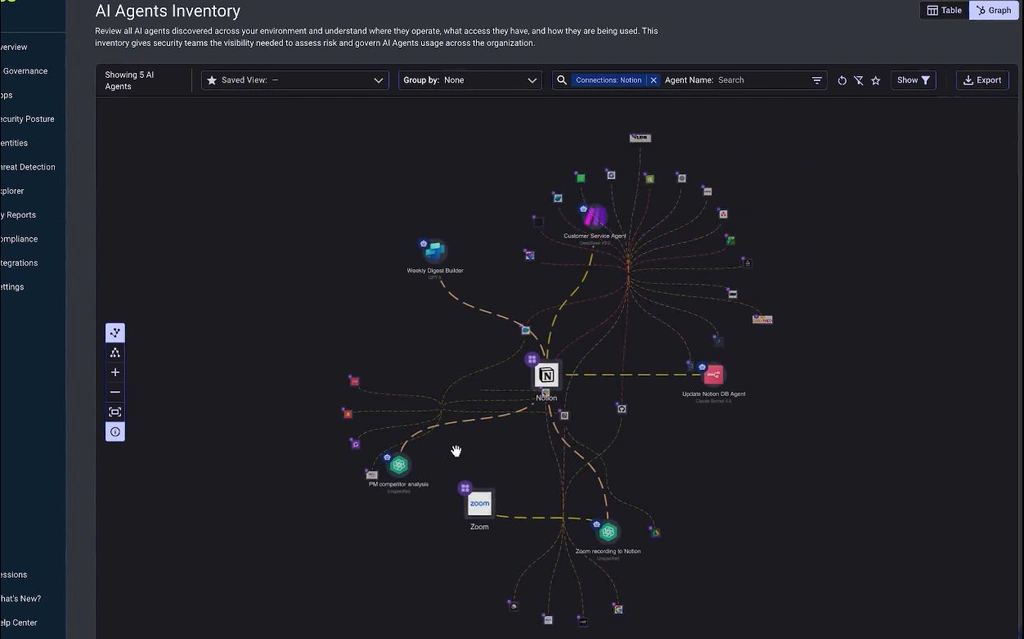
One of Reco’s clearest differentiators is its no-code and low-code integration engine, previously called the SaaS App Factory and now presented as Reco Factory. The company states that it supports more than 260 applications and can add new integrations in days rather than quarters.
During a proof of value, test the depth of each connector rather than accepting the total integration count. Confirm whether the connector supports posture checks, identities, permissions, activity, data relationships, threat detection, and remediation, because coverage may vary by application and API availability.
3. Identity Access Governance
Reco maps human and non-human identities across SaaS applications so you can review access at a cross-application level. It can highlight privileged users, stale accounts, former employees, external collaborators, service accounts, and identities with excessive permissions.
This is useful for joiner, mover, and leaver processes because SaaS access frequently survives outside the central identity provider. A contractor may retain a local account, an integration may keep a long-lived token, or a former administrator may remain connected through a secondary tenant.
4. SaaS Posture Management and Compliance
Reco continuously evaluates SaaS configurations for weak settings, missing controls, unsafe sharing, excessive privileges, and configuration drift. Findings can be mapped to frameworks such as SOC 2, ISO 27001, NIST, and other standards supported by the platform.
Continuous monitoring is more useful than a point-in-time assessment because SaaS settings change frequently. Administrators enable features, vendors update defaults, integrations request new scopes, and business teams adjust sharing rules. Reco helps you detect when those changes move the environment away from the approved baseline.
5. Identity Threat Detection and Response
Reco’s ITDR capability monitors identity and application behavior for signs of compromise, privilege abuse, insider activity, and suspicious access. It combines behavioral signals with information about the user’s role, permissions, connected applications, and potential impact.
The platform’s AI alert intelligence is intended to turn separate alerts into a coherent investigation story. This can help analysts understand what changed, which identities and applications are involved, what data may be exposed, and which response steps should be considered.
6. Data Exposure Management
Reco evaluates how data may be exposed through permissions, external sharing, integrations, identities, and application relationships. This is different from a full DSPM platform that discovers and classifies data across cloud storage, databases, and infrastructure.
Reco is most useful when the question is how SaaS access creates exposure. For example, it can help identify a sensitive application connected to a third-party service, a user with excessive sharing privileges, or an agent that can reach information beyond its business purpose.
7. AI Governance and AI Agent Security
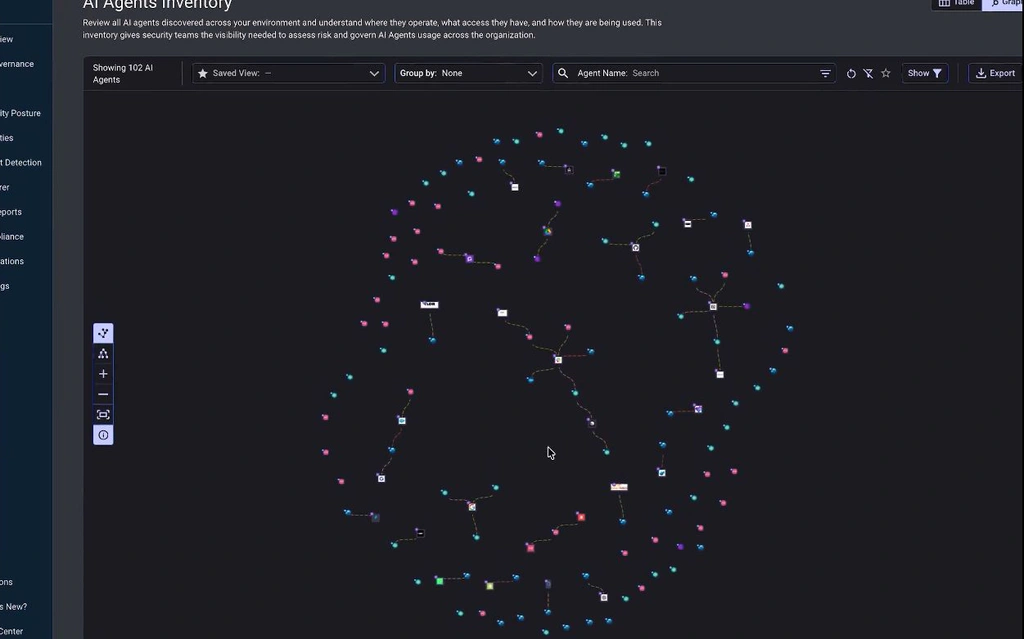
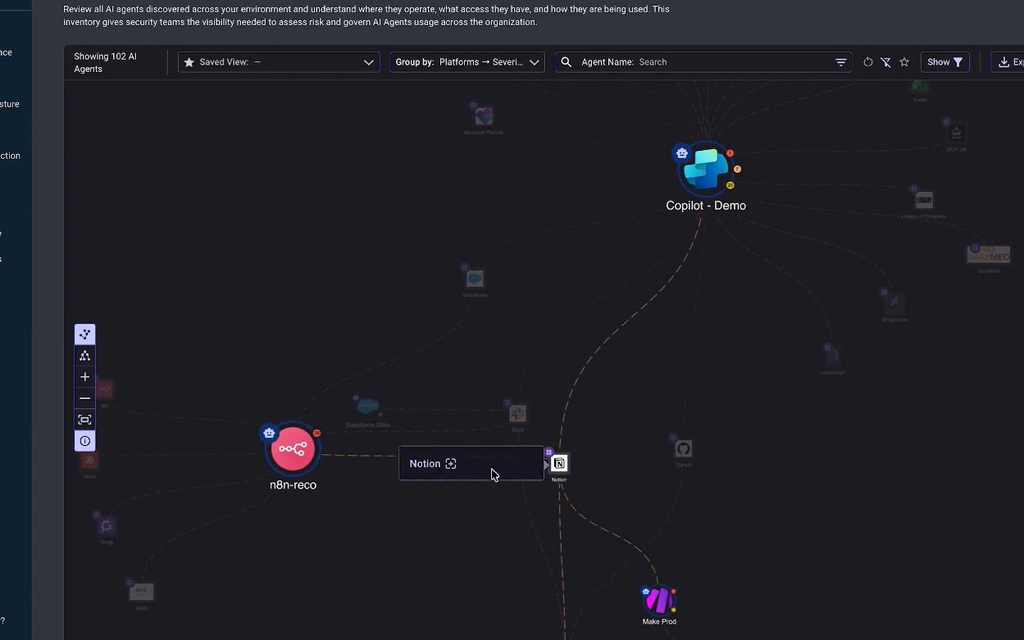
Reco has expanded beyond shadow AI discovery into dedicated AI agent security. It can identify agents across platforms such as Microsoft Copilot, ChatGPT, Claude, Salesforce Agentforce, Make, n8n, and custom integrations, then map what each agent can access.
Reco’s permission mapping and risk scoring can help you identify agents with excessive access, exposed credentials, unsafe vendor connections, or unclear ownership. The platform is strongest when security, IT, legal, and business teams use that context to approve, restrict, monitor, or retire agents based on policy.
8. Agentic Security Posture Management
Reco also uses its own AI agents to support security operations. These agents can summarize alert stories, add identity context, recommend remediation plans, and help analysts move from a finding to an actionable response.
This can reduce repetitive investigation work, but buyers should validate every efficiency claim in their own environment. Measure false-positive reduction, investigation time, evidence quality, analyst overrides, and the percentage of recommended actions that are safe enough to automate.
Pros and Cons
Advantages and Disadvantages
Reco offers unusually broad coverage across SaaS posture, identity, application discovery, data exposure, threats, and AI agents. Its main limitations are pricing transparency, enterprise complexity, and the need to validate connector depth and automation carefully.
Positive
✅ Covers the full SaaS security lifecycle
✅ Strong application and AI discovery
✅ Rapid support for long-tail applications
✅ Connects identity, posture, data, and behavior
✅ Dedicated AI agent security capabilities
✅ API-based deployment and workflow integrations
Negative
❌ No transparent public pricing
❌ Connector depth may vary by application
❌ Broad scope can overlap existing tools
❌ Requires privileged SaaS API access
❌ Best results require mature governance
❌ AI automation claims need local validation
👍 Pros
✅ Covers the full SaaS security lifecycle
Reco combines discovery, posture, identity governance, threat detection, data exposure, compliance, and AI security in one platform. This reduces the need to correlate separate dashboards before understanding a SaaS risk.
✅ Strong application and AI discovery
The platform is designed to identify managed SaaS, shadow SaaS, OAuth applications, embedded AI, generative AI tools, and autonomous agents. Relationship mapping makes the inventory more useful than a simple application list.
✅ Rapid support for long-tail applications
Reco Factory can be valuable when your organization depends on specialist SaaS products that established vendors do not support deeply. Fast connector development can shorten the period in which a critical app remains outside security monitoring.
✅ Connects identity, posture, data, and behavior
The Knowledge Graph approach helps Reco prioritize findings according to business context. This is more useful than treating every weak configuration or unusual event as equally important.
✅ Dedicated AI agent security capabilities
Reco is moving beyond generic shadow AI discovery. Inventory, permission mapping, risk scoring, and agent relationships address a growing governance gap created by non-human identities and autonomous workflows.
👎 Cons
❌ No transparent public pricing
Reco does not publish standard package prices, which makes early budgeting and vendor comparison difficult. You need a tailored proposal before you can evaluate total cost.
❌ Connector depth may vary by application
A high integration count does not guarantee identical capabilities across every connector. Some applications expose richer APIs than others, so posture, event, identity, and remediation coverage should be tested individually.
❌ Broad scope can overlap existing tools
Organizations with mature SSPM, ITDR, DSPM, CASB, SIEM, and identity governance platforms may see functional overlap. Reco must demonstrate better context or lower operational effort, not simply another dashboard.
❌ Requires privileged SaaS API access
Reco needs access to application metadata and security information. Buyers should review connector scopes, service accounts, token storage, support access, and the effect of a Reco account compromise.
❌ Best results require mature governance
The platform can identify owners, access gaps, and risky configurations, but your organization still needs people who can approve changes, handle exceptions, and complete remediation across business teams.
User Experience
Deployment and Daily Operations
Initial Deployment and Connector Setup
Reco states that deployment can begin within 24 hours for supported applications. Core onboarding generally involves connecting priority SaaS tenants, granting read-oriented API permissions, importing identity and configuration metadata, and allowing the platform to build its relationship graph.
A fast technical connection does not mean the full security program is complete. Your team still needs to define critical applications, owners, risk thresholds, compliance frameworks, ticket routing, approved AI use, and response authority.
A sensible rollout begins with three to five business-critical applications, the identity provider, and one SIEM or ticketing workflow. This creates enough context to evaluate prioritization without overwhelming the team with every finding from the full SaaS estate.
Daily Investigation Workflow
Reco’s central value is the ability to move from a risk summary into the identities, permissions, applications, and events behind it. Analysts can use contextual relationships to understand blast radius and decide whether an issue is a configuration problem, access governance gap, suspicious behavior, or agent risk.
Automation and Remediation
Reco can connect findings to remediation plans, ticketing, SIEM, SOAR, and application workflows. Automation should be introduced gradually. Start with evidence collection and ticket creation, then move to low-risk actions such as disabling dormant access or revoking clearly unused connections.
Security Ecosystem
Application Coverage and Integrations
Reco publicly highlights more than 260 supported applications. Major integrations include Google Workspace, Microsoft 365, Salesforce, ServiceNow, Workday, Slack, Okta, Veeva, and SentinelOne. The platform also connects with security operations tools for alerting, response, and workflow management.
| Integration Area | Examples | What to Validate |
| Productivity and collaboration | Microsoft 365, Google Workspace, Slack | Sharing, identities, activity, posture, and data exposure |
| Business-critical SaaS | Salesforce, ServiceNow, Workday, Veeva | Configuration depth, custom roles, logs, and remediation |
| Identity and security | Okta, SentinelOne, SIEM and SOAR tools | Signal flow, response actions, and duplicate alerts |
| AI and agent platforms | ChatGPT, Claude, Copilot, Agentforce, Make, n8n | Agent inventory, permissions, credentials, ownership, and actions |
| Long-tail applications | Industry-specific and customer-requested apps | Connector delivery time and feature parity |
Integration breadth is one of Reco’s strongest selling points, but buyers should create a connector scorecard. List each critical application and grade discovery, identities, posture, event telemetry, data context, threat detections, compliance mapping, and remediation separately.
Pricing
How Much Does Reco Cost?
Reco does not publish standard list pricing. The website directs buyers to request a demo and custom proposal, while software directories list pricing as contact-the-vendor.
The final quote is likely to depend on the number of users, applications, modules, environments, data retention, support level, implementation services, and custom connector requirements. Buyers should request a three-year cost model rather than comparing only the first-year subscription.
Questions to Ask in a Reco Pricing Proposal
- Is pricing based on employees, identities, applications, tenants, or modules?
- Are AI agent security, ITDR, and data exposure included or sold separately?
- Are custom integrations included, capped, or charged as professional services?
- What retention, support, onboarding, and success services are included?
- Does the price increase when new agents, SaaS tenants, or business units are added?
Security and Privacy
How Secure Is Reco?
Reco is a security platform with access to sensitive application metadata, so its own security controls require close review. The Reco Trust Center lists SOC 2 Type 2, ISO/IEC 27001:2022, ISO/IEC 42001:2023, GDPR, CSA STAR Level 1, and EU AI Act materials, along with reports, architecture documents, subprocessors, and security documentation.
The platform’s API-based model can reduce endpoint deployment friction, but it creates a concentrated access relationship. Your procurement and security review should confirm exactly which scopes are requested, where metadata is stored, how tokens are protected, and how Reco personnel access customer environments for support.
Security Questions to Ask Before Deployment
- API permissions: Which permissions are mandatory for each connector, and can write access be avoided?
- Data scope: Does Reco collect content, metadata, event logs, prompts, or only security configuration information?
- AI processing: Is customer data used to train models, and which subprocessors support AI features?
- Residency and retention: Which regions and deletion controls are available?
- Administration: Are SSO, MFA, RBAC, audit logs, and support-access controls available?
- Resilience: What are the uptime, backup, disaster recovery, and incident notification commitments?
Reco’s published security program is suitable for enterprise due diligence, but certification scope and current audit reports should always be verified directly through the Trust Center.
Who It’s Best For
Where Reco Adds the Most Value
| Organization Type | Fit | Why |
| Large SaaS-heavy enterprise | Excellent | Broad applications, identities, integrations, and agent relationships need central context |
| Regulated organization | Excellent | Continuous posture, access governance, evidence, and policy mapping support audits |
| Company adopting AI agents | Excellent | Agent discovery, permission mapping, ownership, and risk scoring address a new control gap |
| Lean security team with many SaaS apps | Strong | AI-assisted investigation and unified findings can reduce manual correlation |
| Small company with a limited SaaS stack | Moderate | The platform may be broader and more costly than the risk requires |
| Organization seeking network or endpoint protection | Poor | Reco does not replace SASE, firewall, EDR, or malware protection |
Reco is especially compelling when your organization has many applications outside SSO, a growing number of AI agents, fragmented application ownership, and a security team that spends too much time correlating identity, posture, and activity manually.
Compare with Others
Reco Alternatives
AppOmni
AppOmni is one of the strongest alternatives when deep posture management, configuration analysis, connected-app risk, and threat detection across major enterprise SaaS platforms are the priority.
Choose Reco when rapid long-tail app coverage, unified identity context, and AI agent security are central requirements. Choose AppOmni when your evaluation prioritizes mature SSPM depth inside business-critical SaaS. Read our AppOmni review for a full analysis.
Grip Security
Grip Security is a strong alternative for identity-driven SaaS discovery, shadow applications, user-created accounts, OAuth governance, lifecycle controls, and browser-assisted visibility.
Choose Grip when unmanaged identities, shadow SaaS, and user access governance are the main problem. Choose Reco when you want broader posture, threat, data, application, and agent context in one graph. See our Grip Security review.
Push Security
Push Security focuses on browser-based identity attacks, phishing, session compromise, credential risks, shadow SaaS, malicious extensions, and policy enforcement at the point of user activity.
Choose Push Security when the browser is your highest-priority control point. Choose Reco when you need deeper API-based visibility into SaaS configurations, permissions, integrations, data exposure, and AI agents. Read our Push Security review.
Which Reco Alternative Is Best?
Reco is the most balanced choice of these options when your goal is to connect a broad SaaS inventory with identity governance, posture, threats, data exposure, and agent security. AppOmni is stronger for deep SSPM, Grip is especially compelling for shadow SaaS and identity governance, and Push Security is the clearest choice for browser-native prevention.
Conclusion
Is Reco Worth It?
Reco is worth serious consideration if your SaaS environment has become too dynamic for separate application consoles, periodic access reviews, and static posture checks. Its strongest advantage is not one isolated feature. It is the ability to connect applications, users, non-human identities, permissions, configurations, data relationships, activity, and AI agents into a shared security context.
The Reco Factory also addresses a practical enterprise problem: the long tail of important applications that established security vendors may not support quickly. Combined with AI agent discovery and permission mapping, this makes Reco particularly relevant for organizations scaling AI adoption across SaaS.
However, Reco is not a simple or transparent purchase. Pricing is quote-based, connector depth must be validated, and the broad platform may overlap tools already in your stack. The best buying process is a proof of value across your most critical and least-supported applications.
Measure how quickly Reco connects, how accurately it prioritizes risk, whether analysts can verify AI-generated conclusions, how much remediation reaches completion, and whether the platform reduces investigation and audit effort. If it improves those outcomes without creating excessive duplication, Reco can become a valuable control layer for SaaS and AI security.
Frequently Asked Questions
Have more questions?
What is Reco used for?
Reco is used to discover and secure SaaS applications, identities, permissions, integrations, configurations, data exposure, threats, AI tools, and autonomous agents. It gives security teams cross-application context and supports governance, investigation, compliance, and remediation.
Is Reco an SSPM platform?
Yes. Reco includes SaaS Security Posture Management, but it is broader than a traditional SSPM. It also covers application discovery, identity access governance, ITDR, data exposure management, AI governance, and AI agent security.
How does Reco discover shadow SaaS and shadow AI?
Reco analyzes application connections, identities, OAuth relationships, SaaS activity, and other available signals to discover approved and unmanaged applications. It can also identify embedded AI features, generative AI tools, and agents connected to enterprise SaaS data.
Does Reco require an endpoint agent?
Reco’s core SaaS monitoring is API-based and does not depend on a traditional endpoint agent. It connects to supported applications and security tools to collect configuration, identity, access, integration, and activity context.
How many applications does Reco support?
Reco states that it supports more than 260 SaaS applications. Its Reco Factory is designed to add support for requested applications quickly, but buyers should confirm the exact feature depth available for every critical connector.
Can Reco secure AI agents?
Yes. Reco can discover AI agents, map their identities and permissions, show which applications and data they can access, identify risky connections, and help teams govern excessive access, exposed credentials, and unclear ownership.
How much does Reco cost?
Reco does not publish standard list pricing. Pricing is customized and may depend on users, applications, modules, environments, support, retention, and integration requirements. Request a detailed multi-year proposal before comparing it with alternatives.
Does Reco replace SIEM, IAM, CASB, or EDR?
No. Reco complements these tools by adding SaaS-specific application, identity, permission, posture, data, and agent context. It can forward findings into existing security operations workflows but does not replace network, endpoint, or identity infrastructure.
Is Reco suitable for small businesses?
Reco is most suitable for mid-market and enterprise organizations with a large or complex SaaS estate. A small business with few applications and limited security resources may prefer a simpler SaaS discovery or posture management product.
What are the best Reco alternatives?
Strong Reco alternatives include AppOmni for deep SSPM and configuration security, Grip Security for shadow SaaS and identity governance, and Push Security for browser-native identity attack prevention and SaaS visibility.