Introduction
Cisco Secure Firewall is an enterprise security platform for consistent inspection and policy enforcement across branches, campuses, data centers, and clouds. It combines stateful firewalling with application control, intrusion prevention, encrypted traffic analysis, malware defense, URL filtering, VPN, segmentation, and centralized management.
It is a broad portfolio rather than one appliance. You can deploy branch hardware, high-throughput data center systems, or virtual firewalls, then manage them through Firewall Management Center, Firewall Device Manager, or Cisco Security Cloud Control. This flexibility also makes selection and licensing more complex.
This review examines the decisions that matter before you buy, including software, threat prevention, encrypted traffic, management, sizing, and total cost.
What Is Cisco Secure Firewall?
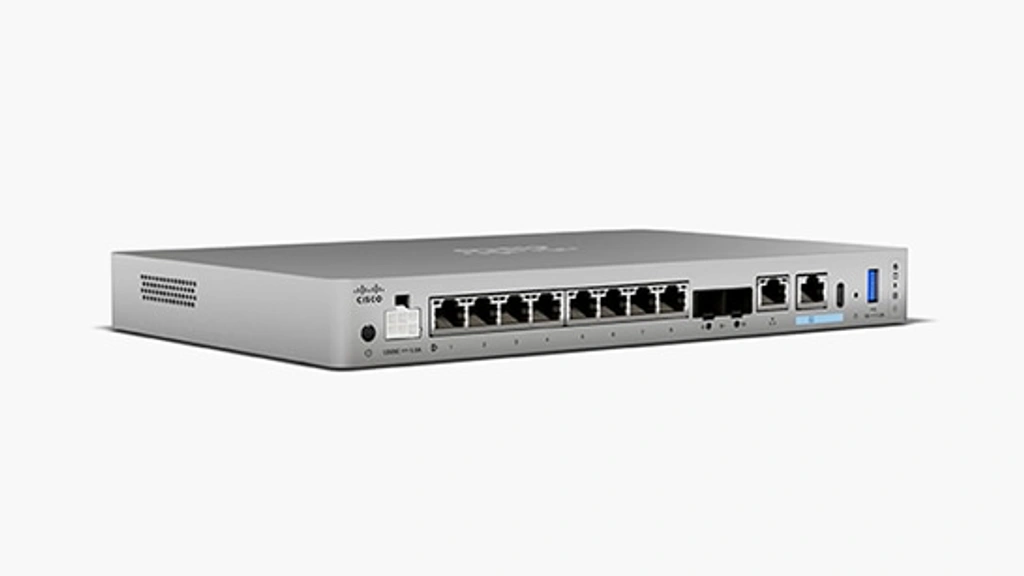
Cisco Secure Firewall is Cisco’s family of physical and virtual firewalls. Current appliance families include the compact Secure Firewall 200 and 1200 Series for branches, the 3100 Series for enterprise edge and campus use, the 4200 Series for large enterprises and data centers, and the 6100 Series for ultra-high-throughput data center and service provider environments. Cisco also continues to support older Firepower families in many deployments.
Most buyers should distinguish between two software paths. Firewall Threat Defense, or FTD, provides Snort 3 intrusion prevention, application visibility, URL filtering, malware defense, and centralized analytics. Adaptive Security Appliance, or ASA, prioritizes mature stateful firewall and VPN functions and can deliver higher raw throughput in some configurations.
FTD is the logical default for a new security-focused deployment. ASA remains relevant for compatibility, established ASA operations, or stateful firewall and VPN use cases that do not need the complete FTD stack.
Feature Analysis
Core Cisco Secure Firewall Capabilities
Cisco Secure Firewall covers the expected next-generation firewall functions, but its real advantage is the combination of threat intelligence, inspection, identity context, and deployment breadth. The following capabilities have the greatest impact on security outcomes and day-to-day operations.
1. Snort 3 Intrusion Prevention and Talos Intelligence
Snort 3 is the core inspection engine in Firewall Threat Defense. It analyzes network traffic for exploits, protocol anomalies, malicious patterns, and other attack indicators. Cisco provides system intrusion policies for common protection levels, while advanced teams can create custom rules and network analysis policies for specialized applications or risk profiles.
Cisco Talos supplies reputation feeds, URL categories, malware analysis, and official Snort rules, creating a continuously updated protection layer.
The benefit is faster blocking of malicious infrastructure and better coverage for new vulnerabilities. The trade-off is tuning, since broad IPS policies can create noise or affect applications.
2. Encrypted Traffic Visibility and Selective Decryption
Encrypted traffic creates a difficult choice for firewall teams. Full TLS decryption improves inspection but can increase processing demands, introduce certificate issues, and raise privacy concerns. Cisco’s Encrypted Visibility Engine, or EVE, analyzes traffic characteristics and metadata to identify applications and suspicious behavior without decrypting every connection.
EVE is not a substitute for decryption. You still need selective TLS inspection for high-risk destinations, file transfers, and traffic requiring content analysis. It does, however, help prioritize which TLS 1.3 and QUIC sessions justify deeper inspection.
This supports a risk-based decryption policy instead of treating every encrypted flow alike.
3. Application Control, Identity, and Segmentation
Firewall rules can use application, user, device, URL, network, and security intelligence context rather than relying only on ports and IP addresses. This is important because many cloud services share common ports, and users can access the same application from multiple devices or locations.
Cisco Identity Services Engine can add user and device context to policy decisions. Security Group Tags and dynamic objects support segmentation without a separate rule for every address.
The value depends on reliable directories, network access controls, and naming standards. Poor identity hygiene can create confusing policy matches.
4. VPN, SD-WAN, and Secure Branch Connectivity
Cisco Secure Firewall supports site-to-site IPsec VPN and remote access through Cisco Secure Client. You can apply firewall and threat policies to traffic entering from remote users or partner networks, then monitor sessions centrally. High-end models provide substantial VPN capacity, while branch appliances are sized for smaller site and remote-access requirements.
Native SD-WAN policies can select paths using application requirements and link conditions such as latency, jitter, or packet loss. This may reduce the need for separate branch routing hardware.
Secure Firewall SD-WAN and Cisco Catalyst SD-WAN are not automatically interchangeable. Complex routing, voice, segmentation, or orchestration may still favor dedicated SD-WAN.
5. Physical, Virtual, and Multicloud Deployment
The hardware range covers small branches through carrier-scale environments. The 220 and 1200 Series target branches, the 3100 serves enterprise edge and campus use, and the 4200 and 6100 Series address high-throughput data centers and service providers.
Threat Defense Virtual supports major public clouds and private-cloud hypervisors. Cisco documents deployment across AWS, Microsoft Azure, Google Cloud, Oracle Cloud Infrastructure, Alibaba Cloud, VMware, KVM, OpenStack, Nutanix, and Hyper-V, although management, autoscaling, clustering, and pay-as-you-go availability vary by platform.
This portability helps you reuse policy concepts across environments, but cloud deployment is not identical to installing a physical appliance. Route design, load balancers, availability zones, cloud-native logging, and traffic inspection costs must be included in the architecture.
6. Firewall Management Center and Security Cloud Control
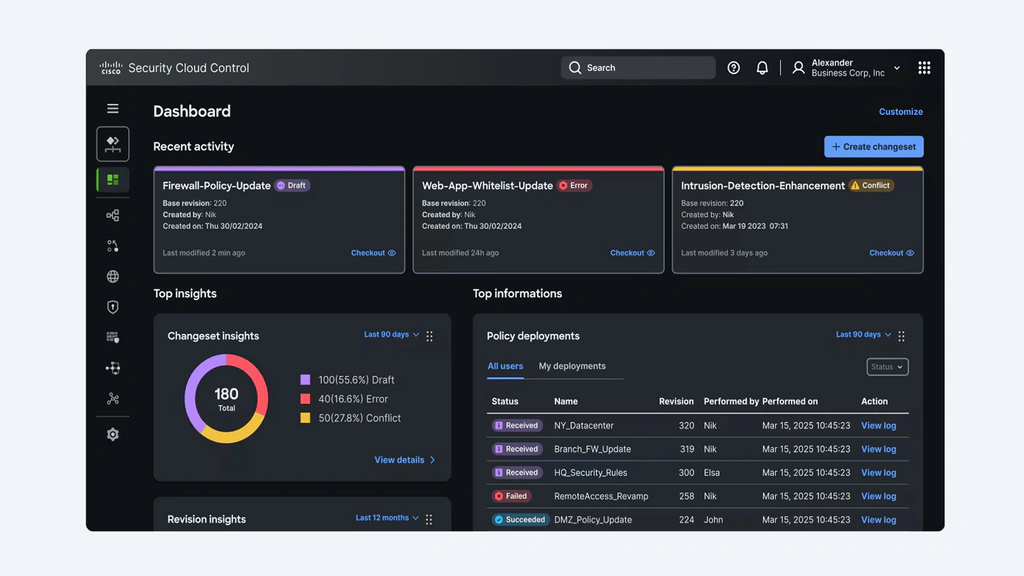
Firewall Management Center, or FMC, remains the deepest management option for FTD. It centralizes access control, intrusion policies, URL filtering, malware defense, events, correlation, reporting, upgrades, and device configuration. FMC is available as physical, virtual, public-cloud, and cloud-delivered form factors.
Firewall Device Manager is the on-box interface included with supported FTD appliances. It is useful for a small deployment or an isolated site, but it does not provide the same multi-device scale and workflow depth as FMC.
Cisco Security Cloud Control adds cloud inventory, shared objects, change tracking, templates, logging, and policy optimization. Cisco is bringing these capabilities into the broader Cisco Cloud Control experience. Confirm feature support for your device type and software version.
Which Cisco Secure Firewall Model Fits Your Environment?
Model selection should start with inspected throughput, TLS decryption, VPN capacity, connection rates, interfaces, high availability, and expected growth. Do not size a firewall from headline stateful throughput alone.
| Deployment Need | Suggested Family | Why It Fits |
| Small or cost-sensitive branch | Secure Firewall 200 Series | Compact form factor, integrated SD-WAN, and entry-level NGFW performance |
| Distributed branch or regional office | Secure Firewall 1200 Series | Broader performance range, desktop and 1U options, plus branch-focused connectivity |
| Enterprise internet edge or campus | Secure Firewall 3100 Series | Higher inspected throughput, clustering options, and flexible interfaces |
| Large enterprise or data center | Secure Firewall 4200 Series | High NGFW and TLS performance, modular interfaces, and up to 16-node clustering |
| AI-scale data center or service provider | Secure Firewall 6100 Series | Ultra-high throughput, 400G connectivity options, and carrier-grade scale |
| Public or private cloud | Threat Defense Virtual | Portable virtual deployment with performance-tier licensing and cloud orchestration options |
Pros and Cons
Advantages and Limitations
Cisco Secure Firewall is powerful and highly scalable, especially when it can use identity, networking, and threat intelligence from the wider Cisco ecosystem. Its main weaknesses are operational complexity, licensing depth, and the planning required for upgrades and policy deployment.
Positive
✅ Strong Snort 3 and Talos threat intelligence
✅ Excellent physical and virtual deployment coverage
✅ Useful encrypted traffic visibility
✅ Deep Cisco identity and networking integrations
✅ Flexible local, centralized, and cloud management
✅ High-end performance and clustering options
Negative
❌ Licensing and quoting can be difficult to model
❌ FMC workflows can feel complex or slow
❌ Upgrades and policy deployments require planning
❌ Skilled administration is needed for best results
❌ Value is strongest in Cisco-centered environments
👍 Pros
✅ Strong Snort 3 and Talos threat intelligence
A mature IPS engine and continuously updated reputation, malware, and exploit intelligence provide a strong baseline against known and emerging threats.
✅ Excellent deployment coverage
Branch appliances, data center systems, virtual firewalls, and cloud management support one policy framework across diverse environments.
✅ Useful encrypted traffic visibility
EVE gives you application and risk insight without requiring blanket decryption. This supports a more selective inspection strategy and can reduce privacy and performance concerns.
✅ Deep ecosystem integration
ISE, Secure Client, Secure Workload, Splunk, and other integrations improve identity-aware control, telemetry, and response in Cisco-centered networks.
✅ Flexible management choices
FDM supports on-box management, FMC provides centralized depth, and Security Cloud Control adds cloud workflows and policy optimization.
✅ Serious scale at the high end
The 4200 and 6100 families offer substantial inspected throughput, VPN capacity, interface flexibility, and clustering.
👎 Cons
❌ Licensing and quoting can be difficult to model
Costs may include hardware, performance tiers, security subscriptions, management, logging, support, and services. Quotes require careful normalization.
❌ Management can feel complex
FMC’s depth creates more objects, policies, and deployment steps. User feedback commonly mentions a learning curve and occasionally slow workflows.
❌ Changes and upgrades require discipline
Compatibility, high-availability sequencing, policy deployment, and upgrades must be tested and scheduled.
❌ Best results require skilled administrators
IPS tuning, decryption, routing, VPN, identity integration, and investigation benefit from experienced security staff.
❌ The ecosystem can encourage lock-in
Mixed-vendor organizations should confirm log export, automation, and policy portability before deepening Cisco dependencies.
Ease of Use
Deployment and Management Experience
FTD vs. ASA: Make the Software Decision First
The software choice changes the rest of the project. FTD is designed for integrated next-generation security and is normally managed with FMC, cloud-delivered FMC, or FDM. ASA is familiar to long-time Cisco administrators and remains useful for established VPN, stateful firewall, and multi-context environments.
Do not choose ASA only because your team already knows the command line. That can preserve operational comfort while delaying application-aware policy, modern IPS, malware analysis, and centralized threat investigation. Conversely, do not choose FTD without checking feature parity for any specialized ASA function your environment depends on.
Migration and Initial Deployment
Cisco provides a Secure Firewall Migration Tool that can convert configurations from ASA, FDM-managed devices, Fortinet, Palo Alto Networks, and Check Point into FTD policies. This is helpful, but automated conversion should be treated as a starting point rather than a final security design.
A strong migration project removes unused objects, consolidates duplicate rules, translates application intent, validates NAT behavior, and tests VPN compatibility. Moving every legacy rule unchanged can reproduce years of technical debt in the new platform.
Day-Two Operations
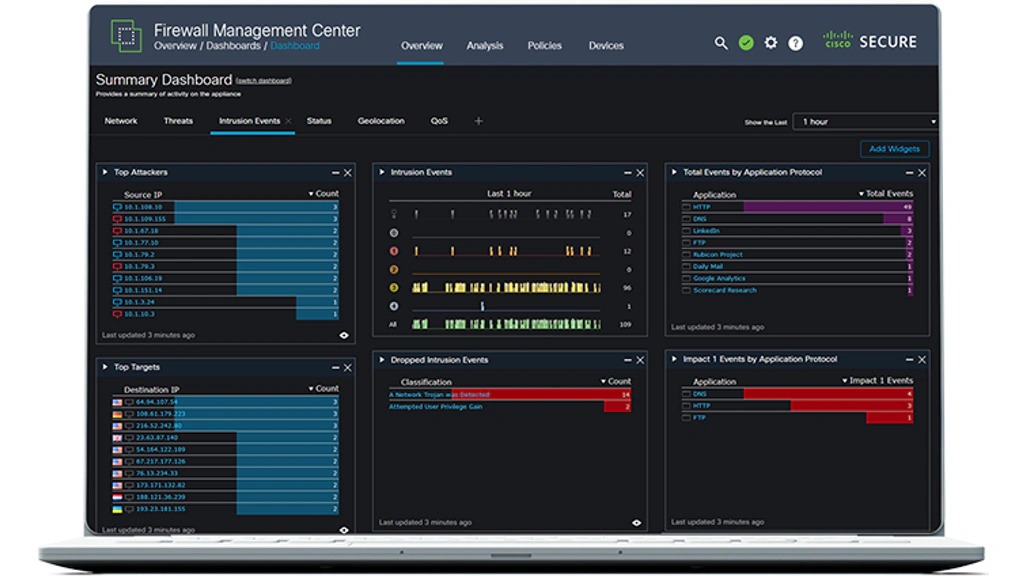
Routine administration includes reviewing intrusion events, tuning false positives, monitoring deployment health, cleaning objects, updating security databases, managing certificates, and scheduling software upgrades. FMC provides the deepest investigation and configuration workflows, while Security Cloud Control can improve cross-device visibility, change management, policy analysis, and template consistency.
The operational experience improves when you standardize names, zones, object groups, policy layers, and change approvals before onboarding many devices. Without standards, centralized management can become a larger version of the inconsistency it was meant to solve.
Protection Quality
Security, Performance, and Resilience
How Strong Is Cisco Secure Firewall Security?
Cisco Secure Firewall provides a strong layered defense when the relevant subscriptions and policies are enabled. Security Intelligence can block known malicious IPs, domains, and URLs early. Snort 3 analyzes allowed traffic for exploits. URL filtering controls risky destinations, while Malware Defense inspects files and can submit supported files for cloud analysis.
The platform also supports file trajectory and retrospective analysis, which can help you understand where a malicious file traveled after its disposition changes. These capabilities are valuable during incident response because a firewall alert becomes connected to a broader investigation rather than remaining an isolated block event.
Performance Planning Beyond Headline Throughput
Cisco publishes impressive performance numbers, especially for the 4200 and 6100 Series. However, production performance depends on enabled inspection, packet size, protocol mix, TLS decryption, logging, connection rates, routing, VPN, and high-availability design.
Your sizing worksheet should include normal and peak bandwidth, east-west traffic, expected growth, decryption percentage, VPN concurrency, new connections per second, application mix, and failover capacity. A high-availability pair must be able to carry the required load after one unit fails.
Patch Management and Platform Hardening
A security appliance is also a high-value target. Cisco has released critical advisories affecting firewall and management components, which reinforces the need for disciplined software lifecycle management. You should track Cisco PSIRT notices, remove unsupported hardware, restrict administrative access, use multi-factor authentication where supported, protect management interfaces, back up configurations, and test fixed releases before production deployment.
This is not a Cisco-specific weakness. Every major firewall vendor requires rapid patching. The more important buying question is whether your team has the process, maintenance windows, inventory accuracy, and support coverage to respond quickly.
High Availability and Scale
Cisco supports active-standby high availability across many models and active-active scale through clustering on selected higher-end platforms. The 4200 and 6100 Series can cluster up to 16 nodes, supporting large environments that need greater throughput and resilience.
Clustering does not remove design work. You still need redundant links, failure-domain planning, state synchronization validation, routing convergence tests, and documented upgrade procedures. For cloud deployments, availability must also align with regions, zones, load balancers, and cloud platform limitations.
Costs to Expect
Cisco Secure Firewall Pricing and Licensing
Cisco does not present one universal public price for Secure Firewall. Quotes depend on appliance model or virtual performance tier, software image, subscriptions, management, logging, support, contract length, and partner discounts. This makes Cisco difficult to compare from a simple list price.
| Cost Component | What It Covers | Budget Impact |
| Hardware or virtual firewall | Physical appliance or licensed virtual performance tier | Quote-based, with cloud PAYG available only in selected environments |
| Threat Protection | Intrusion prevention and threat intelligence functions | Separate subscription or bundle, commonly offered for 1, 3, or 5 years |
| URL Filtering | Website category and reputation controls | Optional subscription or bundled package |
| Malware Defense | File inspection, malware blocking, and Secure Malware Analytics | Optional subscription, with IPS licensing prerequisites |
| Firewall management | FDM, FMC, or Security Cloud Control workflows | FDM is included on supported devices; centralized and cloud management can add licensing or infrastructure costs |
| Logging and retention | Event storage, cloud logging, analytics, and investigation history | May require added capacity, appliances, or cloud subscription tiers |
| Support and services | Technical support, replacement coverage, design, migration, and deployment assistance | Additional contract or professional services cost |
Ask every vendor or reseller to quote the same inspected throughput, security services, management, log retention, support response, and contract term. A cheaper appliance can become more expensive after subscriptions and services, while a higher initial quote may include capabilities another vendor prices separately.
We recommend requesting a bill of materials for year one and the full contract period. Include renewal assumptions, high-availability units, spare interfaces, cloud egress, training, migration work, and any logging platform costs. This exposes the total cost of ownership before a low initial discount influences the decision.
Best Use Cases
Where Cisco Secure Firewall Adds the Most Value
Enterprises Already Using Cisco Networking
Cisco Secure Firewall is easiest to justify when you already use Cisco routing, switching, ISE, Secure Client, Splunk, or other Cisco security services. Shared identity, telemetry, support relationships, and operational knowledge can reduce integration work.
Distributed Organizations with Branch and Data Center Needs
The combination of compact branch appliances, SD-WAN functions, high-end data center systems, VPN, and centralized policy makes Cisco suitable for organizations that need a consistent architecture across many sites.
Regulated and High-Scale Environments
Granular access control, detailed logging, identity integration, high availability, and large hardware platforms fit enterprises that need strong governance and substantial traffic capacity. These benefits are most effective when the organization also invests in policy review, retention, and incident response processes.
When Cisco Secure Firewall May Be Too Much
A small company with one office, limited security staff, and basic firewall requirements may find the platform unnecessarily complex. A simpler managed firewall or unified security appliance could provide better operational value. Cisco may also be less attractive when you want vendor-neutral management or already standardize heavily on another firewall ecosystem.
Competitor Comparison
Cisco Secure Firewall Alternatives
Fortinet FortiGate
Fortinet FortiGate is the strongest alternative when price-performance, integrated SD-WAN, and a broad security fabric are priorities. FortiGate can be easier to position for cost-sensitive branches, while Cisco has an advantage when identity, campus networking, Secure Client, and existing Cisco operations are central to the design. Read our Fortinet FortiGate review for a deeper analysis.
Palo Alto Networks Strata
Palo Alto Networks Strata is a strong choice when application-aware policy, cloud-delivered security services, and a refined security operations experience are the main priorities. It can be more intuitive for security-led teams, while Cisco may fit better when networking integration and hardware scale carry equal weight. See our Palo Alto Networks Strata review.
Check Point Quantum Force
Check Point Quantum Force is worth considering when centralized policy, threat prevention, and a unified management model are more important than deep integration with the Cisco network stack. Check Point often appeals to teams that value mature policy administration across complex estates. Compare the platforms in our Check Point Quantum Force review.
Conclusion
Is Cisco Secure Firewall Worth It?
Cisco Secure Firewall is worth considering when you need enterprise-grade threat inspection across branches, campuses, data centers, and cloud environments, especially when Cisco already powers your network. Snort 3, Talos intelligence, encrypted traffic visibility, identity integration, flexible form factors, and serious high-end performance create a capable security platform.
It is not the easiest firewall to buy or operate. Licensing requires careful comparison, FMC can introduce a learning curve, and successful deployment depends on disciplined policy design, sizing, and patch management. Organizations without experienced administrators may need a partner or managed service.
Our recommendation is to shortlist Cisco when ecosystem integration and deployment breadth are strategic requirements. Run a proof of concept with your real traffic, TLS policy, VPN load, identity sources, and logging volume. Then compare a normalized three- or five-year cost against Fortinet, Palo Alto Networks, and Check Point. Cisco is a strong long-term choice when its integrations reduce operational fragmentation, not simply because the appliance meets a throughput number.
Frequently Asked Questions
Have more questions?
What is Cisco Secure Firewall?
Cisco Secure Firewall is a family of physical and virtual next-generation firewalls. It combines stateful firewalling with application control, intrusion prevention, threat intelligence, VPN, URL filtering, malware defense, and centralized management.
Is Cisco Secure Firewall the same as Firepower?
Cisco Secure Firewall is the current brand that includes technologies and product lines previously known as Firepower. Many older Firepower appliances remain supported, while newer families use Secure Firewall naming.
What is the difference between FTD and ASA?
FTD provides Cisco’s integrated next-generation firewall features, including Snort 3 IPS, application control, URL filtering, and malware defense. ASA focuses on mature stateful firewall and VPN functions and may be preferred for specific legacy or high-throughput use cases.
How is Cisco Secure Firewall managed?
You can manage supported deployments with Firewall Device Manager, Firewall Management Center, or Cisco Security Cloud Control. The right option depends on device count, required policy depth, cloud preference, and analytics needs.
Does Cisco Secure Firewall include intrusion prevention?
Cisco Secure Firewall supports Snort 3 intrusion prevention, but threat protection licensing and policy configuration are required. Confirm the subscriptions included in your quote before comparing prices.
Can Cisco Secure Firewall inspect encrypted traffic?
Yes. It supports TLS decryption and the Encrypted Visibility Engine, which analyzes encrypted traffic characteristics without decrypting every flow. Most organizations use a selective decryption policy based on risk and privacy requirements.
Does Cisco Secure Firewall support SD-WAN?
Yes. Supported models and software can use application-aware path selection across multiple WAN connections. You should verify routing, orchestration, interface, and feature requirements against Cisco Catalyst SD-WAN before consolidating platforms.
How much does Cisco Secure Firewall cost?
Pricing is quote-based and varies by appliance or virtual performance tier, security subscriptions, management, logging, support, and contract length. Request a complete multi-year bill of materials rather than comparing appliance prices alone.
Is Cisco Secure Firewall suitable for small businesses?
The compact 200, 1000, and 1200 families can fit smaller sites, but the management and licensing model may be excessive for a business without experienced IT staff. A managed service can make the platform more practical.
What are the best Cisco Secure Firewall alternatives?
Leading alternatives include Fortinet FortiGate, Palo Alto Networks Strata, and Check Point Quantum Force. Compare inspected throughput, management usability, subscriptions, ecosystem integrations, support, and total multi-year cost.