Introduction
Cortex Cloud is Palo Alto Networks’ attempt to move cloud security beyond a collection of posture dashboards and into a single operating layer for application security, cloud risk, runtime defense, and security operations. It combines cloud-native application protection platform capabilities with cloud detection and response, giving you a path from identifying a risky configuration to investigating and containing an active attack.
That positioning makes Cortex Cloud more ambitious than a conventional CSPM tool. It is designed to connect code, pipelines, cloud assets, identities, data, workloads, and runtime telemetry, then prioritize the small number of issues that can create meaningful business impact.
This Cortex Cloud review examines the platform from a buyer’s perspective. You will learn what it covers, where its code-to-cloud model adds practical value, what implementation and licensing may involve, and when a simpler CNAPP could be a better fit. You can also compare it with the platforms in our best CNAPP platforms guide.
What Is Cortex Cloud?
Cortex Cloud is an enterprise cloud security platform that brings together application security, cloud posture security, cloud runtime security, and SOC workflows. It builds on capabilities associated with Prisma Cloud while placing cloud security on the broader Cortex platform and data model.
The product has two connected layers. Prevention and risk reduction cover posture, identities, data, applications, Kubernetes, pipelines, and agentless scanning. Runtime detection and response add workload protection, behavioral detection, investigation, and containment. Posture shows what could be exploited, while runtime security shows what is happening now.
Platform Features
Core Capabilities of Cortex Cloud
Cortex Cloud’s strongest value is not the number of security modules it lists. The more important advantage is the context it can create across application development, cloud control planes, identities, data, and runtime events. That context helps you move from thousands of disconnected findings to a smaller set of cases with a clearer corrective action.
1. Cloud Posture Security and Exposure Management
The posture layer provides agentless visibility across cloud resources and identifies misconfigurations, vulnerable workloads, excessive permissions, exposed services, risky identities, sensitive data, and compliance gaps. It covers core CNAPP disciplines such as CSPM, CIEM, DSPM, KSPM, cloud attack-surface management, and agentless workload scanning.
Cortex Cloud currently supports onboarding AWS, Microsoft Azure, Google Cloud, Oracle Cloud Infrastructure, and Alibaba Cloud. This breadth is valuable for enterprises that have grown through acquisition or operate separate cloud standards across business units.
The practical benefit is correlation. Cortex Cloud can consider whether an exposed asset has a reachable vulnerability, overprivileged identity, sensitive data, or production connection. This helps security teams prioritize attack paths instead of flat vulnerability lists.
2. Application Security and ASPM
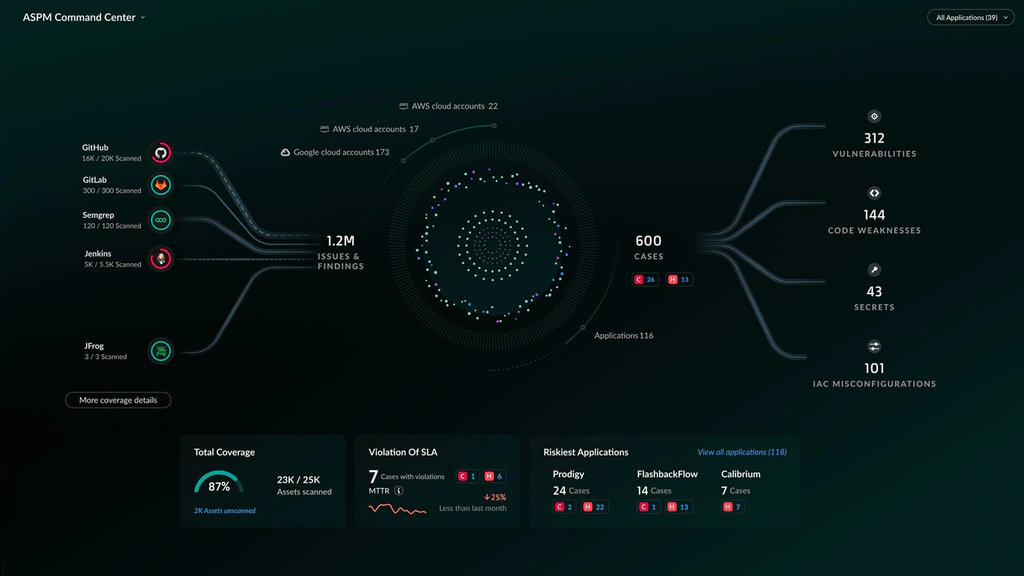
Cortex Cloud Application Security combines native scanning with findings from third-party AppSec tools. Its ASPM layer can bring together code, open-source dependency, secrets, infrastructure-as-code, pipeline, cloud, and runtime context.
This is useful when developers already use several scanners but security teams lack a consistent way to remove duplicates, map findings to applications, and judge production reachability. The platform integrates with major repositories, CI/CD systems, and build tools.
Policies and guardrails can appear in developer workflows, while runtime context helps teams focus on code that creates real exposure. For adjacent coverage, see our SaaS and AI application security guide.
3. Cloud Runtime Security and CDR
Runtime security is the clearest differentiator between Cortex Cloud and posture-first CNAPPs. The platform protects hosts, containers, Kubernetes environments, serverless workloads, web applications, and APIs while collecting telemetry for behavioral detection and investigation.
Cortex Cloud Runtime Security combines cloud workload protection with web application and API security. It can detect malware, exploits, fileless activity, suspicious processes, abnormal network behavior, and other indicators that an attacker is operating inside a workload.
Cloud detection and response connects these events with posture and identity context. Analysts can review the vulnerable asset, affected application, identity path, cloud account, and potential blast radius before containing the incident.
4. SmartGrouping, SmartScore, and Risk Prioritization
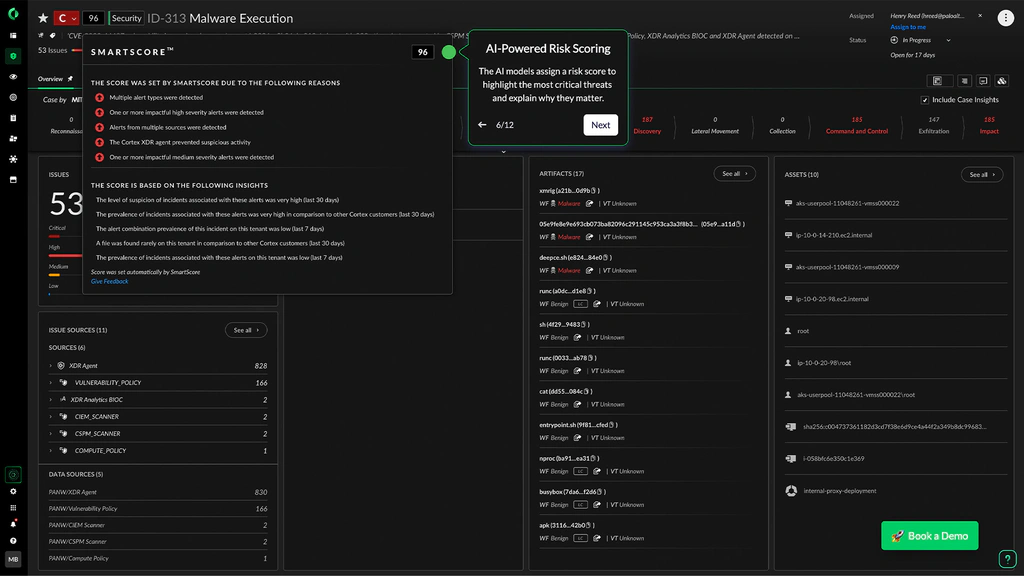
Cloud security programs often fail because they produce more findings than teams can realistically resolve. Cortex Cloud addresses this with SmartGrouping and SmartScore. Related signals are grouped into cases, while risk scoring considers exposure, production behavior, application context, and likely impact.
A useful case should connect the vulnerable package, public route, risky identity, exposed secret, and affected data into one remediation path. During a proof of concept, measure how many raw findings become actionable cases and whether recommended fixes identify the true root cause.
5. Cloud Command Centers and AgentiX Automation
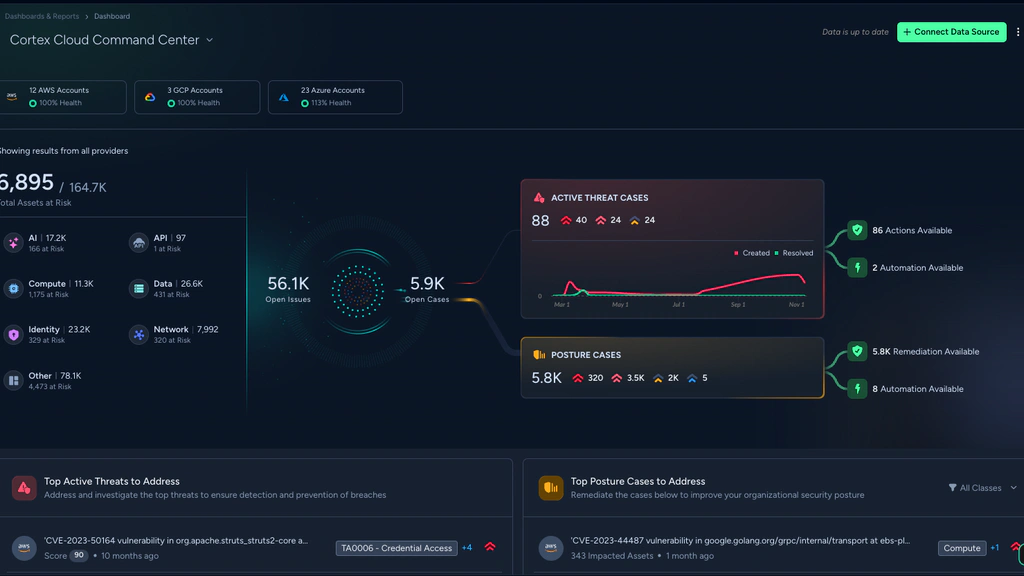
Cortex Cloud 2.0 introduced redesigned command centers for cloud security and application security. These views organize coverage, posture gaps, threats, and recommended actions around the needs of each team while maintaining a shared data source.
The platform also connects with Cortex AgentiX for agentic investigation and remediation. Palo Alto Networks describes ready-to-use playbooks, natural-language automation creation, and AI agents that can investigate root cause, calculate impact, recommend a fix, and execute approved actions.
This can reduce repetitive triage, but governance matters as much as speed. Confirm approval requirements, role enforcement, auditability, and rollback procedures for production changes.
6. Kubernetes, Serverless, API, Data, and AI Coverage
Cortex Cloud extends beyond virtual machines. Kubernetes posture and runtime controls cover cluster configuration, container images, workloads, and drift. Serverless security connects code, configuration, dependencies, and runtime behavior for functions and managed services.
WAAS and API security help discover and protect web applications, APIs, and microservices. Data security capabilities identify sensitive information and connect it to access, exposure, and workload risk. AI-SPM helps inventory and assess AI services, while AI Detection and Response is documented as a beta capability, so you should evaluate its maturity separately from established CNAPP functions.
This breadth can increase implementation scope, so most organizations should phase deployment by business risk rather than activate every module at once.
Pros and Cons
Advantages and Disadvantages
Cortex Cloud is one of the broadest enterprise cloud security platforms available, but its value depends on your operating model. The same convergence that simplifies investigations can create licensing, migration, and administration complexity for teams that only need lightweight posture monitoring.
Positive
✅ Unifies CNAPP and runtime response
✅ Connects code, cloud, identity, and SOC context
✅ Covers agentless and agent-based use cases
✅ Strong multicloud and Kubernetes support
✅ Advanced risk grouping and prioritization
✅ Valuable for existing Cortex customers
Negative
❌ No transparent public pricing
❌ Licensing includes several add-ons
❌ Implementation can require specialist skills
❌ Broad interface may overwhelm smaller teams
❌ Full value favors platform consolidation
❌ Prisma Cloud migration needs planning
👍 Pros
✅ Unifies prevention and active defense
Cortex Cloud does more than identify cloud risk. It connects posture, application security, workload protection, detection, investigation, and response. This reduces the gap between the team that finds a weakness and the team that must stop an attacker.
✅ Provides deeper code-to-runtime context
The platform can trace issues from source and pipeline artifacts into deployed cloud resources and runtime behavior. This helps developers fix problems at the source while giving analysts enough production context to assess urgency.
✅ Supports different deployment models
Agentless scanning accelerates posture coverage, while runtime agents and connectors provide deeper telemetry and enforcement.
✅ Fits complex multicloud estates
Support for major cloud providers, Kubernetes, containers, serverless functions, APIs, data stores, and multiple development systems makes Cortex Cloud suitable for heterogeneous enterprise environments.
✅ Reduces duplicate findings
SmartGrouping and case-based workflows can consolidate related issues into a smaller remediation queue. This is more useful than a dashboard that only ranks thousands of individual alerts by severity.
✅ Extends the Cortex operating model
Organizations already using Cortex XSIAM, Cortex XDR, or related Palo Alto Networks products can gain stronger data and workflow continuity between cloud teams and the SOC.
👎 Cons
❌ Pricing requires a custom sales process
There is no simple public rate card for estimating total cost. You need to model protected workloads, license configuration, add-ons, data retention, query capacity, support, and implementation services.
❌ Packaging can be difficult to compare
Cloud Posture Management and Cloud Runtime Security include different capabilities, while application security, enterprise runtime, ITDR, forensics, host insights, extended hunting, and other functions may be add-ons.
❌ Implementation can become a program
Cloud onboarding, IAM permissions, developer integrations, runtime agents, alert routing, role design, and automation controls require coordination across cloud, AppSec, DevOps, SOC, and governance teams.
❌ Smaller teams may not use the full platform
A company that only needs agentless CSPM and compliance checks may get faster time to value from a narrower platform with simpler packaging and fewer operational dependencies.
❌ Ecosystem value can increase vendor dependence
Consolidating posture, runtime, XDR, automation, and SOC workflows with one vendor can raise switching costs.
❌ Migration requires careful validation
Existing Prisma Cloud customers have an upgrade path, but policies, integrations, custom rules, agents, retention, roles, and reporting should be tested before production cutover.
Implementation and Usability
Deployment and Day-to-Day Use
Cloud Onboarding and Coverage
Deployment normally begins by connecting cloud accounts, subscriptions, projects, or organizations through provider permissions. This creates the normalized asset inventory used for posture analysis and investigation. You can then add developer systems, Kubernetes connectors, agentless scanning, runtime protection, log collection, and application security integrations.
A posture-first rollout can produce visibility quickly, while runtime security needs more testing. Start with a representative production environment, validate permissions, tune policies, and document ownership before expanding.
Investigation and Remediation Workflow
The command centers and case model are designed to reduce navigation between separate cloud-security tools. Analysts can review an issue, affected assets, related findings, identity paths, runtime events, and recommended actions from a connected workflow.
Public user feedback generally praises centralized visibility and the ability to bring multiple security functions together. However, some reviewers also describe setup complexity and features that can be difficult to locate. This is consistent with a platform that serves several personas rather than a single-purpose scanner.
Test the experience for cloud engineers, SOC analysts, AppSec teams, and developers separately because each group needs different context.
Developer and Security Integrations
Cortex Cloud supports common version-control and CI/CD systems, including GitHub, GitLab, Bitbucket, Azure DevOps, Jenkins, CircleCI, and cloud-native build services. It also supports ticketing and operational workflows through broader Cortex integrations and APIs.
Developer findings need ownership, fix guidance, and a blocking policy. Runtime detections need incident routing and containment procedures. Sending every finding into Jira or a SIEM only moves alert fatigue.
Prisma Cloud Migration Considerations
Cortex Cloud is not merely a cosmetic rename of Prisma Cloud. Palo Alto Networks provides an upgrade process that can copy global configuration, CSPM settings, workload protection configuration, application security settings, and CLI workflows into the Cortex Cloud environment.
Existing customers should still treat migration as a controlled transformation. Compare feature availability, regional hosting, retention, custom policies, API behavior, agent versions, and reporting before decommissioning established workflows.
For organizations also evaluating Palo Alto Networks’ network security portfolio, our Palo Alto Networks Strata review explains how its firewall platform differs from Cortex Cloud.
Plans and Cost
Cortex Cloud Pricing and Licensing
Palo Alto Networks does not publish standard Cortex Cloud prices. Licensing is sold as an annual subscription based on the number and type of protected cloud resources. The core consumption metric is the protected workload, with usage measured across workload categories and averaged to accommodate changing cloud environments.
The two primary configurations are Cloud Posture Management and Cloud Runtime Security. Runtime includes posture coverage for the protected asset, which helps avoid double-counting. Additional security and capacity add-ons can materially affect the final quote.
| License or Add-On | Main Coverage | Pricing Basis |
| Cloud Posture Management | CSPM, CIEM, ASPM, DSPM, AI-SPM, ASM, KSPM, CI/CD posture, and agentless scanning | Annual subscription based on protected workloads |
| Cloud Runtime Security | Cloud Posture Management plus workload protection and WAAS | Annual subscription based on protected workloads |
| Application Security | IaC security, software composition analysis, and secrets security | Custom add-on quote |
| Enterprise Runtime Security | Extended XDR capabilities for cloud workloads | Custom add-on quote |
| Other Security Add-Ons | Data ingestion, ITDR, forensics, host insights, extended threat hunting, email security, and selected beta capabilities | Custom add-on quote |
| Capacity Add-Ons | Longer data retention and additional query compute units | Based on retention and query requirements |
Before requesting a quote, inventory each billable resource type and model seasonal or ephemeral growth. Request separate totals for license capacity, add-ons, retention, implementation, support, services, and future expansion.
Risk Management
Security, Privacy, and Governance
Cortex Cloud is a security platform, but deploying it still creates a trust relationship with your cloud estate. Agentless scanning requires cloud permissions and access to resource metadata or snapshots. Runtime protection collects workload telemetry. Application security connects to source, pipeline, and build systems. These controls need the same architectural review you would apply to any privileged security service.
What to Validate Before Deployment
- Data location: Confirm the Cortex region, scanning location, data residency options, and cross-region processing.
- Cloud permissions: Review every requested IAM permission and separate read-only discovery from remediation access.
- Retention: Define how long posture, telemetry, investigation, and audit data must be stored.
- Agent performance: Benchmark CPU, memory, network, and application latency on representative workloads.
- Automation controls: Require role-based approvals, audit logs, scoped actions, and rollback procedures.
- Developer access: Limit source-code and pipeline permissions to the repositories and organizations in scope.
Where Cortex Cloud Is Strong
The platform supports role-based administration, centralized reporting, auditable workflows, regional hosting options, and security controls designed for regulated enterprises. The combination of posture, runtime, and SOC context can also improve incident evidence because analysts can see the configuration state and runtime behavior surrounding an event.
Where Buyers Should Be Cautious
Broad remediation permissions can create operational risk. Confirm what agentless scanning data is copied, where it is processed, how it is encrypted, and when temporary artifacts are deleted.
AI-generated recommendations and autonomous workflows should remain governed by human-defined policy. Treat AgentiX as an acceleration layer, not an excuse to remove change controls from production environments.
Business Fit
Who Should Use Cortex Cloud?
Cortex Cloud is best suited to organizations that need both cloud risk management and real-time defense. It becomes more valuable as the number of cloud accounts, applications, engineering teams, workload types, and security tools increases.
| Organization Type | Fit | Why |
| Large multicloud enterprise | Excellent | Broad cloud, identity, data, application, and runtime coverage |
| Existing Cortex or Palo Alto Networks customer | Excellent | Stronger continuity across cloud security and SOC operations |
| Cloud-native company using Kubernetes and serverless | Strong | Combines posture, workload, API, container, and pipeline controls |
| Regulated organization | Strong | Centralized governance, reporting, regional options, and audit workflows |
| Mid-sized security team with complex cloud risk | Moderate to strong | Can reduce tool sprawl, but requires careful packaging and rollout |
| Small business needing basic CSPM | Weak | Likely more complex and expensive than necessary |
If you only need agentless inventory and compliance, confirm that runtime, AppSec, automation, and SOC capabilities justify the added overhead.
How Competing Platforms Differ
Cortex Cloud Alternatives
The strongest alternative depends on whether you value fast agentless deployment, deep runtime telemetry, hyperscaler integration, or a unified endpoint and cloud ecosystem. Cortex Cloud is strongest when you want posture, application security, runtime defense, and SOC operations connected within one platform.
| Platform | Best For | Main Strength | Main Consideration |
| Cortex Cloud | Enterprise code-to-cloud-to-SOC security | Converged CNAPP and cloud detection and response | Complex packaging and quote-based pricing |
| Wiz | Fast agentless visibility and risk prioritization | Security graph and rapid multicloud deployment | Deep runtime use cases may require added components |
| Orca Security | Agentless cloud coverage with workload context | SideScanning and broad CNAPP visibility | Evaluate runtime enforcement depth for your workloads |
| CrowdStrike Falcon Cloud Security | Teams aligning cloud and endpoint operations | Adversary intelligence and Falcon ecosystem integration | Best value often favors existing Falcon customers |
| Microsoft Defender for Cloud | Microsoft and Azure-centered environments | Native Azure integration and flexible security plans | Multicloud consistency and cost need careful modeling |
Wiz
Wiz is a strong alternative when fast agentless deployment, graph-based attack paths, and an accessible cloud-risk interface are your priorities. It is often easier to position as a posture and exposure platform across diverse cloud teams.
Cortex Cloud has the advantage when runtime detection, workload prevention, SOC investigation, and automation are central requirements. Read our complete Wiz review for a closer look at its strengths and limitations.
Orca Security
Orca Security emphasizes agentless cloud visibility through its SideScanning approach. It is attractive for organizations that want broad coverage without deploying agents across every workload.
Orca may provide a simpler starting point for agentless CNAPP programs. Cortex Cloud is more compelling when you need a tightly connected runtime and SOC operating model, especially across application, cloud, and incident-response teams. Read our complete Orca review.
CrowdStrike Falcon Cloud Security
CrowdStrike Falcon Cloud Security is a logical option for organizations already using Falcon for endpoint, identity, exposure, and threat intelligence. Its cloud platform combines agentless visibility with runtime protection and adversary-led detection.
Cortex Cloud favors Palo Alto Networks workflows, while CrowdStrike may fit teams already converging endpoint and cloud operations on Falcon. See our CrowdStrike Falcon review.
Microsoft Defender for Cloud
Microsoft Defender for Cloud is especially attractive for Azure-centered organizations. It provides CNAPP capabilities, security posture management, workload protection, DevOps integration, and connections with Microsoft’s wider security ecosystem.
Microsoft can offer strong native integration and consumption-based options, but buyers should model multicloud coverage, data ingestion, and individual Defender plans carefully. Cortex Cloud may provide a more consistent independent platform across heterogeneous cloud estates.
Conclusion
Is Cortex Cloud Worth It?
Cortex Cloud is worth evaluating when your cloud security problem has moved beyond posture management. Its strongest advantage is the ability to connect application risk, cloud exposure, workload activity, and SOC response in one platform.
It is particularly well suited to large multicloud organizations, regulated enterprises, cloud-native engineering teams, and existing Cortex customers. SmartGrouping, runtime telemetry, code-to-cloud context, and automation can materially reduce investigation and remediation time when implemented well.
The main trade-offs are cost transparency, packaging complexity, deployment effort, and platform dependence. A smaller team that only needs agentless CSPM may achieve faster value with Wiz, Orca Security, or Microsoft Defender for Cloud.
The best buying approach is a structured proof of concept using real production patterns. Measure coverage, duplicate reduction, case quality, runtime overhead, false positives, developer workflow impact, and time from detection to containment. Cortex Cloud should earn its place by improving operational outcomes, not simply by replacing several product names with one platform license.
Frequently Asked Questions
Have more questions?
What is Cortex Cloud?
Cortex Cloud is Palo Alto Networks’ enterprise cloud security platform. It combines application security, cloud posture management, workload protection, cloud detection and response, and SOC workflows across code, cloud infrastructure, and runtime environments.
Is Cortex Cloud the same as Prisma Cloud?
No. Cortex Cloud builds on Prisma Cloud capabilities but moves cloud security onto the Cortex platform with stronger convergence across CNAPP, runtime detection, investigation, automation, and security operations. Palo Alto Networks provides an upgrade path for Prisma Cloud customers.
What does Cortex Cloud protect?
Cortex Cloud can protect cloud accounts, virtual machines, containers, Kubernetes clusters, serverless workloads, applications, APIs, identities, data, code repositories, pipelines, and other cloud-native resources, depending on the license and modules deployed.
Does Cortex Cloud use agents?
Cortex Cloud supports both agentless and agent-based approaches. Agentless scanning provides rapid posture and vulnerability visibility, while runtime agents and connectors add deeper telemetry, prevention, and response for workloads and Kubernetes environments.
How much does Cortex Cloud cost?
Cortex Cloud uses custom annual subscription pricing based mainly on protected workloads. Final cost depends on the posture or runtime license, workload types, add-ons, retention, query capacity, support, and implementation requirements.
Which cloud providers does Cortex Cloud support?
Cortex Cloud documentation lists support for AWS, Microsoft Azure, Google Cloud Platform, Oracle Cloud Infrastructure, and Alibaba Cloud. Feature depth and regional availability can vary, so confirm the required services during evaluation.
What is Cortex Cloud Runtime Security?
Cortex Cloud Runtime Security combines posture management with cloud workload protection and web application and API security. It detects and prevents active threats while providing telemetry for cloud detection, investigation, and response.
Is Cortex Cloud suitable for small businesses?
Cortex Cloud is generally better suited to mid-sized and large organizations with complex cloud environments. Small businesses needing only basic posture monitoring may find a simpler CNAPP easier and more cost-effective.
What are the best Cortex Cloud alternatives?
Leading Cortex Cloud alternatives include Wiz for fast agentless visibility, Orca Security for broad agentless CNAPP coverage, CrowdStrike Falcon Cloud Security for endpoint and cloud convergence, and Microsoft Defender for Cloud for Microsoft-centered environments.
Is Cortex Cloud worth evaluating?
Yes, especially if you need cloud posture, application security, runtime protection, and SOC response in one platform. Run a proof of concept to measure coverage, risk prioritization, runtime overhead, workflow quality, and total licensing cost.