
Introduction
Aqua Security is one of the more established cloud-native security platforms, but it is not simply another dashboard that lists misconfigurations and vulnerabilities. Its strongest value is the ability to connect development findings with what is actually running, then enforce controls inside containers, Kubernetes workloads, virtual machines, serverless functions, and AI applications.
That distinction matters. A vulnerability may look critical in a scanner but present little immediate risk if the affected package never executes, the workload is isolated, or the vulnerable component is not exposed. Aqua uses runtime context to help you separate theoretical exposure from activity that can affect a live application.
In this Aqua Security review, you will learn how the platform approaches CNAPP, container security, software supply chain protection, cloud posture management, runtime defense, and cloud detection and response. We will also examine deployment effort, usability, pricing, security, ideal customers, and the alternatives you should compare before purchasing.
What Is Aqua Security?
Aqua Security is a cloud-native application protection platform, commonly shortened to CNAPP. It brings together controls for application development, cloud infrastructure, workload protection, compliance, and detection and response.
The platform is designed for organizations operating modern application environments across public cloud, private cloud, Kubernetes, containers, serverless services, and virtual machines. You can use agentless discovery to establish broad visibility, then add workload-level components where deeper runtime detection and prevention are required.
Aqua is best understood as a runtime-first CNAPP. It still covers code scanning, infrastructure-as-code checks, cloud posture, and vulnerability management, but its differentiation is strongest when you need to observe and control what workloads do after deployment.
- Best for: Enterprises with significant Kubernetes, container, hybrid-cloud, or regulated workloads.
- Core strength: Deep runtime visibility and enforcement linked to code-to-cloud context.
- Deployment model: Agentless discovery combined with agent-based or embedded runtime protection.
- Pricing model: Custom pricing based primarily on repositories and protected workloads.
Platform Capabilities
Aqua Security Features
Aqua covers a broad portion of the cloud-native security lifecycle. The platform is most valuable when its individual modules share context, because that allows your teams to connect a risky code component, cloud configuration, identity path, and runtime event rather than treating each finding as an isolated alert.
1. Code-to-Cloud Risk Visibility
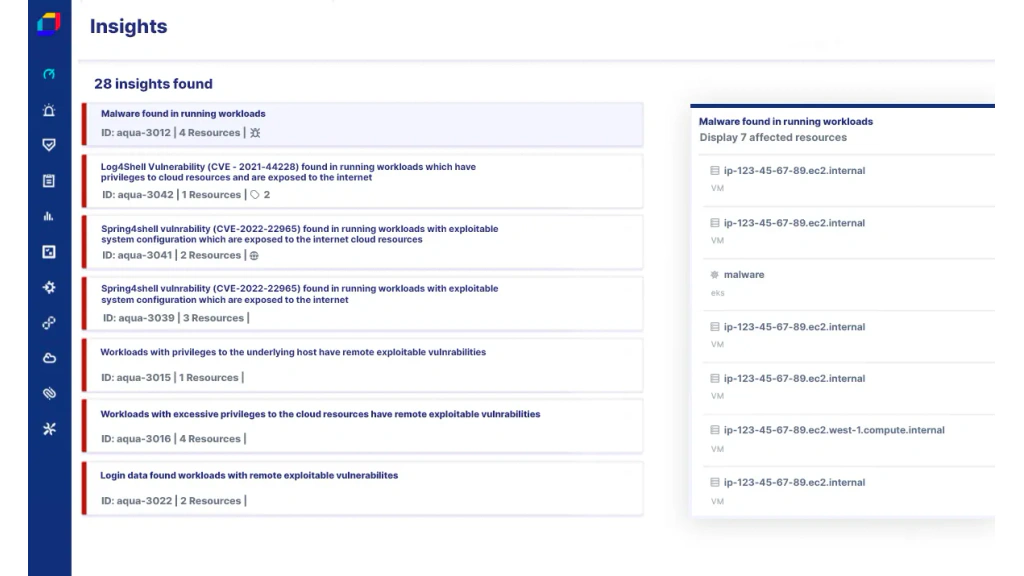
Aqua builds an inventory across repositories, images, registries, cloud accounts, clusters, and running workloads. This gives you a shared view of where an application came from, how it was built, where it was deployed, and what it is doing in production.
This context is particularly useful for vulnerability prioritization. Instead of relying only on a CVSS score, you can consider whether a vulnerable image is deployed, whether the affected package is active, whether the workload is exposed, and whether suspicious behavior has been observed.
2. Container and Image Vulnerability Scanning
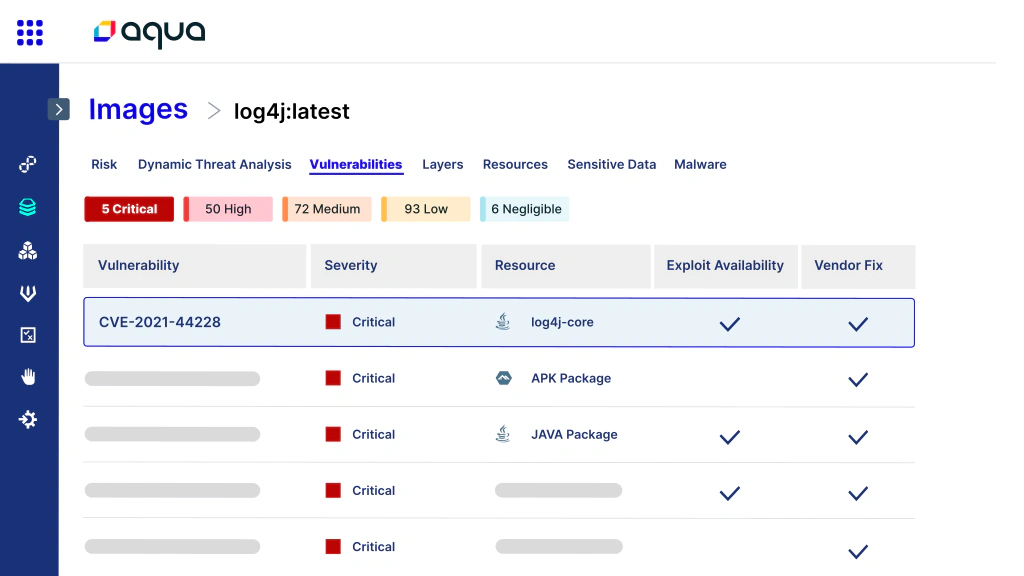
Aqua scans container images, operating system packages, application dependencies, infrastructure-as-code files, exposed secrets, licenses, and malware indicators. Scanning can be introduced in source control, continuous integration pipelines, registries, and cloud environments.
The platform also benefits from Aqua’s connection to Trivy, its widely adopted open-source scanner. Trivy gives development teams a familiar entry point, while the commercial platform adds centralized governance, richer context, policy enforcement, reporting, and enterprise workflow controls.
3. Software Supply Chain and CI/CD Security
Aqua extends beyond image scanning into the systems that build and deliver software. It can inspect repositories, pipeline definitions, CI/CD tools, open-source dependencies, build artifacts, and infrastructure-as-code before risky changes reach production.
The platform supports software bills of materials, artifact integrity checks, pipeline analysis, and CI/CD posture management. These capabilities help you identify issues such as excessive access, exposed credentials, insecure pipeline steps, untrusted packages, and unexpected changes between source and deployment.
This is useful when you are building a program around the NIST Secure Software Development Framework. Aqua can provide technical evidence and enforcement points, although governance processes, ownership, and secure engineering practices still need to be defined outside the product.
4. Cloud and Kubernetes Posture Management
Aqua discovers cloud resources and checks configurations across major public cloud environments. It evaluates compute, storage, databases, identity settings, networking, Kubernetes clusters, and other services against security policies and compliance requirements.
For Kubernetes, the platform can highlight risky workload settings, cluster misconfigurations, excessive privileges, exposed services, weak admission controls, and deviations from accepted benchmarks. This gives you a more focused view than treating Kubernetes as another collection of generic cloud resources.
The posture layer is useful for establishing coverage quickly, but Aqua becomes more differentiated when posture findings are enriched with workload and runtime evidence. If your main requirement is purely agentless CSPM, a simpler competitor may be easier to deploy and operate.
5. Runtime Workload Protection
Runtime protection is Aqua’s most important capability. The platform monitors workload behavior and can detect or block suspicious processes, file changes, network activity, malware, credential access, privilege escalation, and other actions inside running applications.
Aqua uses eBPF-based visibility for Linux workloads and provides enforcement controls such as drift prevention. Drift prevention helps preserve container immutability by stopping executables or files that were not part of the approved image from running inside the container.
6. Kubernetes Admission and Workload Controls
Aqua can apply assurance policies before a workload is admitted into a cluster. You can use these policies to reject images with disallowed vulnerabilities, malware, configuration risks, untrusted registries, weak signatures, or other policy violations.
Once a workload is running, the platform can apply controls based on its expected behavior and identity. This creates a stronger chain from build approval to deployment and runtime, rather than relying on a single scan performed hours or days earlier.
Policy design requires care. Overly strict controls can interrupt deployments, while permissive controls may produce visibility without meaningful risk reduction. Most enterprises should start with monitor-only policies, identify exceptions, and then move high-confidence controls into blocking mode.
7. Cloud Detection and Response
Aqua’s cloud detection and response capabilities help security teams investigate active threats. Events can be grouped into incidents, enriched with workload context, and mapped to tactics and techniques from the MITRE ATT&CK framework.
The useful part is the connection between detection and enforcement. Instead of only sending an alert to a SIEM, Aqua can apply response policies that restrict or block malicious activity inside the workload. This can shorten the gap between identifying a threat and containing it.
However, Aqua should not be treated as a full replacement for every SecOps platform. Your SIEM, case management, identity systems, endpoint tools, and incident response processes will still play important roles. Aqua is strongest as the cloud-native workload evidence and control layer.
8. AI Application Security
Aqua has expanded its platform to cover AI workloads and applications. It can identify AI-related assets, evaluate configuration and development risks, and apply runtime controls for threats such as prompt injection, jailbreak attempts, unsafe model behavior, and post-compromise activity.
This capability is relevant if your AI applications run in containers or cloud-native infrastructure. Aqua can connect prompt-level events with the workload underneath, helping you see whether an AI attack also triggered a shell, unexpected process, credential access, or data movement.
The AI security market is developing quickly, so you should validate supported frameworks, models, deployment architectures, and enforcement methods during a proof of concept. Our guide to AI application security explains the broader controls you may need beyond a CNAPP.
Pros and Cons
Advantages and Disadvantages
Aqua Security provides unusually deep protection for cloud-native workloads, but that depth also increases implementation and operational demands. The platform is a better fit for organizations that need active runtime control than for teams seeking only rapid, agentless visibility.
Positive
✅ Deep container and Kubernetes runtime protection
✅ Connects code, cloud posture, and runtime evidence
✅ Supports agentless discovery and active enforcement
✅ Strong software supply chain security coverage
✅ Broad hybrid-cloud and multi-cloud support
✅ Trivy provides a familiar open-source foundation
Negative
❌ Pricing requires a custom quote
❌ Deep protection requires more deployment effort
❌ Policy tuning can be demanding at enterprise scale
❌ Interface and workflows may feel dense to new users
❌ More platform than smaller cloud teams may need
👍 Pros
✅ Runtime controls go beyond alerting
Aqua can observe and restrict behavior inside running workloads. This makes the platform valuable when you need to prevent container drift, block malware, restrict suspicious processes, or contain an attack before a standard remediation cycle is complete.
✅ Code-to-cloud context improves prioritization
Security teams often struggle because scanners produce more findings than developers can fix. Aqua helps you prioritize by showing which vulnerabilities are deployed, reachable, active, or connected to suspicious runtime behavior.
✅ Strong coverage for containers and Kubernetes
Aqua was built around cloud-native workloads, and that heritage is visible in its image scanning, admission controls, Kubernetes posture checks, workload identity, behavioral monitoring, and runtime enforcement.
✅ Flexible visibility and protection architecture
You can begin with agentless cloud discovery for broad coverage, then deploy sensors or enforcement components to workloads that require deeper protection. This phased model is practical for large environments where one deployment method does not fit every asset.
✅ Software supply chain controls are integrated
Repository scanning, pipeline analysis, SBOM generation, artifact integrity, registry controls, and runtime evidence can be managed as connected parts of the same program. This is more useful than collecting unrelated alerts from several point products.
✅ Open-source tools improve developer familiarity
Trivy, Tracee, and Aqua’s other open-source projects give engineering teams accessible tools and recognizable detection methods. The commercial platform adds the management, policy, reporting, and enterprise support layers needed for broader adoption.
👎 Cons
❌ Pricing is not transparent
Aqua publishes its pricing units but not fixed prices. You need a sales process to understand licensing, package boundaries, support, professional services, and expected cost as repositories and workloads grow.
❌ Full value requires implementation work
Agentless discovery can be quick, but deep runtime control requires sensors, policy decisions, exception handling, and coordination with cloud and platform engineering teams. You should treat Aqua as a security program component, not a plug-and-play scanner.
❌ Policy tuning can become complex
Runtime and admission controls are powerful because they can block activity. That also means poor policy design can disrupt applications or create noisy exceptions. A staged rollout and clear ownership model are essential.
❌ The platform can feel dense
Aqua covers several security disciplines and exposes substantial technical detail. New users may need training before they can confidently move between posture findings, vulnerabilities, workload events, policies, and incidents.
❌ Smaller teams may not use enough of the platform
If you operate a modest cloud environment without Kubernetes, complex pipelines, or strict runtime requirements, Aqua may introduce more cost and administration than necessary. A focused CSPM or vulnerability tool may provide a faster return.
Deployment and Usability
Using Aqua Security
Deployment Approach
Aqua supports SaaS and enterprise deployment patterns across public cloud, private cloud, and hybrid environments. Initial onboarding normally begins by connecting cloud accounts, repositories, registries, and clusters so the platform can discover assets and establish a risk baseline.
Agentless scanning is useful for breadth, especially when you need rapid inventory and posture assessment. Runtime protection requires additional components, such as enforcers or sensors, depending on the workload and deployment architecture.
A sensible rollout starts with a representative environment rather than the entire organization. Connect one cloud account and one cluster, validate asset discovery, test scanning accuracy, measure runtime overhead, tune policies, and confirm how findings flow into your existing ticketing and incident processes.
Interface and Daily Workflow
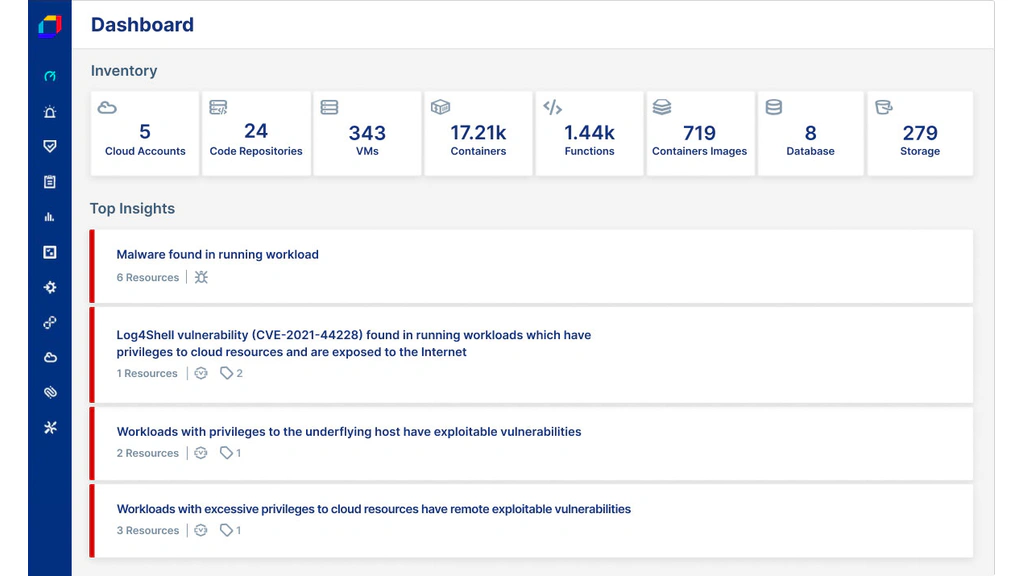
The interface is designed for technical security, DevSecOps, and platform teams. Dashboards can summarize risk, but much of the product’s value appears when you investigate the relationship between an image, workload, vulnerability, policy, and runtime event.
That depth can shorten investigations for experienced users, but it creates a learning curve. Teams should define which views matter to developers, cloud security engineers, platform owners, compliance teams, and incident responders rather than giving every user the same broad dashboard.
Role-based access control helps separate responsibilities. You should also establish naming conventions, business ownership tags, severity thresholds, and service-level objectives before relying on platform-wide risk scores.
Integrations
Aqua integrates with cloud providers, Kubernetes distributions, registries, source control systems, CI/CD tools, ticketing platforms, SIEM products, and analytics tools. Common integration categories include AWS, Azure, Google Cloud, OpenShift, Jenkins, GitHub, GitLab, Azure DevOps, Artifactory, ServiceNow, and Splunk.
Licensing and Cost Factors
Aqua Security Pricing
Aqua Security does not publish fixed subscription prices. Its public pricing page explains that development security is priced by the number of code repositories, while cloud security is priced by the number of workloads, such as virtual machines, containers, and serverless functions.
This structure is logical for enterprise environments, but it makes early budgeting difficult. Two organizations with similar cloud spend may receive very different quotes if one operates thousands of short-lived containers and the other runs a smaller number of persistent workloads.
| Cost Area | How Aqua Prices It | What You Should Confirm |
| Development security | Number of code repositories | Included scanners, SCM coverage, and repository growth |
| Cloud security | Number of protected workloads | How containers, VMs, functions, and ephemeral assets are counted |
| Runtime protection | Included within negotiated cloud scope | Required components, supported workloads, and enforcement coverage |
| Support and services | Custom quote | Support tier, onboarding, training, and professional services |
| Contract expansion | Based on environment growth | True-up terms, overages, and multi-year price protection |
For an accurate comparison, ask each vendor to price the same inventory, retention period, modules, support level, and expected growth. You should also request a clear explanation of how stopped workloads, autoscaling containers, duplicate images, test environments, and serverless executions affect licensing.
Security and Compliance
How Secure Is Aqua Security?
A cloud security platform receives broad access to sensitive infrastructure data, so its own security controls matter. Aqua maintains a public trust and compliance program and states that it undergoes independent audits, including ISO/IEC 27001:2022 and SOC 2 Type II assessments.
Security Controls to Evaluate
- Access control: Confirm RBAC granularity, SSO, MFA, service accounts, and separation between platform administrators and analysts.
- Data protection: Review encryption, regional hosting, log retention, backups, subprocessors, and data deletion terms.
- Cloud permissions: Validate the permissions required for agentless discovery and whether read-only roles satisfy your governance model.
- Runtime components: Test resource overhead, update processes, fail-open or fail-closed behavior, and compatibility with your workloads.
- Auditability: Ensure administrative actions, policy changes, exceptions, and response actions are logged and exportable.
Aqua can help you report against standards and frameworks, including container and Kubernetes benchmarks, but the platform does not make an environment compliant by itself. You still need approved policies, evidence ownership, remediation processes, access reviews, and independent validation.
For regulated environments, request current audit reports and certificates through the vendor’s trust center. Confirm whether the exact service region and product modules you plan to use are covered by the relevant assessment.
Best-Fit Organizations
Who Should Use Aqua Security?
Aqua Security Is a Strong Fit If You:
- Run large Kubernetes, container, serverless, or hybrid-cloud environments.
- Need prevention and enforcement inside live workloads, not only posture alerts.
- Want to connect software supply chain findings with production evidence.
- Operate in a regulated industry with detailed compliance and audit requirements.
- Have dedicated cloud security, platform engineering, DevSecOps, or SecOps resources.
Aqua is particularly compelling for organizations where a container compromise could affect high-value applications and where security teams need direct runtime controls. Financial services, government, healthcare, technology, and critical infrastructure organizations are natural candidates, provided they have the operational maturity to manage the platform.
Consider Another Product If You:
- Primarily need fast, agentless cloud posture visibility.
- Have a small cloud footprint and limited security engineering capacity.
- Do not operate containers, Kubernetes, or complex software delivery pipelines.
- Require transparent self-service pricing before speaking with sales.
- Prefer a lightweight product with minimal policy and deployment work.
Before selecting Aqua, compare it with other products in our guide to the best CNAPP platforms. The right choice depends less on the longest feature list and more on whether your priority is posture, application security, runtime defense, investigation, or platform consolidation.
Competitors to Compare
Aqua Security Alternatives
Aqua competes with broad CNAPP vendors and runtime-focused cloud security platforms. You should compare products using the same cloud accounts, clusters, repositories, and operational workflows rather than relying only on demonstration dashboards.
| Alternative | Best For | How It Compares With Aqua |
| Wiz – Read our Wiz review | Rapid agentless visibility and attack-path prioritization | Easier for posture-first programs, while Aqua offers deeper native runtime enforcement |
| Sysdig Secure – Read our Sysdig Secure review | Runtime threat detection and Kubernetes-focused security operations | The closest runtime-first comparison, with different workflows, open-source foundations, and policy models |
| Orca Security – Read our Orca Security review | Agentless multi-cloud coverage and contextual risk prioritization | Faster for broad visibility, while Aqua is stronger when active in-workload controls are essential |
| Cortex Cloud – Read our Cortex Cloud review | Large enterprises consolidating cloud security and SecOps | Broader SOC ecosystem integration, while Aqua remains highly specialized in cloud-native workload protection |
Which Aqua Security Alternative Is Best?
Choose Wiz when speed, agentless coverage, and clear attack-path visualization are your main priorities. Choose Orca Security when you want broad cloud risk discovery with minimal workload deployment. Choose Sysdig Secure when runtime detection, Falco-based workflows, and Kubernetes operations are central to your evaluation.
Cortex Cloud is worth considering when your organization already uses Palo Alto Networks security products and wants tighter cloud-to-SOC consolidation. Aqua remains one of the stronger choices when your requirements include both granular container controls and code-to-runtime context.
Conclusion
Is Aqua Security Worth It?
Aqua Security is worth evaluating when you need more than cloud inventory and posture findings. Its main advantage is the ability to connect pre-production risk with live workload behavior, then apply controls that can prevent or contain malicious activity.
The platform is especially strong for containerized and Kubernetes-heavy enterprises, regulated organizations, and teams that want software supply chain security and runtime protection in one CNAPP. Trivy and Aqua’s open-source ecosystem also make the platform more familiar to cloud-native engineering teams.
The tradeoff is complexity. Pricing is custom, implementation requires planning, and runtime policies need careful tuning. If you only need fast agentless posture management, Aqua may be more platform than you require.
Our recommendation is to run a proof of concept around your highest-value workloads. Measure discovery coverage, vulnerability reduction, policy accuracy, runtime overhead, incident investigation time, and developer workflow impact. Aqua is a strong option when its enforcement depth solves a real operational problem, not simply because it covers the CNAPP checklist.
Frequently Asked Questions
Have more questions?
What does Aqua Security do?
Aqua Security is a cloud-native application protection platform that secures code, pipelines, cloud infrastructure, containers, Kubernetes, virtual machines, serverless functions, and AI workloads. It combines posture management, vulnerability scanning, supply chain security, runtime protection, and cloud detection and response.
Is Aqua Security a CNAPP?
Yes. Aqua Security is a CNAPP that connects development security, cloud posture management, workload protection, vulnerability management, compliance, and detection and response. Its strongest differentiation is runtime visibility and enforcement for cloud-native workloads.
Is Aqua Security the same as Trivy?
No. Trivy is an open-source scanner maintained by Aqua Security. The Aqua platform uses scanning technology within a broader enterprise product that adds centralized policy, risk context, runtime protection, reporting, integrations, access controls, and commercial support.
How much does Aqua Security cost?
Aqua Security uses custom pricing. Development security is generally priced by the number of code repositories, while cloud security is priced by protected workloads such as virtual machines, containers, and serverless functions. You must request a quote for exact costs.
Does Aqua Security support Kubernetes?
Yes. Aqua provides Kubernetes posture management, image assurance, admission controls, vulnerability scanning, compliance reporting, behavioral monitoring, and runtime enforcement. It supports Kubernetes environments across public cloud, private cloud, and common enterprise distributions.
Is Aqua Security agentless?
Aqua supports agentless discovery and scanning, but its deepest runtime detection and enforcement require workload-level components. This hybrid approach lets you use agentless coverage for broad visibility and add active protection to higher-risk workloads.
Can Aqua Security block attacks?
Yes. Aqua can enforce runtime policies that block unauthorized processes, malware, suspicious file activity, container drift, and other malicious behavior. The available response depends on the workload type, deployment method, and policies you configure.
Does Aqua Security protect AI applications?
Yes. Aqua provides security capabilities for AI applications and workloads, including asset visibility, posture checks, prompt defense, and runtime controls for prompt injection, jailbreak attempts, unsafe behavior, and post-compromise activity.
Who is Aqua Security best for?
Aqua Security is best for enterprises with substantial container, Kubernetes, serverless, hybrid-cloud, or regulated workloads. It is most valuable when you need code-to-runtime context and active workload protection rather than posture reporting alone.
What are the best Aqua Security alternatives?
Leading Aqua Security alternatives include Wiz for agentless risk visibility, Orca Security for broad cloud coverage, Sysdig Secure for runtime-focused Kubernetes security, and Cortex Cloud for organizations seeking cloud security and SecOps consolidation.