Introduction
Choosing between Deel and Rippling is not simply a question of which platform has more features. Both are strong workforce management platforms, but they are built around different priorities.
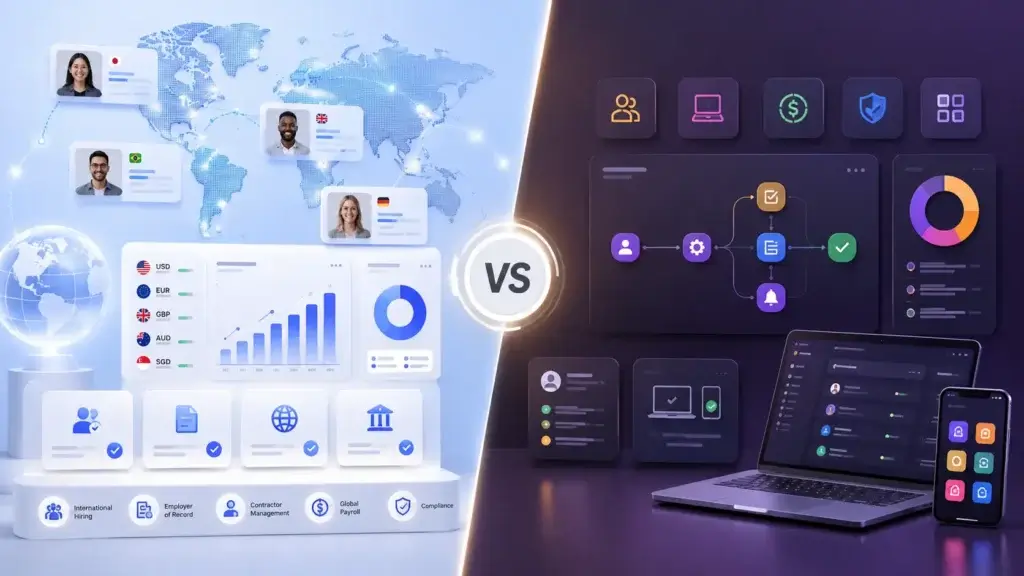
Deel is strongest for companies that want to hire, pay, and manage workers internationally. Its core value is global workforce management, including Employer of Record, contractor management, global payroll, compliance, localized contracts, and cross-border payments.
Rippling is strongest for companies that want to connect HR, IT, finance, payroll, device management, app access, and spend management in one system. It is broader than Deel, but that breadth can also make it less focused for companies whose main challenge is international hiring.
What Is Deel?
Deel is a global HR, payroll, and compliance platform designed for companies hiring and managing distributed teams. It helps businesses hire employees and contractors internationally, run payroll across countries, manage compliance, and support workers without needing to open local legal entities in every market.
One of Deel’s main strengths is its global-first approach. Deel says its global payroll platform supports employees, contractors, and EOR workers across 150+ countries, with unified data, automated compliance, and real-time cost visibility. Deel also states that it is trusted by 40,000+ companies.
For companies hiring internationally, Deel’s biggest advantage is that it brings several difficult workflows into one platform:
- Employer of Record hiring
- Global payroll
- Contractor management
- Contractor of Record
- Localized agreements
- Worker classification support
- Benefits administration
- Compliance workflows
- Multi-currency payments
- HR records and onboarding
This makes Deel especially useful for remote-first companies, SaaS businesses, startups expanding into new markets, agencies managing global contractors, and mid-market companies that want to hire internationally without building local entities first.
What Is Rippling?
Rippling is a workforce management platform that combines HR, IT, finance, payroll, app management, device management, and workflow automation. It is designed to be a connected operating system for employee data and business operations.
Rippling’s own product navigation presents the platform across HR, Payroll, IT, Finance, Global, and AI, which shows how broad the platform has become. Its global product areas include Employer of Record, Global Payroll, Global Contractors, Contractor of Record, Global HRIS, Global Benefits, and Global Spend.
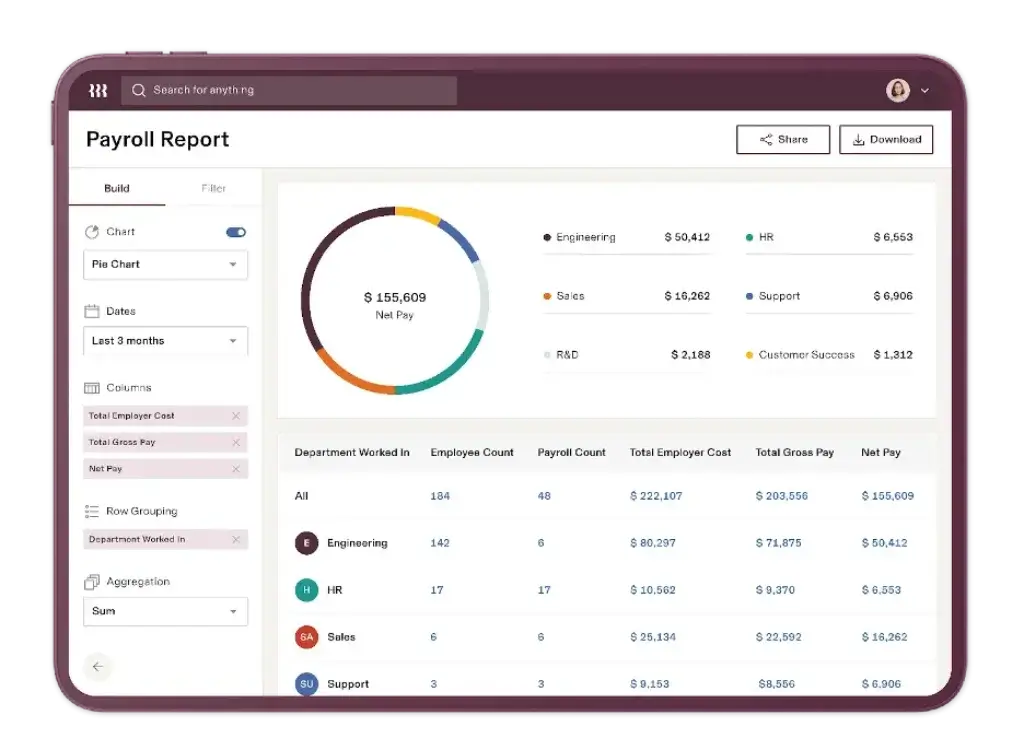
This makes Rippling very different from traditional HR software. Instead of only managing payroll or employee records, Rippling can help companies automate workflows across multiple departments. For example, when a new employee joins, Rippling can connect HR onboarding with payroll setup, app access, permissions, device shipping, security rules, and finance policies.
Deel vs Rippling: Quick Comparison
| Category | Better Fit | Why |
| Global hiring | Deel | 150+ countries |
| Employer of Record | Deel | Core strength |
| Contractor management | Deel | More specialized |
| Global payroll | Deel | Global-first payroll |
| HRIS | Depends | Different focus |
| IT management | Rippling | Stronger IT tools |
| Finance workflows | Rippling | Spend and approvals |
| Pricing clarity | Deel | More public pricing |
| Best for global teams | Deel | Stronger global focus |
| Best for HR + IT + Finance | Rippling | Broader platform |
Core Feature Comparison
Global Hiring, EOR, and Compliance
This is the most important category in the Deel vs Rippling comparison because it shows where the two platforms are fundamentally different.
Deel is built around global hiring. Its EOR service helps companies hire full-time employees in countries where they do not have their own legal entity. That is a major advantage for companies that want to expand internationally without setting up subsidiaries, registering payroll locally, hiring local legal experts, and building country-specific HR infrastructure.
Deel’s global payroll page emphasizes support for employees, contractors, and EOR workers across 150+ countries. Deel also publishes global payroll compliance guidance for 2026, highlighting the growing complexity of tracking jurisdiction-specific tax codes, filing deadlines, and mandatory benefits across countries. This is exactly the kind of operational problem Deel is built to solve.
Rippling also offers global products, including EOR, Global Payroll, Global Contractors, Contractor of Record, Global HRIS, and Global Benefits. However, Rippling’s global hiring tools sit inside a much broader HR, IT, and finance platform. That makes Rippling powerful, but less specialized than Deel for companies that primarily need global hiring and compliance support.
Payroll and Contractor Payments
Payroll is another category where both platforms are strong, but for different reasons.
Deel’s payroll strength comes from its global coverage and worker-type flexibility. Deel can support payroll for employees, contractors, and EOR workers across 150+ countries. That matters because global teams are rarely simple. A company may have full-time employees in one country, contractors in another, EOR employees in a third country, and local payroll entities elsewhere.
Deel’s platform is designed to bring those worker types together. It helps companies manage payments, local compliance, payroll documents, and contractor workflows from one place. Deel also lists payments in 120+ currencies under its contractor management pricing section.
Rippling is also strong in payroll, especially when payroll needs to connect with HR, time tracking, approvals, and employee data.
The difference is that Rippling’s payroll is strongest as part of a broader operating system, while Deel’s payroll is strongest as part of a global hiring and compliance platform.
HR Management and Employee Experience
Both Deel and Rippling offer HR management capabilities, but their HR products serve different strategic goals.
Deel’s HR capabilities are most valuable when the company has an international workforce. It can help manage employee records, documents, onboarding, compliance, payroll-related data, benefits, and country-specific workforce requirements. Deel’s value is not just that it stores employee data. Its value is that employee data connects to global payroll, worker classification, contracts, and country-specific compliance.
Rippling’s HRIS is broader and more operationally connected. Employee data can be used to trigger app access, device provisioning, permissions, finance policies, payroll workflows, and approvals. For example, a role change or department change can affect software permissions, device access, payroll settings, and approval chains.
This is one of the more balanced categories. Deel is stronger when HR is tied to international hiring, payroll, and compliance. Rippling is stronger when HR is the foundation for a connected employee operating system across HR, IT, and finance.
IT, Finance, and Workflow Automation
This is the category where Rippling clearly has the advantage.
Rippling is not only an HR and payroll platform. It is also an IT and finance operations platform. Its product areas include identity and access, device management, permissions, integrations, app workflows, finance, spend management, and travel. Rippling’s product navigation also highlights AI, analytics, workflow automation, permissions, integrations, and App Studio.
This gives Rippling a major advantage for companies that want to automate internal operations. For example, when an employee starts, Rippling can help provision apps, assign permissions, ship devices, apply policies, and connect data to payroll or finance workflows. When an employee leaves, it can help remove software access, deactivate accounts, reclaim licenses, and trigger offboarding actions.
Deel does not compete as directly in this area. Deel may support some HR and workforce-related operations, but it is not primarily an IT management or finance workflow platform.
Pricing and Value
Pricing is a major difference between Deel and Rippling.
Deel is generally easier to evaluate because it provides more public pricing for core plans. Deel lists contractor management from $49 per contractor per month and describes its pricing as transparent and scalable, with no hidden fees. A 2026 third-party Deel pricing guide also reports Global Payroll starting at $29 per employee per month and EOR pricing ranging higher depending on the service package.
Rippling, on the other hand, uses a more modular and quote-based pricing model. Its pricing page asks companies to request a personalized quote based on selected services. Third-party pricing guides commonly describe Rippling as starting with a base platform price, then increasing as companies add modules such as payroll, IT management, finance, global payroll, and EOR.
Here’s how both platforms compare in terms of support and success resources:
| Pricing Area | Deel | Rippling |
| Employer of Record | From $599/employee/month | Quote-based |
| Contractor management | From $49/contractor/month | Quote-based |
| Managed payroll | From $29/employee/month | Quote-based |
| HRIS / employee management | From $5/employee/month | Quote-based |
| Pricing visibility | Stronger | Limited |
| Best pricing fit | Global teams | Modular buyers |
Deel delivers better value when the buyer needs global hiring, EOR, contractor management, and international payroll. The platform is more focused, and the pricing structure is easier to map to global workforce use cases.
Rippling can deliver excellent value when a company wants to replace multiple systems across HR, payroll, IT, finance, spend management, and device management. However, that value depends on whether the company will actually use those modules. If not, Rippling may become broader and more expensive than necessary.
Deel vs. Rippling Pros and Cons
Deel Strengths
✅ Strong global hiring and EOR capabilities
✅ Excellent contractor management
✅ Global payroll across many countries
✅ Clearer pricing for core global workforce products
Deel Limitations
❌ Less advanced for IT management
❌ Limited finance and spend management features
❌ May be more than needed for local-only teams
❌ Some advanced services may still require sales input
Deel Pros
Strong global hiring and EOR capabilities
Deel is a strong choice for companies that want to hire employees in other countries without opening local entities. Its EOR model helps businesses expand into new markets faster while reducing administrative and legal complexity.
Excellent contractor management
Deel is especially useful for companies working with freelancers, consultants, and international contractors. It supports contractor agreements, payments, invoicing, tax documents, and compliance workflows in one platform.
Global payroll across many countries
Deel is built for companies that need to pay employees, contractors, and EOR workers across borders. This is valuable for distributed teams that need payroll coverage, local compliance, and multi-currency payment support.
Clearer pricing for core global workforce products
Deel provides more visible starting prices for several major services, including EOR, contractor management, HR, and managed payroll. This makes it easier for companies to estimate costs before speaking with sales.
Deel Cons
Less advanced for IT management
Deel is not primarily an IT management platform. Companies that need device provisioning, app access control, identity management, and software permissions may find Rippling stronger in this area.
Limited finance and spend management features
Deel focuses more on HR, payroll, compliance, and global hiring. If your company needs corporate cards, expense workflows, travel management, or finance automation, Rippling offers a broader toolset.
May be more than needed for local-only teams
Deel’s strongest value appears when companies hire internationally. If your workforce is mostly local and you only need basic HR or domestic payroll, some of Deel’s global capabilities may not be necessary.
Some advanced services may still require sales input
Although Deel is more transparent than many competitors, some services may still require custom pricing or a demo. This can apply when companies have complex payroll, benefits, or multi-country requirements.
Rippling Strengths
✅ Strong HR, IT, and finance platform
✅ Excellent workflow automation
✅ Advanced device and app management
✅ Useful for companies replacing multiple tools
Rippling Limitations
❌ Less specialized for global hiring than Deel
❌ Pricing is harder to estimate upfront
❌ Can feel too broad for payroll-focused buyers
❌ Add-on modules may increase total cost
Rippling Pros
Strong HR, IT, and finance platform
Rippling is broader than a standard HR or payroll tool. It connects employee data with IT systems, finance workflows, payroll, apps, devices, and permissions.
Excellent workflow automation
Rippling is strong for automating employee lifecycle tasks. Onboarding, offboarding, app access, payroll updates, device management, and approval workflows can all be connected through the platform.
Advanced device and app management
Rippling has a clear advantage for companies that need IT controls. It can help manage laptops, software access, permissions, identity, and offboarding actions from one place.
Useful for companies replacing multiple tools
Rippling can be valuable for companies that want to reduce tool sprawl. Instead of using separate systems for HR, payroll, IT, spend, and approvals, Rippling brings many of these workflows into one platform.
Rippling Cons
Less specialized for global hiring than Deel
Rippling supports global workforce needs, but global hiring is only one part of its broader platform. Deel is more focused on EOR, contractor management, global payroll, and international compliance.
Pricing is harder to estimate upfront
Rippling uses a modular, quote-based pricing model. This gives companies flexibility, but it also makes the total cost harder to understand before speaking with sales.
Can feel too broad for payroll-focused buyers
Companies mainly looking for EOR, contractor payments, or global payroll may find Rippling more complex than needed. Its broader HR, IT, and finance structure can create extra setup work.
Add-on modules may increase total cost
Rippling’s value depends on which modules a company actually uses. If a business adds payroll, IT, finance, global, spend, and automation tools, the final price can rise significantly.
Detailed Buying Scenarios
Scenario 1: You Want to Hire in a Country Where You Have No Entity
Deel is the better choice.
This is one of Deel’s core use cases. Through EOR, Deel can help companies hire employees in countries where they do not have a local legal entity. That can significantly reduce the time, cost, and administrative complexity of entering a new market.
Rippling also offers global hiring products, but Deel is more directly associated with this use case and has stronger positioning around international employment, EOR, and contractor compliance.
Scenario 2: You Work With Many International Contractors
Deel is the better choice.
Deel’s contractor management is one of its strongest areas. It supports compliant contracts, contractor payments, invoicing, document collection, and multi-currency payments. Deel publicly lists contractor management from $49 per contractor per month.
Rippling can manage contractors, but it is not as contractor-first as Deel. If contractors are a major part of your workforce, Deel is usually the more practical platform.
Scenario 3: You Need Payroll Plus IT Automation
Rippling is the better choice.
If payroll is only one part of a broader employee operations problem, Rippling is stronger. Its platform can connect payroll with employee records, app access, device management, finance rules, and offboarding workflows.
This is especially valuable for companies with growing IT operations, complex permission structures, many software tools, or strict security policies.
Scenario 4: You Want Predictable Pricing for Global Hiring
Deel is the better choice.
Deel provides more visible public pricing for key global workforce products, including contractor management. Third-party pricing guides also provide clear starting points for global payroll and EOR.
Rippling’s quote-based model can be flexible, but it requires more sales involvement and makes upfront comparison harder. That is not a problem for larger companies with complex requirements, but it can slow down the evaluation process for teams trying to compare global hiring costs quickly.
Scenario 5: You Want One System for HR, IT, Finance, and Spend
Rippling is the better choice.
This is Rippling’s core advantage. If your company wants to consolidate multiple systems into one connected platform, Rippling is the stronger choice. It is particularly useful when employee data needs to trigger actions across IT, payroll, finance, travel, permissions, and spend.
Deel is better for global workforce management. Rippling is better for full employee operations.
Final Recommendation
For companies comparing Deel vs Rippling specifically for global hiring, international payroll, contractor management, EOR, and compliance, Deel is the better choice.
Deel is more focused on the problem global teams actually need to solve: hiring workers internationally, paying them correctly, managing contractors, reducing compliance risk, and operating across countries without building local entities too early. Its global payroll support across 150+ countries, its contractor management pricing, and its global-first product structure make it the stronger fit for international workforce management.
Rippling is still an excellent platform. In fact, it may be the better choice for companies that want a broader HR, IT, and finance operating system. Its strengths in app access, device management, workflow automation, finance tools, and internal operations are clear.
But for the core comparison question, Deel is the stronger platform for global teams. Rippling is broader, but Deel is more specialized. And when the goal is international hiring and global workforce compliance, specialization matters.
FAQ
What is the main difference between Deel and Rippling?
The main difference is focus. Deel is built primarily for global hiring, EOR, contractor management, international payroll, and compliance. Rippling is a broader workforce management platform that connects HR, IT, finance, payroll, devices, apps, and spend management.
Is Deel better than Rippling for global hiring?
Yes. Deel is generally better for global hiring because it is more focused on international employment, EOR, contractor management, and payroll across 150+ countries.
Is Rippling better than Deel for IT management?
Yes. Rippling is better for IT management. It includes stronger tools for app access, permissions, device management, workflow automation, and offboarding actions. Rippling’s January 2026 update included advanced Microsoft 365 offboarding actions, showing how much the platform focuses on IT workflows.
Which platform is better for contractor management?
Deel is the better fit for contractor management, especially for companies working with international freelancers and distributed contractor teams. Deel’s contractor management plan includes compliant contracts, payments, invoicing, tax form guidance, and document collection.
Which platform has more transparent pricing?
Deel is generally more transparent. It publicly lists pricing for contractor management and describes its pricing as transparent and scalable. Rippling uses a custom quote process, which can be flexible but harder to compare upfront.
Which is better for startups?
Deel is better for startups hiring internationally or working with global contractors. Rippling may be better for startups that are mostly hiring locally and want to centralize HR, IT, finance, software access, and device management.
Should I choose Deel or Rippling?
Choose Deel if your priority is global hiring, EOR, international payroll, contractor management, and compliance. Choose Rippling if your priority is connecting HR, IT, finance, devices, apps, and internal workflows in one platform.