Introduction
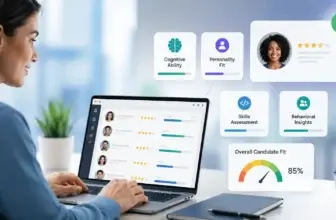
Choosing HR software is no longer just about digitizing employee records. The right platform also affects how managers run reviews, how employees set goals, how HR tracks engagement, and how efficiently your company can connect onboarding, learning, compensation, and reporting. In this Leapsome review, you will get a practical look at what the platform does well, where it is strongest, where it still has trade-offs, and which kinds of businesses will get the most value from it.
Leapsome has evolved from a performance and engagement platform into a broader people platform that now combines HRIS, talent management, AI support, payroll preparation, workflows, time tracking, onboarding, and more. That matters because many companies do not want to juggle one tool for reviews, another for engagement, another for onboarding, and another for core people data. Leapsome is trying to solve that fragmentation problem in a more modern and modular way.
What Is Leapsome?
Leapsome is an AI-powered HR and people platform designed to connect HR operations, performance management, employee engagement, learning, compensation, and analytics in one system. You can use it to manage employee records, automate workflows, run reviews, track goals and OKRs, launch surveys, centralize HR documents, support onboarding, and prepare payroll with synced data.
Its main appeal is that it brings together both HRIS and talent management. Many vendors are strong in one of those areas but weaker in the other. Leapsome is more compelling because it tries to combine operational HR with employee growth and performance in the same platform.
Background and Positioning
Leapsome positions itself as a flexible, modular people platform for HR excellence and high-performing teams. The product now includes HRIS capabilities like employee records, absence management, time tracking, documents and e-signatures, onboarding and pre-boarding, payroll prep, and whistleblowing, alongside talent modules like performance reviews, engagement surveys, goals and OKRs, learning, compensation, feedback, and 1:1s.
Target Users and Use Cases
Leapsome is especially relevant for several buyer types:
- Scaling SMBs and mid-sized companies – You get more strategic people tools than a basic HRIS usually offers.
- HR teams that want one connected platform – It reduces fragmentation across HR operations and talent workflows.
- People-first companies – Leapsome is strong when development, feedback, and engagement matter as much as admin.
- Organizations standardizing performance processes – Reviews, goals, meetings, and learning are meaningful strengths.
- Companies modernizing their HR stack – The modular structure makes phased adoption easier.
That said, Leapsome is not the best fit for every buyer. If you want fully transparent self-serve pricing, a very lightweight HR tool, or a payroll-first platform with native payroll depth across every market, there may be better options. Leapsome is strongest when you want an integrated people platform rather than a narrow point solution.
Core Features of Leapsome
How Does Leapsome Work?
Leapsome stands out because it connects employee data with performance, development, engagement, and workflows. The value is not only in storing information. It is in helping HR teams and managers act on that data through connected processes.
Core HR and Employee Data Management
Leapsome’s HRIS now covers employee records, centralized data, advanced workflows and approvals, reporting and analytics, absence management, and documents. This gives you a real operational foundation, not just a performance layer sitting on top of another system. If you want to reduce HR stack complexity, this matters a lot.
Engagement Surveys and Employee Sentiment
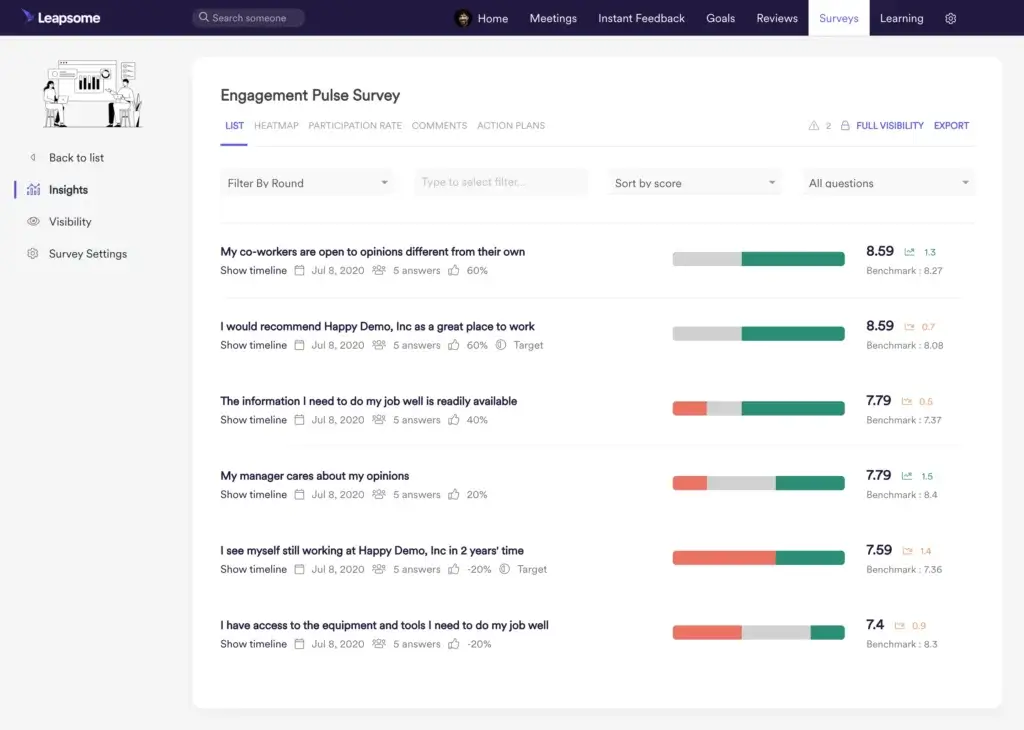
Another major benefit is that engagement is built into the same platform. You can launch pulse surveys, collect feedback, identify patterns, and connect engagement results to development and manager practices. In practical terms, this is more useful than running surveys in a separate tool that never connects back to growth or performance data.
Learning and Development
Leapsome includes learning capabilities that help HR teams deliver training, support onboarding, and connect skill development to performance outcomes. That creates a better closed loop than using a disconnected LMS, especially if your company wants reviews to lead directly into learning plans.
1:1s, Meetings, and Continuous Development
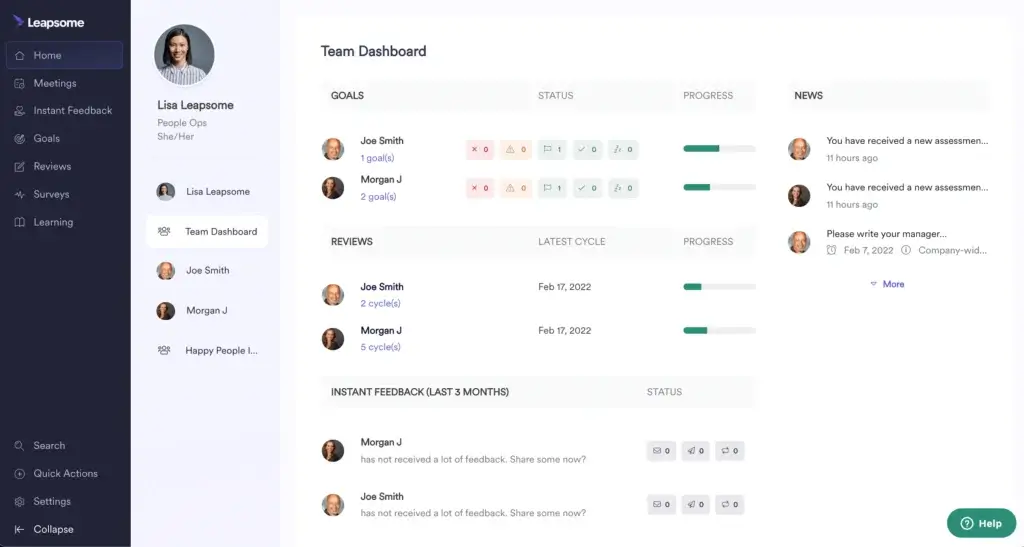
Leapsome is also built around ongoing employee development, not just annual review cycles. Tools for 1:1s, team meetings, instant feedback, and feedback-based growth make the platform more useful for managers throughout the year, not only during formal evaluation periods.
Onboarding and Pre-boarding Workflows
Onboarding has become a meaningful strength in Leapsome’s HRIS offering. You can automate tasks, reminders, and document collection, create customized onboarding journeys by role or department, involve managers and IT, and even connect onboarding to learning modules. That makes Leapsome more relevant for companies that want a strong first-day experience without buying yet another HR tool.
Documents and E-signatures
Leapsome also includes document management and e-signatures, which helps centralize employee files, contracts, and policy sign-offs. This is one of those features that may not feel flashy in a demo, but in practice it removes a lot of manual admin and keeps HR records more organized and compliant.
Absence Management and Time Tracking
On the HR operations side, Leapsome supports absence management and time tracking. Employees can log hours and breaks through a simple interface, while HR and managers can use the data for compliance, reporting, and payroll preparation. This expands the platform beyond pure talent management and makes it more credible as a real HRIS option.
Payroll Preparation
Leapsome’s payroll story is more about connected payroll preparation than becoming a fully universal payroll engine. The platform syncs updates from employee records, absences, and time tracking into payroll workflows, which reduces duplication and helps payroll reflect the latest employee data. That is very useful, but buyers should still confirm exactly how payroll works in their countries and whether native payroll depth matches their needs.
AI Agents and HR Assistance
Leapsome is also pushing more strongly into AI. Its built-in AI agents are designed to reduce admin, support decision-making, and help employees and managers inside the HR platform. This makes the system more current and potentially more efficient, especially for teams that want guidance, summaries, and faster execution across HR workflows.
Workflows and Automation
Leapsome’s workflow builder gives admins a flexible way to automate lifecycle events like onboarding, reboarding, relocations, manager changes, and other employee milestones. This is a meaningful value driver because the automation layer connects core people data to real actions instead of leaving HR teams to manage everything manually.
Performance Reviews and Feedback
Performance management is still one of Leapsome’s signature strengths. You can run structured review cycles, gather 360-degree feedback, standardize assessment frameworks, and connect reviews to competencies and development. This is one of the areas where Leapsome feels more mature than many newer HRIS vendors that added reviews later.
Goals, OKRs, and Alignment
Leapsome also does a good job tying performance to goals and OKRs. Employees and managers can align individual work with broader company priorities, which makes review conversations more useful and less subjective. For organizations trying to build a real performance culture, this is an important advantage.
Business Operations Features
Leapsome Payroll, Integrations, and HR Operations
One of the most important things to understand about Leapsome is that it is broader than many people still assume. It may be best known for performance and engagement, but it now includes a much more complete operational HR layer.
Payroll Readiness Rather Than Payroll-First Positioning
Leapsome’s payroll capabilities focus on accuracy and synchronization. The platform automatically pulls updates from employee records, absences, and time tracking into payroll workflows so compensation data stays aligned. For many companies, that is exactly what they need. For others, especially those seeking deep native payroll capabilities across multiple markets, a payroll-specialist platform may still be stronger.
Integrations and Ecosystem
Leapsome integrates with ATS, HRIS, communication, calendar, and identity tools. It supports Slack, Microsoft Teams, calendar integrations, SSO options like Okta and Google Workspace, and provisioning options such as Microsoft Entra ID. That makes the platform much easier to fit into an existing stack than a closed system with limited connectivity.
Compliance-Oriented Add-ons
Leapsome also offers a whistleblowing add-on, which is more relevant than it may first appear. It provides an internal reporting channel with anonymous submission, secure follow-up, and support for EU and German whistleblower compliance requirements. This will not matter to every buyer, but for regulated and compliance-aware organizations, it is a serious plus.
Analytics and Reporting
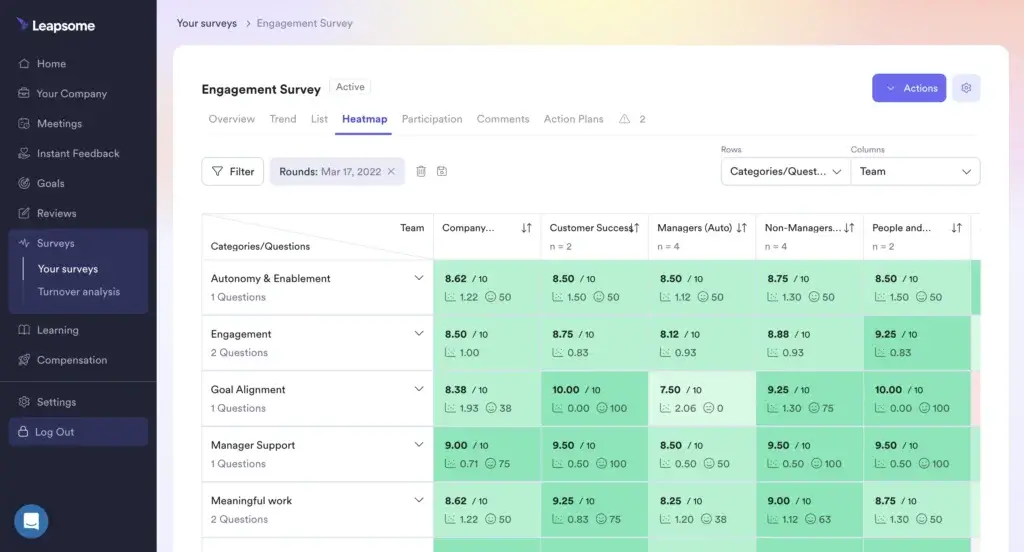
Reporting is another strength because Leapsome connects HR operations data with talent processes. You are not just looking at isolated survey data or standalone review scores. Instead, the platform helps you analyze people data across onboarding, performance, engagement, and development in a more connected way.
Pros and Cons
Benefits and Limitations of Using Leapsome
Positive
✅ Strong mix of HRIS and talent management
✅ Excellent performance management
✅ Useful employee engagement layer
✅ Solid onboarding and workflow value
Negative
❌ Pricing visibility is limited
❌ Costs depend on modules, term length, and scale
❌ Breadth can create complexity
❌ Implementation decisions still matter
Strengths & Benefits
Leapsome gets a lot right if your company wants a connected people platform rather than isolated HR tools.
- Strong mix of HRIS and talent management – It covers both operational HR and employee development in one system.
- Excellent performance management – Reviews, feedback, goals, and development are among its most mature strengths.
- Useful employee engagement layer – Surveys, feedback, and manager support make it more than a basic HR database.
- Solid onboarding and workflow value – HR teams can automate more lifecycle processes without extra point tools.
Limitations & Drawbacks
Leapsome is a strong platform, but it is not automatically the best fit for every HR buyer.
- Pricing visibility is limited – You need to talk to sales for a precise quote.
- Costs depend on modules, term length, and scale– Total cost depends on what you include.
- Breadth can create complexity – Smaller teams may not need everything the platform offers.
- Implementation decisions still matter – The flexibility is valuable, but it also means setup needs planning.
Operational Fit
Leapsome User Experience, Support, and Security
Software fit is not just about feature lists. It also depends on usability, rollout effort, support quality, and whether the vendor can be trusted with sensitive employee data.
Ease of Use
Ease of use is one of Leapsome’s most consistent strengths in public user reviews. Review patterns on G2 and Capterra repeatedly highlight intuitive navigation, simplicity, and the ability to organize feedback and goal tracking well. That matters because adoption is often the difference between a tool that looks good in procurement and one that actually improves day-to-day HR operations.
Customer Support
Leapsome offers implementation and customer success support, though its dedicated customer success services are tied to larger annual contracts. All customers still get ongoing email support and access to the vendor’s success resources. That setup is fairly standard for B2B SaaS, but it is worth understanding before you buy if you expect highly hands-on support from day one.
Security and Privacy
Leapsome’s public trust and privacy materials make it clear that the company places serious emphasis on security and data protection. It maintains a dedicated Trust Center and frames its privacy posture around GDPR compliance. For HR buyers handling sensitive employee information, that is an important trust signal, even if you still need to validate specific security and compliance requirements during procurement.
AI Readiness and Governance
Leapsome’s newer AI positioning is one of its more interesting differentiators. Rather than offering AI as a generic add-on, it is building AI agents into HR workflows to reduce admin and support better decisions. The key question for buyers is not just whether AI exists, but whether it is genuinely helpful. In Leapsome’s case, the AI story looks more connected to real HR use cases than what many vendors currently market.
Implementation Experience
Implementation appears more manageable than many enterprise HR rollouts, especially because Leapsome is modular and can be adopted in stages. At the same time, the more modules you activate across HRIS, reviews, surveys, onboarding, workflows, and payroll prep, the more important proper scoping becomes. This is not a plug-and-play toy. It is a serious platform that benefits from a deliberate rollout.
Pricing
Leapsome Pricing & Plans
Leapsome pricing is flexible, but not fully transparent. The company says modules can be bought individually or combined, with multi-module discounts available. Final pricing depends on the number of employees, contract length, and modules selected, and contracts have a minimum term of one year.
What Leapsome Includes
Leapsome currently offers HRIS, performance reviews, engagement surveys, goals and OKRs, learning, compensation, onboarding and pre-boarding, documents and e-signatures, time tracking, payroll, whistleblowing, workflows, analytics, and AI-related capabilities. That makes the buying process more configurable, but also more dependent on your exact scope.
Free Trial and Buying Model
The company offers a 14-day free trial with no credit card required, which is useful because you can explore the platform before committing. Still, this is not fully self-serve software with a simple pricing calculator that tells you your total cost immediately.
What Affects Total Cost
Your total cost will likely depend on headcount, chosen modules, contract duration, implementation requirements, and how much support you need. That means two buyers can evaluate the same vendor and get very different price points.
What to Ask Before You Buy
If you are considering Leapsome, ask about module packaging, implementation fees, support coverage, payroll capabilities in your regions, integration depth, and how costs change as you expand usage. This matters because Leapsome can look affordable at first and then become a more substantial investment once multiple modules are added.
Pricing Table
The table below gives a practical view of how Leapsome’s pricing approach works today.
| Feature Type | Leapsome | What it means for buyers |
| Pricing model | Custom pricing | You need to request a quote based on scope |
| Buying structure | Modules can be purchased individually or combined | You can tailor the platform, but cost planning takes more work |
| Free trial | 14-day free trial | You can test the platform before committing |
| Contract term | Minimum 1 year | Not ideal if you want very short-term flexibility |
| Support model | Email support for all, broader customer success for larger annual contracts | Important to clarify implementation expectations early |
| Best for | Companies wanting HRIS and talent tools in one platform | Better fit for strategic HR buyers than teams wanting only basic admin |
For many companies, the real pricing question is not whether Leapsome is cheap. It is whether consolidating HRIS, reviews, surveys, onboarding, and development into one system creates enough operational and strategic value to justify the spend. For the right buyer, the answer can absolutely be yes.
Use Cases
Who Should Use Leapsome?
Leapsome is not for every business, but it fits several types of buyers especially well.
Companies That Want HRIS and Talent Tools Together
If you want one platform that covers employee data, onboarding, workflows, reviews, goals, surveys, and learning, Leapsome is a strong choice. This is one of its clearest advantages over more narrowly focused performance vendors.
People Teams Focused on Development and Engagement
Leapsome is particularly attractive if your HR strategy is not just administrative. If you care about manager effectiveness, continuous feedback, employee growth, and measurable engagement, the platform aligns well with those priorities.
Scaling Organizations Standardizing HR Processes
Growing companies often reach the point where spreadsheets, lightweight HR tools, and disconnected performance systems stop working. Leapsome can be a strong next-step platform when you need more structure without jumping into a very heavy enterprise suite.
When Leapsome Might Not Be Right
Leapsome may not be the best fit if you need the simplest possible HR tool, if you want fully transparent public pricing before speaking with sales, or if payroll is your number one priority and needs to be deeply native across all regions. In those cases, a different platform may fit more naturally.
User Feedback
Leapsome Customer Reviews
Leapsome reviews are strong overall. Public review patterns on G2 emphasize ease of use, intuitive design, simple feedback workflows, and strong organization around goals and performance. Capterra reviews also repeatedly highlight usability, customization, and the platform’s ability to centralize HR and employee development processes.
What Users Like Most
The most common positives in public reviews include ease of use, intuitive navigation, useful performance and feedback workflows, strong survey customization, and the ability to connect multiple people processes in one place. This lines up well with Leapsome’s product positioning.
Common Complaints
The most recurring complaints are also fairly predictable. Some users mention a learning curve because the platform is broad, some say the system can feel overwhelming at first, and others note that not every feature is equally intuitive on first use. These are not unusual problems for a platform with this much scope, but they are still worth factoring into your evaluation.
My Take on the Review Pattern
The review pattern suggests that Leapsome is genuinely strong, especially for companies that want a modern, integrated people platform. Its biggest risk is not poor product quality. It is that some organizations may buy more platform than they actually need. If your company will use the connected workflow between HRIS, performance, engagement, and learning, the value is much clearer.
Competitors
Competitor Alternatives to Leapsome
Leapsome is most often compared with platforms like BambooHR, HiBob, and 15Five. The right alternative depends on whether you prioritize HR admin simplicity, a broader modern HR platform, or a more focused employee performance and engagement experience.
| Feature Type | Leapsome | BambooHR | HiBob | 15Five |
| Core angle | Connected HRIS and talent platform | Simpler HR software for SMBs | Modern HR platform for scaling and global teams | Performance and engagement focused platform |
| Best for | Companies that want people operations and development together | Teams prioritizing ease and HR admin basics | Mid-market organizations needing broader HR depth | Companies focused mainly on manager effectiveness and employee growth |
| Performance tools | One of the platform’s biggest strengths | More limited | Solid, but not always its deepest edge | Strong and focused |
| HRIS depth | Now much stronger and broader | Clear and approachable | Very strong modern HR foundation | More limited than HRIS-led vendors |
| Onboarding and workflows | Strong and increasingly valuable | Useful but more basic | Strong and flexible | Less central to its positioning |
| Overall angle | Best balance of HR operations and talent management | Best for simpler HR needs | Best for broader modern HR platform requirements | Best for focused performance and engagement use cases |
Compared with BambooHR, Leapsome usually makes more sense if you care more about performance, engagement, and development in the same system as HR operations. Compared with HiBob, Leapsome often feels more talent- and enablement-centric, while HiBob can feel slightly stronger as a broader modern HR platform for certain mid-market and multinational use cases. Compared with 15Five, Leapsome offers a more complete HRIS and workflow story rather than focusing mainly on performance and manager effectiveness.
If I had to summarize it simply, Leapsome is one of the more compelling options for companies that want a modern people platform with real depth in performance and development, while also reducing HR tool fragmentation.
Best Practices
Getting Started with Leapsome
To get the most out of Leapsome, you should make a few smart decisions early.
Define Your Main Use Cases First
Leapsome can serve as a performance platform, an HRIS, a survey tool, an onboarding system, or a more complete people platform. Before implementation, decide which outcomes matter most so your rollout stays focused.
Scope Modules Carefully
The platform’s modular design is a strength, but it also means you should avoid buying features your organization will not actually use. Be disciplined about what your managers, HR team, and employees need now versus later.
Standardize Your Review and Goal Frameworks
Leapsome becomes much more valuable when you define clear competencies, review cycles, and goal structures from the beginning. The platform can support strong performance practices, but it still needs thoughtful process design behind it.
Connect Onboarding, Learning, and Development
One of Leapsome’s real advantages is that onboarding does not have to sit in isolation. If you connect onboarding to learning and future performance workflows, the platform becomes much more strategic.
Clarify Payroll and Integration Needs Early
If payroll preparation, time tracking, SSO, or system integrations are important to your use case, map those needs before rollout. Leapsome has good connectivity, but the exact setup still matters.
Conclusion
Final Thoughts
⭐ Overall Rating: 8.6/10
Leapsome is one of the more interesting HR software options because it bridges two worlds that are often separated. On one side, you have operational HR needs like employee records, onboarding, time tracking, payroll preparation, and documentation. On the other, you have performance, engagement, learning, and development. Leapsome brings those together better than many competing tools.
Its biggest strengths are performance management, engagement, connected talent development, onboarding flexibility, modularity, and its growing HRIS depth. Its biggest drawbacks are pricing transparency, the risk of overbuying modules, and the fact that payroll may not be deep enough for every international payroll-heavy use case.
Overall, Leapsome is a strong recommendation for companies that want a modern, integrated people platform and plan to use both the HR operations and talent development sides of the product. If your organization wants to reduce tool sprawl while building stronger manager processes, employee growth systems, and more connected HR workflows, Leapsome is well worth considering.
Have more questions?
Frequently Asked Questions
What is Leapsome best used for?
Leapsome is best used for combining HR operations, performance reviews, goals, employee engagement, learning, onboarding, and analytics in one connected people platform.
Is Leapsome an HRIS or a performance management tool?
It is both. Leapsome started with strong performance and engagement functionality, but it now also offers HRIS capabilities like employee records, absence management, documents, onboarding, time tracking, and payroll support.
Does Leapsome include onboarding?
Yes. Leapsome includes pre-boarding and onboarding features with automated tasks, reminders, customizable workflows, learning integration, and onboarding reporting.
Does Leapsome include payroll?
Leapsome supports payroll preparation and data sync by pulling updates from employee records, absences, and time tracking into payroll workflows. You should still confirm the exact payroll setup for your region.
How much does Leapsome cost?
Leapsome uses custom pricing. Cost depends on employee count, contract term, and the modules you choose. The company also offers a 14-day free trial.
Is Leapsome easy to use?
Yes. Ease of use is one of the platform’s strongest recurring themes in public reviews, though some users say the breadth of features can create a short learning curve at first.
What companies is Leapsome best for?
Leapsome is best for growing companies that want a connected people platform combining HR operations with development, engagement, and performance management.
Does Leapsome integrate with other business tools?
Yes. Leapsome integrates with ATS, HRIS, Slack, Microsoft Teams, calendars, SSO providers, and other systems, making it easier to fit into an existing HR tech stack.
What are the main Leapsome alternatives?
The main alternatives usually include BambooHR, HiBob, and 15Five, depending on whether you prioritize simpler HR admin, broader modern HR capabilities, or more focused performance and engagement tools.
Is Leapsome worth it overall?
Yes, for the right buyer. If your company wants to reduce tool sprawl and connect HR operations with employee performance, feedback, engagement, and development, Leapsome is a strong option worth serious consideration.