Introduction
Inventory management and AI are becoming closely connected because businesses can no longer rely only on static spreadsheets, delayed stock reports, and fixed reorder points. When demand shifts quickly, suppliers miss deadlines, customer behavior changes, or sales channels multiply, traditional inventory processes often become too slow to protect margins and service levels.
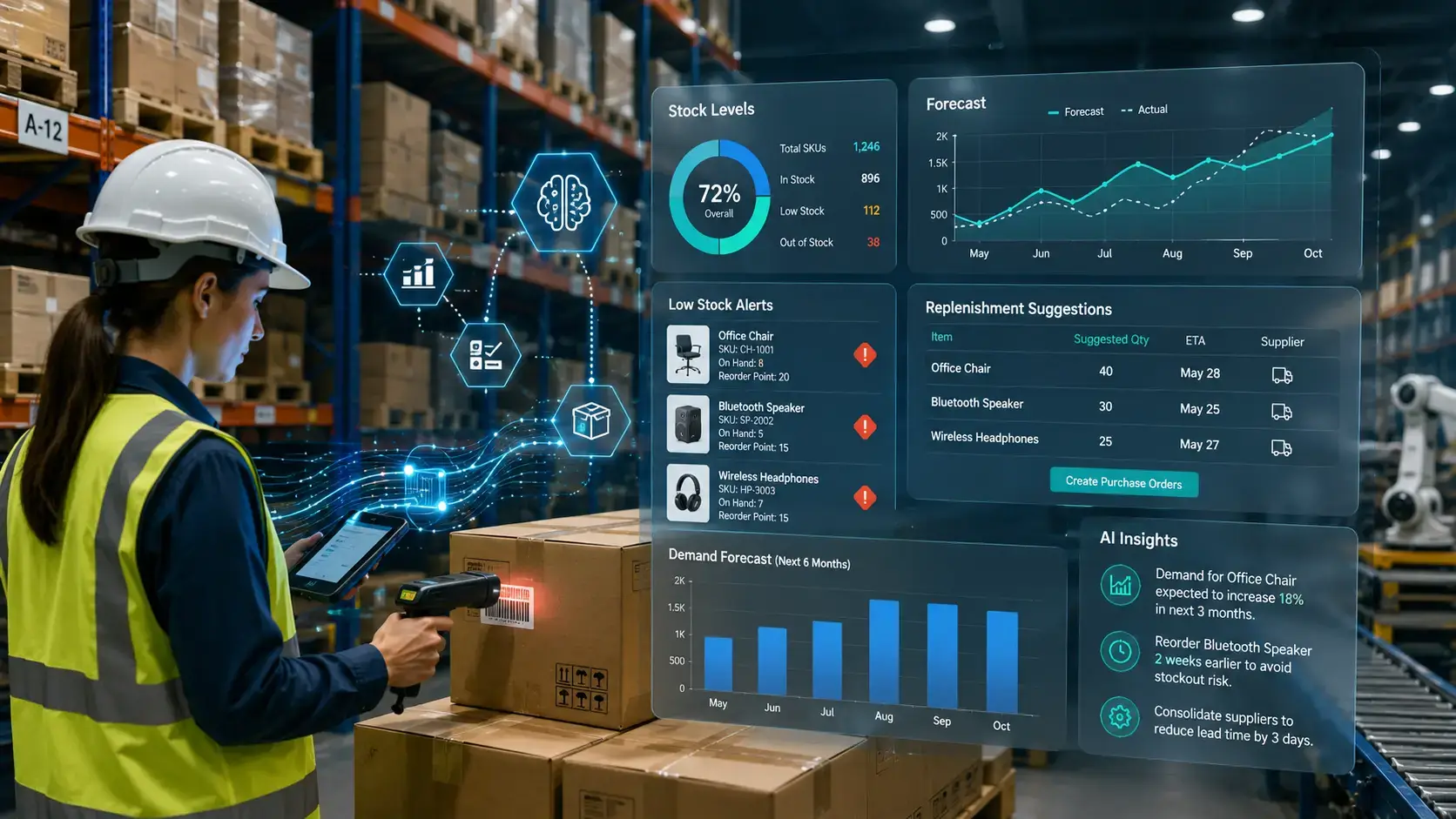
AI inventory management helps you make stock decisions with better data. Instead of only reviewing what happened last month, AI can help forecast what is likely to happen next, recommend replenishment quantities, flag unusual stock movement, identify supply risks, and show where inventory is trapped, missing, or likely to run out.
This does not mean AI should replace inventory managers. The most effective approach is usually a human-in-the-loop model where AI helps your team make faster and more accurate decisions, while experienced operators still review exceptions, supplier issues, strategic orders, seasonal demand, and high-value inventory decisions.
In this guide, you will learn what inventory management and AI mean, how AI improves demand forecasting and replenishment, which use cases matter most, what risks to avoid, which features to compare in AI inventory management software, and how to implement AI without creating unreliable automation.
What Is Inventory Management and AI?
Inventory management and AI refers to the use of artificial intelligence, machine learning, predictive analytics, automation, and real-time data to improve how a business tracks, forecasts, replenishes, and controls stock. The goal is simple: keep the right products, materials, or parts available in the right quantity, at the right location, at the right time.
Traditional inventory management usually depends on historical sales reports, manual counts, spreadsheet models, fixed reorder points, and manager judgment. Those methods can still work for simple operations, but they become harder to manage when your business has multiple warehouses, fast-moving SKUs, suppliers with variable lead times, ecommerce channels, seasonal demand, or manufacturing dependencies.
AI changes the process by analyzing more data, detecting patterns faster, and recommending inventory actions before problems become expensive. For example, an AI-powered system can notice that a product normally sells faster after a promotion, that one supplier often delivers late during peak season, or that a warehouse is likely to run out of a key item before the next purchase order arrives.
AI inventory management in one sentence
AI inventory management is the use of intelligent software to predict demand, optimize stock levels, automate replenishment, detect inventory risks, and support better purchasing, warehouse, and supply chain decisions.
Traditional inventory management vs AI inventory management
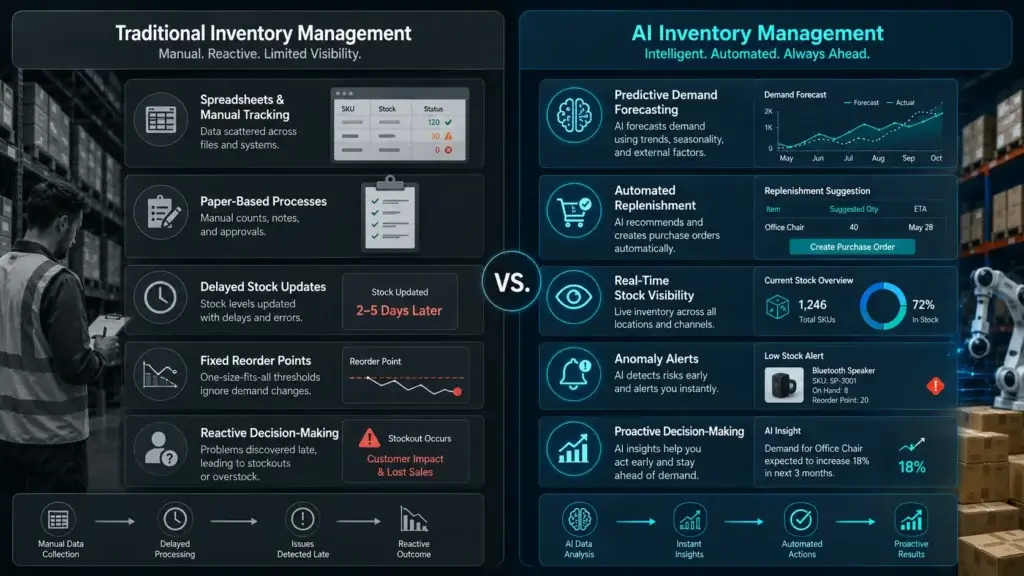
The biggest difference is not only automation. It is the shift from reactive inventory control to predictive inventory planning. Traditional systems often tell you what stock you have now, while AI systems can help estimate what stock you will need next.
| Area | Traditional Inventory Management | AI Inventory Management |
| Forecasting | Uses historical averages, manual judgment, or spreadsheet formulas | Uses machine learning, trends, seasonality, promotions, and external signals |
| Reordering | Depends on fixed reorder points or manual purchasing decisions | Recommends reorder timing and quantities based on demand and lead times |
| Stock visibility | Often delayed, especially across multiple locations or systems | Can provide real-time or near-real-time inventory visibility |
| Decision-making | Mostly reactive after stockouts, overstock, or delays occur | More proactive through alerts, predictions, and exception management |
| Risk control | Relies heavily on manual monitoring and experience | Flags anomalies, unusual movement, supplier delays, and demand changes earlier |
| Best fit | Small or simple inventory operations with stable demand | Growing, multi-location, manufacturing, retail, ecommerce, and distribution teams |
Why AI does not remove the need for inventory expertise
AI can process more data than a person can manually review, but it does not automatically understand every business constraint. A system may recommend a purchase order, but your team may know that a supplier is changing prices, a product is being discontinued, a large customer order is uncertain, or a warehouse has no space for additional stock.
That is why the best inventory management and AI strategy is not full blind automation. It is assisted decision-making. AI should help you identify the best options faster, while your team applies business context before acting on major stock decisions.
Why AI Is Becoming Important in Inventory Management
Inventory management has become more difficult because businesses are dealing with higher customer expectations, more sales channels, fluctuating demand, supplier uncertainty, and pressure to reduce working capital. When inventory data is slow or inaccurate, small mistakes can turn into stockouts, excess stock, late orders, and lost revenue.
AI is becoming important because it helps inventory teams move from periodic reviews to continuous planning. Instead of waiting for monthly reports, you can use AI-supported tools to monitor demand changes, detect stock risks, and adjust purchasing decisions earlier.
Demand is harder to predict
Customer demand can change quickly because of pricing changes, seasonality, promotions, social media trends, competitor activity, weather, macroeconomic conditions, and channel-specific buying behavior. A spreadsheet forecast may not capture those signals fast enough, especially if you sell many SKUs or operate across several locations.
AI demand forecasting can analyze patterns across historical sales, current orders, seasonality, lead times, product categories, and external variables. This gives you a more flexible forecast than a simple average based on last year’s sales.
Inventory mistakes are expensive
Poor inventory decisions affect more than warehouse efficiency. They also affect revenue, customer satisfaction, cash flow, supplier relationships, and production planning. Overstock ties up capital in products that may not sell quickly. Stockouts create missed sales, rushed shipping, backorders, and customer frustration.
The most damaging inventory problems usually come from a combination of inaccurate data and slow decisions. AI helps by monitoring more variables at once and surfacing exceptions before they become operational problems.
Large organizations are moving toward AI forecasting
AI-based supply chain forecasting is moving from experimental use cases into mainstream planning. As more organizations adopt AI forecasting, inventory teams will be expected to make decisions with better visibility, more frequent forecasts, and more automated recommendations.
This matters for growing companies as well. Even if you are not an enterprise buyer, the same principle applies: the earlier you improve forecasting and stock visibility, the easier it becomes to control inventory costs as the business scales.
Core Use Cases of AI in Inventory Management
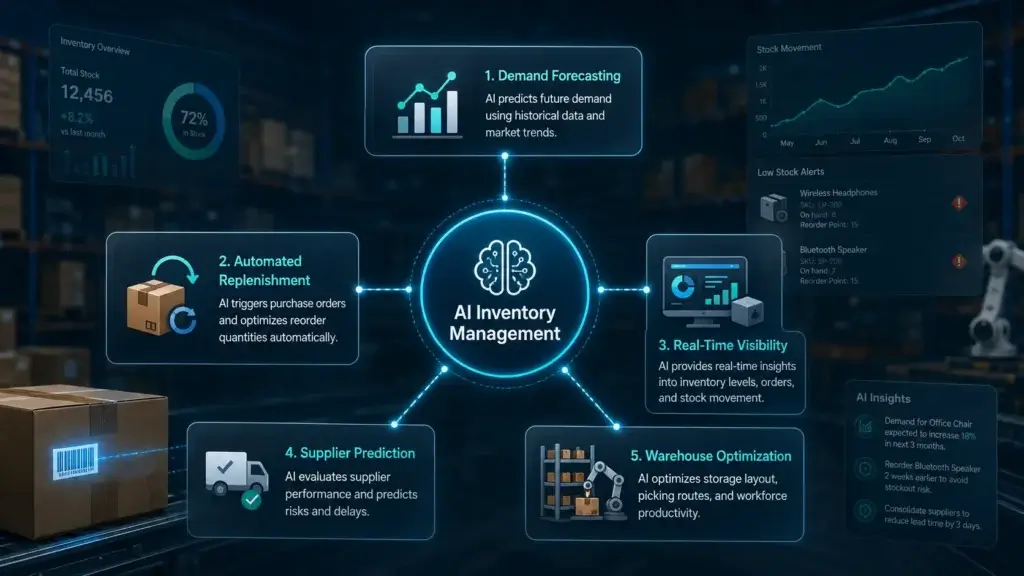
The strongest AI inventory management use cases are the ones that help you reduce uncertainty. AI is most useful when it improves decisions around what to buy, when to buy, how much to stock, where to move inventory, and which risks need attention first.
AI demand forecasting
AI demand forecasting is one of the most valuable applications of inventory management and AI. It helps estimate future demand by analyzing historical sales, seasonality, promotions, product trends, channel behavior, customer segments, and sometimes external signals such as weather or market conditions.
For example, a traditional forecast may assume that a SKU will sell the same number of units next month as it sold last month. An AI forecast can look deeper and identify that demand usually increases after a promotion, decreases after a seasonal peak, or varies by region, warehouse, or customer type.
This helps your team plan purchasing, production, staffing, and warehouse capacity with more confidence. It also reduces the chance of over-ordering slow-moving items or under-ordering fast-moving products.
Automated replenishment
Automated replenishment uses AI or advanced rules to recommend when you should reorder stock and how much you should buy. Instead of using one fixed reorder point for every product, AI can consider demand volatility, supplier lead times, current stock, open purchase orders, safety stock, and service-level goals.
This is especially useful when you manage many SKUs. Your team does not need to manually review every product every day. The system can prioritize items that are close to stockout, likely to spike in demand, or overstocked in one location but needed in another.
Safety stock optimization
Safety stock is the buffer inventory you hold to protect against demand changes and supply delays. Too little safety stock creates stockout risk. Too much safety stock increases carrying costs and ties up cash.
AI can help calculate more dynamic safety stock levels by analyzing demand variability, supplier reliability, lead time variance, service-level targets, and item importance. This helps you avoid using the same buffer logic for every SKU, which is one of the common weaknesses of traditional inventory planning.
Real-time inventory visibility
AI becomes more powerful when it connects to accurate real-time or near-real-time inventory data. This may include warehouse management systems, barcode scanners, RFID, ecommerce platforms, POS systems, ERP software, MRP systems, purchase orders, sales orders, and supplier data.
Better visibility helps you answer practical questions faster. Which warehouse has available stock? Which items are committed to open orders? Which products are in transit? Which SKUs are available online but not physically available? Which location is overstocked while another is running low?
Anomaly detection
Anomaly detection helps identify unusual inventory activity that may require investigation. This can include unexplained stock movements, mismatched counts, sudden demand drops, abnormal returns, duplicate purchase orders, unusually high shrinkage, or stock levels that do not match sales activity.
These alerts can help your team focus on exceptions instead of manually reviewing every product record. For businesses with many SKUs, this can save time and reduce costly mistakes.
Supplier and lead time prediction
Supplier reliability is one of the most important variables in inventory planning. If a supplier frequently delivers late, changes minimum order quantities, or has inconsistent lead times, your inventory plan needs to reflect that risk.
AI can analyze supplier performance history and help predict lead time changes. It can also show which suppliers create the most disruption, which items should have more buffer stock, and when it may be worth finding alternative suppliers.
Warehouse optimization
AI can also support warehouse operations by improving slotting, picking routes, labor planning, space utilization, and stock movement. For example, fast-moving items can be placed closer to packing stations, and the system can recommend better storage locations based on order frequency and picking patterns.
This matters because inventory management is not only about how much stock you own. It is also about how easily your team can find, move, count, replenish, and fulfill that stock.
Benefits of Using AI for Inventory Management
The benefits of inventory management and AI are strongest when your business has enough clean data for the system to learn from. If your stock counts, SKU records, sales history, supplier lead times, and purchase orders are reliable, AI can help your team make better decisions faster.
Better forecast accuracy
AI can improve forecast accuracy by identifying patterns that are difficult to spot manually. It can account for seasonality, product trends, promotions, historical demand, channel differences, and demand volatility across SKUs.
Better forecasting gives your team a stronger foundation for purchasing, production, warehouse planning, cash flow management, and customer fulfillment. It does not guarantee perfect predictions, but it can reduce the guesswork that often leads to overstock and stockouts.
Fewer stockouts
Stockouts happen when products or materials are unavailable when customers, production teams, or job sites need them. AI can help reduce stockouts by detecting demand changes earlier, recommending replenishment before inventory falls too low, and accounting for supplier lead times.
This is especially useful for high-demand products, critical parts, raw materials, and items with long or unreliable lead times.
Lower overstock and carrying costs
Excess inventory can look safe, but it often creates hidden costs. It uses warehouse space, increases insurance and handling costs, creates obsolescence risk, and ties up working capital that could be used elsewhere.
AI can help reduce excess stock by identifying slow-moving items, forecasting future demand more accurately, recommending lower replenishment quantities, and highlighting products that should be discounted, transferred, bundled, or phased out.
Faster decision-making
Inventory managers often spend too much time collecting data before they can make a decision. AI reduces that burden by surfacing recommendations, alerts, and exceptions in dashboards.
Instead of asking your team to manually review every SKU, AI helps them focus on the most important problems first. This can improve productivity and make the inventory process more manageable as SKU counts increase.
Better customer experience
Inventory availability directly affects customer experience. If your website shows products as available but the warehouse cannot fulfill the order, customers lose trust. If production is delayed because a material is missing, customer delivery dates can slip.
AI inventory management helps improve availability by aligning forecasts, purchase orders, warehouse counts, and fulfillment data. That can lead to more reliable delivery promises and fewer backorders.
Improved cash flow
Inventory is often one of the largest uses of working capital for product-based businesses. When AI helps you reduce unnecessary stock while protecting service levels, cash flow improves.
This is one of the most important executive-level benefits. Better inventory planning does not only improve operations. It can also improve financial flexibility.
How AI Inventory Management Works
AI inventory management works by collecting inventory-related data, analyzing patterns, generating forecasts or recommendations, and helping your team act on those insights. The quality of the output depends heavily on the quality of your data and the way your systems are connected.
Step 1: Data collection
The system collects data from inventory, sales, purchasing, warehouse, supplier, production, and finance systems. The more connected your systems are, the more useful AI recommendations become.
- Sales history and current orders
- Stock on hand and committed inventory
- Purchase orders and supplier lead times
- Warehouse locations and stock movements
- Returns, cancellations, and backorders
- Seasonality, promotions, and demand spikes
- Production schedules and material requirements
- Ecommerce, POS, ERP, MRP, and WMS data
Step 2: Pattern recognition
AI models analyze the data to identify patterns, relationships, anomalies, and demand signals. For example, the system may detect that a SKU sells faster in one region, that a supplier’s lead time increases during certain months, or that a product’s demand responds strongly to promotions.
This is where AI can outperform manual reporting. A person can review dashboards and spot some obvious trends, but AI can continuously analyze large data sets and identify patterns across products, locations, time periods, and suppliers.
Step 3: Forecasting and recommendations
After identifying patterns, the system can produce forecasts and recommendations. These may include reorder suggestions, demand forecasts, stock transfer recommendations, supplier risk alerts, safety stock adjustments, or slow-moving inventory warnings.
At this stage, your team should review the most important recommendations, especially when the decision affects high-value inventory, critical production inputs, major purchase orders, or customer commitments.
Step 4: Automation and workflows
Some AI inventory management systems can trigger workflows automatically. For example, the system may create a purchase order draft, notify a manager, alert a warehouse team, update a replenishment plan, or recommend a transfer between locations.
For most businesses, the safest starting point is assisted automation. Let AI recommend actions, then allow managers to approve them. Once the system is trusted and the process is stable, you can automate lower-risk decisions.
Step 5: Continuous improvement
AI systems improve when they receive consistent feedback and accurate data. If a recommendation was accepted, rejected, changed, or overridden, that information can help improve future recommendations.
This is why implementation should include data governance, performance tracking, and regular review. AI inventory management is not a one-time setup. It is an operating model that becomes more valuable when your team monitors and improves it over time.
Challenges and Risks of AI in Inventory Management
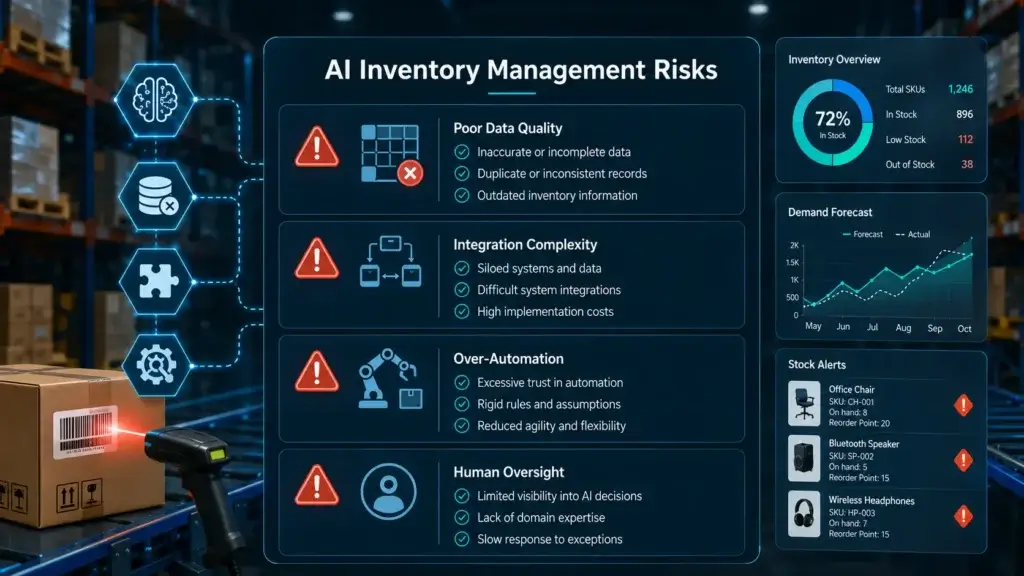
AI can improve inventory management, but it can also create problems if your business automates poor data, ignores integration gaps, or trusts recommendations without review. The goal is not to avoid AI. The goal is to implement it carefully.
Poor data quality
AI depends on clean data. If your SKU records are duplicated, stock counts are inaccurate, product names are inconsistent, warehouses use different naming systems, or supplier lead times are outdated, the system may generate unreliable recommendations.
Before investing heavily in AI inventory management software, audit your data. Make sure product records, units of measure, stock locations, supplier records, open purchase orders, and sales history are accurate enough to support forecasting and replenishment decisions.
Disconnected systems
AI works best when inventory data connects across sales, purchasing, warehouse operations, accounting, production, and fulfillment. If your systems are disconnected, AI may only see part of the picture.
For example, if ecommerce orders are updated in one system but warehouse stock is updated elsewhere, the AI tool may recommend replenishment based on incomplete inventory availability. Integration quality should be one of your most important software evaluation criteria.
Over-automation
Automating every inventory decision too quickly can create risk. Some products are too important, too expensive, too seasonal, or too dependent on supplier relationships to be fully automated without review.
A better approach is to start with recommendation-based workflows. Let the system show what it would do, compare those recommendations to actual outcomes, and then automate low-risk decisions gradually.
Computer vision and counting errors
Some AI inventory tools use computer vision, cameras, scanners, or mobile devices to count and identify stock. These tools can be useful, but they need careful testing because visual recognition can fail when products look similar, lighting conditions vary, labels are unclear, or shelves are arranged differently across locations.
This is an important reminder that AI inventory systems should be validated in real operating conditions before being rolled out broadly. A tool that works in a demo does not always perform reliably at scale.
Employee trust and change management
Inventory teams may resist AI recommendations if they do not understand how the system works or if early recommendations are wrong. To build trust, explain how the system makes recommendations, let users review exceptions, and show measurable improvements over time.
You should also involve warehouse, purchasing, finance, sales, and operations teams early. Inventory management affects many departments, so adoption will be stronger when the system supports the way people actually work.
Cost and implementation complexity
AI inventory management software may require new integrations, data cleanup, workflow redesign, user training, and process ownership. The software subscription is only one part of the total cost.
Before choosing a platform, define your business case. You should know whether the main goal is reducing stockouts, cutting excess inventory, improving forecast accuracy, increasing inventory turnover, reducing carrying costs, or improving warehouse productivity.
AI Inventory Management Software Features to Look For
Not every inventory platform with AI features will be useful for your business. Some tools offer basic automated alerts, while others provide advanced demand forecasting, replenishment optimization, supplier analytics, and warehouse intelligence.
The right feature set depends on your business model. A manufacturer may prioritize material requirements planning and production schedules, while an ecommerce company may care more about multichannel stock visibility, fulfillment speed, and reorder automation.
Demand forecasting by SKU and location
The software should forecast demand at a practical level, not only at a company-wide level. Look for forecasting by SKU, product category, warehouse, store, channel, region, or customer segment.
This matters because demand is rarely uniform. A product may sell quickly online but slowly in stores, or one warehouse may need more stock than another because it serves a faster-growing region.
Reorder recommendations
AI inventory management software should recommend when to reorder and how much to buy. Stronger tools can consider supplier lead times, purchase order status, demand forecasts, minimum order quantities, safety stock, and current inventory commitments.
The best systems do not only generate alerts. They help you make a decision.
Multi-location inventory visibility
If your business operates across several warehouses, stores, fulfillment centers, or job sites, multi-location visibility is essential. The system should show stock on hand, allocated stock, incoming stock, available stock, and stock in transit.
Without this visibility, teams may over-order products that already exist elsewhere in the network.
ERP, MRP, WMS, ecommerce, and POS integrations
AI inventory management becomes much more useful when it connects with your existing systems. Review integrations with ERP, MRP, WMS, ecommerce platforms, POS systems, accounting tools, supplier portals, shipping tools, and production software.
If you are comparing broader systems, you can also review related guides such as best inventory management software, best MRP systems, and manufacturing management software.
Exception alerts
AI should help your team focus on what matters most. Look for alerts that identify stockout risk, delayed purchase orders, unusual demand changes, supplier issues, slow-moving inventory, and mismatched stock counts.
Good exception management reduces noise. The system should not overwhelm users with alerts that do not require action.
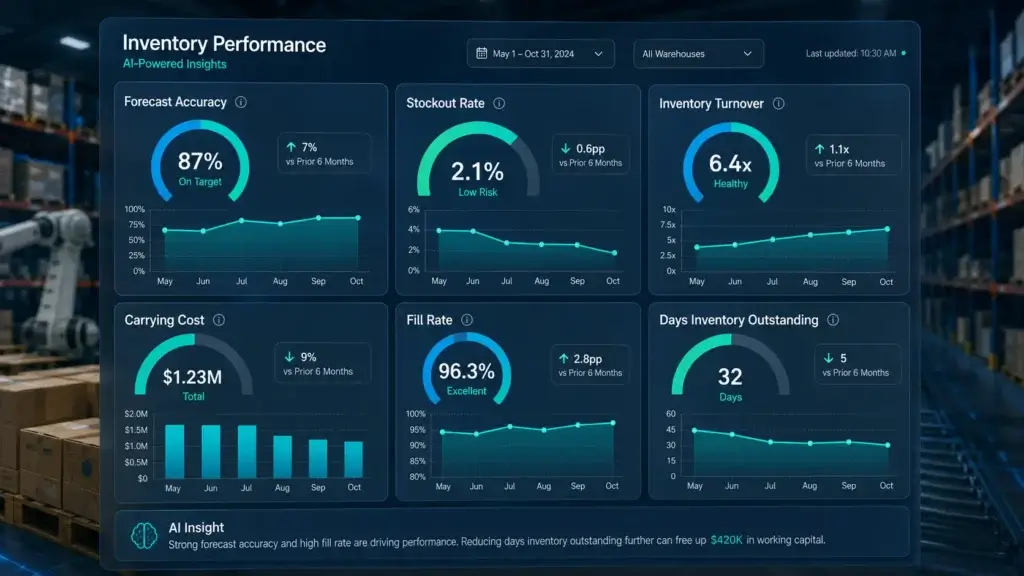
Inventory optimization dashboards
Dashboards should make performance easy to understand. Useful metrics include forecast accuracy, stockout rate, fill rate, inventory turnover, carrying cost, dead stock value, reorder accuracy, supplier lead time variance, and days inventory outstanding.
Dashboards should also show trends over time. A single inventory number is useful, but the direction of performance is often more important.
Human approval controls
AI recommendations should include approval workflows, permission controls, audit trails, and override options. This is especially important for purchase orders, supplier changes, production materials, and high-value inventory.
Your team should be able to see who approved a recommendation, what changed, and why a decision was made.
| Feature Type | Why It Matters | What to Check |
| AI demand forecasting | Helps predict future stock needs more accurately | Forecasts by SKU, location, channel, and seasonality |
| Automated replenishment | Reduces manual reorder work and stockout risk | Reorder suggestions, purchase order drafts, approval workflows |
| Real-time visibility | Improves stock accuracy across locations | Stock on hand, available stock, committed stock, in-transit stock |
| Supplier analytics | Helps account for lead time risk and delivery delays | Supplier performance, lead time variance, late delivery trends |
| Anomaly detection | Flags unusual stock movements or inventory errors | Alerts for count mismatches, shrinkage, duplicate orders, demand spikes |
| Integrations | Connects AI insights to the systems your team already uses | ERP, MRP, WMS, POS, ecommerce, accounting, and shipping tools |
| Approval controls | Prevents risky over-automation | Role permissions, audit trails, review workflows, manual overrides |
How to Implement AI in Inventory Management
Successful AI inventory management starts with a clear business problem. Do not implement AI only because it sounds advanced. Implement it because you want to improve a measurable area such as forecast accuracy, stockout rate, inventory turnover, carrying costs, supplier reliability, or warehouse productivity.
Step 1: Audit your current inventory process
Start by mapping how inventory decisions are made today. Look at how your team forecasts demand, creates purchase orders, tracks stock, updates warehouse counts, handles stockouts, manages slow-moving inventory, and measures supplier performance.
This audit should show where AI can create the most value. For some businesses, the biggest problem is inaccurate forecasts. For others, it is poor stock visibility, manual purchasing, warehouse inefficiency, or supplier delays.
Step 2: Clean your inventory data
Data cleanup is one of the most important implementation steps. Review SKU records, product names, categories, units of measure, supplier data, warehouse locations, sales history, stock counts, purchase orders, and lead times.
If your inventory data is messy, AI will not fix it automatically. It may simply produce faster but less reliable recommendations.
Step 3: Start with one high-value use case
Choose one use case that is valuable but manageable. Good starting points include demand forecasting, automated reorder recommendations, slow-moving inventory analysis, or stockout alerts.
A focused pilot makes it easier to test the system, measure results, train users, and build trust before expanding into broader automation.
Step 4: Connect your key systems
AI inventory management works best when it has access to the systems that influence inventory decisions. Depending on your business, that may include ERP, MRP, WMS, ecommerce, POS, procurement, accounting, production planning, and shipping systems.
If integrations are weak, start by connecting the systems that matter most to your first use case. For example, demand forecasting may need sales history, current orders, product data, stock levels, and supplier lead times.
Step 5: Keep humans in the approval loop
At the beginning, AI should recommend actions rather than execute every action automatically. Let inventory managers, procurement teams, production planners, or warehouse leaders review the recommendations and compare them with real-world results.
This helps your team learn where the model is reliable and where it needs more context.
Step 6: Measure performance before and after
You should track baseline performance before implementing AI. Without baseline metrics, it will be difficult to prove whether the system improved your inventory process.
Measure forecast accuracy, stockout rate, inventory turnover, carrying cost, fill rate, dead stock value, supplier lead time variance, and days inventory outstanding. Then monitor how those numbers change after implementation.
Best KPIs to Measure AI Inventory Management Success
AI inventory management should be measured with operational and financial KPIs. The goal is not only to prove that the system works technically. The goal is to show that it improves availability, reduces waste, improves cash flow, and supports better decisions.
| KPI | What It Measures | Why It Matters |
| Forecast accuracy | How close predicted demand is to actual demand | Shows whether AI is improving planning quality |
| Stockout rate | How often products or materials are unavailable | Helps measure lost sales, service issues, and fulfillment risk |
| Inventory turnover | How efficiently inventory converts into sales or usage | Shows whether stock is moving at a healthy pace |
| Carrying cost | The cost of holding inventory over time | Helps measure storage, insurance, handling, and capital costs |
| Fill rate | The percentage of demand fulfilled from available stock | Shows how well inventory supports customer orders |
| Days inventory outstanding | How long inventory stays before being sold or used | Helps identify slow-moving stock and working capital pressure |
| Dead stock value | The value of inventory that is unlikely to sell or be used | Highlights capital trapped in obsolete or slow-moving items |
| Supplier lead time variance | How much delivery timing differs from expected lead times | Helps improve supplier planning and safety stock decisions |
Which KPI matters most?
The most important KPI depends on your business model. For ecommerce and retail, stockout rate, fill rate, inventory turnover, and dead stock value may matter most. For manufacturing, forecast accuracy, material availability, supplier lead time variance, and production delays may be more important.
For distributors and wholesalers, inventory turnover, carrying cost, warehouse availability, and supplier reliability often become the key measures. The right AI inventory dashboard should let you track the KPIs that match your operating model.
Industries That Benefit Most from Inventory Management and AI
AI inventory management can support many industries, but the business case is strongest when inventory is complex, demand changes often, and stock decisions have a direct financial impact. The more SKUs, locations, suppliers, and sales channels you manage, the more valuable AI can become.
Retail
Retailers can use AI to forecast demand by location, optimize store replenishment, reduce stockouts, and prevent overstock after seasonal peaks. AI can also help with promotion planning, markdown timing, and product allocation across stores.
Ecommerce
Ecommerce businesses often deal with fast-moving SKUs, returns, channel-specific demand, fulfillment complexity, and customer expectations for fast delivery. AI helps by improving stock visibility, forecasting demand by channel, and recommending replenishment before products run out.
Manufacturing
Manufacturers can use AI to manage raw materials, components, work-in-progress inventory, finished goods, production schedules, and supplier lead times. This is especially valuable when inventory planning is connected to MRP systems, production planning, and purchasing workflows.
Wholesale and distribution
Wholesalers and distributors often manage large SKU catalogs, supplier relationships, customer contracts, and multiple warehouse locations. AI can help improve demand planning, stock allocation, replenishment, and warehouse productivity.
Food and beverage
Food and beverage businesses need strong inventory controls because products may expire, spoil, or require specific storage conditions. AI can help forecast demand, reduce waste, optimize purchasing, and improve freshness planning.
Construction and field operations
Construction businesses often need materials at the right job site at the right time. AI can support material forecasting, procurement planning, supplier tracking, and jobsite inventory visibility, especially when project schedules change.
Inventory Management and AI Software Examples
AI inventory management can appear in different types of software. Some platforms focus on inventory forecasting and replenishment, while others connect inventory to ERP, manufacturing, warehouse management, ecommerce, or enterprise supply chain planning.
When comparing systems, do not choose based only on the word “AI” in the product description. Compare how the system actually supports forecasting, replenishment, reporting, integrations, and exception management.
Inventory management software
Inventory management software is usually the most direct fit if your main goal is to track products, manage stock levels, create purchase orders, control warehouses, and reduce manual inventory work.
Tools in this category may support barcode scanning, multi-location inventory, reorder points, order management, sales channel integrations, reporting, and purchasing workflows. Some platforms are adding AI features for forecasting, alerts, and automation.
Real AI inventory management software examples
To make this more practical, it helps to look at how real software platforms apply inventory management and AI in different ways. Some tools focus on small and mid-sized inventory operations, while others are built for enterprise supply chain planning, omnichannel visibility, or advanced demand forecasting.
The key is not to choose the tool with the most AI messaging. You should compare how each platform supports the specific inventory problem you are trying to solve, such as forecasting demand, creating purchase orders, reducing stockouts, improving warehouse visibility, or optimizing inventory across locations.
| Software | Best Fit | How It Relates to AI Inventory Management |
| Cin7 ForesightAI | Product sellers, wholesalers, and multichannel businesses | Focuses on AI-driven inventory forecasting, demand prediction, automated purchase order generation, and reducing stockouts and overstock. |
| NetSuite Demand Planning | Growing businesses and ERP-driven inventory teams | Helps predict future inventory needs using historical demand, seasonality, sales forecasts, opportunities, and other demand planning metrics. |
| IBM Sterling Inventory Visibility | Enterprise retailers, distributors, and omnichannel operations | Provides scalable inventory visibility across systems and silos, with dashboards, alerts, location-level views, and safety stock insights. |
| Blue Yonder Inventory Optimization | Enterprise supply chain and retail planning teams | Supports inventory optimization by balancing excess inventory reduction, obsolescence control, and customer service levels. |
| Logility InventoryAI | Enterprise supply chain planning and inventory optimization | Uses AI-supported planning and generative AI assistance to improve decision-making, inventory optimization, and supply chain performance. |
For smaller and mid-sized businesses, platforms like Cin7 and NetSuite are easier to connect to practical inventory workflows such as forecasting, purchase orders, replenishment, and stock visibility. For larger organizations, IBM Sterling, Blue Yonder, and Logility are better examples of AI-supported supply chain planning at scale.
If your business is mainly comparing inventory tools for everyday stock control, you can also review our guide to the best inventory management software. If inventory planning is tied to production, materials, work orders, and manufacturing schedules, it may be better to compare MRP systems or broader manufacturing management software.
MRP and manufacturing software
MRP systems and manufacturing software are a better fit when inventory is tied to production. If you need to manage raw materials, bill of materials, work orders, production schedules, purchasing, and finished goods, MRP functionality is often more important than basic stock tracking.
You can compare options in related guides such as manufacturing management software, manufacturing scheduling systems, and production management software.
ERP systems
ERP systems are usually best when inventory needs to connect with finance, procurement, accounting, production, fulfillment, CRM, and business reporting. AI inventory features inside ERP systems can be useful because they work from a broader operational data set.
The tradeoff is complexity. ERP systems often require more implementation work than standalone inventory tools, so they are usually a better fit for growing or complex businesses that need a connected operating system.
Warehouse management systems
Warehouse management systems focus on receiving, storage, picking, packing, shipping, barcode scanning, slotting, and warehouse labor. AI features in WMS platforms may help optimize picking routes, storage layouts, replenishment zones, and labor planning.
If your main inventory problems happen inside the warehouse rather than in purchasing or forecasting, WMS functionality may be more important than a general inventory platform.
| Software Type | Best For | AI Value |
| Inventory management software | Stock tracking, purchasing, warehouses, and order management | Forecasting, reorder suggestions, alerts, and stock optimization |
| MRP software | Manufacturing inventory, raw materials, BOMs, and production planning | Material planning, production forecasts, and supplier risk insights |
| ERP software | Inventory connected to finance, procurement, operations, and reporting | Cross-functional forecasting, planning, and business intelligence |
| WMS software | Warehouse receiving, picking, packing, storage, and shipping | Slotting, picking optimization, labor planning, and warehouse alerts |
| Ecommerce operations software | Multichannel sellers and fulfillment teams | Channel-level forecasting, stock allocation, and availability management |
Future Trends in AI Inventory Management
AI inventory management is still evolving. The next phase will likely move beyond basic forecasting and alerts into more connected planning, simulation, and controlled automation.
Agentic AI for replenishment
Agentic AI refers to systems that can complete multi-step workflows with more autonomy. In inventory management, this could mean an AI agent that monitors stock, reviews demand changes, checks supplier lead times, drafts purchase orders, and asks for approval before placing an order.
This can be powerful, but it needs strong guardrails. Businesses should define which actions AI can take independently, which actions require approval, and which decisions must always stay with human managers.
Digital twins for inventory and supply chain planning
Digital twins allow businesses to simulate scenarios before making operational decisions. For inventory management, this can help test what happens if demand increases, a supplier is delayed, a warehouse reaches capacity, or safety stock levels change.
This type of simulation can help leaders make better decisions before committing capital to inventory.
Computer vision for stock counting
Computer vision can help automate counting, shelf monitoring, and warehouse inspection. It may become more common in retail, distribution, manufacturing, and food service environments.
However, this area requires careful testing. Visual AI tools need to perform reliably with real products, lighting conditions, shelf layouts, packaging changes, and similar-looking items.
More connected planning across departments
The future of inventory management and AI is not only about warehouse automation. It is about connecting sales, finance, procurement, production, operations, and customer demand into one planning process.
When those departments work from the same forecast and inventory data, you can make better decisions about purchasing, pricing, production, promotions, cash flow, and fulfillment.
Final Thoughts
Inventory management and AI can make stock control more predictive
Inventory management and AI can help your business move from reactive stock control to predictive inventory planning. Instead of waiting for stockouts, excess inventory, or supplier delays to appear, AI can help you identify risks earlier and act with better information.
The biggest benefits usually come from demand forecasting, automated replenishment, real-time stock visibility, safety stock optimization, anomaly detection, and supplier performance analysis. Together, these capabilities can help reduce stockouts, lower overstock, improve fulfillment, and protect working capital.
Still, AI is not a shortcut around good inventory discipline. You need clean data, connected systems, strong approval workflows, trained users, and clear KPIs. If the data is wrong, the recommendations will be unreliable. If the automation is too aggressive, the process can create new risks instead of solving old ones.
The best approach in 2026 is to treat AI as an intelligent decision-support layer. Use it to surface insights, recommend actions, and improve forecasting, but keep experienced people involved in the decisions that affect customers, suppliers, production, and cash flow.
If you are comparing inventory tools, look for software that supports forecasting, replenishment, multi-location visibility, supplier tracking, exception alerts, and integrations with your existing ERP, MRP, WMS, ecommerce, POS, and accounting systems. The right platform should not only show what inventory you have. It should help you understand what inventory you will need next.
FAQs
What is inventory management and AI?
Inventory management and AI refers to using artificial intelligence, machine learning, predictive analytics, and automation to improve stock tracking, demand forecasting, replenishment, inventory visibility, and stock optimization. It helps businesses make faster and more accurate inventory decisions.
How is AI used in inventory management?
AI is used in inventory management for demand forecasting, automated replenishment, safety stock optimization, anomaly detection, real-time stock visibility, supplier lead time prediction, warehouse optimization, and slow-moving inventory analysis.
Can AI reduce stockouts?
Yes. AI can help reduce stockouts by forecasting future demand, tracking stock levels in real time, accounting for supplier lead times, and recommending replenishment before inventory runs too low. It works best when inventory data and supplier data are accurate.
Does AI help prevent overstocking?
Yes. AI can help prevent overstocking by identifying slow-moving inventory, improving demand forecasts, adjusting reorder quantities, and recommending lower safety stock levels when demand or lead time risk decreases.
What data does AI inventory management software need?
AI inventory management software usually needs sales history, current stock levels, purchase orders, supplier lead times, warehouse data, returns, open orders, production schedules, seasonality, promotions, and product-level demand data.
Is AI inventory management suitable for small businesses?
AI inventory management can be suitable for small businesses if they manage enough SKUs, sales channels, or supplier complexity to justify the investment. Smaller teams should usually start with simple forecasting, reorder alerts, and inventory automation before adopting advanced AI workflows.
How does AI improve demand forecasting?
AI improves demand forecasting by analyzing historical sales, trends, seasonality, promotions, customer behavior, channel data, and sometimes external signals. This helps businesses predict future demand more accurately than simple spreadsheet averages.
What are the risks of using AI for inventory management?
The main risks include poor data quality, disconnected systems, inaccurate recommendations, over-automation, weak user adoption, integration complexity, and limited human oversight. AI should be tested carefully before it controls major inventory decisions.
What features should AI inventory management software include?
AI inventory management software should include demand forecasting, reorder recommendations, multi-location visibility, supplier analytics, anomaly detection, inventory dashboards, ERP or MRP integrations, approval workflows, and performance reporting.
Will AI replace inventory managers?
AI is unlikely to fully replace inventory managers. It is better viewed as a decision-support tool that helps inventory teams analyze data, identify risks, and act faster. Human judgment is still needed for supplier issues, strategic stock decisions, exceptions, and business context.