
Introduction
Endpoint security is no longer only a cybersecurity concern. It is now a core part of IT service management, especially when your organization manages remote users, cloud apps, mobile devices, laptops, servers, and business-critical software across multiple locations.
Every unmanaged endpoint creates a potential security gap. A missed patch, weak access policy, outdated device record, or delayed incident response can expose your business to downtime, data loss, compliance issues, and operational risk.
This is where ITSM endpoint security becomes important. ITSM gives your IT and security teams a structured way to connect device visibility, ticketing, asset management, patch workflows, incident response, and compliance reporting.
Instead of treating endpoint security as a separate technical task, ITSM helps you manage it as an ongoing business process.
Quick Answer: What Is Endpoint Security in ITSM?
Endpoint security in ITSM is the process of managing, securing, monitoring, and supporting devices through structured IT service workflows. It connects endpoint data with IT asset management, patching, access control, incident response, change management, and compliance documentation.
For IT administrators, security teams, and compliance officers, this creates one practical operating model for protecting devices at scale.
Key Endpoint Security Challenges for IT Teams
Endpoint security becomes harder as your environment grows. You are not only protecting office desktops anymore. You are managing a distributed mix of devices, users, apps, networks, and permissions.
- Remote and hybrid work: Devices connect from different networks and locations.
- Unpatched software: Known vulnerabilities remain a common attack path.
- Shadow IT: Teams may use unapproved apps or unmanaged devices.
- Compliance pressure: Auditors expect proof of controls and activity logs.
- Tool sprawl: Security alerts, tickets, and asset data often live in separate systems.
Without a clear ITSM process, endpoint security becomes reactive. Your team spends too much time chasing alerts, updating spreadsheets, checking device status manually, and trying to prove what happened after an incident.
A better approach is to make endpoint security part of your service management workflow from the start.
Why Endpoint Security Matters in IT Management
Your endpoints are where users, applications, and business data meet. That makes them one of the most important areas to secure and one of the hardest to manage consistently.
A single laptop with outdated software can create risk. A mobile device without proper access controls can expose sensitive information. A server missing a critical security update can affect several business services at once.
Endpoint security matters because it protects the devices that support daily operations. But from an ITSM perspective, the goal is bigger than protection alone.
You also need control, documentation, accountability, and repeatable workflows.
Endpoint Security Is Now Part of Service Reliability
When a device fails, gets compromised, or falls out of compliance, the impact is not limited to the device itself. It can disrupt employees, delay service delivery, create support backlogs, or trigger regulatory concerns.
That is why endpoint security should be connected to service management. Your ITSM platform can help your team identify affected users, prioritize tickets, route work to the right technician, document remediation, and report on the outcome.
This turns endpoint security from a technical checklist into a measurable IT service function.
Known Vulnerabilities Need Faster Remediation
Security teams cannot treat every vulnerability the same way. Some vulnerabilities are theoretical, while others are already being exploited in real environments.
That is why many IT teams use external sources like the CISA Known Exploited Vulnerabilities Catalog to help prioritize remediation. The catalog helps organizations focus on vulnerabilities that present a clear and active risk.
ITSM supports this process by turning remediation into a structured workflow:
- Create a ticket when a high-risk vulnerability is identified.
- Link the ticket to affected devices and business services.
- Prioritize based on risk, user impact, and asset criticality.
- Assign remediation to the right IT or security owner.
- Document the fix for audit and reporting purposes.
This is especially important when your organization manages hundreds or thousands of endpoints. Manual follow-up is too slow, and security teams need a reliable way to track remediation from detection to closure.
Compliance Requires Evidence, Not Assumptions
Compliance frameworks such as ISO 27001, HIPAA, GDPR, SOC 2, and NIST-aligned programs often require organizations to show that security controls are implemented and monitored.
For endpoint security, that may include evidence of patching, encryption, access controls, asset ownership, incident response, device configuration, and change approvals.
ITSM helps because it creates an auditable record of work. Instead of saying that endpoints are managed securely, you can show tickets, workflows, approvals, asset records, and reports that prove how your team manages endpoint risk.
How ITSM Enhances Endpoint Security
ITSM is not a replacement for endpoint protection, EDR, antivirus, SIEM, MDM, or vulnerability scanning tools. Those tools are still important.
The role of ITSM is different. ITSM connects security signals to the people, processes, assets, and workflows needed to act on them.
In simple terms, security tools detect the problem. ITSM helps your organization manage the response.
Centralized Device and Asset Visibility
You cannot secure what you cannot see. Endpoint security starts with knowing which devices exist, who owns them, where they are used, what software they run, and whether they meet your security policies.
ITSM platforms with IT asset management and CMDB capabilities help centralize this information. This is useful for daily support, security investigations, compliance reviews, and change planning.
For example, if a vulnerability affects a specific operating system or software version, your team should be able to identify impacted devices quickly. Without reliable asset data, the response becomes slow and incomplete.
Patch and Vulnerability Workflows
Patch management is one of the clearest areas where ITSM and endpoint security overlap. The challenge is not only deploying patches. It is also deciding what to patch first, coordinating timing, documenting completion, and handling exceptions.
ITSM helps you structure the patch process so nothing gets lost between detection and remediation.
- Prioritization: Rank patches by severity, exploit status, and asset importance.
- Approval: Route risky changes through the right change workflow.
- Deployment: Coordinate patching through endpoint management tools.
- Validation: Confirm that devices were updated successfully.
- Reporting: Track patch status for audits and leadership reviews.
This is especially valuable for regulated organizations, where patching must be both timely and documented.
Security Incident Response and Escalation
When a suspicious login, malware alert, failed patch, or unauthorized software installation is detected, your team needs a clear response path.
ITSM tools help standardize that response. They can create security tickets, assign priority, notify the right teams, escalate based on severity, and capture every action taken.
This reduces confusion during high-pressure events. It also improves post-incident review because you have a clear record of what happened, who responded, and how the incident was resolved.
Configuration and Compliance Management
Endpoint security depends on consistent configuration. Devices should follow defined standards for encryption, firewalls, access permissions, VPN use, backups, and approved software.
ITSM can support this through configuration records, change workflows, approval history, and compliance reporting. When a device falls out of policy, the system can trigger a ticket or workflow to bring it back into compliance.
This is where ITSM becomes valuable for compliance officers. It helps convert security policies into trackable work.
Remote Support and Device Troubleshooting
Remote and hybrid workforces need fast support without sacrificing security. IT teams must be able to investigate endpoint issues, apply fixes, and support users without relying on physical access to the device.
When ITSM is connected with endpoint management or remote monitoring tools, support teams can move faster. A technician can review the ticket, check the device context, understand the user impact, and take the right action with less back-and-forth.
Endpoint Security vs Endpoint Management vs ITSM
Endpoint security, endpoint management, and ITSM are closely connected, but they are not the same thing. Understanding the difference helps you choose the right tools and avoid unrealistic expectations.
| Category | Main Purpose | How It Supports Security |
| Endpoint Security | Protects devices from threats | Uses antivirus, EDR, encryption, access controls, and threat detection |
| Endpoint Management | Maintains and controls devices | Supports inventory, patching, remote access, configuration, and monitoring |
| ITSM | Structures IT service delivery | Connects incidents, assets, changes, approvals, escalations, and compliance workflows |
The strongest approach is usually not one tool replacing the others. It is a connected model where endpoint tools manage the device layer, security tools detect and prevent threats, and ITSM coordinates the work.
Managing Devices at Scale with ITSM Solutions
Scaling endpoint security is not about adding more dashboards. It is about giving your team a reliable way to manage device data, security work, service tickets, approvals, and compliance evidence from one connected process.
Below are three relevant platforms to consider, each with a different role in the endpoint security and ITSM conversation.
NinjaOne

Why IT Teams Choose NinjaOne
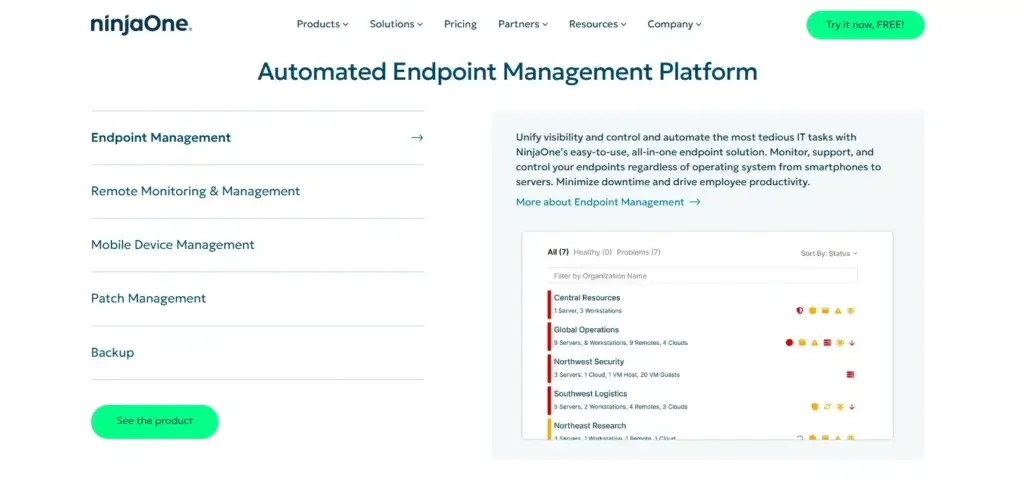
NinjaOne is the strongest fit in this article for endpoint management and patching. It is built for IT teams that need visibility into devices, remote monitoring, automation, patch management, and secure support across distributed environments.
According to NinjaOne, its endpoint management platform supports automated patching, monitoring, remediation, real-time visibility, and integrated remote access for remote, hybrid, and distributed teams.
Key Endpoint Security Strengths
- Endpoint visibility: Monitor laptops, servers, and workstations from one platform.
- Patch automation: Reduce risk by keeping systems updated consistently.
- Remote access: Support users without requiring physical access to devices.
- Policy enforcement: Improve consistency across distributed endpoints.
- Compliance support: Generate reports and documentation for security programs.
NinjaOne is especially relevant when endpoint security depends on fast patching, device health monitoring, and remote remediation. It is not just a ticketing system. It gives IT teams practical endpoint control, which makes it a strong option for organizations managing many devices.
Best For
NinjaOne is best for IT teams that need endpoint management, patching, monitoring, remote support, and compliance visibility in one operational platform.
Freshservice

Why IT Teams Choose Freshservice
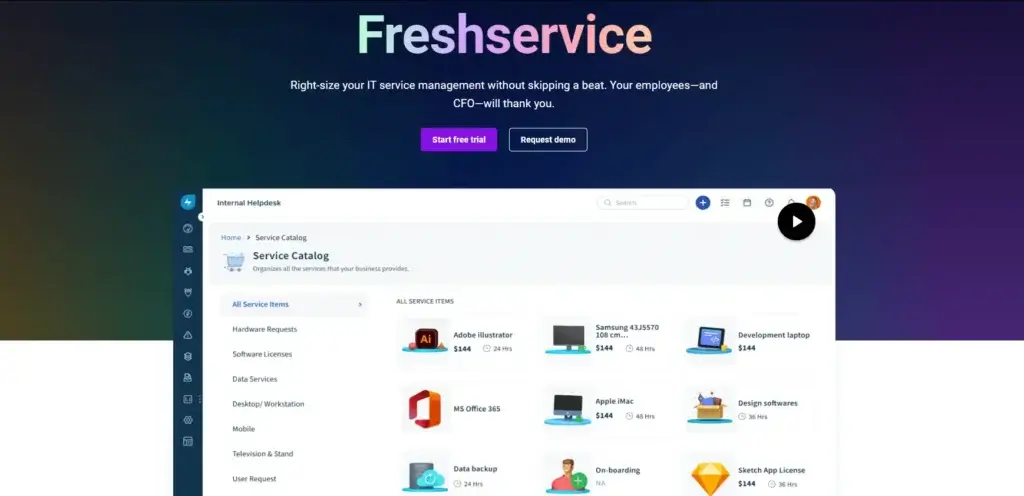
Freshservice is best positioned as the ITSM and IT asset management layer for endpoint security. It helps teams connect incidents, service requests, assets, changes, and configuration data in one platform.
Freshservice is especially useful when you need stronger asset context. Its ITAM capabilities support real-time tracking across hardware, software, and cloud tools in an auto-updating CMDB.
Key Endpoint Security Strengths
- IT asset management: Track hardware, software, and cloud resources.
- CMDB visibility: Map assets, dependencies, and service relationships.
- Incident workflows: Route endpoint-related issues to the right team.
- Change management: Review device-impacting changes before rollout.
- Audit readiness: Maintain records of actions, approvals, and asset history.
Freshservice should not be treated as a dedicated EDR or endpoint patching platform. Its value is in helping your team connect endpoint-related work to ITSM processes, service context, approvals, and compliance documentation.
Best For
Freshservice is best for organizations that want to align endpoint security with ITSM, ITAM, CMDB, change management, and audit-friendly service operations.
monday service

Why IT Teams Choose monday service
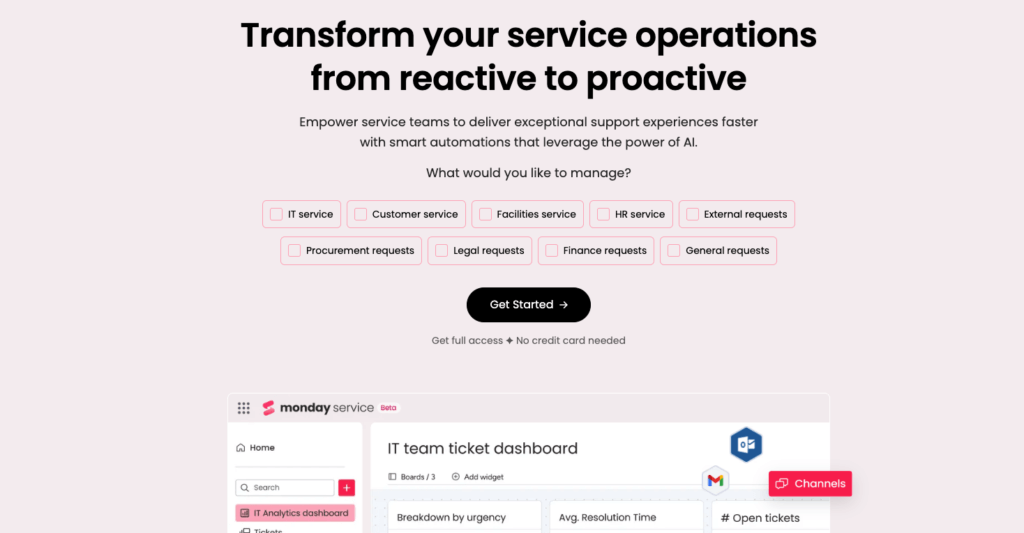
monday service is a flexible service management platform for teams that want customizable workflows, request intake, triage, automation, and reporting. It is useful when endpoint-related work needs to move across IT, HR, security, procurement, and operations.
monday positions monday service as an AI-first service management platform that helps teams manage requests from intake and triage through resolution and reporting.
Key Endpoint Security Strengths
- Custom workflows: Track endpoint requests, escalations, and approvals.
- Service automation: Reduce manual routing and repetitive follow-up.
- Cross-team visibility: Coordinate security tasks across departments.
- Reporting: Monitor request status, ownership, and resolution progress.
- Integrations: Connect service workflows with other IT and security tools.
monday service should be positioned as a workflow and coordination layer. It is not a native endpoint detection or patch deployment tool, but it can support endpoint security operations by organizing requests, approvals, escalations, and reporting.
Best For
monday service is best for teams that need flexible ITSM workflows to coordinate endpoint-related service requests, onboarding tasks, access approvals, incident routing, and security operations across departments.
Endpoint Security and ITSM Tools Comparison
The best choice depends on whether your main priority is endpoint control, ITSM maturity, or workflow flexibility. Here is a clearer comparison of the three options.
| Feature Type | NinjaOne | Freshservice | monday service |
| Best Fit | Endpoint management, patching, monitoring, and remote support | ITSM, ITAM, CMDB, service operations, and compliance workflows | Flexible service workflows, request management, and security coordination |
| Endpoint Focus | Strong | Moderate | Light to moderate |
| Patch Management | Native endpoint patching and reporting | Best handled through ITAM workflows, change processes, or integrations | Usually handled through integrations or workflow tracking |
| Asset Visibility | Strong endpoint inventory and monitoring | Strong ITAM and CMDB capabilities | Good workflow visibility, depends on connected systems |
| Incident Response | Endpoint alerts and remediation workflows | ITSM incident management and service workflows | Custom ticket routing, escalation, and team coordination |
| Compliance Support | Policy enforcement, visibility, and reporting | Asset records, approvals, CMDB context, and audit trails | Custom approvals, request history, and reporting workflows |
| Best For | Teams that need direct endpoint control at scale | Teams that need ITSM structure around assets and compliance | Teams that need flexible service operations and cross-team workflows |
For endpoint-heavy environments, NinjaOne is the most direct fit. For ITSM and compliance maturity, Freshservice is stronger. For flexible workflow coordination, monday service is the easiest to adapt across teams.
Best Practices for ITSM-Driven Endpoint Security
Endpoint security improves when your team treats it as a continuous ITSM process, not a one-time technical project. The goal is to build repeatable workflows that help your team act quickly, document decisions, and reduce risk over time.
1. Build a Reliable Endpoint Inventory
Your endpoint inventory should be accurate, updated, and connected to ownership. At a minimum, your team should track device type, user, department, location, operating system, installed software, warranty status, security status, and business criticality.
This data helps you answer important questions quickly. Which devices are affected by a vulnerability? Which users rely on them? Which business services could be disrupted?
2. Prioritize Patching by Risk
Not every patch has the same urgency. Your team should prioritize based on vulnerability severity, active exploitation, business impact, and asset importance.
A good ITSM workflow helps you move from vulnerability detection to assigned remediation. This creates accountability and makes it easier to show progress to leadership or auditors.
3. Use Change Management for High-Risk Updates
Some updates can be deployed quickly. Others may affect critical systems, integrations, or business applications.
Use change management when patching or configuration updates could disrupt operations. This gives your team a controlled process for approval, testing, scheduling, communication, and rollback planning.
4. Connect Security Alerts to ITSM Tickets
Security alerts are only useful if someone acts on them. When endpoint alerts flow into ITSM, they become trackable work items with owners, priorities, due dates, and resolution notes.
This helps reduce alert fatigue and improves accountability between IT operations and security teams.
5. Standardize Access and Device Policies
Endpoint security depends heavily on consistent policies. Your organization should define standards for device encryption, MFA, approved applications, admin rights, VPN access, remote access, and user offboarding.
ITSM workflows can help enforce these policies through onboarding, access request, device provisioning, and offboarding processes.
6. Document Evidence for Compliance
Compliance teams need reliable evidence. ITSM gives you a practical way to document endpoint-related controls, incidents, approvals, changes, and remediation history.
For audits, this is often just as important as the technical control itself. If you cannot prove that the work happened, the control may not satisfy compliance expectations.
Example ITSM Endpoint Security Workflow
Here is a simple example of how ITSM can support endpoint security from detection to resolution.
- A vulnerability scanner or endpoint tool identifies an outdated software version.
- The ITSM platform creates a ticket and links it to affected devices.
- The ticket is prioritized based on risk, exploit status, and business impact.
- The assigned technician reviews the asset record and patch requirements.
- A change request is created if the update affects a critical system.
- The patch is deployed through an endpoint management tool.
- The ITSM ticket is updated with remediation details and evidence.
- A compliance report shows which devices were remediated and when.
This workflow gives your team visibility and control. It also creates a record that can support security reviews, incident investigations, and compliance audits.
Common Endpoint Security Mistakes to Avoid
Even strong IT teams can struggle with endpoint security when processes are unclear or disconnected. These are the mistakes that often create unnecessary risk.
Relying on Manual Spreadsheets
Spreadsheets may work for a small number of assets, but they become unreliable as your environment grows. They are hard to update, easy to duplicate, and weak for audit evidence.
Treating Patching as a Low-Priority Task
Delayed patching can leave known vulnerabilities exposed. Your team needs a defined patch workflow with prioritization, ownership, and reporting.
Separating Security and IT Operations
Security teams may detect risks, but IT operations often owns the remediation work. If both teams use disconnected processes, response times become slower.
Ignoring Device Ownership
Every endpoint should have a clear owner, department, and support path. Without ownership, remediation and accountability become difficult.
Overlooking Offboarding Workflows
Former employees, unused devices, and stale access rights can create security gaps. ITSM offboarding workflows should include device return, account removal, access revocation, and asset record updates.
Final Thoughts
Endpoint security is now a core part of modern IT management. As your organization grows, you need more than security tools alone. You need repeatable ITSM workflows that help your team manage devices, prioritize risk, respond to incidents, and prove compliance.
The right approach depends on your main challenge.
NinjaOne is the strongest fit when you need direct endpoint management, patch automation, monitoring, and remote support. Freshservice is a better fit when you need ITSM, ITAM, CMDB, and compliance workflows around endpoint security. monday service is useful when your team needs flexible service workflows to coordinate endpoint-related tasks across departments.
The most mature endpoint security strategy combines visibility, automation, ownership, and documentation. ITSM gives you the structure to make that possible at scale.
✅ Compare ITSM Solutions in Our Full Guide
FAQ
What is endpoint security in ITSM?
Endpoint security in ITSM is the practice of managing and securing devices through structured IT service workflows. It connects endpoint monitoring, asset management, patching, access control, incident response, and compliance reporting so IT teams can protect devices at scale.
Why is endpoint security important for IT management?
Endpoint security is important because laptops, desktops, mobile devices, servers, and remote systems can expose the organization to cyber threats, data loss, downtime, and compliance failures. ITSM helps manage these risks through visibility, workflows, accountability, and documentation.
How does ITSM improve endpoint security?
ITSM improves endpoint security by turning security tasks into managed workflows. It helps teams track devices, prioritize vulnerabilities, automate ticket routing, manage patch requests, document incidents, and create audit-ready records for compliance reviews.
Does ITSM replace endpoint protection software?
No. ITSM does not replace endpoint protection, EDR, antivirus, MDM, or SIEM tools. Instead, ITSM acts as the workflow layer that connects alerts, assets, incidents, approvals, remediation tasks, and reporting into one structured process.
What is the difference between endpoint security and endpoint management?
Endpoint security focuses on protecting devices from threats, while endpoint management focuses on maintaining and controlling devices throughout their lifecycle. Endpoint management includes inventory, patching, configuration, remote support, and monitoring, which all support stronger endpoint security.
How does ITSM support patch management?
ITSM supports patch management by creating a structured process for patch prioritization, approvals, scheduling, deployment tracking, exception handling, and reporting. This helps IT teams reduce vulnerability exposure and maintain evidence for audits.
Can ITSM help with compliance requirements?
Yes. ITSM helps with compliance by documenting endpoint-related activities such as patching, access requests, incident response, change approvals, asset ownership, and configuration updates. These records can support audits for frameworks such as ISO 27001, HIPAA, GDPR, SOC 2, and NIST-based programs.
Which tools are useful for endpoint security in ITSM?
NinjaOne is useful for endpoint management, patching, monitoring, and remote support. Freshservice is useful for ITSM, ITAM, CMDB, and compliance workflows. monday service is useful for flexible service workflows, request routing, approvals, and cross-team coordination.
Can ITSM help secure remote and hybrid workforces?
Yes. ITSM helps secure remote and hybrid workforces by centralizing endpoint-related tickets, asset records, access requests, patch workflows, incident escalations, and compliance documentation. When connected with endpoint management tools, it improves visibility and response across distributed devices.
What endpoint data should IT teams track?
IT teams should track device owner, department, location, operating system, installed software, patch status, warranty status, encryption status, security policy status, remote access history, and business criticality. This data helps prioritize support, remediation, and compliance work.